As an Amazon Associate we earn from qualifying purchases. We may earn a commission from links on this page, at no extra cost to you. Learn more.
We judge a milk frother the way we judge a steam wand: by the foam it pours, not the number of buttons on the base. The best machines here make glossy, fine-bubbled foam that blends into coffee instead of sitting on top of it like shaving cream.
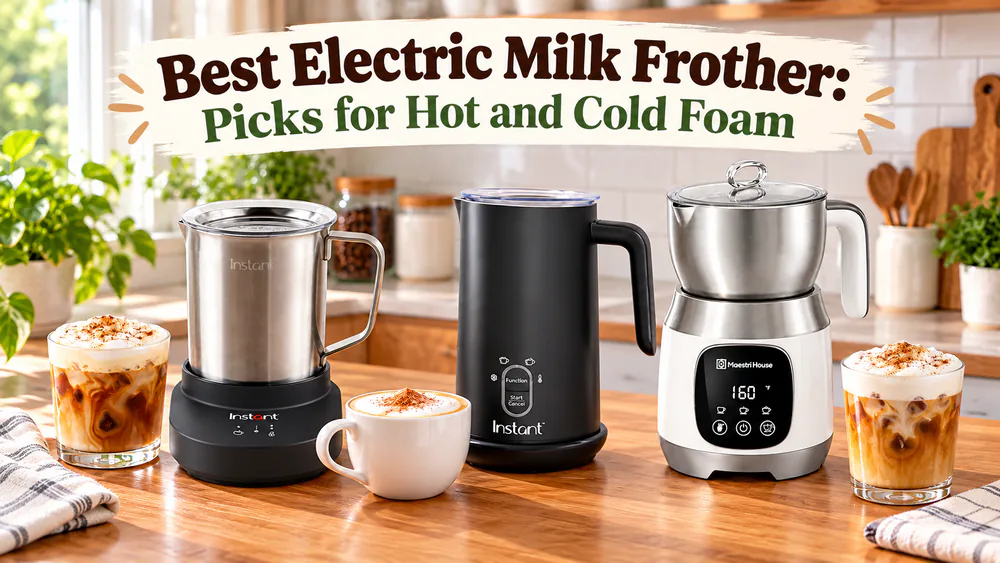
We chose these six for different jobs and judged each on foam, ease of use and cleanup, the three things a daily habit depends on.
If you want the wider category, our milk frother reviews cover more models. This guide sticks to six electric picks that suit different kitchens, from a countertop jug that heats and froths in one go to a rechargeable handheld wand.
How We Tested These Electric Milk Frothers
We judge every frother as a barista would: by its performance with cold milk, combined heating and frothing, cold foam for iced coffee, and less-forgiving oat milk.
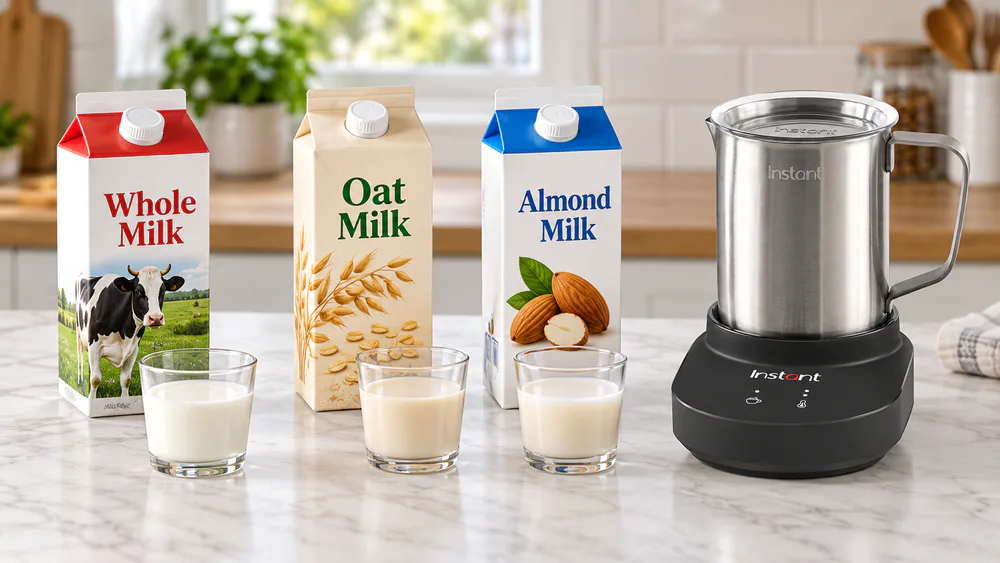
Every pick gets the same questions: how it handles whole, oat and almond milk, how it does hot foam and cold foam, and how it behaves at the pour.
We score on four things. Foam texture comes first, because a frother that makes big, airy bubbles is a heater with a hobby. Ease of use comes second: how many buttons you press, how obvious the fill lines are, and how quickly you get from cold milk to a finished drink on a weekday morning. Cleanup is third, since a frother you dread washing ends up in a cupboard. Capacity is last, and we separate how much a jug can warm from how much it can actually froth, because the two numbers are rarely the same.
Whole, oat and almond milk each behave differently under a whisk.
Evaluation criteria and evidence
Where a number comes from the manufacturer, such as a fill line, a wattage or a warranty term, we state it plainly and read it against the printed manual. Where we describe how a frother behaves in the cup, that is a hands-on judgment about foam, pouring and cleanup. We do not publish a numeric score for a model unless we can stand behind how we measured it, which is why you will see written verdicts and pros and cons rather than invented decimals.
Alternatives considered and model differences
We also looked at the Zulay Milk Boss, a cheaper handheld that we cover below as a budget alternative to our handheld pick. Nespresso's Aeroccino is the other name most people bring up. We considered it and left it off the ranked list because its foam collapses quickly, especially with oat milk, and its narrow interior makes bottom residue awkward to reach. If you already own one, our Nespresso Aeroccino 3 vs 4 comparison and Nespresso Aeroccino 4 review explain the differences in detail.
Our Top Electric Milk Frother Picks at a Glance
Here are the six picks side by side. Each one earns its slot for a specific job, so read the use case first and the compromise column last.
Model / use case
Type
Heating and cold-foam modes
Usable frothing capacity
Cleaning limits
Instant Pot MagicFroth 9-in-1 (best overall)
Countertop
Cold, warm and hot; stir, foam and extra foam set independently
8.5 oz Foam, 6.5 oz Extra Foam (heats up to 17 oz)
Jug, lid and whisk are dishwasher-safe; wipe the base
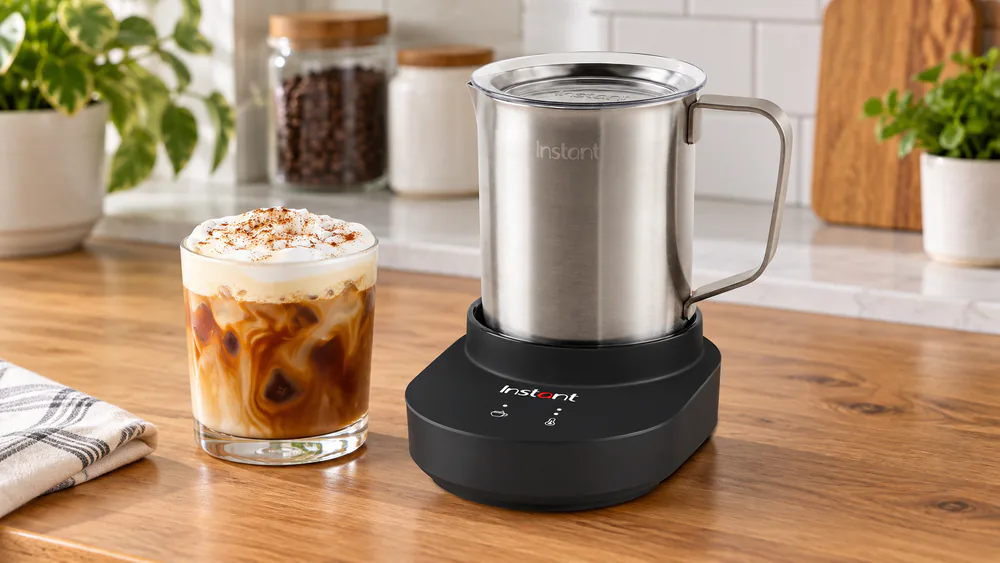
The MagicFroth is the frother we would buy again. It makes glossy whole-milk foam and fine almond-milk bubbles with very little operating noise, and it gives cohesive oat-milk foam and a tidy cold foam for iced coffee. It is slower than many automatic frothers, but the results justify the wait, and that is why it holds our top slot.
Pros
Glossy whole-milk foam and fine almond-milk bubbles
Cohesive oat-milk and cold foam
Independent cold, warm and hot settings with stir, foam and extra foam controls
Removable steel pitcher with dishwasher-safe jug, lid and whisk
Very quiet while it runs
Cons
Slower cycles than many automatic frothers
Exact footprint varies between published sources, so measure your counter space
Foam capacity is far lower than the heating capacity
Foam options, capacity and everyday use
The control layout is what makes the MagicFroth easy to live with. Temperature (cold, warm or hot) and the action (stir, foam or extra foam) are set independently, so the same jug makes a stirred hot chocolate, a warm latte foam or a cold foam for an iced drink. That independence is the reason it beats simpler single-button machines for a household that drinks different things in the same morning.
Capacity needs care. The foam maximum is 8.5 ounces, Extra Foam tops out at 6.5 ounces, and heating goes up to 17 ounces. In practice that means one generous latte or two small cappuccinos of foam per run, not a full jug of foamed milk. Fill to the foam line and you avoid the overflow that catches people out.
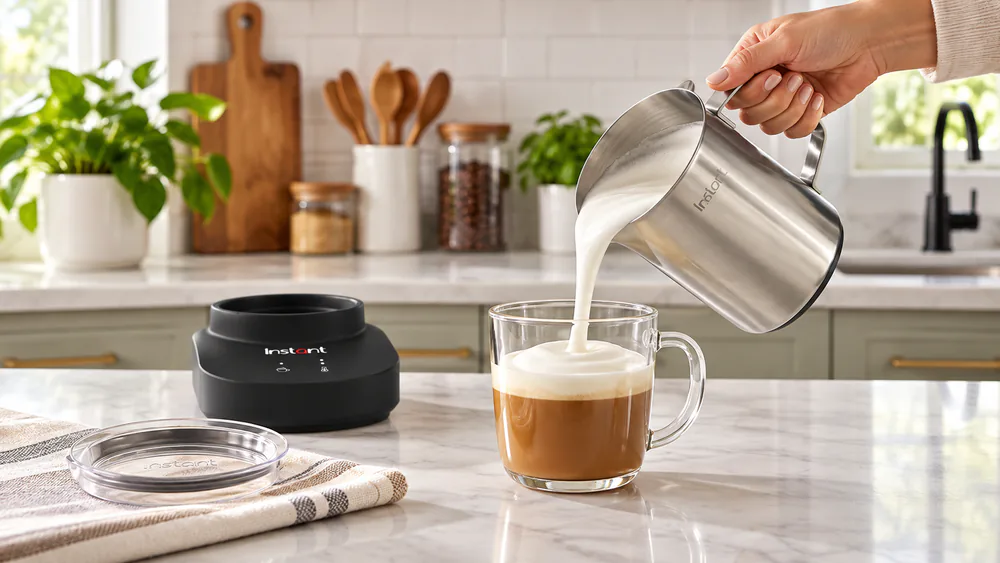
Poured into a mug of coffee, the whole-milk foam came out glossy and the unit stayed quiet through the cycle. The handle stays comfortable while the jug warms, the pouring spout is clean, and the pitcher lifts off the base for washing. The jug, lid and whisk are dishwasher-safe, which is the single biggest reason a frother keeps getting used past the first month. A one-year warranty, which is shorter than we would like, covers the unit.
Whole-milk foam from the MagicFroth pours glossy and even.
A family making four lattes will run it twice, so it suits a household of one to three best.
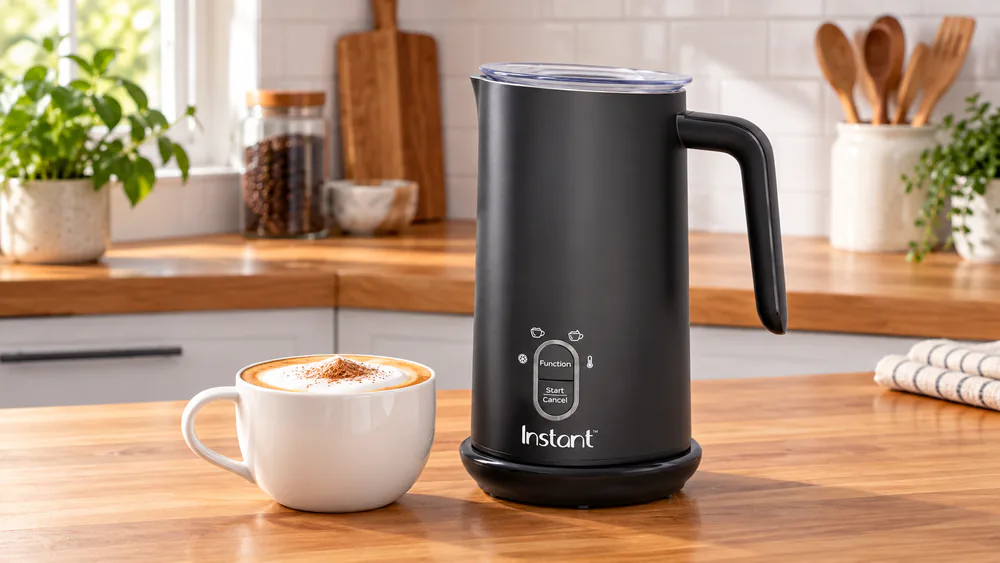
The Instant 4-in-1 is the cheapest countertop pick in this guide and a sensible first frother. It makes distinctly lighter latte foam and denser cappuccino foam, it pours neatly, and it handles almond milk well. The compromises are a small jug and some concerns about long-term reliability.
Pros
Separate lighter latte foam and denser cappuccino foam settings
Pours neatly from the spout
Handles almond milk well
Programs stop at completion, with a maximum run of 3 minutes
Lid and paddle are dishwasher-safe
Cons
Small jug; exact frothing maximum is not confirmed for this 10 oz model
Warming alone can leave hot chocolate cooler than you want
The paddle can stop running while the lights stay on
The jug interior must be hand-washed
Essential settings and value
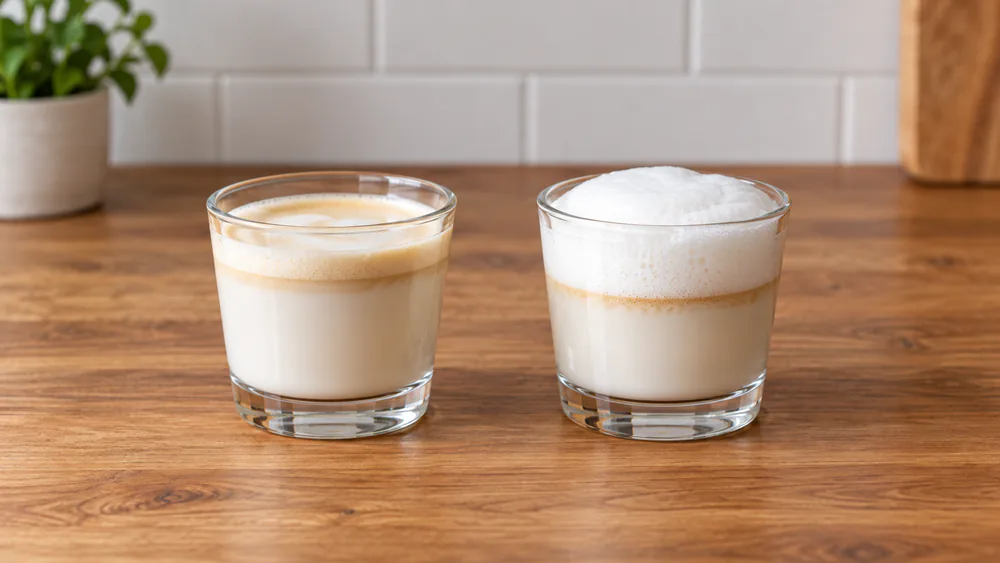
Poured from the spout, the foam lands neatly in the cup, and almond milk froths well. Four buttons cover the whole job: cold foam, light warm foam, dense warm foam and warm milk. For a beginner, that is the right amount of choice. The light setting gives you a latte-style foam that blends with espresso. The dense setting makes the thicker cap you want on a cappuccino.
The capacity story is the awkward part. The listing names a 10 ounce, 295 ml model, while the manufacturer's current product page describes larger figures for a similar product, and the two do not agree. Use the fill marks on the jug supplied with your unit instead of any number you read online, including ours. Programs stop on their own and the longest run is 3 minutes, so you do not need to stand over it.
Cleanup is a mixed bag. The lid and paddle can go in the dishwasher, but the pitcher interior needs hand washing, and the pitcher should not be immersed. That makes cleanup more work than with the dishwasher-safe MagicFroth jug. A one-year warranty applies.
We treat it as a good value pick rather than a buy-it-for-life one.
The light setting and the dense setting produce visibly different foam.
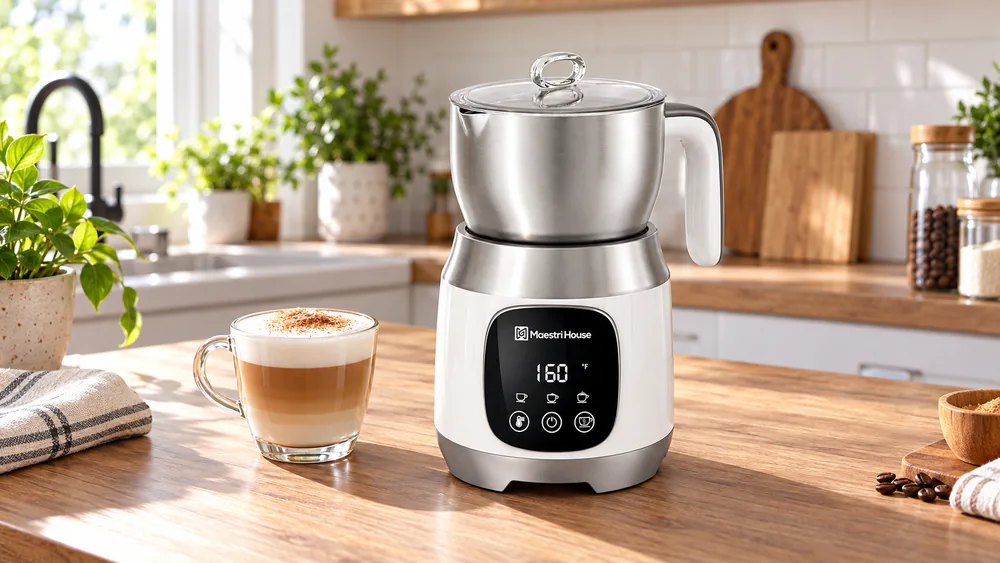
The Maestri House DualFro 600 is the pick for anyone who cares about exactly how hot the milk gets. Its settings are straightforward to learn and its magnetic whisk lifts out easily for cleaning. The catch is at the pour: milk and foam separate as they leave the jug, which makes controlled latte-art pours harder.
Pros
Ordinary, 120 F, 140 F and 160 F temperature settings
Low, medium and high foam levels
Large heating capacity of 600 ml
Magnetic whisk lifts out easily
Top-rack dishwasher-safe jug, lid, cap and whisk
Cons
Milk and foam separate during pouring
Milk residue can need scrubbing from the bottom of the jug
Frothing capacity is half the heating capacity
Minimum fill varies between versions, so follow the MIN mark
Temperature controls and serving capacity
Four temperature options, ordinary, 120 F, 140 F and 160 F, let you match the milk to the drink. A cappuccino for a sensitive mouth belongs at 120 F, a standard latte at 140 F, and a drink you want properly hot at 160 F. It draws 550W.
The jug is where this model earns its place. It heats up to 600 ml, and frothing tops out at 300 ml, so you can warm milk for a small group but should froth in smaller batches. Hot chocolate maxes out at 500 ml. Because the heating figure is double the frothing figure, always check which line you are filling to.
At the pour, milk and foam separate as they leave the jug, which is where it falls behind the handheld and the SMEG Mini. Cleaning is easy but not perfect. The whisk lifts out magnetically, and the jug rinses easily after use, although milk residue can need scrubbing from the bottom. The detachable jug, lid, cap and whisk are all top-rack dishwasher-safe.
If latte art is the goal, this is not the machine; it suits anyone who cares more about temperature than pour.
4. Best Electric Milk Frother for Plant-Based Milk
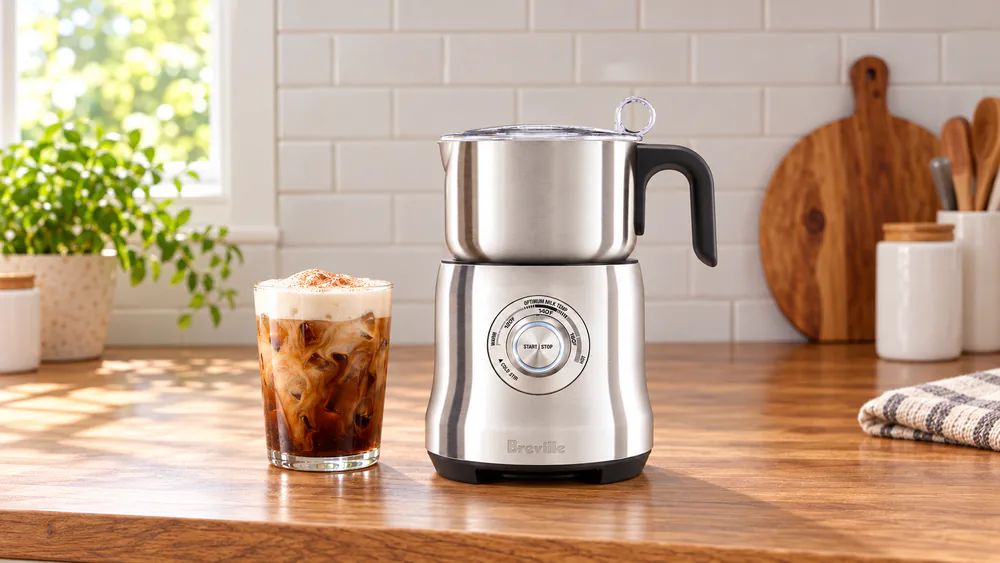
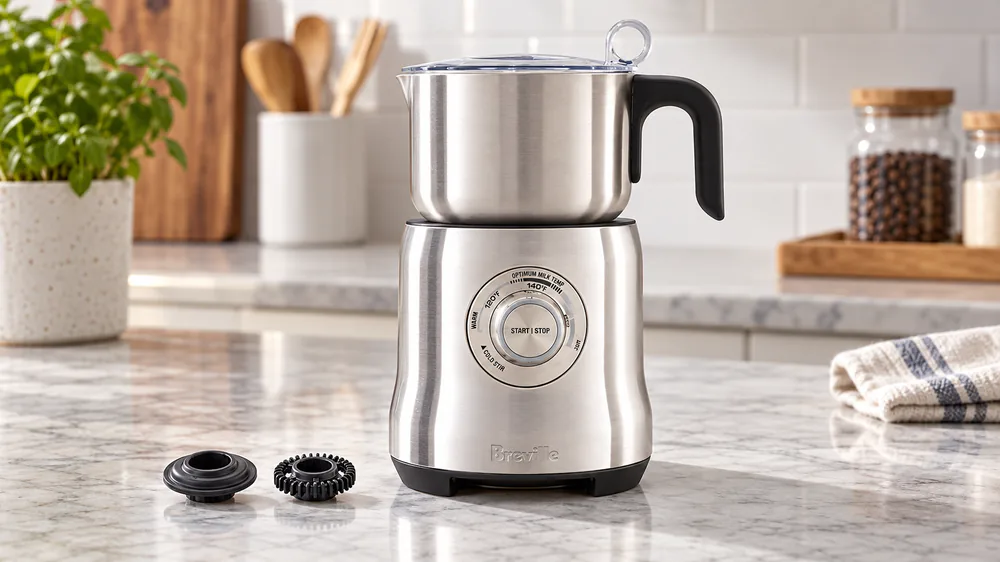
The Breville Milk Cafe is the one we would pick for plant-based milks, because the temperature dial and the latte disc let you tune the texture of oat and almond milk. It heats consistently, it gives silky bubbles, and the removable steel jug washes straightforwardly. It is large, it costs the most here, and the carafe can rattle.
Pros
Variable temperature dial, plus Cold Stir that adds no heat
Latte and cappuccino discs help tune plant-based foam
Heats consistently with induction
Removable steel jug washes straightforwardly
Large 25 fl oz heating capacity
Cons
Silky bubbles, but not steam-wand microfoam
The carafe can rattle
Big footprint and the highest cost in the guide
Frothing performance can fade even while heating keeps working
Milk compatibility and foam texture
Plant-based milks are the hardest test, because their proteins and fats do not behave like dairy. The Breville gives you two levers to pull: the temperature dial and the choice of latte or cappuccino disc. Together they let you tune the foam instead of accepting whatever one preset produces.
The numbers matter. Use the 16 fl oz CAPP/LATTE line for frothing and the 25 fl oz HOT CHOC line for warming. It draws 500W, measures 6.4 x 7.5 x 10.4 inches, and carries a one-year warranty.
Nudging the temperature dial and swapping between the latte and cappuccino discs is how we tune oat milk on this machine. The Breville gives silky bubbles, but it does not guarantee steam-wand microfoam, and the carafe can rattle during a run. Frothing performance can also fade over time even while the heater still works, which is worth knowing before you spend this much.
The two whisk discs are the Breville's main tool for tuning foam.
If you drink oat milk every day and want the most control, it is worth it. If you froth dairy now and then, a cheaper pick will do.
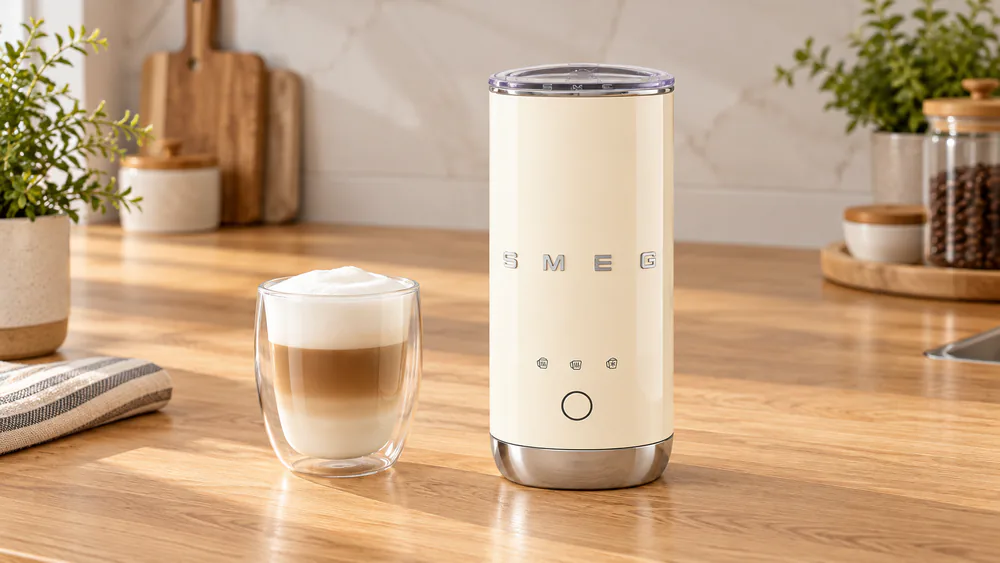
The SMEG Mini fits a small coffee station, and it makes smooth hot foam and silky cold foam from a single button. Pouring is neat even without a spout. The serving volume is restrictive, so it suits one drink at a time.
Pros
Smooth hot foam and silky cold foam
Neat pouring despite having no spout
Hot milk, hot foam and cold foam from a single button
Ceramic nonstick interior and automatic shutoff
Small body suits a tight coffee station
Cons
Very small capacity of 120 ml for frothing
Oat-milk foam is light and less fluffy than whole-milk foam
Body must be hand-cleaned
Check the exact regional model's voltage and dimensions before buying
Counter space, capacity and storage
Poured without a spout, the hot foam still lands neatly in the cup. This is a small cylindrical frother meant for one cup. It froths 120 ml at most and heats 180 ml, so it makes a single latte or cappuccino. That is a feature if you live alone or keep your coffee gear on a shelf, and a problem if you host.
The single button selects hot milk, hot foam or cold foam, which keeps the learning curve at nearly zero. The interior is ceramic nonstick, the whisk is removable and dishwasher-safe, and the unit shuts off automatically. The body itself is hand-clean only, so you rinse it and wipe the base rather than loading it into the dishwasher.
Treat it as a one-person machine, and expect the oat-milk foam to come out lighter than the whole-milk foam.
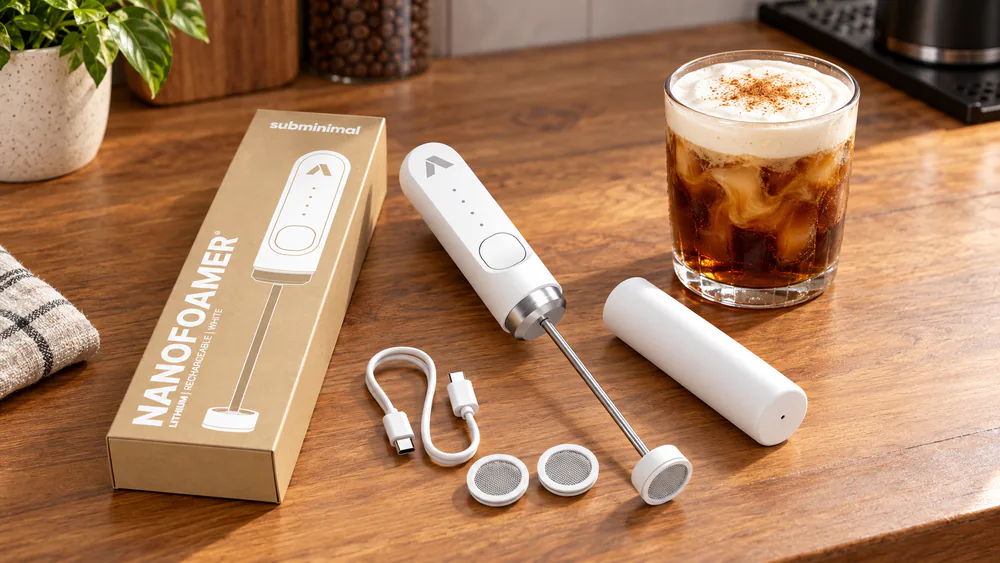
The NanoFoamer Lithium is the handheld that gets closest to barista-style texture. It produces a fine, pourable foam with practice, and the foam is uniform enough for latte art. It has no heater, so you warm the milk separately, and there is a learning curve.
Pros
Fine, pourable foam, uniform enough for latte art
Thicker shaft feels stable in the hand
Two NanoScreens supplied, fine and superfine
USB-C rechargeable, with a battery indicator
Dual-speed control and a replaceable impeller
Cons
No heating element, so milk is warmed separately
Technique takes practice
Setup instructions are digital-only
Rinse the head promptly; IPX-4 means splash resistant, not immersion proof
Power source, handling and separate milk heating
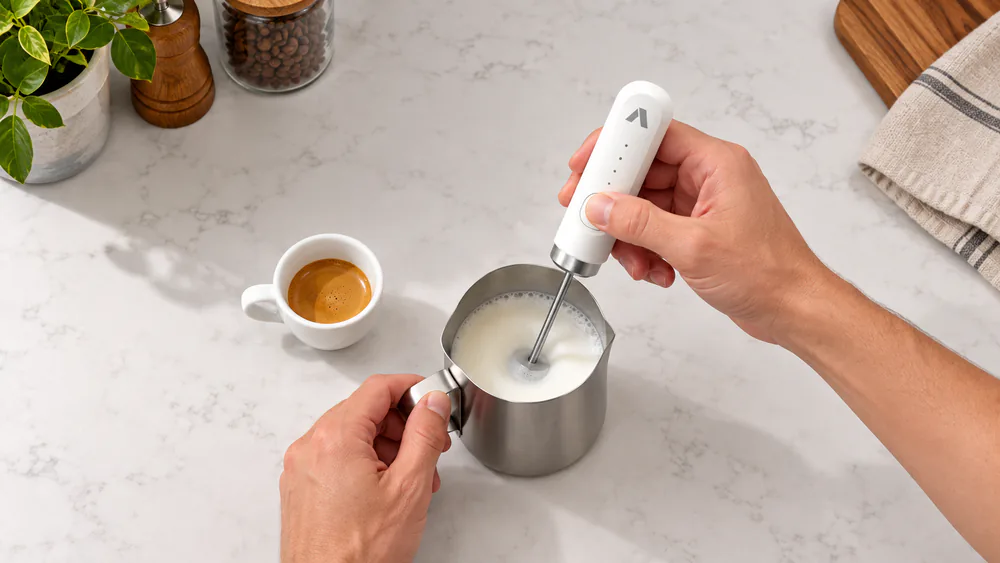
The NanoFoamer works differently from every other pick here. There is no jug and no heater. You warm the milk in a pan, a microwave or a steam pitcher, then froth it in the vessel of your choice, which is why capacity depends on your jug rather than on the frother itself.
Warm milk in a small pitcher turns into fine, pourable foam after a little practice. That freedom is what makes it the latte-art option. Its thicker shaft also feels stable in the hand. Two screens, fine and superfine, are supplied. Dual-speed control gives you a gentle setting for a cappuccino and a more aggressive one for dense foam. It charges over USB-C, so there are no batteries to replace.
The body is 234 mm long, rated IPX-4 for splashes, and the best habit is to rinse the head under the tap right after use. Setup instructions are digital-only, which is inconvenient if you like paper. Subminimal offers 30-day change-of-mind returns on direct purchases, excluding shipping.
The handheld works in whatever jug you already own.
If a handheld is the right format but the NanoFoamer sounds like too much, the Zulay Milk Boss is the cheaper alternative. It runs on 2 AA batteries, feels comfortable in the hand, and its simple control makes everyday frothing straightforward. It mixes small drinks readily, but its foam is less velvety, larger batches take more effort, and it can stop switching on during regular use. Battery consumption also varies noticeably. Package contents differ by seller, so check the stand and batteries before you buy.
How to Choose an Electric Milk Frother
Countertop versus handheld frothers
A countertop frother heats and froths in one jug at the push of a button. It is the right choice if you want hands-off coffee on a busy morning and do not mind the counter space. A handheld frother is smaller, cheaper to store and better for texture control, but it has no heating element, so you warm the milk separately. Heating and agitation are separate functions, and handhelds only do one of them.
Note. Cold-foam modes do not chill milk. They whip cold milk without heating it, so start with milk straight from the refrigerator.
Hot foam, cold foam and latte-art texture
Light, pourable foam suits lattes and flat whites. Thick, spoonable foam suits cappuccinos. Cold foam is its own category, and it works best when the whisk can run without heat. Neither a temperature dial nor a large foam volume guarantees latte art. What matters is whether the foam stays blended with the milk as you pour, which is why the handheld and the SMEG Mini poured better for us than the Maestri House.
For latte art, foam that blends smoothly with the milk as you pour matters more than its volume.
Frothing capacity versus heating capacity
Every jug has two fill lines. The frothing line is lower because milk expands, while the heating line is higher because warming milk needs less room. Keep milk below the frothing line so the foam has space to rise, and follow each manual instead of filling to the brim. The MagicFroth heats 17 ounces but froths 8.5, and the Maestri House heats 600 ml but froths 300.
Dairy and plant-based milk compatibility
Whole milk gives the glossiest foam. Oat milk gives a more cohesive foam than almond on the best machines, and almond foam tends toward fine bubbles that fade sooner. Plant-based formulas vary a lot between brands, and barista blends are the practical starting point because they contain added fats and stabilizers. If you mostly use plant-based milks, favor a model with temperature and foam adjustment.
Cleaning, removable parts and storage
Clean milk-contact parts promptly, use nonabrasive tools, dry everything before storing it, and keep the electrical base out of the water. Never assume that one jug's dishwasher suitability applies to another, because the Instant 4-in-1 needs a hand-washed interior while the MagicFroth jug goes in the dishwasher. A wide jug and a lift-out whisk are worth more than a long feature list.
Removable whisks and wide jugs make daily cleanup faster.
Common Mistakes When Buying a Milk Frother
The most common mistake is buying on the heating number. A 17 ounce heating capacity sounds generous until you find that the foam line sits at about half of it. The second is expecting steam-wand microfoam from any jug-style machine, because even our favorites give silky bubbles rather than the dense microfoam a barista pulls from a steam wand. The third is ignoring cleanup, since a hand-wash-only body makes a daily habit feel like a chore.
Frequently Asked Questions
Does an electric milk frother heat milk?
Countertop models do, and handhelds do not. The MagicFroth, Instant 4-in-1, Maestri House DualFro 600, Breville Milk Cafe and SMEG Mini all warm milk in the jug, while the NanoFoamer and Zulay only whip it, so you warm the milk in a pan or microwave first.
Can an electric milk frother make cold foam?
Yes. Most countertop models have a cold setting that whips cold milk without heating it, and a handheld works on cold milk by default. Cold foam does not chill milk, so start with milk that is already cold.
Can you froth oat milk and other plant-based milks?
Yes, and the MagicFroth gave us cohesive oat-milk foam. The Breville is the best for tuning texture, while the SMEG Mini makes lighter oat foam. Barista blends froth most reliably.
Can you make latte art with a milk frother?
Sometimes. The NanoFoamer Lithium makes foam uniform enough for latte art with practice. Jug-style machines can separate milk from foam in the pour, as the Maestri House does, which makes art difficult.
Why is my milk not frothing?
Check the milk first, since old milk or an unsuitable plant-based formula froths poorly. Then look for residue on the whisk, a paddle that is not seated correctly, and an overfilled jug. Overheating can also stop a cycle.
How do you clean an electric milk frother?
Rinse the jug and whisk right after use, using a soft tool, and dry them before storing. Check whether your model allows the jug in the dishwasher, and wipe the base without immersing it.
Final Verdict: Which Electric Milk Frother Should You Choose?
Choose the MagicFroth if you want one machine for dairy, oat milk and cold foam. Pick the Instant 4-in-1 when budget rules, the Maestri House when temperature control matters, and the Breville if plant-based drinks are your habit. The SMEG Mini suits a one-cup counter, and the NanoFoamer Lithium is for people who want latte-art texture and do not mind warming the milk themselves.
If the MagicFroth's foam volume proves too small for your household, the Breville is the step up: its foam line sits at 16 fl oz, nearly double the MagicFroth's 8.5 oz.