
Helping you create a kitchen you love.

Kitchen Appliances

Ninja Crispi Review: Is the Portable Glass Air Fryer Worth It?

As an Amazon Associate we earn from qualifying purchases. We may earn a commission from links on this page, at no extra cost to you. Learn more.

Ninja Crispi Review: Is the Portable Glass Air Fryer Worth It?

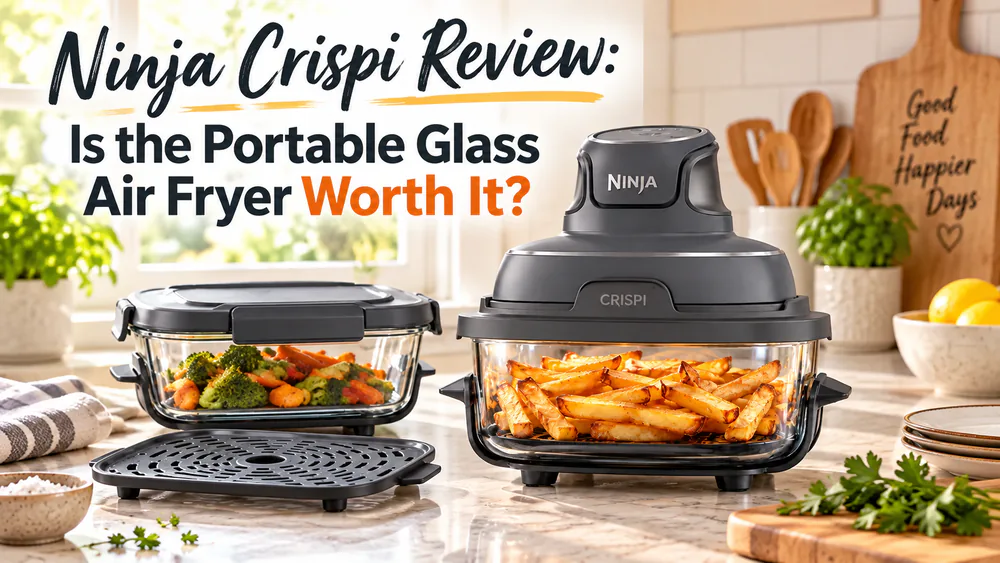
The Ninja Crispi is a portable 4-in-1 glass air fryer that cooks in borosilicate glass containers instead of a nonstick basket. It is also one of the most unusual air fryers on the market, and a couple of its design choices make it hard to recommend to everyone.

We cooked 50 meals in the Crispi, running it head to head with the Crispi Pro and a classic basket fryer, the 4-qt Ninja AF101. Every batch was scored on crisping, evenness, speed, noise, and glass durability.

The short version is that the Crispi cooks genuinely crispy food on bare glass, and the full verdict lands below. The long version involves a 375F temperature floor, a small cooking surface, and a safety note worth reading before you buy.

Key takeaway. Our verdict: the Ninja Crispi earns 4.5 out of 5. Best for singles and couples who want crispy food on glass, with containers that go from fridge to fryer to table. Skip it if you cook for a family, need a custom temperature, or keep a cluttered counter.

Ninja Crispi Glass Air Fryer 4-in-1 (Portable)
1

Ninja Crispi Glass Air Fryer 4-in-1 (Portable)

Top Pick
Check Price on Amazon
4.5/5

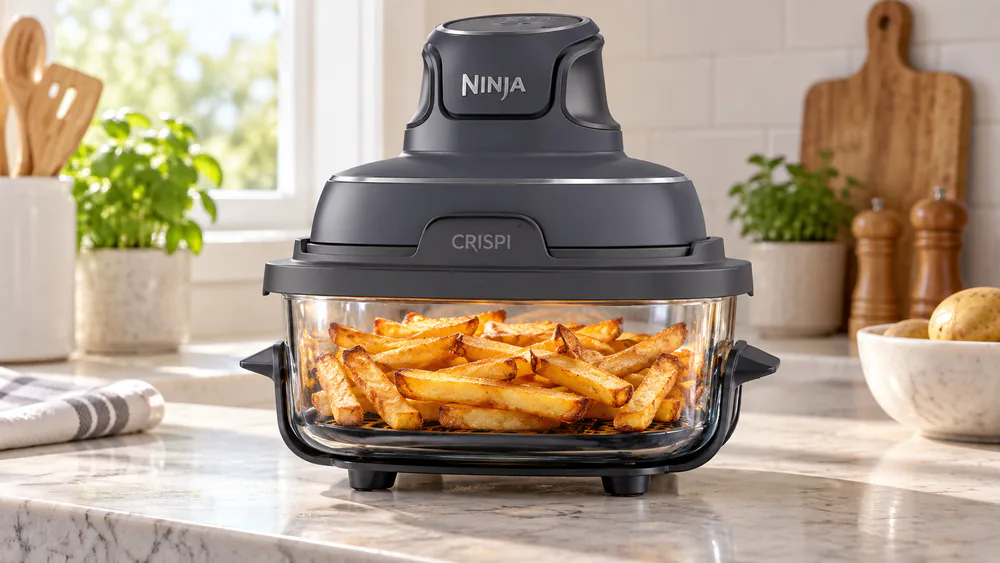
Fifty meals in, the batch that sold us was a modest load of frozen fries: crisp edges, nothing stuck to the glass. Wings and salmon in later batches were just as good, crisp-skinned and clean-flaking, all of it cooked on bare glass.

  • Crisped frozen fries, wings, and salmon on bare glass
  • The crisper plate stayed seated through 100 removals
  • Everything dishwasher safe, with no coating to flake or chip
  • No preheat or shake reminder; shaking is on you

Specifications

Containers
4-qt + 6-cup glass, 2 lids, 2 crisper plates
Power
1500W
Modes
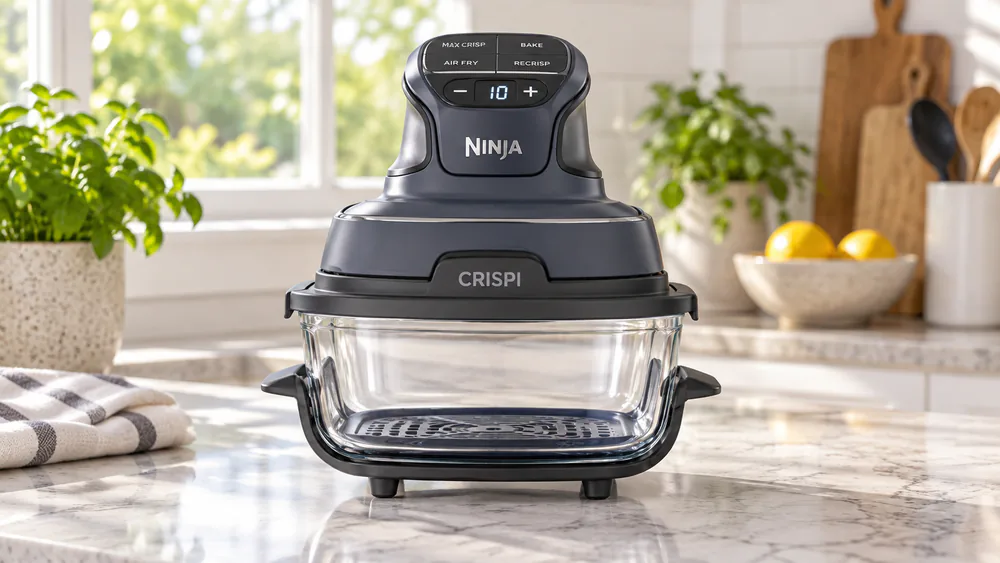
4 presets (Max Crisp, Air Fry, Bake, Recrisp), 375F floor
Max temperature
450F
Dimensions
About 13.5 x 12 x 13.5 in (official figures vary)
Weight
About 15.7 lb boxed; about 9 lb for the unit
Material
Borosilicate glass, BPA-free snap-lock lids
Dishwasher safe
Yes, all components
Warranty
1-year limited
Price
$179.99 list, about $159 street (moves week to week)

Cleanup is where the design earns its keep: the same container goes from fridge to fryer to table, and most nights the wash was a quick wipe.
Key Takeaways

  • Crispy fries, wings, and salmon on bare glass, no coating in the mix
  • Four presets with a 375F floor and no custom temperature
  • About 64 sq in of cooking surface, roughly 10 to 11 wings laid flat
  • Keep the PowerPod's landing spot clear; let the glass cool before washing

What Is the Ninja Crispi?

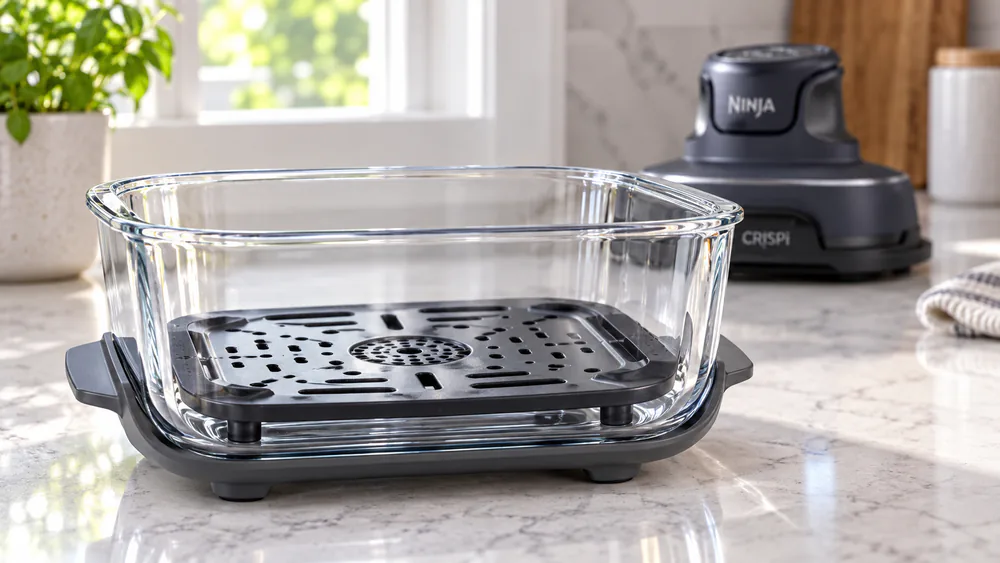
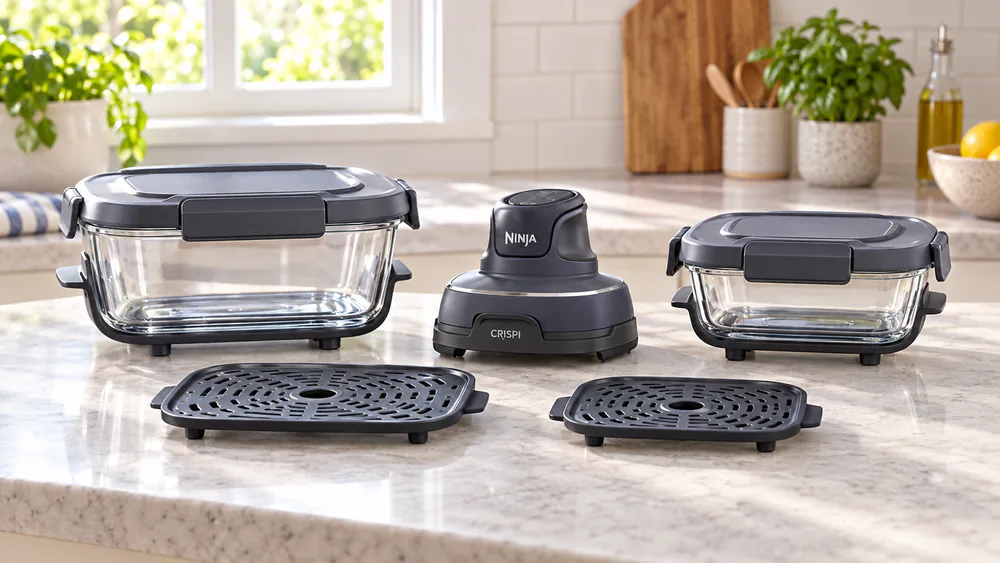
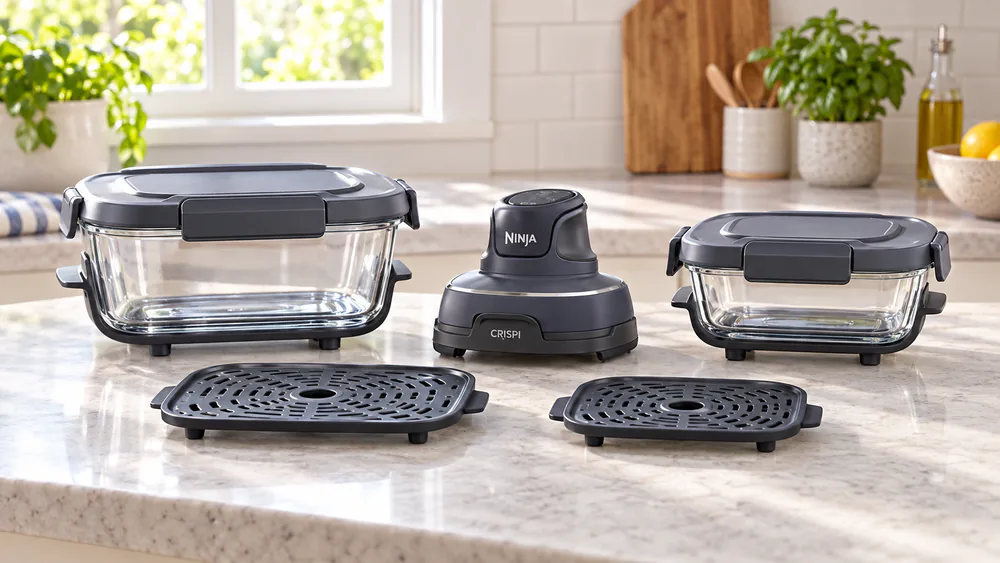
The Ninja Crispi is a portable 4-in-1 glass air fryer announced in September 2024 and on sale later that year. Instead of a drawer, it cooks in two borosilicate glass containers, a 4-qt and a 6-cup, sold as TempWare at launch and now called CleanCrisp. The whole machine is the detachable PowerPod, which nests inside the containers when not in use.

The box adds two snap-lock BPA-free lids, two ceramic-coated crisper plates, a container adapter, and a 36-inch cord, all dishwasher safe. Ninja's page for the Ninja Crispi 4-in-1 Portable Glass Air Fryer lists it at $179.99, and street prices usually run about $159 at Amazon. It ships in Grey and Stone, and the containers have permanently fixed heat-safe feet, so there is no trivet to lose.

The bigger sibling, the Crispi Pro, swaps the detachable PowerPod for an integrated heating stand and a 6-qt container. The full comparison lives further down.

The Ninja Crispi system on a counter: the detachable PowerPod, 4-qt and 6-cup glass containers with snap-lock lids, and two crisper plates.
The full Crispi system, ready to nest away.

Cooking Performance: Crisping, Speed, and Noise

Crisping is the reason anyone buys this air fryer, and the glass delivers on it. The four presets top out between 375F and 450F, with no custom temperature: you cook at Ninja's numbers or not at all. In lab testing, Air Fry mode ran almost 18 degrees below its set temperature, a drift that showed up as timing you learn by feel.

Speed is a genuine strength: small frozen snacks came up in 5 to 7 minutes, and the 6-cup container made a quick solo meal. Noise measured 62 dBA on Air Fry at 400F, quieter than the Crispi Pro at 67 dBA, though opinions on loudness split.

The Ninja Crispi PowerPod control panel with its four preset buttons and time dial.

Crisping Tests: Fries, Wings, and Salmon

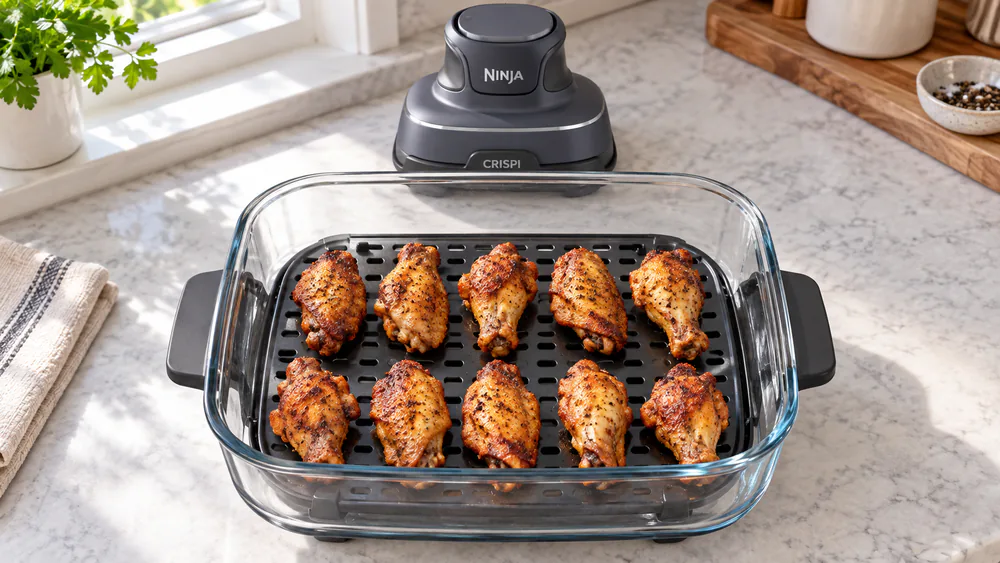
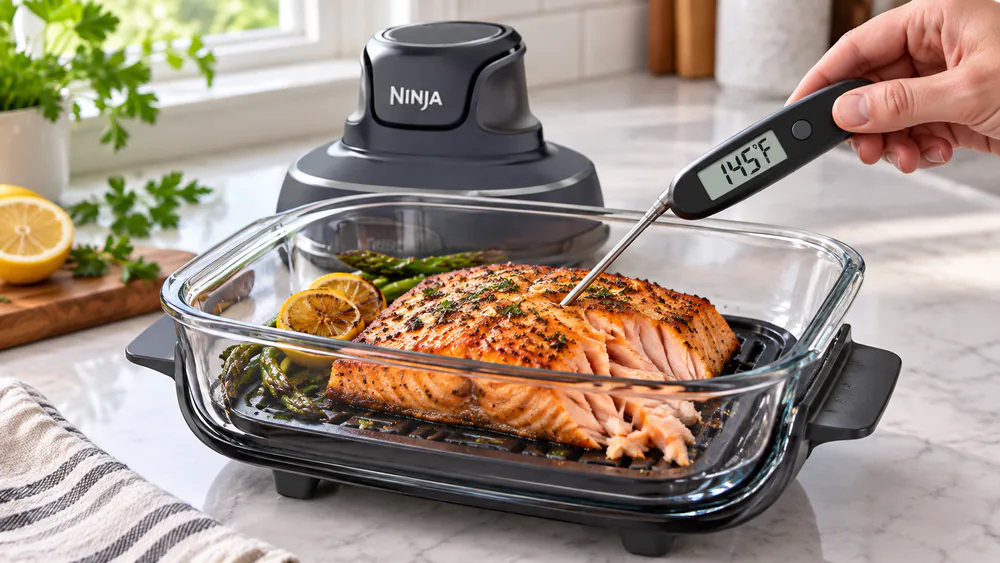
Frozen fries in a modest batch crisped in about 10 minutes, a fuller load with tater tots closer to 19. Wings were the highlight: 10 to 11 laid flat in the 4-qt container finished in about 23 minutes with crisp skin and juicy meat. Salmon hit 145F at 16 minutes and flaked cleanly.

Breaded and coated food came out beautifully batch after batch, and the glass walls let you watch it brown. Two dishes to skip: cake batter scorched on top and stayed raw in the middle, and cookies over-browned on top with dough stuck badly to the glass.

Golden frozen fries in the Ninja Crispi 4-qt glass container, edges browning through the glass.
Ten chicken wings laid flat on the crisper plate inside the Ninja Crispi 4-qt glass container.

Batch Size and Shake Requirements

The cooking surface is about 64 square inches (one measured figure put it closer to 77). Ten to 11 wings fit laid flat in the 4-qt container, about 6 in the 6-cup, and Ninja says the 4-qt holds a 4-lb chicken, though two Cornish hens fit ours and a whole roasting chicken was optimistic.

Shaking is on you. There is no shake-reminder beep and no preheat cycle, so we set a phone timer and flipped on our own schedule. Overfilling the small bowl pushes food into the heating element, where it sticks, so the 6-cup works best about three-quarters full.

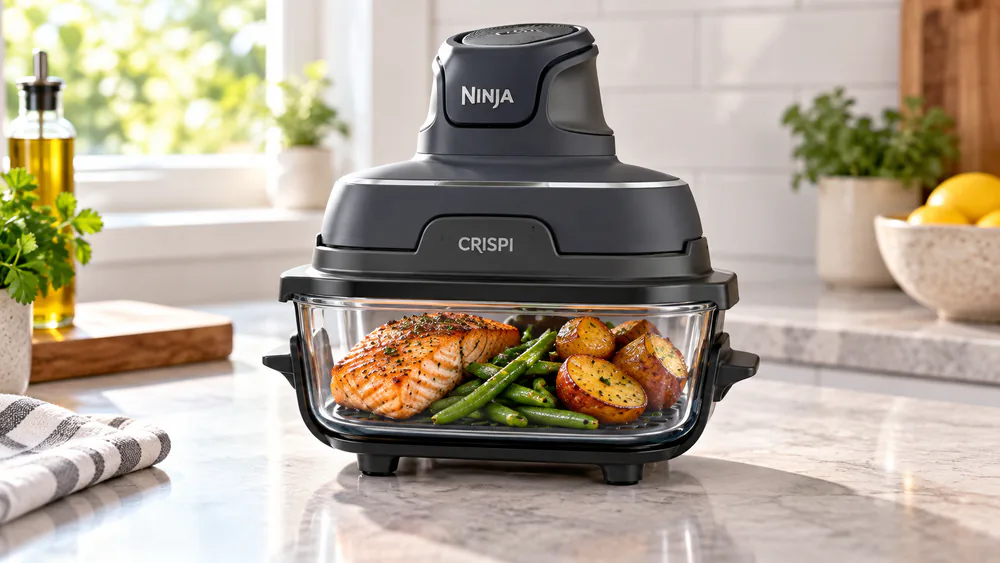
A single-serve meal in the 6-cup glass container.
The 6-cup container crisps a personal meal in about 7 minutes.
Salmon at 145F in the Ninja Crispi glass container, flaking cleanly.

Materials: Is the Glass Actually Non-Toxic?

The containers are borosilicate glass, PFAS-free and PTFE-free, with BPA-free snap-lock lids: food never touches a nonstick coating. Nothing stuck on any of our regular savory meals, and most nights cleanup was a quick wipe; sticky batters and cookie dough were the one exception.

Bare glass cooked meal after meal in our kitchen, and the only stuck-on messes came from sticky batters and cookie dough.

The fine print starts with the crisper plates. Your food sits on a ceramic-coated aluminum plate, not the bare glass, and the coating's exact composition is not fully disclosed. "Non-toxic" is a marketing term with no legal definition and a Guardian investigation found similar claims outpacing the evidence. Even the American Ceramic Society and a 2016 study caution that labels cannot tell you what is in a coating.

The thermal-shock claims are real up to a point. In controlled testing the glass survived ice water on a hot container and freezer-to-max-crisp cycles. But owners report it is not Pyrex-grade: it can crack under extreme temperature swings, so the cardinal rule is to let it cool fully before washing.

Note. Your food touches the ceramic-coated crisper plate, not bare glass. The plate is PFAS-free and PTFE-free, but "non-toxic" is not a regulated claim.

Close-up of the glass container wall and the ceramic-coated crisper plate inside.

Capacity, Cleaning, and Usability

Capacity is the Crispi's tightest squeeze. The 4-qt container is the daily driver, and for a couple it is barely enough: two portions of protein plus a side means cooking in stages. Cook times run short and sequential, thighs about 10 minutes and vegetables about 5, so courses cook in order without going cold.

Cleaning is the payoff. Most nights it was a quick wipe, and the same container doubles as a serving and storage dish. The caveats: a small gap under the container traps food and water with no good way to scrub it dry, and the heating-element ceiling on the pod is hard to clean once grease lands on it.

Tip. Let the glass cool fully before washing. Hot glass in cold water risks cracking, so we never put cold food into a hot container.

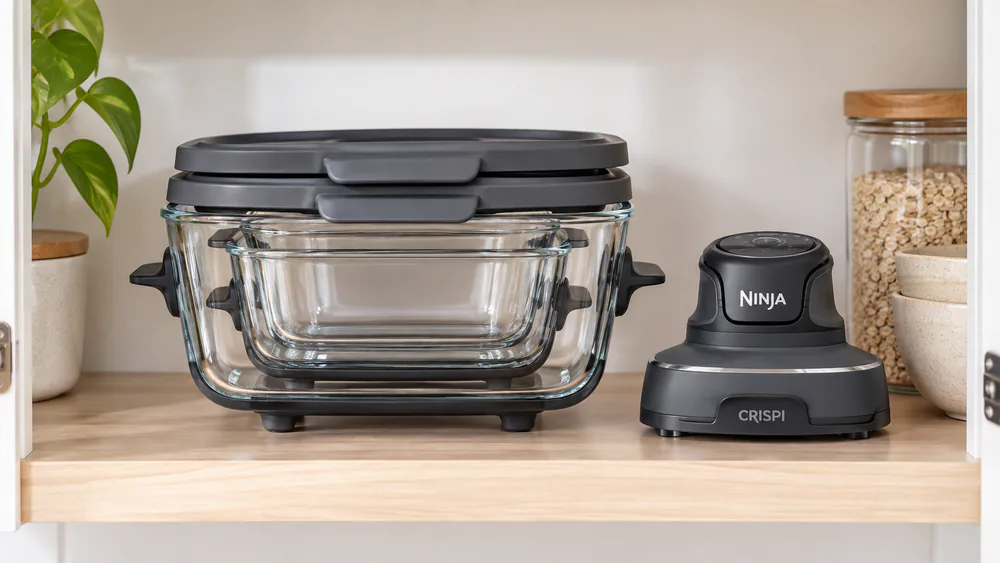
Usability is a mix. The pod and containers nest into a compact stack that fits one kitchen cupboard shelf. The glass and lid stay hot for 5 to 10 minutes after cooking, so mitts stay within reach.

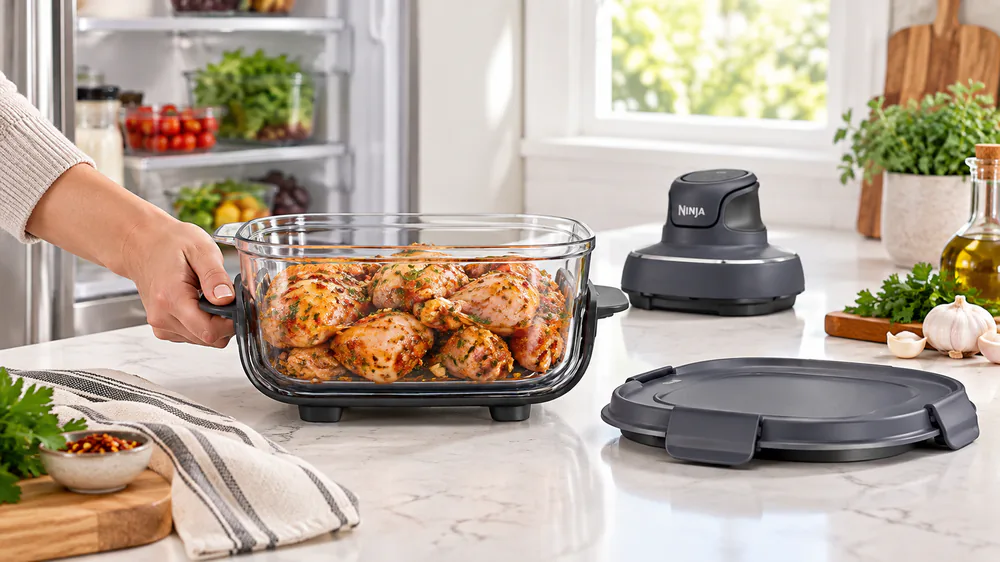
The same Ninja Crispi glass container going from fridge to fryer with marinated chicken, lid set aside.
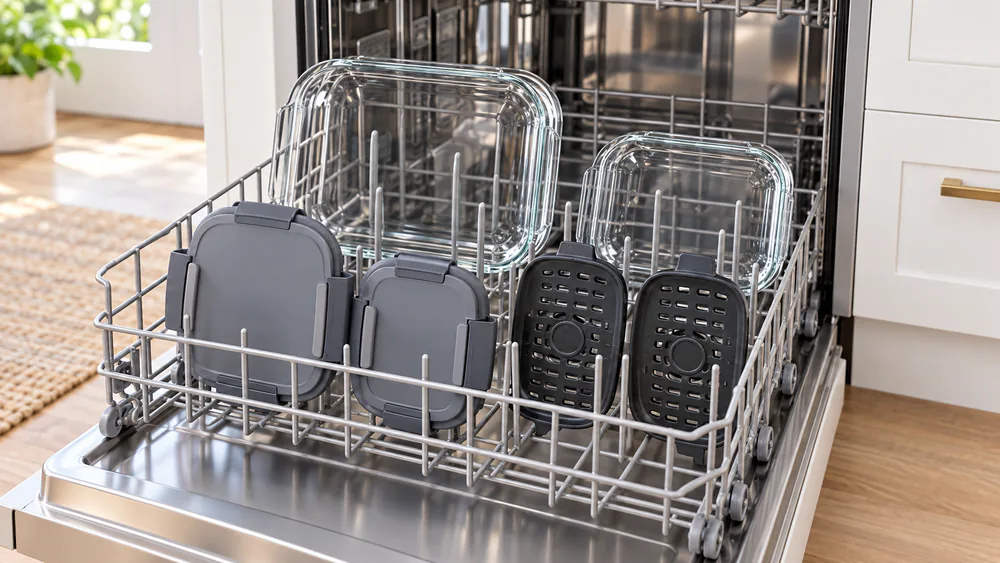
Ninja Crispi glassware loaded into a dishwasher rack.
The Crispi pod and containers nested on one cupboard shelf.

Safety and Glass Durability

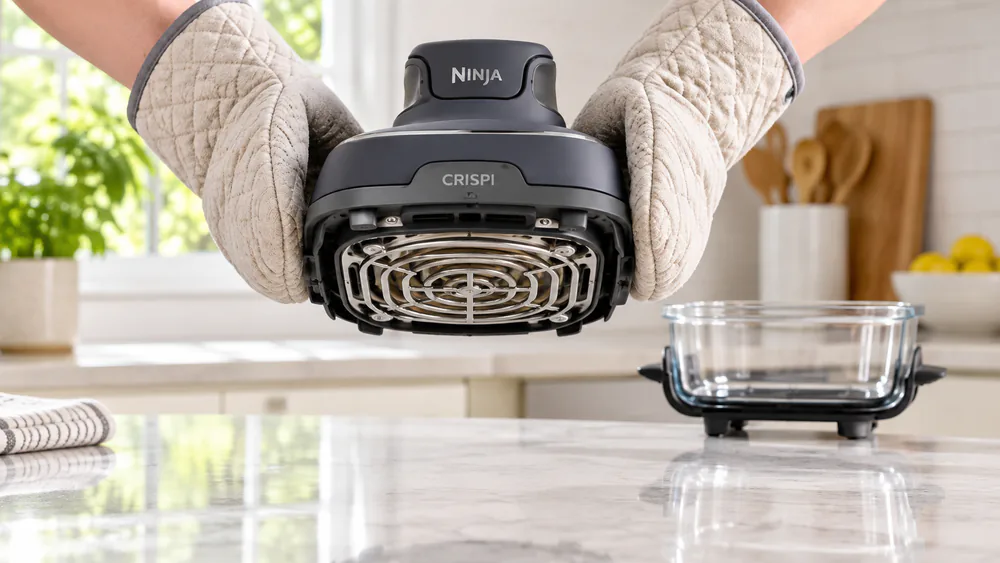
Safety is the reason to read a review before buying this one. The PowerPod's exposed coils sit about two inches above whatever surface is under it when set down, a real hazard on a cluttered counter near paper or cookbooks, and the exhaust vent sits under the power cord, blasting hot air onto the cable. We kept the pod's landing spot clear and unplugged it after each batch.

Glass breakage is the second concern. Documented reports exist of containers shattering during normal cooking, including one mid-cook on two chicken breasts at 15 minutes, with the glass cutting the owner. In controlled testing our glass survived ice water and freezer-to-max-crisp runs, but owners report cracks under extreme temperature swings, so treat the glass as durable, not unbreakable: cool fully before washing, no cold water on hot glass, no cold food in a hot container.

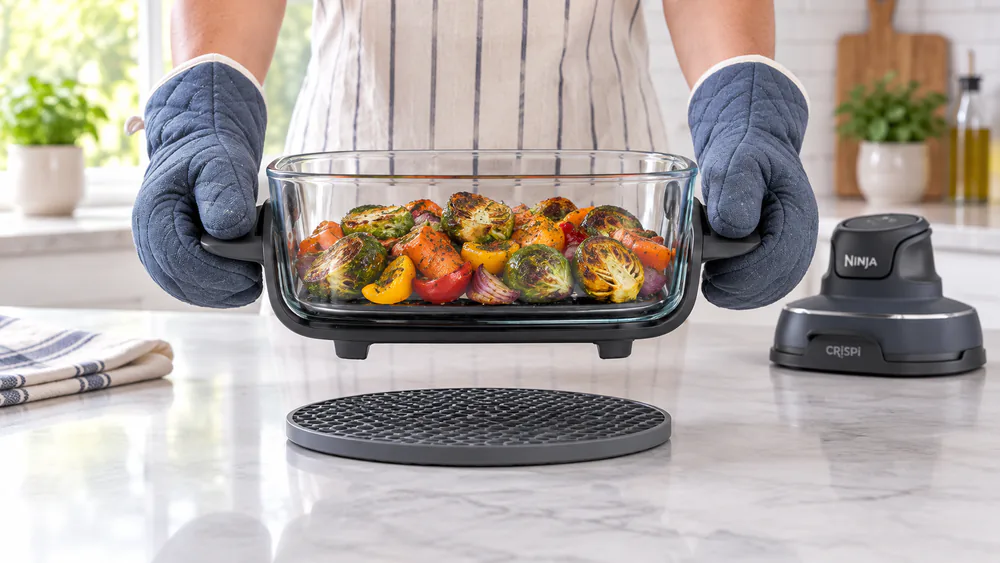
The manual is blunt about heat. The glass exterior reached 280F in lab testing, hot enough for severe burns, and Ninja calls for oven mitts. Some owners report the crisper-plate coating coming off after a single use, and the silicone feet on the crisper tray snap off over time. None are common enough to call the design broken, but they are why the 1-year warranty matters.

Warning. Two warnings from our testing: owners have documented glass containers shattering mid-cook, and the PowerPod's exposed coils sit about two inches above the counter when set down. Keep the pod's landing spot clear, and let the glass cool fully before washing.

The Ninja Crispi PowerPod with its exposed heating element above the counter.
Hands in oven mitts lifting the hot 4-qt glass container out of the Ninja Crispi.

Pros and Cons

Pros

  • PFAS-free borosilicate glass containers, with no nonstick coating to flake or chip
  • See-through cooking, so you watch food brown without opening the unit
  • Dishwasher-safe containers that double as serve and storage dishes
  • Detachable PowerPod and nesting containers pack into one cupboard shelf
  • Daily cleanup is a wipe of the glass and a quick wash

Cons

  • No custom temperature, with 4 presets and a 375F floor
  • Small cooking surface, about 64 sq in and 10 to 11 wings max
  • Exposed PowerPod coils and very hot glass demand clear counters and mitts
  • Price runs high for the capacity, about $159 to $180 street

Ninja Crispi vs Basket Air Fryers (Comparison Table)

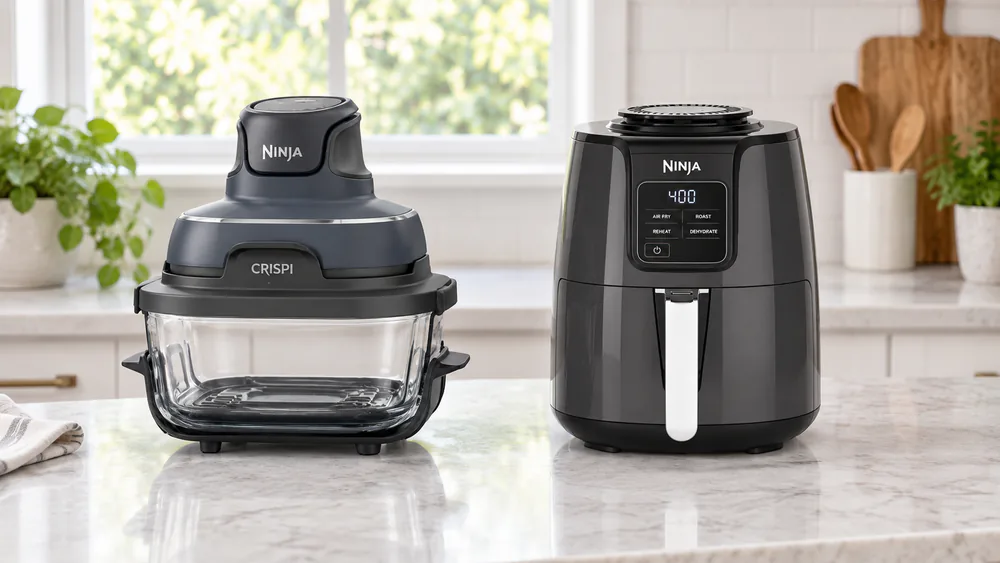
The natural question is whether glass is worth the premium over a basket fryer. Our reference is the 4-qt Ninja AF101, a roughly $90 workhorse we reach for on weeknights. It dials any temperature from 105F to 400F, its 1550W basket fits 2 lb of fries, and cleanup is a 1 to 2 minute wash. What it cannot do is cook on glass: food touches the ceramic-coated aluminum basket, and the round drawer wastes space on long foods.

FeatureNinja Crispi (portable)Ninja AF101 (basket)
Street price About $159 About $90
Wattage 1500W 1550W
Capacity 4-qt + 6-cup glass containers 4-qt basket, about 2 lb of fries
Temperature control 4 presets, 375F floor, no custom temp 105-400F, fully adjustable
Materials Borosilicate glass, ceramic-coated plate Ceramic-coated aluminum basket
Cleaning Everything dishwasher safe Basket and plate dishwasher safe
Noise (measured) 62 dBA Not measured
Max temperature 450F 400F
The Ninja Crispi glass air fryer next to a Ninja AF101 basket fryer.

Ninja Crispi vs Crispi Pro: Which Should You Buy?

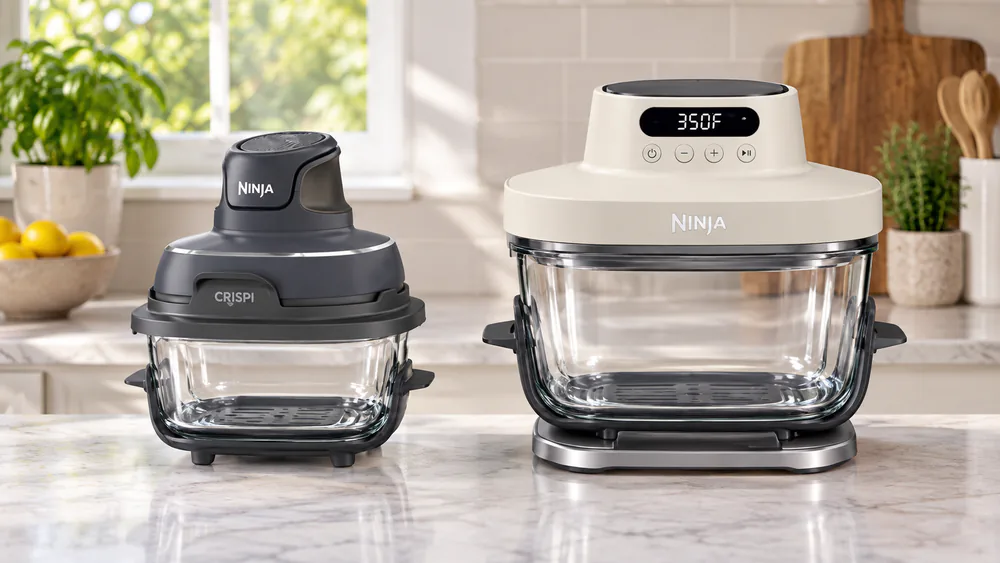
The Crispi Pro is the full-size sibling, launched in October 2025 at $279 and now running about $285 at Amazon, or $299.99 on the Ninja Crispi Pro 6-in-1 Glass Air Fryer page. It upgrades the portable in four ways: a 6-qt and 2.5-qt glass set, temperature control from 80F to 450F in 5-degree steps, six modes that add Roast and Dehydrate, and an integrated heating stand that removes the exposed-PowerPod risk. It also costs roughly $125 more, runs louder at 67 dBA, and weighs about 17.5 lb, so it stays in one spot.

Lived details: the Pro's bowls do not nest, so it takes more cabinet space; the 2.5-qt bowl puts food too close to the heating element; and a whole chicken at 375F for 1 hour 15 minutes came out very crispy outside and juicy inside.

Choose the portable if you cook for one or two, want the pod to pack away, and can live with four presets. Choose the Pro if you feed four or more, roast whole chickens, or want real temperature control.

The portable Ninja Crispi next to the larger Ninja Crispi Pro.

Frequently Asked Questions

Is the Ninja Crispi worth it?

If you cook for one or two and want crispy food on glass, yes, it earns its price. The workflow is the value: the container you marinate in is the one that crisps and the one you serve from, so the fridge-to-fryer-to-table loop leaves one dish to wash. It is a harder sell for families, and the street price swings between about $159 and $179.99, so check the live listing before you commit.

Can the glass containers go in the dishwasher?

Yes, every component is dishwasher safe, including the glass, lids, and crisper plates. Let the glass cool fully first, since hot glass in cold water risks cracking, and hand-blot the Pro's rubber base after a cycle because it traps water.

How much food fits in the Ninja Crispi?

A dinner for two, in one round. Ninja rates the 4-qt container for a 4-lb chicken, but ours fit two Cornish hens, and a whole roasting chicken was optimistic. A family meal runs in stages: two or three batches, with the small bowl kept about three-quarters full so food stays clear of the heating element.

Does it really crisp better than a basket air fryer?

Not better, just as good, and without a nonstick coating. Our fries, wings, and salmon matched a good basket fryer, and Recrisp is superb on leftovers. The trade is losing a custom temperature dial and a shake reminder.

Should I buy the Ninja Crispi or the Crispi Pro?

For a family that roasts whole chickens, the Pro earns most of the roughly $125 premium: the 6-qt bowl takes a full bird, and temperature control from 80F to 450F replaces the four presets. Price in the extras before you commit. The 6-qt bowl is mostly for big cooks, the 2.5-qt bowl puts food too close to the heat to use well, and the separate 4-qt container, sold on its own, ends up as the daily driver.

Bottom Line: Is the Ninja Crispi Worth Buying?

The bottom line is that the Crispi is the right air fryer for a specific person: a single or a couple cooking crispy food on glass, with storage at a premium. The fridge-to-fryer-to-table containers are the best meal-prep setup we have used in this category.

It is not the air fryer for everyone. Families outgrow the surface, and cooks who live by precise temperatures will chafe at the 375F floor. If we could change two things, it would be adding a shake reminder and a way to set your own temperature.

Buy it if you want crispy food without nonstick coatings and can live with four presets. Skip it if you cook for four or want to dial in exact heat. Check the live price at Amazon before you decide.

Read next

Which Crispi fits your kitchen?

Three ways to buy: the portable we reviewed, extra TempWare glassware for meal prep, or the full-size Crispi Pro for families and custom temperatures.