As an Amazon Associate we earn from qualifying purchases. We may earn a commission from links on this page, at no extra cost to you. Learn more.
A double burner griddle only earns its counter space if it spreads heat evenly across two burners that were never designed to work as one. That is the problem we kept coming back to while comparing these pans, and it is why we start with the All-Clad HA1 13x20, our top pick for most gas and electric kitchens. It gives you a big hard-anodized surface for a family breakfast, a stainless base, and a lifetime warranty. Below we weigh it against the older 3020, a stainless Cuisinart, and a cast iron Lodge, so you can match the pan to your stove.
Quick Picks at a Glance
Rank
Product
Best for
Cooking surface
Rating
Buy
1
All-Clad HA1 Hard Anodized Nonstick Double Burner Griddle 13x20
We judge a double burner griddle on five things: how evenly it heats across two burners, how well food releases, how it handles cleanup, whether it stays flat under heat, and whether it fits the stove it will actually sit on. Those five criteria cover heat distribution, food release, cleanup, resistance to warping, and stove fit.
The Cuisinart and Lodge notes below come from cooking on them: quesadillas, pancakes, scrambled eggs, bacon and steaks, on gas burners and an induction bridge zone.
Two pans give us findings we can state plainly: the Cuisinart and the Lodge. The All-Clad HA1 and 3020 are different. The maker's page backs the HA1's specifications, but we have no hands-on results for it that we can stand behind yet, and the 3020 is an older model that All-Clad no longer lists. Where we lack firsthand results, we say so and limit our claims to what the maker publishes. A pick that is only partly proven gets a rating that reflects that.
The questions we ask are practical ones. Does the middle of the pan cook darker than the edges when it bridges two unequal burners? Do pancakes and eggs slide off without butter? Does the base rock on the cooktop once the pan has been hot a few times? Is the pan a chore to lift out of the cabinet? Those are the checks that separate a griddle you use every weekend from one that lives in a drawer.
We also pay attention to the things a spec sheet hides. A pan can list a 500F oven rating and still be too awkward to move with two hands. A coating can release an egg beautifully on day one and look tired a few years later. So we weigh what the maker publishes against how a pan behaves on a real stove, and we mark clearly which is which.
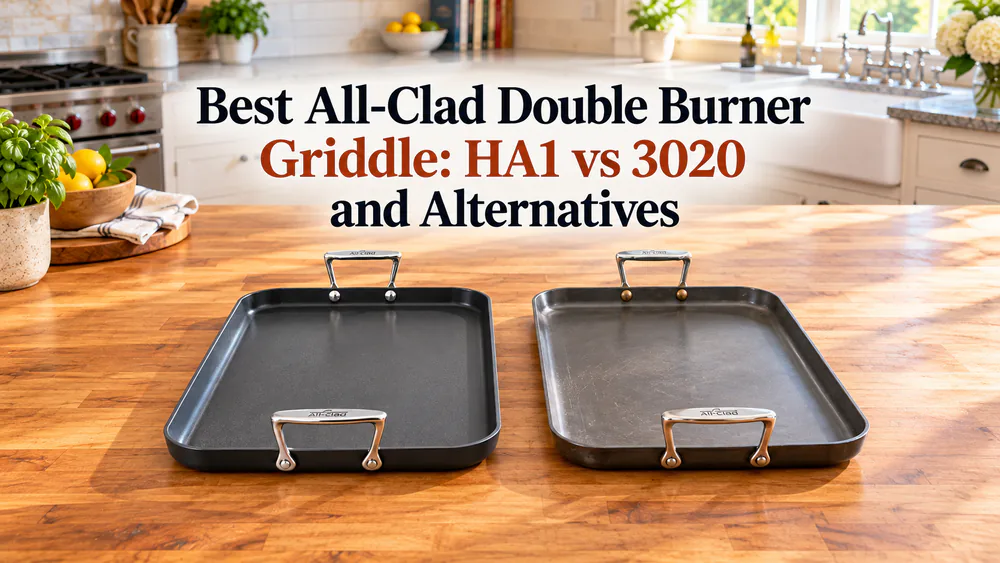
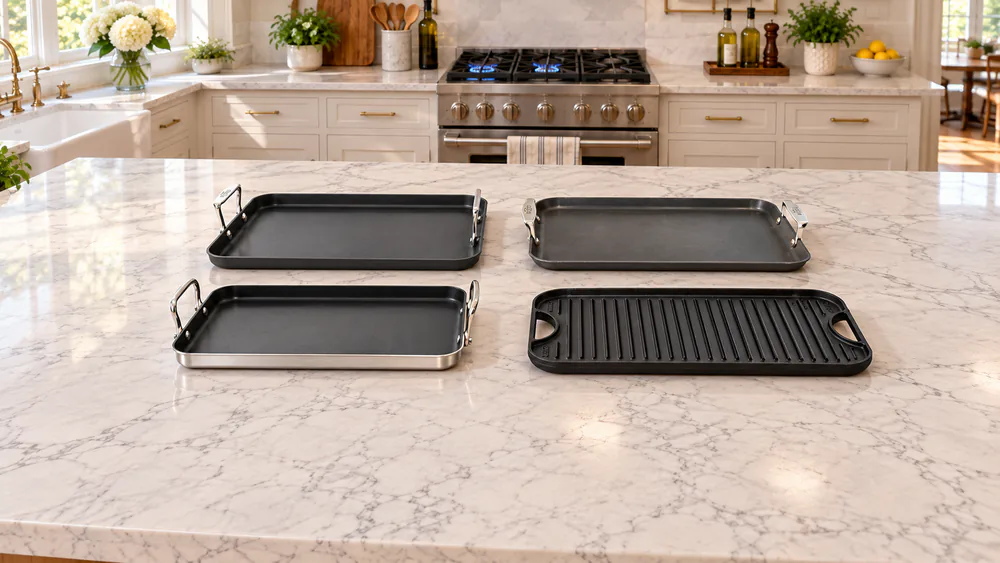
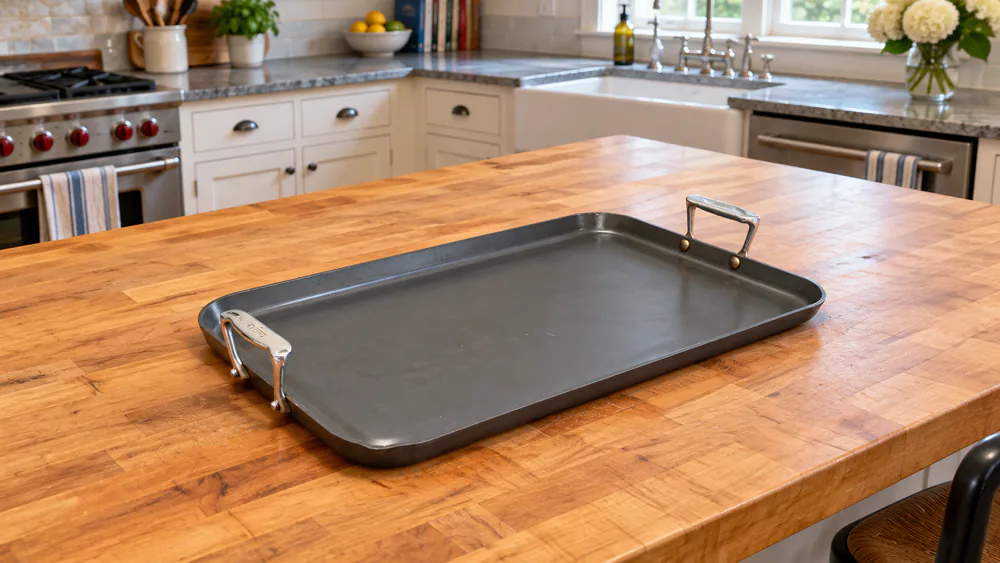
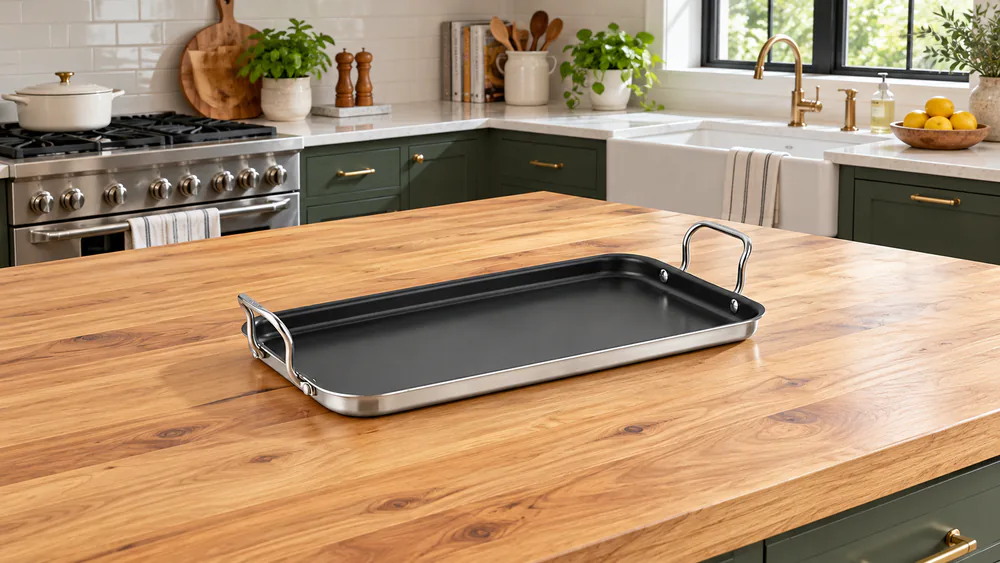
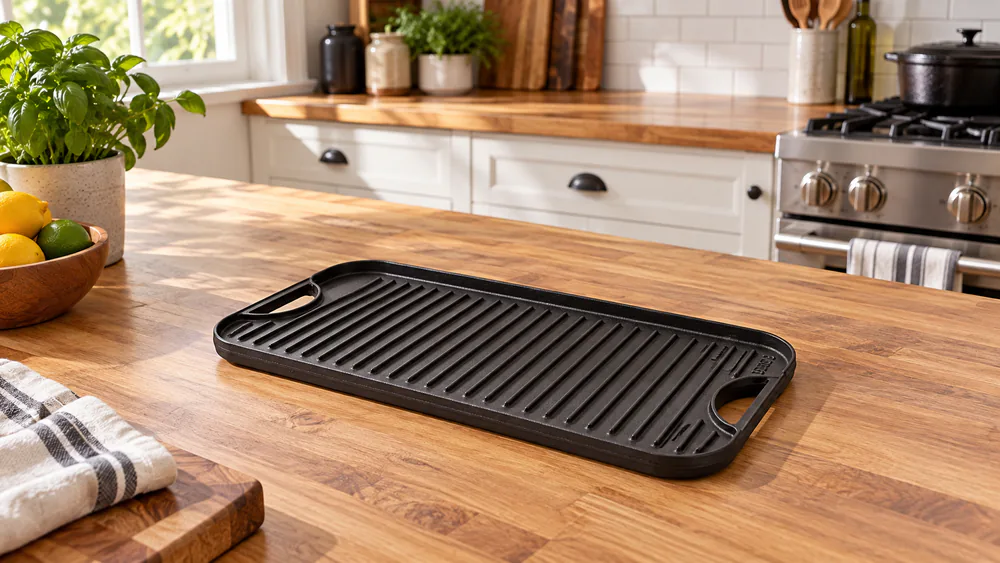
The four pans in this roundup, from the 10 x 18 inch Cuisinart to the heavy Lodge.
If you are still deciding between pan families, our stainless steel cookware reviews explain how tri-ply construction behaves on the stove, which matters for the Cuisinart pick below.
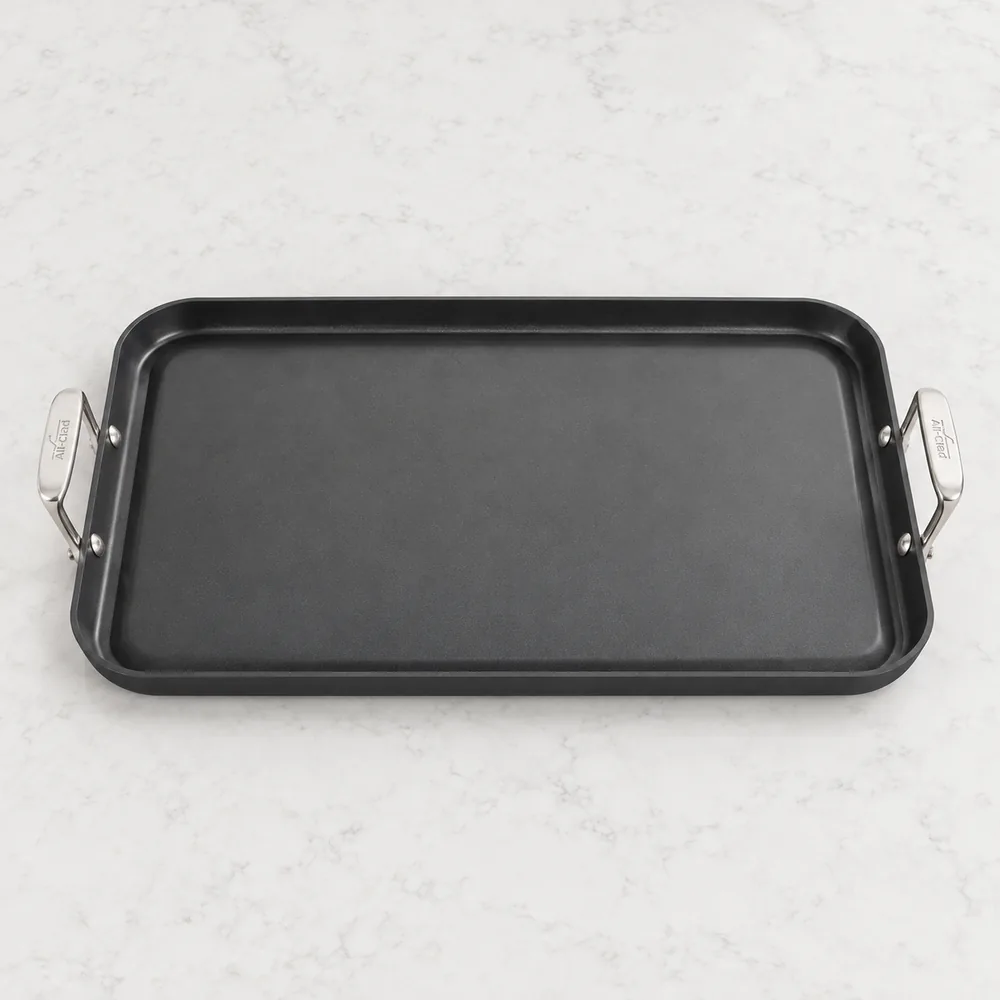
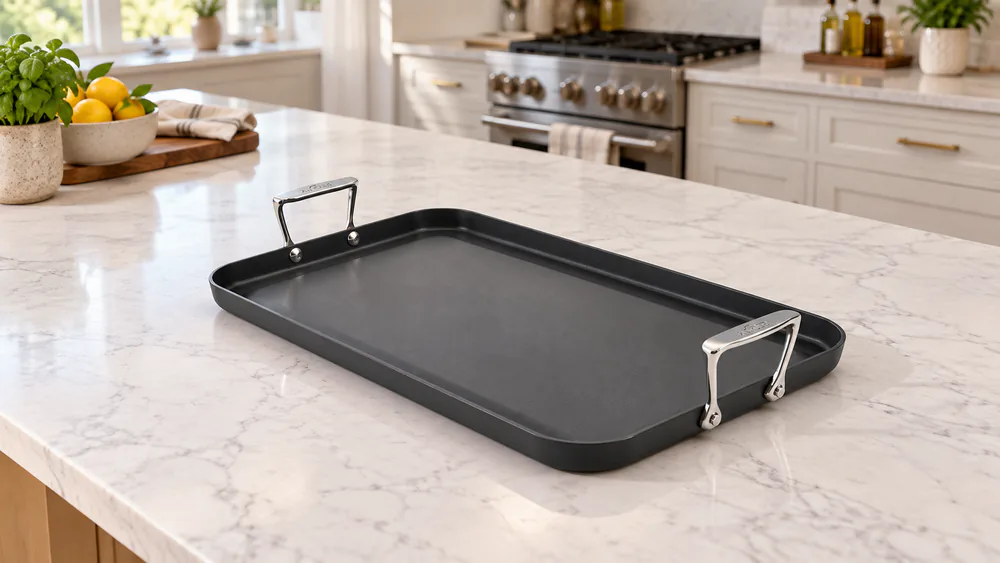
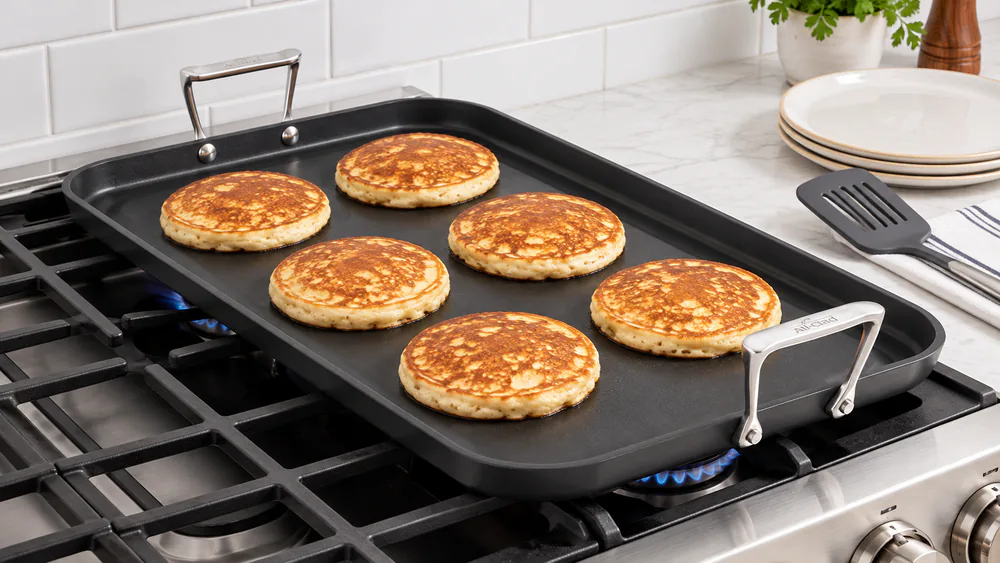
The HA1 is the pan we recommend first because its design answers the main double burner problem. The body is heavy-gauge hard-anodized aluminum with a stainless steel base, which is the construction that resists the rocking and hot-side drift thinner griddles develop. The 13 x 20 inch cooking surface is the largest of the four pans, and All-Clad backs it with a Limited Lifetime Warranty. If your stove is gas, electric coil, or a glass or ceramic top, this is the one we would buy.
On paper, a hard-anodized body over a stainless base is the right build for a pan that has to bridge two burners. We make no hands-on claim about its edge-to-center evenness or egg release, and we rely on what the maker publishes.
The HA1 has one hard limit. It is not compatible with induction, and the maker is explicit about that. If you cook on induction, skip to the Cuisinart. Everyone else should read on.
What the specifications tell us
The surface is PTFE nonstick, a fluoropolymer in the PFAS family. The pan is oven safe to 500F, though the lids are rated to only 350F and All-Clad says to avoid the broiler. The handles are double-riveted stainless steel, and the dark matte finish hides stains better than a bright surface would. The pan is designed in Canonsburg, Pennsylvania and made in China.
The weight is published without a unit. The figure is 5.6, which suggests pounds and fits the shipping dimensions of roughly 21 x 13 x 4 inches. Treat it as a pan around five and a half pounds, and confirm the number before you rely on it for storage planning. That is still far lighter than cast iron, which makes the HA1 the easier pan to carry from cabinet to stove.
Cleanup and care
The label permits the dishwasher, but All-Clad itself recommends hand washing to keep the finish new. We would follow the maker. Let the pan cool before it meets water.
Who should buy it
Buy the HA1 if you have a gas or electric stove, cook for three or more people, and want a pan that can also finish a dish in the oven. The 13 x 20 inch surface handles a full family breakfast in one pass, which is the real convenience of a double burner pan. Skip it if you avoid PTFE on principle. We have no independent long-term data on warp or coating wear for this specific model, so the lifetime warranty is the safety net we point to.
Pros
Largest cooking surface in the roundup at 13 x 20 inches
Hard-anodized body with a stainless base for stable heat
Oven safe to 500F
Limited Lifetime Warranty
Easy to clean when hand washed
Cons
Not compatible with induction
PTFE nonstick coating, part of the PFAS family
Costs more than the Cuisinart and Lodge
No independent long-term warp data for this model
2. All-Clad 3020 Hard Anodized Double Burner Griddle (Best for Heavy Daily Use)
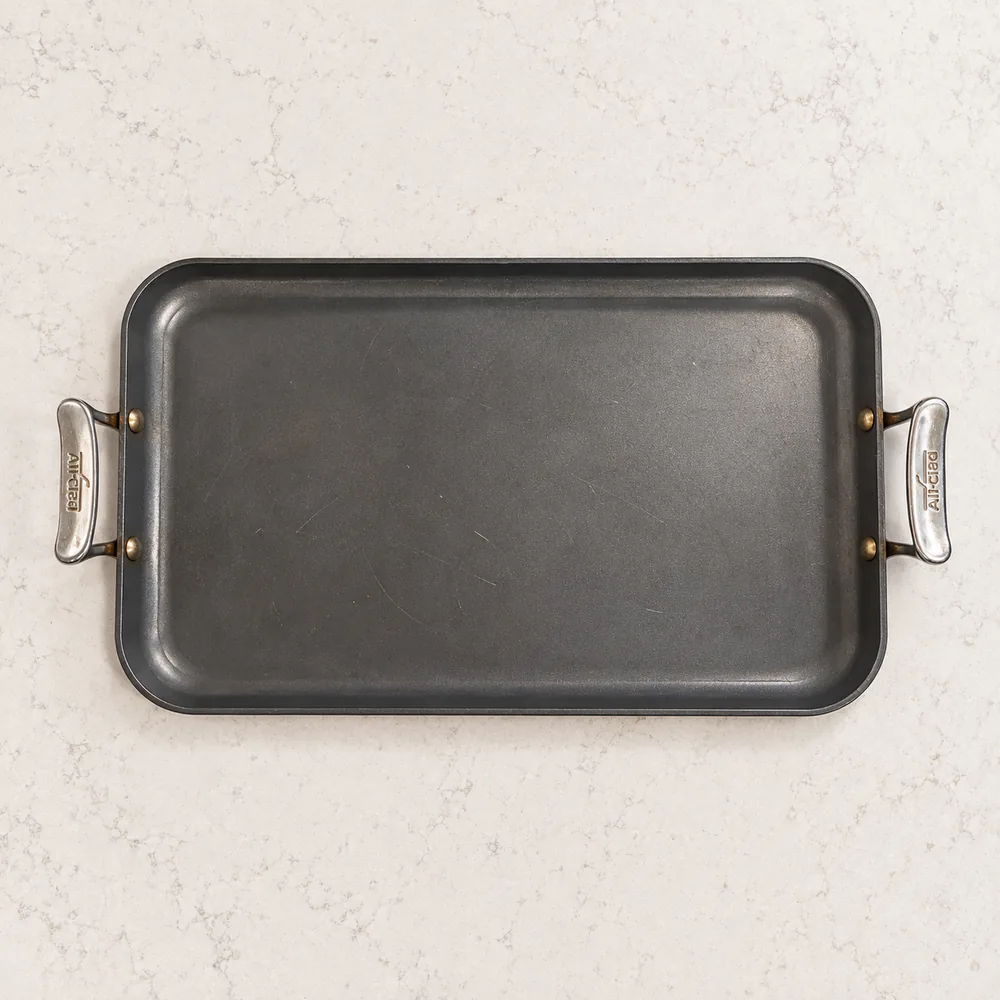
The 3020 is an older model number for All-Clad's 13 x 20 inch hard-anodized double burner griddle, sometimes sold as the Grande. All-Clad's current site lists only the HA1 Expert and the NS Pro ceramic version, so the 3020 now turns up mainly through resellers and secondhand listings. Its construction is hard-anodized aluminum with a nonstick surface and riveted stainless handles, which is the same family of materials as the HA1.
We have not cooked on a 3020, so everything here rests on the construction it shares with the HA1 rather than on our own results.
We rank it second because the family resemblance is strong, and we gave it the "Heavy Daily Use" label because hard-anodized aluminum is the kind of body that holds up to frequent cooking. It is worth being clear about what we cannot confirm. Dimensions, weight, oven rating, induction compatibility, dishwasher guidance, warranty and price are not stated by any source we trust for the 3020. That uncertainty is why it sits below the HA1 and why its rating is lower.
How to buy a 3020 sensibly
If you find one, ask the seller three questions before you pay. Is the coating undamaged? Is the base flat when you set it on a counter? What is the return window? A used hard-anodized pan with a scratched surface is a poor deal at any price. A new-in-box unit at a price close to the HA1 is also a poor deal, because the HA1 has a published warranty and the 3020 does not.
For most readers the 3020 is a fallback, not a target. We would choose it over the HA1 only if we found a clean unit at a fair price.
Why the HA1 usually wins the cross-shop
The practical difference is paperwork. With the HA1 you can read the oven limit, the lid limit, the induction restriction and the warranty on the maker's own page. With the 3020 you are reading resale descriptions that disagree with each other. For most kitchens, having specifications you can verify and plan around is worth the price difference.
Pros
Same hard-anodized aluminum family as the HA1
13 x 20 inch size, based on the model's published identity
Riveted stainless handles
Can be a bargain if you find a clean unit
Cons
Older model that All-Clad no longer lists
Warranty, oven rating and induction compatibility are unconfirmed
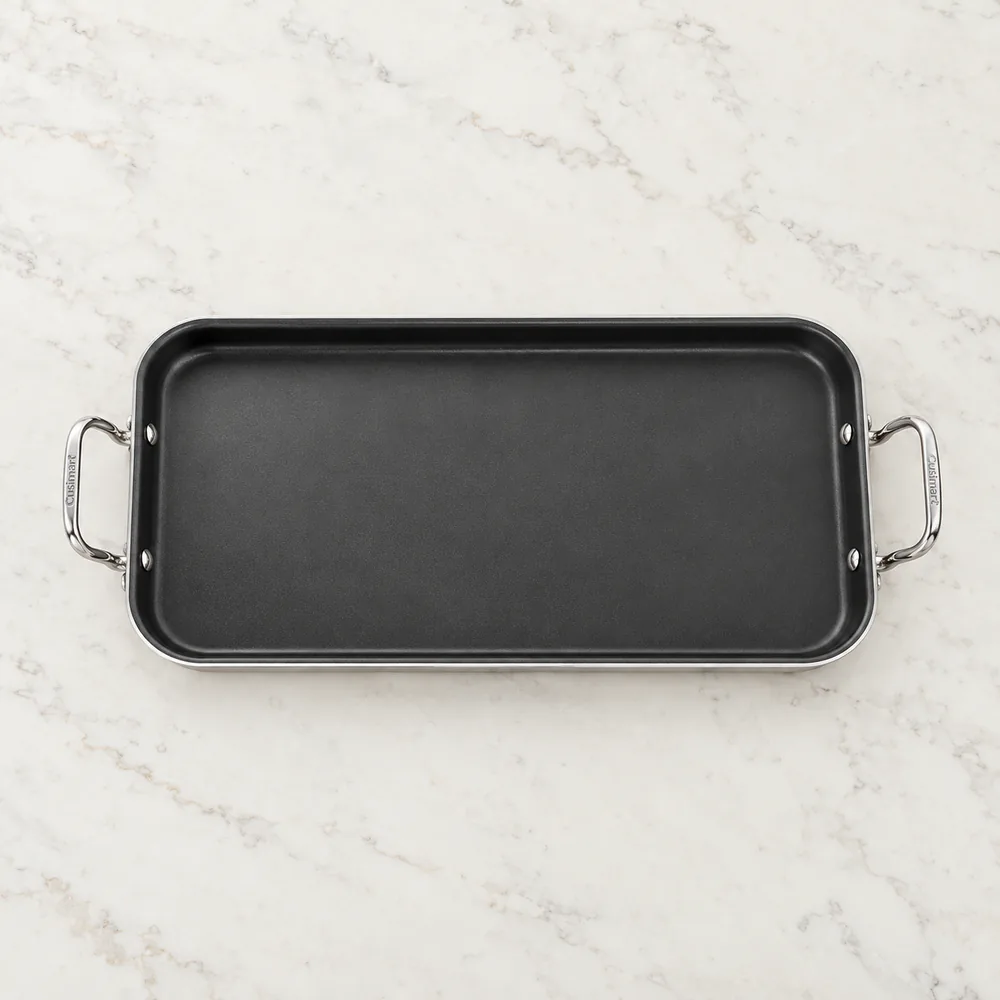
Where the HA1 rules out induction, the Cuisinart is built for it. It is the pan we recommend when the HA1 is out of reach on price or incompatible with your stove. It is triple-ply, with a pure aluminum core inside a brushed stainless exterior, and it is suitable for induction cooktops. It costs far less than the HA1 and carries a lifetime warranty. Pancakes and scrambled eggs release cleanly from the nonstick surface without any babying, and that is the result most people buy a griddle for. For a longer look at this pan, see our Cuisinart MultiClad Pro double burner griddle review.
The 10 x 18 inch surface is smaller than the All-Clad's, and that matters. A full Sunday brunch of pancakes, bacon and two kinds of eggs fits on this pan, but the shape imposes some limits, and you will cook in two rounds if you feed more than four.
Heat behavior
Any double burner pan that bridges two burners with a gap between them cooks darker in the middle. That pattern shows up with quesadillas, which come out crisp but browned unevenly across the surface. The fix is simple: rotate the food halfway through, and keep your hottest items over the burners rather than the gap.
On an induction bridge zone the Cuisinart needs a few minutes of preheat at medium while you slide it around. Skip that step and the heat spread is uneven. Gas cooks get steadier results because the flames sit directly under the pan.
Warping and handles
A thin aluminum-core griddle like this can warp slightly on the bottom and start to rock on the cooktop, which shifts the heat to one side. That is the main risk at this price and the reason we rank it below the HA1. The stainless handles stay cool during gentle cooking but warm up at high heat, so keep a mitt nearby.
Nonstick life and model notes
The nonstick cleans easily at first, but it can wear and peel after roughly four years of regular use. Treat it as a pan you will replace someday, and wash it by hand even though retailers list it as dishwasher safe, because Cuisinart recommends hand washing. Retail spec sheets also disagree on oven use, with one listing giving 500F and another marking it not oven safe, so check the current manual before you slide it into the oven.
One more caution about shopping. Cuisinart lists the MCP45-25NS and MCP45-25NSP1 as discontinued, and the MCP45C-25NS is the current model, so the exact version on shelves may differ from the one we describe.
Pros
Works on induction cooktops
Triple-ply stainless with an aluminum core
Pancakes and eggs release cleanly
Lifetime warranty at a budget price
Cons
Smaller 10 x 18 inch surface
Can warp and rock on the cooktop over time
Nonstick can wear after about four years
Oven rating is inconsistent across listings
4. Lodge Reversible Cast Iron Griddle (Best Non-Nonstick Alternative)
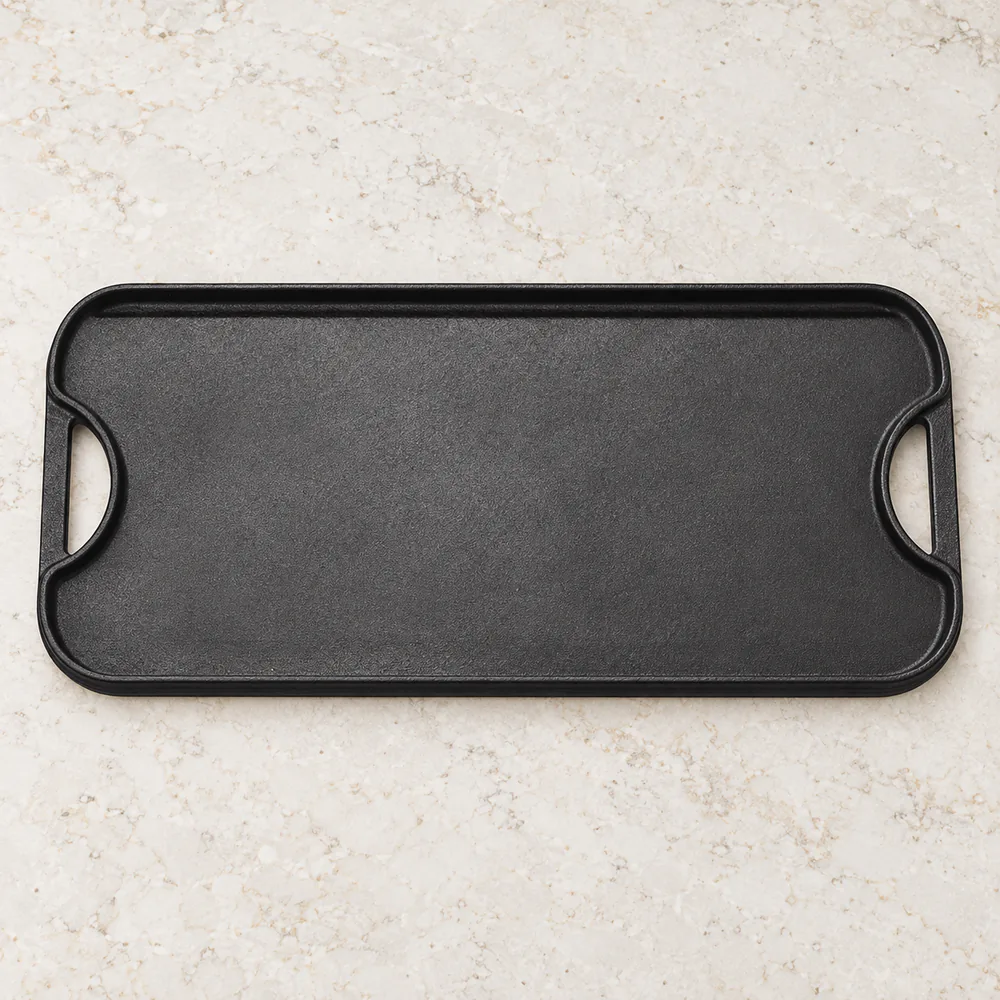
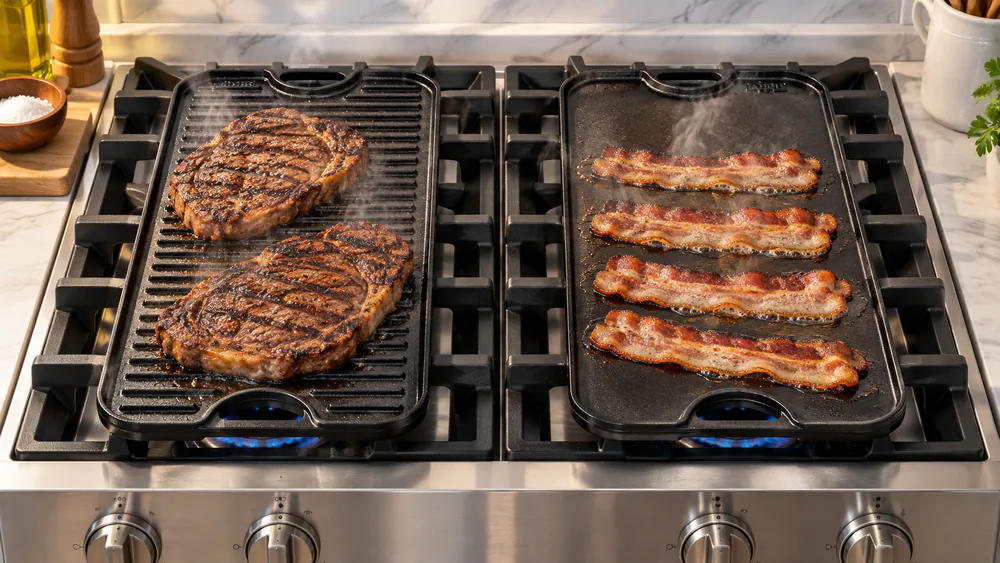
The Lodge is the workhorse of this group, and it is the only pan here that will not warp. It is seasoned cast iron, 20 x 10.5 inches, sized to span two burners, with a flat side and a ridged grill side. It is heavy enough to resist warping and holds screaming-hot heat for searing steaks and pancakes on gas. It costs a fraction of the HA1, and the surface is free of PFOA, PTFE and PFAS. The trade is the weight: it is a chore to lift in and out of storage, and Lodge lists it at 13.5 pounds, though other sources put it at 14 to 15 pounds.
Cooking and cleaning
Bacon is the weak spot. It spits and splatters badly on the ridged side, and the shallow grease trough does not hold much fat. Use the flat side for bacon and keep the ridges for steaks and vegetables.
Cleaning is easy with a hot water rinse and light scraping once the pan is seasoned. Before that, expect several rounds of seasoning before food stops sticking, and avoid soap. This is the main adjustment for anyone moving from nonstick, and it is why the Lodge does not take the top spot despite its durability.
Fit and stove compatibility
The Lodge fits across two gas burners or down the center, and it fits electric coils with only a small overhang. Lodge says it is compatible with induction, but a double burner pan may not sit flat on every induction top, so fit depends on your cooktop's bridge layout. We would not buy it for induction without checking your range first.
Pros
Will not warp under heat
No PFOA, PTFE or PFAS
Reversible flat and ridged cooking sides
Lowest price of the four
Improves with seasoning
Cons
Very heavy to lift and store
Bacon spits and splatters on the ridged side
Needs several seasoning rounds and no soap
Induction fit varies by range
All-Clad HA1 vs 3020: Side-by-Side
The table below lines up the two All-Clad pans against the Cuisinart and the Lodge. Where a value is unconfirmed, we say so rather than guess. The HA1 and 3020 share a material family, but only the HA1 has specifications that All-Clad publishes today.
Spec
HA1 13x20
3020
Cuisinart
Lodge
Size
13 x 20 in
13 x 20 in (older Grande, unconfirmed)
10 x 18 in
20 x 10.5 in
Material
Hard-anodized aluminum, stainless base
Hard-anodized aluminum
Triple-ply stainless, aluminum core
Cast iron
Surface
PTFE nonstick
Nonstick
Nonstick
Seasoned, PFAS-free
Induction
No
Unverified
Yes
Yes (fit varies)
Oven max
500F
Unverified
Listings conflict
Oven safe
Dishwasher safe
Listed safe, hand wash advised
Unverified
Hand wash advised
No, hand wash
Weight
5.6 (unit not stated)
Unverified
About 4 lb
About 13.5 lb
Warranty
Limited Lifetime
Unverified
Lifetime
Unverified
Our rating
4.5
4.0
4.2
4.4
The comparison shows why the HA1 wins on everything we can verify: it is the largest, the best documented, and the only nonstick pan with a published 500F oven rating. The 3020 loses on the unknowns rather than on any proven flaw. If you want a pan that will outlast the others, the Lodge is the one.
How to Choose a Double Burner Griddle
Choosing the right pan comes down to your stove, your cooking habits, and how much weight you will tolerate. The five criteria below are the ones that decided our rankings.
Size and burner coverage
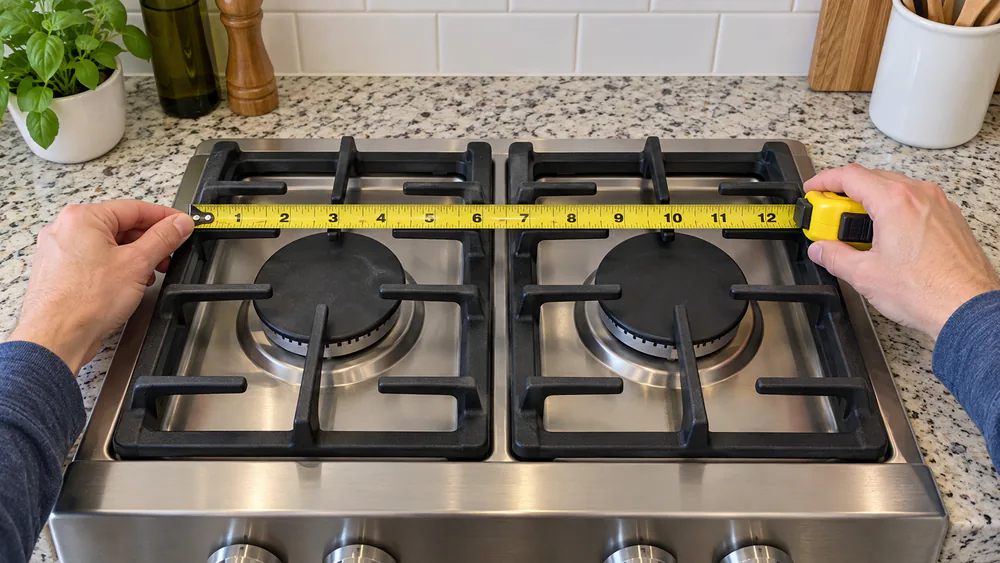
Measure your burner spacing before you buy. A 13 x 20 inch pan like the HA1 needs two burners side by side with enough clearance, and a 10 x 18 inch pan like the Cuisinart leaves more room on a crowded cooktop. The Lodge, at 20 x 10.5, fits across two gas burners or down the center, and it fits electric coils with only a small overhang.
The gap between burners matters as much as the pan size. When the burners are unequal or far apart, the middle of the pan cooks darker than the edges. Choose a thicker base if your burners are mismatched, and plan to rotate food halfway through. If your range has a dedicated bridge or griddle zone, a double burner pan will usually seat better there than across two ordinary burners.
Tip. Preheat a double burner pan at medium for a few minutes before you add food, and move the food around once. A slow, even preheat does more for heat distribution than a higher flame.
Material and warp resistance
Material decides how the pan behaves over time. Hard-anodized aluminum with a stainless base, as on the HA1, gives you good heat spread and a durable body at a moderate weight. A tri-ply stainless pan like the Cuisinart is lighter but thinner, which is the trade covered in its review above. Cast iron is heavy enough to resist warping and holds heat longest, at the cost of weight.
For a broader look at how layered construction changes heat behavior, see our guide to All-Clad D3 vs D5, which covers the same stainless-and-aluminum thinking on a smaller scale.
A double burner griddle is only as good as its base. If it rocks on the cooktop, the heat drifts to one side and nothing else about the pan matters.
Nonstick coating and PFAS
Both All-Clad pans and the Cuisinart rely on a nonstick coating. The HA1's is PTFE, a fluoropolymer in the PFAS family, and the maker's page does not use the word PFAS. Nonstick gives you easy release for pancakes and eggs and quick cleanup, but it is a coating with a finite life. On the Cuisinart the cleanup is easy at first, then the coating can wear and peel after roughly four years of regular use.
If you want to avoid PTFE altogether, the Lodge is seasoned with iron and oil and is free of PFOA, PTFE and PFAS. All-Clad also sells an NS Pro ceramic 13 x 20 inch double burner griddle, oven safe to 450F with a one-year limited warranty, for shoppers who want a ceramic surface. We have not ranked it because it falls outside the four pans we compare here.
Warning. Avoid metal utensils and abrasive pads on any nonstick pan. A scratched coating is the usual first sign that a griddle is near the end of its life.
Gas, electric and induction compatibility
This is the criterion that eliminates pans fastest. The HA1 works on gas, electric and glass or ceramic tops but not on induction. The Cuisinart is suitable for induction, though you must preheat it patiently on a bridge zone. The Lodge is rated for induction, but a double burner shape may not sit flat on every induction top, so check your range's bridge layout.
On a glass or ceramic cooktop, the main concern is a flat base. A warped or rocking pan can scratch the glass and heat unevenly, so lift the pan rather than sliding it. If you cook on gas, any of the four pans will work, and the Lodge shines there.
Care and warranty
Hand wash every pan here, even when the label allows a dishwasher. The makers of the HA1 and Cuisinart both advise it over the dishwasher. For the Lodge, rinse with hot water, scrape lightly, and skip soap so the seasoning builds.
Warranty varies. The HA1 carries a Limited Lifetime Warranty and the Cuisinart a lifetime warranty. We could not confirm the Lodge's warranty or the 3020's, so check at purchase. Keep your receipt either way.
Common Mistakes When Buying a Double Burner Griddle
The most common error is buying for size alone. A 13 x 20 inch pan sounds generous, but if your burners sit too close to the wall or the next burner, it will not seat flat. Measure first.
The second error is ignoring your cooktop type and brand-shopping before checking compatibility. The third is expecting a nonstick coating to last forever. Even a good one wears, so budget for replacement or choose cast iron.
Finally, many cooks skip the preheat. Heating a cold pan on high and adding batter right away produces the dark middle and pale edges that get blamed on the pan. A few minutes at medium fixes most of it.
Frequently Asked Questions
Can I use a double burner griddle over a single burner?
You can set it there, but the shape is built to span two burners. Over one burner the heat concentrates in a small patch and the far end stays cooler. We have not tested that setup, so we would use the whole pan only across two burners.
Is PTFE nonstick a concern if the pan gets very hot?
The HA1's coating is PTFE, a fluoropolymer in the PFAS family, and the maker's page does not use the word PFAS. If that matters to you, the Lodge is seasoned with iron and oil and is free of PFOA, PTFE and PFAS. Follow the maker's oven and heat limits either way.
Is a double burner griddle safe on a glass cooktop?
The HA1 is rated for glass and ceramic tops. Keep the base flat and clean, and lift the pan instead of sliding it so you do not scratch the glass.
How long does a nonstick griddle last?
It depends on use and care. On the Cuisinart, the coating can wear and peel after roughly four years of regular use. Hand washing and wood or silicone tools are the habits that protect it.
Will a 13 x 20 inch pan fit my range?
It depends on your burner spacing and the clearance to the wall or neighboring burners. Measure the distance across both grates and compare it to the pan before you buy.
Is the HA1 worth the extra money over a cheaper pan?
If your stove allows it, yes. You pay more for the largest surface, a stainless base and a lifetime warranty. If you want to spend less, the Cuisinart or the Lodge is the better value.
Final Verdict
Pick by stove first and budget second. On gas, electric coil or glass, the HA1 is the pan to buy. If your stove rules it out, buy the Cuisinart. If you sear steaks more than you flip pancakes and do not mind the weight, the Lodge is the best value in the group.
Treat the 3020 as a bonus find, not a plan. If a clean unit shows up at a fair price, it deserves a look, but the HA1 has the published specifications and warranty that make a purchase easy to defend. Whichever pan you choose, give it a slow preheat and it should serve a family breakfast for years.