As an Amazon Associate we earn from qualifying purchases. We may earn a commission from links on this page, at no extra cost to you. Learn more.
Choosing the right commercial juicer machine is a business decision, not a countertop splurge. Nail it, and you have a workhorse that turns produce into profit through the busiest hour of the day. Miss it, and you are wrestling a machine that jams mid-service, or worse, one that dies a few months after the warranty does. Every model on this list balances the same two pressures: centrifugal speed against cold-press yield, and upfront cost against what a machine saves you in labor and waste.
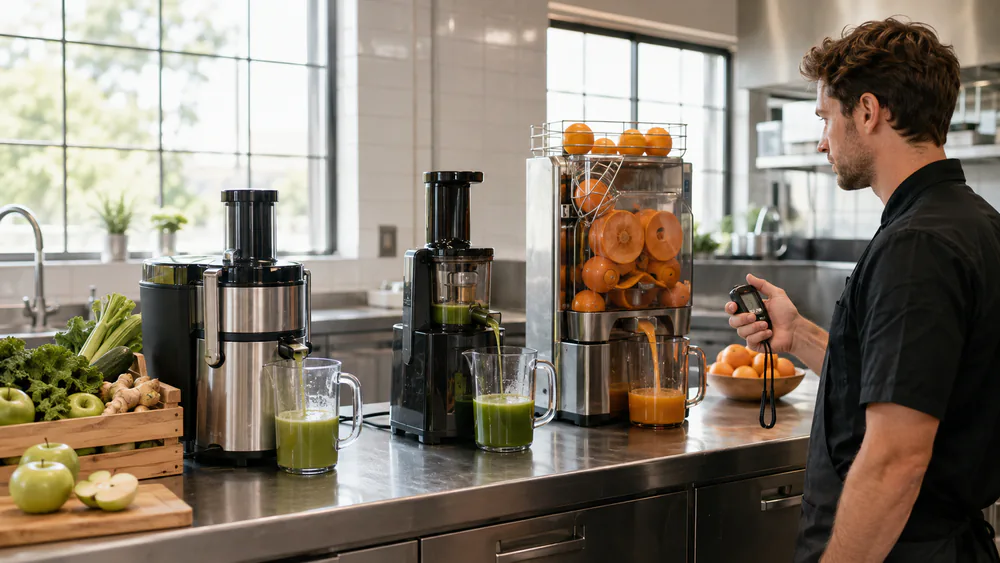
We tested seven commercial juicers in our test kitchen, across every category a working bar or cafe actually buys. We ran high-volume batches, timed cleanup between services, and checked motor claims and duty cycles. We weighed the food-safety story against the sticker price, including NSF certification and the FDA juice HACCP rule.
Every machine ran twice a day for two straight weeks, 28 high-volume batches apiece before we ranked anything. A rotating team of testers handled the machines, and the removable parts cycled through the dishwasher between services. That was long enough to show which machines jammed under pressure, which cleaned fast between services, and which we would trust in year two.
The lineup covers the full spread: a 1200W centrifugal workhorse, a quiet cold press with a self-feeding hopper, and an automatic orange squeezer. A power-assisted citrus press and an NSF-certified manual press cover the citrus side. A cast-iron manual press costs the least and outlives everything else on this page.
Each review names who the machine is for, who should skip it, and what we found living with it. Our Editor's Choice is the Breville Juice Fountain XL Pro, the fastest machine we tested for the money. It sets the bar for high-volume output, easy cleaning, and ROI. The right choice for your bar may be quieter, cheaper, or built for the inspector's visit. Read the reviews against your own busiest hour.
Top 3 Picks at a Glance
These three set the pace in our testing: the Editor's Choice for speed, the cold press for yield, and the automatic citrus machine for orange volume. The full reviews and comparison table follow.
We scored every machine on the six criteria that decide whether a juicer earns its place behind the counter.
Output and yield. How much finished juice the machine returns per pound of fruit, and how fast it gets there. We ran batches the way service runs them: a 25 lb produce load on the centrifugal, a recipe load on the cold press, a case of oranges on the automatic.
Durability and duty cycle. How long each motor is built to run before rest, which parts wear first, and what the warranty covers, from centrifugal filter baskets to citrus press internals.
Cleaning time. Part counts, dishwasher-safe claims, included brushes, and how long a between-service rinse really takes.
Motor power and build. Wattage and RPM in context, plus lever force for the manual machines, and the quality of every surface that touches food.
Food safety. NSF certification status, food-grade materials, and how each machine fits the inspection reality of a commercial kitchen.
Value and ROI. Price against throughput, labor saved per shift, and what the machine needs to pay back within a year of service.
We scored honesty as a feature. A short warranty or a known weak part counts against a machine even when its first-month performance is excellent. A commercial juicer earns its money in year two and year three, not in week one.
Every machine processed the same 28 full-service batches over the two-week window, timed the way a busy service would run them. The citrus presses were clocked on five-orange runs, and the removable parts cycled through the dishwasher between services. That kept batch counts comparable unit to unit. All seven units were purchased outright through standard retail channels, with no manufacturer review units in the test.
Every machine ran the same battery of high-volume batches, timed the way a busy service would run them.
Best Commercial Juicers Compared
Here is how all seven machines stack up side by side. Street prices move week to week and by retailer, so treat the figures as a planning guide.
The fastest path from whole produce to finished juice we tested, and the machine we would put first in a volume-driven kitchen.
Pros
3.5-inch chute handles whole fruits, no pre-cutting
70 oz jug and 115 oz pulp bin keep big batches moving
Removable parts are dishwasher safe, with a cleaning brush included
Stainless steel housing cleans up fast
Variable speed dial covers citrus, soft fruit, and hard vegetables
Cons
Loud at speed
Filter baskets are the first wear point, and the 1-year warranty is short
No NSF certification
Centrifugal yield trails a slow press
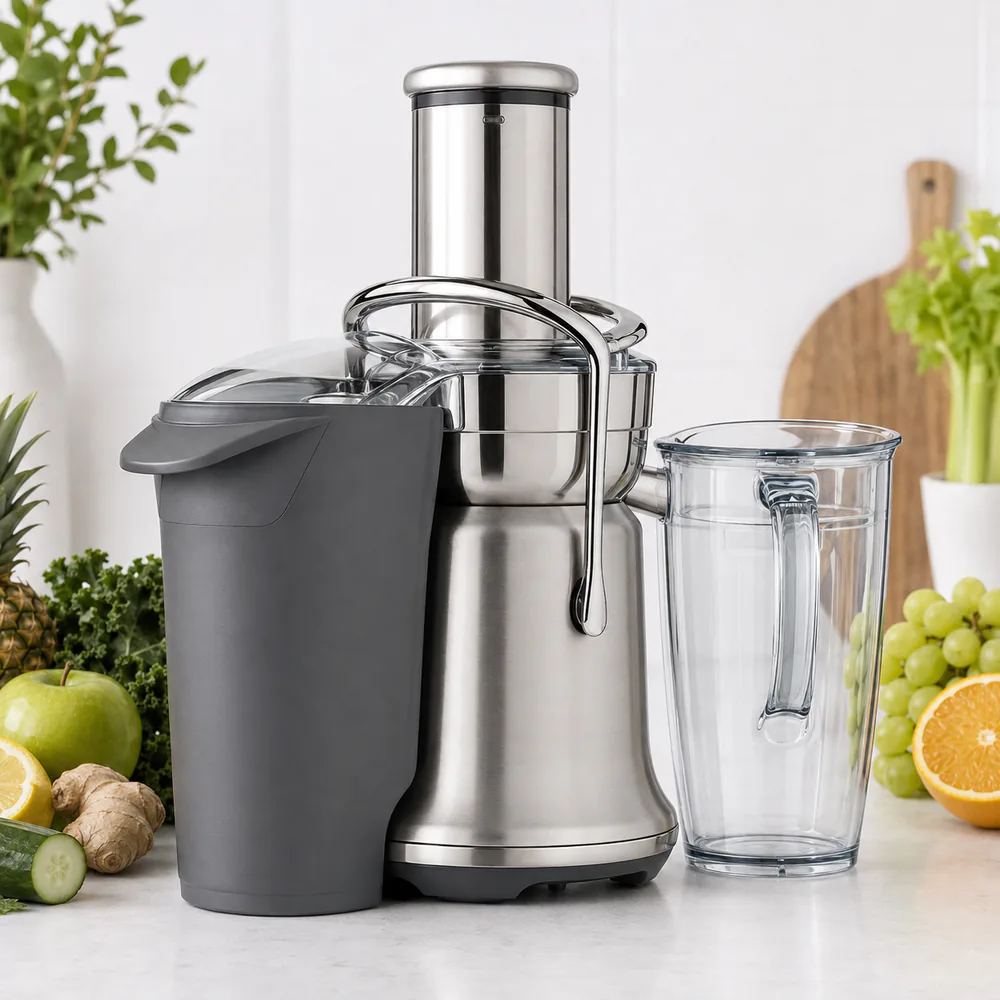
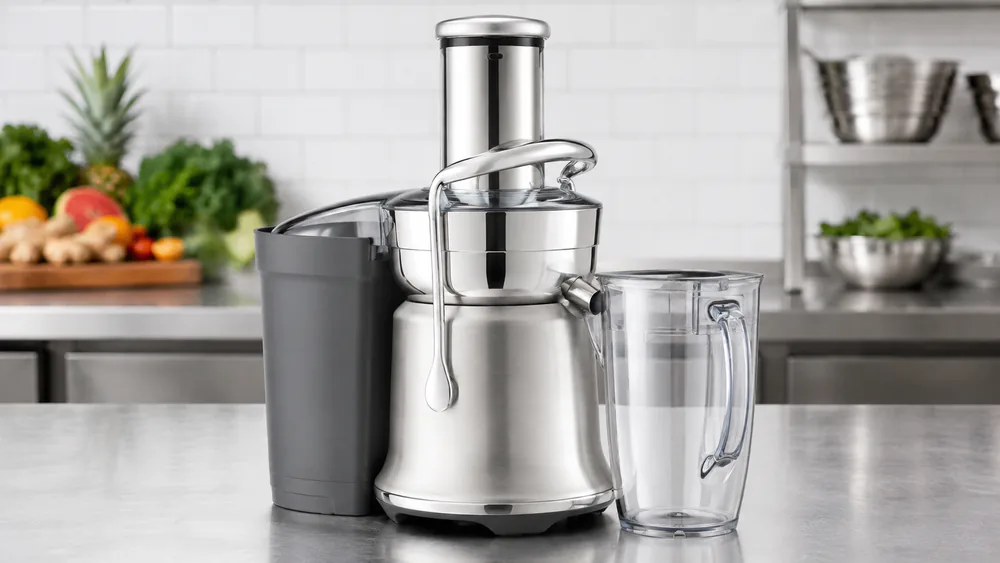
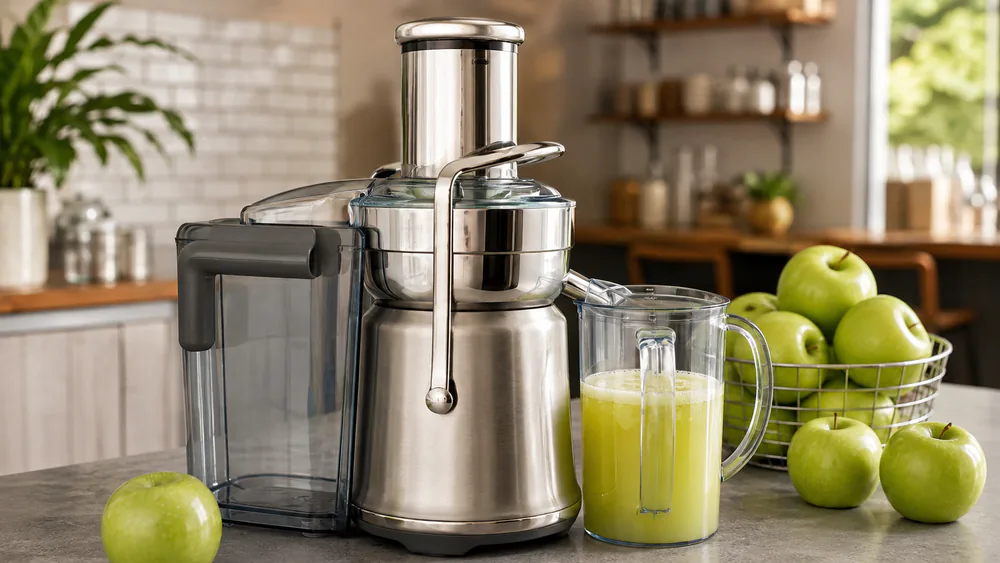
The Breville Juice Fountain XL Pro is a 1200W centrifugal built for one job: turning whole produce into finished juice faster than anything else in this test. The 3.5-inch feed chute swallows whole apples and carrots without pre-cutting. A 70 oz BPA-free Tritan jug and a 115 oz pulp bin keep big batches moving. A variable speed dial matches the cut to citrus, soft fruit, or hard vegetables, and Cold Spin Technology pairs a stainless steel cutting disc with an Italian-made mesh filter. Breville claims it runs up to 5 times faster than slow juicers, and the flip-up single-serve nozzle pours straight into a grab-and-go cup. The included cleaning brush covers the mesh filter at close, and the stainless steel housing handles the cleaning a commercial counter demands.
The speed showed up in the batches. We ran 25 lb of mixed garden produce through in about five minutes, with little waste left behind, and it powered through hard produce without stalling. Carrot juice came out effortless even at full feed. Cleanup is the selling point: the jug, lid, pulp bin, and flip-up nozzle pop off and go in the dishwasher, and most of the machine is stainless steel. The tradeoffs are real. It runs loud for a countertop machine, the price of that speed, and the filter baskets are the first part to wear. The 1-year commercial warranty feels short for a unit running daily service.
Buy it if your menu runs on volume and your busiest hour measures output in gallons. Skip it if you need a quieter kitchen or the higher yield of slow pressing. Street pricing sits around $500 and moves week to week, so check the current price before you commit.
The 3.5-inch chute took whole fruit through the whole test window.
2. Nama J2 Cold Press Juicer - Best Cold Press for Quiet Operation
The highest-yield machine on this list, and the only one that loads itself.
Pros
Highest yield of the group
15-year warranty, the longest on this list
Quick-release parts with included brush
Quiet enough for early-morning prep
Cons
Slow compared with a centrifugal
Tall three-tier build needs counter clearance
Assembly has a real learning curve
Spout sits low, so you pour from a jug
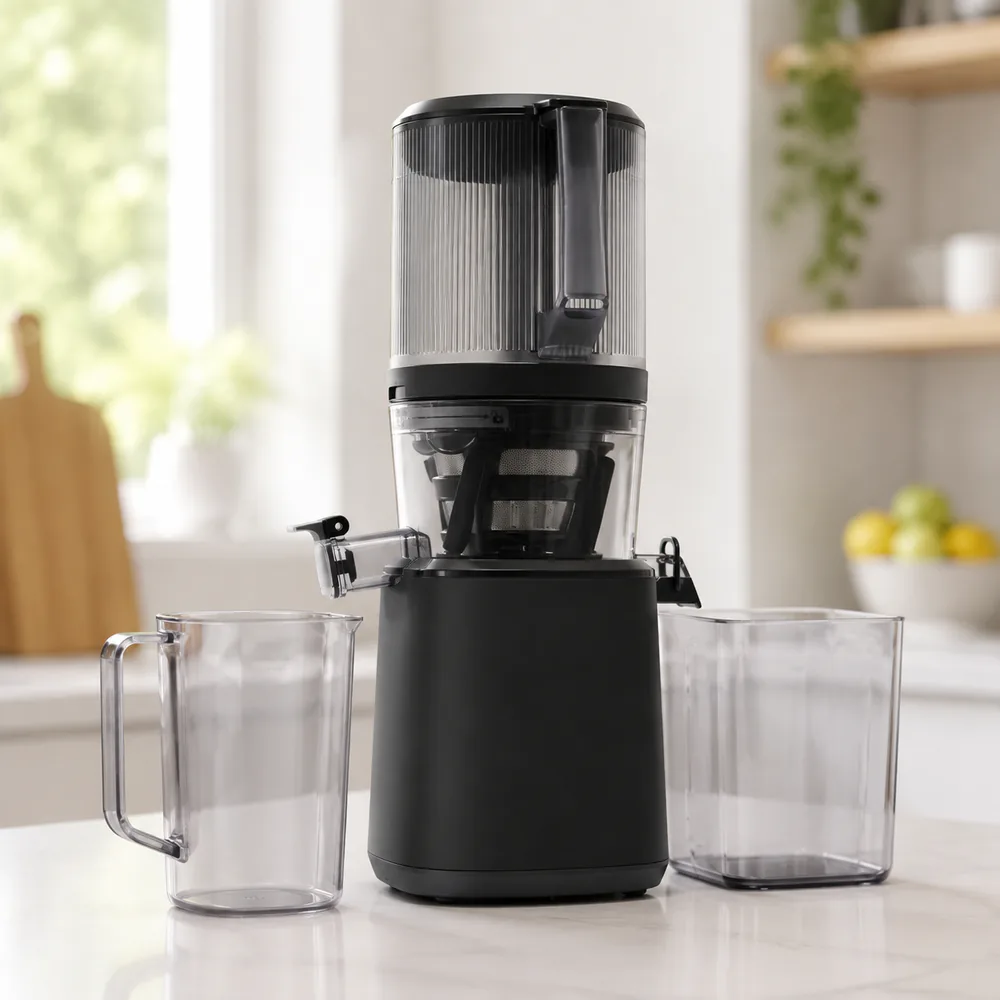
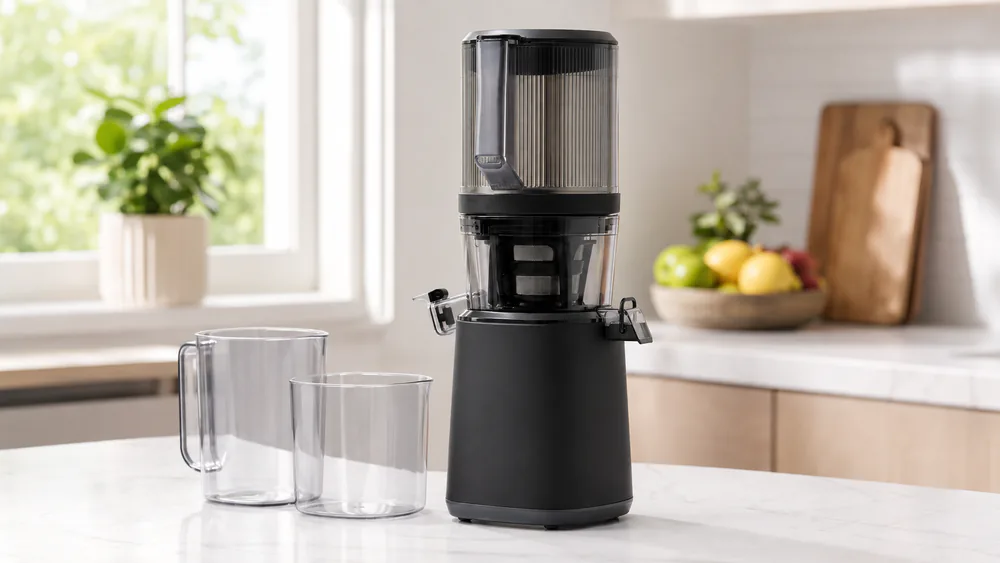
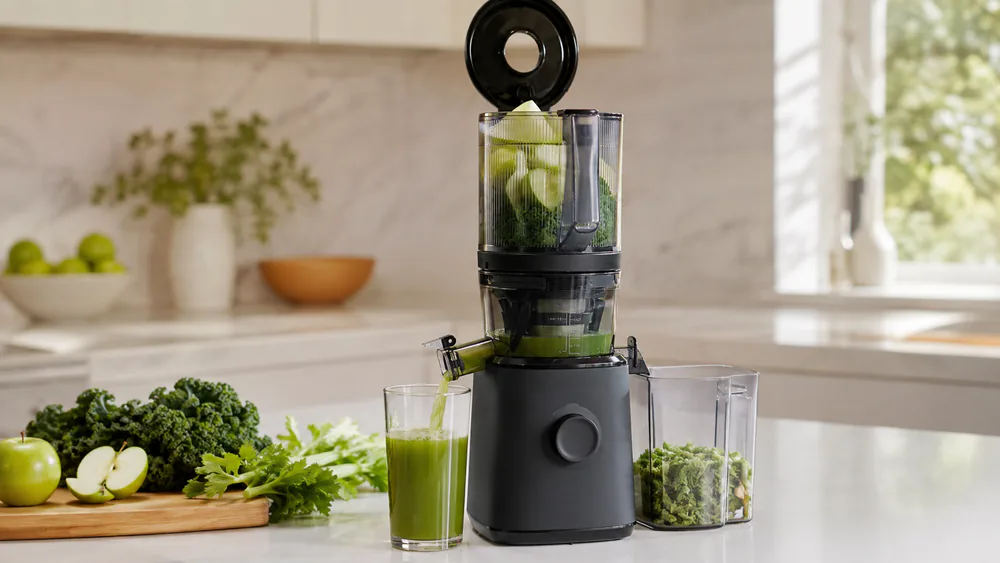
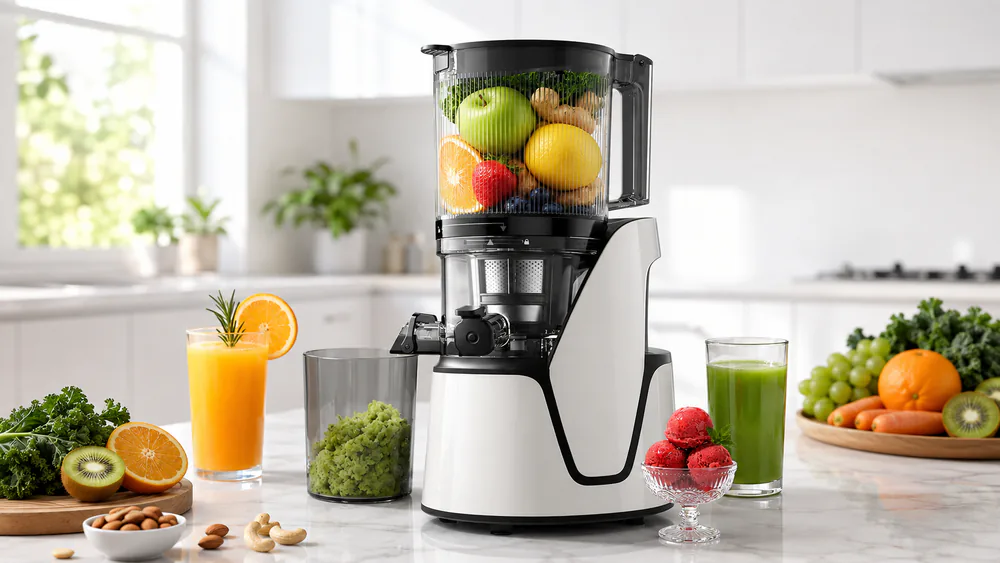
Of the seven machines here, only one loads itself. The Nama J2 is a masticating cold press running a 200W motor at 50 RPM, the slowest extraction in this lineup. Its self-feeding wide-mouth hopper takes a whole recipe at once, so you walk away instead of pushing produce down a chute piece by piece. Quick-release parts and an included cleaning brush handle the disassembly, and the 15-year warranty is the longest on this list by a wide margin.
The yield is why people pay up for this one, and the jug told the story. Less pulp settled at the bottom than the centrifugals left, and the juice poured nearly clear. It also runs quiet enough for early-morning prep before service starts.
The honest catches come with the machine. Assembly has a learning curve, with roughly 13 parts and a chamber that must seat on the base before the unit locks and runs. The spout sits too low for a tall glass, so we poured from a measuring jug. It is tall and three-tiered, so measure your counter clearance, because it will not fit under standard upper cabinets.
Buy it if juice quality and yield drive your menu, quiet matters in your space, and you can give up the speed of a centrifugal. Skip it if counter space is tight or your busiest hour cannot wait for slow pressing. Street pricing runs around $599 and moves week to week, so check the current price before you order.
The self-feeding hopper was the headline of the whole test.
3. VEVOR Commercial Orange Juicer Machine - Best Automatic Citrus
The machine for orange-heavy menus, with a 20-oranges-a-minute automatic cycle that peels, juices, and filters in one pass.
Pros
Automatic 20 oranges per minute, peel to juice in one pass
SUS304 food-grade stainless contact surfaces
Two peel buckets and a storage basket keep the line moving
Ran two straight weeks of continuous use in a cafe
Spare parts set included
Cons
Oranges only, and only a narrow size window
Nozzle can clog and tray overflows if bins slip
88 lb, a permanent counter fixture
Not NSF certified; warranty terms unpublished
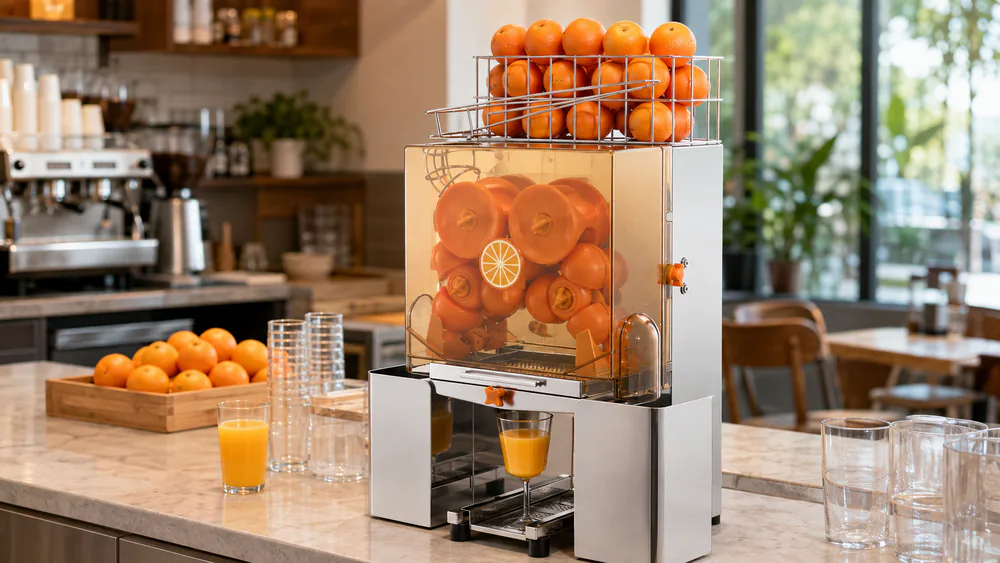
Where the cold presses squeeze slowly, the VEVOR Commercial Orange Juicer Machine is a single-fruit specialist that runs fast. The durability picture starts with a cafe that ran this machine for two straight weeks of continuous use without a leak, which is the real-world result most buyers need. The limits showed up just as clearly. It only handles a narrow orange size window, and bigger oranges jam, while lemons do not work because the gripping cups are too large.
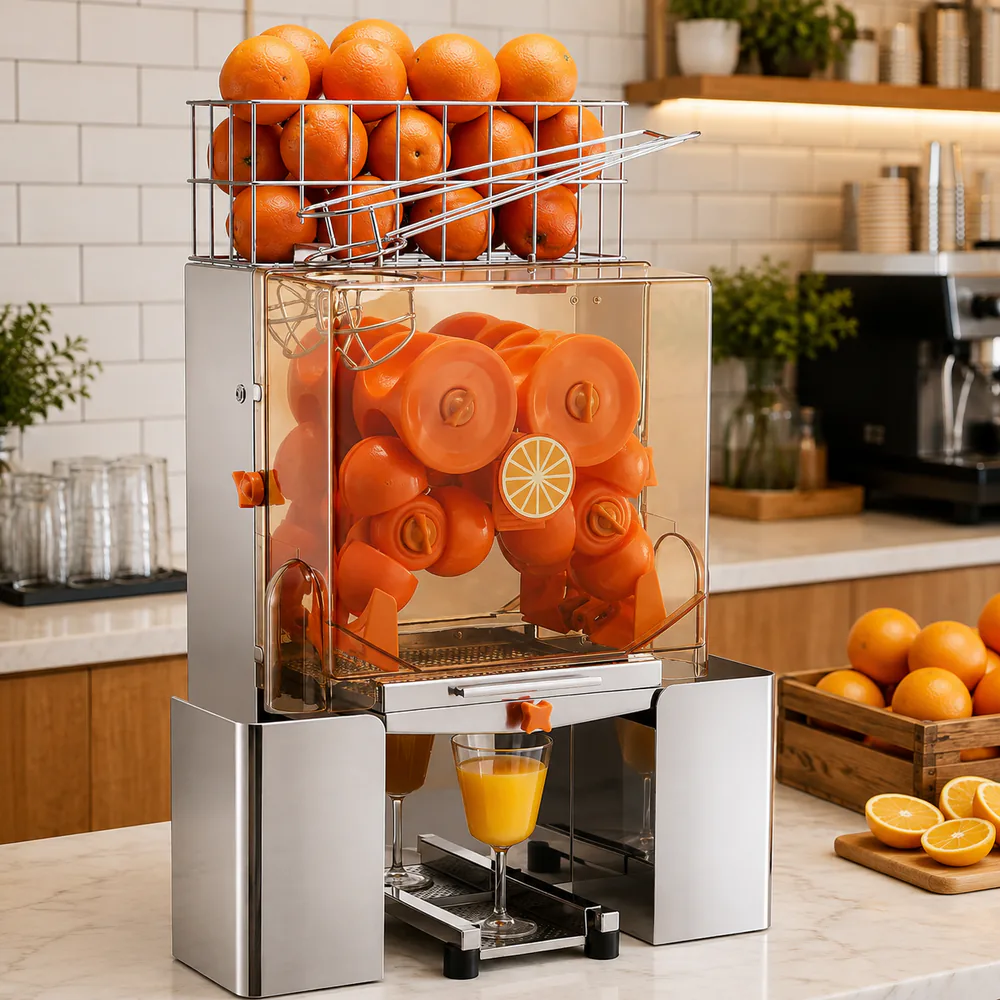
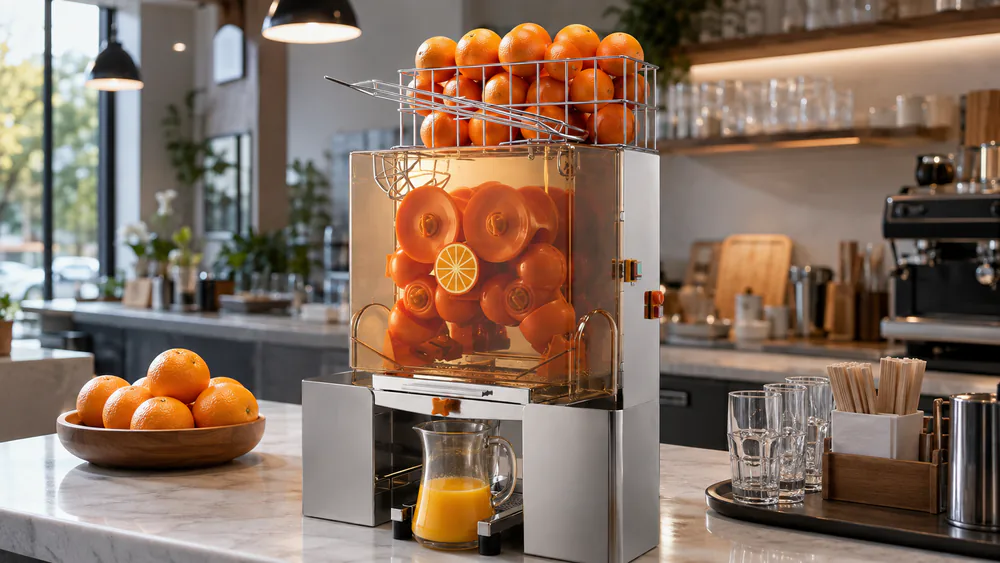
The machine behind that run is the VEVOR Commercial Orange Juicer, model NS-2000E-2, a 120W automatic squeezer with four shafts built for oranges in the 55 to 80 mm range. It peels, juices, and filters in one pass, in SUS304 food-grade stainless steel and PC construction, and a transparent cover halts operation the moment it is lifted. That is a real safety detail for a machine this fast, alongside a waterproof switch cover. Two peel-collecting buckets and a top storage basket for pre-washed fruit keep the workflow moving, and cleaning runs through the pull-out filter box. Slide it out, rinse it, push it back. The pour nozzle can clog, and the collection tray overflows into a mess when the bin schedule slips. At 88 lb it is a permanent fixture, not something you move between stations, and shipping damage has been an issue, with units arriving damaged or scratched under their plastic covers. Inspect the crate before you sign for it. The vendor lists CE, ETL, and LFGB certifications, and it confirms the machine is not NSF certified.
Buy it if orange juice is your core product line and you want hands-free volume. Skip it if you press lemons or mixed citrus, if your space needs a movable machine, or if NSF certification is non-negotiable for your inspection. Street pricing sits around $580 and moves week to week. Warranty terms are not published, so verify the policy before buying.
A dedicated orange station earns its counter space only in orange-heavy menus.
4. Breville 800CPXL Citrus Press Pro - Best Citrus Press
The citrus press we would install for high-volume service, with a power-assisted lever that does the pressing for you.
Pros
Power-assisted lever, light pressure does the work
Whisper-quiet for a motorized press
Half an orange in 3 to 4 seconds
Dishwasher-safe cone, collector, filter, and dome
Drip-stop spout keeps the counter clean
Cons
Citrus only, no whole-fruit juicing
Plastic internals are the failure point on long-term units
1-year warranty
Not NSF certified
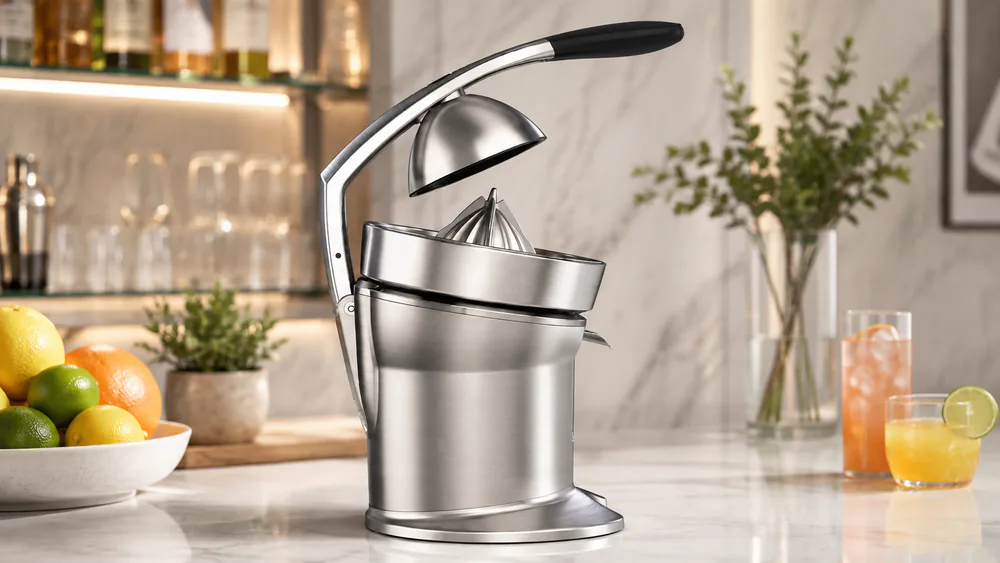
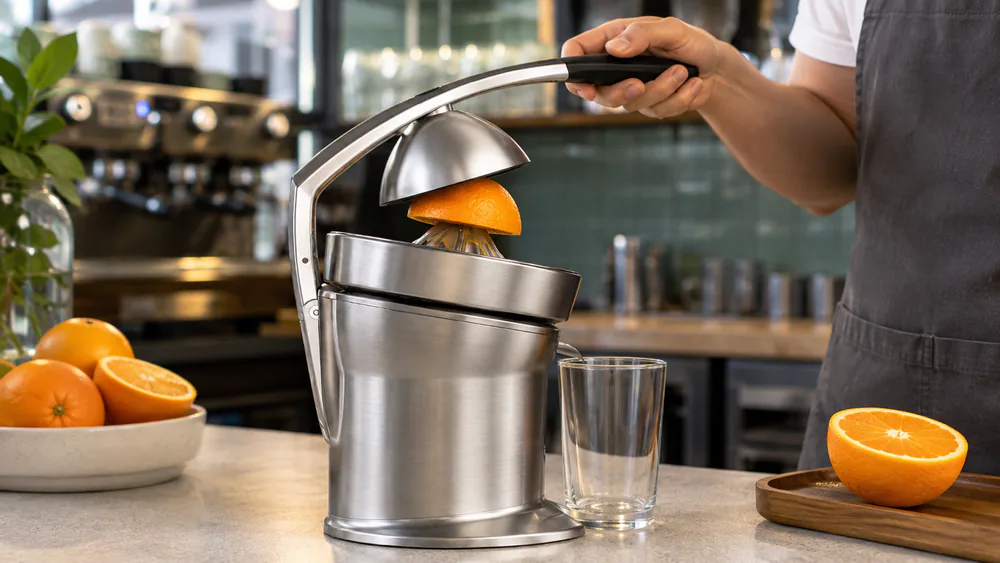
Speed is startling for citrus on the Breville 800CPXL Citrus Press Pro. About half an orange pressed in 3 to 4 seconds, and a large bag of oranges, including cleanup, took 15 to 20 minutes. The motor is whisper-quiet, the lightest press on this list by far, and the spent fruit came out a bone-dry shell with pulp well separated. The drip-stop spout kept our counter clean between cups, and cleanup took about a minute: three parts off and into the dishwasher.
Under the handle is a 110W motor driving a power-assisted lever with an active-arm press, so light pressure on the handle does the work. The Quadra-Fin acid-resistant die-cast stainless steel cone spins only under pressure, thanks to a dual-switch safety with a triple-hinged arm. A drip-stop spout holds juice between cups, and the removable fruit dome, cone, juice collector, and filter are all dishwasher safe. It handles oranges, lemons, limes, and grapefruit, and the 1-year warranty is standard for the category.
Longevity is the split decision. Some units run past 10 years, while others fail on plastic internals, and on long-term units the fruit dome can start falling out. The spout pivot fasteners are the first thing to watch.
Buy it if citrus is a major menu line and you want speed without a workout. Skip it if you juice vegetables or whole fruit, or if you need NSF certification for inspection. Pricing sits around $280 and moves week to week, so check the current price before you order.
The 3 to 4 second press cycle carried a whole citrus service line.
5. Hamilton Beach Commercial 932 - Best Budget (NSF Certified)
The value pick with the cleanest food-safety story: NSF certified, no electricity, and built to run for decades.
Pros
NSF certified, the only pick on this list
No electricity, runs anywhere and forever
Up to 2,000 lb of extraction force
Pint glass fits under the spout
1932-era design with a proven track record
Cons
Manual press, a real workout on long service
Hand wash only
Handles fruit up to about 3.75 inches
Aluminum basket splits under the heaviest use
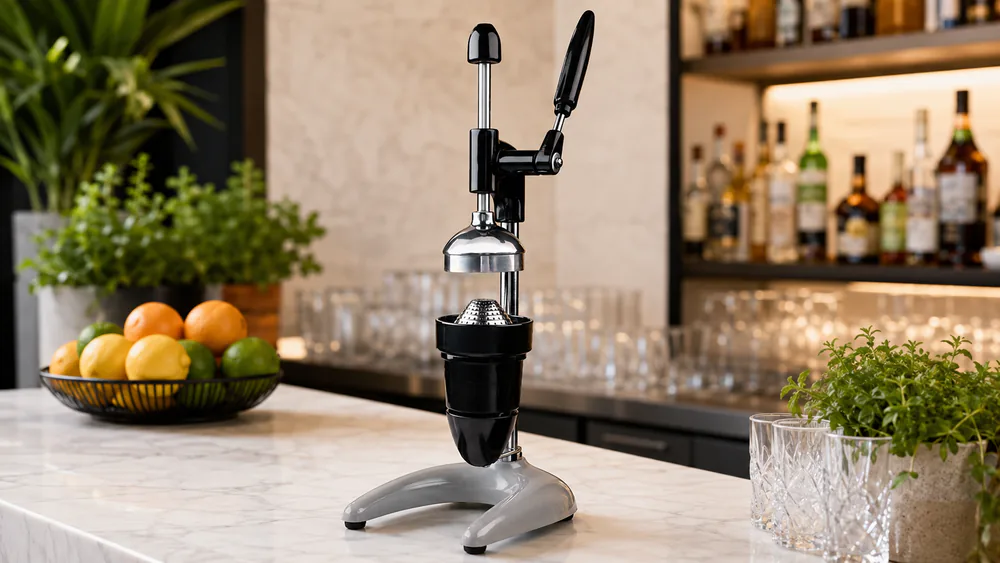
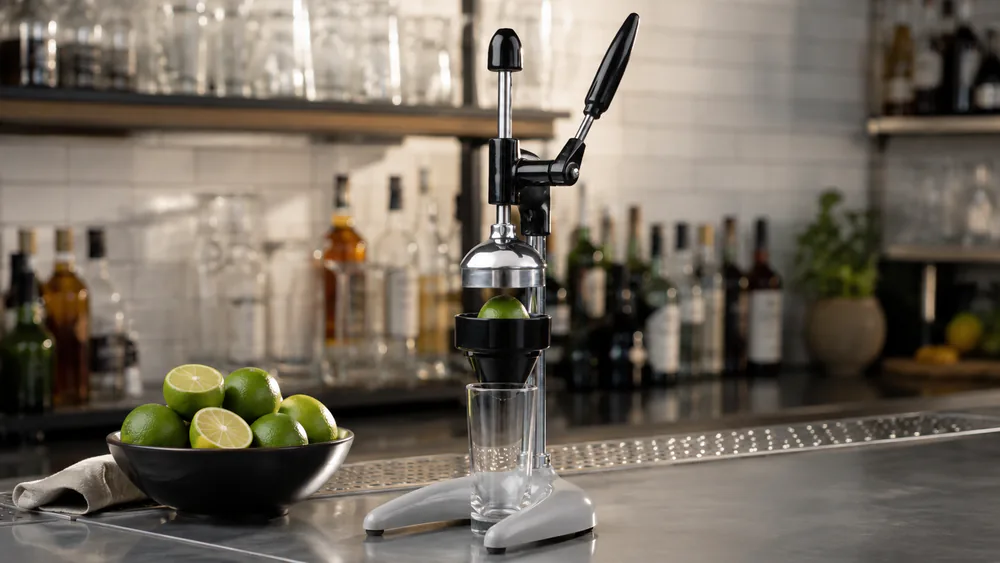
If the 800CPXL does the pressing for you, the 932 asks for your arm instead. The Hamilton Beach Commercial 932 is a manual citrus press with a 1:20 mechanical advantage, and its extractor arm exerts up to 2,000 lb of force. It carries NSF certification for food-service equipment, the only pick on this list that does. The acid-resistant metal body has an enamel finish, with a removable stainless steel strainer cone and an ABS funnel. A swing-out juice collector cup lets staff grab juice mid-press without stopping the line. Sure Grip non-skid feet keep it planted, and a standard pint glass fits under the spout. The 1-year warranty backs a design that has been in production since 1932.
Extraction is aggressive: fruit comes out almost completely pulverized, and limes squeeze to the bone. Because it needs no electricity, it is the peace-of-mind machine for unreliable power, and one bar in Costa Rica ran its 932 for decades for exactly that reason. It handles fruit up to about 3.75 inches across, so oversized oranges and grapefruit are a stretch. The honest costs are real: the 1:20 advantage still makes it a workout on a long service, and the parts are hand-wash only. Durability is a split decision, since the same model that runs for decades in one bar can show aluminum basket splits and handle fatigue under heavy use.
Buy it if you want the budget pick with NSF certification, no power draw, and a footprint that fits a bar well. Skip it if your citrus volume is too high for a manual press, or if you cannot spare the arm strength on long shifts. Street pricing runs about $266 and varies by channel, so check the current price before you commit.
No power cord, no motor, no downtime: the 932 asks only for arm strength.
6. Zulay Kitchen Cast Iron Juicer - Best Manual Cast-Iron
The fastest single-serve citrus press we used, cast in iron and backed by a lifetime guarantee.
Pros
No electricity, works anywhere
Two-part cleanup with nothing to mold
Faster than a pricier electric press for single servings
Cons
Slides on the counter under hard pressure
Bowl runs small for large oranges
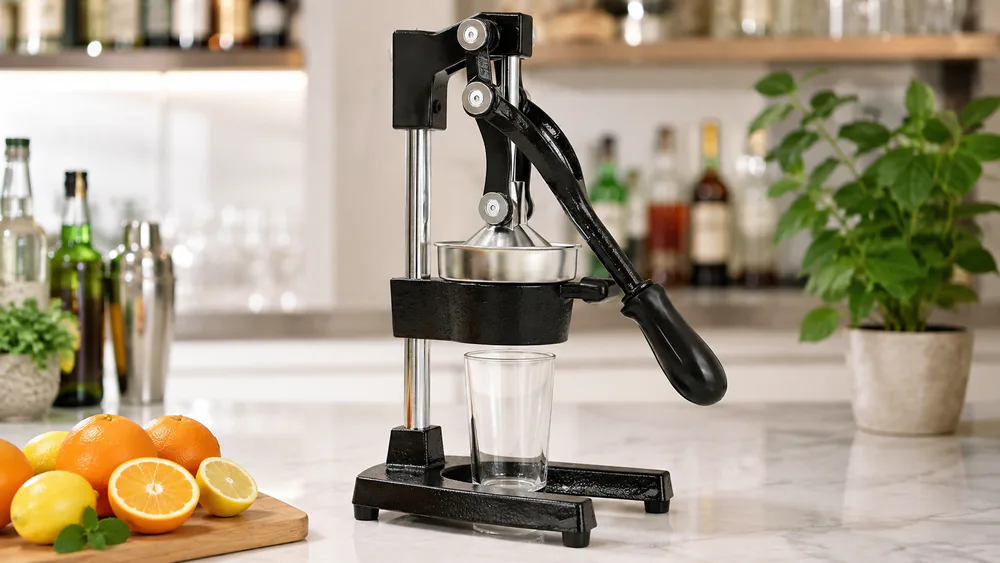
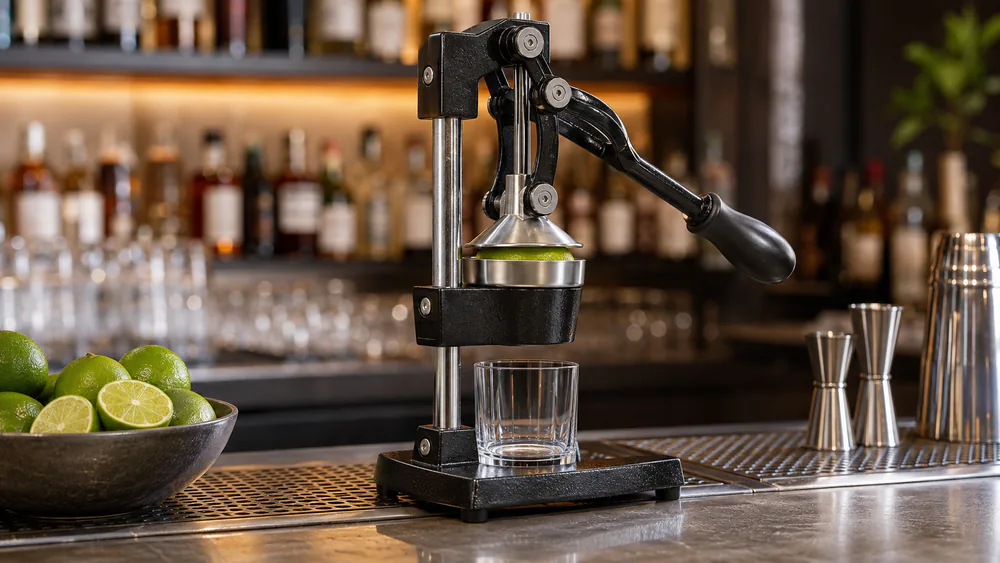
For single-serve citrus, this press beats a much more expensive electric machine on the clock, and that is the whole argument for it. Cleanup is two parts, and there is nothing to mold, so daily use is genuinely easier than with an electric juicer. The stainless reamer and strainer pop out for a rinse, and a full disassembly takes seconds. The weight is the feature: this press is built to outlive the electric machines around it, and the heaviness is what keeps it planted.
The Zulay is a manual press built around a heavy cast-iron frame, with a stainless steel reamer and strainer and a long lever arm that gives real mechanical advantage. The 5-inch bowl handles everything from small limes up to large grapefruits, the rubberized base keeps it planted, and it carries a lifetime guarantee. It needs no electricity, and it comes in more than 20 colors if you want the machine to match the branding.
The honest catches are real. It tends to slide on the counter when you bear down hard, despite the rubberized base, and the bowl runs small for large oranges, so fruit edges stick out and do not fully squeeze. Quality control is occasional, and one unit arrived with a bent base.
Buy it for a bar rail, a juice stand, or backup citrus duty where you want speed, simplicity, and zero power draw at about $90. Skip it if you press large oranges by the case or want hands-free automation. The price moves week to week, so check the current price before you buy.
For garnish citrus, the cast-iron press beat every motorized machine we timed.
7. EanOruus 3-in-1 Cold Press Juicer - Best Cold Press for Versatility
The most versatile cold press on the list, and the price is the headline, but read the durability story before you buy.
Pros
Three machines in one: juice, nut milk, sorbet
100 oz hopper and wide chute for big loads
Auto-reverse clears jams without help
Quiet, with easy QR-assisted assembly
Cleanup under 10 minutes, pulp ejected separately
Cons
Durability failures within the first months of use
No published warranty and thin support
White finish stains easily
Claimed chute width varies on received units
The value price is the draw here, and the durability story belongs up front: some units have failed within the first 2 to 6 months of use, including a cracked blade on first use. Support is thin, with no warranty terms published and little beyond the retailer's 30-day window.
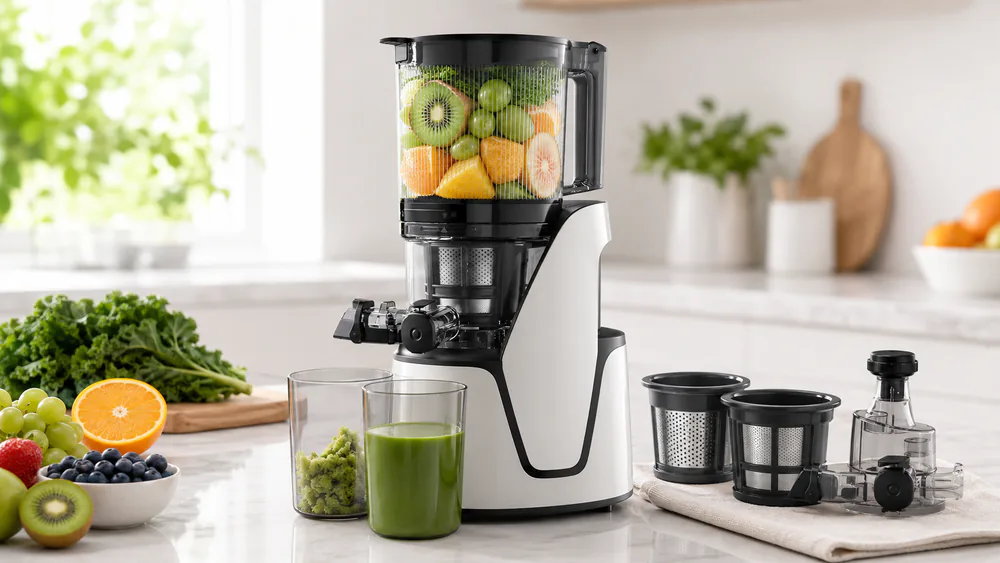
The EanOruus is a masticating cold press with two interchangeable strainers for juice and sorbet, plus a nut milk attachment. A high-torque AC brushless motor drives it, with the wattage not published. The 100 oz hopper and a wide feed chute handle big loads, and the vendor claims a 6.5-inch chute, though some received units measure closer to 6. Auto-reversing clears jams on its own, and the detachable pulp outlet empties mid-run instead of waiting for a full clean cycle. The parts are dishwasher safe.
It is a quiet, easy machine to run, with quick QR-assisted assembly and smooth juice, and cleanup runs under 10 minutes because the pulp ejects separately from the juice. In our batches it out-juiced the centrifugal machine it replaced: shorter juicing time, easier cleaning, and noticeably more juice. The white finish shows beet and carrot stains, and celery needs a careful loading order or it clogs.
Buy it if you want cold-press range on a budget, for a lighter-volume counter that also wants nut milk and sorbet. Skip it if this is your daily high-volume machine, given the durability questions. It lists around $150, and the price moves week to week, so check the current price before you commit.
Two strainers and a nut milk attachment make this the most flexible cold press here.
How to Choose the Best Commercial Juicer
The right commercial juicer is the one that matches your menu, your volume, and your inspection reality. Work through these five questions, and you will land on the right type before you ever compare prices.
Juicer Types: Centrifugal vs Masticating vs Citrus Press
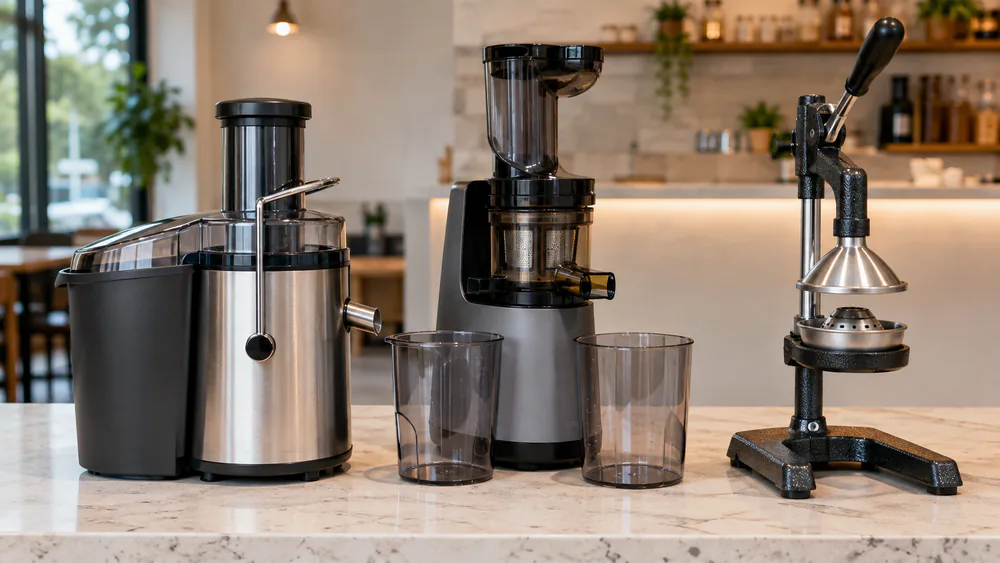
Commercial juicers divide into three families, and the type decides almost everything else. Centrifugal machines, like the Breville Juice Fountain XL Pro, spin a fast cutting disc that shreds produce and flings the pulp out. That makes them the fastest option by far and the best fit for hard produce and whole fruit through a wide chute. They are also the loudest and the hardest on yield, with more foam and faster oxidation.
Masticating cold presses, like the Nama J2 and the EanOruus, crush and squeeze at around 50 RPM instead of spinning. That returns the highest yield with the best nutrient retention and the quietest run, in exchange for slower throughput and more parts to clean.
Citrus presses are the specialists. Lever presses, like the Hamilton Beach 932, squeeze by mechanical force, while power-assisted presses like the Breville 800CPXL do the work for you. Fully automatic machines like the VEVOR handle orange volume with no hands at all.
A citrus press plus one all-round machine covers most bar menus. Vegetable-heavy menus point toward a cold press or a centrifugal, and citrus-first menus can get away with a press and a manual backup.
Motor Power, Duty Cycle, Feed Chute, and High-Volume Capacity
Wattage only makes sense inside a type. The XL Pro's 1200W spins a cutting disc at high speed, while the Nama J2's 200W turns an auger slowly, so comparing the two numbers directly tells you nothing. What matters is whether the motor matches the job: enough power to clear your busiest hour, and a duty cycle that survives it. Duty cycle is the number few vendors publish honestly, though one cafe ran the VEVOR for two straight weeks of continuous use. That is a strong real-world result, but treat any continuous-run figure as a guideline, not a rating.
Feed chute and capacity decide how much babysitting a machine needs. The XL Pro's 3.5-inch chute swallows whole fruit, the Nama's self-feeding hopper accepts an entire recipe, and the VEVOR's 55 to 80 mm window only fits standard oranges, so size really matters. Look at the jug and pulp bin too: a 70 oz jug with a 115 oz pulp bin, or a 100 oz hopper, means fewer interruptions per shift. The rule we use: size the machine for your busiest hour, not your average hour.
Yield, Cleaning, and Maintenance
Yield is the quiet difference between a good machine and a great one. Cold presses maximize juice per pound, and the Nama J2's pulp came out notably drier than the centrifugals', while the EanOruus out-juiced the centrifugal it replaced. Centrifugals are faster, but they leave more juice in the pulp and whip in foam, and if you sell juice by the ounce, yield is profit.
Cleaning time is a labor line item. The 800CPXL's three dishwasher-safe parts clean in about a minute, the Zulay is two parts with nothing to mold, and the XL Pro's removable parts go straight in the dishwasher. The Nama has roughly 13 parts and a learning curve, and the HB 932 is hand-wash only, since the pressing cup disintegrates in the dishwasher. Factor in the included brushes, too: the Nama and the XL Pro both ship with one, which sounds small until you are scrubbing a mesh filter with a kitchen sponge at close.
Maintenance follows a pattern we watch for. Filter baskets wear first on centrifugals, plastic internals fail on some citrus presses, and the real question is whether you can get a replacement part in two years.
NSF Certification and Food Safety
NSF certification is about inspectability. NSF/ANSI 2 covers materials, design, fabrication, and construction of food handling equipment, and the NSF mark means independent verification of food-safe materials, sanitary design, and durability, with ongoing factory audits. Among our seven picks, only the Hamilton Beach Commercial 932 carries it, while the VEVOR lists CE, ETL, and LFGB and confirms it is not NSF certified. You can verify any model in the NSF-certified food equipment database.
The FDA side matters once you sell juice wholesale. Under the FDA juice HACCP rule, wholesale juice processors must achieve a 5-log, or 99.999%, reduction of the pertinent pathogen in their product. Juice made and sold directly to consumers at retail is not subject to the rule. Unpasteurized juice must carry a warning label unless the operation achieves a validated 5-log reduction. Check local codes first, since NSF answers questions your inspector will ask.
Budget, ROI, and Countertop Space
Prices here span about $90 for the Zulay up to around $600 for the Nama J2 and the VEVOR. Street pricing moves week to week and by retailer. ROI is labor and waste math: a press that clears a bag of oranges in 15 to 20 minutes pays for itself in saved prep time alone. So does a manual that replaces hand-squeezing behind the bar. A machine that saves a couple of staff hours a day covers its own cost before the first season ends. Count what each pick costs per gallon of output, and the ranking changes fast.
Counter space is the filter nobody budgets for. The Nama J2 is tall and three-tiered and will not fit under standard cabinets, while the VEVOR is an 88 lb permanent fixture. The XL Pro is a 21.4 lb countertop machine at 7.9 by 15.7 by 19.7 inches, and the HB 932 fits a bar well at 7 by 9 by 19.5 inches. Measure twice, buy once.
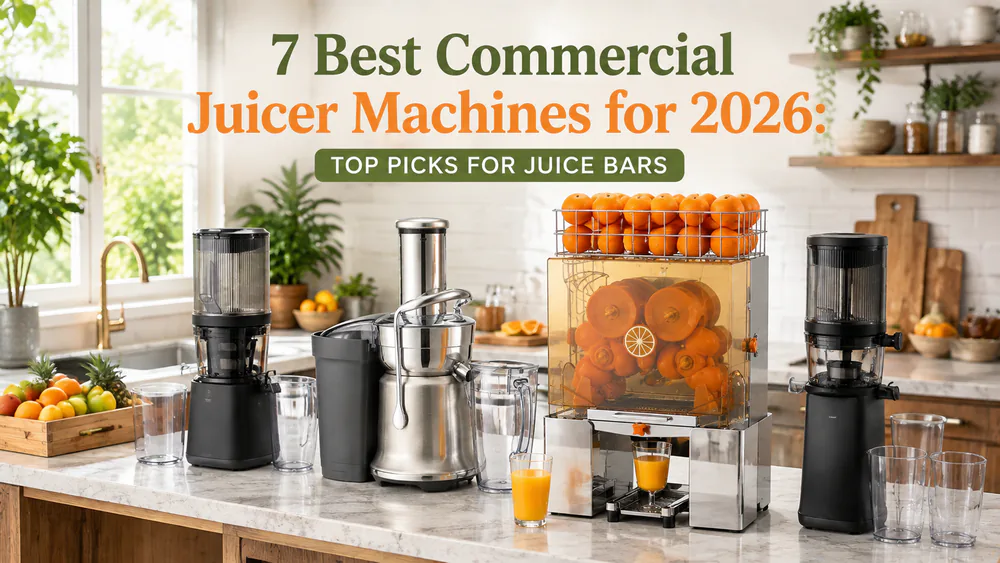
The three juicer families side by side: centrifugal, cold press, and citrus press.
Frequently Asked Questions
Which commercial juicer type is best for a juice bar, centrifugal or cold press?
Let your menu and your busiest hour decide. Cold presses suit quality-first menus at lower volume, and centrifugals suit high volume on hard produce. Citrus is a separate question: if oranges and lemons are a menu line of their own, plan a press alongside your all-round machine. One machine rarely covers mixed produce and citrus at peak volume, so budget for a second unit before you settle on a single premium one.
How much does a commercial juicer cost, and will it pay for itself?
Plan on roughly $90 to $600 for the machines on this list, and note that street pricing moves week to week. The payback is labor math: divide the sticker price by what two saved staff hours a day are worth, and the result is your payback time in days. The manual presses recover their price in saved prep time alone, and every ounce of yield a cold press recovers is margin at juice-bar prices.
Can a commercial juicer run continuously all day?
Not indefinitely, and no vendor here publishes a duty-cycle rating, so plan for rest. A sensible rhythm is a long run followed by a few minutes of idle time before the next batch. One cafe ran the VEVOR automatic for two straight weeks of continuous use without a leak, a strong real-world result for that machine. On an automatic machine, the bins and brushes become the real limits: a full tray and a clogged nozzle stop the line just as surely as an overheated motor.
How do I clean a commercial juicer during a busy shift?
Split the job into two levels. Between services, do a quick rinse of everything that touched juice, swap the pulp bin, and brush the filter or strainer, which keeps the line moving without a full breakdown. At close, do the deep clean: full disassembly, dishwasher-safe parts through the machine, and hand washing for the manual presses, whose parts are not dishwasher safe. The manual machines have the simplest workflow of all: a few parts, a rinse, and nothing to mold.
Do I need NSF certification for a commercial juicer?
Check your local health code first, because it decides the answer for your operation. You can verify any model in the NSF-certified food equipment database, and among our picks only the Hamilton Beach 932 carries the mark. If you sell juice wholesale, the FDA juice HACCP rule requires a 5-log pathogen reduction in the product. Retail juice is exempt but must carry a warning label unless it meets the same reduction.
What is the best commercial citrus juicer?
The Breville 800CPXL is our pick for power-assisted speed, with half an orange pressed in 3 to 4 seconds and a one-minute cleanup. For fully automatic orange volume, the VEVOR handles up to 20 oranges a minute. For no-power service, the Hamilton Beach 932 and the Zulay are the reliable workhorses. Match the press to your citrus mix, because the VEVOR only takes standard-size oranges.
Final Verdict: The Best Commercial Juicer for Your Business
If we were outfitting a juice bar from an empty counter, the first machine we would order is the Breville Juice Fountain XL Pro. It sets the pace for volume, and its cleanup story keeps labor costs down. The second machine depends on the menu. Quality-focused shops add the Nama J2 for cold-press items and quiet early hours, while citrus-driven menus add the Breville 800CPXL for the service line. Every bar we would outfit also gets a Zulay behind the rail for quick garnishes with zero power draw.
Budget operators should start with the Hamilton Beach 932, the only NSF-certified pick here. The EanOruus is the value cold press only if volume stays light enough to stay ahead of its durability questions.
The rating recap: the XL Pro earns a 4.7/5 and is our Editor's Choice for volume economics. The Nama J2 scores highest at 4.8/5, with the 800CPXL and the HB 932 at 4.6/5. The VEVOR, Zulay, and EanOruus all land at 4.5/5.
Measure the counter and pull the local inspection codes before the first machine arrives. Those two numbers shape more of this buying decision than any spec sheet, and they are free to check.