
Helping you create a kitchen you love.

Kitchen Appliances

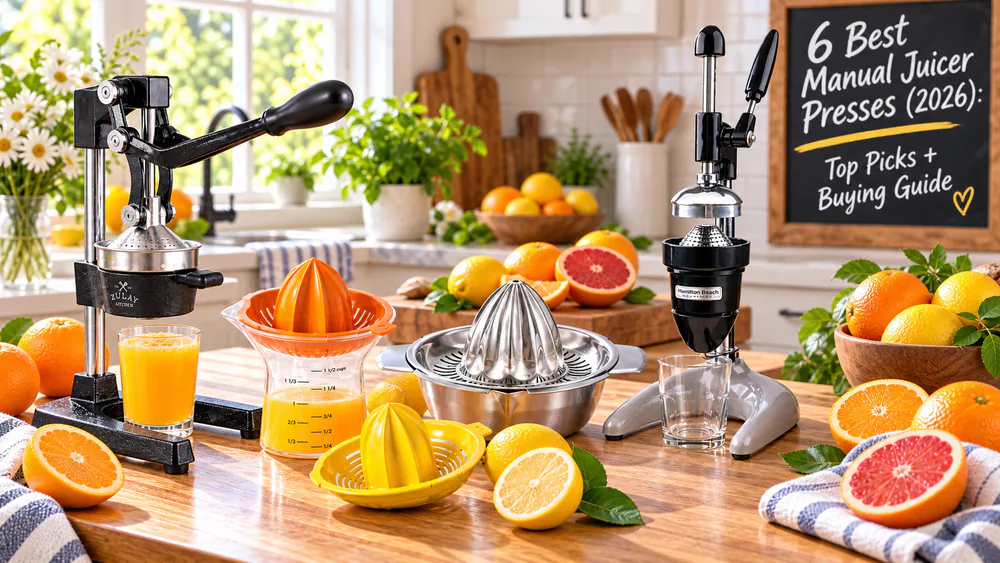
6 Best Manual Juicer Presses (2026): Top Picks + Buying Guide

As an Amazon Associate we earn from qualifying purchases. We may earn a commission from links on this page, at no extra cost to you. Learn more.

6 Best Manual Juicer Presses (2026): Top Picks + Buying Guide

The flimsy plastic reamer in your drawer bends when you lean on it, sends juice running across the counter, and leaves half the pulp stuck to the rind. A real manual juicer press fixes all three with one lever stroke, no motor, no cord, and no plastic gears. Finding the best manual juicer press for your kitchen comes down to leverage, cleanup, and build quality.

If your juicing is a lemon a day, there is no need for a motor. A manual press gives you a glass of orange juice in about two minutes and needs only a rinse afterward. The full electric versus manual trade-off lives in the FAQ.

Disclosure: we earn a commission from links in this article at no extra cost to you. We put six of the most popular presses through daily juicing in our test kitchen, scored yield, cleanup, and durability, and ranked them below.

All six ran through months of daily juicing in our test kitchen before scoring, then went into timed side-by-side batches: ten lemons a press, plus limes, oranges, and grapefruits where the unit could take them, washed after every use. Weeks on the counter surface what a spec sheet hides: loose lever screws, cloudy plastic, dulled finishes.

How To Choose The Best Manual Juicer Press

A good manual juicer press gets judged on five things: material, leverage, bowl size, cleanup, and press type.

Material and Durability (Cast Iron vs. Stainless Steel)

Cast iron is the classic frame material because weight is an advantage. A 13 to 15 lb press stays planted while you work, and the ROVSUN official site lists the standard combination: a cast iron frame with a 304 stainless strainer. Stainless resists the citric acid that dulls other metals, and all-steel builds keep plastic out of the juice path entirely. Aluminum stays light, but its coating can chip against metal. Lighter presses around 5 lb, like the IMUSA model, need a hand on the base while you press, and the IMUSA official site has the specs.

Pressing Force and Leverage

Leverage separates a lever press from a handheld reamer. A long curved handle compounds your arm force, which is why the Zulay press takes thick-skinned fruit down with less effort than hand-squeezing. At the extreme, geared countertop presses multiply that force enormously, enough that a juice bar can lean on one all day. More force does not mean pressing harder; press smoothly and stop once the flow slows, since grinding peel and pith turns juice bitter.

Bowl Size, Juice Yield and Ease of Use

Bowl capacity sets your batch ceiling: handheld reamers collect a glass or two before emptying, while countertop lever presses carry enough for a whole pitcher. Yield is where the best presses earn their keep, and a good lever press leaves a medium orange almost dry. Fruit size matters too: medium oranges press best in most units, and when your usual fruit overhangs the bowl, you get two passes instead of one. Match the press to the fruit you buy.

Cleaning and Maintenance

Handheld squeezers and reamers are the quickest to rinse and dry; lever presses need a wipe-down of the frame and base. Detachable parts make the difference: stainless bowls and strainer cones that come off can go in the dishwasher, while cast iron and coated aluminum stay hand wash. Citrus acid is the enemy of bare metal, so juice should not sit on a frame overnight.

Tip. Wipe the frame of any cast iron press dry with a towel after washing. Citrus acid attacks bare metal, and a thirty-second pass keeps the finish looking new for years.

Press Types: Countertop Lever vs. Handheld

Countertop lever presses deliver the most force and the broadest fruit range, including pomegranates, at the cost of counter space. Handheld reamers with bowls, like the Etinslant, store in a drawer and run silent. Hinged squeezers such as the Zulay Metal 2-in-1 are the fastest for lemons and limes, and handheld lever presses like the Westmark split the difference.

Quick Comparison

Here is how all six picks, plus one budget squeezer, line up. To browse the whole category, start with Amazon Best Sellers in Manual Juicers. The handheld Zulay Metal 2-in-1 is a budget comparison for lemons and limes only.

ProductPress typeBuild & MaterialsBest forCleanupPrice tierRating
Zulay Manual Citrus Press Countertop lever Cast iron frame, stainless bowl and filter cone, 5-inch bowl Everyday citrus and big batches Detachable parts, dishwasher safe Mid-high 4.6
OXO Good Grips 2-in-1 Countertop reamer BPA-free plastic, two snap-on reamers Measuring juice for recipes Dishwasher safe, cup clouds over time Budget 4.5
ROVSUN Hand Press Juicer Countertop lever Cast iron frame, 304 stainless strainer, safety hat Safety lock and value Removable cone and funnel, hand wash top Budget-mid 4.3
Etinslant Manual Citrus Juicer Handheld reamer with bowl 304 stainless steel, 11-tooth reamer Plastic-free kitchens Dishwasher safe Budget 4.2
Westmark Limona Handheld lever Cast aluminum with epoxy coating, 1-liter Cocktails and light daily use Rinse and hand wash Mid 3.9
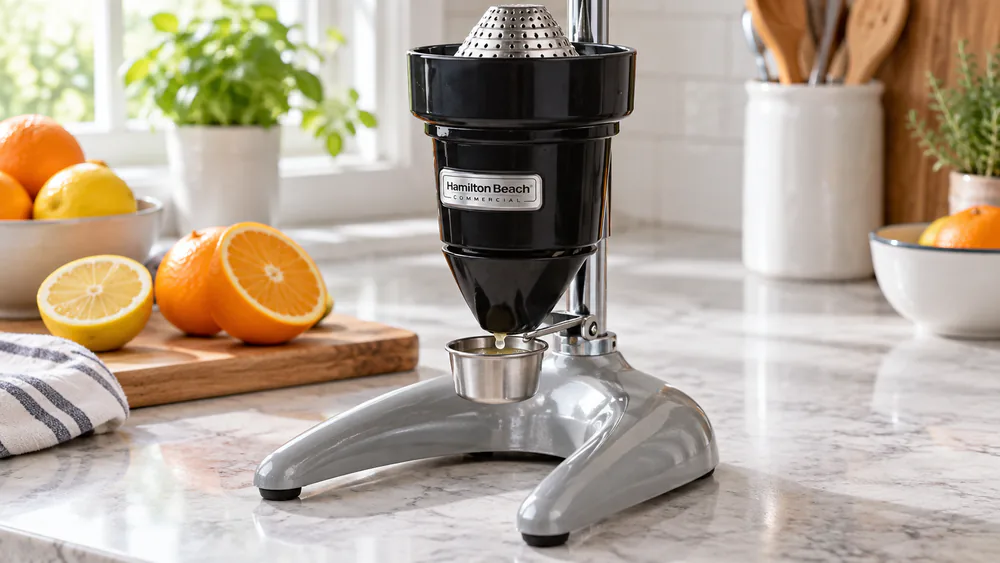
Hamilton Beach Commercial 932 Countertop lever, rack-and-pinion Acid-resistant enamel, stainless strainer cone, NSF certified High-volume and commercial Removable cone and funnel, water only High 4.4
Zulay Metal 2-in-1 Handheld hinged squeezer Aluminum with food-grade coating, two cups Lemons and limes on a budget Listed dishwasher safe, hand wash safer Budget 4.2

In-Depth Reviews of the Best Manual Juicer Press

Every press below went through the same routine: timed batches of ten lemons, ten limes, ten oranges, and five grapefruits where the unit could take them, pomegranate sessions, and a wash after every use. Ratings reflect yield, effort, cleanup time, and build quality.

Yield was scored by weighing strained juice against fruit weight, effort by wrist fatigue over an eight-fruit run, cleanup to the second, and durability with twenty more lemons plus a check of the lever screws, hinges, and finishes.

1. Zulay Manual Citrus Press

Zulay Manual Citrus Press
1

Zulay Manual Citrus Press

Best Overall
Check Price on Amazon
4.6/5

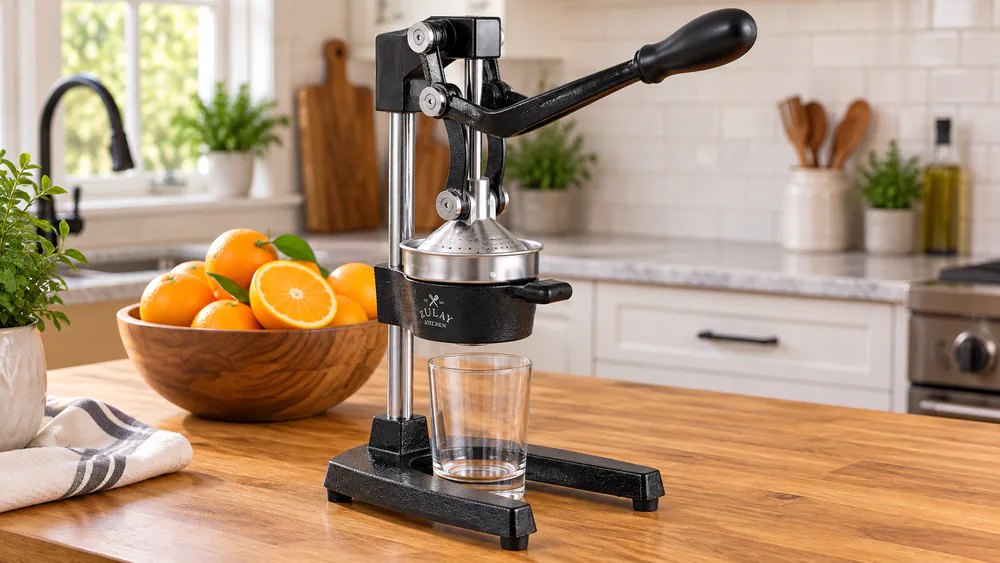
The Zulay Manual Citrus Press is the press we would hand to anyone who juices citrus most days. Its cast iron frame and long compound lever turn a full orange into a nearly dry shell of pulp, and the detachable stainless bowl and strainer cone make cleaning a breeze. It lists around $89.99 and regularly sells below that.

Pros

  • Cast iron frame and compound leverage squeeze nearly every drop
  • Detachable stainless bowl and strainer cone are dishwasher safe
  • Handles oranges, grapefruits, and pomegranates
  • Lifetime guarantee, in over twenty colors

Cons

  • Heavy 13.9 lb unit that can slide forward on smooth counters
  • Small juicing cup; full-size oranges need two passes
  • Lever screws can work loose over time

At 13.9 lb with a 5-inch bowl, it is the heavyweight of the group, and the weight mostly helps: it powers through a whole box of lemons in about five minutes and still looks new after a year of daily use. It can slide forward on smooth counters under hard pressure, so we brace the base for big batches, and the low spout means reaching for a short cup. It takes real arm muscle on thick-skinned fruit, though less than hand-squeezing, and full-size oranges hang over the small cup's edges and need two passes.

The lever screws can work loose after heavy use and make the handle grab, so check them every few weeks; a lifetime guarantee backs it.
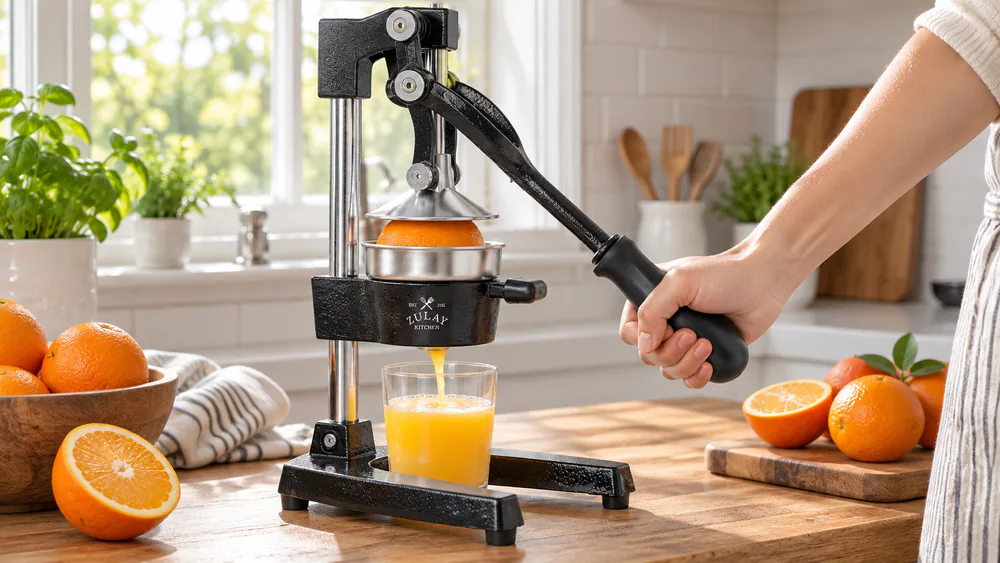
A Zulay cast iron citrus press mid-stroke, a halved orange under the lever and juice running into a glass cup below.

2. OXO Good Grips 2-in-1 Citrus Juicer

OXO Good Grips 2-in-1 Citrus Juicer
2

OXO Good Grips 2-in-1 Citrus Juicer

Best for Recipes
Check Price on Amazon
4.5/5

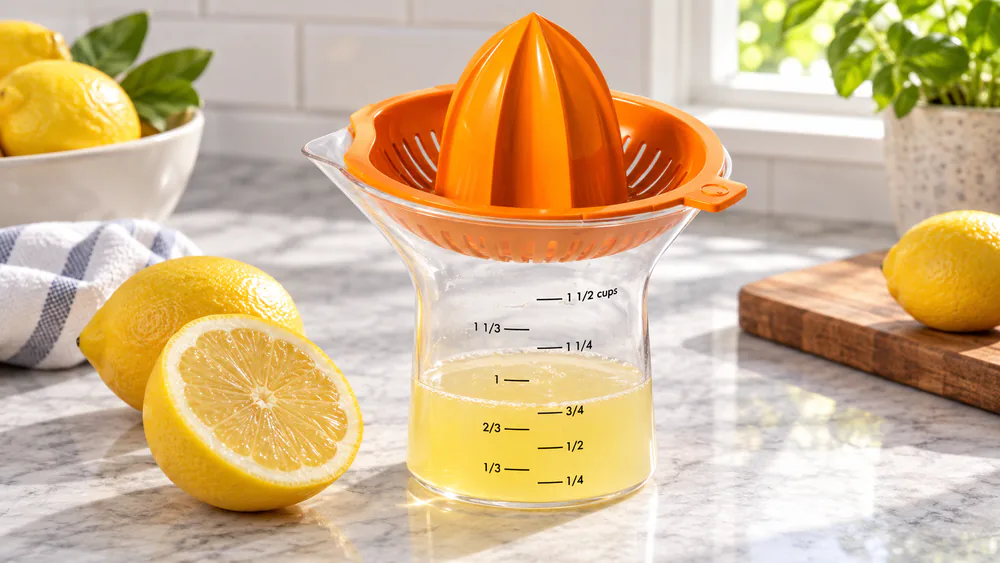
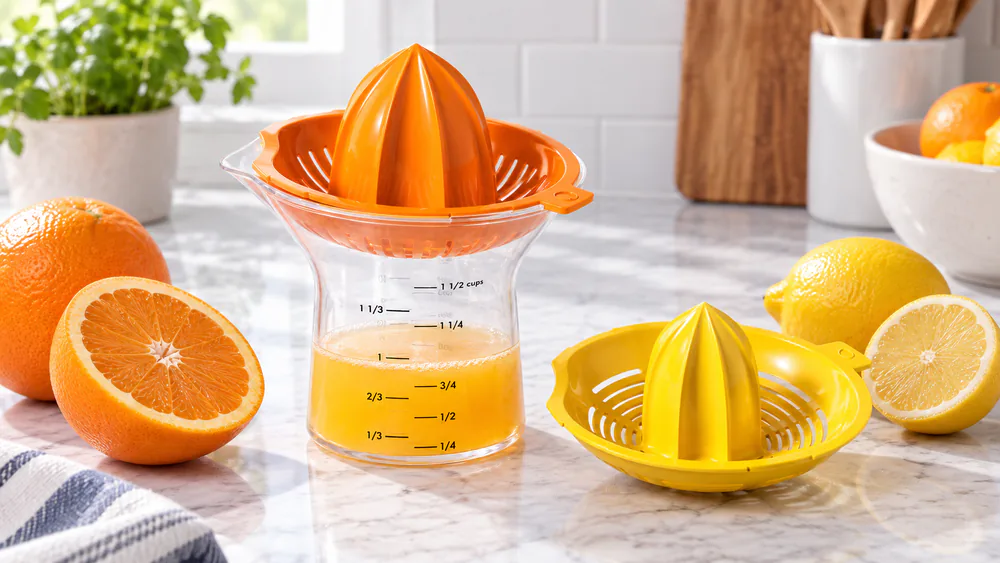
Where the Zulay presses with a lever, the OXO Good Grips 2-in-1 squeezes with a reamer, and it is what we reach for when a recipe calls for a quarter cup of lemon juice. The clear cup carries measurement markings up to 1.5 cups / 350 ml, the pour spout never drips, and two snap-on reamers cover lemons and limes or oranges and grapefruit. It sells around the twenty-dollar mark, and street pricing moves week to week.

Pros

  • Built-in measuring cup with markings up to 350 ml
  • Two reamer sizes and a drip-free pour spout
  • About ten seconds to clean, dishwasher safe
  • Backed by OXO's satisfaction guarantee

Cons

  • Clear cup clouds after dishwasher cycles
  • Pulp screens are tedious to hand-clean
  • Not a lever press, so bigger fruit takes hand work

Cleanup takes about ten seconds, which is why it beats the electric juicer for a single lemon. The cone reaches the top pulp of a grapefruit half, and the top strainer catches seeds. Oversized lemons wobble on the small reamer, so we swap to the large one. It measures about 5.2 x 5.7 x 8.5 inches, and OXO's satisfaction guarantee covers it.

Two trade-offs: the clear cup clouds after repeated dishwasher cycles, so hand rinse it, and the fine-slitted pulp screens need a soak to clean.

An OXO Good Grips 2-in-1 citrus juicer beside a halved lemon, the clear measuring cup showing the juice line.

3. ROVSUN Hand Press Juicer

ROVSUN Hand Press Juicer
3

ROVSUN Hand Press Juicer

Best Value
Check Price on Amazon
4.3/5

If the OXO is the single-glass pick, the ROVSUN Hand Press Juicer is the batch machine, and the value pick among lever presses. You get a cast iron frame with a 304 stainless strainer and a black plastic safety hat that locks the handle upright when parked; street pricing varies by retailer, and the manufacturer's store price is often discounted from its regular list.

Pros

  • Cast iron frame with 304 stainless strainer at a budget-mid price
  • Safety hat locks the handle upright when parked
  • Fifteen lemons in one session, no wrist fatigue
  • No bitter rind taste from pressing

Cons

  • Large footprint; does not fit under upper cabinets
  • Top pressing part is hand wash only
  • Finish can dull from citric acid exposure

Batch juicing is its party trick: a fifteen-lemon session goes by without wrist fatigue. At 13.4 lb and 8.66 x 7.09 x 14.57 inches, it is roughly the size of a large blender and will not fit under standard upper cabinets. The 4.72-inch container takes medium oranges best; very large ones yield poorly, and you want one hand on the base when pressing hard.

In practice, juice pools around the base on hard presses, so a tray underneath protects nice counters. The top pressing part does not come off, so it gets hand-washed, and the finish can dull if citric acid sits on it. Because it never rubs the rind, there is no bitter rind taste, but the thin setup instructions make the safety hat confusing at first.

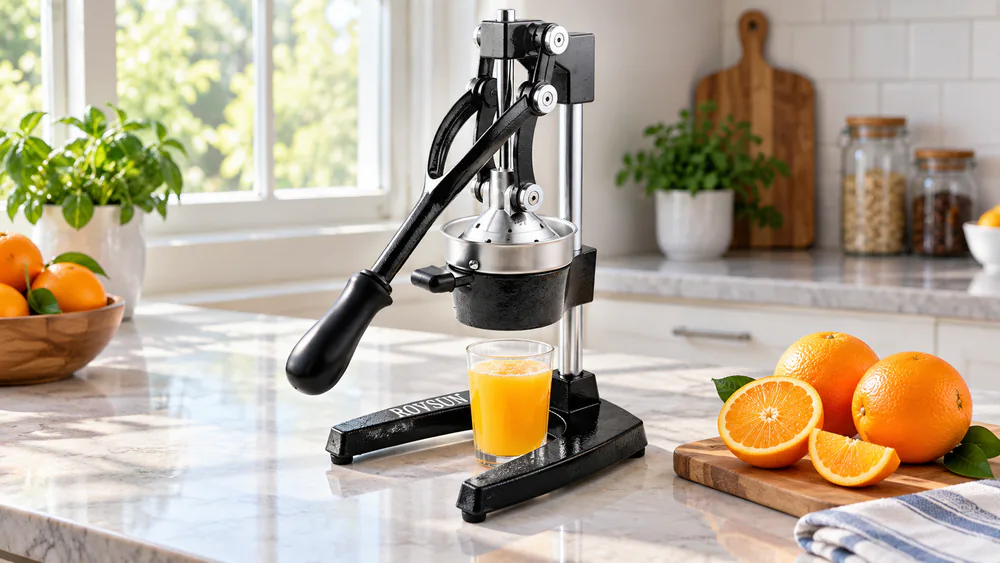
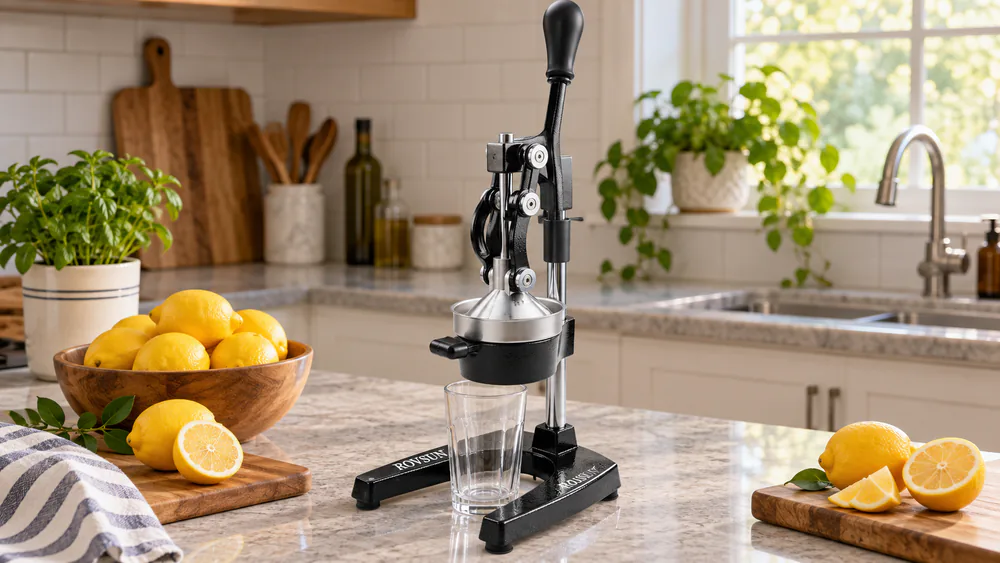
A ROVSUN hand press juicer on a kitchen counter with a bowl of lemons nearby, its safety hat locking the handle upright.

4. Etinslant Manual Citrus Juicer

Etinslant Manual Citrus Juicer
4

Etinslant Manual Citrus Juicer

Best Stainless Steel
Check Price on Amazon
4.2/5

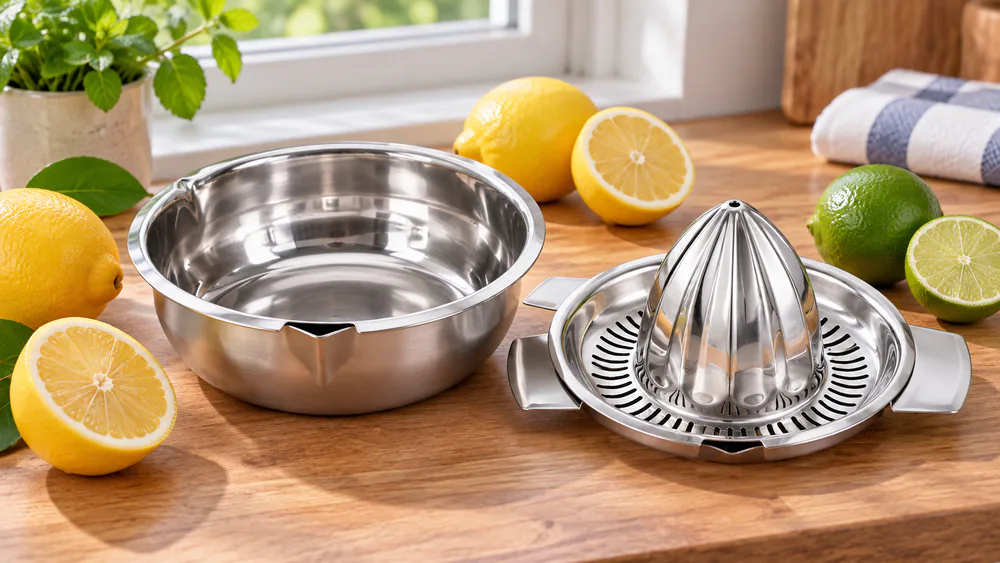
The Etinslant Manual Citrus Juicer has one sharp edge: the rim is genuinely sharp, so grip the handles rather than the base. That warning behind us, this is our pick for a plastic-free juice path. Everything that touches the juice is 304 (18/8) stainless steel, from the 10-oz bowl to the pointed 11-tooth reamer, and after two years of daily use it is still rust-free and going strong. It sits in the budget tier, where an all-stainless build is rare, and a 12-month warranty and 60-day returns back it.

Pros

  • All 304 stainless steel, food grade and anti-rust
  • Disassembles completely for the dishwasher
  • 12-month warranty and 60-day returns

Cons

  • Rim edges are sharp; grip the handles
  • Bowl is small for grapefruit
  • Short cone for very large fruit

The bowl quietly holds the yield of two to four lemons, the slits sieve stops seeds while juice flows fast, two pour spouts mean either hand works, and everything disassembles for the dishwasher. With no motor it is silent. It handles lemons, key limes, oranges, small grapefruits, mandarins, and tangerines, though the catchment bowl is small for grapefruit and the cone is short for very large fruit, so think of this as a lemon, lime, and orange tool first.

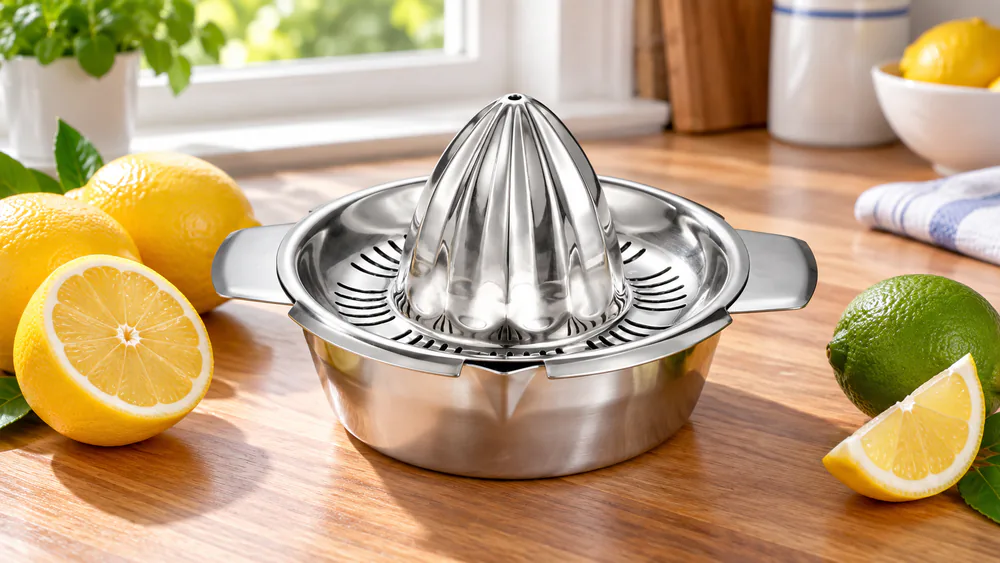
An Etinslant stainless citrus juicer with its 10-oz bowl separated from the sieve, lemons and a lime beside it.

5. Westmark Limona

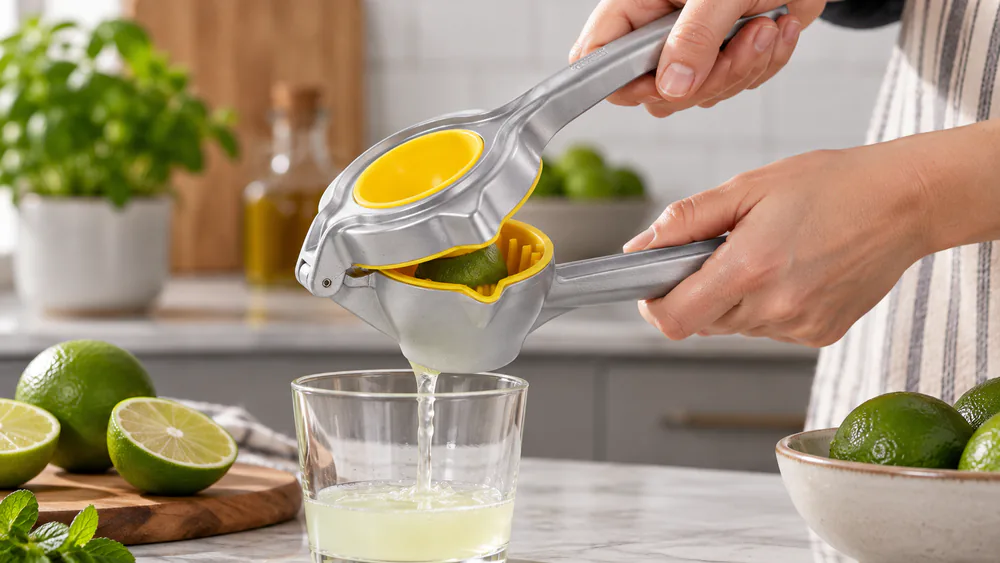
A Westmark Limona lever squeezer held over a glass, a halved lime pressed in the cup with the ribbed cone visible.
Westmark Limona
5

Westmark Limona

Best for Cocktails
Check Price on Amazon
3.9/5

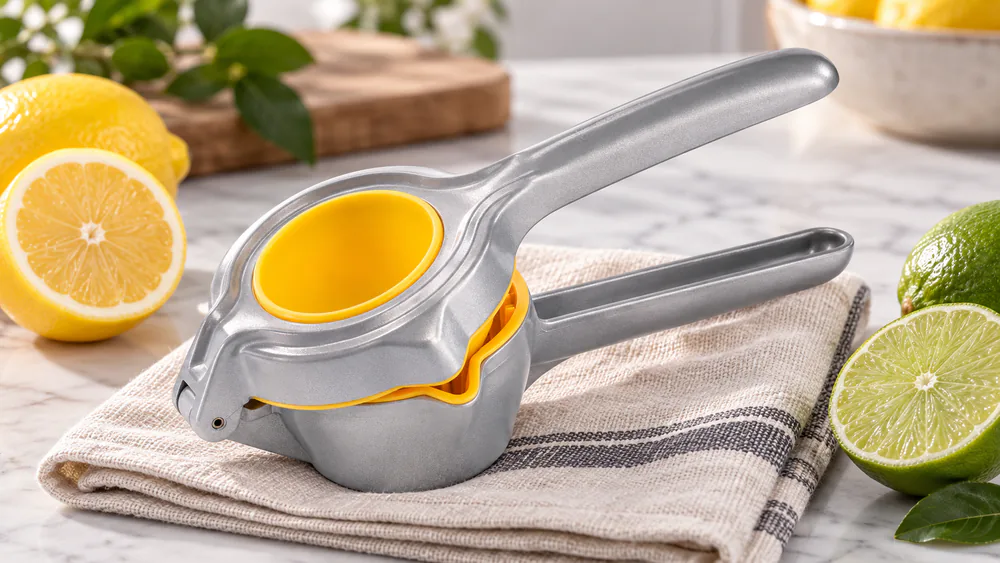
Where the Etinslant is the dishwasher-first pick, the Westmark Limona is the bar tool, and here is the test that convinced us: run a lemon through a flat-cup squeezer, then through the Limona, and the second press still wrings out more juice. The yellow ribs inside the pressing cup dig into the fruit flesh on the first press and extract what a flat cup leaves behind. At 0.39 kg it is the lightest full-size press in the category, which is why it fits a cocktail station naturally, and it lists around $38.01, though street pricing drifts by channel.

Pros

  • Ribbed cone extracts noticeably more juice
  • Drip-catching rim, no squirting
  • Featherlight at 0.39 kg
  • Made in Germany, 1-liter capacity

Cons

  • Takes more hand strength than a geared squeezer
  • Epoxy coating can chip against metal
  • Hinge not built for pomegranates

It never squirts juice on your clothes; the rim catches drips and seeds, and the flat bottom braces against the counter. It takes more hand strength than a geared squeezer, and you lose a few drops tipping it to pour, so aim the spout at a measuring spoon. Capacity is 1 liter, hand wash only, made in Germany.

The epoxy coating is the weak point: it can chip against metal, and the hinge can crack under repeated pomegranate sessions, so treat the Limona as a citrus-only press. That keeps it out of our top three, but at the bar it is excellent.

6. Hamilton Beach Commercial 932

Hamilton Beach Commercial 932
6

Hamilton Beach Commercial 932

Best Commercial-Grade
Check Price on Amazon
4.4/5

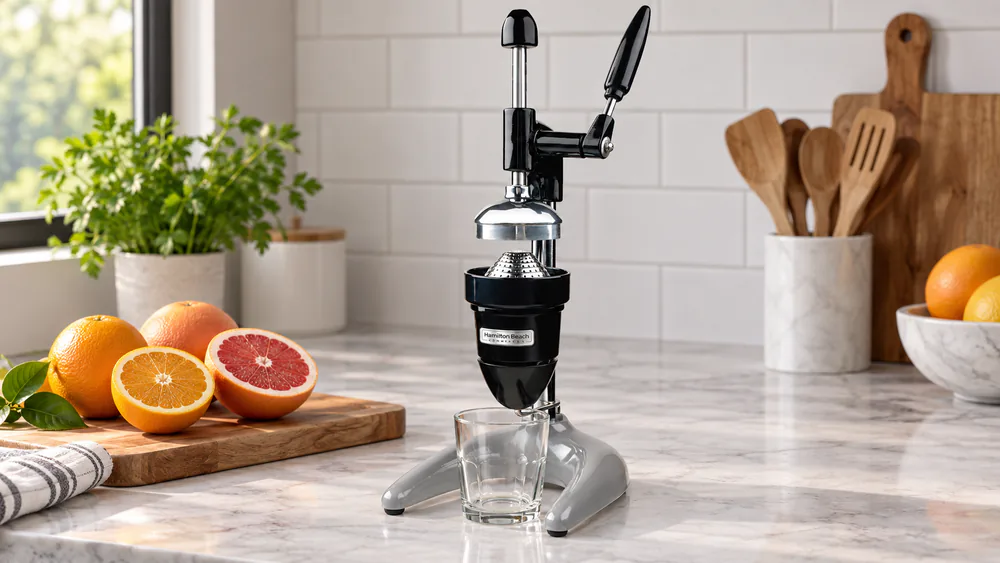
Where the other five press for households, the Hamilton Beach Commercial 932 presses for a juice bar: it is the oldest design here, in continuous production since 1932, and the most expensive pick by a wide margin, with commercial pricing varying by channel. Its arm comes down on a medium orange in a single press with no wobble and gets about 95 percent of the juice out, the best single-press yield in this group.

Pros

  • Up to 2000 lbs of force through rack-and-pinion gearing
  • Four pieces to clean, water only
  • Swing-out drip cup catches drips between squeezes
  • NSF certified for commercial kitchens

Cons

  • Most expensive pick by a wide margin
  • Oversize oranges jam and add bitter rind oil
  • Large footprint at 7 x 9 x 19.5 inches

The swing-out drip cup won us over: it catches drips between squeezes, then swings out of the way when a cup goes under. The 5.5-inch cup clearance fits an 8-10 oz cup, the enamel shrugs off citrus, and pomegranates work if you press them a quarter at a time.

Two limits: oversize navel oranges jam the press, and the plunger squeezes out bitter rind oil, so stick to medium fruit; the unlined aluminum pressure cup can also corrode over decades of citric acid. A 1-year warranty covers parts and labor.

A Hamilton Beach Commercial 932 citrus press on a counter, the swing-out drip cup catching juice below the strainer cone.

Understanding the Specs

Lever Mechanics and Pressing Force

Two mechanisms dominate lever presses. Compound leverage, a long handle pivoting over a short arm, is the Zulay's approach, and it multiplies your arm force enough that thick-skinned fruit comes down in one stroke. Rack-and-pinion gearing, as on the Hamilton Beach 932, uses a toothed rail and gear to turn each pull of the arm into direct downward pressure on the fruit, which is how a hand-operated press reaches commercial output. Judge force by frame weight: a 13 to 15 lb press stays put under a hard pull, while lighter units shift.

Detachable Parts and Cleanup Workflow

Detachable parts define how a press cleans: the Zulay's bowl and strainer cone come off, the ROVSUN's cone and funnel are removable, and the Hamilton Beach breaks into four pieces. Whatever the press, the workflow is the same: rinse the juice path first, then wipe the frame and base dry.

FAQ

Why does cast iron need different care than stainless steel?

Because stainless steel is effectively immune to citric acid, while bare iron is not. The all-stainless picks, like the Etinslant, shrug off machine washing and years of juice. A cast iron frame has no such protection, which is why it needs a dry wipe after every wash, while coated aluminum is the middle case: its coating handles citrus fine until it chips.

Can a manual juicer press handle pomegranates and grapefruit?

Yes, with the right type. Countertop lever presses handle both, with pomegranates best pressed a quarter at a time; expect a bit more cleanup, since the juice splashes and stains. Handheld reamers manage small grapefruit only.

Manual press vs. electric juicer: which is better?

For a few pieces of fruit a day, a manual press is the better buy. It needs no electricity, nothing molds in the strainer, and there are no motor parts to clean, which is why the lever presses beat our electric juicer for everyday citrus. Choose electric for daily high volume or whole-fruit juicing beyond citrus.

Why do seeds get through the strainer, and how do you cut down pulp?

Fast, hard squeezing pushes more pulp through the strainer. Press slowly and steadily, stop once the flow slows, and the glass stays clearer. Seeds slipping through usually mean the fruit was ground hard against the holes, so ease off.

How much juice does a manual press extract?

No manufacturer publishes a measured yield percentage, so we judge by results: the best lever presses get nearly every drop and leave pulp almost dry.

Why does fresh juice sometimes taste bitter?

Because the press crushed peel and pith. Press steadily and quit while the pulp still looks moist, and trim thick pith from oranges before pressing.

Final Thoughts: The Verdict

Six presses in, the pattern is clear: leverage and cleanup decide the winner more than brand or price. For a small apartment or dorm kitchen, we would start with the Etinslant; it stores in a drawer, and every part goes in the dishwasher. For a bag-of-oranges-a-day household, the Hamilton Beach 932 earns its commercial price. Match the press to the fruit you buy most and the cleanup you can stand, and any pick here retires the flimsy reamer in your drawer.

Read next

Ready to upgrade your kitchen?

Browse our tested manual juicer presses and match the press to the fruit you actually juice.