Helping you create a kitchen you love.

Kitchen Appliances

Best Non-Toxic Rice Cookers: Stainless Steel, Ceramic and Clay Options

As an Amazon Associate we earn from qualifying purchases. We may earn a commission from links on this page, at no extra cost to you. Learn more.

Best Non-Toxic Rice Cookers: Stainless Steel, Ceramic and Clay Options

If you want a rice cooker without a nonstick coating, you give up some easy cleanup. If you want effortless cleanup, you accept a coating. Most of this guide is about that trade, and how to make it with your eyes open.

We looked closely at five cookers: three with uncoated stainless steel pots and two with PFAS-free ceramic nonstick coatings. Each one is a specific, verified model, because "non-toxic" claims change from one model to the next, even inside a single brand. Our test kitchen is built around our rice cooker reviews, so we judged these five the way we judge every rice cooker: by the rice they make and the cleanup afterward.

Best Non-Toxic Rice Cookers at a Glance

Here is the short version. The first column tells you what touches your rice, which is the question that brought you here. Capacity is labeled as cooked or uncooked, because brands mix the two freely.

ModelFood-contact potCapacity basisBest forKey limitation
Buffalo Classic KWBSC10-IIUncoated clad stainless steel5 cups uncooked, 1.0 L nominalCoating-free pot with grain buttonsRest before serving; short keep-warm window
Aroma Select Stainless ARC-753SGRUncoated 304 stainless steel3 cups uncooked, up to 6 cookedSmall, affordable stainless cookerSputtering and bottom sticking
Aroma Select Stainless ARC-757SGUncoated 304 stainless steel7 cups uncooked white riceLarger family batchesSticking; no delay timer
GreenLife Go GrainsPFAS-free ceramic coating2 supplied cups uncooked, 4 cups cookedSmall households wanting easy releaseSmall batches; time and water tweaks
GreenPan Bistro CC008304-001PFAS-free Thermolon Volt ceramic coating4 cups uncooked, 8 cups cookedDigital grain varietyMixed cooking results; coating care

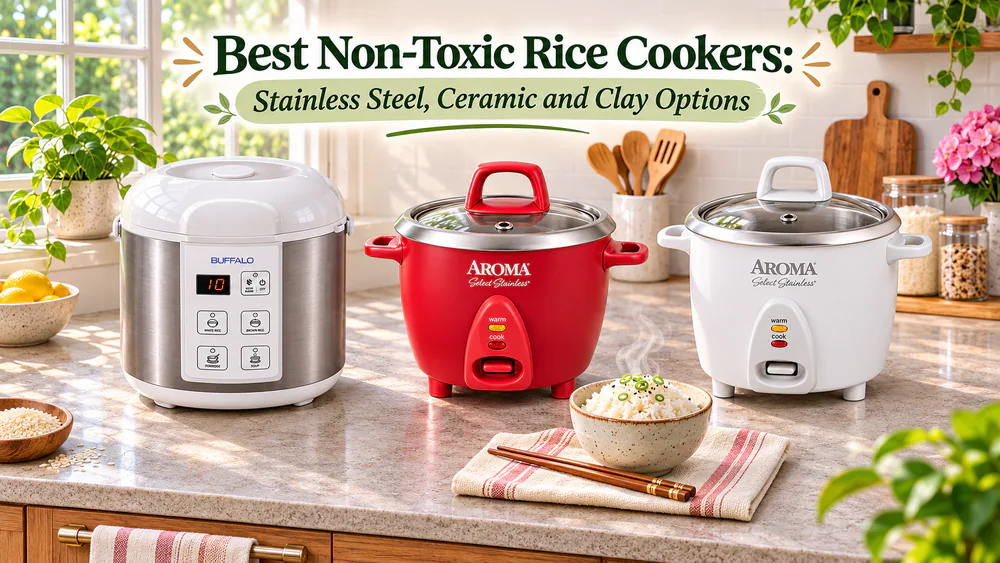
Our quick calls: the Buffalo is our best overall, the Aroma 753 is the budget pick, the Aroma 757 is the stainless choice for bigger households, the GreenLife is the compact ceramic option, and the GreenPan Bistro is the digital option with a coating.

How We Chose These Rice Cookers

We started with one rule. The pot that touches the rice has to be identified by exact model, with the manufacturer's own food-contact disclosure on record. A brand that sells both coated and uncoated pots does not get a free pass on the one we did not test.

Then we judged how each one cooks. We looked at white rice, brown rice, and where the machine offers it, porridge and oats. We paid attention to what happens at the vent and at the lid, to the keep-warm setting, and to how each pot cleans up by hand.

We weighed five things:

  • Food-contact surface and coating disclosure. Is the pot uncoated, or coated, and what exactly does the maker claim?
  • Cooking results. Texture, sticking, and how much water adjustment the cooker demands.
  • Cleanup. How the pot releases rice, and whether the lid and vent come apart.
  • Capacity. Stated honestly as cooked or uncooked, using the supplied cup.
  • Support. Warranty terms and what we could confirm about replacement pots.

Two cautions shape every recommendation here. First, we did not review a batch-matched laboratory report on PFAS or metal migration for any of these pots, and manufacturer disclosures do not prove zero migration under every condition. Second, the ratings you see below are our editorial judgments of fit, not laboratory scores. They reflect how well each cooker serves the buyer we name for it.

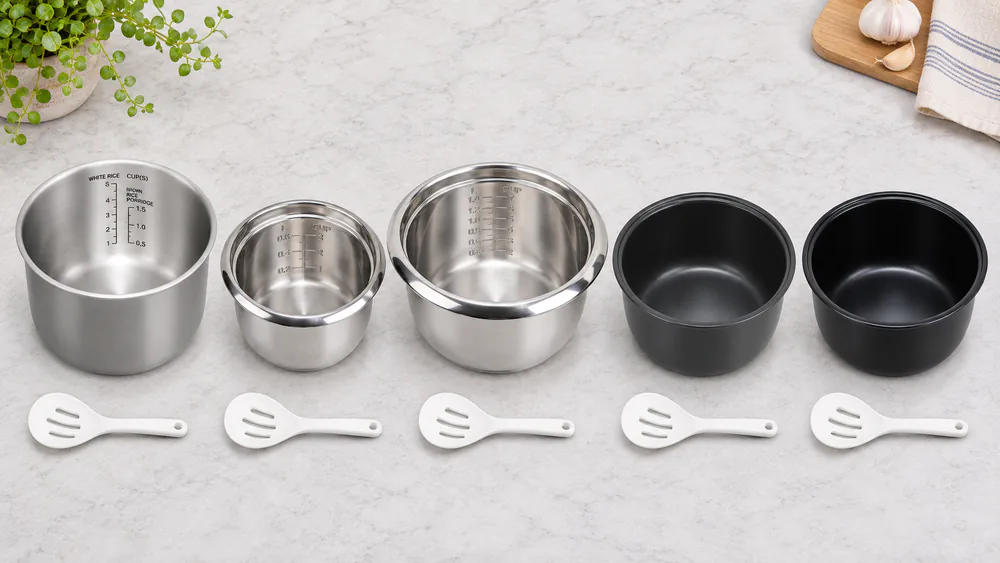
Five rice cooker inner pots lined up on a kitchen counter, three bare stainless steel and two with pale ceramic nonstick interiors, rice paddles beside each
Three uncoated stainless pots and two ceramic-coated pots, side by side.

Our Non-Toxic Rice Cooker Picks

Each pick lists its pot material, coating disclosure, and capacity basis, then the trade-offs we noticed. We did not invent a clay pick. We found no clay model with a complete, model-matched documentation record, so clay stays in the materials discussion below.

1. Best Overall: Buffalo Classic KWBSC10-II

Buffalo Classic KWBSC10-II
1

Buffalo Classic KWBSC10-II

Best Overall
Check Price on Amazon
4.6/5

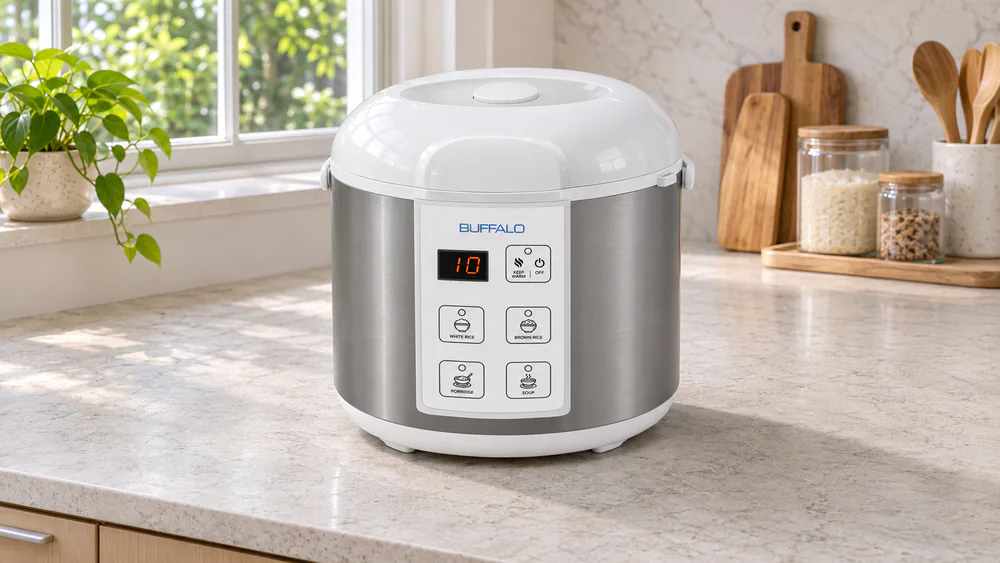
The Buffalo Classic is the cooker we would buy first if the pot material is your priority. The inner pot is uncoated Buffalo Clad multilayer stainless steel with no added nonstick layer, and the grain-specific buttons mean you are not forcing every grain through one generic cycle. Switching from white rice to brown rice or porridge took a button press, not a guess.

Pros

  • Uncoated multilayer stainless steel pot with no nonstick layer
  • Separate buttons for white rice, brown rice, porridge and soup
  • Removable steam vent for easier starch cleanup
  • 3-year inner-pot warranty

Cons

  • Needs a 10-minute rest before stirring to reduce sticking
  • Short recommended keep-warm window
  • The premium tier among our picks
  • Current replacement-pot stock unconfirmed

The model is the KWBSC10-II Classic, not the IH Smart Cooker, so check the listing before you order. It is a 5-cup model, with a 1.0 L nominal rice capacity and a basis of 5 cups uncooked. Cooked yield depends on the rice and the water. It draws 500W and weighs 6.62 lb. The makers also supply a measuring cup, a rice paddle and a soup ladle, and the steam vent lifts off, which makes dried starch easy to reach.

We lifted the steam vent off to rinse the starch from it, and because nothing is fixed in place the dried residue was easy to reach. The maker's guidance is to rest the rice about 10 minutes before stirring, and to keep it warm for no longer than 4 hours to avoid burning, so this is not a cooker to leave holding rice through a workday. The inner pot carries a 3-year warranty, with 1 year on the outer pot. We could not confirm current replacement-pot stock, so confirm the exact part before relying on a spare.
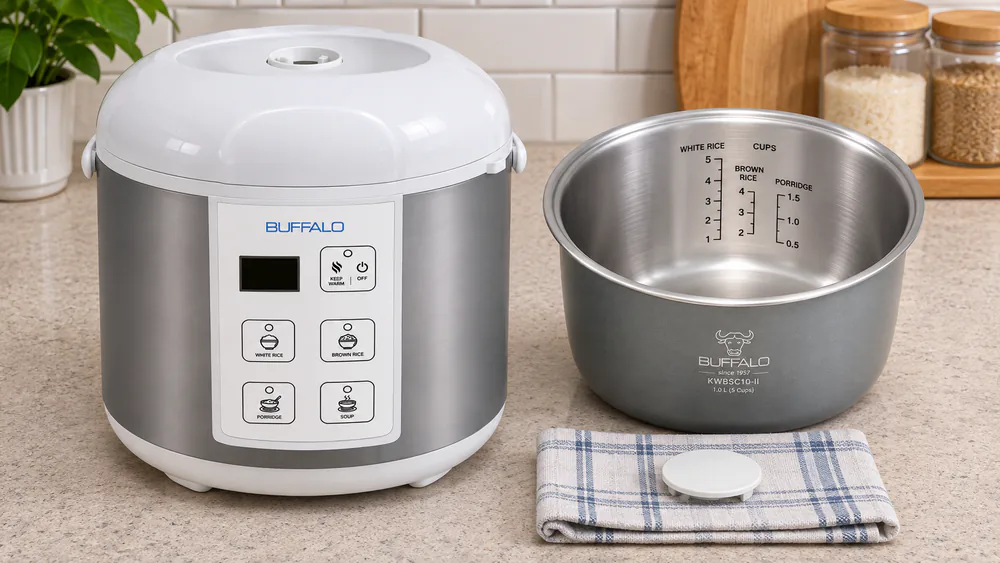
Buffalo Classic KWBSC10-II rice cooker with its removable steam vent lifted out and set beside the stainless inner pot on a counter
The steam vent lifts off, so dried starch has nowhere to hide.

2. Best Budget Option: Aroma Select Stainless ARC-753SGR

Aroma Select Stainless ARC-753SGR
2

Aroma Select Stainless ARC-753SGR

Best Budget Option
Check Price on Amazon
4.4/5

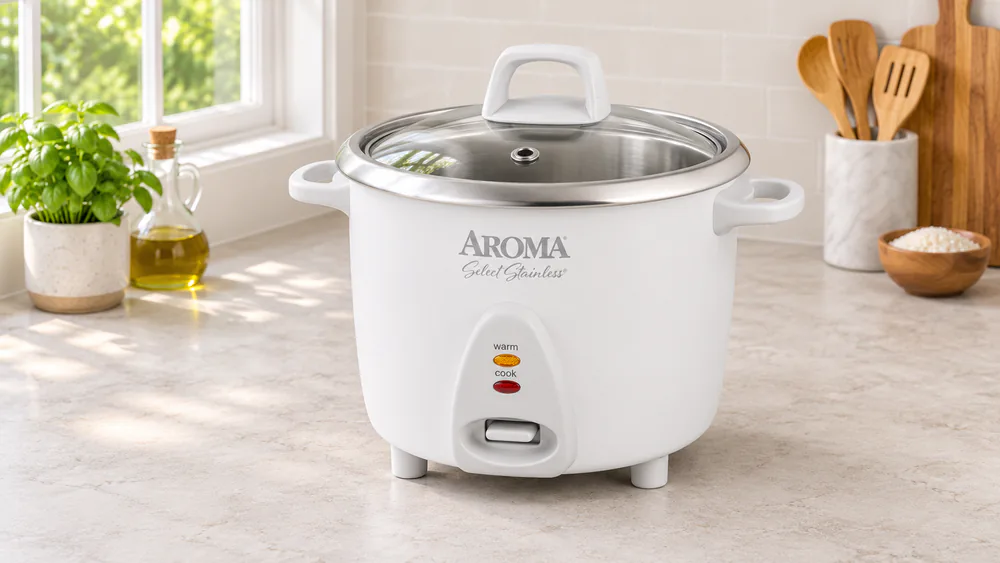
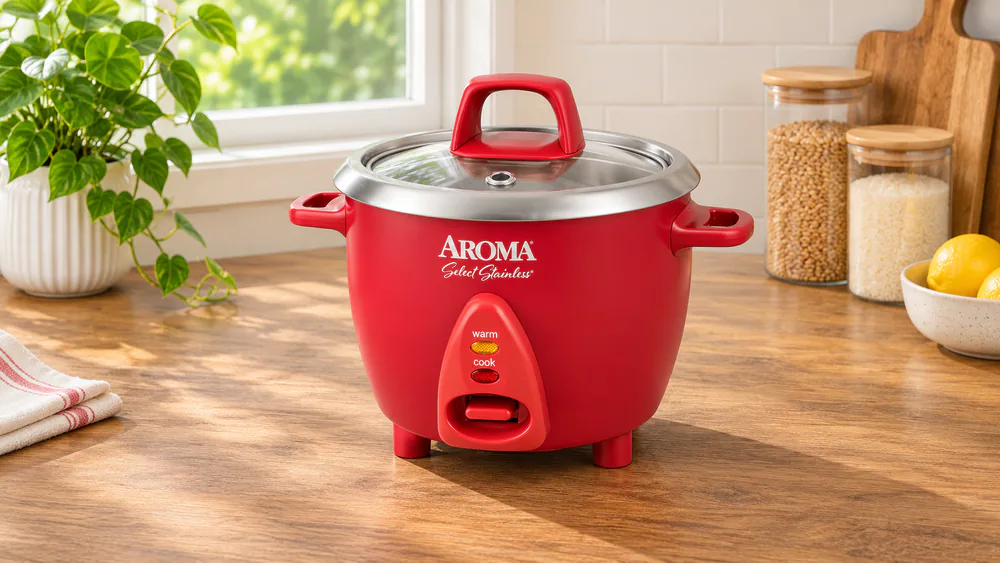
The Aroma 753 uses a single lever instead of the Buffalo's grain buttons. That lever is not an off switch: keep warm continues until you unplug the unit. That one fact tells you what this cooker is. It is the cheapest way into an uncoated stainless pot on our list, and a small batch fits comfortably on a crowded counter and is easy to put away.

Pros

  • Uncoated 304 stainless steel pot
  • Compact and easy to store
  • Removable, dishwasher-safe pot and a removable glass lid
  • The most affordable pick here

Cons

  • Sputtering through the lid vent, worse with big batches
  • Bottom sticking if the water is off
  • No digital grain menus and no delay timer
  • Keep warm runs until you unplug it

The ARC-753SGR is the red variant of a family that also includes white and black versions. The cooking pot is uncoated food-grade 304 stainless steel. Capacity is 3 cups uncooked white rice, up to 6 cups cooked, measured with the supplied 180 mL rice cup, not a standard kitchen measuring cup. It runs at 300W, measures 10.3 inches long by 8.3 wide by 7.9 high, and weighs 3.4 lb.

With a batch of jasmine, we watched starchy droplets sputter through the glass lid vent, then let the covered pot rest. A soak in the removed pot loosened any stuck layer. The warranty is 1-year limited. A model-specific replacement pot is catalogued, but availability varies, so confirm color and model compatibility before you count on a spare.

3. Best Stainless Steel Option for Families: Aroma Select Stainless ARC-757SG

Aroma Select Stainless ARC-757SG
3

Aroma Select Stainless ARC-757SG

Best Stainless Steel Option for Families
Check Price on Amazon
4.3/5

When the household grows, the ARC-757SG is the stainless pot that grows with it. We cooked white rice on the simple lever control and watched through the clear glass lid as it went, a small pleasure opaque lids deny you. Afterward the lid lifted off and washed easily.

Pros

  • Uncoated 304 stainless steel pot
  • Largest white-rice capacity on this list
  • Clear glass lid that lifts off for washing
  • Removable, dishwasher-safe pot

Cons

  • Bottom sticking, the usual cost of an uncoated pot
  • Brown rice can need extra water
  • No delay timer and no steam tray
  • Cook-switch durability over many years is unproven

The inner pot is uncoated food-grade 304 stainless steel. Our capacity basis is 7 cups uncooked white rice, the unambiguous limit, using the supplied 180 mL cup. Brown rice tops out at 6 cups. The product is marketed as a 14-cup cooked machine, but the manual contradicts itself on cooked yield, with one sentence saying 12 cups, so trust the uncooked number. It draws 500W and measures 12.4 inches long by 9.9 wide by 9.8 high, at 4.7 lb.

Brown rice is where this cooker asks more of you, since it can need extra water. When rice did stick, a water soak freed it from the stainless. The cook-switch mechanism is a potential long-term failure point, though we have no established failure rate to cite. Coverage is a 1-year limited warranty against material and workmanship defects, with proof of purchase required.

4. Best Compact Ceramic-Coated Option: GreenLife Go Grains

GreenLife Go Grains digital 4-cup
4

GreenLife Go Grains digital 4-cup

Best Compact Ceramic-Coated Option
Check Price on Amazon
4.2/5

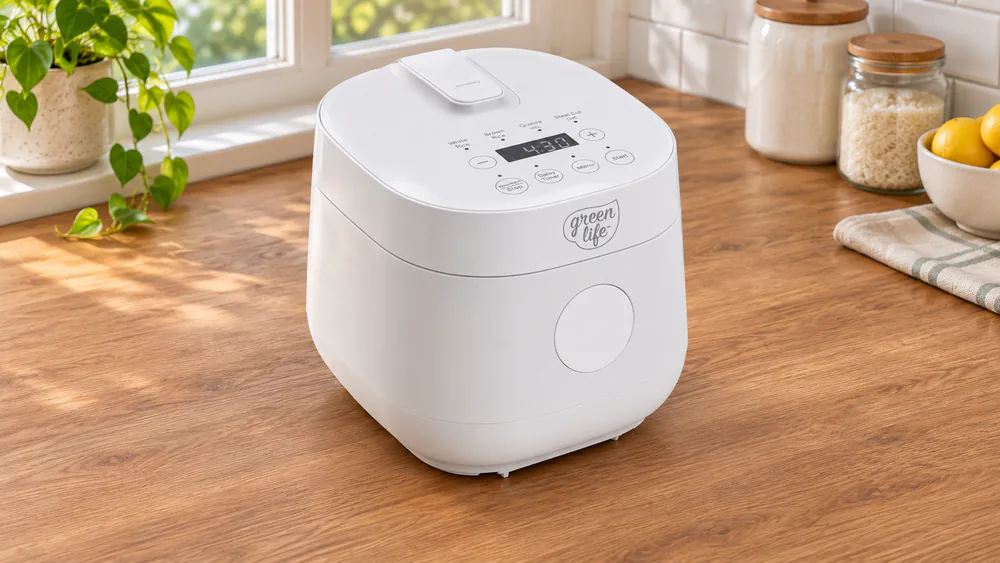
The GreenLife holds less rice than the Aroma 757 but releases it more easily, making it a good choice if you want to avoid rice sticking to stainless steel. After a batch, residual rice wiped away with warm water and a soft sponge. The compact body suits small meals and stores easily without dominating the counter.

Pros

  • PFAS-free ceramic coating wipes clean with a soft sponge
  • Grain presets, fuzzy logic and a delay timer in a small body
  • Top-rack dishwasher-safe pot and cover
  • 2-year limited electrics warranty

Cons

  • Small batches, a real limit for groups
  • Trial and error with water and time to avoid mushy rice
  • Touch controls can feel unresponsive
  • Coating needs gentle utensils and cleaners

Be clear about what the pot is. It carries a ceramic nonstick coating, not a solid ceramic pot, and the maker describes the coating as free of PFAS, PFOA, lead and cadmium. That describes the coating chemistry. It does not make the surface permanent. The capacity is 4 cups cooked, and the white-rice chart permits 2 supplied cups uncooked. For brown rice the chart permits at most 1.5 supplied cups. The unit draws 240W, measures 8.23 inches long by 7.44 wide by 7.36 high, and weighs 3.97 lb.

Controls are the draw. You get white rice, brown rice, quinoa and steel-cut oats, plus fuzzy logic, adjustable cooking time, a delay timer and keep warm. The clearly arranged controls made the presets easy to select, and brown rice came out fluffy. When we tried to start a second batch straight away, the cooker needed to cool down before it would reset.

The pot, inner cover and accessories are top-rack dishwasher safe, but the maker says to avoid abrasive pads and cleaners. The electrics carry a 2-year limited warranty that excludes normal wear. No steaming basket is supplied.

5. Best Ceramic-Coated Option with Digital Controls: GreenPan Bistro CC008304-001

GreenPan Bistro 8-cup, graphite CC008304-001
5

GreenPan Bistro 8-cup, graphite CC008304-001

Best Ceramic-Coated Option with Digital Controls
Check Price on Amazon
3.9/5

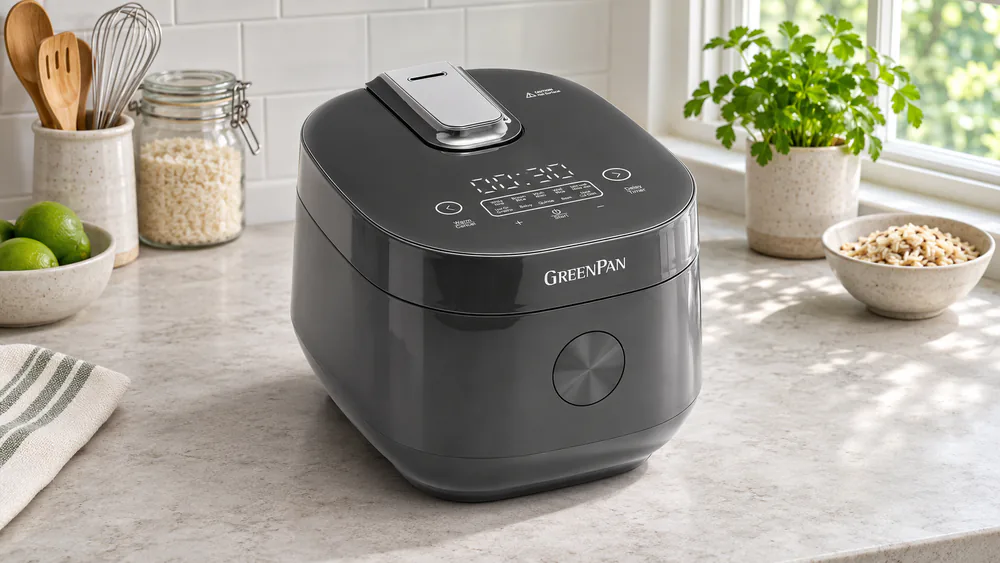
Check the Bistro's warranty before buying: its product page advertises limited lifetime coverage, but the electrics policy says two years. Confirm which terms apply to your unit. It is also the most feature-rich cooker here, and the one we recommend with the most caveats. The model is the Bistro CC008304-001 in graphite, which is a different product from the Elite 10-cup and Elite induction cookers. Nothing we say about the Bistro applies to those.

Pros

  • Many grain presets and a delay start of up to 24 hours
  • Removable ceramic nonstick bowl releases oatmeal, beans and seasoned rice easily
  • Top-rack dishwasher-safe pot, cover and accessories
  • Largest ceramic-coated capacity here

Cons

  • Bottom scorching and fast yellowing on keep warm are possible
  • Cooking results are mixed
  • Warranty duration is unclear, so verify before buying
  • Premium tier for a coated pot

The pot is a Thermolon Volt ceramic nonstick coating with a PFAS-free coating claim. It is not uncoated stainless steel. Capacity is 4 cups uncooked and 8 cups cooked. The cooker offers 10 presets, covering white, brown, multigrain and wild rice, low-carb white and brown rice, barley, quinoa, beans and steel-cut oats. It has an LED display and keep warm, plus a delay start of up to 24 hours. It draws 450W and measures 8.6 inches long by 10.5 wide by 8.5 high, at 6.4 lb. A carb-reduction tray comes in the box. That tray is a cooking feature, not evidence of any health outcome.

The removable nonstick bowl was straightforward to clean after a seasoned rice dish. Oatmeal and beans also released easily. The cooking is where it wobbled: we would not promise uniformly perfect rice. Top-rack dishwasher cleaning is permitted for the pot, inner cover and accessories.

What Does "Non-Toxic" Mean for a Rice Cooker?

"Non-toxic" is a shopping phrase, not a regulated standard. In practice it usually asks one question: what is the pot made of, and does a coating sit between the metal and the rice?

Keep the worry in proportion. Regulators note that highly polymerized nonstick coatings have negligible amounts of PFAS capable of migrating to food. Picking an uncoated pot is a preference, and a reasonable one, but it does not mean conventional rice cooking poisons your dinner. We will not tell you any pot is universally the safest.

PFAS-Free, PTFE-Free and PFOA-Free Claims

These three terms get blurred, and the blur is where marketing slips in.

PFAS is a broad family of chemicals. PTFE is one fluoropolymer inside that family. PFOA is a different PFAS that was formerly used in making some nonstick coatings.

So a "PFOA-free" label tells you about one chemical. It does not tell you the coating is PTFE-free, and it does not tell you the coating is free of all PFAS. A "PFAS-free" claim is broader and more useful, but it still describes the coating chemistry as the maker states it. It does not describe how long the surface lasts, and it does not describe the whole machine.

When you read a claim, ask three things. Which chemical does it name? Which part of the cooker does it cover? And does the maker publish it on the exact model page?

Inner-Pot Materials Versus Exterior Finishes

A cooker is more than its pot. The lid, the vent, the heating plate and the exterior shell are different parts, and a claim about one does not cover the others.

Food touches the inner pot, the lid underside and often the paddle. The exterior plastic and the control panel do not touch your rice. A marketing line like "stainless steel rice cooker" can describe a shiny shell around a coated pot. That is why every pick above states the food-contact pot specifically, and why we flagged each model's lid and vent separately.

What Manufacturer Documentation Can Confirm

Manufacturer documentation can confirm a lot: the pot material, the coating claim, the labeled capacity, the cleaning instructions and the warranty. It cannot confirm that no trace of anything ever leaves the pot under every cooking condition.

Stainless steel is a good example. It contains alloying elements including nickel and chromium. An uncoated surface is not a promise of zero metal migration, and it is not automatically right for anyone who is sensitive to nickel. Likewise a ceramic coating claim describes the coating's chemistry, not an all-ceramic vessel.

In plain terms: trust the model page, check the exact part number, and treat any promise of a "chemical-free" or "toxin-free" dinner as a red flag.

Stainless Steel vs Ceramic-Coated vs Clay Inner Pots

The table below sets the three material families side by side. We found no clay model with a complete, model-matched record, so the clay row is a material description, not a recommendation.

MaterialConstruction and claim scopeCleanupWear and damageReplacement
Uncoated stainless steelBare alloy or clad metal; confirm the food-contact pot, not the exteriorStuck starch may need soakingNo coating to peel; dents or warping can affect fitMatch the approved model
Ceramic-coatedThin nonstick coating on a metal base; check the exact PFAS claimEasy release with a gentle sponge and soft utensilsCoating can wear; dishwasher permission does not mean indefinite lifeMatch the approved coated pot
Clay or solid ceramicCeramic body rather than coated metal; check food-use migration documentationCool before washing, soak residue, dry fullyBrittle; impact and sudden temperature change can crack the potMatch the exact insert and model

Stainless Steel: Coatings, Cleanup and Durability

A stainless steel pot has no coating to peel, flake or scratch away, which is the whole appeal. You can use a metal paddle without the guilt you would feel on a coated surface, though a wood or silicone paddle is still kinder to the finish.

The cost shows up in the sink. Rice proteins and starch grip bare metal, especially at the bottom where heat is highest. The stainless cookers share one pattern: when the water balance was right, the rice released fairly well, and when it was off, a stuck layer formed. A soak loosens that layer before cleanup, and a rest after cooking helps the rice let go.

Durability is mostly a question of dents and warping. A pot that no longer sits flat on the heating plate can cook unevenly. Stainless pots do not lose a coating, but they can lose their shape, so store them without stacking heavy items inside.

Pros

  • No coating to wear, peel or chip
  • Tolerates firmer utensils and scrubbing
  • Nothing to degrade after years of dishwasher cycles
  • Clear material claim: the pot is simply metal

Cons

  • Rice sticks at the bottom when the water balance is off
  • Soaking is often needed before cleanup
  • Alloy contains nickel and chromium, which matters to nickel-sensitive cooks
  • Dents or warping can affect fit on the heating plate

Ceramic-Coated Pots: Coating Claims and Wear

A ceramic nonstick layer is still a coating. That surprises many shoppers, who assume "ceramic" means a solid ceramic bowl. In a rice cooker, it usually means a thin coating on a metal substrate.

"PFAS-free" on such a pot identifies the coating chemistry. It does not promise permanent nonstick performance. Both ceramic-coated cookers here release rice more easily than any stainless pot, and the GreenLife wiped clean with warm water and a soft sponge.

Wear is the long-term question. Use soft paddles, skip abrasive pads, and treat dishwasher permission as convenience, not a guarantee of indefinite life. If you see peeling, gouges, warping or a damaged fit, contact the manufacturer's support rather than attempting a home repair of the coating.

Clay and Solid Ceramic: Construction and Testing Documentation

Unglazed clay is a different material from ceramic-coated metal. It is a solid vessel, with no metal underneath, and it cooks gently. It is also brittle. Clay can fracture with a drop or a sudden temperature change, so let it cool before washing and dry it fully.

The documentation question matters more here than for metal. Food-use ceramicware needs relevant lead-migration documentation, and a lead-free label alone does not rule out contamination during manufacture. One clay-pot maker describes unglazed clay and laboratory testing for lead and cadmium. That is a manufacturer compliance statement, not an independently reviewed test report for a selected batch. For that reason, and because we found no exact clay model with a matched buying record, we are not recommending one.

If you shop for clay, ask for the test report for the specific model, check that the insert matches the cooker, and plan for a gentler routine than you would use with metal.

How to Choose and Care for Your Rice Cooker

Pick the material first, then the size, then the controls. In that order the rest of the decision gets small.

Cooked vs Uncooked Capacity

Brands mix "cups cooked" and "cups uncooked" without warning. A "10-cup" cooker may hold only five cups of dry rice. Check which number the maker is quoting, and use the supplied cup, which is a 180 mL measure on the Aroma cookers, not a standard kitchen measuring cup.

Our rough fit: the Aroma 753 and GreenLife suit one or two people. The GreenPan Bistro and the Buffalo suit a small family. The Aroma 757 suits the biggest batches. Brown rice capacity is lower than white-rice capacity on every model that lists it, so size up if brown rice is your default.

Rice Types, Controls and Cooking Functions

A lever cooker does one job well: white rice. If you also cook brown rice, porridge or oats, look for grain-specific buttons, as on the Buffalo, or a preset list, as on the GreenLife and GreenPan.

Fuzzy logic is helpful, but it is not magic. It adjusts the cycle based on sensor readings, and our GreenLife results still needed water and time tweaks. A delay timer is the other control worth having, if you like rice ready when you get home. Be careful with long keep-warm periods on any cooker, since yellowing and burning come from holding rice hot for too long.

Cleaning, Utensils and Replacement Inner Pots

Rinse the rice before cooking, and follow the grain-specific water chart. Dry the pot's exterior before it goes onto the heating plate, and unplug and cool the cooker before cleaning.

Use gentle utensils on coated pots and nonabrasive cleaning. For stuck rice in stainless, soak first. Wipe the base, body and top cover with a damp cloth, and never submerge the base.

Replacement pots must match the approved cooker. A similar diameter does not guarantee correct sensor contact or heating behavior. We could not confirm current stock of replacement pots for the Buffalo, the Aroma 757, the GreenLife or the GreenPan, and the Aroma 753 parts page exists but showed its pot out of stock when we checked. Buy a cooker you are happy with now, and do not count on a spare pot later.

Warranty, Support and Long-Term Value

Warranty length is a clue to a maker's confidence, but read the scope. The Buffalo covers the inner pot for 3 years. The GreenLife has a 2-year limited electrics warranty, and normal wear is excluded. The Aroma cookers carry 1-year limited coverage. The GreenPan terms conflict between the product page and the electrics policy.

Think about value across the years, not the first month. An uncoated pot may outlast a coated one, but a coated pot may save you ten minutes at the sink every night. We would pay a little more for a pot we expect to keep using, and a cooker we will actually clean.

Frequently Asked Questions

Why do the Aroma 757 listings disagree on cooked capacity?

The maker markets it as a 14-cup cooked machine, but the manual contradicts itself on cooked yield, and actual cooked volume depends on the rice variety. The 7 cups uncooked white rice figure, measured with the supplied 180 mL cup, is the number to plan around, and brown rice tops out at 6 cups.

How do I confirm the GreenPan Bistro warranty before buying?

The product page advertises limited lifetime coverage, while the electrics policy specifies two years. Read the terms for the exact model number at checkout, keep your proof of purchase, and treat two years as the safe assumption until the maker confirms otherwise in writing.

Does a keep-warm setting matter for rice quality?

Yes. The Buffalo guidance is no longer than 4 hours to avoid burning, and the Aroma 753 keeps warming until you unplug it. Long holds are where yellowing and burning start, so unplug or switch off once the rice is served.

How can I check a Zojirushi or Cuckoo model's inner-pot material?

Check the exact model number and the maker's current food-contact disclosure. Some current Zojirushi models explicitly claim PFAS-free food-contact surfaces, so a brand-wide PTFE claim is inaccurate. Cuckoo sells conventional replacement pots and, for selected compatible models, coating-free stainless replacements, so match the part number to your cooker.

Is stainless steel safe if I am sensitive to nickel?

Not automatically. Stainless steel contains alloying elements including nickel and chromium, and an uncoated surface is not a promise of zero metal migration. If you are sensitive to nickel, talk to your doctor before choosing an uncoated pot.

Final Verdict: Which Rice Cooker Should You Choose?

Our top review already named the overall winner. What matters here is matching a cooker to your kitchen.

If you cook for one or two and want the lowest cost with no coating, take the Aroma 753 and accept some sputtering. If you cook for a crowd, the Aroma 757 gives you the capacity, and you will soak the pot afterward. If cleanup matters more than a bare-metal pot, the GreenLife is the compact ceramic choice, and the GreenPan Bistro is the digital option, as long as you watch its keep-warm and scorching behavior.

The middle ground is worth naming. If you are torn between bare metal and a coating, the Buffalo gives you the uncoated pot with the most helpful controls, and its removable vent takes some of the cleanup sting away. If you already know you will not soak a pot at night, buy the ceramic-coated cooker and treat it gently. Neither choice is a mistake. The mistake is buying on the word "non-toxic" alone, without reading what the maker says about the pot, the lid and the exact model number.

Also think about the habits you already have. A cook who rinses rice, measures with the supplied cup and lets the pot rest will get good results from nearly any cooker here. A cook who wants to press one button and walk away will be happier with presets and a coating, and will need to accept the occasional adjustment to water and time.

Whatever you buy, confirm the exact model, read the food-contact claim on the maker's own page, and keep your expectations about "non-toxic" realistic.

Read next

Ready for an uncoated stainless pot?

Explore more buying guides for your kitchen, or get our latest advice in your inbox.