As an Amazon Associate we earn from qualifying purchases. We may earn a commission from links on this page, at no extra cost to you. Learn more.
A stainless steel juicer, in practical terms, is one where the parts that touch your produce and your juice are steel: the gears, the cone, the strainer, or the bowl. The housing, the lids, and the pushers are often something else, and that difference matters when you are shopping. In our family kitchen, where juice gets made for a crowd and the dishwasher runs twice a day, we care about how those steel parts behave on a busy Tuesday.
We picked four juicers that cover the main ways people juice: a slow twin-gear extractor for leafy greens, a motorized citrus press, a manual lever press, and a handheld squeezer. If you want to see everything else we have covered, our juicer reviews collect it in one place. Below, we also explain what "stainless steel" can and cannot promise on a juicer label.
Best Stainless Steel Juicers at a Glance
The table compares every model side by side. Swipe across to see the remaining columns. We marked composition as unverified wherever we could not confirm what a part is made from, because a steel gear does not tell you what the lid is made of.
Model
Best use
Juicer type
Verified steel components
Other food-contact materials
Main limitation
Tribest Greenstar Pro GS-P502-B
Leafy greens and mixed vegetables
Horizontal twin gear, 110 rpm
All-stainless twin gears
Plastic and wood tampers; full housing resin composition unverified
Feeding effort, bulky parts, and screen cleanup
Breville Citrus Press Pro 800CPXL
Repeated citrus servings
Motorized citrus reamer with lever
Cone and filter basket
Fruit-dome assembly includes polymer parts; exact juice-contact polymer map unverified
Citrus only; raised-arm clearance
Zulay Kitchen Cast Iron Citrus Juicer, Black
Manual citrus batches
Lever press
Removable juice bowl and strainer
Full upper pressing-cup composition unverified; cast-iron frame and rubber feet are not stainless
Large fruit fit and receiving-vessel clearance
Zulay Kitchen Stainless Steel Lemon Squeezer
Cooking quantities of lemon and lime
Handheld hinged press
18/8 stainless bowl and metal body
Silicone handle sleeves, outside the intended juice path; hinge details unverified
Hand effort and small-batch use
Breville Juice Fountain Elite 800JEXL (context only)
Fast hard-produce juicing
Centrifugal
Micro-mesh filter and titanium-reinforced steel disc
Full polymer composition unverified
No buy link verified; weak standalone leafy-green extraction
How We Tested These Juicers
We judge every appliance by how it handles a real family week: rushed breakfasts, full-size dinners, and kids of every age reaching for it. For juicers that means looking at juice quality, how much effort the machine asks of us, how loud it is, how many pieces we rinse afterward, and whether a teenager can run it safely.
We matched each of the four picks to the produce it is built for: leafy greens and fibrous vegetables for the Greenstar Pro, halved oranges and grapefruit for the two citrus presses, and lemons and limes for the handheld squeezer. Then we used the manufacturers' material notes and each machine's design to assess how well it would fit our family routine.
Our ratings are editorial judgments, not averages of anyone else's scores. Each one weighs how well the juicer fits its job, how clearly we can verify its materials, how much effort it takes, and how painful the cleanup is. We do not publish yield percentages or cleaning stopwatch times, because we did not run a controlled protocol, and we would rather say so than invent numbers.
Material verification and product selection criteria
We started with one rule: only models that put steel where it counts. That meant steel gears, a steel cone and filter, a steel bowl and strainer, or a fully steel handheld body. Then we checked what else touches the food. The manufacturer's own material notes were our starting point, and where they stopped short we marked the part as unverified rather than guessing.
We excluded accessories and steam juicers. We also left out any model we could not tie to a working buy link, which is why the Breville Juice Fountain Elite appears in the table for context but not as a pick.
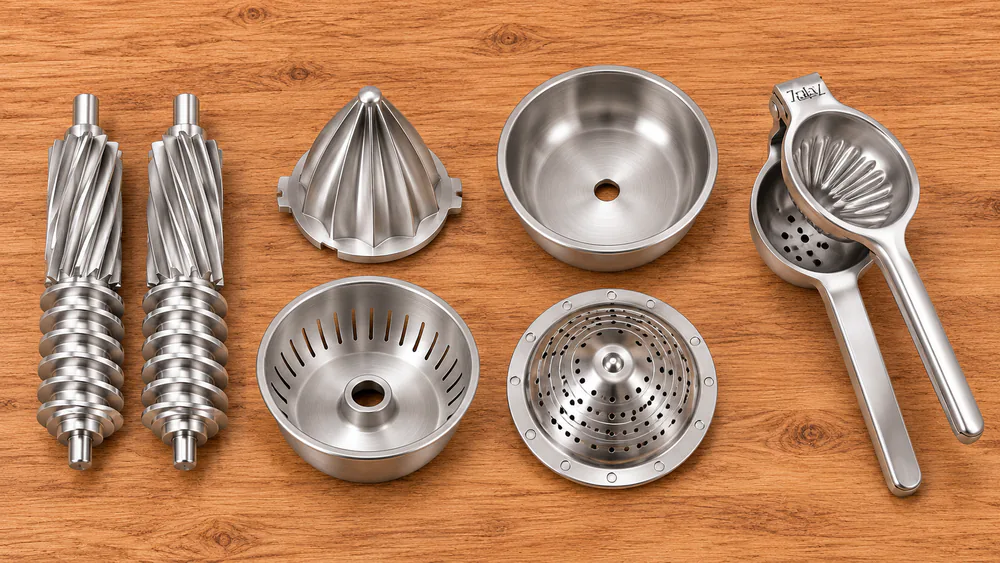
Steel parts come in very different shapes across the four picks.
How we compared performance, cleaning, and value
For cleaning we counted the removable pieces and noted which ones need a brush. For value we placed each model in a tier (budget, mid-priced, or premium) against what it does, since we do not quote prices here.
Safety counts in a house with five kids. We checked whether each machine has a guard or interlock and read the manufacturer's notes on unplugging before assembly. An interlock helps, but it never replaces supervision.
Our Stainless Steel Juicer Picks
1. Tribest Greenstar Pro GS-P502-B: Best for leafy greens
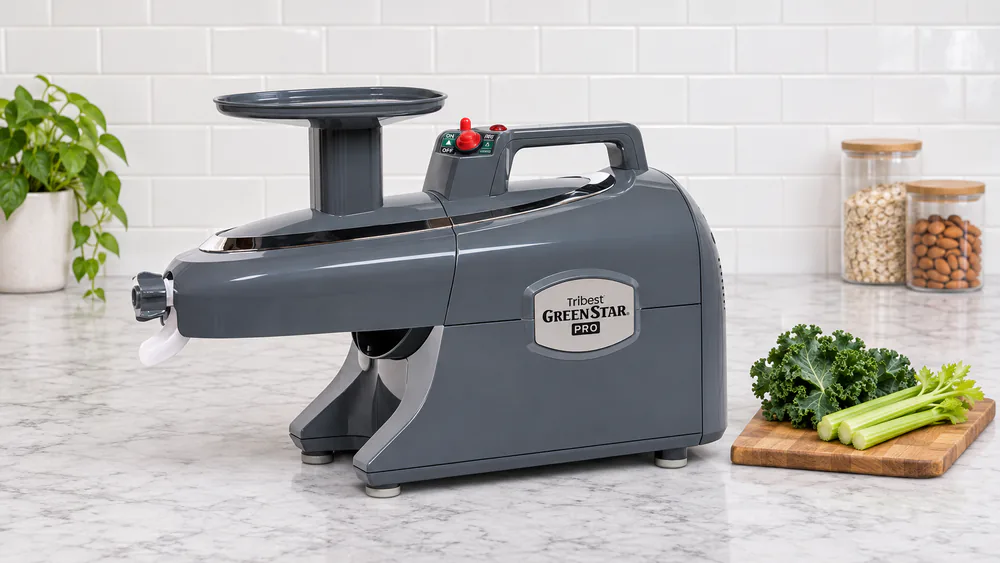
The Greenstar Pro is the juicer we would choose for anyone whose routine is built around greens. Its twin gears turn at 110 rpm and they are all stainless steel. Leafy greens and fibrous vegetables give useful extraction, with only fine residual particles in the glass. Our rating of 4.3 reflects that strength, offset by the effort and cleanup it demands.
Pros
All-stainless-steel twin gears
Useful extraction from leafy greens and fibrous vegetables
Adjustable pulp outlet and a hood-removal safety switch
15-year US household warranty for eligible authorized-reseller purchases with registration
Cons
Hard ingredients need firm feeding pressure
Large components and screen cleaning make wash-up more involved than the juicing itself
Slow processing suits batch prep, not a waiting queue
Plastic and wooden tampers still touch your produce
In use, the Greenstar Pro asks you to feed it patiently. Hard ingredients need firm pressure, and the twin gears have to be aligned correctly during assembly, so the first morning is slower than you expect. Once it runs, the slow rotation is the point: it works through greens that a fast machine leaves wet and stringy.
The slow pace also decides when you use it. It is poorly suited to serving a line of hungry kids at the counter, so we prepare a batch in advance instead.
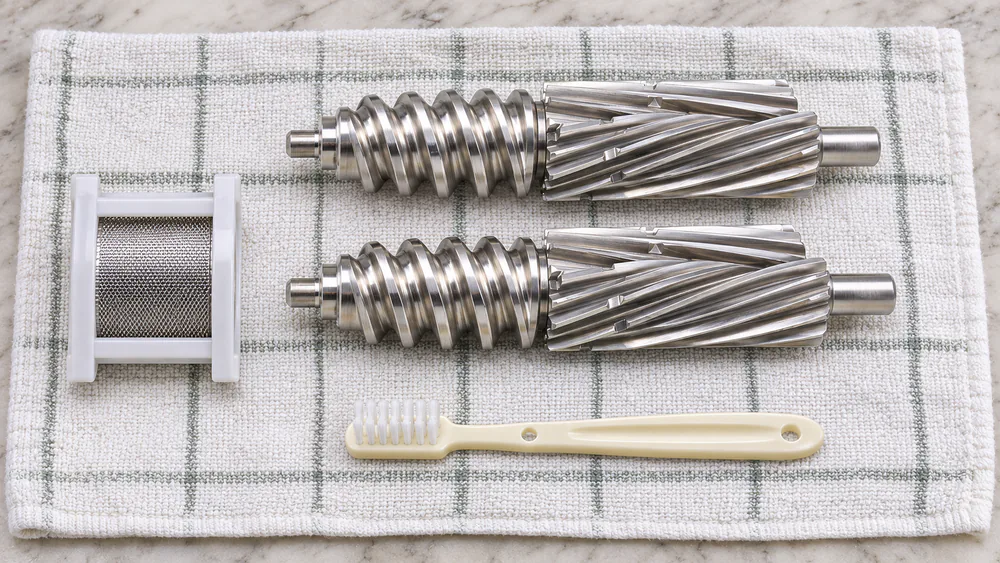
The Greenstar Pro demands more effort at cleanup. Large components and screen cleaning make the wash-up more involved than the juicing itself suggests. The gear teeth create awkward surfaces, and the screens need a brush in the corners. The manual says to unplug, disassemble, brush the gears and screen corners with mild detergent, rinse and dry, and keep water out of the motor body. Avoid bleach. Dishwasher permissions vary by manual revision, so hand-washing the juicing parts is the safer habit.
It is also a heavy machine that wants a dedicated working area. The US manual gives 18.25 x 12.5 x 6.88 inches and 26.6 pounds, though retailer measurements differ, so confirm the exact unit before you assign it permanent counter space. Peel citrus and remove the pith before feeding it, and send very soft fruit through the homogenizing function, which also handles nut butters and frozen-fruit sorbet.
On the steel question, the gears are steel, but the tampers are plastic or wood. Steel gears do not mean a completely steel food path. The hood-removal safety switch is a genuine plus in a house with teenagers, since the machine will not run with the hood off.
The gear teeth and screen corners are where the cleaning time goes.
2. Breville Citrus Press Pro 800CPXL: Best electric citrus juicer
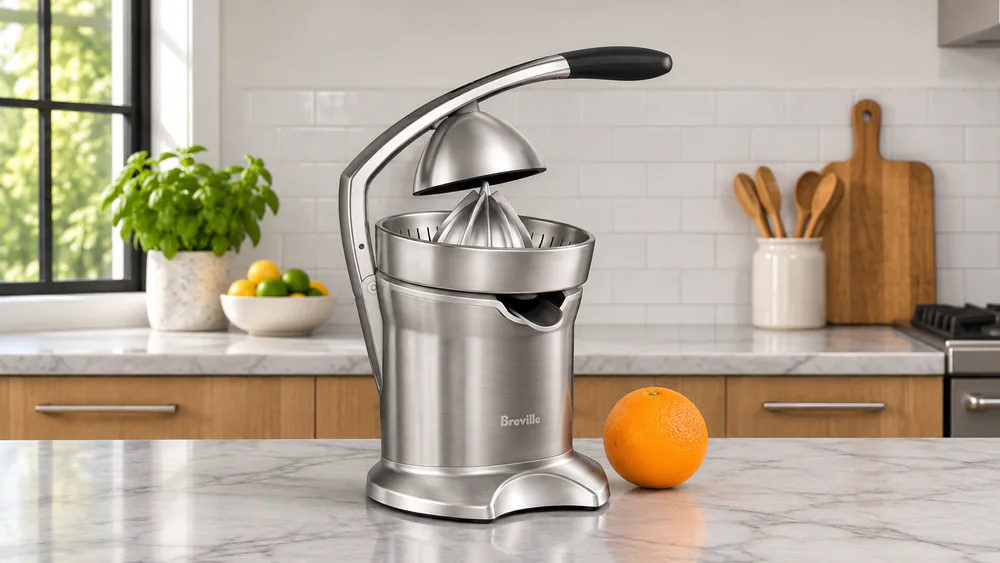
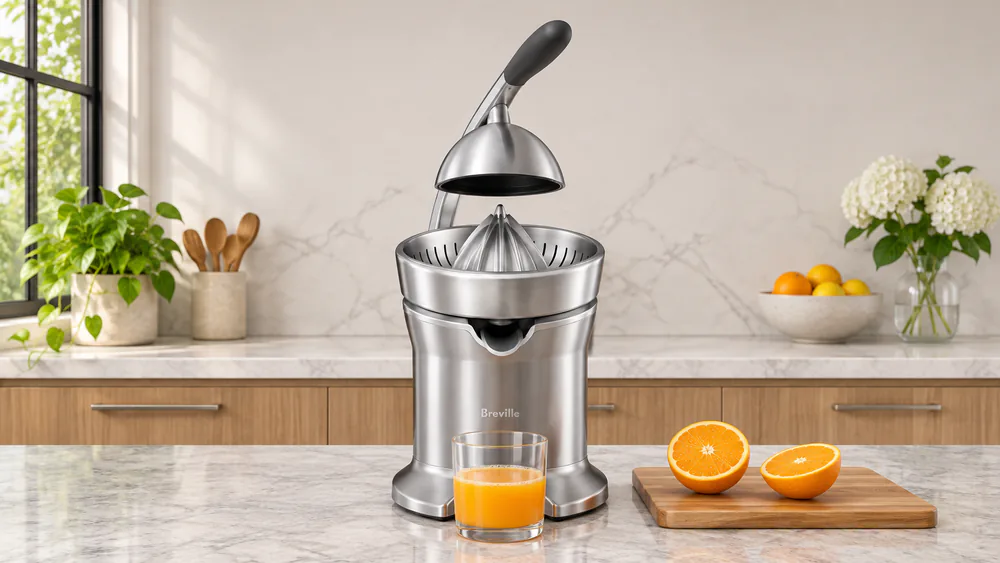
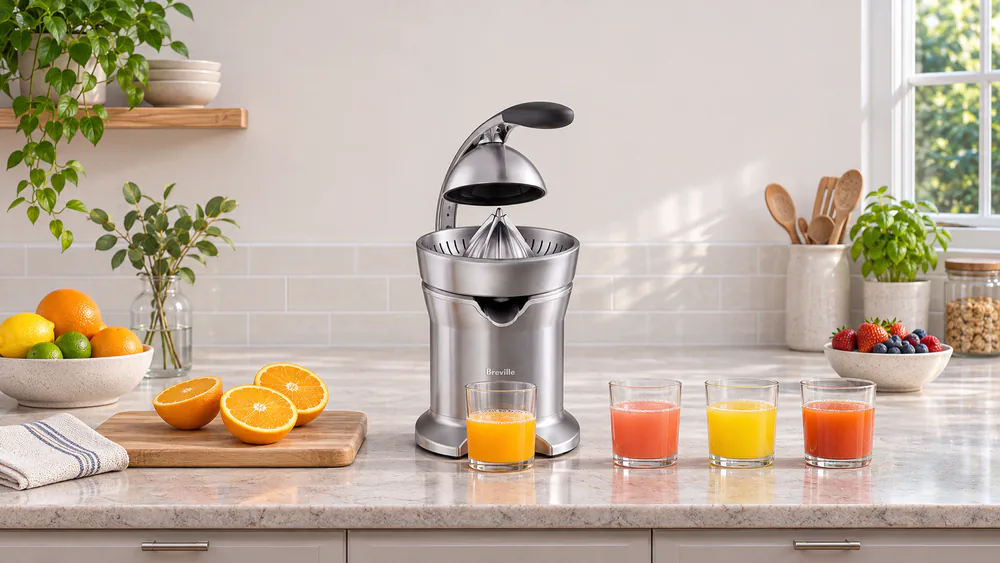
If your family drinks citrus juice most mornings, this is the one we reach for. The lever greatly reduces squeezing effort, the motor is comparatively quiet, and the drip-stop flap lets us swap glasses without juice landing on the counter. The stainless cone and filter basket sit on a die-cast base, and we rate it 4.5 because it does one job very well, with a few annoyances around storage and wear.
Pros
Lever greatly reduces squeezing effort
Comparatively quiet motor
Drip-stop spout helps swap glasses cleanly
Cone, juice collector, filter, and fruit dome are dishwasher-safe
Cons
Citrus only
Lever rises instead of locking down, which makes under-cabinet storage awkward
The fruit-dome retaining ring can wear over time
The metal shell does not tell you how long the internal drive will last
The press is a pleasure to use because it demands so little. After you halve the fruit and press the lever, the motor starts when the pressure and arm-position interlock conditions are met. Pulp collects in the basket, and you can spoon it back into the glass if someone wants a pulpier drink. The filter does its job on the first glass and the tenth.
The limits show up after the juice is poured. Oversized grapefruit can retain juice at the edges, and orange skins sometimes stick in the dome. The published size is 7.6 x 10.3 x 14 inches, but the raised lever needs more clearance than those figures suggest, so allow room for it to rise and move. Wattage also varies in published copy, with 110W in US product copy and 100W in another specification, so use the electrical label on the model you receive.
Cleanup is easy if you stay on top of it. The cone, juice collector, filter, and fruit dome are dishwasher-safe, and the removable pieces lift off readily for rinsing. Rinse promptly, because dried pulp is harder to remove. Thin tray and strainer rims deserve gentle handling when you wash them by hand. Wipe the motor base and press arm, and dry everything before reassembly.
One durability caution: internal drive gears can fail even when the metal exterior stays sound, so do not equate the shell with the drivetrain. The 1-year limited product warranty is worth keeping in mind.
The raised lever needs more headroom than the published height suggests.
3. Zulay Kitchen Cast Iron Citrus Juicer, Black: Best manual citrus press
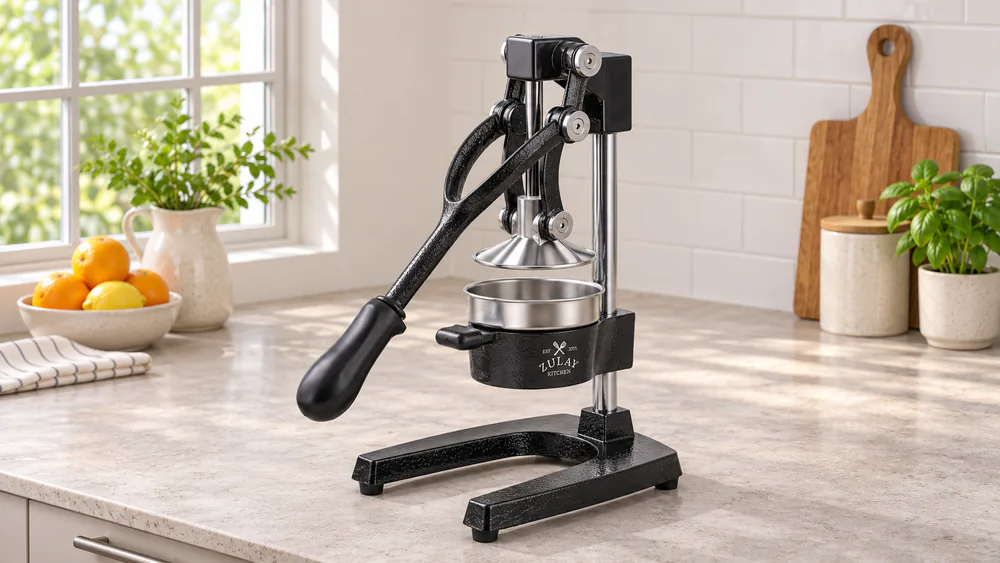
This is the press for people who want citrus juice without a motor or a cord. Setup and cleanup are simple enough to make repeated drinks practical, and a larger countertop press reduces the hand work of repeated squeezing. We rate it 4.2: the steel parts are limited to the removable bowl and strainer, and the fit with large fruit is the weak spot.
Pros
No motor, so nothing to plug in
Removable stainless bowl and strainer rinse readily
Larger press cuts down hand work on repeated squeezing
Rubberized feet and a substantial cast-iron frame
Cons
Extra-large grapefruit can extend beyond the pressing area and leave wet edges
Space between the feet limits the receiving vessel
Hinge play can need attention
The cast-iron frame is not stainless and is heavy
The 5-inch bowl diameter sounds generous, but fruit shape matters more than width. Large citrus may exceed the effective pressing area, so oversized fruit may need to be cut smaller. Halved citrus drains into a separate vessel, and the gap between the feet limits what fits underneath. For a family batch, we decant the juice into a larger pitcher.
Adjusting the cup height changes handle clearance, and the short supplied Allen keys can make that adjustment frustrating. Nothing here needs a cord, which makes it one of the easier machines to hand to a kid who wants to help.
The detachable pieces are easy to rinse, and the large body encourages permanent counter storage. That is a real consideration in a small kitchen. Treat the frame differently from the bowl: wipe it and dry it. Broad dishwasher wording does not make the cast-iron frame dishwasher-safe, so limit machine washing to detachable parts the instructions permit.
The manufacturer gives limited lifetime household defect coverage, with conditions that apply to direct US purchases, so read the terms before assuming you are covered. It sits in the mid-priced range, below the motorized press.
4. Zulay Kitchen Stainless Steel Lemon Squeezer: Best handheld lemon and lime squeezer
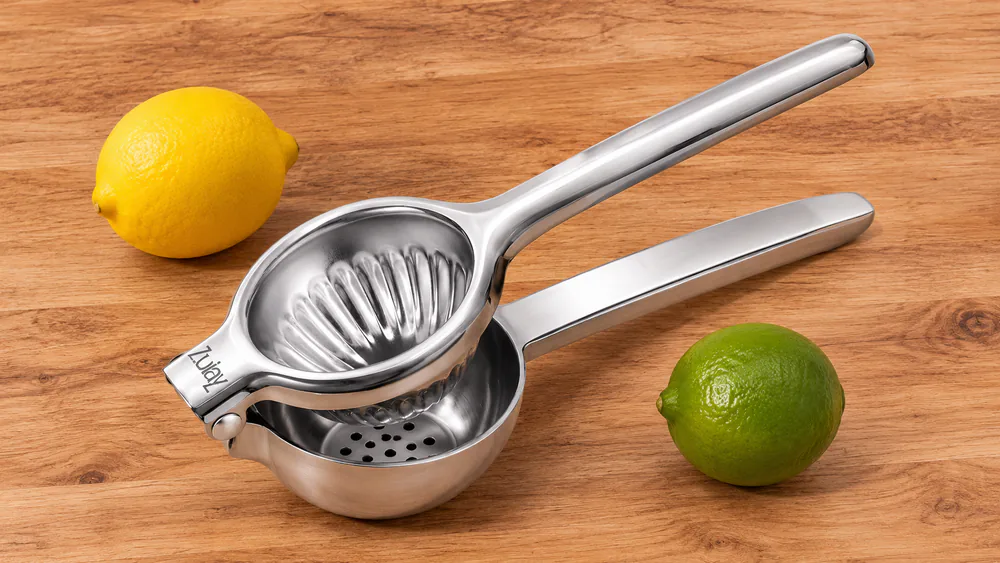
The squeezer is the most completely steel product here, and the cheapest pick on the list. It is made of 18/8 stainless steel with a steel food-contact bowl, and it tolerates vigorous squeezing and routine dishwasher cleaning. We give it 4.3 for the job it does, which is a lemon or lime for dinner, not a morning pitcher.
Pros
18/8 stainless steel bowl and metal body
Tolerates vigorous squeezing
Top-rack dishwasher-safe
Budget tier and easy to store in a drawer
Cons
Hand effort adds up beyond a few fruits
Best on lemons and limes; larger oranges suit a bigger press
Silicone sleeves on the handles
Bowl size for this standard version is not confirmed
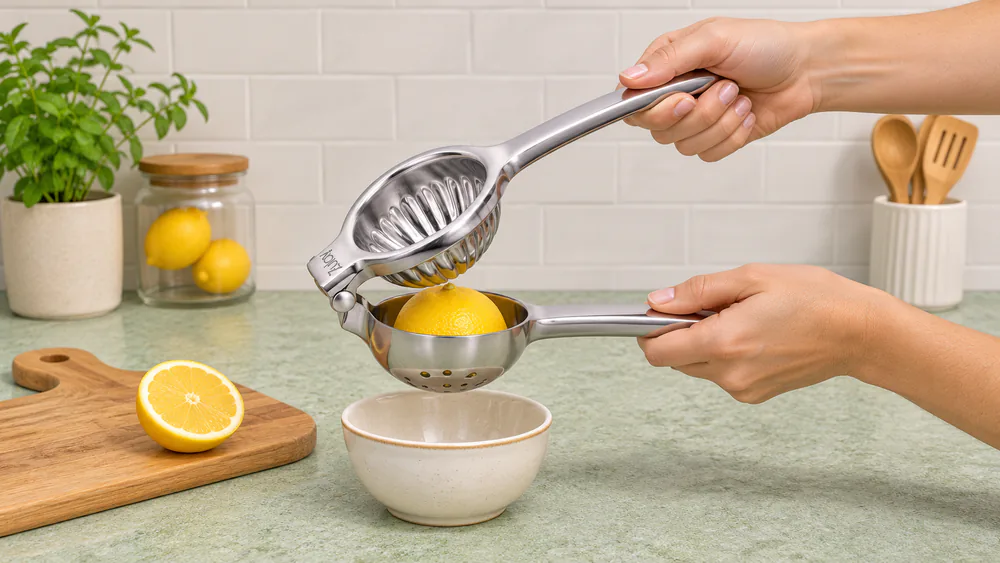
The smaller size is useful for lemons and limes, and it needs no cord or spinning part, so a young cook can run it. Larger oranges are better suited to a larger press.
Care is simple. Rinse citrus residue after use and put it in the top rack of the dishwasher. The silicone sleeves on the handles sit outside the juice path, but they do mean we cannot call it plastic-free in every sense. The standard and Extra Large squeezers are separate variants, so match the bowl size to the version you buy rather than assuming the dimensions carry over.
The hinged press is built for lemons and limes, not for a pitcher of orange juice.
A note on the Breville Juice Fountain Elite
The Breville Juice Fountain Elite 800JEXL is the centrifugal option people ask about, so we looked at it for context. It has a 1000W motor, a 3-inch feed chute, a 1.1qt juice jug, and a 3.2qt pulp container, along with a stainless steel micro-mesh filter and a titanium-reinforced stainless cutting disc. Hard produce processes quickly, though the high-speed setting is intrusive in a quiet kitchen.
Assembly is straightforward, and the smooth removable pieces are easy to wash, but the fine mesh needs its brush. Standalone wheatgrass, spinach, and kale extraction is a weak point, because hard-produce strength does not carry over to every leaf. If your routine is greens first, choose a twin-gear machine like the Greenstar Pro.
We could not verify a buy link for the right Elite model, and we will not point you at a Plus or Cold model by mistake. Published size figures disagree too, so confirm the assembled height before planning cabinet clearance.
What Stainless Steel Means in a Juicer
Most shoppers read "stainless steel juicer" and imagine steel from the feed chute to the glass. In practice, no juicer we looked at offers a fully documented plastic-free juice path. Steel often means the gears, the filter, the cone, or the bowl, while the lid, the pusher, the spout, and the pulp bin may be something else.
A steel gear or a steel shell tells you about one part of the machine, not about every surface your juice touches.
Stainless steel housing versus parts that touch juice
Separate the outer housing, the extraction parts, and the juice-contact surfaces. A brushed steel shell says nothing about the screen.
The Greenstar Pro shows the pattern: steel gears, but plastic and optional wooden tampers that contact produce. The Citrus Press Pro has a stainless cone and filter basket, while the fruit dome includes polymer parts. The Zulay cast-iron press has a removable stainless bowl and strainer, but the frame is cast iron and the feet are rubber. Only the handheld squeezer is close to all steel, and its handle sleeves are silicone.
How to check plastic parts and steel-grade claims
Read the manual's parts list, not just the product title. "BPA-free" does not mean plastic-free, and a steel exterior does not describe the composition of every part. We found no coating, contaminant-free, or health-superiority claim we could support, so we do not make one.
For grades, 304 and 316 are common stainless food-equipment grades, and 316 is not the only suitable food-contact steel. 316 generally offers greater corrosion resistance than 304, but the grade alone does not describe the whole machine or establish better juice yield. Only the handheld squeezer has an explicit 18/8 claim. We could not confirm exact grades for the motorized extraction parts or the cast-iron press bowl.
How to Choose a Stainless Steel Juicer
Match centrifugal, cold-press, or citrus designs to your produce
Start with what you will juice. A dedicated citrus press handles halved citrus. A twin-gear extractor like the Greenstar Pro also handles greens and peeled citrus, with different preparation and cleanup. A centrifugal machine is faster for hard produce, but standalone leaves can be a weak spot.
No single juicer here does everything well. If you juice both oranges and kale, pairing a citrus press with a twin-gear machine works better than asking one machine to handle both. The press is quick for morning citrus, and the twin-gear handles the weekend greens.
Compare capacity, preparation time, and counter space
Think about how much you need at once. The Zulay press pours into a vessel that must fit between its feet, so a family batch needs decanting. The Elite's 1.1qt jug and 3.2qt pulp bin speed up repeated servings but add pieces to store.
Prep time varies as much as capacity. The Greenstar Pro wants manageable pieces fed gradually, while a press only needs you to halve the fruit. Counter space matters too: the Greenstar Pro wants a dedicated area, and the Citrus Press Pro needs headroom for its lever.
Check cleaning effort, noise, and ease of use
Count the pieces. A machine that makes great juice and takes a long time to wash gets used less. Ask which parts go in the dishwasher and which need a brush, and follow the manual for the exact revision you buy.
Noise matters in a shared kitchen. The Citrus Press Pro is comparatively quiet, and the Elite's high-speed setting is intrusive. For kids, look for a safety switch or interlock.
Warning. Always disconnect power before assembling or cleaning any electric juicer. A safety interlock does not replace supervision or the proper use of the food pusher.
Weigh price, warranty, and replacement parts
Treat price as a tier. The handheld squeezer is the budget pick, the cast-iron press is mid-priced, and the Citrus Press Pro and Greenstar Pro sit higher. Warranty is where the Greenstar Pro stands out, with 15-year US household coverage when you buy from an authorized reseller and register. The Citrus Press Pro carries a 1-year limited warranty.
Check seller-specific return and warranty terms before you buy, because they vary and we cannot promise a universal window. Look at replacement parts too: a fruit dome ring or a pulp bin is easier to replace than a drive motor.
A quiet press and a drip-stop spout make school-morning juice manageable.
Cleaning and Caring for Your Juicer
Rinse screens and food-contact parts after use
Rinse as soon as you finish, because dried pulp is the main enemy in every juicer here. For the Greenstar Pro, brush the gears and screen corners with mild detergent and dry them before storing. For the Citrus Press Pro, wipe the motor base and press arm and let the parts dry before reassembly.
Steel is durable, but it is not immune. Stainless can stain or corrode under unsuitable conditions, so remove deposits, rinse and dry, and avoid chloride-containing cleaners and ordinary steel wool. Skip bleach on the Greenstar Pro in particular.
Check dishwasher instructions for each removable part
Do not assume a dishwasher rule covers the whole machine. The Citrus Press Pro's cone, juice collector, filter, and fruit dome are dishwasher-safe, and the handheld squeezer can go on the top rack. The cast-iron press frame should be wiped and dried, and the Greenstar Pro's guidance depends on the manual revision. Water never goes in a motor base.
Tip. When a manual and a listing disagree about the dishwasher, follow the manual that came with your unit. Hand-washing removable juicing parts avoids the question.
Which Stainless Steel Juicer Should You Choose?
The right pick depends on what ends up in your glass. For leafy greens, the Greenstar Pro is the one to buy, as long as you can live with the cleanup. For citrus most mornings, the Citrus Press Pro is the easiest to live with. If you want a no-motor option, the Zulay cast-iron press is a sturdy mid-priced alternative, and the handheld squeezer covers lemons and limes for almost nothing.
If we were starting over, we would buy the press first if the family drinks juice daily, and add the twin-gear machine only if greens are a real habit. A juicer you dread washing ends up in the cabinet, however good its steel is.
Stainless Steel Juicer FAQs
Can a stainless steel juicer be completely plastic-free?
Not on the evidence we found. No juicer here has a documented plastic-free juice path. Steel gears, cones, and bowls are common, but tampers, domes, lids, and handle sleeves are often plastic, wood, or silicone. Check the manual's parts list.
Is 304 or 316 stainless steel worth prioritizing?
Both 304 and 316 are common food-equipment grades, and 316 generally resists corrosion better. The grade does not describe the whole machine or improve yield, so we would not choose a juicer on that number alone.
Can one juicer handle both citrus and leafy greens?
Not well. A citrus press handles halved citrus. A twin-gear extractor handles greens and peeled citrus, with more prep and cleanup. A centrifugal machine can struggle with standalone leaves, so most households do better with two tools.
Can stainless steel juicer parts rust or stain?
Yes, under unsuitable conditions. Rinse and dry after use, remove deposits, and avoid chloride-containing cleaners, bleach, and ordinary steel wool. Frames and housings that are not stainless need their own care.