As an Amazon Associate we earn from qualifying purchases. We may earn a commission from links on this page, at no extra cost to you. Learn more.
We judged six Hurom slow juicers the way a family actually uses them: a rushed breakfast, a pile of produce, and a sink full of parts afterward. What separates these machines is not horsepower, since every US model here is rated at 150 W. It is how they clean up, how much pulp ends up in the glass, and how much counter and cabinet room they take. This guide walks through each model, then helps you match one to your household. If you are still deciding between machine types, our juicer reviews cover the wider field.
How We Tested These Hurom Juicers
Our test kitchen is a working family kitchen. Three meals a day for seven people means a juicer has to earn its counter space fast. We care about four things: how easily the parts rinse, how much pulp reaches the glass, how loud the machine is, and whether it fits under a real cabinet.
We worked from the US specification for each exact model. That matters because Hurom sells regional variants with similar names. The H310 is not the H310A, the H320 is not the H320N, and the H330 is not the H330P. We kept their specs, accessories, and warranties separate.
Our ratings are editorial. They reflect how well each model fits its intended user, how easy it is to clean, and how well its published specifications back that up. They are not measured scores from a common lab protocol, and the order of the picks below is not a performance ranking. Rinse time, full cleanup time, and drying time are different measures, so we do not quote a single wash time as a promise.
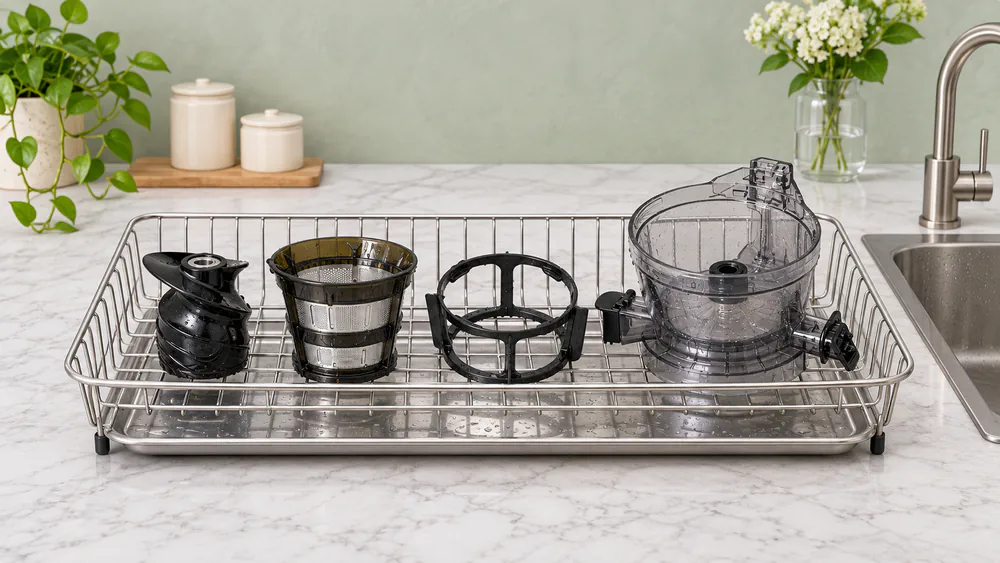
Parts washed by hand and left to air-dry, our default routine for every model here.
Best Hurom Juicers at a Glance
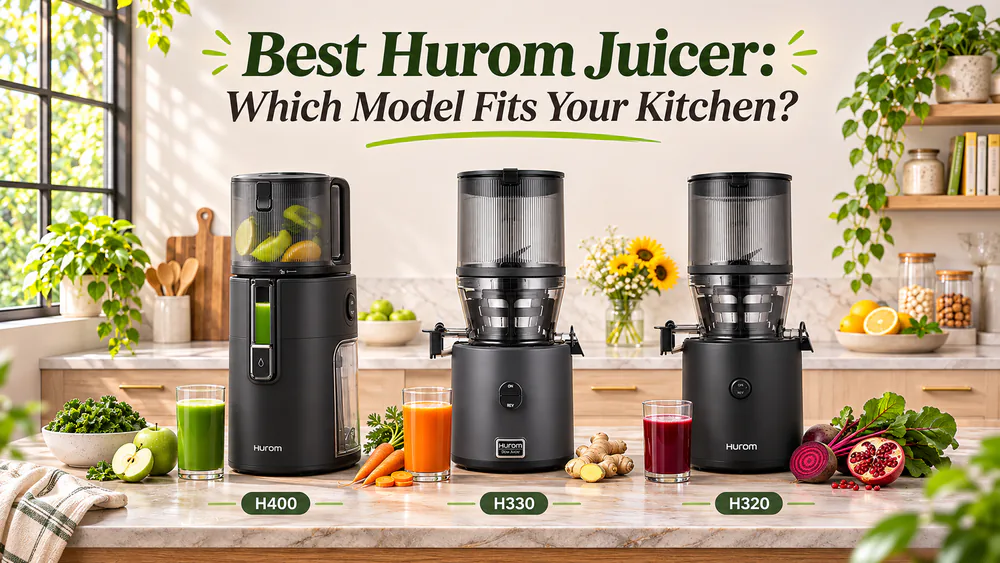
Six models, three different ideas. The H400, H70, and H310 use a mesh-free auger for easier rinsing. The H330, H320, and H-AA use fine and coarse strainers for more control over texture. The table below puts the specs side by side, with hopper and juice-chamber capacity kept separate. The chamber holds juice as it builds up, and it is not your finished batch yield.
Model
Intended user
Cleaning system / strainer
Hopper capacity
Juice chamber
Dimensions and closed height
Warranty
Hurom H400
Batch juicing with easier rinsing
Mesh-free two-part auger
Not confirmed for the US unit
550 ml
169 x 261 x 471 mm; 18.5 in closed (varies by region)
Advertised 15 years motor and parts; confirm terms
Hurom H330
Batch juicing with mesh filtration
Fine and coarse strainers
2L
500 ml
248 x 223 x 462 mm; 18.19 in closed
Advertised 15 years motor and parts; confirm terms
Hurom H320
Smooth-juice fans who want strainer choice
Fine and coarse strainers
2L
500 ml
243 x 223 x 463 mm; 18.2 in closed
Advertised 15 years motor and parts; confirm terms
Hurom H70
Easy Clean design in a shorter body
Mesh-free two-part auger
Not confirmed for the US unit
450 ml
174 x 216 x 436 mm; 17.2 in closed
Advertised 15 years motor and parts; confirm terms
Hurom H310
Personal servings in small kitchens
Mesh-free two-part auger
Not confirmed for the US unit
220 ml
160 x 171.5 x 395 mm; 15.5 in closed
10-year motor; 2-year parts
Hurom H-AA
Manual feeding plus dessert accessories
Fine, coarse, and ice-cream strainers
Manual-feed chute; volume not confirmed
500 ml
223 x 180 x 407 mm (metric; inch depth is inconsistent)
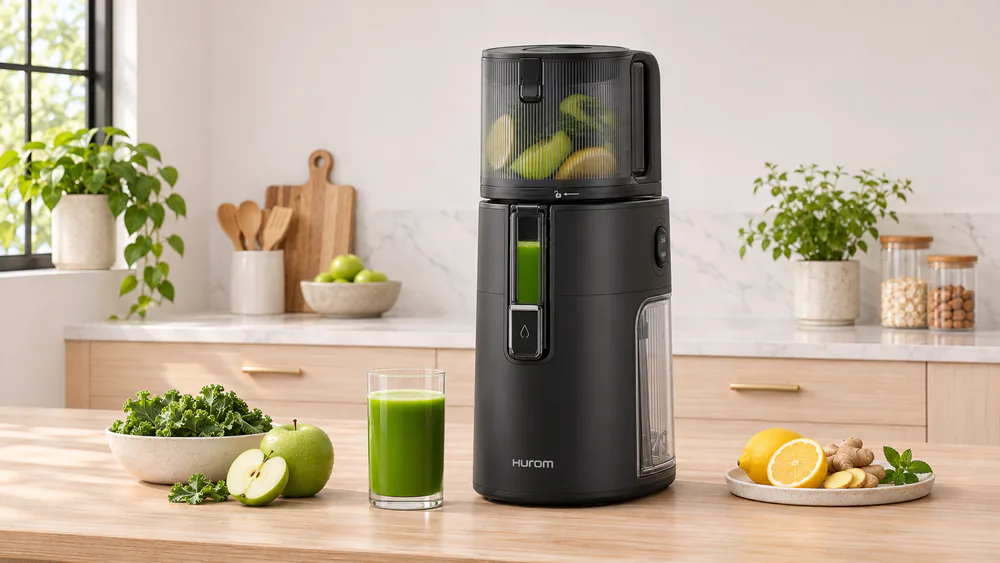
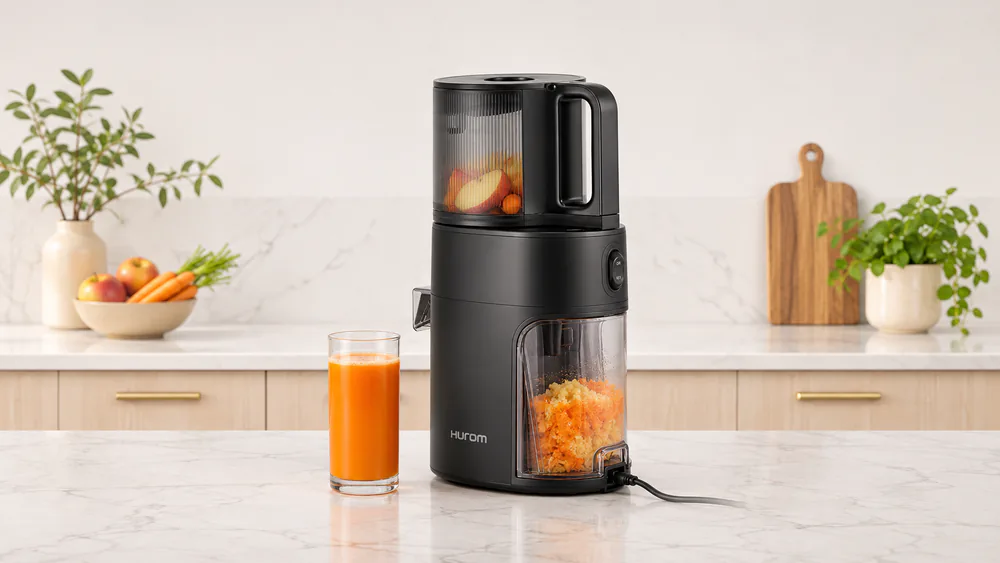
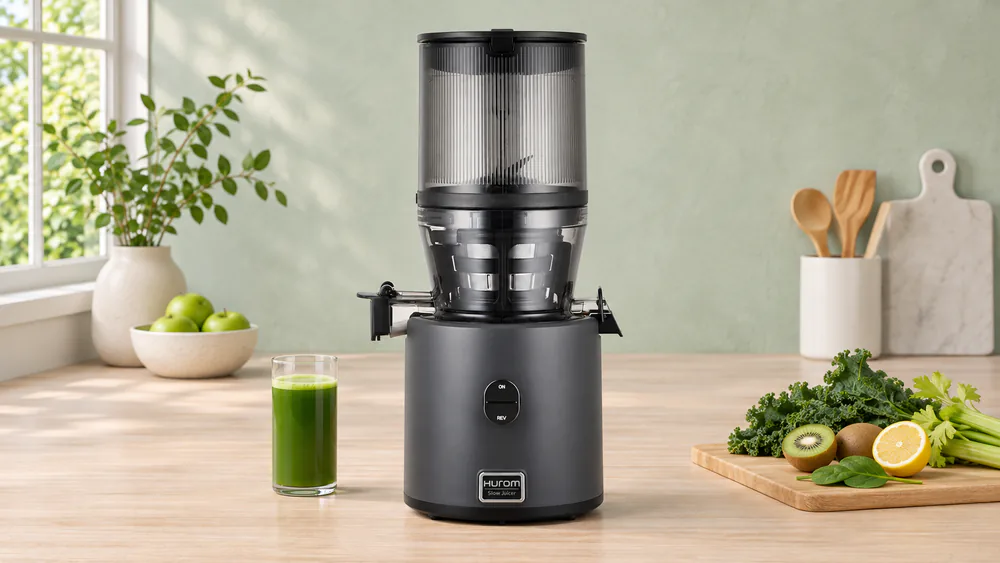
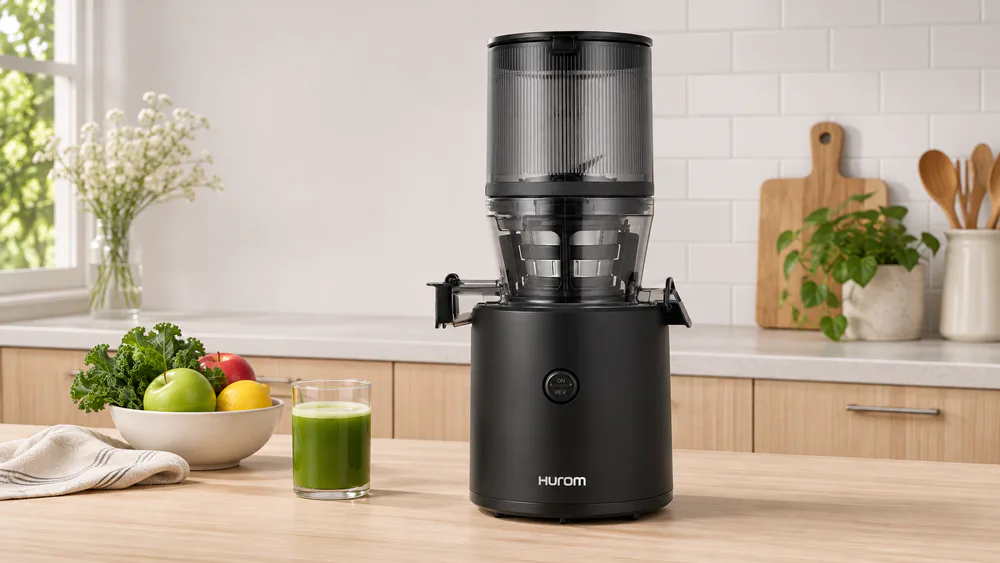
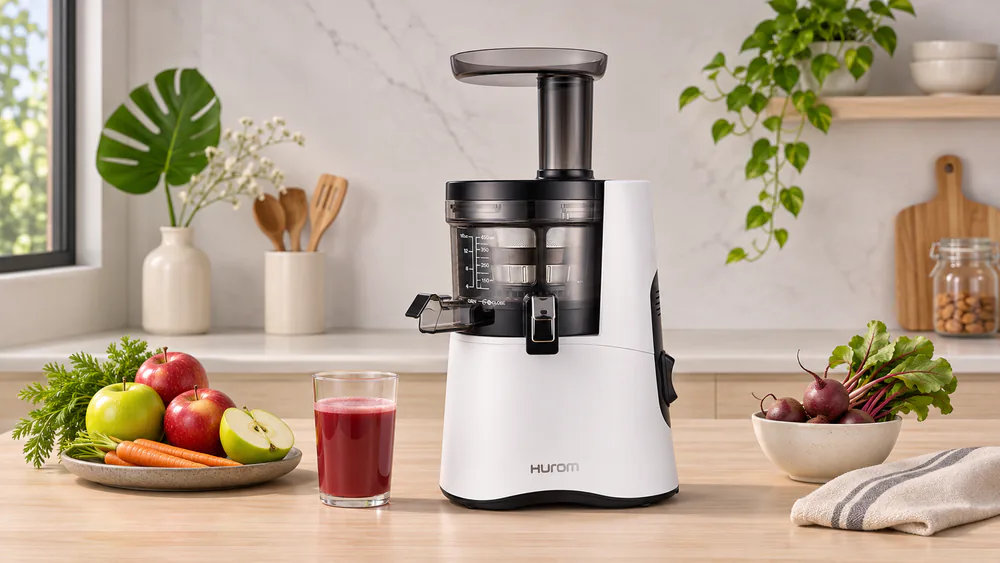
The H400 is the one we would put in a busy family kitchen first. The mesh-free parts rinse readily, the rear pulp bin keeps the worktop tidy, and the motor runs quietly. It asks for a little practice with the top assembly and an occasional fine sieve if you like clear juice.
Integrated rear pulp bin cuts down on containers across the worktop
Quiet operation
Largest juice chamber in this group at 550 ml
Front chamber gauge shows how full the chamber is
Cons
Juice keeps some pulp, so a fine sieve helps if you want a clear drink
Aligning the top assembly takes practice
Celery can block the pulp outlet
Tallest unit here at 18.5 inches closed
Cleaning Design and Everyday Use
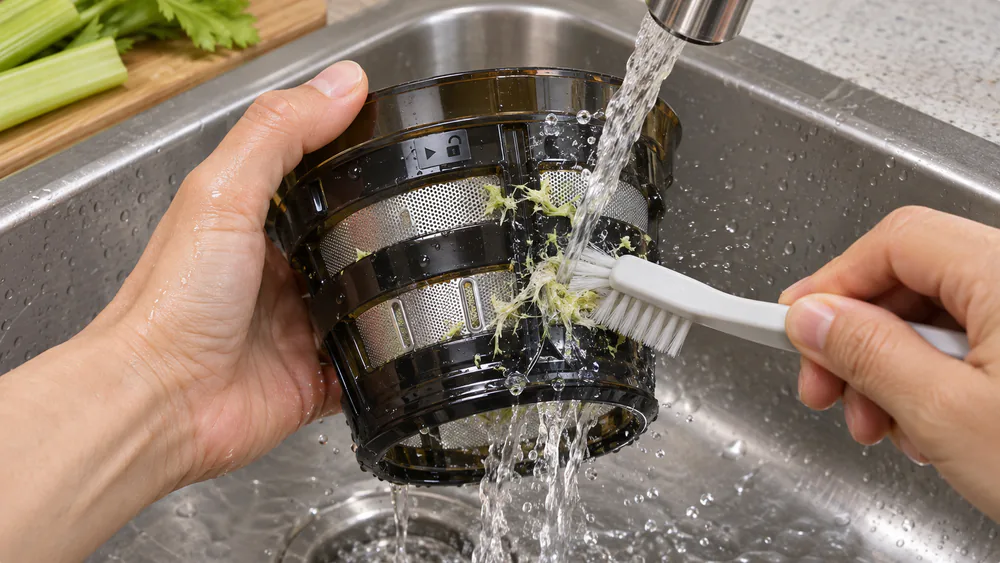
Cleaning is where the H400 earns its place. With no mesh strainer to scrub, the auger parts rinse readily, and the self-feeding hopper, juice cup, pusher, and cleaning brush all come in the box. The advice we repeat in our kitchen applies here more than anywhere: wash right away. Dried fibers need soaking and brushing, and a quick rinse while everything is still wet saves a lot of effort. Pulp can also cling where the chamber meets the body, so a pass with the brush there is worth it.
A few habits keep the H400 running smoothly. Celery can block the pulp outlet and force a stop to clear it, so we cut stalks into shorter pieces. Leafy greens sometimes need the pusher, and carrots can bounce around before they feed. If the rear pulp bin gets overfilled, more fibers can slip into the juice, so we empty it between batches. The juice-spout seal also needs a look during cleaning to avoid drips.
On noise, the H400 is genuinely quiet. It is rated at 90 RPM, the fastest auger in this group, yet the sound stays low enough for a morning kitchen. Its continuous-use limit is 30 minutes, which covers a large batch comfortably.
Who Should Buy the H400, and What It Costs You
Choose the H400 if you juice for several people and want the easiest rinsing in the lineup. Almonds and water make a creamy drink, and the H400 handles frozen-fruit desserts without an extra coarse strainer. The trade-offs are real, though. The juice is fuller in texture than a finely filtered drink, so if you want something close to pulp-free you will want a fine sieve. The US specification lists a closed height of 18.5 inches, so measure your cabinet clearance before you buy, and allow extra room overhead for the lid. We could not confirm the exact hopper volume on the US unit, so we do not quote one. The product page advertises 15-year motor and parts coverage; confirm the terms for your exact model and seller. The H400 is also the premium-priced model here, so it costs more than the H330 and the H310.
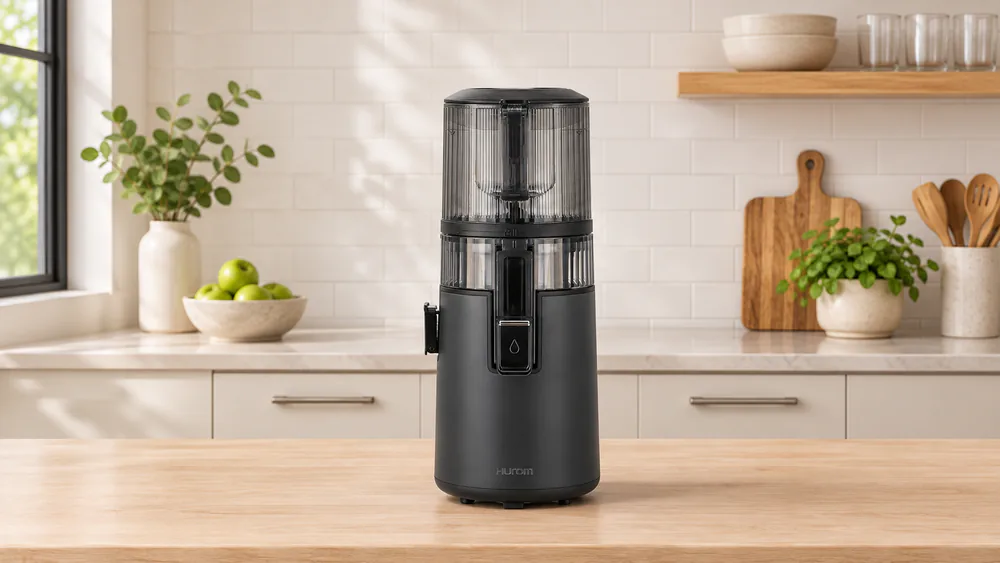
Where the H400 skips the mesh, the H330 brings the strainer approach at a mid-range price tier. Assembly is straightforward, it runs quietly, and the 2L hopper means fewer refills. Pulp comes out dry, which is a good sign that the auger is squeezing hard at 50 RPM.
Pros
Large 2L self-feeding hopper, separate from the juice chamber
Fine and coarse strainers let you choose juice texture
Straightforward assembly and quiet operation
Lid-opening motor shutoff and detachable power cord
Mid-priced within this group
Cons
Mesh strainers need brushing, unlike the mesh-free models
18.19-inch closed height needs cabinet clearance
Ice-cream strainer for frozen desserts is sold separately
Batch Size and Juice Texture
The H330 is built for batches. Its 2L produce hopper is separate from its 500 ml juice chamber, so you can load a good amount of produce and walk away for a moment. The continuous-use limit is 30 minutes. Two strainers shape the result: the fine one gives a smoother glass, and the coarse one leaves a fuller-textured drink that works well for smoothie-style blends. Separate juice and pulp containers keep the output tidy, and the paint-free body is a small environmental plus.
In use, the machine is easy to put together and runs quietly. Pulp from the spout comes out dry after juicing, which tells us the extraction is thorough. Bulky vegetables are the one place we slow down. Celery and beets still need to be cut small so the hopper lid closes, even though whole apples cut down the prep work. We worked from the official specification for the H330 and kept regional H330P material out of our conclusions.
Where the H330 Asks for More Effort
The H330 fits a family that wants the strainer approach and a big hopper, and does not want to pay premium prices. It also supports nut milk and smoothies. The cost of that flexibility is cleanup. Mesh strainers need a brush, so the H330 asks for more rinsing effort than the H400. The tall body is another consideration, since the assembled unit stands 18.19 inches high and the open lid needs extra space. The product page advertises 15-year motor and parts coverage; confirm the terms for your exact model and seller.
Compared with the H330's broader texture range, the H320 is the model for smooth-juice lovers. Whole apples and peeled citrus feed smoothly, a mixed leafy-green and fruit batch comes out smooth rather than pulpy, and it stays unobtrusive while it runs. It is also the most expensive of the strainer models here.
Pros
Fine and coarse strainers plus a pulp-control lever
Mixed green-and-fruit juice comes out smooth
Unobtrusive noise during a mixed-produce batch
Large 2L self-feeding hopper
Supports nut and seed processing
Cons
Celery and ginger fibers may need brushing, not just rinsing
Tall assembled body can be a storage problem under low cabinets
Premium price tier in this group
Ginger and turmeric leave dry pulp, so expect to clean the strainer
Strainer Options and Pulp Control
Strainer choice is the heart of the H320. The fine strainer suits a smooth glass, while the coarse strainer supports fuller-textured drinks. A pulp-control lever adds another way to steer the result. In our kitchen, whole apples and peeled citrus fed through smoothly, and the large self-feeding hopper kept refilling to a minimum. Ginger and turmeric leave dry pulp behind, which is normal for tough roots.
Mixed leafy greens and fruit came out smooth, not like a pulpy blended drink. The noise stayed unobtrusive during a mixed-produce batch, which matters when someone is still asleep down the hall. Cleanup takes more than a rinse. Celery and ginger fibers may need brushing, so we budget a few extra minutes at the sink. The H320 runs at 50 RPM with a 30-minute continuous-use limit.
Who Should Skip the H320
Pick the H320 if you want a clean, smooth glass and are willing to brush a strainer. The assembled body is 18.2 inches tall, and if your cabinets are low you may need to separate the hopper and base for storage. The US box does not list an ice-cream strainer, so we do not promise a frozen-dessert method for this model. Do not confuse it with the H320N, a regional variant. Warranty coverage is advertised at 15 years for motor and parts; confirm it for your purchase.
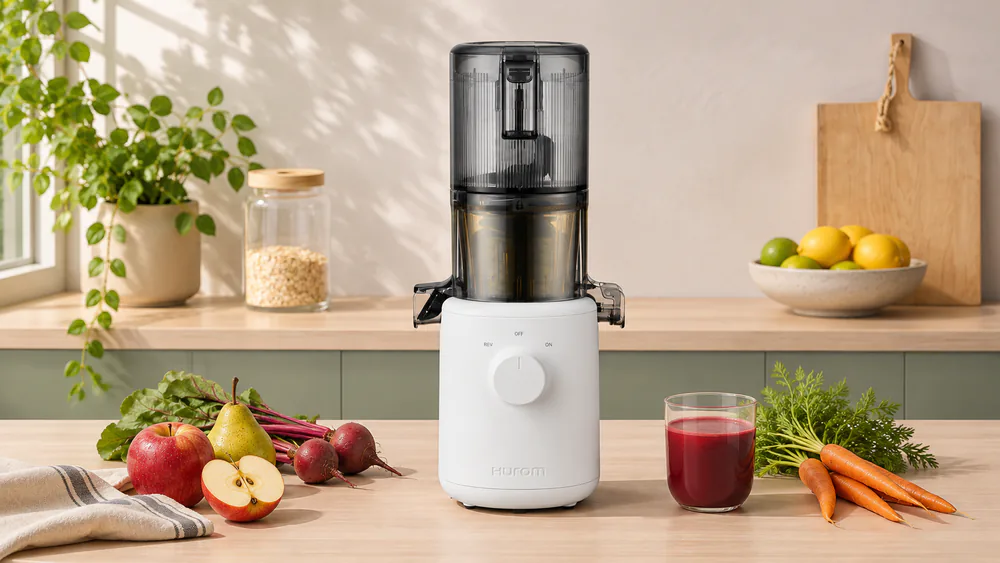
Unlike the tall strainer models before it, the H70 packs the mesh-free idea into a shorter body. Parts unclip and rinse readily, the broad hopper reduces chopping, and the side pulp outlet shows when the bin needs emptying. It is the model for tighter cabinet clearance, with a closed height of 17.2 inches.
Pros
Mesh-free two-part auger (Easy Clean approach)
Shorter 17.2-inch closed height than the H400, H330, and H320
Side pulp outlet makes it easy to see when the bin needs emptying
Broad hopper access reduces dicing
Frozen-fruit desserts without an extra coarse strainer
Cons
Carrot and celery juice can be pulpy
Unlocking the chamber after juicing can be difficult
Lower auger can be hard to lift out after some ingredients
Premium price tier
Counter Space and Cleaning Design
At 174 x 216 x 436 mm and 17.2 inches closed, the H70 sits lower than the H400. The chamber holds 450 ml, and the auger runs at 60/70 RPM. The parts unclip and rinse readily, then need drying space, so plan a spot on the counter or a drying rack. The external side pulp container makes it easy to see when it is full, and stray pineapple fibers at the outlet are easy to reach.
The side bin does add width, so allow room beside the machine. Two small frustrations come up. The lower auger can be harder to lift out after some ingredients, and unlocking the chamber after juicing can occasionally be difficult. Neither is a deal breaker, but both are worth knowing. The broad hopper means you do not have to dice produce into tiny pieces.
Where the H70 Compromises on Juice
The H70 suits a kitchen where cabinet height matters and cleaning ease still comes first. Juice quality is where it asks for compromise. Pineapple juice retains some pulp, and celery juice has noticeable fibers. Mango can leave substantial flesh in the discarded pulp, while carrot juice may be too pulpy for anyone who prefers a smooth glass. If that sounds like you, the H320 is the better match. The product listing calls it by a different model name in its readable link, but it identifies as the H70 Easy Clean, and we treat it as the H70 throughout. Confirm the 15-year advertised warranty before you buy.
The H310 is smaller overall than the H70, making it our pick for small kitchens. It is light, narrow, and quiet with mixed fruit and hard baby carrots, and fresh residue rinses off easily. The small chamber and 15-minute continuous-use limit mean it suits personal servings, not family batching.
Pros
Light, narrow body is easy to move when wiping the counter
Shortest closed height here at 15.5 inches
Quiet with mixed fruit and hard baby carrots
Mesh-free two-part auger; fresh residue rinses off easily
10-year motor warranty and 2-year parts warranty for eligible US purchases
Cons
Small 220 ml chamber
15-minute continuous-use limit is the shortest here
Dried pulp is harder to remove than fresh residue
Chamber must come apart for washing
Serving Size and Produce Preparation
The H310 is deliberately small. Its 220 ml juice chamber and 15-minute continuous-use limit favor a glass or two, not a whole week of juice. The body measures 160 x 171.5 x 395 mm, and at 15.5 inches closed it slides under cabinets the taller models cannot. At 45 RPM it is also the slowest auger in the group.
Preparation matters on a compact machine. The manual says to cut leafy and stem vegetables into pieces no longer than 3 cm, and we follow that. The chamber must come apart for washing, but fresh residue rinses off easily. Dried pulp is harder to remove, and the small brush helps reach the auger assembly. Rinse right after the last pour and it is a quick job. We would not put this machine in a child's hands, since the manual says an adult should control operation and cleaning.
Who the H310 Is Too Small For
The H310 is the right answer for one or two people, a studio kitchen, or a shelf that cannot take a tall machine. It is the budget-tier pick here. If you juice for a household of four or more, the chamber and run-time limits will frustrate you, and the H400 or H330 is the better choice. Dishwasher use is not something we recommend: the H310 manual says not to put parts in a dishwasher. Its warranty is a 10-year motor warranty and a 2-year parts warranty for eligible US purchases. Do not mix it up with the H310A, a different variant.
The H-AA is the most versatile juicer here, but it takes more preparation and cleaning than the H310. Orange and apple-kale recipes give strong extraction, almond milk is straightforward, and the strainers fit together intuitively. You pay for that versatility in prep work and in cleaning.
Pros
Fine, coarse, and ice-cream strainers included
Strong extraction from orange and apple-kale recipes
Nut milk and frozen desserts supported
Budget-tier price within this group
Strainers fit together intuitively
Cons
Manual-feed chute means more produce prep
Strainer and pulp outlet need targeted brushing
A mixed vegetable batch can stall and need reverse
Silicone brush pieces can loosen and get lost during washing
Feeding Design and Versatility
The H-AA is the one model here with a manual-feed chute, not a big self-feeding hopper. Carrots need narrow pieces and ginger needs slicing, so ingredient preparation remains part of the job. The extra strainers add assembly steps, but the pieces fit together intuitively. The set includes a pulp-control lever, fine and coarse strainers, an ice-cream strainer, a spinning brush, a drying rack, and cleaning brushes, and it supports nut milk and frozen desserts.
Results are strong where the produce cooperates. Orange and apple-kale recipes extract well, and almond milk is straightforward to make, with fresh residue washing off readily. A mixed vegetable batch can stall briefly and resume after reverse. Hard produce can cause groaning and a chamber assembly that is hard to lift from the base.
The Real Cost of the H-AA's Versatility
The H-AA suits a cook who wants more than juice and does not mind a little extra work. It is the budget-tier model here. Cleaning is the cost. The strainer needs brushing, and the pulp outlet must be opened for a thorough rinse. Air drying is easier than towel drying the small recesses. The silicone spinning-brush pieces can loosen and are easy to lose during washing, and replacements must fit the exact basket. Use the metric dimensions (223 x 180 x 407 mm) when measuring your space, because the printed depth in inches is inconsistent. Allow extra room for both collection containers and the open feed chute. Its warranty is a 10-year motor warranty and a 2-year parts warranty for eligible US purchases.
How to Choose the Best Hurom Juicer for You
Start with the household, then the kitchen, then the cleaning routine you will actually keep. The sweet spot for most families is the model that you will wash on the same day you use it. Everything else follows from that.
Easy Clean vs. Mesh Strainers
The first decision is cleaning style. The H400, H70, and H310 use a mesh-free two-part auger. The H330, H320, and H-AA use fine and coarse strainers. Neither approach is dishwasher magic: Easy Clean does not mean dishwasher-safe, and we default to hand washing for every model here.
Pros
Mesh-free (H400, H70, H310): no mesh screen to scrub, so parts rinse readily
Mesh-free: fewer small pieces to lose or dry
Strainer models (H330, H320, H-AA): fine and coarse strainers let you choose juice texture
Strainer models: a pulp-control lever or coarse strainer supports fuller drinks like smoothies
Cons
Mesh-free: juice keeps some pulp, so a fine sieve may be needed for a clear drink
Mesh-free: dried fibers still need soaking and brushing
Strainer models: the strainer and pulp outlet need targeted brushing
Strainer models: extra strainers add assembly steps and small parts to keep track of
Juice Texture, Yield and the Produce You Use
Texture depends on the produce as much as the machine. Hard roots like carrots and ginger leave dry pulp. Celery can block outlets on some models. Citrus and apples feed easily. Pineapple and mango keep some pulp or flesh. We do not claim a ranked yield for the six exact US models. We recommend you match the strainer to your texture preference first and treat yield as a secondary question.
Hopper Capacity, Prep Work and Batch Size
Hopper and juice chamber are different things. The hopper is where produce waits, and the chamber is where juice collects. The H330 and H320 offer a confirmed 2L hopper. The H400, H70, and H310 are self-feeding, but we could not confirm exact US hopper volumes, so check the product page. The H-AA uses a manual-feed chute and needs smaller pieces. For a family, a bigger hopper means fewer trips back to the machine. For one person, the H310's small chamber is plenty.
Counter Space, Cabinet Clearance and Noise
Closed heights run from 15.5 inches on the H310 to 18.5 inches on the H400. Measure under your cabinets, then add room for the open lid, because open-lid heights are unconfirmed for all six US units. Body footprint also leaves out room for containers, the cord, and drying. Noise varies with produce, room, and distance, so no machine is guaranteed silent, but the H400, H330, H320, and H310 all ran quietly in our kitchen. Every US model is rated at 150 W.
If kids are around, keep the juicer on an adult-run routine. The manuals say an adult should control operation and cleaning, and fingers and utensils belong out of the feed openings.
Note. Hurom sells similar names in different regions. The H310 is not the H310A, the H320 is not the H320N, and the H330 is not the H330P. Check that the listing matches the exact US model before you rely on any spec, accessory list, or warranty.
Price, Warranty and Replacement Parts
Within this group, the H400 is the splurge, the H320 and H70 are premium, the H330 sits in the middle, and the H310 and H-AA are the budget tier. Promotions can change that order. Warranty terms need a careful look. The H400, H330, H320, and H70 pages advertise 15-year motor and parts coverage, while Hurom's general FAQ gives a shorter period. The H310 and H-AA match the shorter terms: a 10-year motor warranty and a 2-year parts warranty. Confirm the coverage for your exact model, purchase date, and seller.
Returns differ by where you buy. Direct Hurom.com opened-appliance returns must start within 30 calendar days of delivery, and unopened items have a 90-calendar-day window. Purchases elsewhere follow the original retailer's return policy. Parts and accessories are final sale. Do not assume strainers or other parts interchange across generations, and contact customer service for model-specific replacements.
Pick the juicer you will wash the same day you use it. Everything else is secondary.
Cleaning and Common Hurom Juicer Problems
Most problems come down to timing and preparation. A juicer that sits dirty overnight is harder to clean, no matter the model.
Assembly, Clogs and Pulp Buildup
Misaligned parts cause many first-week problems. Line up the hopper lock marks, keep the juice outlet open during extraction, check gaskets for leakage, and use reverse when the machine overloads. Persistent faults need service. On the H400, aligning the top assembly takes practice, and celery can block the pulp outlet. On the H-AA, a mixed vegetable batch can stall and then resume after reverse. On the H70, unlocking the chamber can occasionally be hard. Cutting stems into shorter lengths prevents most clogs, and on the H310 the manual sets 3 cm as the limit.
We have not established a failure rate for any model, and we do not claim a most-likely-to-break part. These are maintenance habits, not predictions.
Cleaning Steps and Model-Specific Care
The routine is simple. Unplug before disassembly, rinse the food-contact parts promptly, brush the outlets and seals, air-dry fully, and wipe the motor base rather than immersing it. Hand wash by default. The general FAQ permits the auger in a dishwasher, while the H310 manual prohibits it, so check the manual for your exact model.
Model by model, a few details stand out. The H400 needs attention at the juice-spout seal. The H330 and H320 need brushing on the strainer, especially after celery and ginger. The H70 parts unclip, but need drying space. The H310 has a small brush for the auger assembly. The H-AA needs the pulp outlet opened for a thorough rinse, and its tiny recesses dry faster in open air than with a towel.
Hurom Juicer FAQs
Which Hurom model is best for one person?
The H310 is the best fit for one or two people. Its 220 ml juice chamber, 15.5-inch closed height, and light, narrow body suit small kitchens. Its 15-minute continuous-use limit means it is not meant for big batches. If you want a bit more room, the H70 is the next step up, with a 450 ml chamber and a closed height of 17.2 inches.
What should you compare between the Hurom H400 and H320?
Start with cleaning. The H400 has a mesh-free two-part auger that rinses readily, while the H320 uses fine and coarse strainers with a pulp-control lever and needs more brushing. The H320 leans toward smooth juice, and the H400 keeps some pulp. The H400 has a larger 550 ml chamber against the H320's 500 ml, and the H320 has a confirmed 2L hopper. Check cabinet clearance too, since both stand over 18 inches closed.
Are Hurom juicers worth the price?
They sit at the higher end of the slow-juicer market, and the six models here run from budget to splurge tiers. The value comes from rinse-friendly designs, quiet operation, and long advertised warranties, though coverage terms vary by model and seller. If you will not juice at least a few times a week, a cheaper machine may serve you better. If you will, a model that cleans quickly is what keeps you using it.
Can Hurom juicers make nut milk or frozen desserts?
Some can. The H-AA supports nut milk and frozen desserts, and almond milk is straightforward on it. The H330 supports nut milk and smoothies, and its ice-cream strainer is sold separately. The H400 and H70 support frozen-fruit desserts without an additional coarse strainer. We have not verified a dessert method for the H310 or H320, so check the manual first.
Final Verdict: Which Hurom Juicer Should You Choose?
For a busy family, we would start with the H400, because the rinse-friendly auger and quiet motor are what keep a juicer in use week after week. If you want texture control and a big hopper at a lower price tier, the H330 is the strainer model to consider. The H320 is the one for smooth-juice fans. Shorter cabinets point to the H70, and one or two people should look at the H310. The H-AA is for the cook who wants nut milk and desserts and will accept more prep.
Whichever you pick, wash it the same day and keep an adult in charge of assembly and cleaning.