
Helping you create a kitchen you love.

Kitchen Appliances

Professional Can-Can Manual Juice Press Review: Performance, Cleaning, and Value

As an Amazon Associate we earn from qualifying purchases. We may earn a commission from links on this page, at no extra cost to you. Learn more.

Professional Can-Can Manual Juice Press Review: Performance, Cleaning, and Value

The Tribest Professional Cancan is a heavy, motor-free citrus press that squeezes halved fruit through a geared rotary arm instead of a simple lever. It exists for the family kitchen that wants fresh juice on a Saturday morning without a spinning blade, a power cord, or a pile of mesh parts to scrub. In a house that runs on three meals a day, a press like this earns its counter space only if it is steady, easy to rinse, and not a wrestling match.

This review covers the MJP-100, the model sold in black as the MJP-100BK, and we judge it on the things a busy household notices first: how much juice it gives up, how hard the arm is to turn, how it behaves on the counter, and how long cleanup takes. If you are shopping the wider category, our juicer reviews cover the electric and cold-press alternatives we have tested.

Quick Verdict: Who Should Consider This Press?

This press suits a home cook who juices citrus regularly, wants a sturdy manual machine, and has a permanent spot for a 12-pound appliance. It is a good fit for oranges, lemons, limes, and grapefruit when you press a few cups at a time. It is a poor fit if you want a quick pull-and-done lever, if you juice for a crowd, or if you need to tuck the press into a cabinet after every use.

Tribest Professional Cancan MJP-100
1

Tribest Professional Cancan MJP-100

Our Pick for Steady Manual Citrus Juicing
Check Price on Amazon
4.3/5

In our kitchen the MJP-100 felt sturdy from the first press, stayed steady on the counter, and produced a generous amount of citrus juice from halved fruit. The price of that solid feel is weight and a cranking motion that takes a little getting used to. If you accept both, it is a press we would happily keep out on the counter.

Pros

  • Stays steady on the counter while you turn the arm
  • Produces a generous amount of citrus juice
  • Locking stainless bowl and strainer twist off for washing
  • No motor, so no cord, blade, or motor noise to manage
  • 3-year household warranty on authorized US purchases

Cons

  • Heavy at 12.1 pounds, so it is a chore to move
  • Repeated crank turns add work to a large citrus batch
  • Fruit size can limit what fits comfortably under the press
  • The winding motion needs familiarization if you expect a simple lever pull
Juicing Performance and Ease of Use

The geared arm controls both the pressing and lifting motion. The press works by rotating a geared arm toward you twice to lower the upper plate onto the fruit, then rotating it twice in reverse to raise it. Tribest rates the squeezing force at 200 pounds, generated through the internal gears. That gearing is why the press can extract so much from a halved fruit without you leaning your body weight into it.

Citrus and Pomegranate Compatibility

The MJP-100 is built around citrus, and the maker also lists tomato compatibility. Oranges, lemons, limes, and grapefruit are the natural fit. Its bowl is 3.9 inches across, and that number matters more than any marketing line. Fruit size can limit what fits comfortably under the press, so a very large grapefruit or a softball-sized pomegranate will sit awkwardly in a bowl that narrow.

Yield, Pulp, and Pressing Effort

Yield is where the press earns its keep. It produces a generous amount of citrus juice, and the strainer holds back peel and most of the pulp so the glass fills cleanly. We did not run a controlled yield test, so we offer no percentage figure. What we can say is that the strainer keeps peel and most pulp out of the glass, so a centered container catches clean juice.

Effort is the part that surprises people. The arm feels solid and smooth, but the motion is a winding crank rather than a quick pull. The winding action takes familiarization when you expect a simple lever. Repeated crank rotations add work to a large citrus batch, so a full pitcher for a brunch table asks more of your wrist than a glass or two.

Batch Speed and Practical Limitations

This is not a speed machine. Every fruit half means seat, press, reverse, and remove the spent peel.

In a family kitchen the practical limits are simple. It takes one cook at a time, it needs a clear counter, and it does not suit anyone who wants a hands-off juicer. The press has no motor noise, though we have not measured the sound of its gears and arm; we also cannot say a young cook can use it unsupervised. Treat it as a tool for adults, or for kids working beside an adult.

Which Can-Can Juice Press Does This Review Cover?

Before the details, a quick note on naming. Can-Can is a family of manual presses made in Turkey, and the names are confusing. Different regional models share the same look but not the same measurements, so we want to be exact about what we are describing. This review covers the Tribest Professional Cancan MJP-100, sold as the MJP-100BK in black, and we do not borrow specifications from other Can-Can variants.

Model Identification and Verified Specifications

Tribest Professional Cancan MJP-100 specifications
ModelMJP-100BK (black), MJP-100GY (gray)
Bowl diameter3.9 inches
Dimensions (W x D x H)7.5 x 11.4 x 21.7 inches
Weight12.1 pounds
Rated squeezing force200 pounds
Bowl and strainertype 304 stainless steel
MechanismGeared rotary arm
Household warranty3 years

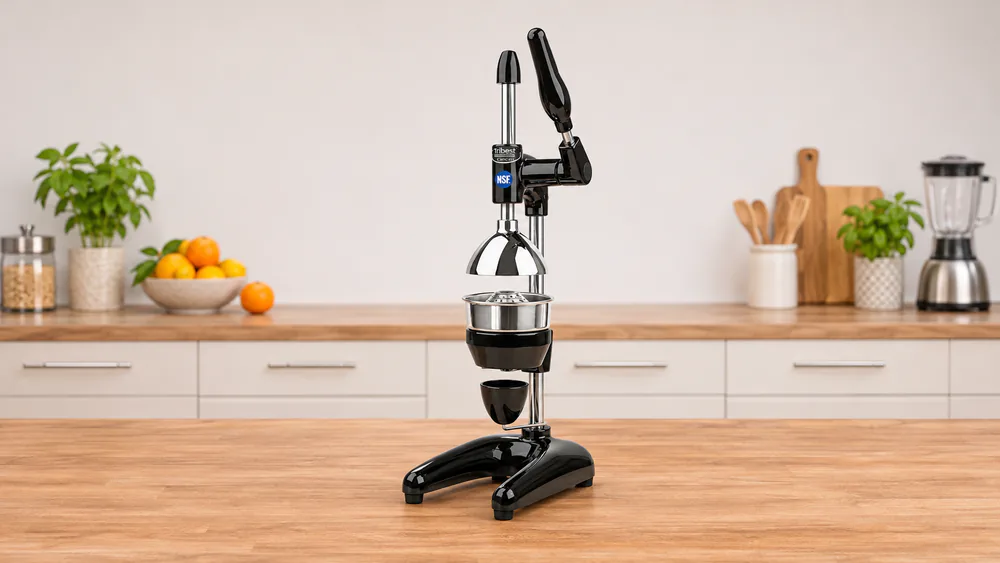
The press has a locking stainless bowl and strainer, twist-release washing parts, a movable drip cup, and solid load-bearing bars. The bowl and strainer are type 304 stainless steel, which is the contact material that matters for juice.

What This Review Is Based On

We judge this press the way we judge every appliance that lands in a family kitchen: performance first, then size, noise, cleanup, and how safely a household of varied ages could use it. We score on the maker's specifications, operating manual, and warranty documents, plus the findings we report here: the press feels sturdy, stays steady, gives generous juice, and has a winding action that takes familiarization.

The fruit this press suits best is oranges, lemons, limes, and grapefruit, and oranges and pomegranates both make enjoyable juice with straightforward cleanup afterward.

Where we have not measured something, we say so. We have no controlled yield figure, no timed family batch, and no sound measurement, so none of those appear as numbers in this review.

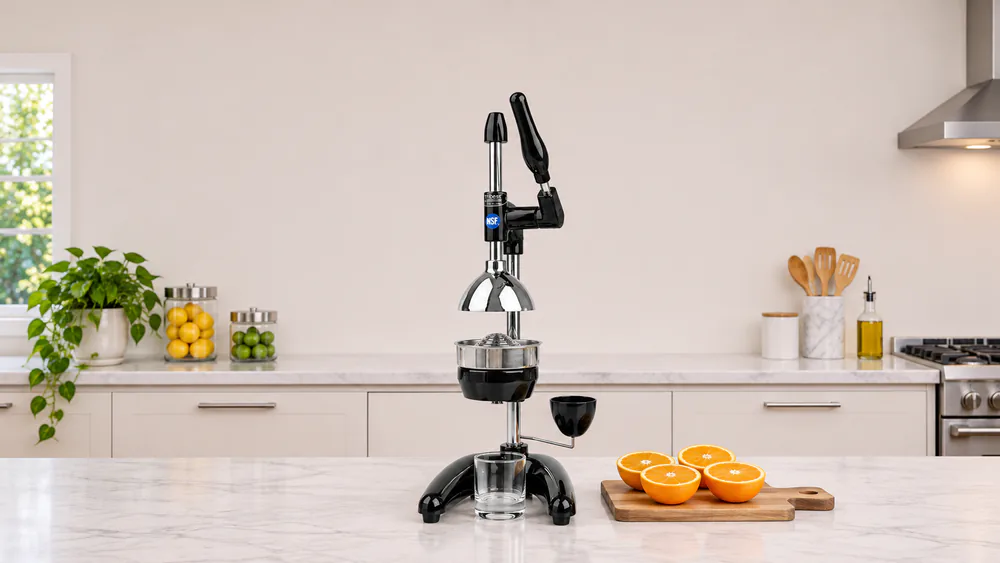
The black Tribest MJP-100 manual juice press on a kitchen counter with halved oranges beside it
The MJP-100 set up for a morning of orange juice.

Build Quality, Stability, and Counter Space

Stability matters most here. This press is built like a small piece of commercial equipment. It feels sturdy in use, and it stays steady on the counter while the arm turns. For a machine that applies this much force, stability is the feature we care about most, and the MJP-100 delivers it.

Frame, Pressing Parts, and Materials

The bowl and strainer are type 304 stainless steel. The load-bearing bars are solid metal, but the exact alloy is described differently in different places, so we will not make a claim about it. The mechanism is internal gears driving the arm, which is what lets the press reach its 200-pound rated force.

The manufacturer lists replacement parts for the bowl, strainer, gasket, drip cup, and drip-cup wire. Tribest's troubleshooting notes mention that a stiff arm can point to gear damage or oxidation, and that missing rubber feet can cause wobble. Those are possibilities the maker flags, not failure rates, and we have no data showing any part commonly gives out first.

Handle Clearance, Cup Clearance, and Storage

The body measures 7.5 x 11.4 x 21.7 inches and weighs 12.1 pounds. That is a tall, narrow footprint, but the height is the thing to check. The arm swings through a sweep we have not measured, and the 21.7-inch body height does not tell you how much room the operating arm needs under a cabinet. Measure your clearance before you commit to a spot.

The weight is the other storage fact. The MJP-100 is heavy to move, and the maker says to carry it upright from the lower body with both hands, never by the operating arm. In practice that means this is a press you leave on the counter. If your plan is to pull it out of a cabinet for every use, expect that to get old quickly.

How to Use the Press

Fruit Preparation and Positioning

Wash and halve the fruit. Seat and lock the strainer and bowl, center a juice container underneath, and swing the drip cup aside. Installing and removing the strainer and funnel becomes straightforward when you follow the locking instructions, and it is worth reading them the first time rather than guessing.

Place a half cut side up in the bowl. Fruit that is too big will not sit flat, so trim or choose a smaller piece if it rocks. Remove the spent peel between halves so the next one has room.

Pressing Technique and Safe Handling

Rotate the arm twice toward yourself to press, then twice in reverse to raise it. Turn with steady pressure rather than jerking the arm. A smooth turn keeps the press stable and the juice flowing into the cup rather than onto the counter.

Use a flat, nonslip surface and dry hands, and keep fingers clear of the bowl while the arm moves. The maker says to carry the press upright from the lower body and never to lift it by the arm. With children around, we would keep the arm and the bowl in adult hands. The maker has not stated a child-use approval, and we are not claiming one.

Warning. Never lift the press by its operating arm. Carry it upright from the lower body with both hands, and set it down on a flat, nonslip surface before you start turning.

Cleaning and Maintenance

After the pressing itself, cleanup is the next thing a busy household notices. The press has a small set of washing parts, and the removable bowl and strainer keep routine cleanup straightforward.

Removable Parts and Daily Cleanup

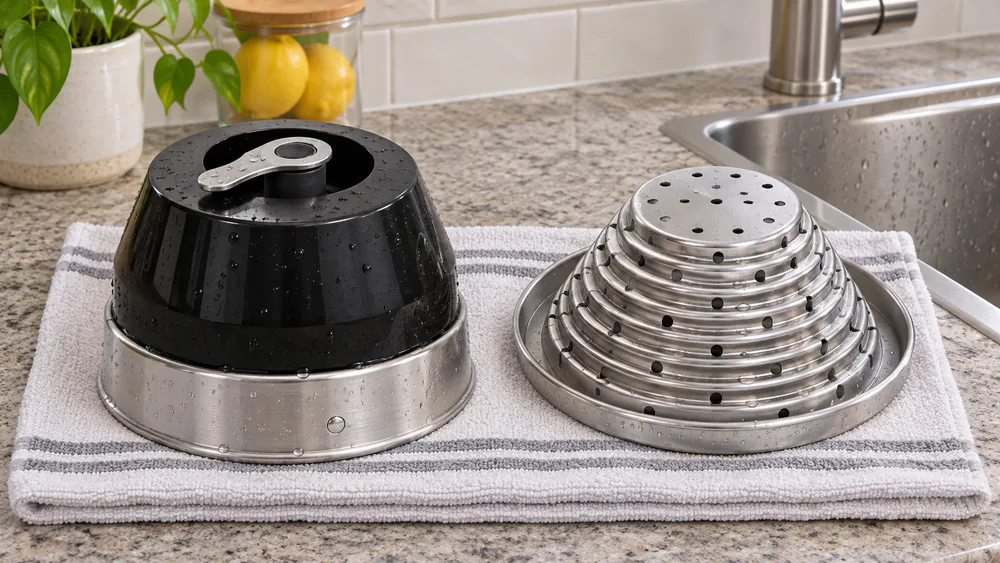
After pressing, twist out the locking bowl and strainer and wash them by hand. The manual limits cleaning water to 104 F (40 C), so skip the kettle. The small collection of washing parts makes cleanup manageable even on a busy weeknight.

We cannot tell you the press is dishwasher safe, because we have no model-specific approval and we will not borrow claims from other presses. Hand washing is the documented method. The manual recommends a mild cleaner in one passage but prohibits soap in another, so confirm suitable cleaning agents with Tribest before using dish soap.

Care of the Frame and Moving Parts

Wipe and dry the fixed upper press after each session. Do not submerge the frame, and keep water away from the gearing. Because the maker connects a stiff arm with possible oxidation or gear damage, drying the frame fully is cheap insurance.

The stainless steel bowl and strainer of the Tribest MJP-100 drying on a dish towel next to a kitchen sink after hand washing
The washing parts are few, and they twist apart for cleanup.

Price, Warranty, and Alternatives

We do not quote prices in this review, because they change and we would rather you check the current listing. In tier terms, the MJP-100 is a premium manual citrus press, and that is the right frame for the buying decision. You are paying for sturdy construction and gearing, not for features.

What to Verify Before Buying

The US household warranty is 3 years, subject to authorized-reseller and registration terms. Buy from an authorized seller and register the press, or you may void the coverage. Commercial-use coverage is murkier: the current product page includes commercial use, while the older warranty card excludes it, so confirm the terms for your specific purchase if you plan to use the press in a business.

We could not verify a return window, so check the seller's return terms before you buy. Confirm the model, too, since the Can-Can name appears on several models.

How Comparable Manual Presses Differ

The closest alternative is the Tribest Cancan MJP-105, a pomegranate-focused press from the same family with a larger bowl. Its wider bowl gives larger fruit more room, and its locking parts twist apart for cleanup. The 4.5-inch bowl is the reason to look at it if your fruit runs large.

Price, Warranty, and Alternatives

FeatureTribest Cancan MJP-100Tribest Cancan MJP-105
Main fitCitrusLarger fruit and pomegranates
Bowl diameter3.9 inches4.5 inches
Body W x D x H7.5 x 11.4 x 21.7 inches7.9 x 11.8 x 21.7 inches
Weight12.1 pounds13.2 pounds
MechanismRotary geared armRotary geared arm
Household warranty3 years, authorized US purchase terms3 years, authorized US purchase terms
Commercial warrantyConflicting documents; confirmOlder card excludes commercial use

If you mostly juice oranges and lemons, the MJP-100 is the better match and a little lighter. If you juice pomegranates or large grapefruit, the MJP-105's 4.5-inch bowl is worth the extra pound. An electric juicer such as those in our best orange juicers roundup will beat either press for speed, but it brings a motor, noise, and more parts to wash.

Final Verdict: Is the Can-Can Press Worth It?

Our overall score remains 4.3 out of 5. What is left is the choice between machines: pick the MJP-100 if citrus is your main fruit, and pick the MJP-105 if you regularly press large grapefruit or pomegranates.

Pros

  • Sturdy geared arm, rated at 200 pounds of squeezing force
  • Stays steady on the counter
  • Stainless bowl and strainer twist out for hand washing
  • 3-year household warranty on authorized US purchases

Cons

  • Heavy at 12.1 pounds, so it lives on the counter
  • Cranking adds work to big batches
  • The 3.9-inch bowl limits very large fruit

If you want a quick lever pull, plan to juice for a crowd, or need cabinet storage, an electric juicer or a lighter lever press is the better call.

Read next

Ready to press fresh citrus at home?

Explore our buying guides for more ways to make fresh juice part of your kitchen routine.