As an Amazon Associate we earn from qualifying purchases. We may earn a commission from links on this page, at no extra cost to you. Learn more.
In a house with five kids, a bag of oranges disappears fast, and the juicer on the counter has to keep up with a rushed school-morning breakfast. We judged five orange-compatible juicers on how well each fits an orange, how much hand effort it takes, how it handles pulp and seeds, and how painful it is to clean. If you want the short answer, the Breville Citrus Press Pro is the one we would buy first, but the right pick depends on your hands, your counter, and how many glasses you pour at a time.
We focus on what matters when a family shares one juicer: noise at breakfast, batch size, storage, and whether a teenager can rinse it without a lecture. You can also browse our juicer reviews if you are weighing a different style of machine.
How We Tested These Orange Juicers
Here is how we score a juicer. We judge every model against a family's morning needs: full glasses for the whole table, a quick serving before the bus, and a pile of cut oranges to juice before they dry out. Each juicer is used the way the manufacturers of these reamers and presses say to use it: washed oranges halved across the middle and set cut side down, peel left on.
We score each model on five things: how well it fits an orange, how much effort it asks of the hands and wrists, how much control you get over pulp and seeds, how easy it is to pour and collect juice, and how long cleanup takes afterward. We also weigh what a spec sheet does not tell you, like how loud the motor is at the breakfast table and whether the juicer is awkward to lift in and out of a cabinet.
Evidence Sources and Selection Criteria
We started with models that accept a full-size orange, since a lemon squeezer is the wrong tool for that job. The five picks cover the main styles: a powered lever press, a compact manual reamer, a cast-iron manual press, a hands-free electric juicer, and a budget electric reamer. We cross-checked every claim about dimensions, capacity, and warranty against the manufacturer's own product pages and manuals, and where published numbers disagreed, we say so instead of picking a favorite.
We do not quote product prices in this guide. Instead, we describe where each pick sits in the range, from the budget end to the splurge, because those figures shift too often to be useful.
Orange Fit, Juicing Effort, and Cleaning Trade-offs
Every juicer trades something. The powered lever press takes the most effort out of squeezing but needs the most counter height. The hands-free model removes the pressing altogether but adds handling between halves. The manual presses cost the least in electricity and noise and the most in wrist work. Cleaning is where the differences show up most, because pulp left to dry in narrow slots is a chore nobody enjoys at 7 a.m.
Best Orange Juicers at a Glance
Here is how the five picks line up, ranked by our own rating.
Product
Best role
Action
Collection
Cleanup
Our rating
Breville Citrus Press Pro 800CPXL
Everyday electric
Lower a powered lever
Separate glass
Dishwasher-safe juicing pieces
4.6
OXO Good Grips 2-in-1 Citrus Juicer
Compact manual
Twist fruit by hand
1.5 cups built in
Dishwasher-safe
4.5
Zulay Professional Heavy Duty Citrus Juicer
Manual lever press
Pull a cast-iron lever
Separate glass
Rinse removable pieces, wipe frame
4.4
Vinci Hands-Free Citrus Juicer
Hands-free
Load, latch, press a button
12-ounce bowl or open spout
Top-rack removable parts
4.3
BLACK+DECKER CJ625
Budget electric
Hold fruit on powered cone
Roughly quart-size pitcher
Top-rack removable parts
4.1
Best Electric Orange Juicer for Everyday Use: Breville Citrus Press Pro 800CPXL
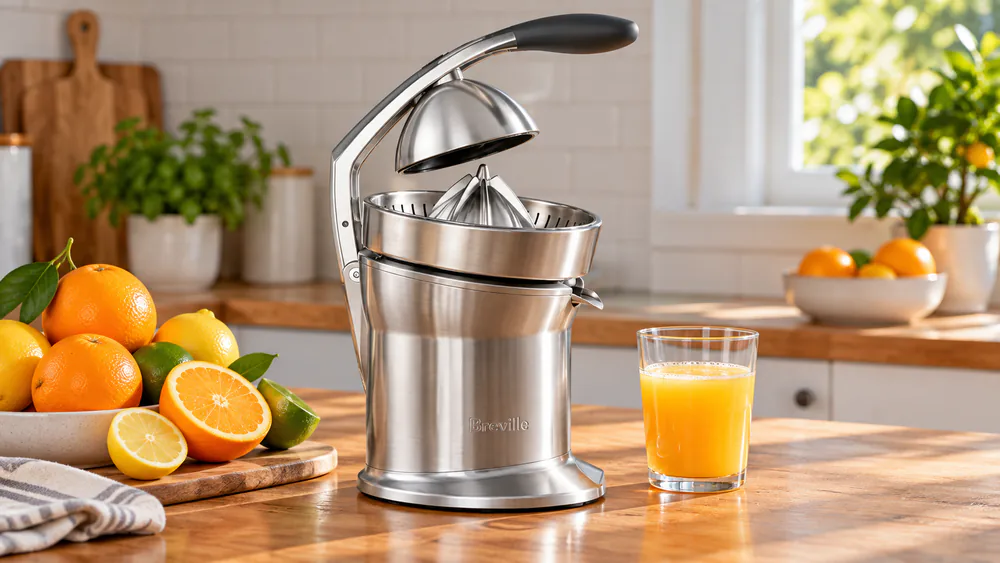
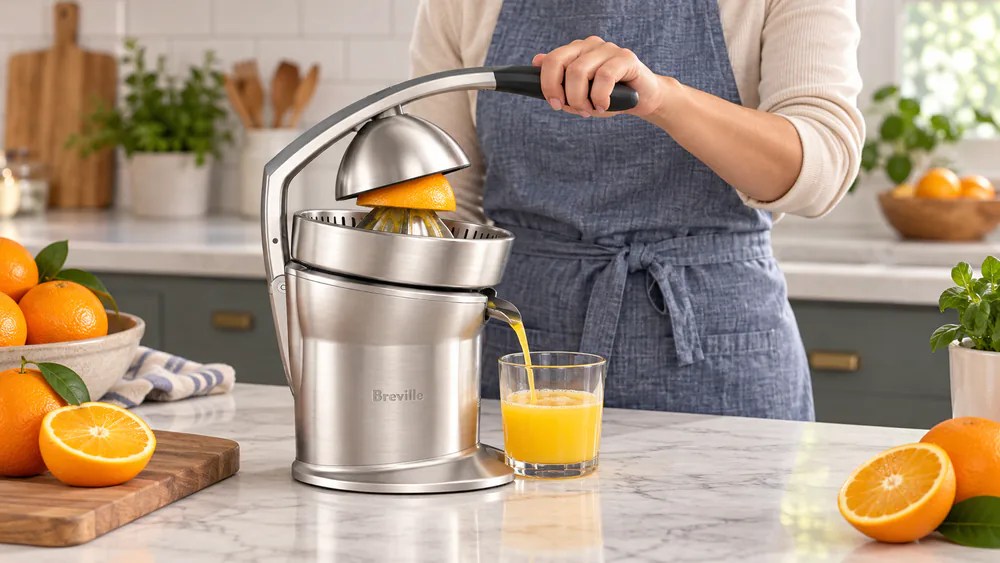
The Breville Citrus Press Pro is the juicer we reach for when there are four or five glasses to fill. The long lever does the work, the pointed metal cone holds a halved orange firmly in place, and the heavy body stays put while you press. The motor is quiet enough that it does not drown out a morning conversation, and a stop-drip spout with a shutoff flap makes swapping glasses less messy than on any other juicer in the group.
Pros
The long lever reduces squeezing effort, which matters when you press oranges back to back
Universal metal cone grips fruit securely and handles a wide range of orange sizes
Quiet motor, suited to an early breakfast
Captured pulp is easy to scoop back into the glass for pulpy juice
Cone, collector, filter, and fruit dome are dishwasher-safe
1-year limited warranty
Cons
The tall raised arm is awkward to store, and the handle does not lock down for compact storage
The lever makes over-reaming easy, and pushing into the pith can add bitterness
Orange peel can stick inside the upper dome and need removing between halves
Fixed strainer basket, so no pulp dial
The lever is what sold us. Pressing a half orange down onto the cone takes a gentle push rather than a wrestling match, which makes it the easiest of the five on the wrists. The lever makes it tempting to keep pressing after the juice stops flowing, so learn to ease off when the flow slows; grinding the rind can make the juice less sweet.
Space is the real cost. Allow extra clearance for the raised lever, because published dimensions of 7.6 x 10.3 x 14 inches do not describe the height of the arm when it is up. The 110W rating on the US manual is the figure we trust, since some retail listings quote 100W. If you keep appliances on the counter, this one earns the room. If you store everything in a cabinet, a shorter model will suit you better.
The long lever lowers a halved orange onto the metal cone with a light push.
Best Compact Manual Orange Juicer: OXO Good Grips 2-in-1 Citrus Juicer
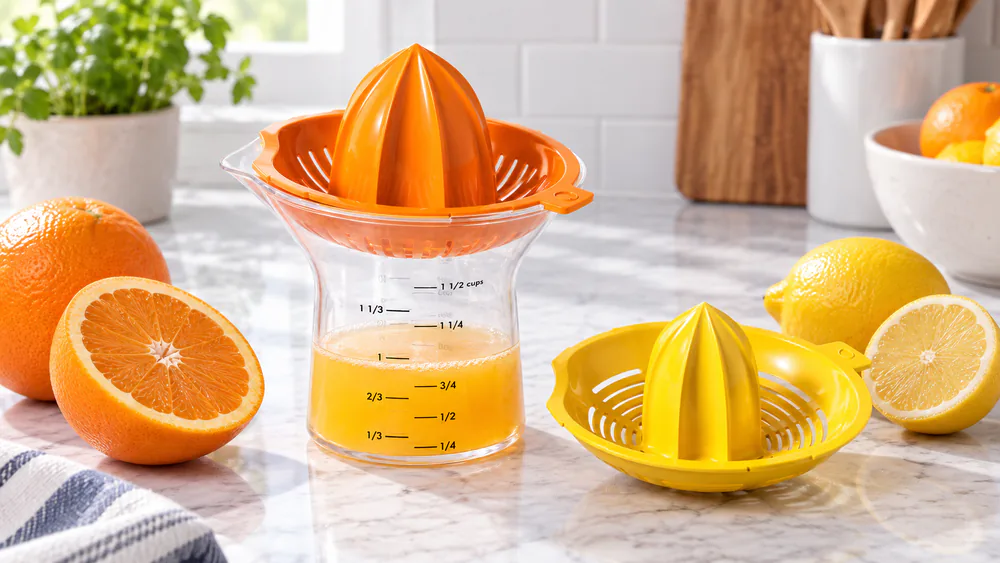
The OXO needs almost no counter space and has no cord; it tucks into a drawer while the Breville demands a permanent spot. It is a manual twist reamer with interchangeable small and large cones, seed-straining slots, and a measuring cup you can pour straight from. The snap-on cones sit securely on the cup, the cup is comfortable to hold, and the spout pours neatly. It asks for hand strength in return.
Pros
Built-in measuring cup is useful for single servings and recipe quantities
Snap-on cones sit securely, and the cup pours neatly
Cones snap off for washing and nest for storage
Dishwasher-safe and BPA-free
Compact at 5.2 x 5.7 x 8.5 inches
Cons
Manual twisting and downward pressure still require hand strength
Narrow cone slots can hold pulp, so inspect them even when the cup looks clean
Pulp can be awkward to recover from the strainer if you want it back in the juice
Completely smooth juice can still need an extra straining step
The marked capacity of 1.5 cups is enough for a couple of glasses, which suits a single breakfast but not a table of seven. Because the cup doubles as the measure, it is handy when a recipe calls for a quarter cup of fresh juice. Large oranges are easier with the large cone, and smaller fruit can be easier still, so match the cone to the orange and expect to supply the twisting force yourself. For kids learning to cook it is a simple tool, but it is not effortless for little hands, so we would supervise.
Cleanup is where it earns its rating. The cones snap off and nest for storage, and the whole thing is dishwasher-safe. A quick rinse right after use keeps pulp from drying in the narrow slots. We could not confirm a warranty duration for this model, so check the maker's guarantee page before you rely on one.
Best Manual Lever Press for Oranges: Zulay Professional Heavy Duty Citrus Juicer
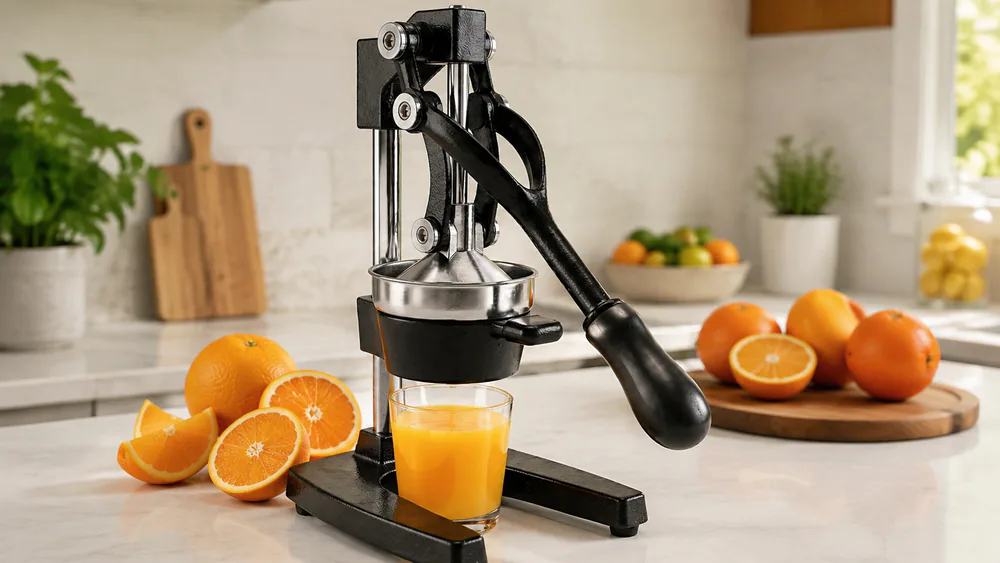
Lever power with no motor and no batteries: the standard Zulay gives you the Breville's pressing leverage in silence, though not its convenience. It is a cast-iron press, so it is heavy, and the space beneath the spout limits what you can put under it. Where the OXO relies on your wrist, this one relies on a long handle, and the removable straining pieces rinse clean without fuss.
Pros
Leverage makes pressing manageable without a motor
No batteries or outlet, and no motor noise at breakfast
Removable juicing pieces are straightforward to rinse
Rubberized feet and a removable strainer
Limited lifetime coverage for eligible household purchases under the published terms
Cons
The heavy body is awkward to lift in and out of storage
Limited room beneath the strainer makes taller collection vessels inconvenient
The base can slide, even with a towel underneath
A wide orange can protrude beyond the pressing area and leave juice at its outer edges
Hinge play and fasteners that are hard to tighten can make setup frustrating
Despite its weight, the cast-iron press can move during a hard pull, so steady it with one hand. On a stable counter the lever action is smooth, and it asks for less from the wrist than twisting a hand reamer.
The bowl is 5 inches across, so smaller or medium oranges work best. For a family batch, the tight clearance under the spout means pouring into a small glass and moving the juice to a larger pitcher, which adds a step. Tighten the fasteners carefully on first assembly. For cleaning, rinse the removable pieces and wipe the frame; dishwasher guidance differs between descriptions and applies to the removable pieces rather than the assembled press, so follow the supplied care directions. This one favors a permanent counter spot, because lifting it out every morning gets old.
Best Hands-Free Orange Juicer: Vinci Hands-Free Citrus Juicer
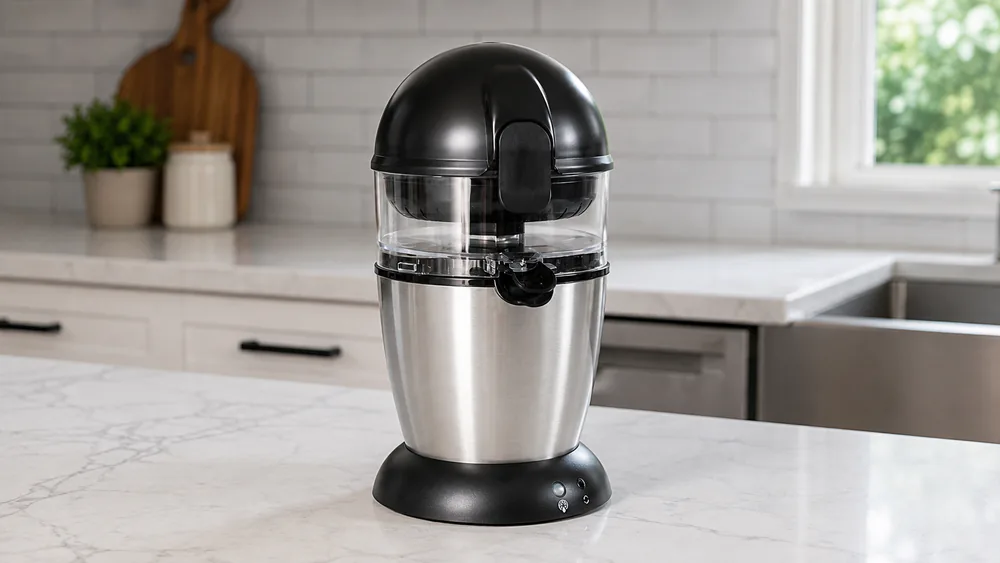
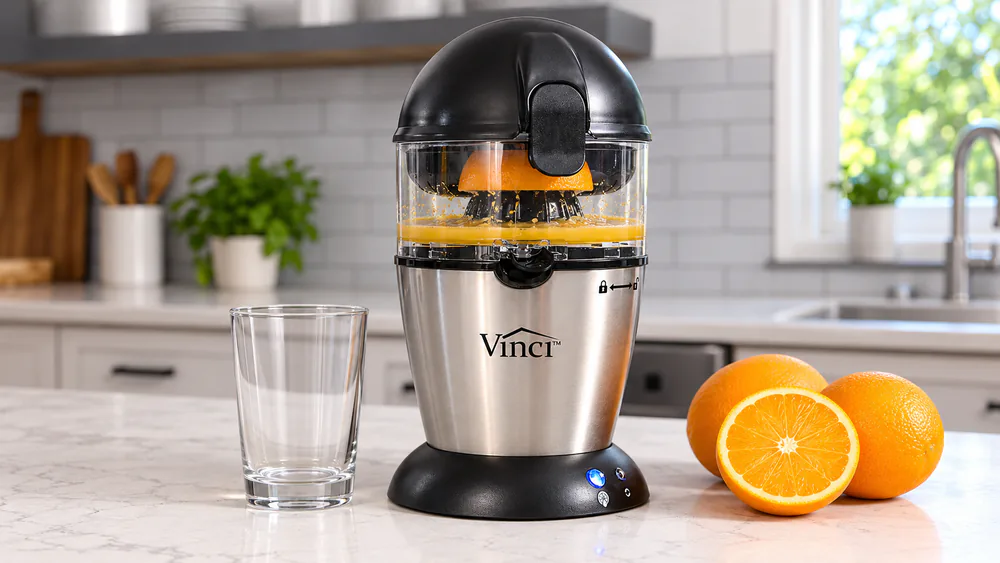
The Vinci's lid is both its best feature and its biggest limit: close it, press Auto Juice, and the motor raises and lowers the reamer for you, but the lid has to stay shut for the whole cycle. Unlike the Zulay, nothing here asks for a pull or a push. Fine and coarse pulp filters let you choose between smooth and pulpy juice, and the difference between them is real. It suits a cook with sore hands or anyone who would rather walk away from the counter while it works.
Pros
Closing the lid and pressing a button removes sustained downward hand pressure
Swapping fine and coarse strainers makes a useful difference to pulp texture
Accepts citrus up to 4.5 inches in diameter
Removable parts are top-rack dishwasher-safe, and the lid detaches
1-year warranty with registration within 30 days
Cons
Each half has to be loaded and latched, which adds handling between cycles
The motor makes an audible whir
A large grapefruit can make the lid difficult to close
Automatic extraction can still leave a bitter edge with some fruit
Hands-free does not mean automatic loading. The Vinci handles one citrus half at a time, so a pitcher of juice still involves a rhythm of load, latch, press, and open. What you save is the leaning and the wrist work, not the handling.
The 12-ounce juice bowl fills quickly with a few oranges, so plan on emptying it between rounds. The footprint is modest at 7 x 8.5 x 12.5 inches, but the lid needs extra clearance to swing open, so check the gap under your cabinets. The lid can also drop onto fingers if it is left partly open, so open it fully before loading and keep young helpers away while it runs.
Plastic juicing parts release pulp readily during ordinary cleanup, so rinsing is quick. Bitterness varies with the fruit and how much rind the reamer meets, so we would not promise juice that is never bitter. Register the warranty within 30 days.
Close the lid, press the button, and the reamer does the pressing.
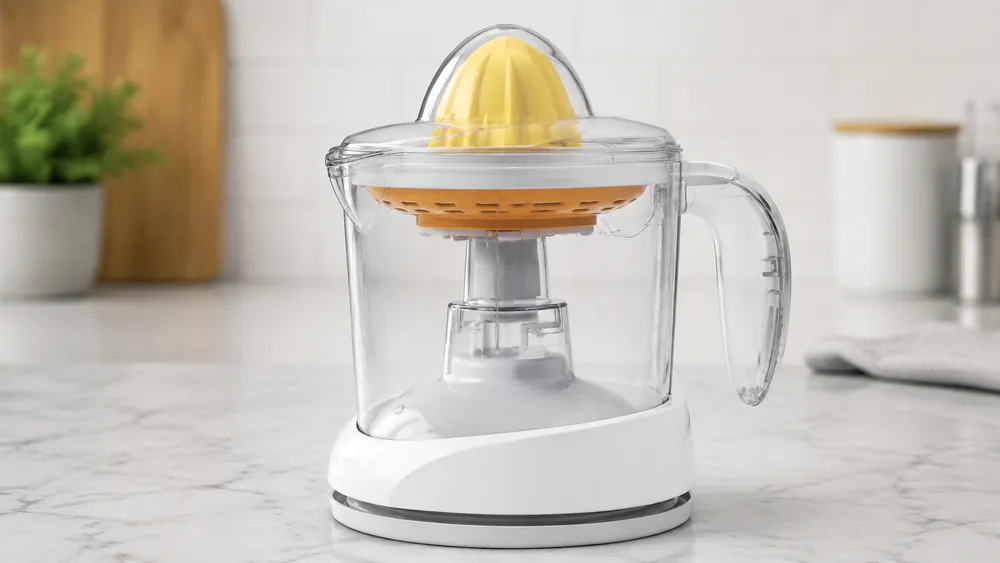
The BLACK+DECKER CJ625 is the budget electric choice, and it juices an orange perfectly well as long as you accept its limits. Unlike the Vinci, it is not hands-free: you press the fruit onto the spinning cone yourself, and the pitcher catches the juice directly, so you do not need a second glass. It is the model we would hand to a student or a first apartment, not the one we would run through a long Sunday brunch.
Pros
Pitcher catches juice directly, with no extra collection vessel
Pulp slider lets you vary juice texture, and the clear pitcher pours easily
Nesting large and small cones fit different fruit sizes
Compact and light, so cabinet storage is manageable
2-year limited warranty for household use
Cons
Hand pressure is still needed, and repeated oranges can tire the wrists
The motor is conspicuously loud, and the light body can move while you work
Layered pulp-control plates create more crevices to inspect when washing
The reamer socket can crack while the motor still runs, leaving the cone unable to turn
The motor spins the cone, but you provide the downward force, so a few oranges in a row will tire the wrists. The manual says not to run it for more than 10 minutes at a time, which is rarely a problem for one pitcher but worth knowing if you are juicing a whole bag. The light body can creep across the counter while you lean on it, and the motor is loud enough that we would not run it next to a sleeping baby.
The pitcher is roughly quart-size, though the published capacity is 32 ounces on the product page and 34 ounces in the manual, so we treat it as a quart and do not fill it to the brim. The cover, cones, strainer, and pitcher all go on the top rack, and the base wipes down without being immersed. The layered pulp plates have more crevices than the other models, so inspect them after washing.
How to Choose the Best Orange Juicer for Your Kitchen
The right orange juicer comes down to who is squeezing, how many glasses you make, and where it lives between mornings. The sections below walk through the choices we weigh most heavily.
The best orange juicer is the one you will still be willing to wash on a Tuesday morning.
Electric Reamers, Hands-Free Juicers, and Manual Presses
An electric reamer such as the BLACK+DECKER spins a cone while you press fruit onto it. A powered lever press like the Breville lowers fruit onto a stationary cone and does most of the work, at the cost of counter height. A hands-free juicer like the Vinci automates the pressing cycle, but you still load one half at a time.
Manual presses skip the motor entirely. A lever press such as the Zulay gives leverage, while a twist reamer such as the OXO gives you the smallest footprint and the most wrist work. If anyone in your house has arthritis or sore hands, lean toward the powered lever or the hands-free model.
Orange Size, Cone Fit, and Juice Yield
Orange size drives which juicer feels good. The Vinci accepts citrus up to 4.5 inches across, the Zulay bowl is 5 inches wide, and the OXO and BLACK+DECKER offer a choice of cones. Whatever you buy, cut oranges across the middle and place them cut side down for best contact.
Juice yield depends on the variety, ripeness, size of the fruit, and how well the juicer extracts. We would not trust a promise of a set number of ounces per orange. If a recipe needs a specific amount, juice and measure, then buy a few extra oranges.
Tip. Stop pressing when the flow slows. Pushing past that point into the white pith, especially with a lever model, adds bitterness without adding much juice.
Pulp Control, Seed Straining, and Pouring
Pulp preferences split a family quickly. The Vinci offers fine and coarse filters, the BLACK+DECKER a pulp slider, and the Breville and OXO fixed baskets or slots. Seeds are caught by all of them, but expect to pass juice through a strainer if someone wants it silky.
Pouring matters more than people expect. A juicer that drips into a glass saves cleanup; one that collects into a pitcher or cup saves a dish. Check how much room sits under the spout before you commit to a glass size.
Batch Size, Counter Space, and Storage
Match the collection size to your crowd. The Vinci bowl holds 12 ounces, the OXO marks 1.5 cups, and the BLACK+DECKER pitcher is roughly a quart. The Breville and Zulay juice into whatever glass you place beneath them, which is flexible, but only if the glass fits.
For storage, the two lever presses are counter residents, the BLACK+DECKER is light enough for a cabinet (published dimensions disagree, so check the current unit), and the OXO tucks into a drawer.
Cleaning, Build Quality, and Warranty
The rule that held across all five is to rinse promptly. Dried pulp in narrow slots turns a two-minute job into a scrubbing session. Warranty terms vary a lot: the Breville carries 1 year, the BLACK+DECKER 2 years, the Vinci 1 year with registration within 30 days, and the Zulay a limited lifetime coverage with channel and region restrictions. We could not confirm the OXO term.
Warning. We do not recommend letting young children run any of these juicers unattended. None of the five has an independent child-use assessment behind it.
Build quality matters, but we would not use these notes to predict a lifespan. Isolated failures show what to watch for, such as a cracked reamer socket or a mechanism that presses less well over time, not what typically breaks first.
How to Use and Clean an Orange Juicer
Preparing Oranges for Your Type of Juicer
Wash the fruit, cut it across the middle, and place it cut side down with the peel left on. Roll or press oranges on the counter first if you like. For a lever press, seat the half firmly before you pull. For a hands-free juicer, confirm the lid is fully open when you load and fully closed before you start the cycle.
Work in rounds. Juice a few halves, empty the collection vessel, and clear any peel stuck in the dome. That small rhythm keeps pulp from piling up and keeps the juice flowing.
Cleaning Removable Parts and the Motor Base
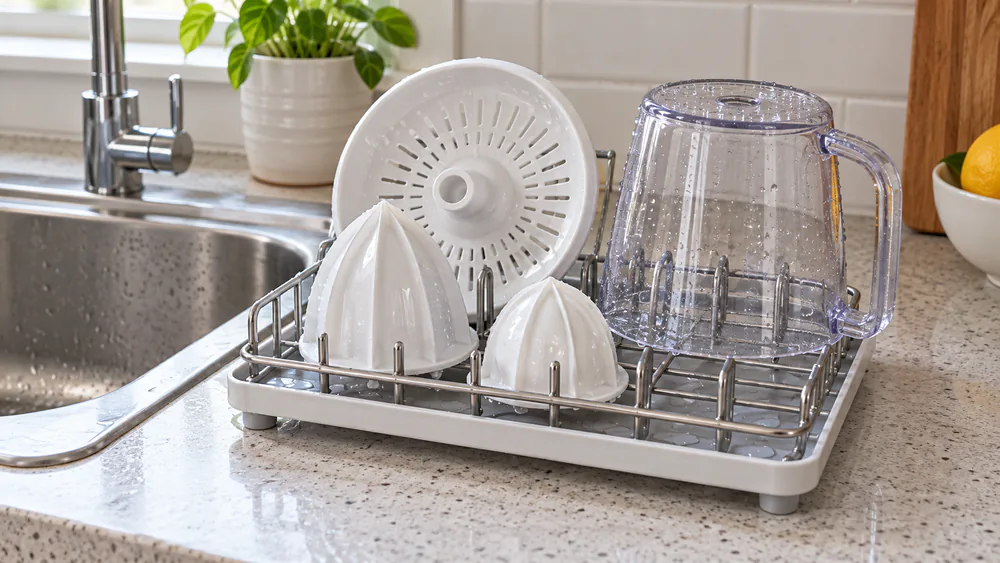
Cleaning is the part families skip, and it is the part that decides whether you keep using the juicer. Rinse removable pieces right away so pulp does not dry in the slots. For electric models, unplug before taking anything apart, and never immerse the motor base. Wipe it with a damp cloth instead.
Most removable parts on the Breville, BLACK+DECKER, Vinci, and OXO are dishwasher-safe, with the BLACK+DECKER and Vinci parts on the top rack. Keep the Zulay frame out of the sink and wash only the removable food-contact pieces. Check narrow slots and layered plates by eye before you put the juicer away.
Rinse parts right after juicing so pulp does not dry in the slots.
Orange Juicer FAQs
Do You Need to Peel Oranges Before Juicing?
Not for citrus reamers and presses. Halve a washed orange across the middle, place it cut side down, and leave the peel on. A general slow juicer is different, and it usually needs peeled citrus to avoid a peel flavor.
Can a Lemon Squeezer Handle Oranges?
Usually not well. A lemon-sized handheld squeezer can be too small for an orange, so choose a bowl or reamer made for orange-sized fruit.
Is a Citrus Juicer or a Masticating Juicer Better for Orange Juice?
A dedicated citrus juicer suits orange-only use because it takes halved fruit with the peel on. A masticating machine makes sense if you juice mixed produce, but expect to peel the oranges first.
How Much Juice Can You Expect from an Orange?
It depends on the variety, ripeness, size, and the juicer. We do not promise a fixed amount, so if a recipe needs a set quantity, juice an orange and measure what you actually get.
Can You Use the Same Juicer for Lemons and Grapefruit?
Often yes, but check the fit. The OXO's interchangeable cones suit different fruit sizes, while the Vinci takes citrus up to 4.5 inches across.
Final Verdict: Which Orange Juicer Should You Choose?
Choose by your kitchen, not by a single winner. If you have the counter height, the Breville is the one for a family that juices daily. For a small kitchen or a single glass at a time, the OXO is the easiest to live with. The Zulay suits a cook who wants a quiet cast-iron press and has a permanent spot for it, the Vinci is the better pick if your hands tire quickly, and the BLACK+DECKER is the pick when budget matters most and you can live with the noise.