
Helping you create a kitchen you love.

Kitchen Appliances

Best Nama Juicer: Which Model Fits Your Kitchen?

As an Amazon Associate we earn from qualifying purchases. We may earn a commission from links on this page, at no extra cost to you. Learn more.

Best Nama Juicer: Which Model Fits Your Kitchen?

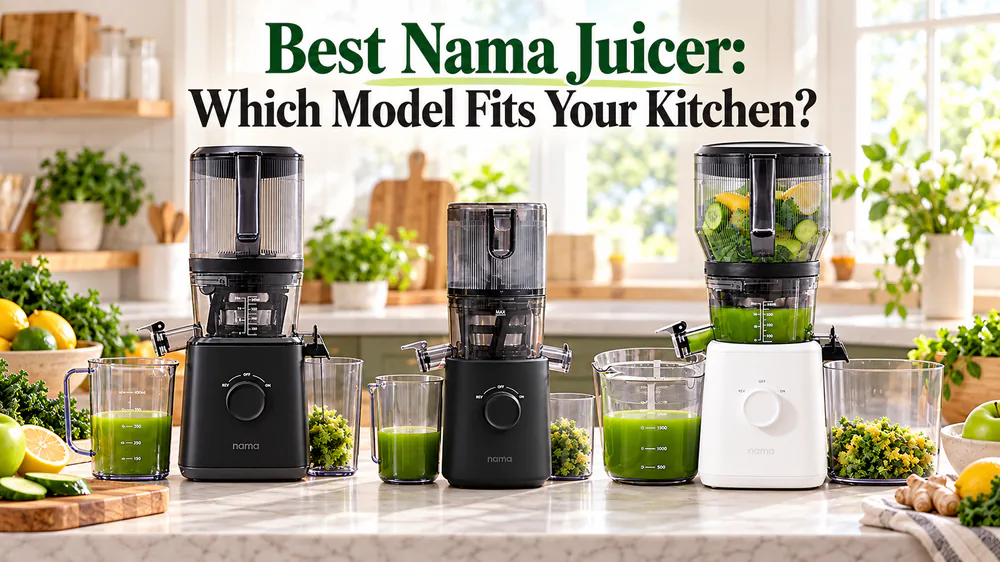
The question with Nama juicers is never which one is fanciest. We scored each model on how well it fits your counter, your batch size, and your patience for cleanup.

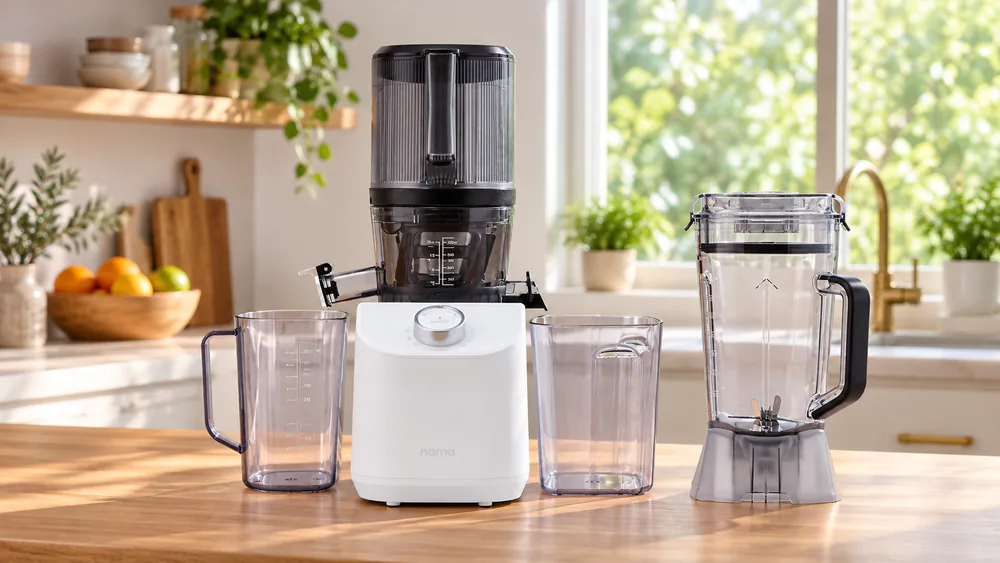
The four models share a slow-pressing design and a long warranty. They differ in hopper size, footprint, and whether they also blend. If you want a wider view of the category, see our juicer reviews.

How We Tested the Nama Juicers

Here is how we rate: juice quality, how much prep the produce needs, how hard the cleanup is, and how much space the machine takes up. No brand paid for placement. We judge carrot, apple, kale, celery, and citrus results, plus what the washing-up looks like afterward.

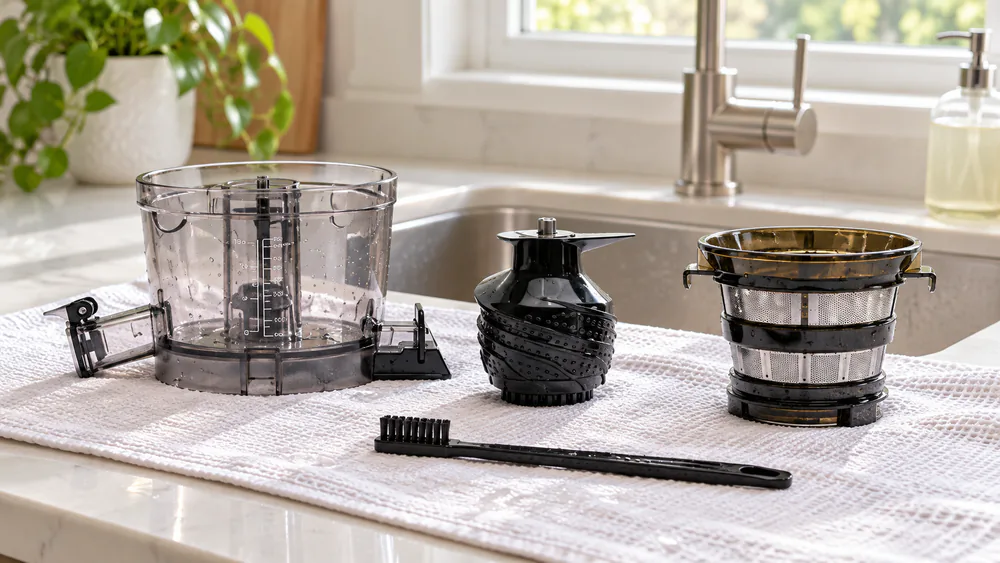
Disassembled Nama juicer chamber, auger, strainer, and cleaning brush drying on a kitchen towel next to the sink
Chamber, auger, strainer, and brush drying after washing.

Best Nama Juicers at a Glance

The table below puts the four models side by side. Hopper size describes space for produce, not the amount of finished juice.

ProductBest forProduce hopperClosed size (W x D x H, in)MotorFunctionsWarranty
Nama J2Regular daily juicing70-ounce9.8 x 9.0 x 17.7200WJuice15-year, terms apply
Nama J3Small kitchens, smaller servings34-ounce8.9 x 6.5 x 15.4130W per the manufacturerJuice15-year, terms apply
Nama J2 XLLarger household batches105-ounce9.8 x 9.7 x 17.7200WJuice, sorbet attachment15-year, terms apply
Nama C2Juice plus blending70-ounce10.1 x 11.6 x 20.0 (juicer)200W juicing, 1000W blendingJuice, blend, sorbet15-year, terms apply

1. Nama J2: For Everyday Juicing

Nama J2
1

Nama J2

Best for Everyday Juicing
Check Price on Amazon

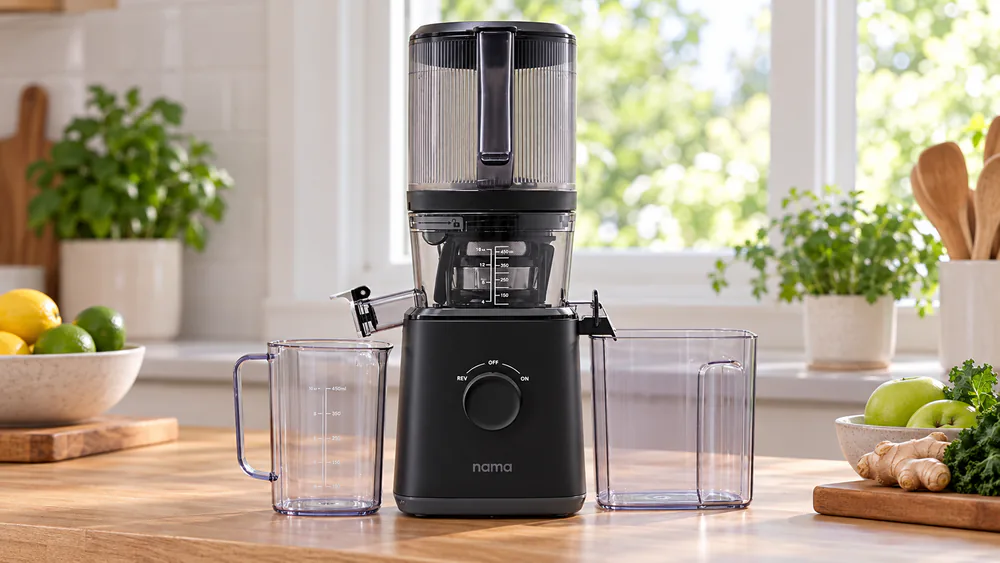
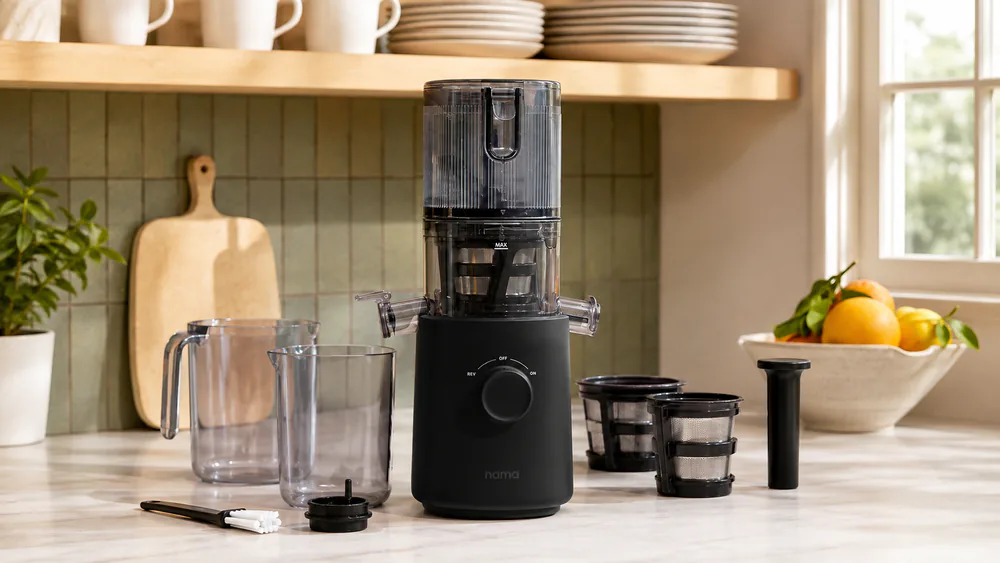
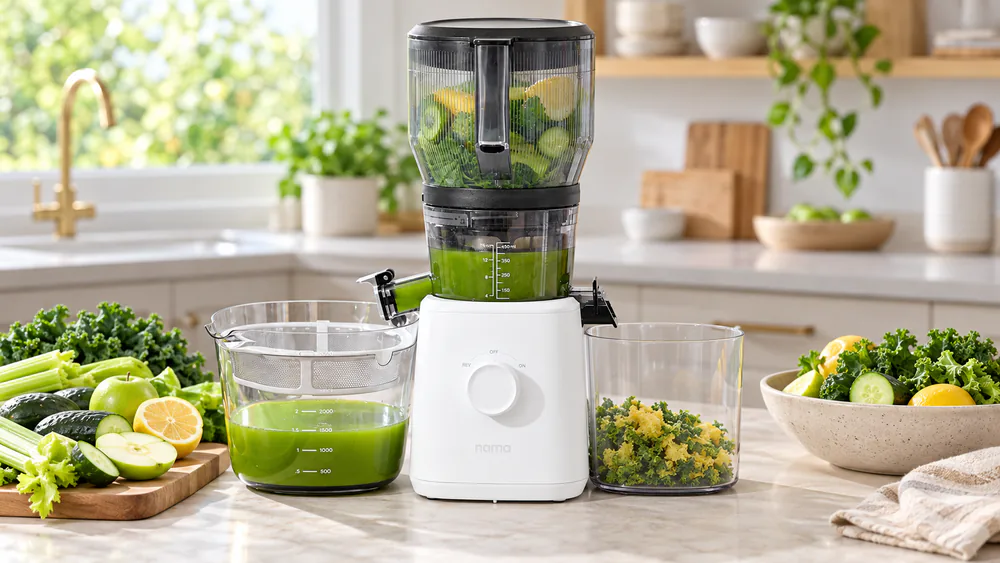
The J2 is the model we would buy first. Carrot and apple juice came out sweet with little foam, and kale juice was smooth with very little pulp. The 200W motor presses at 50 RPM, and the self-feeding 70-ounce hopper means you are not pushing produce down all morning.

Pros

  • Low-foam juice from carrots, apples, and kale
  • Quiet running and a solid feel
  • 15-year warranty on all parts for normal household use

Cons

  • The pulp outlet gasket is easy to lose
  • The mesh strainer needs careful brushing

After we loaded the hopper, the machine ran smoothly and felt solid without needing our attention. Leafy greens gathered into a ball before loading left drier pulp than loosely dropped leaves. After the batch, rinsing removed most residue, but fibers caught in the internal ridges needed the cleaning tool.

Assembly takes attention at first, because the parts must align. The mesh strainer needs targeted brushing, and the small pulp outlet gasket is easy to misplace while washing. Without it, celery can back up.
2. Nama J3: For Smaller Kitchens

Nama J3
2

Nama J3

Best for Smaller Kitchens
Check Price on Amazon

The J3 takes up less counter space than the J2 but holds less produce, so it needs more frequent refills. Larger recipes need refills, and the lid must be closed again before pressing resumes. Carrot and ginger leave relatively dry pulp.

Pros

  • Smallest footprint of the four
  • Easy to store and take apart

Cons

  • Larger recipes need topping up
  • Fibers hide in the filter and pulp outlet

It stands 15.4 inches tall with a 34-ounce hopper, so it tucks away easily and looks fine left on the counter. Disassembly is straightforward, and the small chamber handles peeled oranges well.

Adding ingredients in stages interrupts the run: we stopped, opened the lid, added more, closed it, and turned the dial again. After rinsing, most parts ran clear, but small fibers stayed in the filter, beneath the auger rim, and at the pulp outlet, so keep the brush handy.

3. Nama J2 XL: For Larger Batches

Nama J2 XL
3

Nama J2 XL

Best for Larger Batches
Check Price on Amazon

The J2 XL keeps the J2's 200W motor and slow pressing speed but adds a 105-ounce Large Hopper with 50% more produce capacity than the standard 70-ounce hopper. It ships with a sorbet attachment and a large pitcher set. The payoff is fewer refills during family batch preparation, and the cost is more parts to wash and store.

Pros

  • 105-ounce hopper means fewer refills
  • Sorbet attachment and large pitcher included

Cons

  • Extra large parts add washing and storage
  • Deeper than the J2

The Large Hopper seats securely and cleans much like the standard one.

4. Nama C2: For Juicing and Blending

Nama C2
4

Nama C2

Best for Juicing and Blending
Check Price on Amazon

Start with what the C2 cannot do: it cannot be small or quiet. At 20.0 inches tall with the juicer fitted, and taller still with the blender, it demands open counter space and cupboard room for the spare attachments. A tight blender lid and the juicer alignment can make early assembly awkward.

Pros

  • Juices, blends, and makes sorbet from one base
  • Blender cleaning program reduces scrubbing

Cons

  • Tall, heavy, and storage-hungry
  • Blender mode is loud

What you get is a cold-press juicer and a 1000W blender on one base. Juicing mode runs at 200W with a 70-ounce hopper, and frozen-fruit smoothies blend evenly.

Fitting the blender jug for a frozen-berry smoothie needed clear space above the base, and the assembled blender had to be pulled forward from under overhead cabinets. The smoothie cycle pulsed loudly through ice and berries, yet the drink finished evenly blended. Cleanup was simpler on the blender side, with warm water, dish soap, and the cleaning program.

Nama J2 vs J3 vs J2 XL vs C2: Which Should You Choose?

J2 or J3 for your daily routine

Pick the J2 if you juice most days and want fewer refills. Pick the J3 if counter space is tight and you make one or two servings at a time.

J2 or J2 XL for larger batches

If you cook for a family, the XL's 105-ounce hopper saves real time. If you already own a J2, the Large Hopper is an add-on that extends it.

When the C2 makes sense

Choose the C2 only if you would otherwise buy a separate blender. If you want a plain juicer, it is more machine than you need.

How to Choose the Best Nama Juicer for You

Batch size, hopper capacity, and preparation

Hopper capacity is produce space, not juice. Prep still matters on every model: core apples, remove hard pits and tough skins, and cut fibrous celery and kale short before loading.

Counter space, storage, and portability

Check the closed height against your cabinets, then add room to open the lid. The J3 is the easy one to store. The C2 is the hardest.

Cleaning, assembly, and everyday upkeep

Wash every part by hand, promptly. Lift the chamber off the base before taking it apart, brush the screen and pulp outlet, and dry everything before reassembly.

Note. The Nama M1 is a plant-milk maker, not a produce juicer. The Large Hopper is an accessory for the J2, J2 XL, and C2, not a complete juicer.

How cold-press juicing affects your choice

A slow auger presses juice out of pulp, which is what the 50 RPM figure describes. That gives you low foam and dry pulp. It does not guarantee better health outcomes, so choose on taste, speed, and cleanup.

Functions, warranty, and long-term value

All four models carry a 15-year warranty on all parts for normal household use, and direct purchases have a 30-day return window. Replacement augers, strainers, chambers, and gaskets are catalogued. Skip the blender or large hopper if you will not use them.

Frequently Asked Questions

Is a Nama juicer worth the price?

These are premium machines, with the J3 the entry point to the lineup. They earn their keep if you juice often. If you juice only now and then, a cheaper machine makes more sense.

Can you put whole fruit in a Nama juicer?

Not quite. Core apples, remove hard pits, and peel unsuitable skins first.

Which Nama juicer suits leafy greens and celery?

Cut them short before loading, and keep the pulp outlet gasket seated.

Is the Nama M1 a juicer?

No. The M1 makes plant milk from nuts, seeds, and grains, so it complements a juicer rather than replacing one.

Should you consider the J1 or a J2 hopper attachment?

The J1 is an older chute-fed design that needs more active feeding, and new-unit availability is uncertain. For bigger batches, the Large Hopper extends a J2, J2 XL, or C2.

Final Verdict: Choose for Your Routine

Nama is not for everyone. Skip it if you dislike hand-washing a dozen small parts, or if you want a fast centrifugal machine that takes whole fruit. A Nama earns its place only when daily juicing is a routine.

Read next

Final Verdict: Choose for Your Routine

Browse more buying guides to find kitchen tools that fit your daily routine.