As an Amazon Associate we earn from qualifying purchases. We may earn a commission from links on this page, at no extra cost to you. Learn more.
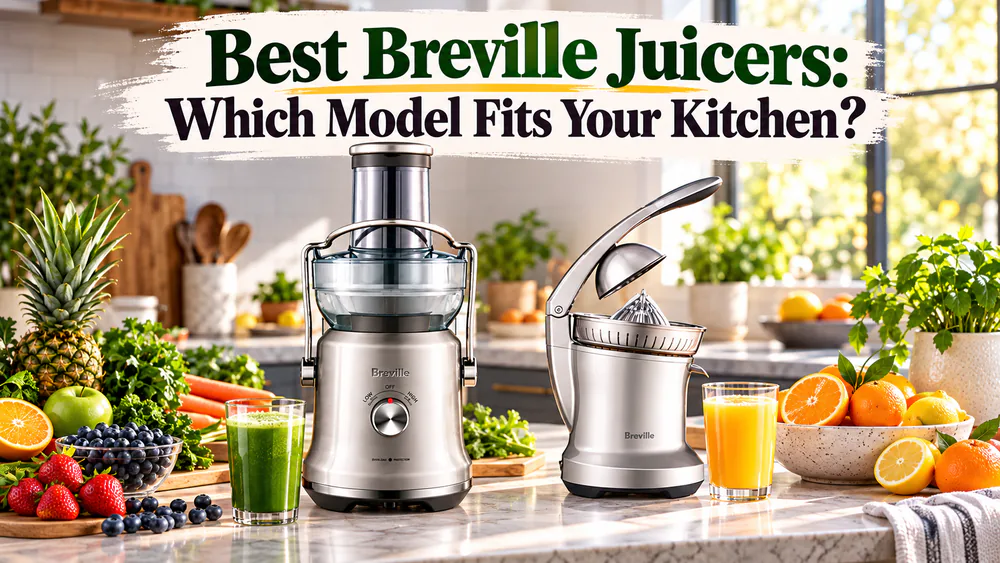
We judge a juicer by the work a family kitchen actually throws at it: a pile of carrots, a bag of apples, a bowl of oranges, and a sink that is already full. Across every juicer in our juicer collection, the Breville line gave us the clearest spread of sizes, motors and cleanup trade-offs, which is why we put the models side by side here. If you want the short answer, the Juice Fountain Cold Plus is the one we would buy for a busy household, and a Citrus Press is the better call if your routine is mostly oranges and lemons.
Most of the confusion around Breville juicers comes from the names. Cold, Cold Plus, Cold XL, Plus and Compact sound similar, but their jug sizes, chute widths, motor ratings and counter space requirements differ. The two Citrus Presses are a different kind of tool altogether. We sorted the lineup by what each one does well on a weeknight, what it makes you pay for in cleanup, and who it suits.
How We Tested These Breville Juicers
We score every model the way a family would use it. That means testing hard produce such as carrots, beets and apples, soft fruit such as pears and oranges, and leafy greens, using the pusher as directed in the manual. It also means weighing the cleanup, because that is what decides whether a juicer stays on the counter or ends up in the back of a cabinet.
Ease of feeding and washing matters in daily use, so both weigh heavily in our ratings.
Our scoring follows the same order we use for every appliance in a house with five kids. We look at performance first, then size, noise, cleanup, and whether a young cook can use it safely with an adult nearby. A juicer that makes great carrot juice but takes twenty minutes to wash after every glass does not earn a high mark from us.
A few ground rules shaped the results. We follow each model's manual for preparation and cleaning steps, including which parts can go in the dishwasher and which cannot. Where the published specifications disagree, we say so rather than pick a number we cannot stand behind. We do not chase a yield percentage, so you will not find a fake precision score in this article. What you will find is what each machine is like to feed and wash, and which parts are likely to annoy you.
Hard produce, soft fruit and greens, the mix we juiced through each machine.
Warning. A built-in locking arm is an assembly interlock, not permission for children to run the machine. Keep hands out of the chute, use the pusher, unplug before cleaning, and wait for the basket to stop spinning. In our house the juicer is an adult-supervised appliance, and kids help with washing produce and carrying the jug.
Best Breville Juicers at a Glance
Here is the quick version, sorted by who each machine fits best. We give the longer reasoning in the reviews below.
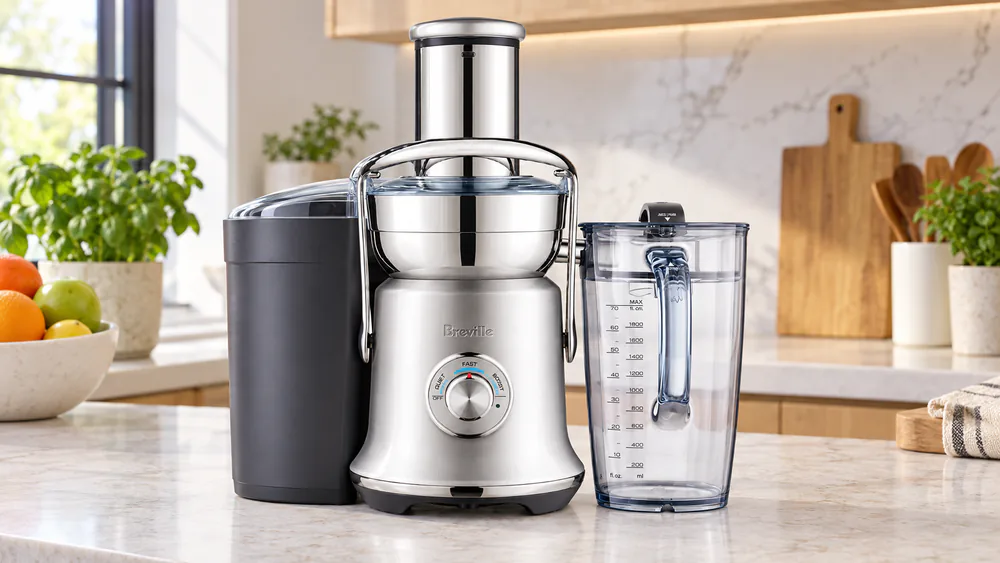
Best overall for families: Juice Fountain Cold Plus (BJE530BSS). A 70 fl oz jug, a 3.5-inch chute and a 1000W motor handle big batches with less cutting. It is the premium-tier pick among the juice fountains, and it needs real counter space.
Best for the biggest batches: Juice Fountain Cold XL (BJE830BSS). A 1200W motor and a Quiet setting for the splurge price tier. The cleanup has more parts to wrestle with than any other model here.
Best large-jug value: Juice Fountain Cold (BJE430SIL). The same 70 fl oz jug as the Cold Plus at a mid-priced tier, with a narrower 3-inch chute.
Best budget juice fountain: Juice Fountain Plus (JE98XL). A 35.2 fl oz jug and two speeds at a budget tier. It is loud, and it needs the pulp lid seated properly.
Best for small kitchens: Juice Fountain Compact (BJE200XL). A pulp compartment built into the body, a single speed and a small footprint.
Best citrus press: Citrus Press (BCP600SIL). A motorized reamer with an assisted lever for regular glasses of orange juice, at a mid-priced tier.
Best premium citrus press: Citrus Press Pro (800CPXL). A die-cast body and the same easy lever, with a handle that springs up and a premium price tier.
Compare Breville Juicer Models
The table lists the published specifications from the manufacturer's manuals and product pages. Dimensions are width x depth x height and describe the machine alone, not the extra room you need for the jug, the pulp bin and the overhead clearance. Asterisks mark figures that conflict between sources.
Product
Type
Juice capacity
Pulp capacity
Chute
Power
Dimensions, inches
Buyer fit
Juice Fountain Cold Plus (BJE530BSS)
Centrifugal
70 fl oz
3.9 qt
3.5-inch
1000W
13.1 x 8.7 x 17.6
Fast family batches with a rear pulp bin
Juice Fountain Cold XL (BJE830BSS)
Centrifugal
70 fl oz
3.9 qt
3.5-inch official specification*
1200W
13.4 x 8.7 x 17.4
Large batches with a Quiet setting
Juice Fountain Cold (BJE430SIL)
Centrifugal
70 fl oz
3.6 qt
3-inch
850W
13.6 x 8 x 16.7
Large jug at a lower price tier
Juice Fountain Plus (JE98XL)
Centrifugal
35.2 fl oz
2.6 qt
3-inch
850W
14.1 x 9 x 16.5 (independent measurement)
Entry-level two-speed juicing
Juice Fountain Compact (BJE200XL)
Centrifugal
25 fl oz marketed, 800 ml in the manual*
1.6 qt
3-inch
700W
9.1 x 9.8 x 15.7
Small batches and limited counter space
Citrus Press (BCP600SIL)
Motorized citrus press
Your own glass or jug
Strainer, no external bin
Halved citrus
110W
Published footprint differs*; allow room for the raised arm
Regular orange, lemon, lime or grapefruit juice
Citrus Press Pro (800CPXL)
Motorized citrus press
Your own glass or jug
Strainer, no external bin
Halved citrus
110W per the US manual*
7.6 x 10.3 x 14 listed; the raised arm needs more room*
Frequent citrus with heavier metal construction
Two patterns jump out. The three 70 fl oz machines are built for batches, while the Plus and Compact serve one or two people at a time. And the citrus presses sit in their own lane, because a centrifugal juicer needs the fruit peeled and a press does not.
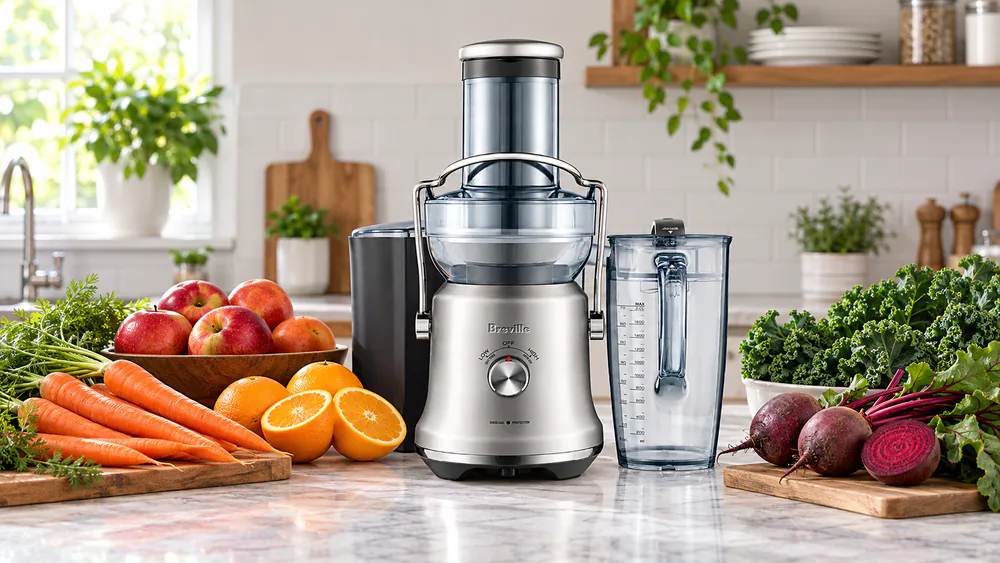
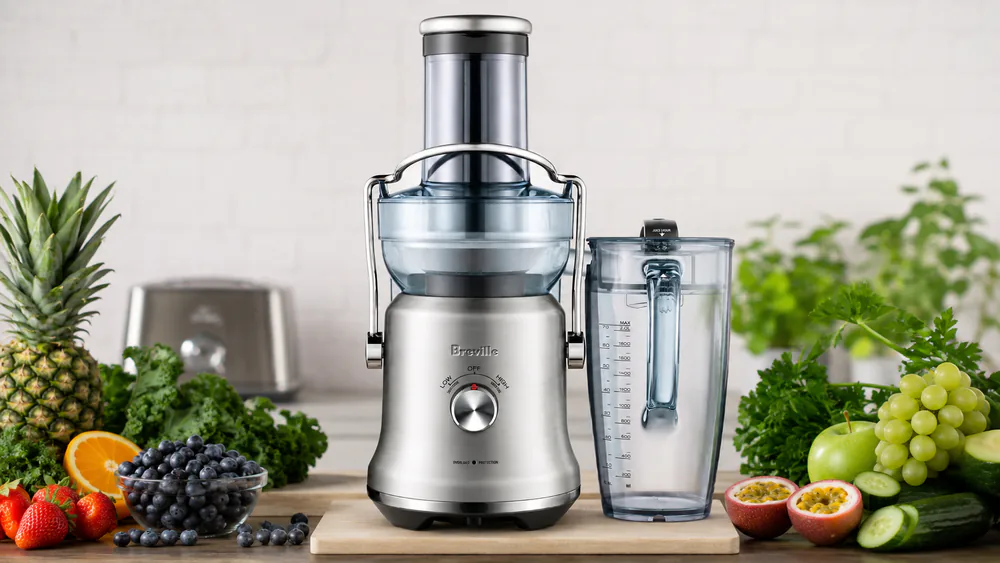
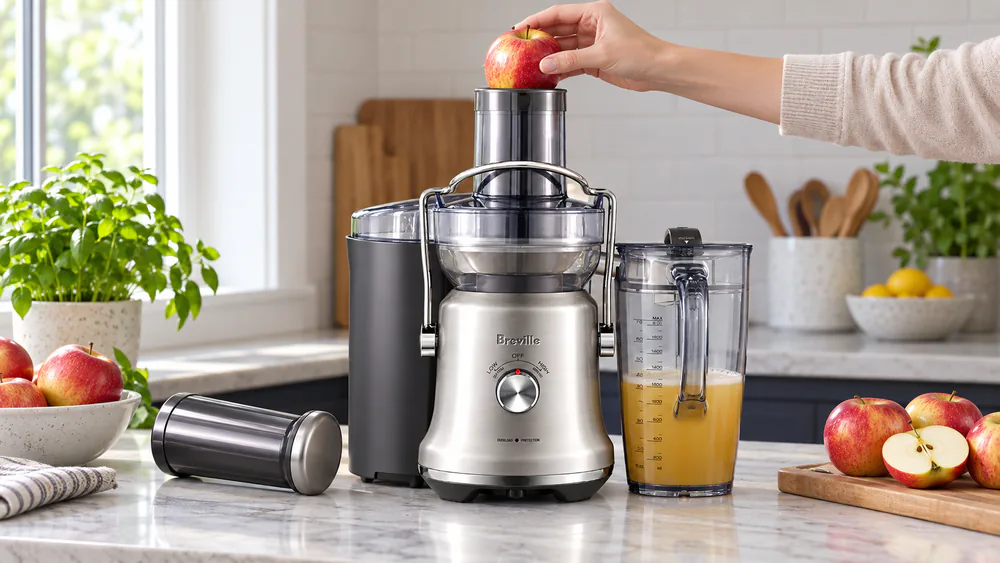
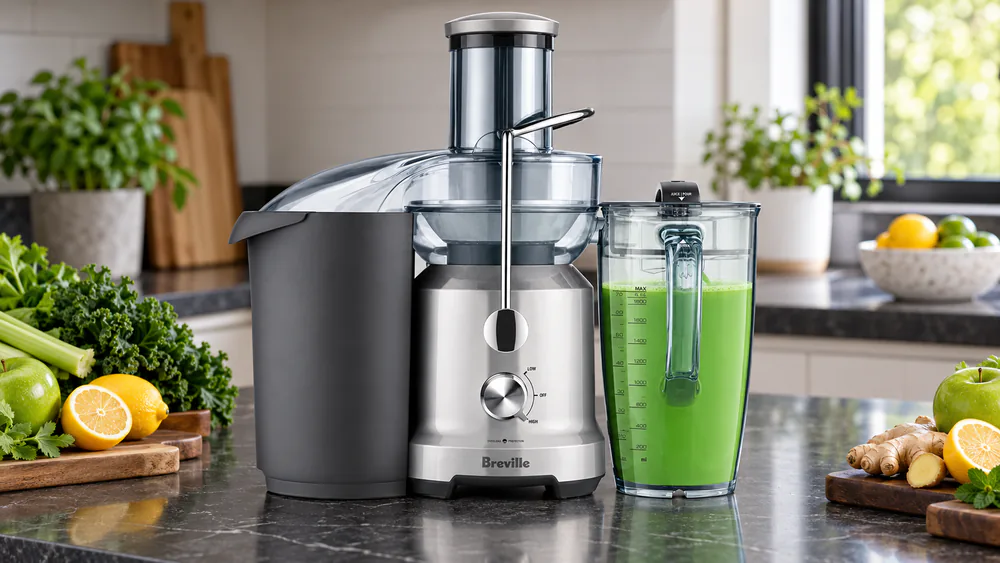
The Juice Fountain Cold Plus is the one we would buy for a family that juices more than once a week. Hard produce goes through quickly, and the 3.5-inch chute swallowed the apples that fit whole, so there was less chopping before breakfast. Apple, carrot and kale juice came out sweet with no noticeable pulp, and the 70 fl oz sealing jug is useful when you are pouring for a table instead of one glass.
Pros
1000W motor and 3.5-inch chute handle hard produce with less cutting
70 fl oz sealing jug with a foam separator suits batches
Rear pulp bin holds 3.9 qt, so it rarely needs emptying mid-session
Speed dial is easy to read, and the 1-year warranty matches the rest of the lineup
Cons
Bulky to store: the base, jug and pulp container take real cabinet space
Very large apples still need cutting, and the pulp can stay damp
Chute details and bowl recesses hold food that a quick rinse will not clear
The jug lid can be stiff to remove
The Cold Plus earns its place when you need a full jug fast. Large pieces feed readily, and the removable assembly comes apart without much effort. The speed dial has low and high settings that are easy to interpret, and the sealing pitcher with its pouring separator helps hold back foam. One honest note: a small serving barely covers the bottom of that large jug, so this machine rewards bigger batches.
The cleanup deserves a straight description. The large removable parts eat a lot of dishwasher space, so rinsing and washing them right away often felt simpler. The manual says to hand-wash the food pusher and wipe the motor base. The other removable parts can go in the dishwasher, with the mesh basket on the top shelf, though repeated dishwasher cycles can shorten the life of the parts. Brush the mesh promptly after juicing. Food also lodges around the chute details and bowl recesses, and those spots take more than a quick rinse.
The unit measures 13.1 x 8.7 x 17.6 inches, and storage stays awkward even with the rear-bin layout. If your counter is short on room or your cabinets are shallow, read on to the Compact. If you have the space and a family to feed, this is the one.
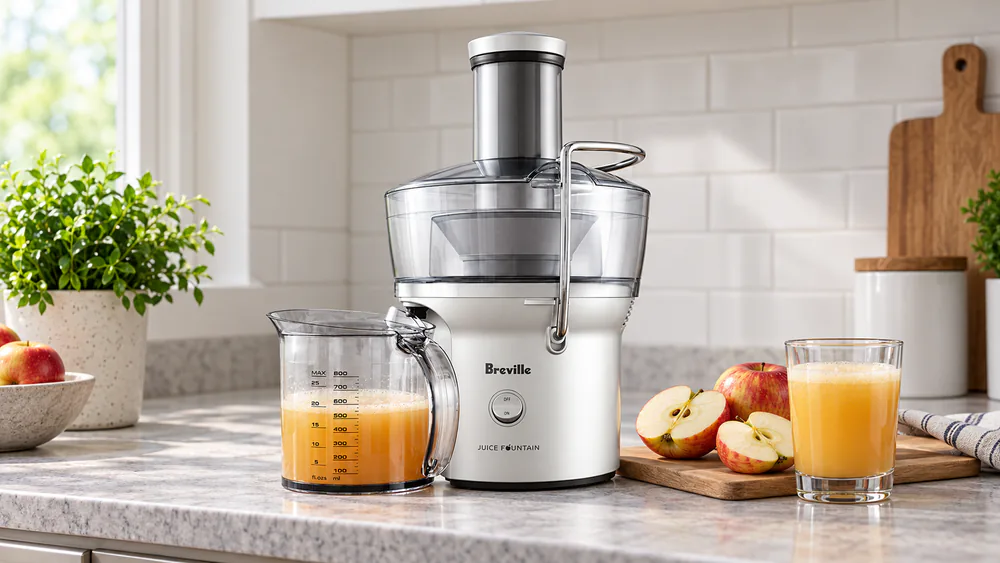
The wide chute takes apples that fit whole, which cuts down on prep.
Where the Cold Plus favors the wide chute and a rear bin, the Juice Fountain Cold XL has the most powerful motor in the lineup at 1200W, and it extracts fast. Whole carrots and medium apples need little cutting, and the 70 fl oz jug lets you juice for a crowd in one run. It sits at the splurge end of the price range, and the extra money buys speed and controls, not a different style of juice.
Pros
1200W motor and 70 fl oz jug for big batches
Quiet, Fast and Boost controls give you some say over noise
Rear pulp bin keeps the counter organized, and the parts fit together securely
3.9 qt pulp container for long sessions
Cons
Disassembling and washing the many parts takes time
Fine mesh and hidden bowl rims trap pulp and need deliberate brushing
High speed is still conspicuous in a kitchen
Storage requires a large space
The honest drawback is cleanup. Extraction is fast, but taking the machine apart and washing the many parts takes time. The separated pieces can fill a sink, which is why we only think the XL is worth running for larger batches. If you are juicing one glass at a time, the cleanup effort outweighs the speed.
Noise is the one place the XL tries to help. The Quiet mode is designed to reduce mechanical noise, and low-speed operation is quieter than high speed. Fast operation remains audible, though, and we would not call this a machine for juicing while a sleeping baby is in the next room. A poorly aligned pulp bin can let debris escape at the back, so seat it fully before you start.
The manual's care steps are worth following exactly. Hand-wash the cover and the pusher, and wipe the base. The component diagram calls the cover dishwasher safe, but the cleaning section excludes it, so we hand-wash it. The unit measures 13.4 x 8.7 x 17.4 inches. The manufacturer's specification lists a 3.5-inch chute, though some product copy says 3 inches, so confirm that on the box if chute width is the deciding factor for you.
Where the Cold XL charges a splurge price for speed, the Juice Fountain Cold gives you the big jug without the premium tier. The 850W motor and the 70 fl oz jug do the job for a household that juices carrots, apples and oranges in batches, and the machine stays planted during juicing. The trade is a 3-inch chute, which means more cutting than on the Cold Plus.
Pros
70 fl oz jug at a mid-priced tier
Easily emptied pulp bin holds 3.6 qt
Smooth carrot juice, and the jug separator helps restrain foam
Stays planted on the counter while it runs
Cons
Loose kale can blow back up the chute and leave unprocessed pieces in the pulp
Carrot and beet juice can carry a heavy foam layer
Carrot pigment can stain the plastic parts, and recesses retain wash water
Occupies a substantial work area
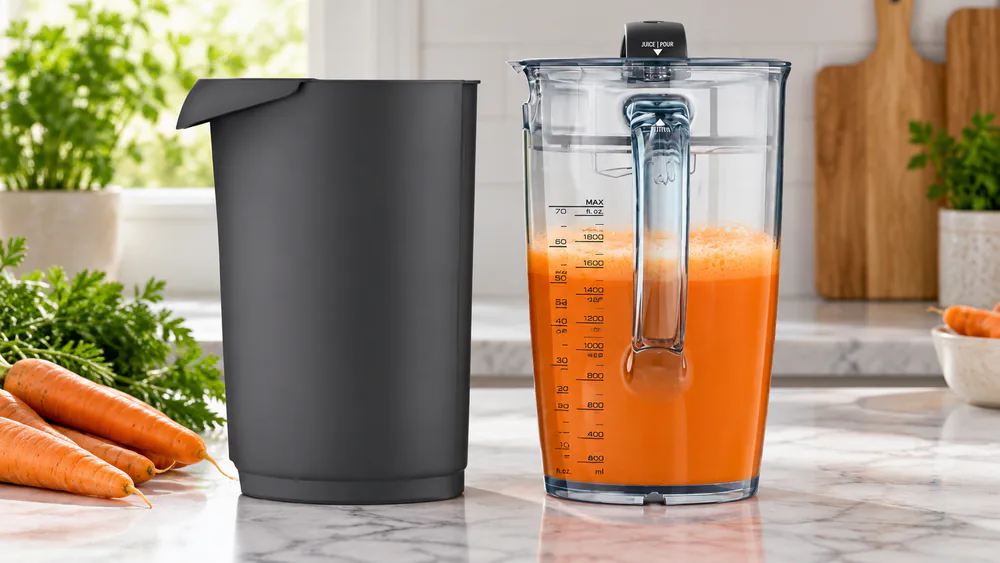
Carrot juice comes out smooth. Orange and mixed juices carry foam, which the jug separator helps restrain, and carrot and beet juice can build a substantial foam layer. If a thick head on your glass is a dealbreaker for the kids, plan on spooning it off or letting it settle.
Leafy greens are the weak spot. Loose kale can blow back up the chute and leave unprocessed pieces in the pulp bin, so we would not buy this machine mainly for green juice. The residual moisture in the discarded pulp can also make extraction feel wasteful, so a second pass through the pulp is a habit worth trying.
Cleanup needs more care than the specs suggest. The manual says to hand-wash the cover and the juice jug with its lid. The filter bowl, basket, food pusher and pulp bin are top-shelf dishwasher safe. Wipe the base, and brush the basket right after juicing, because the mesh needs the supplied brush to clear fine residue. A large sink makes the bulky parts easier to wash. The unit measures 13.6 x 8 x 16.7 inches.
Carrot juice from the Cold comes out smooth, with foam on top.
Where the Cold trades on its big jug, the Juice Fountain Plus is the entry point for people who want a real centrifugal juicer without paying for a 70 fl oz jug. The 850W motor with a titanium-reinforced cutting disc handles hard produce well. Beets and sweet potatoes process well, and apple juice tastes good. Leafy greens are less efficient.
Pros
850W motor with a titanium-reinforced cutting disc
35.2 fl oz jug and 2.6 qt pulp bin for one to three servings
Low and high settings, a cleaning brush and built-in cord storage
Budget price tier among the juice fountains
Cons
Operation is loud
Pulp can gather between the lid and body if the pulp-container hood is not seated correctly
Wet pulp and leakage around the pulp side are possible
Leafy greens come out less efficiently than hard produce
Setup and disassembly are straightforward, and the open pulp path is accessible when washing. The supplied brush makes the basket manageable, though crevices in the juice cup can need soaking. Cleanup involves several components, so it is more work than rinsing a drinking cup, but it is not worse than the bigger machines.
Two habits matter on this model. Check that the pulp-container hood is seated before you start, because pulp can gather between the lid and the body when it is not. And cut dense vegetables into smaller pieces. Produce can kick back before the pusher is in place, and smaller pieces reduce strain on the motor. With a 3-inch chute you will be cutting most things anyway.
The independent measurement of the body is about 14.1 x 9 x 16.5 inches. That is not far off the big Cold machines, which is a point worth weighing: if you have the counter for a Plus, the Cold's larger jug costs relatively little more. Warm soapy water is the safe cleaning method for the removable parts, and the 1-year warranty applies here as well. Check the supplied manual before you put anything in the dishwasher.
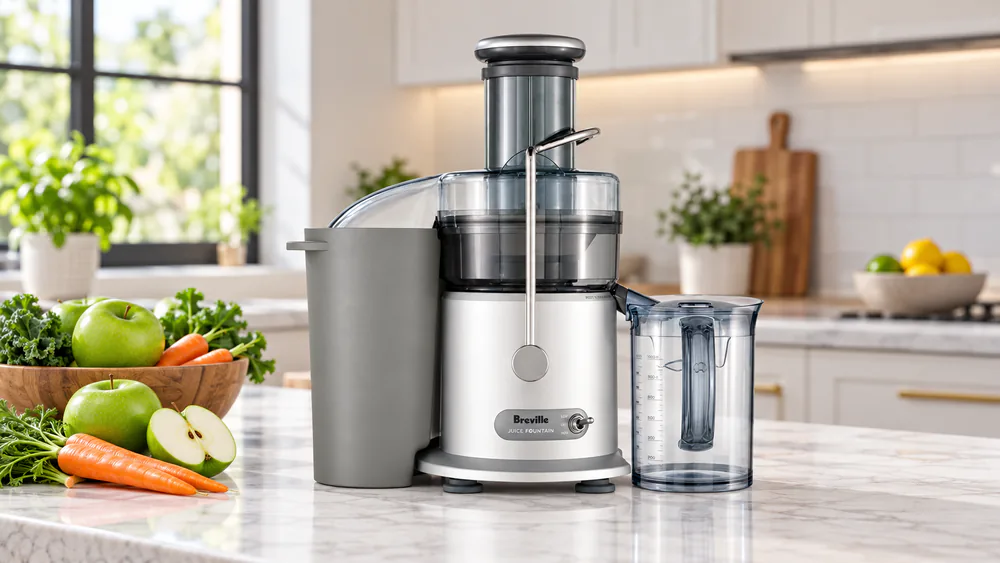
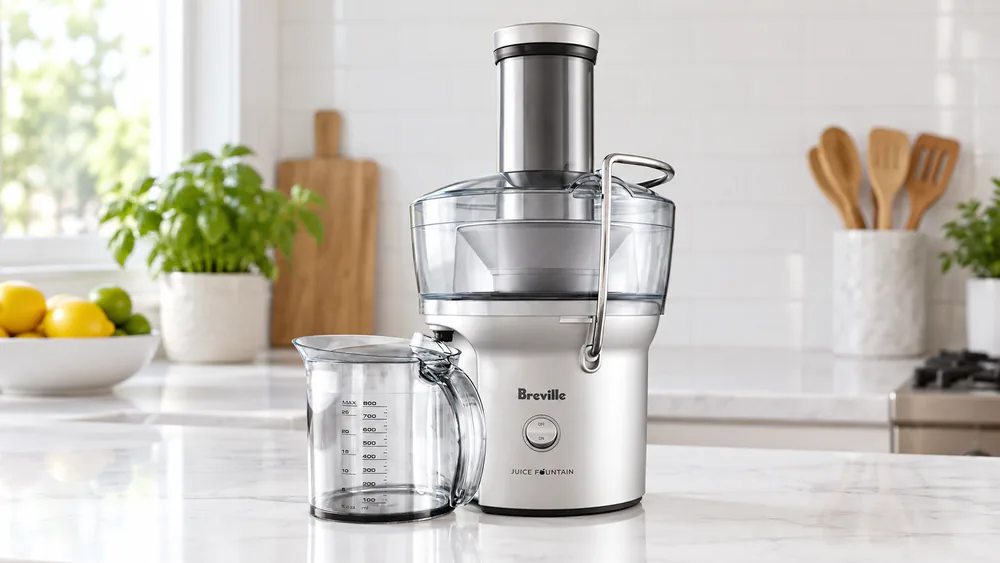
Where the Plus is loud and wide, the Juice Fountain Compact earns its place with its footprint. The pulp collects around the basket inside the body, so there is no separate bin hanging off the back, and the cord wraps up for storage. At 9.1 x 9.8 x 15.7 inches it fits on counters where the Cold models do not.
Pros
Smallest footprint in the lineup, with a cord wrap for storage
Internal pulp compartment saves counter space
Intuitive disassembly, with a cleaning brush for the fine mesh
Budget price tier
Cons
Motor noise is noticeable
Sprayback can occur while inserting produce
Some unjuiced pieces remain in the collected pulp
The 1.6 qt internal pulp container fills quickly
The compromises are what you would expect. Small apples fit through the 3-inch chute whole, while larger apples still need cutting, and dense beets make the 700W motor work harder. Sprayback can occur while you insert produce, and some unjuiced pieces remain in the collected pulp. Soft pears can clog the screen and demand extra cleaning, and rinsing right away keeps fresh pulp easier to remove.
The advertised jug is 25 fl oz, while the manual labels it 800 ml, so check the jug markings when it arrives. Plan on small batches, one or two glasses at a time. The pulp container holds 1.6 qt, which is fine for a single session and means emptying it between rounds.
Cleanup is fairly friendly. The manual calls the cover, integrated pulp container, filter disc and juice jug top-shelf dishwasher safe. Hand-wash the pusher, wipe the base, and inspect the mesh against the light for blocked holes. The mesh basket and grating disc may need replacing while the motor remains usable. Retained liquid can drip during disassembly, so keep a towel handy.
The Compact keeps its pulp inside the body, so it fits where the bigger models do not.
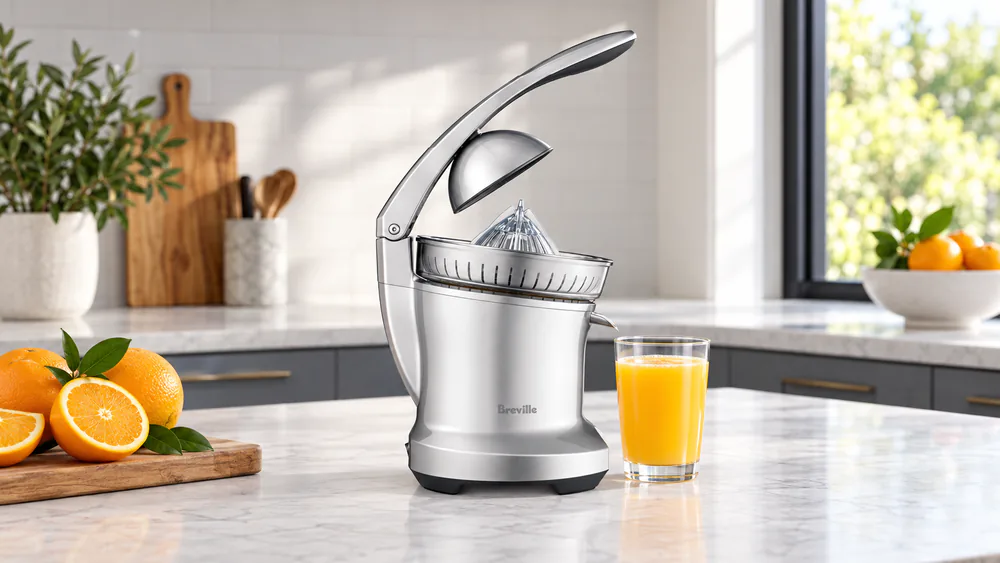
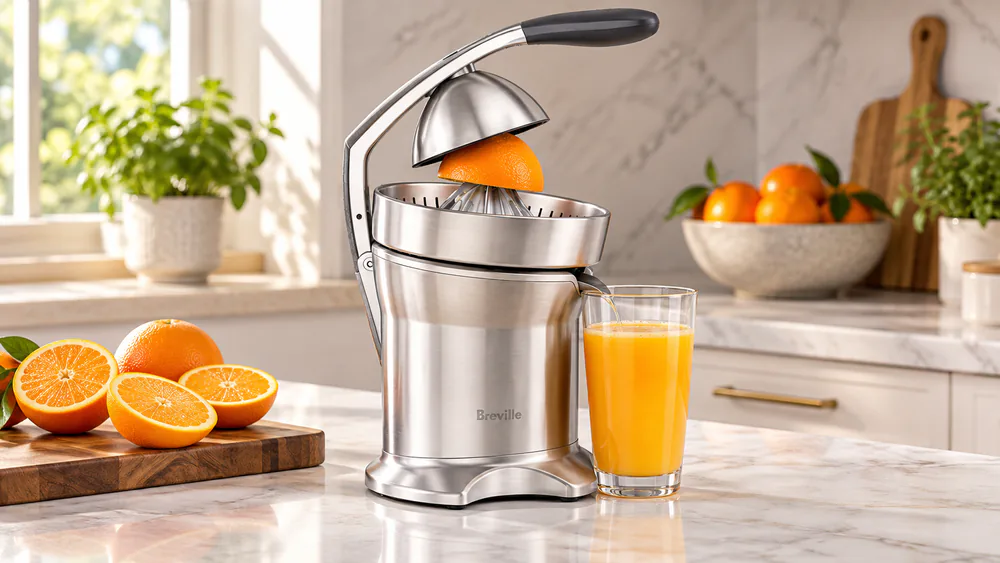
Where the juice fountains need peeled fruit, the Breville Citrus Press is a motorized citrus-only reamer, and it does one job better than any centrifugal juicer in this article. Halving citrus replaces the peeling you would need for a centrifugal machine, and one cone handles different fruit sizes. Orange juice tastes rich without a pronounced bitter pith flavor.
Pros
One cone fits different citrus sizes, with an assisted lever that takes little pressing effort
Quiet enough to talk over
Dishwasher-safe cone, juice collector, filter and dome
Drip-stop spout and a glass-under-the-outlet setup that keeps serving simple
Cons
Citrus only
The raised arm can interfere with overhead cabinets
Pulp builds up in the strainer over repeated glasses and needs clearing
Less compelling for an occasional squeeze of lemon
This press suits the daily glass. A glass under the outlet keeps serving simple, and the lever takes little effort, so a kid can sit nearby and watch without any danger from a spinning blade. The 110W motor is quiet enough that you can carry on a conversation while it runs. We still treat the pressing as a grown-up job, since the powered cone is moving.
The cleanup is easy. The cone, juice collector, filter and dome are dishwasher safe, and you wipe the powered base. Remove fresh pulp before it dries, and clear the strainer between glasses when you are making several. Pulp builds up there during repeated glasses.
Two cautions. The published footprint differs between the product page (8 x 12.8 x 18 inches) and the manual (roughly 7.5 x 9.5 x 18.1 inches), so allow space for the raised arm and check your cabinet clearance before you buy. And this appliance is more compelling for regular glasses than for an occasional squeeze of lemon, so a hand reamer is the better call if you only juice citrus now and then. The 1-year warranty applies.
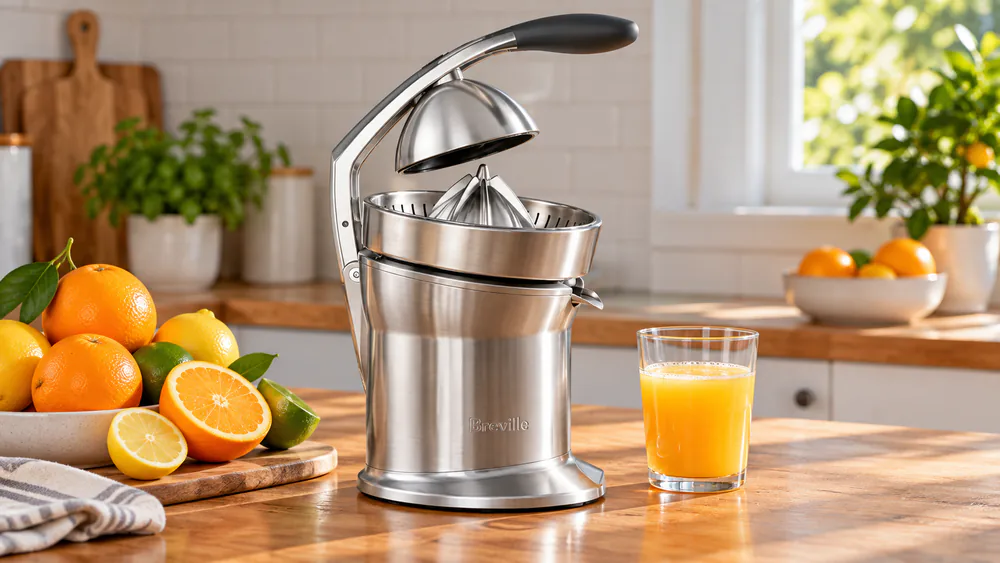
Where the standard Citrus Press stays light, the Citrus Press Pro adds a die-cast body, an acid-resistant stainless cone and a soft-grip arm to the same basic design. The lever needs little hand force, and changing citrus sizes does not require changing the cone. The metal-bodied Pro and the lighter standard Citrus Press give similar basic pressing performance.
Pros
Die-cast body and stainless cone feel sturdy
Soft-grip lever needs little hand force
Drip-stop is useful when switching between glasses
Dishwasher-safe cone, juice collector, filter and fruit dome
Cons
Premium price tier for the same basic pressing
The handle springs up instead of locking down, which complicates storage under wall cabinets
Internal plastic components can be a durability weak point
Large grapefruit may need repositioning, and peel can stick in the upper dome
The pressing is easy to repeat. Batches of citrus go through without fuss, the removable parts lift off readily, and the strainer is accessible for washing. The drip-stop is useful when you switch between glasses. When family members ask for juice thirty seconds apart, the drip-stop helps keep the counter clean between glasses.
Our hesitation is what sits behind the metal exterior. Internal plastic components can be a durability weak point even though the outside feels sturdy, and older units can stop driving the cone when plastic gear teeth strip. That describes a failure mode we are aware of, not a typical lifetime, and we cannot claim every current unit has the problem. Even so, the exterior is not proof of internal toughness, so we would not pay the premium for the metal alone.
The substantial body occupies more counter space than a small hand reamer, and the raised handle can need roughly 18 inches of clearance even though the listed height is 14 inches. The listed footprint is 7.6 x 10.3 x 14 inches. The US manual rates the motor at 110W, though other descriptions use 100W. If you juice citrus nearly every day and like a heavy, planted machine, the Pro makes sense. Otherwise the standard Citrus Press is the better value.
Halved oranges go straight onto the cone, with no peeling.
Other Breville Models and Variants to Consider
The seven machines above are the ones we would point a shopper to. The rest of the Breville range is either an older relative or a different product family, and a few notes will save you some confusion.
Juice Fountain Elite and Older Models
The Juice Fountain Elite (800JEXL) shares much of the Cold design with a 1000W motor, a 3-inch chute, a 1.1 qt jug and a 3.2 qt pulp container. Dense produce responds well to the higher setting, and simple assembly with accessible components keeps washing manageable. The motor handles firm fruit and vegetables quickly, but it needs plenty of counter space.
We kept the Elite out of the main ranking. We could not confirm a clean new-unit buy link for it, and stock changes by retailer, so an out-of-stock notice does not mean it is discontinued. The same caution applies to the Plus and the Compact: age and a missing product page do not prove a model is gone. If you spot an Elite at a retailer you trust, treat it as a close cousin of the Cold line and compare the jug and chute against the picks above.
Bluicer Combos and Commercial Juicers
Bluicer machines combine blending with centrifugal juicing, and model availability differs, so a discontinued family member does not tell you the status of every Bluicer. We did not rank them because they are a different kind of purchase. If you need one appliance to both blend and juice, look at them separately.
The commercial Juice Fountain line is aimed at bar and food-service work. Its intended duty is not the same as a household model, and we would not buy it for a home kitchen just to get a bigger motor.
Color Variants, Bundles and Refurbished Units
Finishes are not separate models, so a different color of the same machine is the same juicer. Bundles that add accessories are not separate picks either. Refurbished or remanufactured units are outside the scope of our testing, and we selected none. If you consider one, confirm the seller, ask about warranty coverage, and match the model code against the names above.
How to Choose the Best Breville Juicer for You
This section covers what actually separates these machines. We keep it tied to the way a family uses a juicer, not to a spec sheet.
Centrifugal Juicers, Citrus Presses and Your Produce
Start with what you plan to juice. The five Juice Fountain models are centrifugal machines: a fast-spinning basket shreds the produce and flings the juice through a mesh screen. They are quick, they handle hard produce like carrots, apples and beets well, and they are the better tool for mixed juices.
They are not the best tool for leafy greens, and they are not the best tool for citrus unless you do not mind peeling. The two Citrus Presses are the opposite. They are citrus-only, they need no peeling, and they leave you with juice that tastes rich without much bitter pith. If most of your juicing is oranges, lemons, limes and grapefruit, a press is a smarter buy than a juice fountain. If you want both, the two types complement each other, and we cover that in the FAQ below.
Pick the juicer for the produce you will actually feed it on a Tuesday, not the produce in the photo on the box.
Cold Spin Technology and Cold-Press Juicing
The Cold Plus, Cold XL and Cold carry the Cold Spin name. Cold Spin describes limited heat transfer during centrifugal extraction. It is not an auger-based cold-press process, and it does not refrigerate the juice.
That matters because "cold" on a box can read as "cold-pressed." These machines are still fast-spinning centrifugal juicers. We make no claim that Cold Spin gives you more nutrients or better health outcomes, because we cannot support one, and the same goes for how long a jug of juice stays fresh. Drink it soon and keep it cold.
Motor Power, Feed Chute Size and Preparation Time
Motor power runs from 700W on the Compact to 1200W on the Cold XL. A stronger motor helps with dense vegetables and holds its speed under load, but the jump from 850W to 1000W matters less in practice than the chute width. Chute width controls how much knife work you do before you start.
A wide chute reduces cutting only for produce that fits. The Cold Plus and Cold XL list 3.5-inch chutes (with a conflicting 3-inch description for the XL), and the Cold, Plus, Compact and Elite list 3-inch chutes. Small apples will go in whole on the narrower chutes, while larger apples still need cutting, so a wide chute helps, but it does not remove prep.
Prep still counts regardless of the machine. Wash produce, remove hard pits and unsuitable rinds, and follow the preparation guide for your model. Dense vegetables in smaller pieces reduce strain on the motor. Use the pusher every time, and never use your hands to push produce through.
Jug Capacity, Counter Space and Storage
Think about how many glasses you pour at once. The Cold Plus, Cold XL and Cold carry a 70 fl oz jug, the Plus holds 35.2 fl oz, and the Compact lists 25 fl oz in marketing with an 800 ml jug in its manual. The Elite has a 1.1 qt jug. Pulp containers run from 1.6 qt on the Compact to 3.9 qt on the Cold Plus and Cold XL.
Counter space is the cost of capacity. The Compact measures 9.1 x 9.8 x 15.7 inches, while the big Cold models measure about 13 to 14 inches wide and well over 16 inches tall. Check the clearance under your wall cabinets for the machine and any raised arm. For the citrus presses, the handle height is the number to check. The Citrus Press Pro can need roughly 18 inches with the arm up.
Storage deserves a sentence of its own. The base, the pitcher and the pulp container of the larger machines stay bulky to store even with a rear-bin layout. If you do not have a spot to leave one on the counter, factor in the cabinet space you will need.
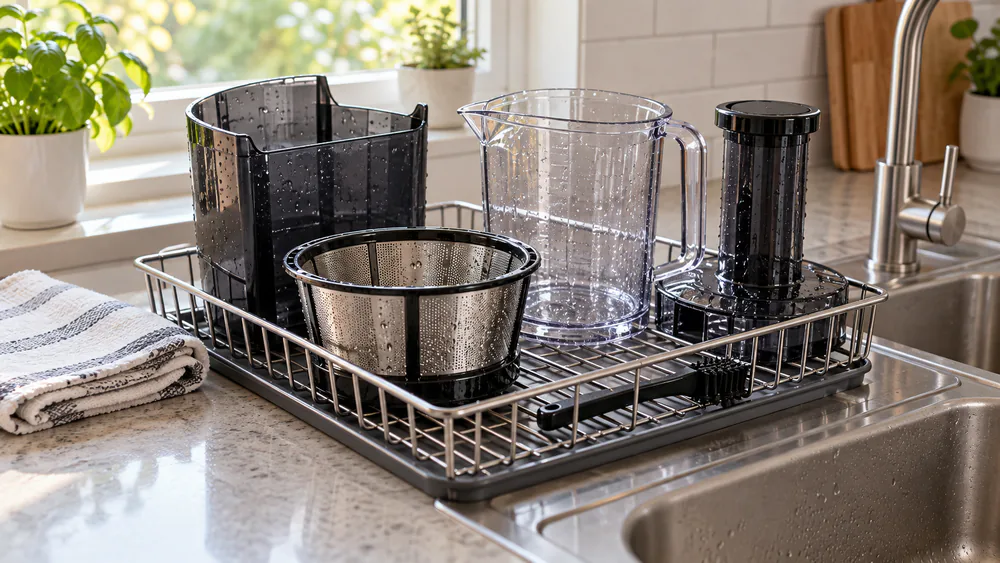
The washing-up is the real cost of juicing, so count the parts.
Cleaning, Noise and Everyday Use
Cleanup is where juicers win or lose a place on the counter. Every Juice Fountain here needs the same ritual: pull the parts apart, rinse the pulp off, brush the mesh basket with the supplied brush, and hold the basket up to the light to check for blocked holes. Do it right after juicing, because dried pulp sticks. The brush is part of the box for a reason.
Dishwasher rules differ by model, and the manual for your model governs. The Cold Plus lets you wash everything except the pusher in the dishwasher, with the basket on the top shelf. The Cold wants the cover and jug washed by hand. The Cold XL asks for the cover and pusher by hand. The Compact puts its cover, pulp container, filter disc and jug on the top shelf. For the older Plus, we stick with warm soapy water. Do not use harsh chemicals, abrasives or damaged filters, and never immerse the motor base.
Noise is a mixed picture. Low-speed operation on the Cold XL is quieter than high speed, and the Citrus Presses are quiet enough to talk over. The Plus is loud. The Compact's noise depends on the produce and the speed, so we would not promise a quiet kitchen. No juicer here is a good bet for a house with a sleeping baby.
Price, Warranty and Replacement Parts
We deliberately do not quote dollar figures, since prices move. What we can say is how the tiers fall. The Plus and the Compact are the budget picks, the Cold and the Citrus Press are mid-priced, the Cold Plus and the Citrus Press Pro are premium, and the Cold XL is the splurge pick.
Every machine in this article carries a 1-year limited product warranty. Limited warranty remedies depend on purchase circumstances, so keep your proof of purchase and check whether the seller is an authorized retailer. Breville also offers a 30-day return window for qualifying direct Breville USA purchases, with return authorization and policy conditions that apply. Breville provides model-specific replacement parts and support, but confirm the model code before you order a basket, jug, cover or pusher. We cannot promise a part will be in stock or for how many years a machine will last.
Tip. Look at the model code on the bottom of your juicer before you order any replacement part. Cold, Cold Plus and Cold XL parts are not interchangeable, and the wrong basket is an easy mistake.
Breville Juicer FAQs
Can a Citrus Press and a juice fountain share the same kitchen?
Yes, and the two complement each other. The press handles oranges, lemons and grapefruit without peeling, while a juice fountain covers carrots, apples and mixed juices. Counter space is the practical limit, so check the raised arm of the press against your wall cabinets.
Which parts should you replace first?
The mesh basket and grating disc are the first to wear, and they can need replacing while the motor is still usable. Confirm the model code before you order, since Cold, Cold Plus and Cold XL parts are not interchangeable.
Do you need a separate juicer for citrus?
If you juice oranges or grapefruit regularly, yes, a Citrus Press is worth it. A press needs no peeling, and the juice tastes rich without much bitter pith. A juice fountain can handle citrus once the peel is off, but it is more work. For an occasional lemon, a hand reamer is enough.
Are Breville juicers worth the price?
They are worth it if you will use them often enough to justify the cleanup. A budget Plus or Compact is a sensible way to find out whether you will stick with it, and the Cold Plus makes sense for a family that juices weekly. If you juice only once in a while, the washing-up will outweigh the benefit.
Final Verdict: Which Breville Juicer Should You Buy?
Match the machine to the household, not to the longest feature list. For a family that juices in batches, the Cold Plus is our pick, with the Cold as the step down when you want the same jug at a lower tier. Choose the Compact if counter space is the limit, the Plus if you want a budget starter and can tolerate the noise, and the Cold XL only if you will really run large batches often.
For citrus, buy the standard Citrus Press first. The Pro is the pick if you want a heavier machine and accept the unknowns about its internals. Whatever you choose, plan the cleanup before the first batch, keep kids on washing and carrying duty, and read the manual for your model before anything goes in the dishwasher.