As an Amazon Associate we earn from qualifying purchases. We may earn a commission from links on this page, at no extra cost to you. Learn more.
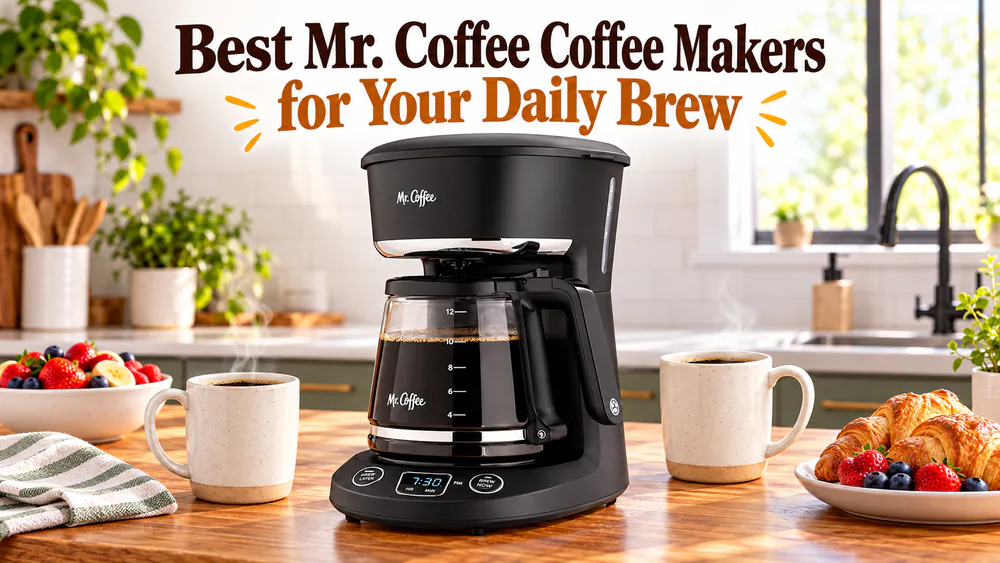
We score every Mr. Coffee drip brewer on the parts of a morning that decide whether you like a machine: how easy it is to fill, how simply the basket loads, how the carafe pours, how much cleanup it leaves, and how well it holds coffee afterward. Batch size, carafe type, and cleanup separated these five far more than any spec sheet. If you want one answer, the 12-cup Programmable Brew Now or Later is our top pick for most households. The 5-cup Mini Brew is the better call for one or two mugs, and the thermal model suits anyone who sips slowly. The rest of this guide, part of our coffee maker reviews, explains why.
How We Tested These Mr. Coffee Coffee Makers
Here is how we score. Every machine gets the same questions. How easy is it to fill and load before the first cup? How does the carafe pour? What does the machine ask of you after brewing, and what happens if you forget a step? We weigh those everyday points first, then check them against what the controls promise on paper.
We also weigh how a carafe holds coffee once the brew is done. A glass pot on a warming plate and an insulated thermal pot behave differently over a long morning, so hold quality counts alongside fill, load, pour, and cleanup.
We keep each model exact. Mr. Coffee sells many look-alike brewers, and a nominal cup count does not tell you which carafe, lid, or basket fits. Throughout this guide we name the specific model each pick refers to, and we do not promote color variants to separate picks.
Two limits are worth stating up front. These are drip brewers, so none of them makes espresso or steamed milk. And because we compare the machines on daily-use criteria rather than a lab protocol, we do not publish a numeric brew-temperature or extraction score for any of them.
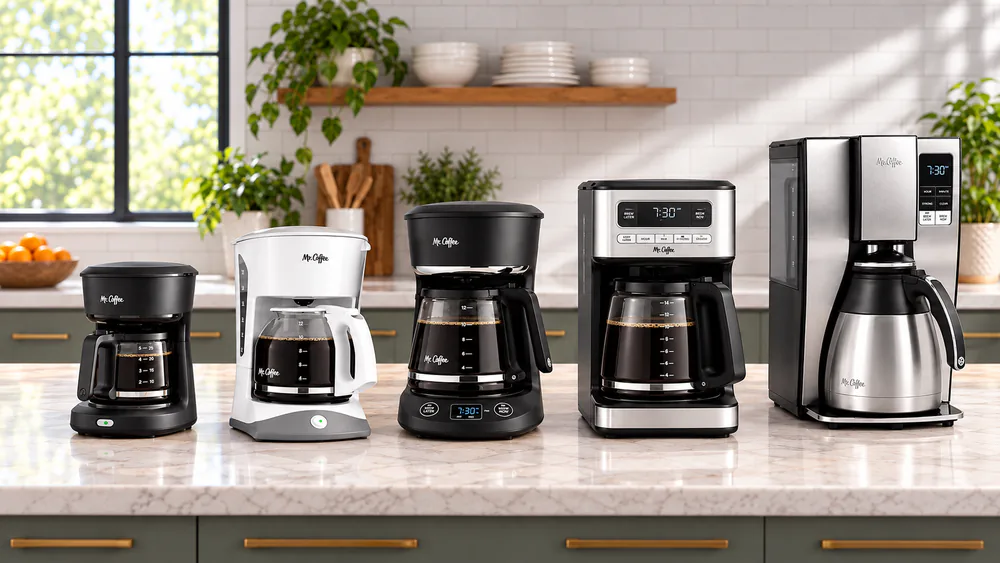
The five brewers we compared, from smallest to most feature-rich.
Mr. Coffee Coffee Makers at a Glance
Here is how the five picks compare on the points that decide most purchases. Rows follow the same order as the reviews below.
Model
Best for
Capacity
Carafe
Programmable controls
Principal limitation
12-Cup Programmable Brew Now or Later
Scheduled everyday pots
12-cup / 60 fl oz
Glass
Brew Later
No dedicated small-batch mode
5-Cup Mini Brew Switch
One drinker or two modest mugs
5-cup / 25 oz
Glass
None
Small yield, manual switch-off
12-Cup Switch Coffee Maker
Manual simplicity
12-cup
Glass
None
Variable extraction, manual switch-off
14-Cup Programmable Coffee Maker
Large households and mixed batch sizes
14-cup / 70 fl oz
Glass
Brew Later, Strong Brew, 1-4 cup
Lid clearance and pouring cleanup
10-Cup Thermal Programmable Coffee Maker
Coffee held for later pours
10-cup / 50 fl oz
Double-wall stainless thermal
Brew Later, Strong Brew, freshness timer
Heavier carafe, hand washing
1. Mr. Coffee 12-Cup Programmable Brew Now or Later
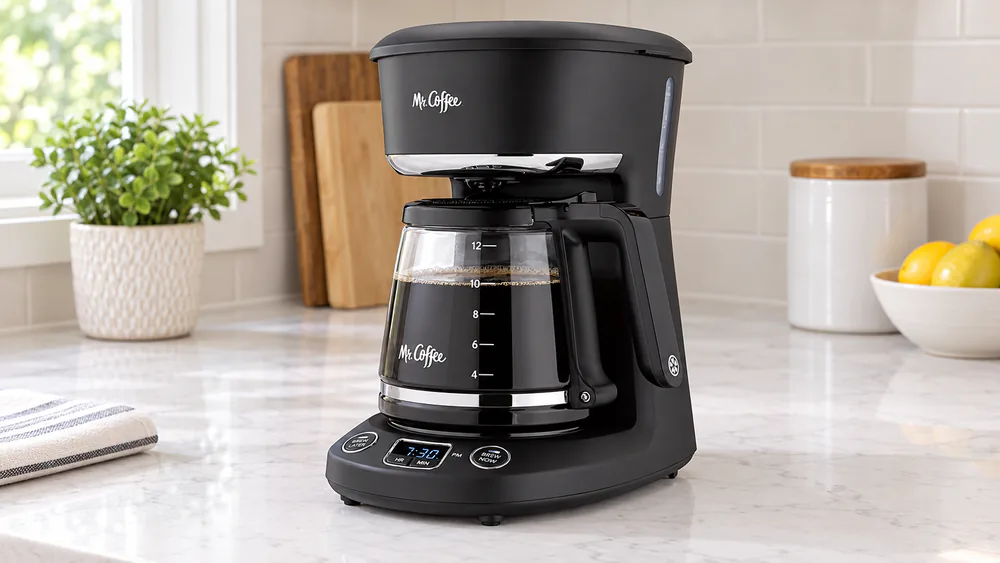
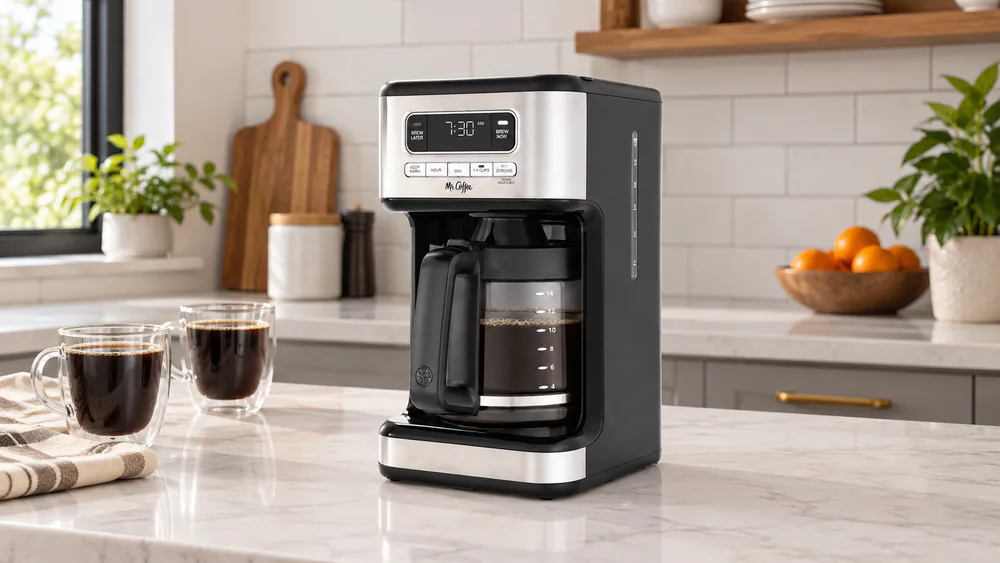
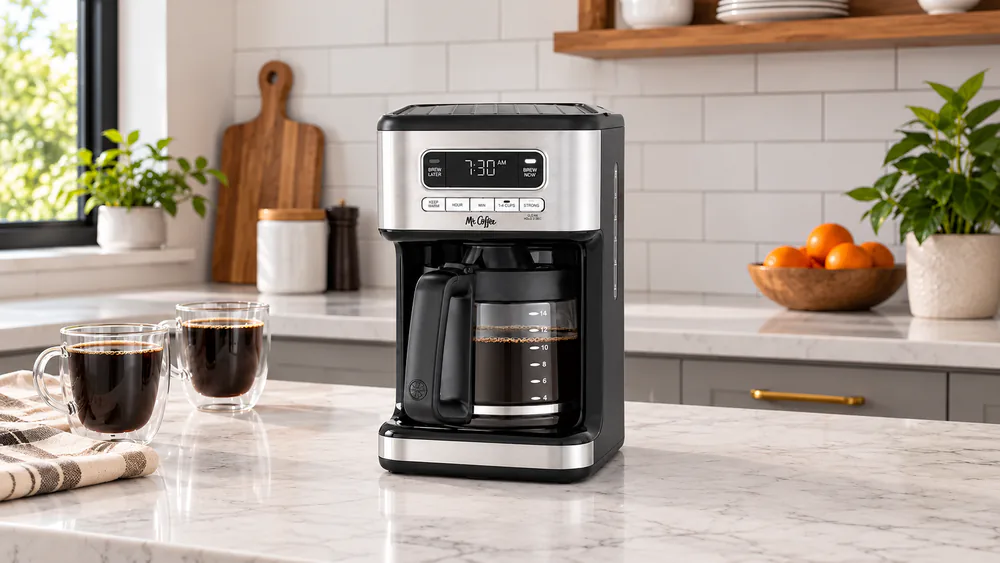
This is the brewer we would hand to most people who just want a dependable full pot, and it earns the top spot because it does the everyday job without a learning curve. Scheduled brewing saves a manual start on busy mornings, the water window makes filling easy to judge, and the removable basket makes grounds disposal and rinsing straightforward.
Pros
Brew Later scheduling starts the pot before you are up
Visible water window makes filling easy to judge
Removable brew basket rinses out quickly
Automatic shutoff after 4 hours
One of the cheapest picks in this group
Cons
No documented dedicated small-batch or strength selector on this version
Leaving the carafe out mid-brew can overflow the basket
Glass carafe on a warming plate, so coffee keeps cooking after it brews
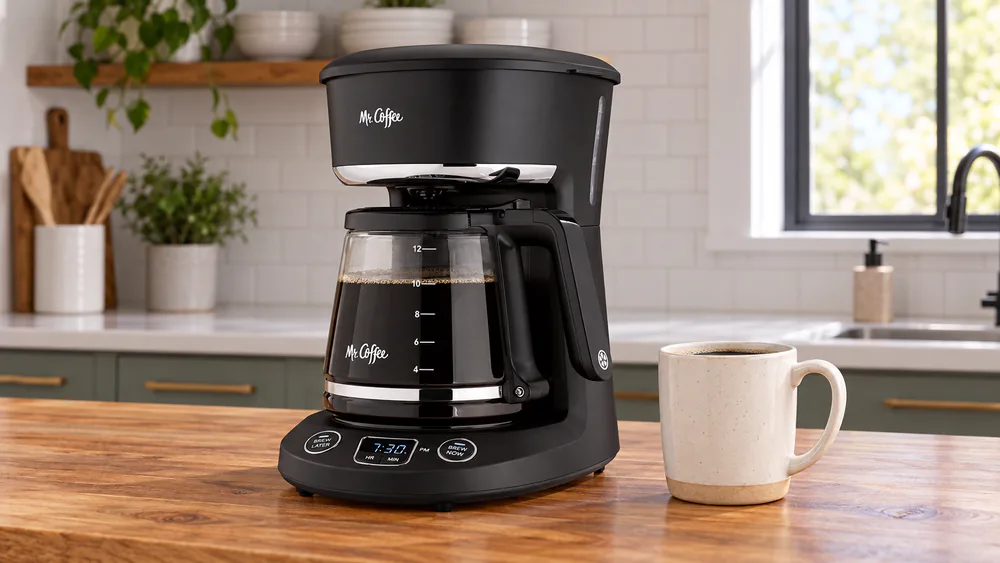
The clock and water window are the two parts you touch most.
Features, trade-offs, and who it suits
The Brew Now or Later name tells you the whole idea. You can start a pot right away, or set the machine the night before so it brews at a time you choose. The selected buy link is the basic version, which matters because Mr. Coffee also sells Strong Brew and Rapid Brew configurations under similar names. This one does not have a documented strength selector, and we would not assume it does.
Capacity is 12 cups, which in this machine means 60 fl oz of water, with each marked cup counting as 5 fl oz. Grounds hold back some water, so you will pour a little less than that into your mugs. The brew basket lifts out, and the Grab-a-Cup pause stops the flow so you can pour early. The LED display is bright enough to stand out in a dark kitchen, which is handy for a scheduled brew and a little annoying if the machine sits near a bed.
Choose it if your mornings are predictable and you drink most of a pot. The low cost means you are not paying for features you will not use. If you often brew a single mug, look at the Mini Brew or the 14-cup model instead, because a half-full pot tends to make weaker, less even coffee than a machine built for it.
2. Mr. Coffee 5-Cup Mini Brew Switch
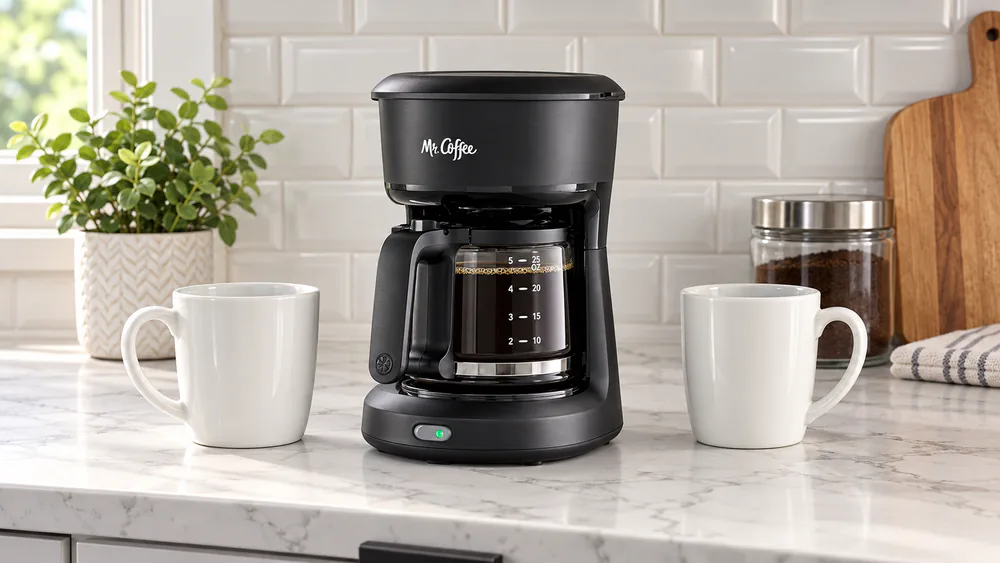
Two 12-ounce mugs is about what one full pot delivers.
Where the programmable 12-cup is built for a full pot, this is the brewer that fits one or two mugs a morning. The compact body slides onto a crowded counter far more easily than a full-size machine, the ounce markings on the carafe take the guesswork out of measuring a small batch, and lifting and rinsing the basket keeps cleanup simple. The tradeoff is capacity, which is restrictive when several people want refills.
Pros
Compact body fits crowded counters
Ounce markings on the carafe make small batches easy to measure
Basket lifts out and rinses quickly
Illuminated switch and no clock to set
Among the cheapest picks in this group
Cons
Only up to 25 oz per pot
No programmable start
You have to remember to switch it off
Features, trade-offs, and who it suits
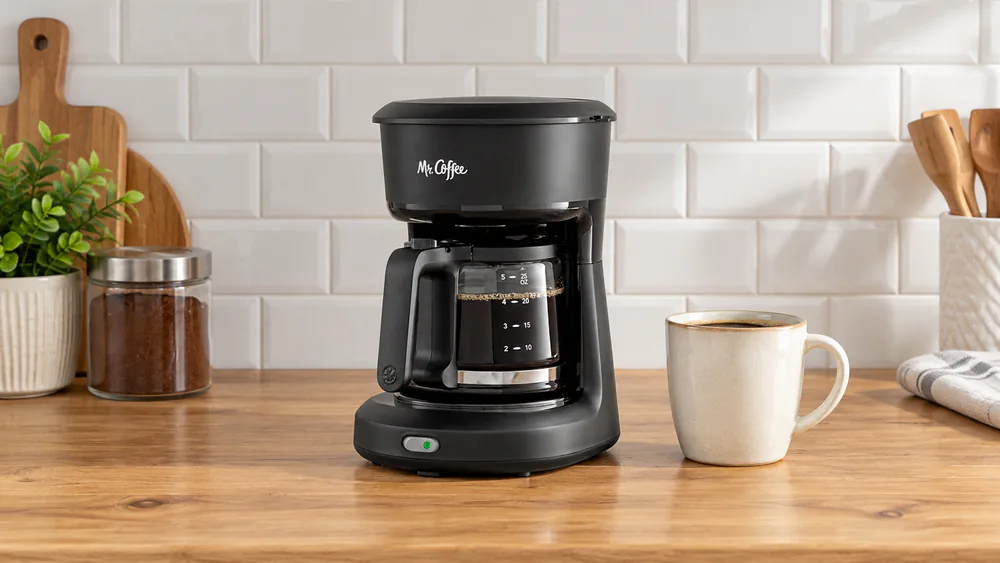
This is the model with the SAP number 2129512, the black Mini Brew. It has a manual illuminated on/off switch, a glass carafe marked in ounces, a removable basket, a water window, and the Grab-a-Cup pause. It holds up to 25 oz, which is enough for two 12-oz mugs and not much more. It is built for a small yield, and it does that well. Measuring is easier than on a larger brewer because the carafe markings are in ounces rather than abstract cups.
There is no timer, and the manual switch means the machine stays on until you turn it off, so build the habit of flicking it as soon as you pour. A water-filtration disk and frame are compatible accessories sold separately, so do not assume one comes in the box. Published dimensions vary across revisions, so measure your exact unit and allow extra room to open the lid.
Choose it for a dorm, a small apartment, an office desk, or a household where one person drinks coffee. It is also a smart second brewer for guests. Skip it if you host regularly or if two people want a refill each.
The limit to know about this one comes first: the coffee is acceptable but can lack body and complexity, and brew timing and temperature can vary between consecutive pots. Unlike the Mini Brew, it makes a full pot, but it is the simplest machine here, with no clock to set, just a switch. That makes it a convenience pick rather than a flavor pick.
Pros
No clock setup, just a switch
Dual water windows and a lift-out basket
Paper filters make spent-ground disposal easy
Familiar full-pot capacity at a budget-tier cost
Cons
Coffee can taste flat, without much body
Brew timing and temperature can vary between pots
No timer or automatic shutoff
Rear tank can mean turning the machine to fill it
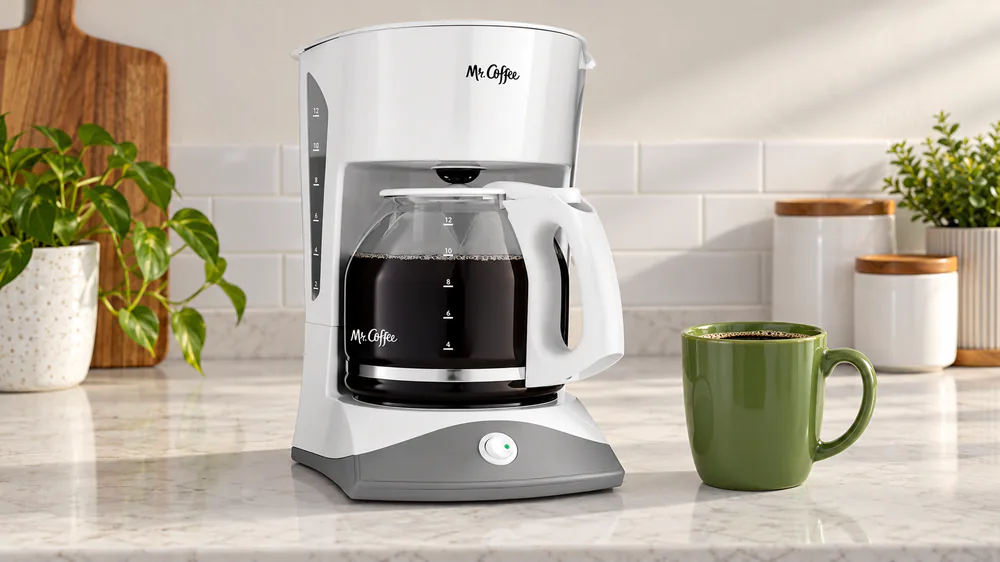
The white SK12-RB is the version we chose; the black SK13-RB is a color counterpart.
Features and trade-offs
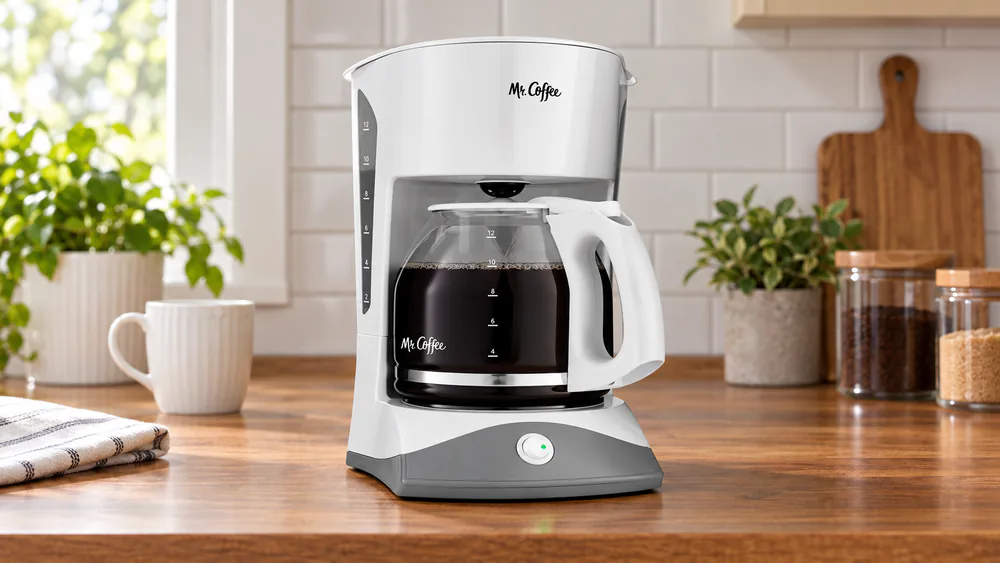
The model we selected is the white Simple Brew, SK12-RB. The black SK13-RB is just a color counterpart, not a separate pick. The nominal capacity is 12-cup, and the machine has a manual illuminated switch, a lift-out basket, dual water windows, a glass carafe, a warming plate, and the Grab-a-Cup pause.
If you notice a flat cup, the machine is the likelier explanation than your beans. It is also a little fussy to handle. The tank is at the rear and the water marks can require turning the brewer to fill it, and the showerhead needs moving aside to load grounds before it returns when the lid closes.
Day to day, the habits matter. A very full carafe needs a careful, slow pour to avoid spills. Residual drips can land on the warming plate and leave a rough, corroded surface over time, so wipe it once it has cooled. Brewing can also be intermittently noisy. Running one around the clock can wear out the switch or heater, which says little about normal household life; we do not promise any number of years from any model here.
Who it suits
Choose it if you want the lowest-effort full pot and you are not particular about the finer points of flavor. It suits a second kitchen, a guest room, or a workshop where programmable features would go unused. If you care about a bright, even cup or want a timer, our first and fourth picks give you scheduling, and the thermal model does a better job of holding quality after brewing.
Where the basic 12-cup programmable has one batch size, this is the most flexible brewer in the group, and the one we would choose if the household changed batch sizes through the week. The small-batch mode makes partial-pot brewing more useful, Strong Brew produces a bolder cup, and the large pot can fill travel mugs while leaving coffee for everyone else. The costs are a full batch that takes patience, a tall lid, and a carafe that is harder to scrub.
Pros
Dedicated 1-4 cup selector for small batches
Strong Brew for a bolder cup
Adjustable keep-warm time and Brew Later scheduling
Reusable dishwasher-safe nylon filter included
Programming is straightforward and the clock is easy to read
Cons
Needs substantial overhead clearance to reach the rear tank
Plastic pouring guard makes the carafe harder to scrub
A full carafe can spill at the pouring lip
A full batch takes patience
The 1-4 cup and Strong Brew buttons are what set this model apart.
Features and trade-offs
The model is the BVMC-PC14BL2. It brews a 14-cup pot, which here means 70 fl oz of water and 5 fl oz per marked cup. The features list is the longest of the glass-carafe picks: Brew Later scheduling, Strong Brew, a small-batch mode, a cleaning cycle, a reusable dishwasher-safe nylon filter, and a keep-warm duration you can set from 1 to 4 hours before the machine shuts itself off.
Both Strong Brew and the small-batch mode work by slowing the brew with intermittent pauses, which is why a full batch takes patience and why Strong Brew yields a bolder cup. Brew Later needs to be set again for the next day, so it is not a permanent schedule. You can use either an 8-12 cup basket paper filter or the reusable filter, so paper is optional. If you pull the carafe mid-brew, put it back within 30 seconds.
Cleanup is mostly easy. The basket, the reusable filter, and the carafe are top-rack dishwasher safe. If your configuration includes water-filtration hardware, remove it before descaling, and check the box contents, because hardware varies by configuration. The footprint also varies depending on where you read it. Allow room above the lid as well as around the base. That makes it a poor fit under a low cabinet.
Who should choose it and who should skip it
Choose it if you switch between a single mug on weekdays and a full pot on weekends, or if your household has more than one coffee drinker with different tastes. Skip it if you have a low cabinet over your counter or if you only ever brew one size. In those cases, the 12-cup programmable or the Mini Brew will feel less fussy.
5. Mr. Coffee 10-Cup Thermal Programmable Coffee Maker
5
Mr. Coffee 10-Cup Thermal Programmable Coffee Maker
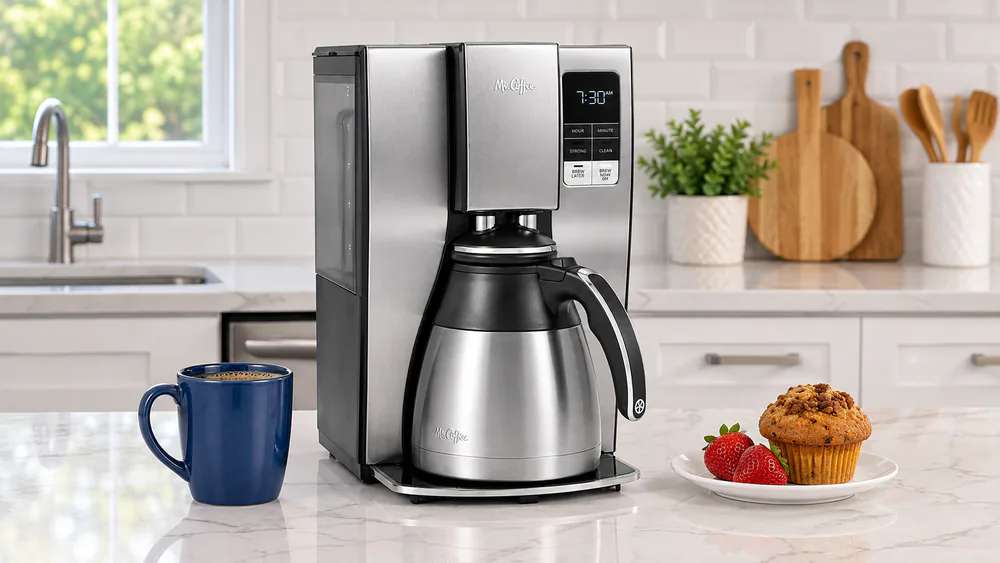
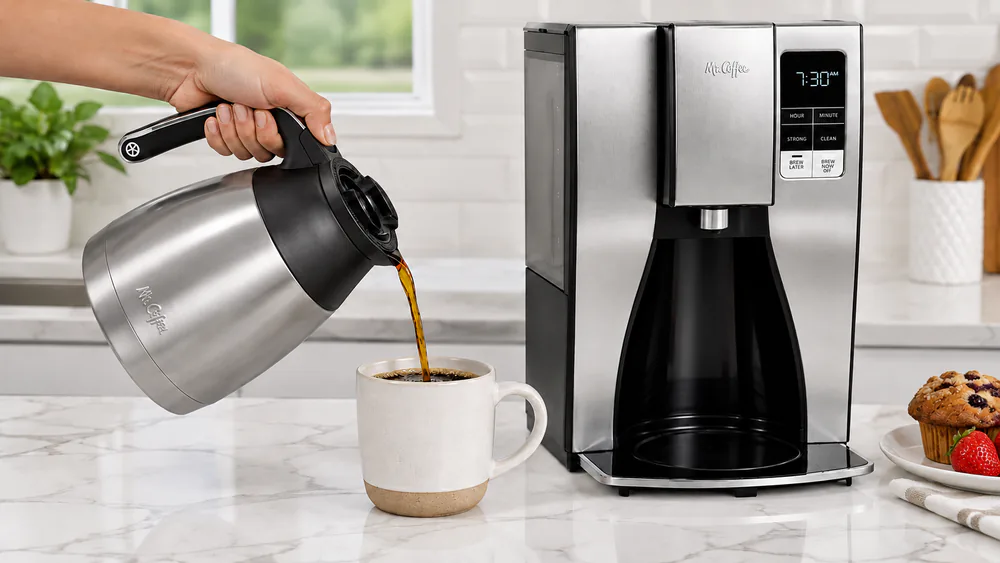
Every other pick here keeps coffee on a warming plate; this one does not, and that is why it exists. If you drink coffee slowly over a morning, the insulated pot avoids the cooked flavor you get from a hot plate, and the heat retention suits a slower drinking routine. You pay for that with a carafe that is heavier than glass, and it is the most expensive machine in this group.
Pros
Insulated carafe avoids the cooked taste of a hot plate
Heat retention suits a slow drinking routine
Strong Brew, Brew Later, and a freshness timer
Optimal Brew is designed to reach up to 205 F while brewing
Cons
Premium-tier cost relative to the other four
Thermal pot is heavier to handle than glass
Carafe needs hand washing
No warming plate, so the pot holds heat on its own.
Features and trade-offs
This is the B08MX4XG97 variant, identified as model 2150023. We kept to its own controls and did not borrow specifications from older PSTX or 2133734 models, which are different machines. It has a 10-cup capacity at 50 fl oz of water, Optimal Brew, a Strong Brew selector, Brew Later scheduling, a removable water reservoir, a freshness timer, water filtration, and the Grab-a-Cup pause.
The temperature claim deserves a careful reading. Optimal Brew is designed to reach up to 205 F during brewing, which is within the range baristas aim for, but it is not a guarantee of serving temperature. The same goes for the 20% faster brewing claim, which compares this machine specifically with the BVMC-SJX39 and not with every drip maker. Treat both as design intent, not a promise. We also have no verified figure for how many hours the carafe holds temperature, so we do not state one.
Choose it if you pour a cup, drink it, and come back for another an hour or two later. It is also the best fit for a household where the pot sits for a while, because the second cup tastes closer to the first. A glass pot is the easier choice if you want the cheapest brewer or have limited grip strength.
How to Choose a Mr. Coffee Coffee Maker
Mr. Coffee's lineup is deep, and many models look alike on the shelf. The decision comes down to four practical questions, covered below.
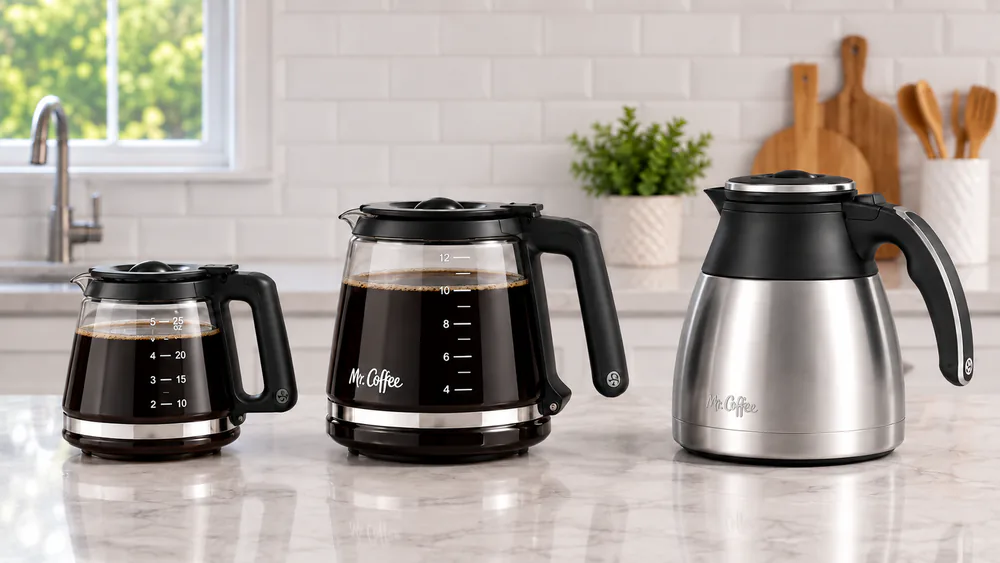
Carafe size and material shape your morning more than most spec lines.
Brew capacity, mug size, and small batches
Start with how much coffee you drink at once, not how many cups the box says. A marked "cup" on these machines is 5 fl oz, far smaller than a typical mug. A 12-cup brewer with 60 fl oz of water gives you roughly five 12-oz mugs, and less after the grounds absorb some. The Mini Brew's 25 oz covers two mugs. The 14-cup model's 70 fl oz is generous enough for a crowd.
Small batches are where design shows. A full-size brewer making two cups often produces a weaker, less even result. The 14-cup model's 1-4 cup selector is built for that, and the Mini Brew is sized for it.
Glass versus thermal carafes and warming plates
Glass carafes sit on a warming plate. The plate keeps the coffee hot, but it also keeps cooking it, so the flavor drifts the longer the pot sits. If you drink a pot within 30 to 45 minutes, a glass carafe is fine. If you spread it over a long morning, a thermal carafe holds heat without a plate and keeps the last cup closer to the first.
Thermal carafes cost more and weigh more; glass is lighter and cheaper. Choose by how you drink, not by which sounds better.
A warming plate keeps coffee hot, but it also keeps cooking it. How long your pot sits decides which carafe you need.
Programmability, brew strength, and auto shutoff
Brew Later scheduling is the feature most people will use daily. It saves a manual start, and on the 14-cup model you need to set it again for the next day. Strength selectors such as Strong Brew slow the brew to extract more, which gives a bolder cup at the cost of time. Shutoff matters for safety and for taste. The programmable models shut themselves off, while the two switch models have no automatic shutoff, so you have to remember.
Warning. The manual-switch models, the 5-cup Mini Brew and the 12-cup Switch, stay on until you turn them off. Build the habit of flipping the switch the moment you pour.
Counter space, cleaning, and descaling
Measure before you buy. Published dimensions disagree across retail and manufacturer sources for several of these models, so allow extra room above the lid, especially for the 14-cup model and its rear tank. Under a low cabinet, a front-fill or compact machine is easier to live with.
Cleaning has two layers. Daily care is easy: cool and unplug the machine, wash removable parts with mild soap, and empty spent grounds. The longer job is descaling. General guidance is every 40-80 brews, adjusted for your water hardness and your manual, and the 14-cup manual says to descale every 40 brew cycles with hard water or 80 with soft water, following the CLEAN indicator. Our guides on how to clean a coffee maker, how to descale a coffee maker, and cleaning a coffee maker with vinegar walk through the steps.
Tip. Paper filters are optional on the 14-cup model, but they make disposal easier on any machine. The 8-12 cup basket size fits the 14-cup model.
When to Choose an Iced Coffee or Espresso Machine
A drip brewer makes drip coffee, and that is all these five do. If your morning drink is a latte, cappuccino, or flat white, no Mr. Coffee drip machine will deliver steamed milk or true espresso. Those drinks need a different machine, and our guide to the best espresso and coffee maker combos covers machines that do both. If iced coffee is your daily habit, a dedicated iced or cold-brew system will serve you better than adapting a hot drip machine.
Common Mistakes
The most frequent mistake is buying by cup count alone. A 12-cup label does not tell you the carafe style, the controls, or which replacement parts fit. The second is ignoring how you actually drink: a thermal carafe is wasted on a one-mug household, and a Mini Brew is wasted on a family of five. The third is skipping descaling until the coffee tastes off or the machine slows down.
Frequently Asked Questions
Can you make good iced coffee with a drip Mr. Coffee?
Yes, as an occasional drink. Brew a strong pot, using Strong Brew on the 14-cup or thermal models, and pour it over a full glass of ice so the melt does not thin it. For a daily iced habit, a dedicated system is easier.
Are carafes interchangeable between Mr. Coffee models?
Not reliably. Match replacement carafes, lids, and filter baskets by the exact model number, because a nominal cup count alone does not establish compatibility. A 12-cup label on two machines does not mean one pot fits both.
What does the 1-year warranty ask of you?
Each of these five carries a 1-year limited warranty for eligible original purchases. Authorized-seller, normal-use, and proof-of-purchase conditions apply, so buy from a seller you trust and keep your receipt.
Has any of these been recalled?
The single-cup recall we found applies to BVMC-KG1-series brewers, not to the five drip designs here. That is not a clearance for every serial number, so check your unit's label against the maker's recall page.
Final Verdict: Which Mr. Coffee Maker Should You Choose?
The 12-Cup Programmable Brew Now or Later is the one we would buy first. If you are torn between it and another model, let one question decide: how many mugs do you pour on a typical morning? One or two, and the Mini Brew saves counter space. A different size every day, and the 14-cup earns its higher cost. A pot that sits for hours, and the thermal model is the upgrade.