Helping you create a kitchen you love.

Kitchen Appliances

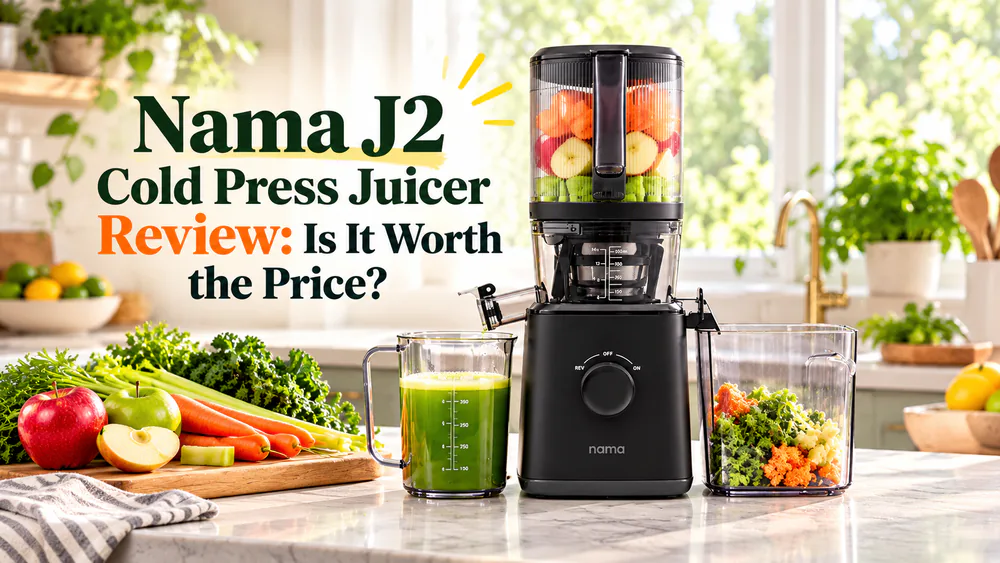
Nama J2 Cold Press Juicer Review: Is It Worth the Price?

As an Amazon Associate we earn from qualifying purchases. We may earn a commission from links on this page, at no extra cost to you. Learn more.

Nama J2 Cold Press Juicer Review: Is It Worth the Price?

The juicer that wins in a busy kitchen is the one that lets breakfast carry on while it works. The Nama J2 does that better than most. Once loaded and running, the juicer feeds the produce through on its own, leaving your hands free for other tasks.

We ran the J2 in our family kitchen for two months, juicing three times a week for breakfast and lunch, and it stayed on the countertop the whole time. The rotation covered orange, carrot and apple on their own, green juice, carrot with apple, orange with pineapple, and orange with lemon, plus a mixed green batch of broccoli, ginger, celery, apple, pear and fresh parsley that took just one cleanup afterward.

If you are weighing it against other juicers we have reviewed, this review covers hopper loading, juice quality, noise, cleanup and long-term value so you can decide whether the J2 fits your week.

Quick Verdict: Who Should Buy the Nama J2?

Key takeaway. Buy the Nama J2 if you juice in big batches, have room for a tall machine, and will rinse and brush the parts right after use. Skip it for occasional juicing or a small kitchen, and look at the Nama J3 first.

Nama J2 Cold Press Juicer

Nama J2 Cold Press Juicer

Best for Big Batches
Check Price on Amazon

Loading a mixed batch into the hopper frees our hands in a way a chute-style juicer never does. The body feels sturdy and runs smoothly, and the juice comes out smooth and fresh.

  • Self-feeding hopper reduces active feeding work
  • Fine and coarse strainers included
  • 15-year warranty on all parts

Specifications

Motor
200W induction
Speed
50 RPM
Warranty
15-year all parts

Nama J2 Specifications and What Comes in the Box

The J2 runs on a 200W induction motor that turns the auger at 50 RPM. The hopper holds 70 ounces of produce; that capacity does not indicate how much juice a batch will yield. Nama's own estimate is roughly 20 to 30 ounces of juice per load, and the real number depends on the produce, its ripeness and how you stack the hopper.

The machine measures 9.8 inches wide, 9.0 inches deep and 17.7 inches high. Nama lists the weight at 12.1 pounds with the chamber set, though published weights differ, so plan your lifting and storage with that in mind.

Nama J2 specifications
Motor200W induction
Speed50 RPM
Hopper volume70 ounces (produce space, not juice yield)
Dimensions9.8 W x 9.0 D x 17.7 H inches
StrainersFine juice and coarse
Warranty15-year, all parts

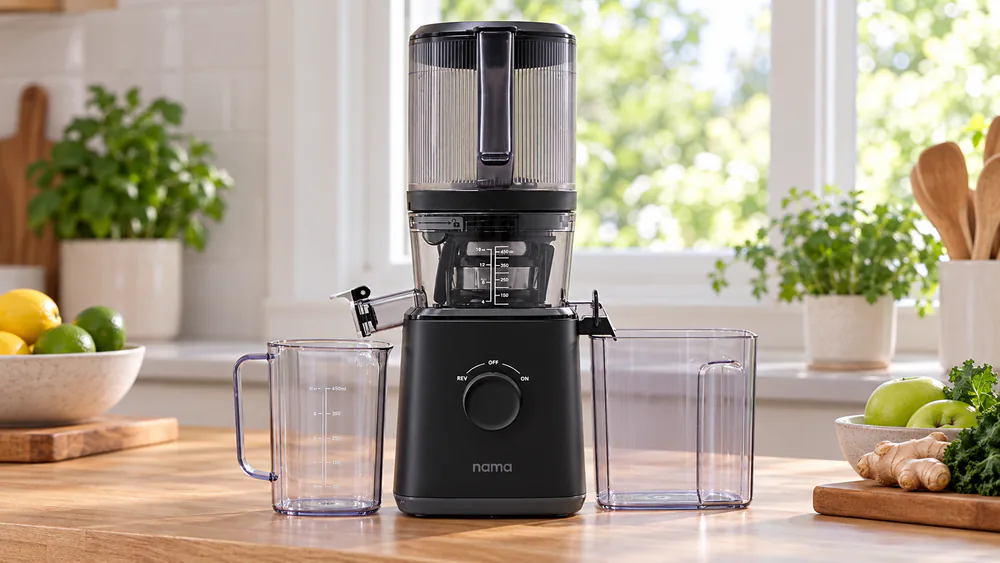
In the box you get the base, detachable cord, chamber, hopper and lid, spinning brush, auger, juice container with lid, pulp container, juice strainer, coarse strainer, pusher, cleaning brush, recipe book, quick-start guide and manual. Sorbet needs a separate attachment that is not included.


Setup, Hopper Loading, and Everyday Use

Assembly felt unintuitive at first. The chamber and hopper have to be joined before the whole assembly goes onto the base.

How the Self-Feeding Hopper Works

The hopper holds a full batch and meters it down to the auger on its own. Nama's layering guidance is to load leafy greens first, then soft fruit, then medium-firm produce, with hard roots on top. We follow that order for every batch.

The hopper changes the rhythm of a morning, because the J2 does the feeding that a pusher-style juicer leaves to you. It is still a powerful machine with sharp parts, so we would not leave a child running it alone.

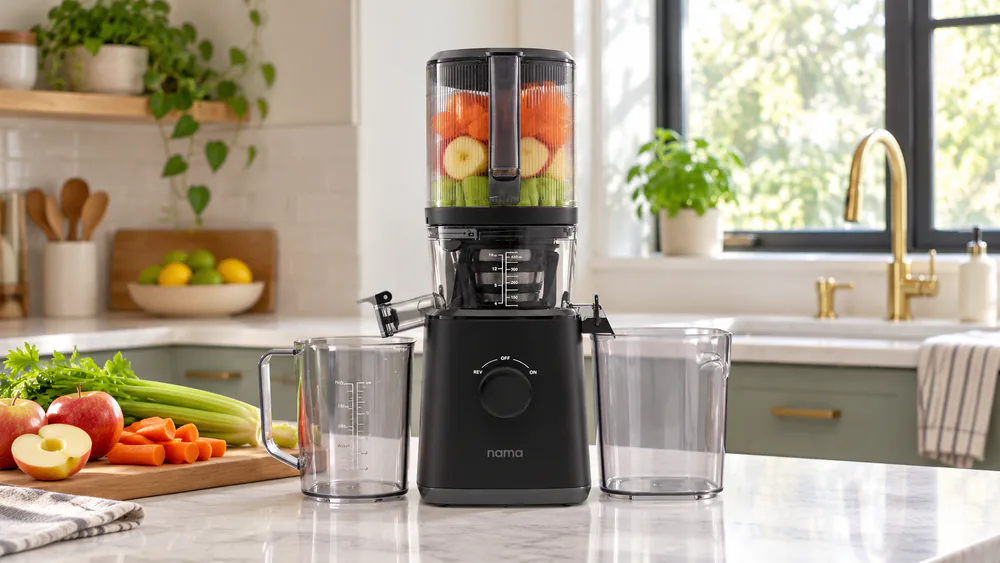
The Nama J2 hopper loaded with cut celery, carrots and apple on a family kitchen counter before juicing begins
A loaded hopper, ready to run while we get breakfast on the table.

Produce Preparation and Batch Juicing

Whole-fruit convenience is not zero prep. Nama's guidance is to cut celery and kale into thirds or smaller, cut large produce to fit, and remove pineapple skin and top, watermelon rind, stone-fruit pits and apple cores and seeds. Citrus peel can come off to reduce bitterness.

The low juice spout is the other quirk. The supplied collecting jug suits that spout better than a tall drinking glass, so pour from the jug into cups.

Juice Quality, Yield, and Noise

The juice is the reason to put up with the rest. It comes out smooth and fresh, and the pulp is relatively dry, which tells us the auger is pulling most of the liquid out. We do not have a lab number to give you for yield, and a loaded hopper is not the same as finished juice.

Leafy Greens and Fibrous Produce

Citrus, carrots, apples and beets give satisfying output. Leafy greens on their own are less impressive, so we pair them with apple or cucumber and load them first, as the layering guide suggests. Celery and ginger run well when cut small enough.

Hard Fruits, Soft Fruits, and Pulp Levels

Hard produce like carrots and apples yields dry pulp and a clean, low-foam glass. Soft fruit juices easily but goes best in the middle layers so it does not slick the chamber early. Pulp drops into its own container, and the fine strainer keeps the juice smooth.

Operating Noise and Juicing Time

The motor is quieter than a blender but still audible in the kitchen. We would not call it silent. Juicing is slow, which is the honest cost of cold pressing, and the hopper is what makes the wait tolerable.

Cleaning, Reassembly, and Counter Space

Cleanup is where a juicer lives or dies in our house. Rinse and brush right away and it stays manageable. Let produce dry on the parts and it gets much harder.

Cleaning the Strainer and Other Parts

Nama's cleaning guide says to hand wash promptly, lift the chamber set off the base, open the pulp outlet and brush the strainer and narrow channels. Wipe the base with a damp cloth, and every so often pull the silicone seals out for a proper wash.

Watch the small removable pulp-outlet gasket. It is easy to lose during washing, and without it celery fibers can collect in the outlet. Wash it over a tub so nothing slips down the drain.

Reassembly, Storage, and Kitchen Fit

Damp rubber parts make reassembly awkward, so drying the components first helps a lot. The tall hopper and chunky base take up substantial counter space, so check your cupboard clearance before deciding where to store the juicer. If you will leave it out, the footprint is the price of the big hopper.

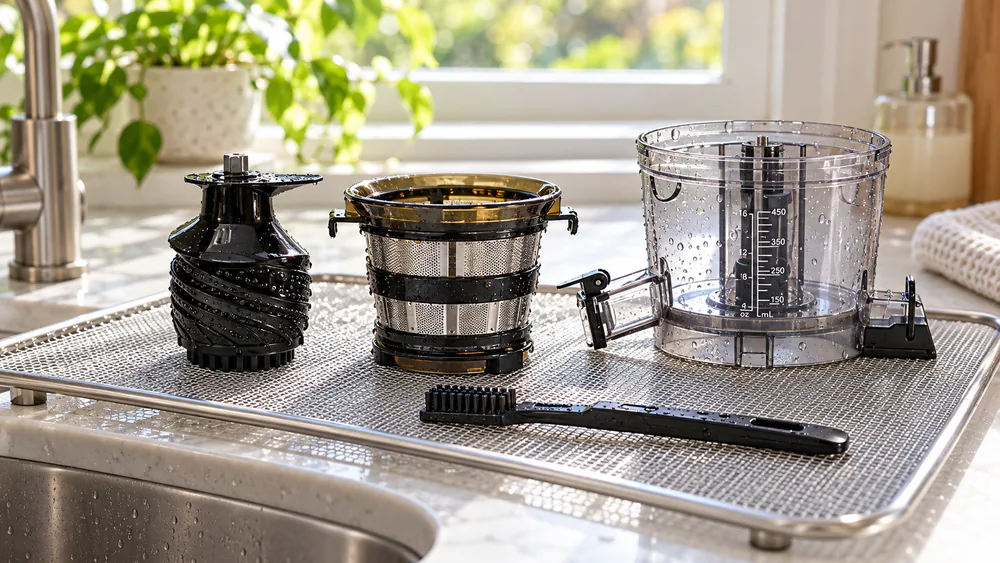
Nama J2 strainer, auger, brush and silicone seals laid out to dry on a rack beside a kitchen sink
Drying every part before reassembly saves a fight with the damp seals.

Nama J2 Pros and Cons

Pros

  • Self-feeding hopper cuts repetitive pushing
  • Smooth juice with dry pulp and little foam
  • Sturdy body that runs smoothly
  • Quieter than a blender
  • Nut milk without a separate bag-squeezing step

Cons

  • Tall and bulky, with real counter and cupboard demands
  • Hand washing only, and dried residue is hard to clear
  • Small pulp-outlet gasket is easy to lose
  • Slow extraction
  • Low spout suits the supplied jug better than tall glasses

Nama J2 Alternatives: Which Juicer Fits Your Needs?

The Nama J3 is the compact sibling. Its 34-ounce hopper means larger batches need more refills, and the smaller opening asks for more chopping, but the body is easier to put away and gives back counter space. Hard carrot chunks can hang up on the J3 and need reverse. The Kuvings AUTO10 is the bigger-batch option with a 100 oz hopper, and its pulp comes out dry too, though it is bulky and needs generous space. We compare the Nama J2 and the AUTO10 in more detail in Nama J2 vs Kuvings AUTO10, and our roundup of the best cold press juicers puts all three in context.

FeatureNama J2Nama J3Kuvings AUTO10
Hopper volume70 ounces34 ounces100 oz
Dimensions (inches)9.8 W x 9.0 D x 17.7 H8.9 W x 6.5 D x 15.4 H10 x 8 x 18
Weight12.1 lbs per current spec9.7 lbs16.5 lbs
Best fitFrequent family batchesSmall kitchens, smaller servingsLarge batches with extra counter space
WashingHand washHand washHand wash
Warranty15-year, all parts15-year, all partsUS 15-year limited

Price, Warranty, and Long-Term Value

The J2 sits in the premium tier, and the J3 costs less while the AUTO10 costs more. We would not call it a casual purchase. It makes sense when you juice several times a week and the hopper saves you real time.

Nama backs the J2 with a 15-year warranty on all parts for ordinary household use. Coverage is for the original owner, needs proof of purchase and a serial number, and requires an authorized purchase. Direct purchases from Nama also carry a 30-day return window: request authorization, return the juicer clean and complete, and expect to pay return shipping. A warranty length does not tell you service life, so in the long run careful, prompt cleaning is what protects your investment.

Frequently Asked Questions

Do the Nama J3 and Kuvings AUTO10 also need hand washing?

Yes. Both are hand-wash machines like the J2, so the cleaning routine does not change if you switch.

Which of the three has the shortest warranty?

None is short. The J2 and J3 carry a 15-year warranty on all parts, and the AUTO10 has a US 15-year limited warranty.

Do the competing juicers handle sorbet?

The AUTO10 ships with a blank sorbet strainer. The J2 needs a separate compatible attachment, so check what is in the box before you plan frozen desserts.

Are the return terms different for the Kuvings AUTO10?

Its direct-purchase window is also 30 days, but it requires original packaging and complete clean parts, and the buyer normally pays return shipping.

Do I need to buy extras to use the J2 for leafy greens?

No. The fine and coarse strainers come in the box, and the layering guide costs nothing to follow. Pairing greens with apple or cucumber helps.

Final Verdict: Is the Nama J2 Worth Buying?

The split between the three comes down to space. The J3 saves counter space and suits smaller batches, while the AUTO10 handles the largest batches and takes up the most room; the J2 falls between them with its 70-ounce hopper.

Read next

See the Nama J2 for yourself

Explore more buying guides to find the right fit for your kitchen routine.