As an Amazon Associate we earn from qualifying purchases. We may earn a commission from links on this page, at no extra cost to you. Learn more.
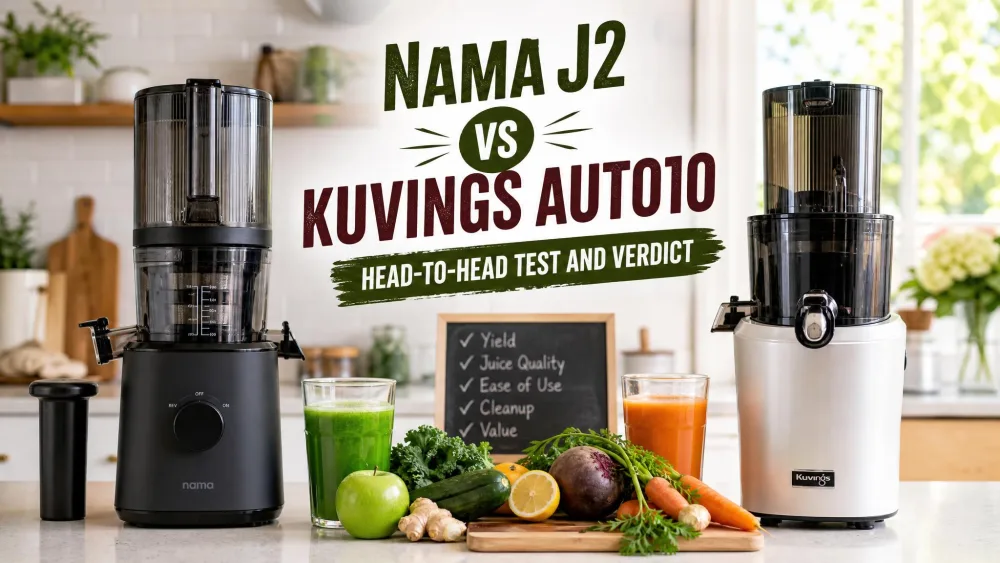
The Nama J2 beats the Kuvings AUTO10 for most home users. The J2 squeezes more from leafy greens with drier pulp, runs quieter at about 60 dB against the AUTO10's 76 dB, and costs about $130 less. The AUTO10 fights back with a 100 oz hopper, a 240W motor rated for 30 minutes, and more juice from oranges. So the question is: do you juice for a couple, or for a crowd?
We ran both machines through weeks of daily use with carrots, celery, oranges, and kale, scoring yield, pulp dryness, noise, cleanup, assembly ease, and build quality.
Quick Answer: Nama J2 vs Kuvings AUTO10
The J2 wins on greens yield, noise, price, and warranty. The AUTO10 wins on batch size and soft fruit.
Key Specifications Compared
Feature
Nama J2
Kuvings AUTO10
Price (street)
$599
$729.99
Motor power
200W
240W
RPM
50 RPM
50 RPM (60-80 some models)
Hopper size
70 oz
100 oz (3 L)
Weight
12.1 lbs
16.5 lbs
Noise level
~60 dB
~76 dB
Continuous runtime
~20 min
30 min
Batch capacity
16-32 oz per load
Whole recipes, family size
Warranty
15 years, all parts
15 yr US; 10-yr motor some regions
Dimensions
9.8 x 9.0 x 17.7 in
8.1 x 10.0 x 18.1 in
Price & Warranty at a Glance
The J2 lists around $599 and the AUTO10 around $729.99 at most US retailers, and street pricing drifts with promos. Nama covers all parts for 15 years with a 30-day full-refund guarantee. The AUTO10 also carries 15 years in the US, though some regions cover only the motor for 10 years.
Choose the Nama J2 if You…
Your daily juice is greens and celery, where the J2 yields more with drier pulp
You want the quieter machine for early mornings
You want the lighter, cheaper machine
You want the longer all-parts warranty
Choose the Kuvings AUTO10 if You…
You juice for a family or batch ahead for the week
You want the stronger 240W motor and 30 minutes of run time
Oranges and citrus are your daily driver
You want the extra lid slot for mid-run additions
You accept more noise and cleanup for batch size
Nama J2 Overview
The J2 is the machine that defines this comparison, with specs from Nama's official J2 page.
The J2 earned the top spot in our kitchen the same way it wins the yield test: quietly and on greens. In head-to-head batches it crushed the leafy-greens category, the biggest gap in the whole comparison, and it produced slightly less foam with soft fruits. Cleanup is the trade-off. The parts are hand-wash only, so we cleaned right away; dried-on pulp turns into a serious chore. Once the strainer snap clicked, disassembly went fast. Watch the tiny rubber pulp-outlet gasket during cleanup; it can pop off, and without it, celery strings jam the outlet.
Pros
Best leafy-green yield and driest pulp in our tests
Quiet at about 60 dB, with a 15-year all-parts warranty
About $130 cheaper than the AUTO10
Cons
Hand-wash only; dried-on pulp gets stubborn fast
Plastics feel lighter than the price suggests
Runs about 20 minutes before a rest
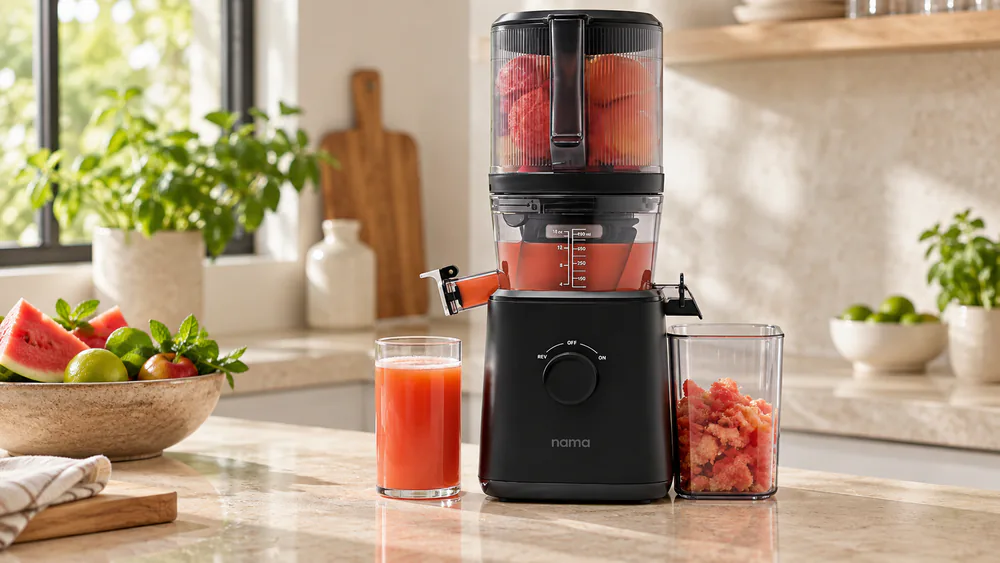
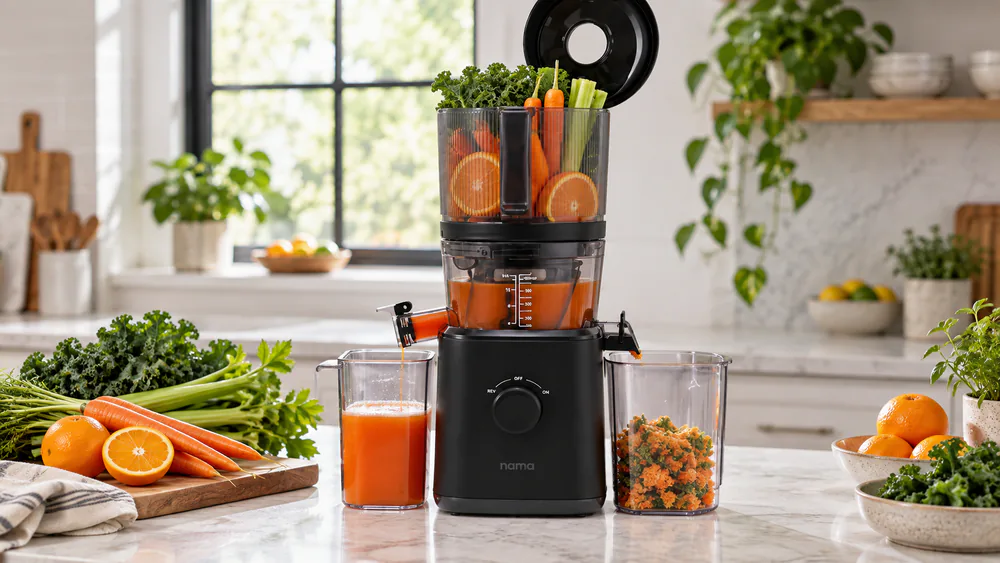
The J2's wide-mouth hopper feeds whole produce with no pre-chopping.
Kuvings AUTO10 Overview
Where the J2 is the all-rounder, the AUTO10 is the batch machine, with specs from Kuvings' product page.
The AUTO10 loads a week of produce at once. Its 100 oz hopper swallowed whole recipes in our testing, and the extra lid slot let us add produce mid-run. It nudged past the J2 on carrots, squeezed noticeably more from oranges, and its pulp came out bone dry. The trade-offs showed up in daily use. On hard produce like ginger and beets it ran louder: about 76 dB on average, with a spike past 80 dB in one session. Cleanup was easy once we followed the included setup video, but long batches demand so much mid-session attention that it stops feeling worth the price.
Pros
100 oz hopper loads whole family and multi-day batches
240W motor rated for up to 30 minutes
Strongest results on oranges and soft fruit
Cons
Louder in use, averaging about 76 dB with spikes past 80 dB
More parts and slower daily cleanup than the J2
Heaviest machine here at 16.5 lbs
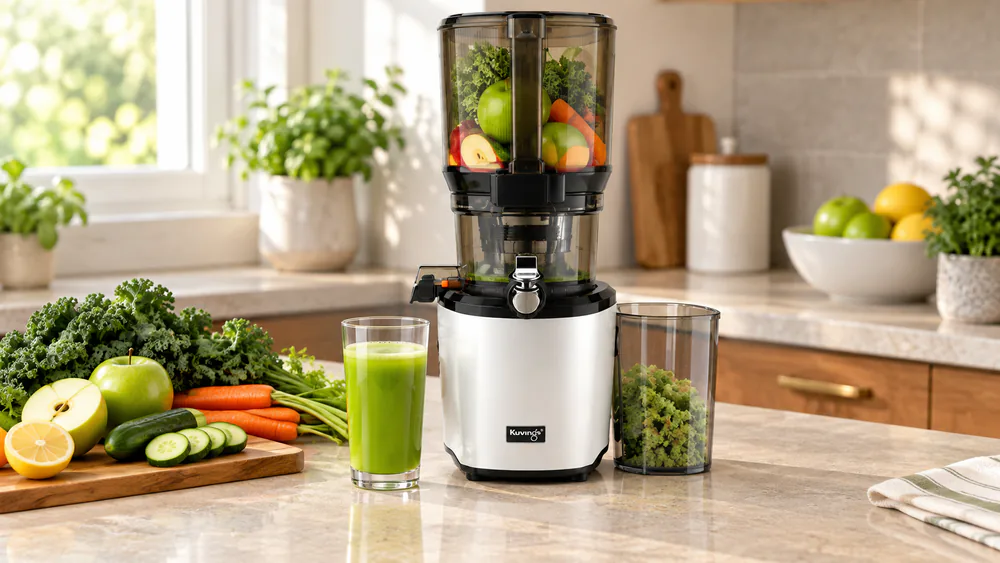
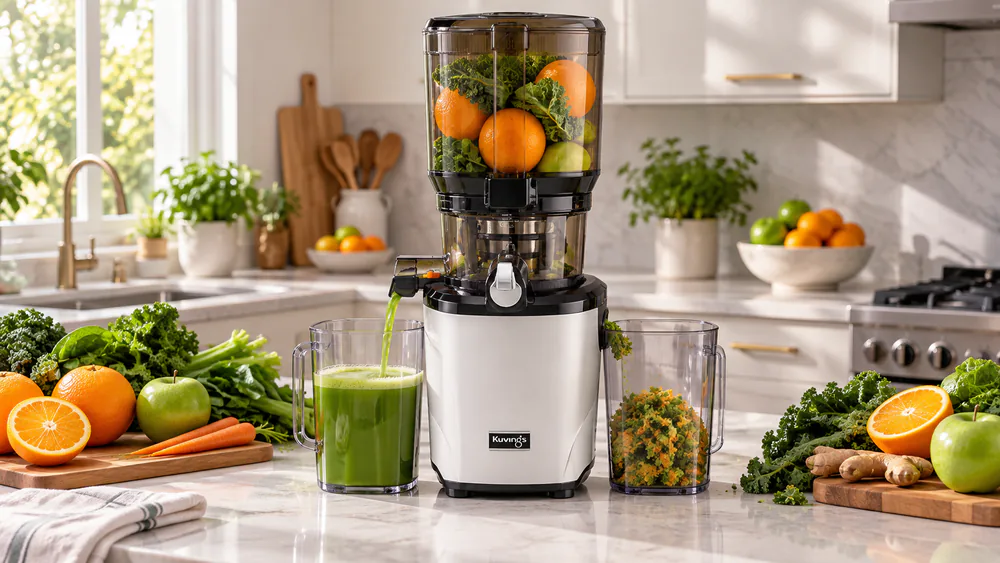
The AUTO10's 100 oz hopper takes a whole family batch at once.
Head-to-Head Feature Comparison
Here is where the two machines separate, feature by feature.
Note. Kuvings sells the AUTO10 in several variants (AUTO10S, AUTO10 Plus), and specs differ across them: RPM ranges from 50 to 80 and wattage from 200 to 240W. This comparison covers the current US AUTO10.
Motor Power & Runtime
The AUTO10 brings the stronger motor, 240W against the J2's 200W, and it is rated for up to 30 minutes of continuous use. The J2 runs about 20 minutes before a rest, though published figures reach 60 minutes. Both spin at 50 RPM.
Hopper Size & Batch Capacity
The AUTO10's 100 oz hopper loads whole recipes for family-size or multi-day batches. The J2, on the other hand, uses a 70 oz hopper, with a 105 oz extended hopper sold separately. A full J2 load yields 16 to 32 oz of juice, typically 20 to 30 oz.
Noise Level (dB)
Noise decides how early you can juice. We measured about 60 dB from the J2 and about 76 dB from the AUTO10, which spiked past 80 dB on hard produce. Readings vary with what is being juiced, so treat decibels as a range. The direction is what matters: the J2 runs at conversation level, the AUTO10 more like a vacuum cleaner.
Cleaning & Maintenance
Both machines are hand-wash territory. The J2 cleans fastest if you stay on top of it: rinse the parts, run the spinning brush through the strainer, and you are done. The AUTO10 is easy once you follow the included video, but the parts count is higher and daily upkeep runs slower.
Build Quality & Materials
Both machines use BPA-free materials. The J2 pairs a SAN hopper with a Tritan chamber and an Ultem auger; the AUTO10 uses Ecogen BPA-free materials with a triple-interlock safety. In the hand, the J2's plastics feel lighter than the price suggests, while the AUTO10 is the heavier machine at 16.5 lbs. It carries Red Dot and Kitchen Innovation design awards.
Warranty & Support
Nama's 15-year all-parts warranty is the strongest coverage in this matchup. The AUTO10 also carries 15 years in the US, though some regions and retailers cover only the motor for 10 years. Support is the J2's weak spot: a small replacement part took multiple calls to source.
Juice Yield Testing: The Real Difference
Yield is the number that separates these two, and the direction flips by produce type.
Carrots & Hard Vegetables
On carrots, the AUTO10 nudged ahead: about 211 ml versus about 200 ml for the J2, a difference of roughly two teaspoons. Batch yields shift with ripeness and prep. The edge on hard produce is real but narrow.
Leafy Greens & Pulp Content
This is the J2's category, and it is not close. In head-to-head batches the J2 crushed the leafy-greens test with noticeably drier pulp. On celery it managed about 131 ml to the AUTO10's 118 ml. If your daily juice is kale and celery, this single result outweighs most of the spec sheet.
Soft Fruits & Citrus
Soft fruit flips it back. The AUTO10 yielded noticeably more from oranges, while the J2 produced slightly less foam. Pick the Kuvings if citrus is your daily driver.
Juice Yield: The Bottom Line
Across a week of batches, the winner depends entirely on what is in your basket. Greens and celery point to the J2. Carrots, citrus, and family volumes point to the AUTO10.
Produce (per batch)
Nama J2
Kuvings AUTO10
Carrots (hard vegetables)
~200 ml
~211 ml
Celery
~131 ml
~118 ml
Leafy greens
More juice, drier pulp
A step behind
Oranges and soft fruit
Slightly less foam
More juice from oranges
Pulp dryness
Drier on greens
Bone dry
Cold Press Technology & Nutritional Value
What "Cold Press" (Masticating) Actually Means
Cold press is a marketing label with a real mechanical meaning. A slow masticating auger crushes produce at 50 RPM instead of shredding it like a centrifugal juicer, which keeps heat and oxidation down. Hurom, the Korean maker that builds Nama's juicers, reports the J2 uses its patented Slow Squeeze Technology; Hurom's comparison of the two brands lays out the connection.
Nutrients, Foam, and Oxidation: What the Research Says
A 2019 study from the National Institutes of Health found no significant differences in vitamin C, phenolics, carotenoids, or antioxidant capacity between cold press and centrifugal, and nutrients degrade within 48 hours at room temperature. A 2024 study of cold-pressed microgreen juices found high phenolic content, with broccoli highest at 92.92 mg GAE per 100 mL. Drink your juice fresh, and buy the juicer that makes you use it daily.
Why Hands-Free Matters for Daily Use
The hands-free hopper keeps a juicer on the counter, not in a cabinet. Load the produce, close the lid, and walk away while the auger feeds itself. That is the difference between juicing as a habit and juicing as a project.
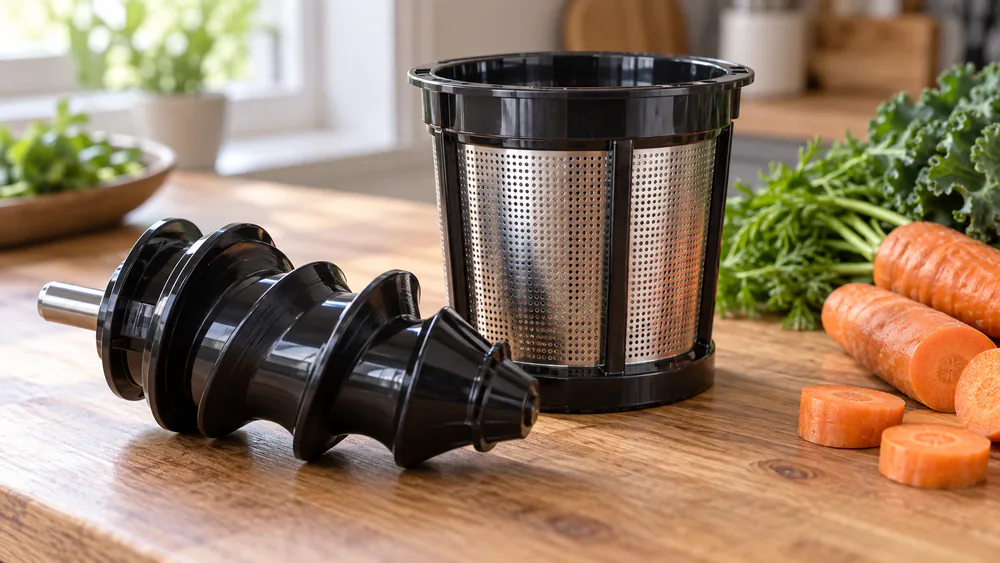
Both machines use a slow 50 RPM auger that squeezes rather than shreds.
Cleaning & Daily Use
Yield matters, but so does cleanup.
Nama J2 Cleaning Walkthrough
We cleaned the J2 after every batch: rinse the chamber, run the spinning brush through the strainer, wipe the containers. Lining the pulp container with a plastic bag keeps emptying mess-free. Watch the rubber pulp-outlet gasket; it can pop off, and without it, celery strings jam the outlet.
Kuvings AUTO10 Cleaning Walkthrough
The AUTO10 cleans easily once you follow the included setup video. Big batches bring mid-session cleaning more often than we liked.
Warranty & Long-Term Durability
Nama J2's 15-Year Warranty Explained
Fifteen years on all parts is the headline: the auger, strainers, hopper, and chamber are covered. A 30-day satisfaction guarantee refunds you in full within 30 days of shipment. For a $599 machine, that is the peace of mind shoppers buy into.
Kuvings AUTO10's Warranty Explained
The AUTO10 carries 15 years in the US, though some regions and retailers cover only the motor for 10 years, and 12 years is quoted in others. The gap matters on a $730 purchase.
What Owners Report After a Year+
Long-term service tells a separate story from our test window. The J2's hopper lid loosens after six to twelve months of daily use, and Nama sends free replacements. The auger shows wear only after two to three years. The AUTO10's motor has produced no issues over years of service, the pattern we look for in a machine built to last. Its weak points are mechanical: the lid hinge loosens and can drop the lid, the pulp chute shows concerns past eighteen months, strainer mesh wears under hard produce, and rubber seals need replacing every couple of years.
Real User Reviews & Feedback
The spec sheet and the track record tell one story together.
Nama J2 in Daily Life
Price complaints are about the sticker, not the machine: the J2 stings at checkout, then earns it back in daily use. The hands-free hopper turns juicing into a 25 to 40 minute session that stocks four days of juice, where an older centrifugal juicer took close to two hours and wasted roughly 15 percent of it.
Kuvings AUTO10 in Daily Life
The AUTO10's value story is durability. It outlasts cheaper juicers that cannot take the strain of daily use, and its parts survive drops without cracking. That is the case for the higher price.
Which Juicer Should You Buy?
Best Overall: Nama J2
The J2 takes the top spot for the same reason it wins the yield test: most daily juice is greens and celery, and that is where it dominates. To see today's price, check the Nama J2 offer price on Amazon.
Key takeaway. Best overall: the Nama J2, rated 4.7 out of 5, for most home users. It wins on leafy-green yield, quieter operation at about 60 dB, and a lower price. Choose the Kuvings AUTO10, rated 4.3 out of 5, for large-batch family juicing and soft fruits.
Best for Beginners / Best Value: Nama J2
Beginners get the same winner. The J2 is the simpler machine to start with: fewer parts to clean, quieter mornings, and a lower price. Assembly clicks fast once you seat the strainer firmly.
Best for Large Batches / Serious Juicers: Kuvings AUTO10
The AUTO10 is the family machine. You trade noise, weight, and cleanup for batch capacity, and if you juice for four or more or batch ahead weekly, that trade pays off. To compare prices, check the Kuvings AUTO10 on Amazon.
The Bottom Line
Both machines are excellent cold press juicers, and neither is a wrong answer. The J2 is our pick for most households because it wins where it counts: everyday greens, quiet mornings, and price. Buy the AUTO10 when your kitchen runs on big batches.
Frequently Asked Questions
Which juicer extracts more juice, and with which produce?
Let batch size and noise decide first. The J2 wins on leafy greens and celery with drier pulp, while the AUTO10 nudges ahead on carrots and squeezes more from oranges. On most produce the gap is only a few teaspoons per batch.
Is the Nama J2 quieter than the Kuvings AUTO10?
Yes, clearly. The J2 measured about 60 dB against the AUTO10's 76 dB, and it is quiet enough to run while someone sleeps nearby.
Which is easier to clean?
The J2, if you clean right after each batch. Its parts are hand-wash only, and dried-on pulp gets stubborn fast. The AUTO10 has more parts and a strainer screen that needs deep cleaning.
Can both make nut milk and smoothies?
Yes. The J2's fine and coarse strainers handle soaked nuts, and the AUTO10 ships with dedicated juice, smoothie, and sorbet strainers. For smoothies, the AUTO10's smoothie strainer is the more turnkey option.
Do both juicers fit a small kitchen?
Both sit about 18 inches tall on a footprint under one square foot. The J2 is lighter at 12.1 lbs; the AUTO10, at 16.5 lbs, is more of a counter dweller.
Does the Nama J2's 15-year warranty cover the motor?
Yes. Fifteen years on all parts means the motor is included, and the 30-day full-refund guarantee makes the first month a free trial. The AUTO10 also carries 15 years in the US, though some regions and retailers cover only the motor for 10 years.
Can I juice whole fruits without cutting them first?
Mostly, yes. Both hoppers are self-feeding and cut produce as they load, so apples, oranges, carrots, and celery go in whole. Halve oversized items like beets or pineapple.
Are these juicers dishwasher-safe?
Neither manufacturer recommends the dishwasher for the main extraction parts. The J2's parts are hand-wash only, and the AUTO10's strainer screen is best cleaned by hand to protect the mesh.
Conclusion: Nama J2 vs Kuvings AUTO10
The verdict from our head-to-head: the Nama J2 is the machine we would buy for most kitchens, and the Kuvings AUTO10 is the machine we would buy for the kitchen that juices for a crowd. We would still pick the J2 for ourselves, because our daily juice is greens first and everything else second. If your household runs on citrus, or you batch a week's juice in one sitting, the AUTO10's 100 oz hopper and stronger motor make it the better spend. Start with the Nama J2 on Amazon to see today's price.