
Kitchen Appliances
Cuisinart ICE-200 Review: Slush, Soft Serve, and Our Verdict

As an Amazon Associate we earn from qualifying purchases. We may earn a commission from links on this page, at no extra cost to you. Learn more.
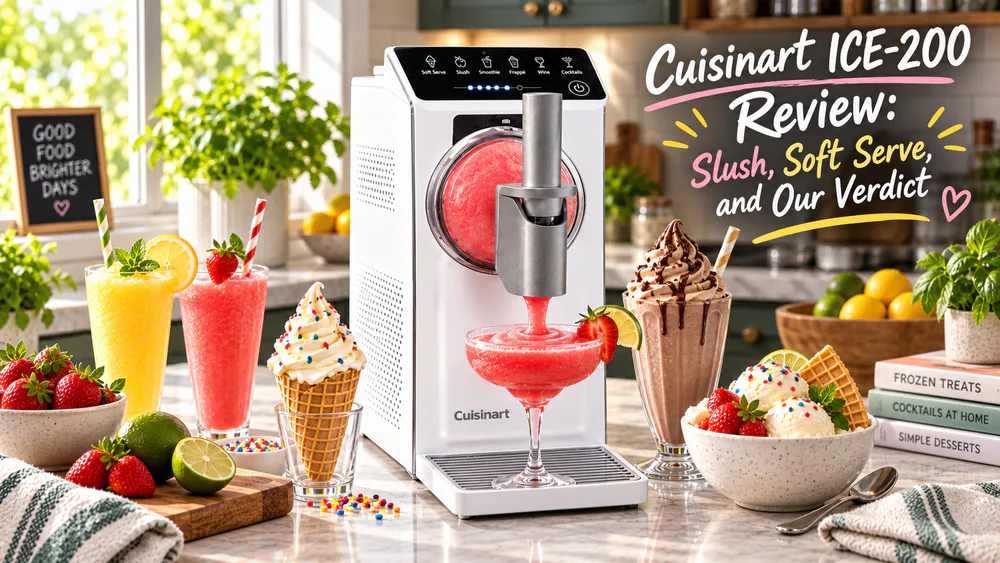
The Cuisinart ICE-200 combines frozen-drink and soft-dessert programs in one compressor-based countertop machine. Pour in a mixture, choose a program, and dispense without first finding freezer space for a bowl. That unusually broad workflow makes it worth a closer look, but the useful question is how well its different modes fit the way you serve.
We examined the machine's design and official specifications alongside hands-on results from the closely related UK Frost Fusion platform. That evidence lets us separate the ICE-200's practical strengths from the recipe and ownership details a specification sheet cannot settle.
Key takeaway. This is a multi-purpose dispenser, not a conventional hard-ice-cream churner. Start by deciding whether tap service and a mixed drinks-and-desserts menu matter in your kitchen.
Cuisinart ICE-200 review: quick verdict
The ICE-200 is easiest to recommend as a versatile frozen-drink machine. Its compressor removes the biggest planning nuisance associated with freezer-bowl models, while six presets and a dispensing tap make the process approachable. A 1.7-quart vessel also gives it enough room for a shared batch rather than one carefully rationed pint.
Our definitive verdict is that the ICE-200 is easiest to recommend for households that make frozen drinks most often and want soft serve or sorbet as useful extras. Testing of the closely related UK Frost Fusion found drinks more dependable than desserts, which were softer and more sensitive to recipe balance. Buyers focused on dense, scoopable ice cream should choose a CREAMi or conventional compressor churner instead.
What it does best
The ICE-200 suits spontaneous entertaining. There is no bowl to freeze overnight, and Cuisinart says some recipes can finish in as little as 15 minutes. In related hands-on testing, margaritas froze in about 25 minutes, while a full soft-serve recipe took about 30 minutes and served roughly five to six people.
The dispensing format is also more convivial than scooping from a conventional compressor bowl. Smart Dispense Control, a firmness display, an ingredient funnel, and a drip tray turn the machine into a small serving station rather than merely a churner.
The main drawbacks
At 18.42 inches long, 7 inches wide, and 17.83 inches high, this is narrow but unusually tall. It weighs 24.47 pounds, so moving it in and out of a cabinet is not an attractive daily routine. We would measure the space below upper cabinets and plan a permanent counter position before buying.
Cleanup is the second compromise. The five-minute rinse cycle helps with loose residue, but dairy mixtures cling more stubbornly than slush. Several pieces still require removal, soaking, and hand washing. Finally, no credible long-term durability pattern or repeat failure point has emerged for this new model, so the 3-year limited warranty carries extra practical value.
Cuisinart ICE-200 specifications at a glance
With that performance hierarchy established, the specifications show what accommodating the machine requires.
| Appliance type | Compressor-based slushy and soft-serve maker |
|---|---|
| Programs | 6 preset programs |
| Capacity | 1.7 quarts |
| Dimensions | 18.42 L x 7 W x 17.83 H inches |
| Weight | 24.47 pounds |
| Power | 60W |
| Cooling | Built-in compressor; no pre-freezing required |
| Keep-cool behavior | Keeps treats cold, but the US material gives no verified duration |
| Warranty | 3-year limited warranty |
| Included parts | Compressor base, ingredient funnel cover, ingredient funnel tray, Smart Dispense Sensor, dispenser assembly, star tip, dispenser cover, auger, drip tray, and instruction/recipe booklet |
The selling price changes with promotions. At the time of the research pack, Cuisinart showed a $279.95 sale price and a $329.95 regular price. Direct purchases also carried 30-day returns. Those figures can move, so compare the current price with the type of output you actually make most often.
Design, size, and what comes in the box
Those numbers become more meaningful once we translate them into counter placement and daily handling.
Build quality and countertop footprint
The ICE-200 uses a vertical layout to fit its chilling chamber, controls, and dispenser into a seven-inch-wide body. That slim width helps, but the 17.83-inch height can create clearance trouble beneath cabinets. Its 18.42-inch depth may also bring the front close to the counter edge.
At 24.47 pounds, this is a countertop appliance in the literal sense. The weight is consistent with an internal compressor, and it discourages constant lifting. From an ownership perspective, a stable location also protects the refrigeration system from unnecessary tilting. After transport, keep the machine upright for at least 4 hours before first use.
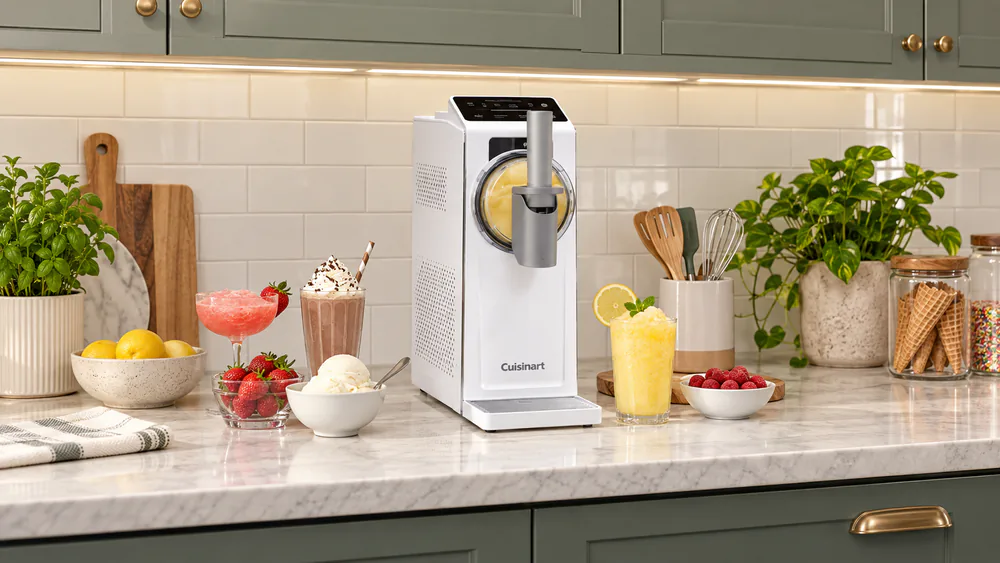
Controls, presets, and dispensing system
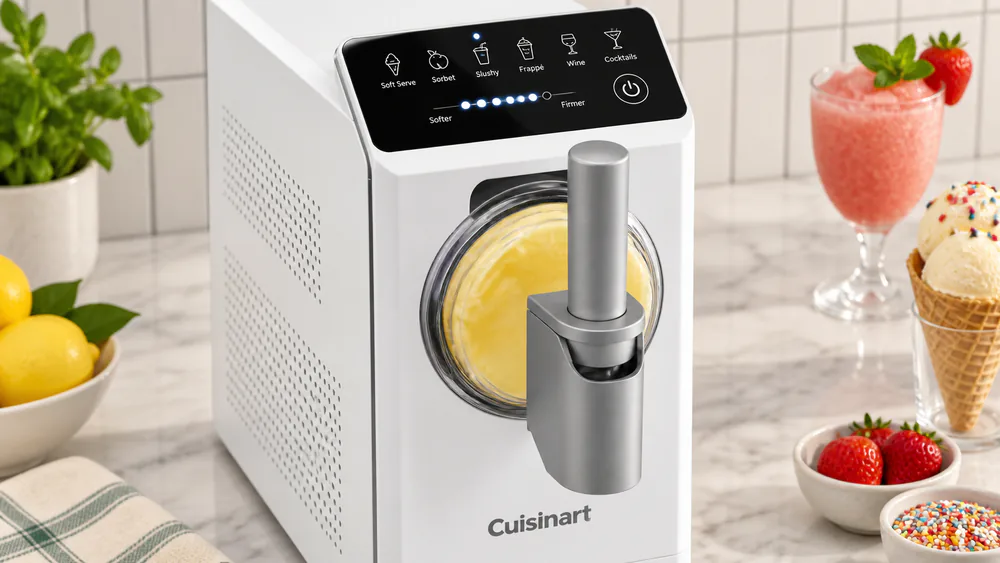
The control scheme combines 6 presets with a firmness progress display. Smart Dispense Control releases the finished mixture through the front tap, while the ingredient funnel provides a route for additions. A drip tray catches ordinary drips, and the star tip gives soft serve its familiar ridged shape.
These features reduce guesswork, but they do not remove recipe chemistry. Sugar, alcohol, fat, and solids all affect freezing. A preset can manage time and temperature; it cannot make an unsuitable mixture behave like a balanced one.
How the Cuisinart ICE-200 works
Once the machine has a suitable home, its compressor-and-auger workflow explains both its convenience and its texture limits.
Compressor cooling and no-pre-freeze operation
The built-in compressor chills the mixture while the auger keeps it moving. Unlike a freezer-bowl machine, the ICE-200 does not require a bowl to spend hours in the freezer. That makes an unplanned batch possible and avoids dedicating freezer space to a bulky insert.
The auger helps control crystal growth and moves the finished mixture toward the dispenser. This continuous movement is well suited to pourable slush and soft dessert textures. It is not the same process as hardening ice cream for scooping, so expectations should remain closer to soft serve than a firm premium pint.
The six frozen-drink and dessert programs
The program set covers soft serve, sorbet, slushy, cocktail, frappe, and wine. That mix explains the machine's broad appeal: one chilling system handles family treats, coffee drinks, and adult beverages. Cuisinart's official ICE-200 specifications also describe quick-freeze chilling, the dispensing system, rinse cycle, and removable components.
We would still choose recipes according to the program rather than assuming any liquid can freeze. Alcohol depresses the freezing point, and very low-sugar mixtures can freeze too hard or develop a rough texture. Following a tested formula is especially important during the first few batches.
Cuisinart ICE-200 performance results
That mechanism favors flowing textures, and the results make the distinction clearest.
Slushies and frozen cocktails
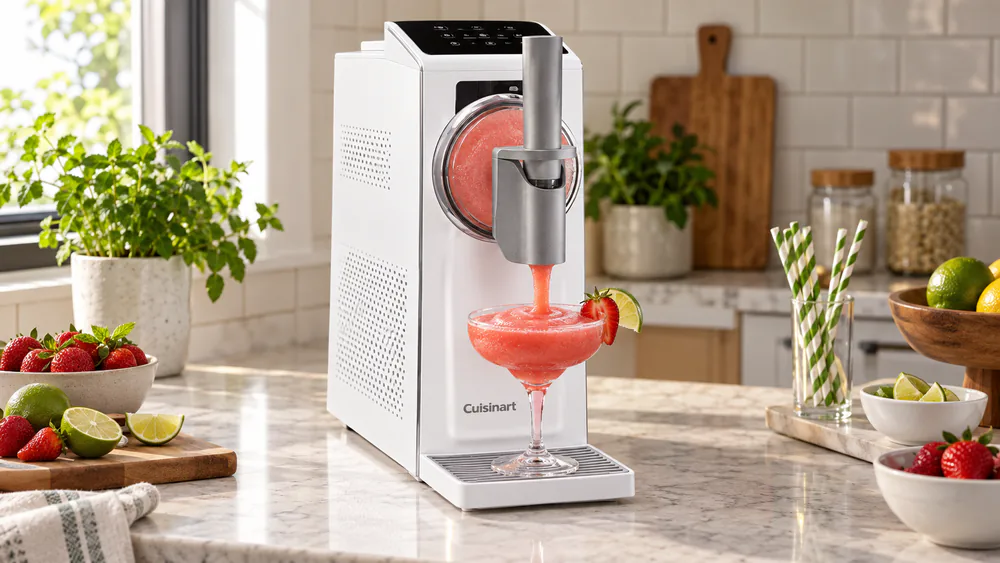
Frozen drinks are the strongest reason to buy. In testing of the closely related Frost Fusion, margaritas froze in about 25 minutes and dispensed with the expected slushy consistency. The drink melted quickly after dispensing, however, and the yield was roughly half the booklet's claimed serving count. Some liquid also remained behind the dispenser.
Those findings should be treated as closely related context, not proof that the US ICE-200 and UK ICE200U or ICE201U have identical hardware and firmware. Even so, they reveal realistic ownership issues: serving claims depend on glass size, frozen drinks begin warming immediately, and dispenser geometry can leave a small remainder.
Soft serve, ice cream, and sorbet
A full soft-serve recipe in the related machine took about 30 minutes, produced a clean swirl, and served roughly five to six. The result softened during a 30-minute hold, so we would dispense dessert when it reaches the desired firmness rather than treating the chamber as a hardening freezer.
Soft serve and sorbet also proved more recipe-sensitive than slush. A mixture that contains too much free water can feel icy, while one with an unsuitable sugar, fat, or solids balance may remain loose. The ICE-200 can make an attractive soft swirl, but buyers who prioritize dense, scoopable ice cream should consider a CREAMi or a conventional compressor churner.
Cycle time, texture, consistency, and keep-cool performance
Cuisinart advertises results in as little as 15 minutes, but richer or larger recipes can take longer. The related tests provide more useful planning numbers: around 25 minutes for margaritas and around 30 minutes for a full soft-serve batch. Mixture temperature, room conditions, recipe balance, and fill level can all change the endpoint.
The firmness progress display is more useful than a rigid countdown because texture is the real finish line. The machine can keep treats cold, but official US material does not establish a dependable keep-cool duration. We would plan to serve promptly, particularly for dairy dessert and alcoholic mixtures that soften quickly.
Noise during operation
Cuisinart calls the motor ultra-quiet, but no independent sound measurement for the US ICE-200 is available. A compressor and auger create operating sound, so “ultra-quiet” should not be read as silent.
For context, the Ninja SLUSHi produced a low, steady hum measured at 54 dB from a few feet away. The Ninja CREAMi is conspicuously louder, closer to a blender, although its processing cycle lasts only a few minutes. Without a comparable ICE-200 measurement, we would not rank these machines by noise alone.
Ease of use and cleaning
Performance is only half the ownership story; setup and residue determine how readily we would run another batch.
Setup and learning curve
Initial setup is intuitive, with one important refrigeration rule: leave the compressor upright for at least 4 hours before first use. Once settled, the workflow is straightforward. Add a suitable liquid mixture, choose the matching preset, watch firmness progress, and dispense when the texture is ready.
The learning curve lies mainly in formulation and timing. Start with the supplied recipe framework, avoid overfilling, and change one variable at a time. If a dessert is runny, immediately adding more liquid usually moves it in the wrong direction. Record the recipe and endpoint so a successful batch can be repeated.
Auto-clean cycle and hand washing
The rinse cycle runs for about five minutes and is valuable immediately after serving. It loosens residue before it dries around the auger and dispenser. For slush, that can make cleanup relatively manageable.
Dairy residue demands more work. Testing of the related UK unit found ice-cream residue harder to remove than slush, with several parts requiring soaking and hand washing. Only the auger was listed as top-rack dishwasher safe on that reviewed UK unit, so US owners should verify their manual before putting other pieces in a dishwasher.
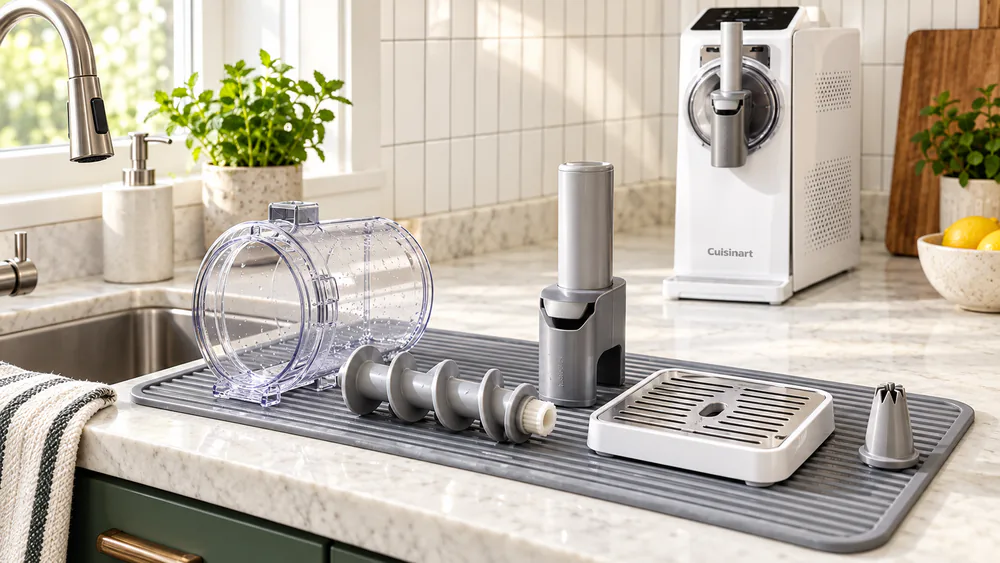
From a repair-aware perspective, accessible removable food-contact pieces are preferable to residue trapped inside a fixed path. Still, more joints and seals mean more surfaces to inspect. Wash gently, clear the dispensing passage, and reassemble only when parts are clean and dry.
Cuisinart ICE-200 pros and cons
Taken together, the testing and ownership details reduce to the following tradeoffs.
Pros
- Built-in compressor means no bowl pre-freezing
- 6 presets cover frozen drinks and soft desserts
- 1.7-quart capacity suits shared batches
- Smart Dispense Control and firmness display simplify serving
- Rinse cycle helps loosen fresh residue
- 3-year limited warranty exceeds both named Ninja competitors
Cons
- Tall, deep, and heavy for frequent cabinet storage
- Soft serve and sorbet can be recipe-sensitive
- Dairy cleanup requires more than the rinse cycle
- US keep-cool duration and independent noise level are not established
- Long-term durability patterns are not yet available
The strongest positives all concern workflow. The biggest negatives concern physical ownership and the gap between versatile programming and consistently firm dessert texture. Buyers who accept those tradeoffs get more from the machine than buyers chasing one perfect type of ice cream.
Cuisinart ICE-200 vs. the competition
Those tradeoffs sharpen when the ICE-200 is placed beside machines with narrower jobs.
| Product | Workflow | Strongest output | Pre-freezing | Dispensing | Ideal buyer |
|---|---|---|---|---|---|
| Cuisinart ICE-200 | Pour liquid, select mode, dispense | Slush and frozen drinks; also soft desserts | No | Smart Dispense tap | Wants one unit for drinks and soft desserts |
| Ninja SLUSHi FS301 | Pour drink, select mode, dispense | Smooth frozen drinks | No | Spout | Primarily makes party drinks |
| Ninja CREAMi NC301 | Freeze pint overnight, then process | Dense, customized scoopable desserts | Yes, overnight | None | Plans pints ahead and prioritizes recipe control |
| Conventional compressor maker | Pour chilled base, churn, scoop | Traditional churned ice cream and gelato | No | None | Prioritizes conventional churned texture |
ICE-200 vs. Ninja SLUSHi
The SLUSHi is the more focused party-drink appliance. It has an 88-ounce vessel, makes 7+ drinks per batch, offers 5 presets, uses 200 watts, and can maintain slush for 12+ hours. Its selling price changes with promotions; the research pack recorded $299.99.
In testing, soda became smooth slush in about 30 minutes at a steady 54 dB hum. Cleanup took only a few minutes with the rinse cycle, followed by washing the vessel and auger and wiping the chilling cylinder. Its minimum fill made a single serving impractical, with tested recipes bottoming out around two to three servings. Choose the SLUSHi for drinks; choose the ICE-200 for a broader menu and a longer 3-year warranty instead of the SLUSHi's 1-year limited warranty.
ICE-200 vs. Ninja CREAMi
The CREAMi uses two included 16-ounce pints and an 800-watt motor. Its base must freeze overnight before processing, so it cannot match the ICE-200 for spontaneity. The payoff is greater control over dense, scoopable, customized desserts through seven treat programs plus Re-Spin.
CREAMi processing is loud but brief. Its removable parts are machine washable or easy to rinse, and a dry result can often be improved with Re-Spin. The selling price changes with promotions; the pack recorded a $199.99 sale price and $229.99 regular price. Its warranty is 1-year. Pick it when dessert texture and pint-by-pint customization matter more than dispensing or frozen drinks.
ICE-200 vs. a conventional compressor ice cream maker
A conventional compressor maker also avoids pre-freezing, but it churns a chilled base for scooping rather than sending the result through a tap. This class generally specializes in ice cream and gelato rather than slushies, frappes, or frozen wine.
Capacity, price, power, and warranty vary by model, so numeric comparisons require a named alternative. Conceptually, the choice is simple: buy a conventional churner for traditional dessert texture, or the ICE-200 for a wider drinks-first menu and tap service.
Who should buy the Cuisinart ICE-200?
Buy it if
Buy the ICE-200 if you regularly serve a group from the tap and want one control panel for cocktails, frappes, wine slush, sorbet, and soft serve. It particularly suits hosts who prefer a shared batch to preparing individual frozen pints.
The 3-year limited warranty is meaningful for cautious early adopters because no dependable long-term durability record exists yet. Direct buyers also have a 30-day return window, though current terms should always be checked before purchase.
Skip it if
Skip it if you normally make one drink at a time or prefer individual flavor customization. Renters and infrequent entertainers may also struggle to justify dedicating a permanent appliance position to occasional batches.
Frequently asked questions
Can the ICE-200 make firm, scoopable ice cream?
Its dispensing system is designed around soft, flowing textures. Buyers whose priority is dense, scoopable dessert should compare a CREAMi or conventional compressor churner.
Is the ICE-200 practical for one serving?
Its 1.7-quart capacity and serving-station format make the strongest case for shared batches. A small household should weigh the cleanup and permanent counter space against how often it will make more than one portion.
Can we compare the ICE-200's noise level with the Ninja SLUSHi?
Not reliably. An independent US ICE-200 sound measurement was not established, so the SLUSHi's measured 54 dB result should not be transferred to this machine.
Does the ICE-200 have a verified keep-cool duration?
Official US material says it keeps treats cold but does not provide a dependable duration. Plan serving around the finished texture rather than assuming an all-day hold.
What does the 3-year limited warranty tell us about durability?
It provides longer stated coverage than either named Ninja competitor's 1-year warranty, but it does not substitute for long-term evidence. No credible repeat failure pattern has yet been established for this new model.
Is ICE-200 the same as Frost Fusion or ICE200U?
ICE-200 is the current US model, while Frost Fusion coverage often concerns UK ICE200U or ICE201U variants. Their workflows are closely related, but hardware or firmware equivalence has not been established, so UK performance is context rather than exact proof for the US unit.
Final verdict: is the Cuisinart ICE-200 worth it?
Yes, for frequent hosts who will use its range often enough to justify a dedicated serving appliance. Occasional users and texture-focused dessert makers will get better value from a narrower alternative.
Read next
Ready to upgrade your kitchen?
Explore more practical appliance reviews and buying advice for your kitchen.