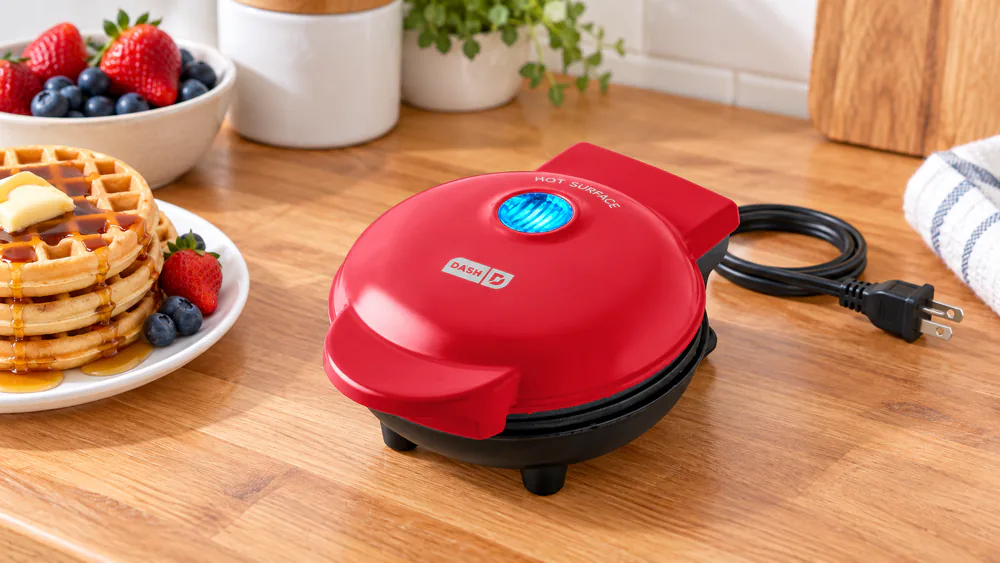
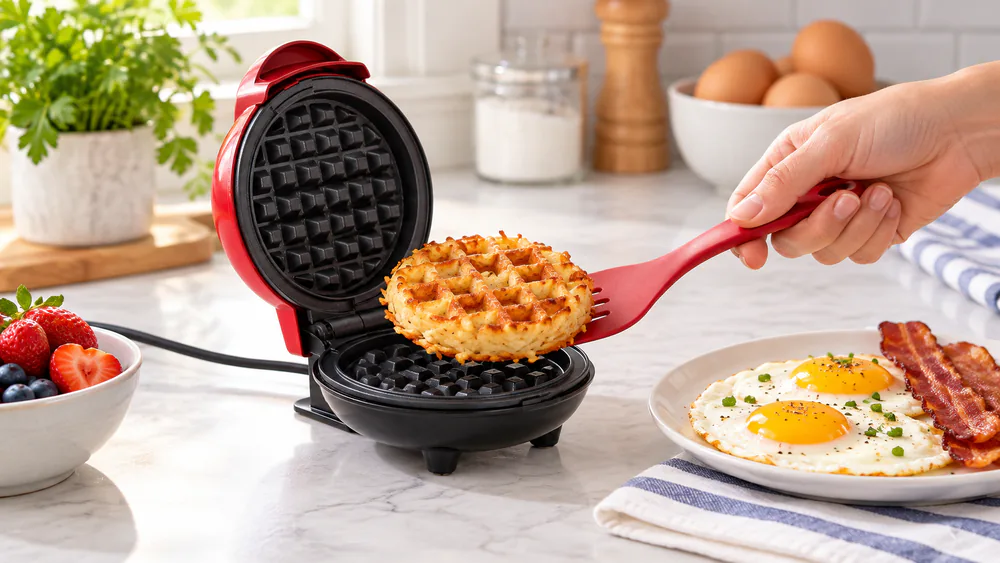
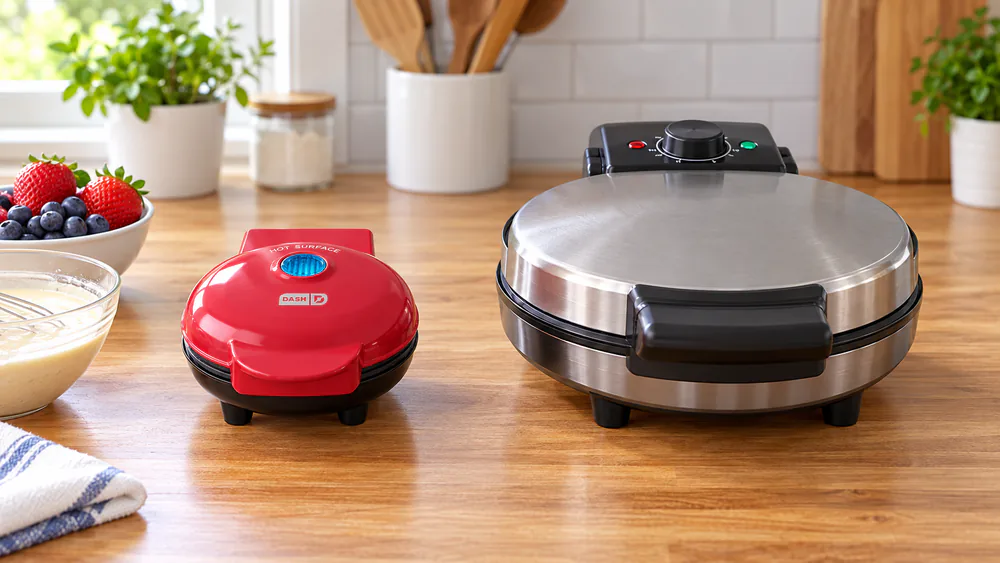
The Dash Mini makes a good small waffle, but speed and consistency depend on your batter and your patience. The plates can give a waffle a crisp shell with a soft middle, and light, fluffy results are possible without flipping the machine over.
Preheating and the First Waffle
Plug it in and the indicator light comes on. When the light goes out, the plates have reached preheat temperature. We do not quote a preheat time, because it varies with the unit and your kitchen, so watch the light instead.
The light has a catch. It cycles during cooking, so it is not a doneness sensor, and it can be hard to see in bright light. Judge the first waffle by steam and color rather than the light.
Start with 3-4 tablespoons of batter and adjust for how much your batter expands. Roughly two to four minutes works for ordinary waffles, though some batters take much longer. Use the waffle's color as your guide, not a fixed countdown.
Browning, Texture and Batter Differences
Buttermilk and cheddar-scallion batters gave evenly textured waffles with a pleasantly crisp exterior. A little longer on the plates improves golden color and crispness, so do not pull the first waffle too early.
Not every batter behaves. Some combinations brown heavily in the wells while the center stays dense or overly moist, and the top can brown less evenly than the bottom. Crisp edges and a soft center are achievable here, but uniform browning is not guaranteed. A thinner batter and a slightly longer cook is the combination we would try first.
Cooking Several Waffles in a Row
This is where the Dash Mini shows its limits. Making enough waffles for several people ties you to the machine for repeated small batches, and serving a whole family takes patience because every portion requires its own cooking cycle.
The practical workaround is to cook in a stream and keep finished waffles in a warm oven, or to batch-cook and freeze them, which Dash supports. On a school morning with several hungry people, though, you will be standing at the counter the whole time.