As an Amazon Associate we earn from qualifying purchases. We may earn a commission from links on this page, at no extra cost to you. Learn more.
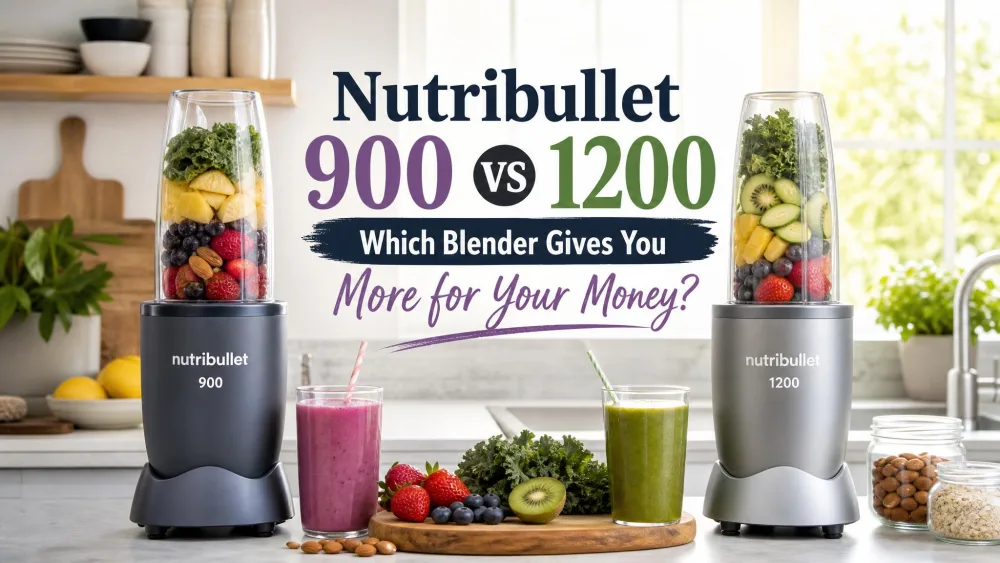
Which Nutribullet is worth your money, the 900 or the 1200? The 900 costs less, and the 1200 packs more power. The honest answer depends on how often you blend.
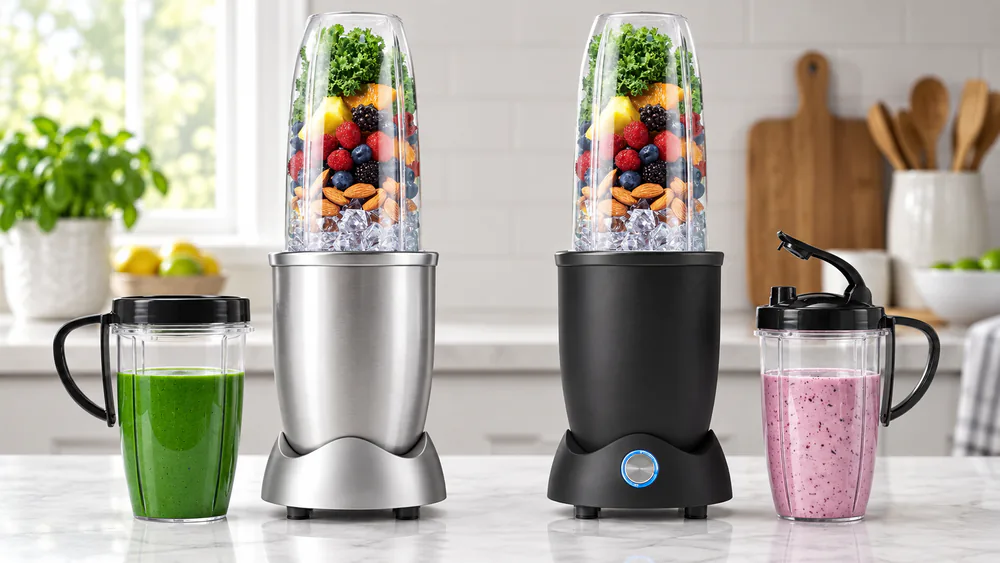
We ran the NutriBullet 900 and the NutriBullet 1200 through our test kitchen. Morning smoothies, frozen fruit, ice, nut butters, and salsa batches all kept the blades busy.
Both machines logged weeks of real daily use on our counter before any scoring, not a one-afternoon lab session. A typical week ran like ordinary kitchen life. There was a smoothie every morning, frozen fruit and ice blends, post-workout shakes, and meal-prep batches. Salsa and sauce duty fell to the 1200's pulse button.
Here's what we'll compare: motor power and blend speed, cup capacity, cleanup, noise, and price, ending with a clear pick for each kind of buyer.
Quick Comparison Summary: NutriBullet 900 vs 1200
Feature
NutriBullet 900 (Pro)
NutriBullet 1200 (Pro+)
Blender type
Personal single-serve bullet blender
Personal single-serve bullet blender
Release date
Mid-2010s (2013-2014, sources disagree)
Pro+ family late 2019; matte black variant 2022-2023
Motor power
900W, 25,000 RPM
1200W, no official RPM
Cup capacity
32 oz and 24 oz cups
32 oz and 24 oz cups
Dimensions and footprint
4.7 lbs; 6 x 6 in footprint, 11.6 in tall with cup
6.2 lbs; 5.4 x 5.4 in footprint, 14.4 in tall with cup
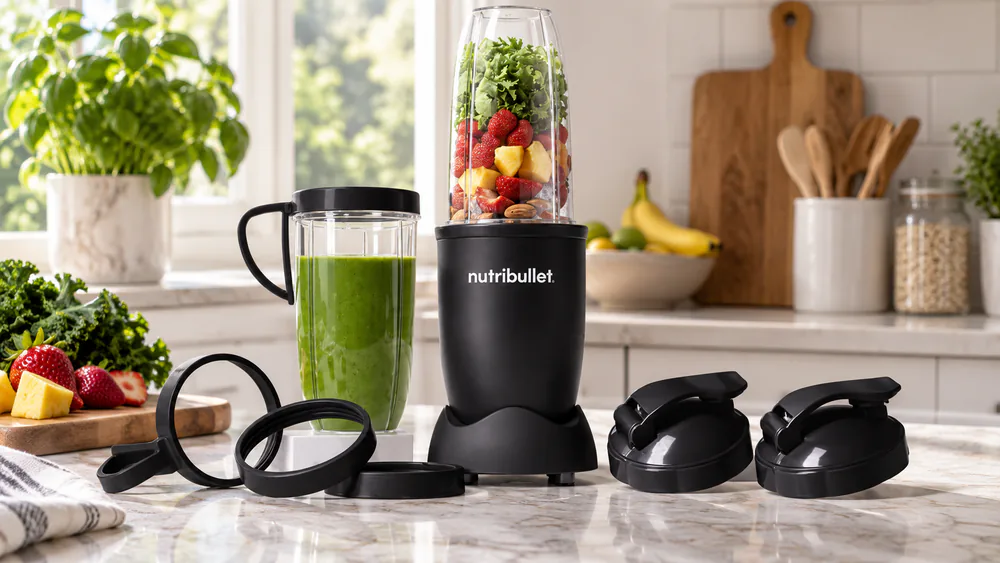
The 900 is our budget pick. For about $80 to $90 you get a compact single-serve blender that gets the job done, with limits worth knowing before you buy.
900W high-torque motor
32 oz and 24 oz BPA-free cups
Cups top-rack dishwasher safe; blade is not
Specifications
Motor
900W
Cups
32 oz and 24 oz
Weight
4.7 lbs
Our morning test exposed the limits quickly. On thick mixes it ran slightly grainy and needed a shake or stir to finish, since the blade sits low and top ingredients spin in place. Full-size ice cubes struggled in the small cup, while small cubes for margaritas blended fine.
Pros
Budget-friendly, roughly $80 to $90
Compact and light at 4.7 lbs
Blends a fruit smoothie in 30 to 45 seconds
Top-rack dishwasher-safe cups and lids
Cons
Grainy on thick blends; needs a shake
No auto shut-off; heavy runs risk overheating
Full-size ice cubes struggle in the small cup
Light base can shift on the counter
Who Should Buy the NutriBullet 900
The 900 fits your lifestyle if you blend a few times a week and want to spend under $100. It suits small kitchens and anyone who prefers no buttons or programs. Full specs are on the NutriBullet Pro 900 official specs page.
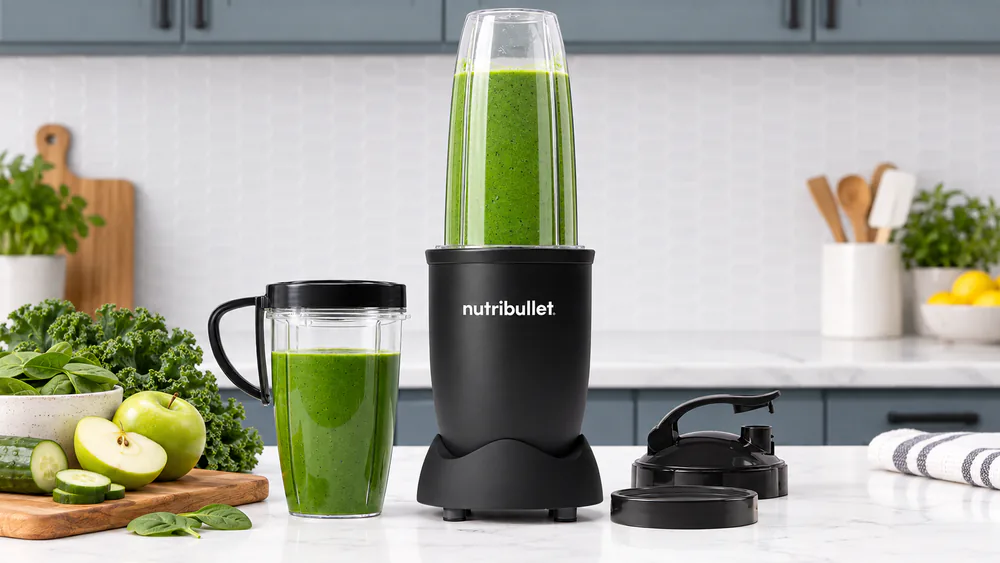
Where the 900 saves money, the 1200 spends it on power, and the extra watts earned their keep. If you blend most days, the premium is worth your money.
1200W motor with dedicated pulse button
60-second auto shut-off cycle
Crushes ice and frozen fruit to powder
Suction feet hold the base steady
Specifications
Motor
1200W
Cups
32 oz and 24 oz
Weight
6.2 lbs
We put the 1200 through the same frozen strawberry and ice test, and it came out looking like a different class of machine. It crushed ice and big frozen strawberries to a powder-like finish, with smoothies silky in 20 to 30 seconds and fewer restarts than the 900. The 60-second auto shut-off stops runs for you, though thick mixes can leave ingredients stuck at the top.
Pros
Silky-smooth texture on thick blends
Pulse button for salsa and chunky sauces
Hands-free 60-second auto shut-off
Rock-steady suction feet
Cons
Loud during a blend
60-second cycle limits long runs
Honest life expectancy: about two years
Max-fill line sits low, shrinking batch size
Who Should Buy the NutriBullet 1200
The 1200 is for daily blenders who want a step change in texture, crush ice and frozen fruit, and make salsas and chunky sauces. If you value speed and smoothness over quiet, this is your machine. Full specs are on the NutriBullet Pro+ 1200 official specs page.
Head-to-Head Comparison: NutriBullet 900 vs 1200
The differences live in the motor, controls, and build.
Motor Power and Blending Performance
The 900 packs 900 watts and spins at 25,000 RPM; the 1200 packs 1,200 watts, with no published RPM. In testing, the same smoothie took 30 to 45 seconds in the 900 and 20 to 30 in the 1200.
Feature
NutriBullet 900 (Pro)
NutriBullet 1200 (Pro+)
Motor
900W, 25,000 RPM
1200W, no official RPM
Smoothie blend time
30-45 seconds
20-30 seconds
Texture on thick blends
Slightly grainy
Smooth, few specks
Blending Capacity and Cup Sizes
Both ship with a 32 oz and a 24 oz cup, so raw capacity is identical. The 1200's max-fill line sits about a third of the way down, so frozen fruit and greens fill it fast and the usable batch is smaller than 32 oz suggests.
Feature
NutriBullet 900 (Pro)
NutriBullet 1200 (Pro+)
Cup capacity
32 oz and 24 oz cups
32 oz and 24 oz cups
Footprint
6 x 6 in, 11.6 in tall with cup
5.4 x 5.4 in, 14.4 in tall with cup
Weight
4.7 lbs
6.2 lbs
Blade and Jar Quality
Both use a stainless steel extractor blade in BPA-free cups. The parts story differs: the silicone gasket under the 900's blade fails first, and the plastic drive gear inside the base is the weak point on both.
Feature
NutriBullet 900 (Pro)
NutriBullet 1200 (Pro+)
Blade
Stainless steel extractor blade
Stainless steel extractor blade
Blade reach
Sits low; top ingredients spin in place
Reaches smooth blends without mid-run help
Weak points
Silicone gasket, drive gear
Drive gear, gasket
Ease of Use and Cleaning
Cleanup is the best part of both: blend and drink from the same cup, cups and lids go on the dishwasher's top rack, and rinsing right away beats brushing out dried blends. The 900 is buttonless push-and-twist; the 1200 is one-touch plus pulse.
Feature
NutriBullet 900 (Pro)
NutriBullet 1200 (Pro+)
Controls
Buttonless push-and-twist
One-touch plus pulse
Cleanup
Same-cup blending, top-rack safe
Same-cup blending, top-rack safe
Stability
Light base can shift
Suction feet hold steady
Noise Level
Neither is quiet. The 900 spikes at startup and runs higher-pitched under load, but stays quieter than full-size blenders. The 1200 is louder, about 93.3 dB, though it finishes in 20 to 30 seconds.
Feature
NutriBullet 900 (Pro)
NutriBullet 1200 (Pro+)
Startup
Loud spike at startup
Loud from the start
Under load
Higher pitch, sharper sound
Louder, less strained
Measured loudness
Quieter than full-size blenders
About 93.3 dB
Price and Value for Money
The 900 typically sells for about $80 to $90 and the 1200 about $120 to $135, with street pricing moving week to week. For daily blenders the extra $40 is worth it; for casual users the 900 gets the job done for less. Both carry a 1-year warranty plus an optional 3-year paid extension, per the official NutriBullet website.
Feature
NutriBullet 900 (Pro)
NutriBullet 1200 (Pro+)
Street price
About $80-90 (around $84 now)
About $120-135 (around $119 now)
Warranty
1-year + optional 3-year extension
1-year + optional 3-year extension
Value verdict
Best for budget buyers
Daily blenders
Real-World Testing and User Feedback
Spec sheets compare motors; daily use compares everything else. We scored both machines on blend speed, texture, noise, cleanup, and durability. Durability is the honest part: the silicone gasket under the 900's blade fails first, some units die within two or three months while others run for years, and the honest expectation for the 1200 is about two years.
NutriBullet 900 in Real Use
Day to day, the 900 is the easiest machine on our counter: you blend, cap, and drink from the same cup, and the cup and lid ride the dishwasher's top rack. The to-go lid occasionally fails to seat tight and lets contents slip near the lid, and the small flip clips snap off with casual handling.
NutriBullet 1200 in Real Use
The 1200 took a little learning. Gloppy ingredients like Greek yogurt stick to the lid end of the inverted cup and never reach the blades, so we load wet, heavy ingredients first. The motor-engage tabs on the base get sticky when dried food builds up and can stop the motor from starting; a small brush or a dab of lubricant frees them.
Which NutriBullet Is Right for You?
Let your routine break the tie.
Key takeaway. If you blend most days, the 1200 is the better buy: faster, smoother, steadier, with pulse for salsas and chunky sauces. If you blend a few times a week, the 900 gets the job done for roughly $40 less.
Pick the NutriBullet 900 if:
You blend a few times a week, not every day
You want to spend under $100
You mostly blend fruit, greens, and liquids
Counter space is tight
Pick the NutriBullet 1200 if:
You blend daily, including frozen fruit and ice
You want silky-smooth texture
You make salsas, dips, and chunky sauces
You want hands-free auto shut-off
FAQs About NutriBullet 900 vs 1200
What's the main difference between the NutriBullet 900 and 1200?
Power and controls: 900 watts with push-and-twist on the 900, 1,200 watts with pulse and 60-second auto shut-off on the 1200.
Can the NutriBullet 900 handle ice and frozen fruit?
Frozen fruit, nuts, and seeds blend fine; full-size ice cubes struggle in the small cup, so use small cubes.
Is the NutriBullet 1200 worth the extra cost?
For daily blenders, yes: faster, smoother, steadier, with pulse for salsa texture. Occasional users can save money on the 900.
Are the cups and blades interchangeable between the two models?
Officially no. NutriBullet says each model has its own cups and blades, and warns that mixing parts leads to extra wear.
How loud is the 1200 compared to the 900?
Loud enough that earplugs are worth it. The 1200 measured about 93.3 dB, and the consolation is the short blend time: 20 to 30 seconds a batch, then it is done.
Can I blend hot liquids in these blenders?
No. Neither is made for hot liquids in sealed cups; heat and pressure can build up while blending.
How long do these blenders last?
The parts fail before the blender does. The gasket under the 900's blade is the first part to go, and it is user-serviceable: when it pops out of place, re-seat it before it gets caught in the blades. The plastic drive gear inside the base is the shared weak point on both machines. If you crush ice daily, the optional 3-year warranty extension is the hedge.
Final Thoughts: Here's What We Suggest
Here's what we suggest. If you blend most days, buy the 1200; the faster, smoother results justify the premium, and the pulse button makes it more than a smoothie machine. If you blend a few times a week, the 900 gets the job done for roughly $40 less. Neither is built for hot liquids, and daily ice-crushing is not a ten-year plan, so weigh the optional 3-year warranty extension.