As an Amazon Associate we earn from qualifying purchases. We may earn a commission from links on this page, at no extra cost to you. Learn more.
Pancakes brown evenly on a good cast iron griddle, and the ridged side leaves proper sear marks on meat. What really decides the purchase is whether the plate fits your burners and whether you can lift it once it is loaded. We tested six reversible and round griddles with that in mind.
Our top pick is the Lodge Pro-Grid. Its main limit is weight, and it suits most gas, electric and induction stoves. If you are still building your kitchen, our cookware reviews cover the pans that sit alongside a griddle.
How We Tested These Cast Iron Griddles
We assessed every griddle in this roundup by asking the same questions. Does it sit flat across the burners you actually own? How much of the plate is real cooking surface once the handles and grease channel are subtracted? Can you lift it safely when it is hot and loaded with food?
We rated each plate against the breakfast and weeknight foods a griddle is bought for: pancakes, eggs, bacon, burgers, sausage, sandwiches and sauteed onions and peppers. For each one we looked at how the seasoning releases food, how fat behaves near the edges, and how much effort the cleanup takes.
We also scored each pick on weight, handle design, grease management, heat-source fit and the care it demands. Footprint, nominal size and usable cooking area are different measurements, so we kept them apart throughout. Where makers publish conflicting weights or dimensions, we say so and tell you to check the current listing before you buy.
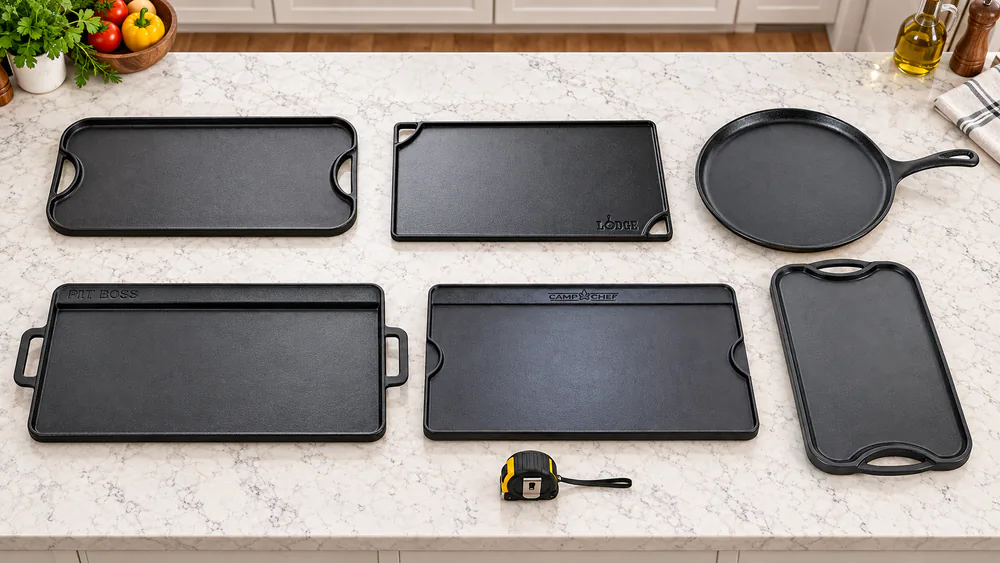
Round and rectangular plates compared for footprint before any cooking started.
Note. None of these plates is a nonstick surface. Sticking and cleanup vary with seasoning, heat and the food, so treat every release claim as a starting point that improves with use.
Best Cast Iron Griddles at a Glance
Six picks cover the common situations: one overall winner, a budget plate, a round single-burner option, a big family griddle, a camping plate and a premium model. The table keeps overall size, usable area and heat-source fit separate, because those numbers are easy to confuse.
Unknown does not mean incompatible. Where a maker has not documented induction or glass-top fit, the table says so rather than guessing.
Product
Best for
Overall size (inches)
Usable area
Weight
Surface
Documented heat sources
Our rating
Lodge Pro-Grid LPGI3
Overall; mixed breakfast and searing
20 x 10.5 x 0.81
Inset panel 16.56 x 7.93
13.5 lb listed; published weights disagree
Seasoned, flat and ridged
Gas, electric, induction, oven, grill, campfire
4.6
Lodge Double Play LDP3
Budget two-burner plate
16.75 x 9.5 x 0.62
Interior flat area unverified
9.35 lb
Seasoned, flat and ridged
Gas, electric, induction, oven, grill, campfire
4.3
Lodge 10.5-inch Round L9OG3
One-burner pancakes and tortillas
15.87 x 10.62 x 1.5 with handle
10.5 nominal; interior unverified
About 4.6 lb
Seasoned, single flat face
Any stovetop including induction, oven, grill, campfire
4.5
Pit Boss 68008
Large family meals and big grills
About 31.25 x 14 x 1; handles included
14 x 28 advertised, 392 sq in
Published weights conflict
Seasoned, flat and ridged
Grills and stovetop; induction and glass fit unverified
4.2
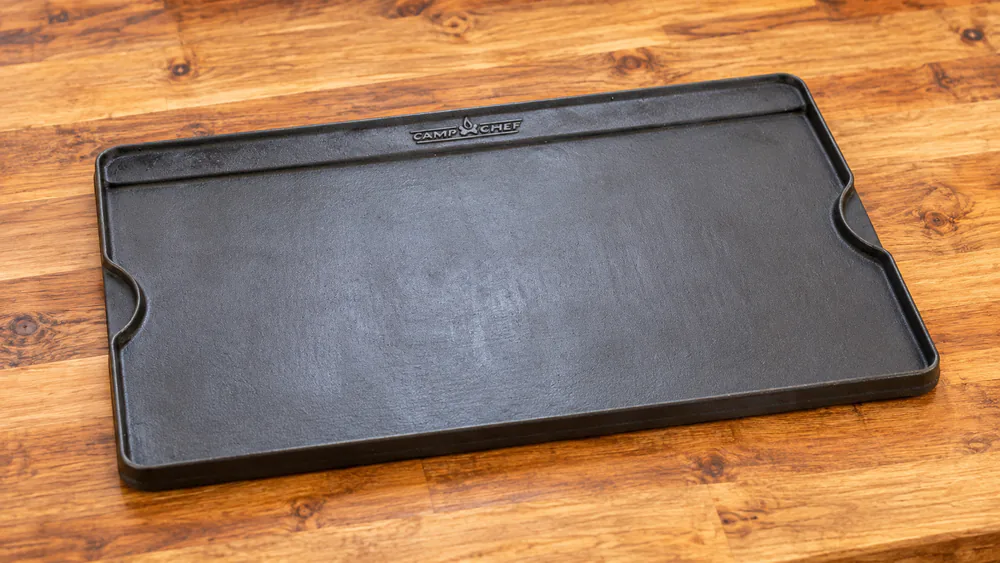
Camp Chef CGG24B
Group camping on compatible outdoor stoves
24 x 16 nominal
16 x 24 advertised; interior unverified
About 21 to 22 lb
Seasoned, flat and ribbed
Named Camp Chef 16-inch systems; household fit unverified
4.0
Viking 40351-1220-REV
Premium reversible plate with raised handles
About 20.5 to 20.9 x 11
20-inch named size; interior unverified
11.73 lb
Seasoned, flat and ridged
Gas, electric, halogen, ceramic, induction, oven to 400 F, grill
3.7
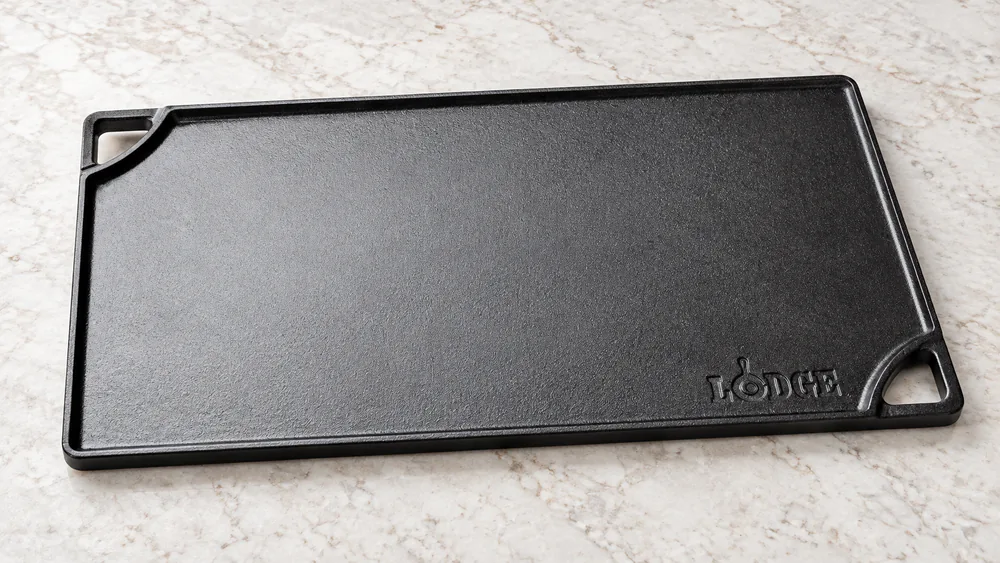
1. Best Overall Cast Iron Griddle: Lodge Pro-Grid LPGI3
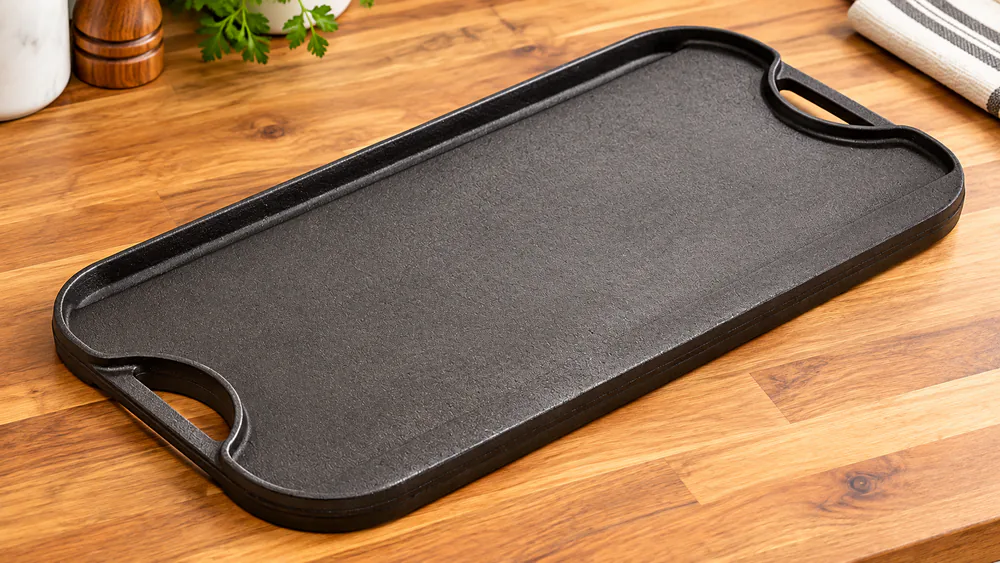
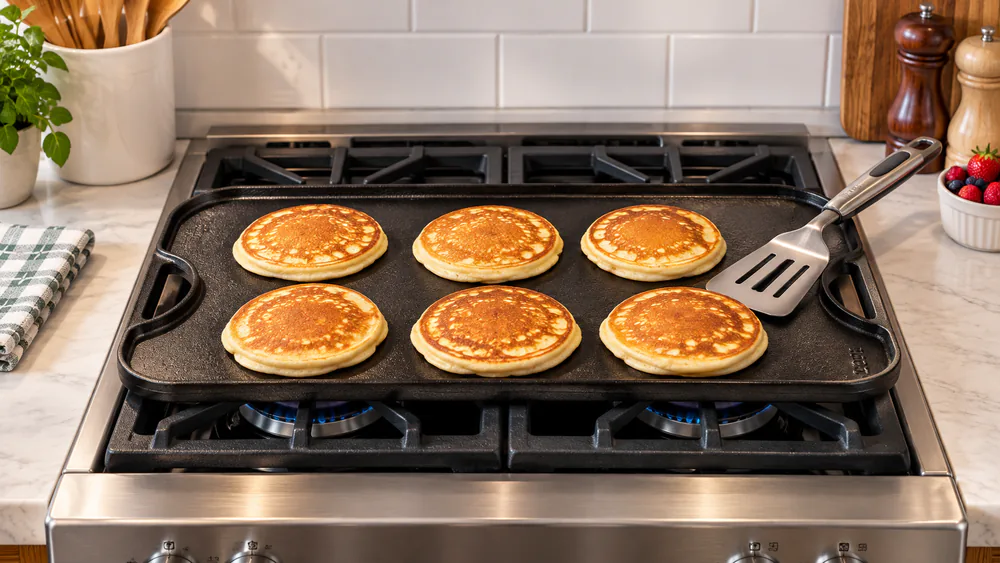
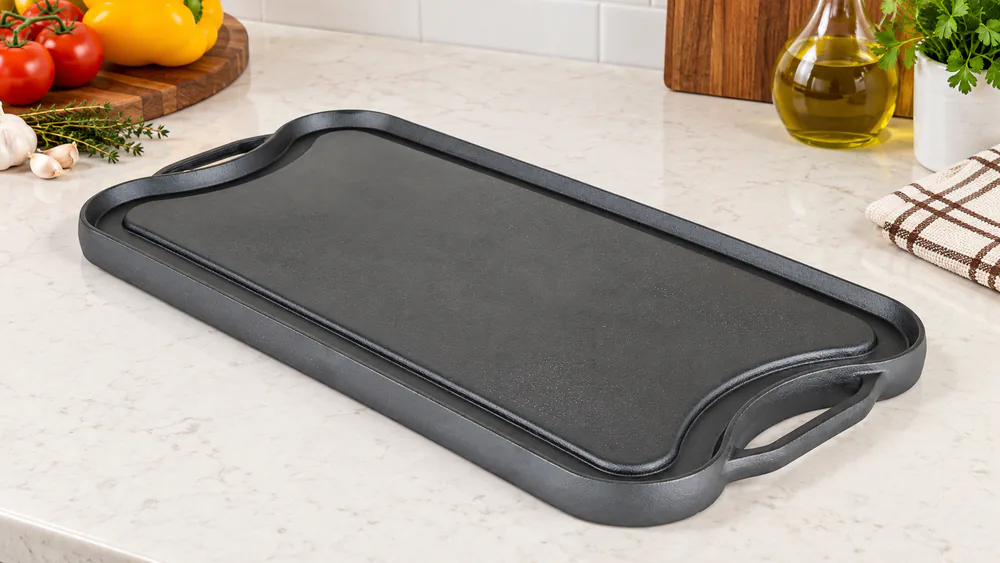
Pancakes browned well on the flat face of the Pro-Grid, and the factory finish let food release cleanly from the first cook. The ridged side left deep marks on meat. The plate is heavy, though, and the inset handles make a hot, loaded griddle awkward to move.
Pros
Reversible flat and ridged faces cover breakfast and searing
Spans two burners on gas, electric and induction stoves
Grease channel and made-in-USA construction
Factory seasoning released food well from the start
Made Right limited lifetime warranty against casting defects
Cons
Heavy and cumbersome to lift, wash and store
Inset handles eat into useful cooking space
Grease channel is shallow for fatty batches
The flat side did the best work for pancakes.
Cooking surface, burner fit, and everyday use
The Pro-Grid measures 20 x 10.5 x 0.81 inches overall. That footprint is generous, but the real cooking space is smaller than it looks. The inset flat panel in Lodge's dimensional drawing is 16.56 x 7.93 inches, and it excludes the handles and the surrounding channel. Plan meals around that panel, not the outer edges.
On a two-burner layout, it covers a bridge zone nicely and spreads heat across the plate. Lodge documents it for gas, electric and induction stovetops, plus the oven, grill and campfire. Actual burner spacing and your cooktop rules still decide the fit, so check them before ordering.
Flipping it is simple. The flat face makes pancakes and eggs, and the ridged face handles chicken thighs, burgers and vegetables. The ridges leave pronounced marks on meat, which is exactly what you want from a grill-style face.
Fatty foods need some care. The grease channel has limited capacity, so a heavy batch of bacon or sausages can still splatter or overflow. Pour off fat between rounds of bacon or sausages.
Is the Pro-Grid too heavy to live with?
Weight is the trade-off, and the warranty covers cracking and warping. Lodge lists 13.5 lb, although published weights disagree, so confirm the current figure before buying if lifting is a concern. At that mass, washing and cabinet storage are more demanding than they are with a small griddle.
Cleanup was straightforward once we accepted the bulk. A hot-water rinse and mild scraping cleared ordinary residue without stripping the finish. Seasoning can bubble or lift in a small patch, and that is a repair job, not a broken casting. Hand wash it, dry it completely and rub on a light film of oil.
Skip it if you have a small kitchen, limited wrist strength or a stove with widely spaced burners. In those cases the round pick below is easier to live with.
A practical note on storage: a plate this size does not slide into a typical pan drawer. Most kitchens will keep it on a shelf or in a low cabinet, and that is worth deciding before it arrives. If you already own a large skillet and a grill pan, ask whether you will really use the extra range. If you cook pancakes on weekends and sear meat midweek, the answer is usually yes.
2. Best Budget Cast Iron Griddle: Lodge Double Play LDP3
The Double Play feels substantial for its compact outline, and it suits pancakes and French toast better than big greasy batches. Its shallow edges are the trade-off.
Pros
Lowest cost of the reversible picks here
Lighter and easier to handle than the Pro-Grid
Flat and ridged faces in a compact outline
Works on gas, electric and induction stovetops, oven, grill and campfire
Made Right limited lifetime warranty
Cons
Shallow edges leave little room for fat
Grill grooves and tight corners beside the handholds are slow to clean
Short plate can miss widely spaced burners
Value, cooking capacity, and finish
The Double Play measures 16.75 x 9.5 x 0.62 inches and weighs 9.35 lb. Next to the Pro-Grid, that is roughly four pounds lighter and noticeably shorter. For a reversible Lodge, it is the cheapest way into a two-burner griddle.
Interior usable area is not something we can quote. Lodge's dimensional graphic shows a diagonal grill line rather than a rectangular flat footprint, and multiplying the outer dimensions would overstate the space. In practice, it holds a breakfast for one or two people at a time.
The finish is the same vegetable-oil seasoning Lodge uses across the range. As with any factory-seasoned plate, it improves with repeated use and a thin coat of oil after washing.
The plate feels more substantial than its size suggests. That helps with heat retention, though it also means the Double Play is no featherweight.
Will the Double Play fit your burners?
This is the plate for pancakes, French toast, eggs and grilled sandwiches. The shorter outline slides into a bridge zone neatly on stoves where two burners sit side by side.
That same compact length can work against you. A shorter two-burner plate can fit a bridge zone well but miss widely spaced burners, so measure the gap between your burners first. Lodge flags the same concern in its compatibility notes.
Large greasy batches are better handled by the Pro-Grid or Pit Boss.
Cleaning takes more work than the flat face suggests. The grill grooves and tight corners beside the handholds trap residue, so keep a nylon brush handy. Hand wash, dry completely and oil lightly, as with every plate here.
Choose the Double Play when budget matters, your burners sit close together and breakfast is the main job. Skip it if you cook fatty meats often.
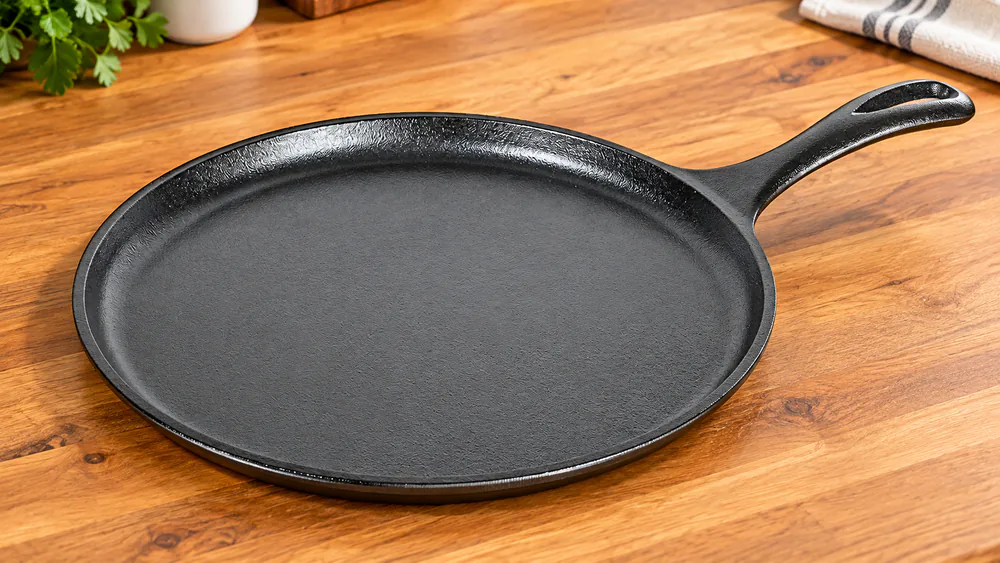
3. Best Round Cast Iron Griddle for One Burner: Lodge 10.5-inch Round Griddle L9OG3
Unlike the two-burner plates above, the round Lodge is the griddle we would hand to someone cooking for one or two. It worked well for tortillas and modest pancake batches on a single burner, and pancakes cooked without scorching once the heat was under control. Grease needs careful handling because the low-sided surface has no pouring spout.
Pros
Fits one burner on any stovetop, including induction
Light enough for easy one-handed handling with the long handle
Low edge gives spatulas easy access
Good for tortillas, flatbreads, quesadillas and pancakes
Made Right limited lifetime warranty
Cons
Small batches only
No pour spout and low liquid capacity
Nominal size is not the same as interior cooking diameter
Single-burner fit and usable cooking space
The L9OG3 is sold as a 10.5-inch round griddle. That is a nominal size, so do not equate it with the measured interior cooking diameter. Including its long handle, the piece measures 15.87 x 10.62 x 1.5 inches.
It weighs about 4.6 lb. Published weights vary slightly between 4.57 and 4.65 lb, so treat about 4.6 lb as the useful number. That is light enough to lift with one hand, which sets it apart from every other plate in this guide.
Lodge documents it for any stovetop, including induction, plus the oven, grill and campfire. Its compact single-burner form means it never fights with burner spacing. If your stove has awkward or unevenly spaced burners, this is the safest bet.
The cooking face is a single flat surface with a low edge for spatula access. It is not a grill pan, so do not expect sear marks.
What is the round Lodge good for, and where does it fall short?
Tortillas, flatbreads, quesadillas, toasted sandwiches and pancakes are where it shines. The low-sided round griddle is convenient for all of them, and the long integral handle keeps your hand away from the heat.
Heat control matters more here than on a big plate. A small piece of iron responds quickly, so pancakes brown nicely when you hold the burner at a steady medium and burn when you leave it high.
Grease handling is the main compromise. With no dedicated pouring spout and a low side wall, hot fat has to be managed carefully, and the plate is a poor choice for bacon by the pound. Think dry or shallow cooking, not simmering sauces.
You will also hit its size limit quickly. Cooking for four means cooking in batches. If that is your reality, step up to the Double Play or Pro-Grid.
It earns a high rating because it does a small job well. Anyone with one burner, a small kitchen or a need for a dedicated tortilla pan will get years of use from it, and the warranty is the same as on the larger Lodge plates.
It also makes a good second griddle. Plenty of cooks own a big reversible plate for weekends and keep this one by the stove for quick weekday jobs, because it heats faster and washes in a minute. At this size, storage is rarely a problem either.
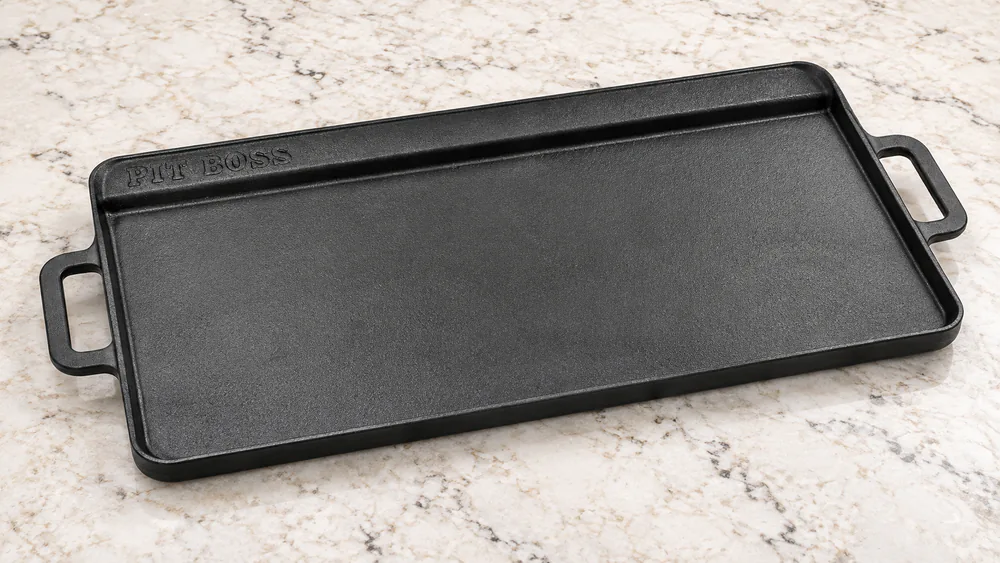
4. Best Large Cast Iron Griddle for Family Meals: Pit Boss 14 x 28 Cast Iron Griddle 68008
The Pit Boss is bulky, but its broad face let us cook a family batch of burgers without dividing it into smaller rounds. The weight makes lifting and sink cleanup awkward even when food releases readily.
Pros
Roughly 392 square inches of advertised cooking area
Reversible flat and ridged faces
Grease trough on the flat face
Integral helper handles
Cooks a whole family meal in one go
Cons
Oversized footprint and heavy to lift
Published weights conflict
Stovetop induction and glass fit not established
No confirmed product-specific warranty
Two-burner coverage and batch cooking
Pit Boss advertises a 14 x 28 inch cooking surface, or 392 square inches. That is the largest cooking area in this guide by a wide margin. The 28-inch figure is a cooking-size claim, not the full length: the handles extend beyond it.
The current dimensional graphic gives 31.25 x 14 x 1 inches overall, though an older comparison lists 32 inches. Allow for the full footprint and check your clearances. A griddle this long overhangs most stovetops.
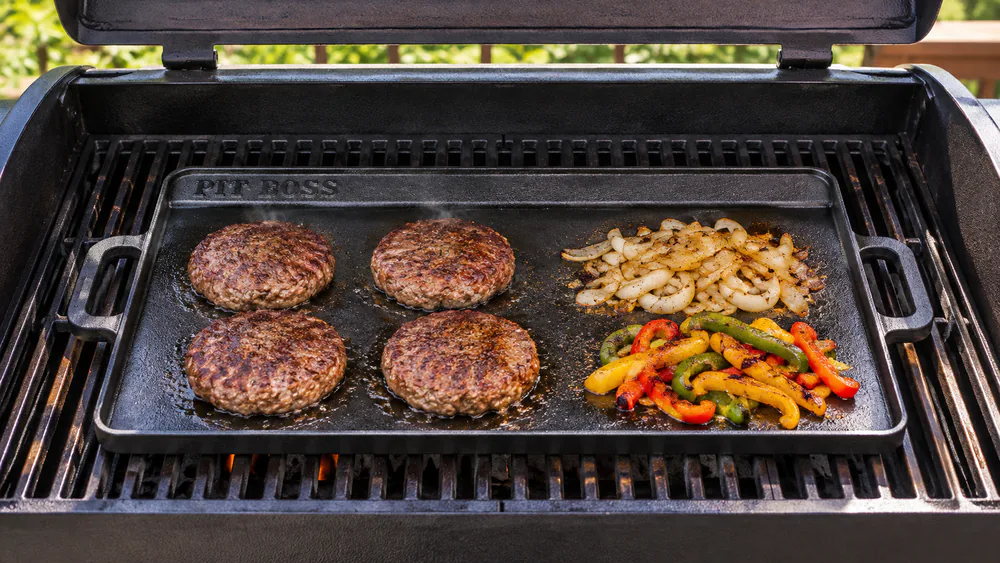
For a wide outdoor grill or a flat-top setup, the size is a gift. There is room to cook sandwich meat, toast rolls and saute onions and peppers together. Our family-batch burger test went faster because we were not rotating small groups.
The flat face has a grease trough, and the reversible ridged side adds a grill option. Pit Boss documents outdoor grill and stovetop use. Induction and glass-top fit are not established for this model, and magnetism alone does not guarantee a safe fit.
Is the Pit Boss worth the space?
Capacity is the whole argument for this plate. Pancakes, sausage and vegetables all cook on the same surface you use for eggs and bacon, which makes weekend breakfasts for a crowd much faster.
Weight and bulk are the counter-argument. Published weights conflict: Pit Boss's own graphic says 12.5 lb, while other sources list around 28 lb. Do not trust any single figure, and confirm before planning storage.
Whatever the true number, the plate is too large and heavy for a smaller cooking setup. Sink cleanup is awkward, and lifting it with greasy hands takes care. Wash it in the tub if your sink is small.
Warranty coverage is unclear. Generic grill warranty terms do not establish what protects this accessory, so do not assume lifetime coverage.
Buy the Pit Boss if you cook for a crowd, own a large grill or a griddle-friendly stove, and have the storage. Skip it for a standard apartment kitchen.
Before ordering, lay a tape measure along the longest dimension on your stove and grill. Count the handles in that number. If the plate sits even slightly off the heat source at one end, that end will cook cooler, and you will end up working the batch toward the hot zone.
The wide plate handles burgers and sides together.
5. Best Cast Iron Griddle for Grilling and Camping: Camp Chef CGG24B 16 x 24 Reversible Griddle
Unlike the Lodge plates built for the home stove, the large CGG24B suits group meals and needs careful two-handed handling during transport and cleaning. A rough initial surface benefits from extra seasoning, and preheating is slow, though retained heat helps once it is hot.
Pros
Large reversible format feeds a camp group without small-pan batches
Retained heat sustains cooking once hot
Molded integral side handles
Fits listed Camp Chef 16-inch outdoor systems
Cons
Heavy and awkward to carry and clean
Slow to preheat
Rough starting surface may need more seasoning
Household induction and glass fit unverified
Grill fit, handles, and outdoor use
Camp Chef lists this plate as 24 x 16 inches nominal overall, with height varying between 1.5 and 2 inches across sources. Check clearance before ordering. The 16 x 24 inch cooking size is a nominal claim that includes the molded handles and boundaries, so the uninterrupted flat area is smaller.
Fit is the key question. The CGG24B is documented for Camp Chef's listed 16-inch systems: PRO 16, Tundra, Big Gas Grill 3X, Expedition and Tahoe. Do not transfer compatibility from the smaller CGG16B to this larger plate.
It is a plate only, so an external heat source is required. Household induction and glass-top fit are not confirmed by the maker, and unknown does not mean incompatible. Check your cooktop manual before trying it indoors.
Weight sits around 21 lb on the current fitment guide, with an older catalog listing 22 lb. That is a lot of iron to carry to a campsite, so plan to move it with both hands and a secure grip.
Who should buy the Camp Chef?
Group cooking is where this plate earns its place. The large reversible format supports a camping meal for several people without multiple small-pan batches, and the molded side handles give you something solid to grab.
Preheating is slow, and that is the main thing to plan around. Once the iron is hot, the retained heat sustains cooking steadily, which suits a long breakfast service on a camp stove.
The surface can start rough. Extra seasoning helps delicate foods release cleanly, so season it before the trip, not at the campsite. Use thin coats and the oven method described in the care section.
Cleaning takes deliberate handling too. At camp, scrape while warm, wipe, dry over the flame and oil it before it goes back in the car.
The warranty is a 90-day limited term, far shorter than Lodge's lifetime coverage. We would not call cracking a common failure, but that short coverage is worth knowing about.
Pick the Camp Chef if you own a compatible Camp Chef stove and cook for groups outdoors. Skip it if you want one plate for both indoor and outdoor use.
Pack it carefully for transport. A heavy iron plate can scratch a car's cargo area, and a damp plate will rust on the drive home. Wrap it in a towel or cloth bag once it is oiled and fully dry.
6. Best Premium Cast Iron Griddle: Viking 20-inch Reversible Cast Iron Grill/Griddle 40351-1220-REV
6
Viking 20-inch Reversible Cast Iron Grill/Griddle 40351-1220-REV
The Viking feels sturdy but heavy and awkward to reposition, and the premium tier does not remove the maintenance that every bare cast iron plate demands.
Pros
Raised end handles help maneuver the plate
Perimeter grease channel
Broad documented compatibility including induction, ceramic, halogen and electric
Limited lifetime coverage for manufacturing defects
Cons
Sticking and staining can show up early
Rust appears if moisture remains after washing
Heavy, with demanding storage
Hand wash only; oven and broiler limit of 400 F
Surface finish, handling, and price
Viking names this the 20-inch model, and the nominal size is the one fixed number. Published exterior dimensions differ: Popular Mechanics lists 20.87 x 11.22 x 2.17 inches, while Macy's gives approximately 20.5 x 11 x 1.75. Confirm the footprint and handle clearance for the current model.
It weighs 11.73 lb, which is lighter than the Pro-Grid and the Camp Chef. The finish is preseasoned bare cast iron, not the enamel used on other pieces in Viking's range. Do not apply enamel care rules to it.
This is the premium-tier pick, and it costs more than every Lodge plate here. The extra spend buys a reversible plate with raised end handles and a perimeter grease channel. It does not buy a nonstick surface.
Viking documents gas, electric, halogen, ceramic and induction ranges, plus oven and grill use. The official page sets a 400 F oven and broiler limit, so follow that instead of the higher temperatures used for rebuilding seasoning on other cast iron.
What do the raised handles buy you?
The raised handles are the clearest win. They help maneuver a heavy plate, and the plate feels sturdy. The same bulk makes storage demanding.
Surface performance was the letdown. Pancakes and eggs can stick despite added oil, and bacon can leave stubborn residue on a first use.
Rust is the other thing to watch. It can appear after washing if moisture remains, so thorough drying matters as much as seasoning. Viking's guidance is hand wash only.
Warranty coverage is limited lifetime for manufacturing defects under normal household use in the US and Canada. The original purchaser needs proof of purchase from an authorized seller, and shipping a warranty return is paid by the consumer. Return conditions depend on the seller, so check the policy at checkout.
We do not recommend it over the Pro-Grid for most cooks, because the premium tier does not remove the sticking and seasoning work. It makes sense if you want raised handles and a polished look in a premium range.
If you buy it, start with fatty foods such as bacon to build a layer of oil, and wait until the surface darkens before cooking delicate eggs.
How to Choose a Cast Iron Griddle
A griddle lives or dies by how well it matches your stove and your habits. The best plate on paper is the wrong one if it overhangs your burners or sits unused because it is too heavy to lift.
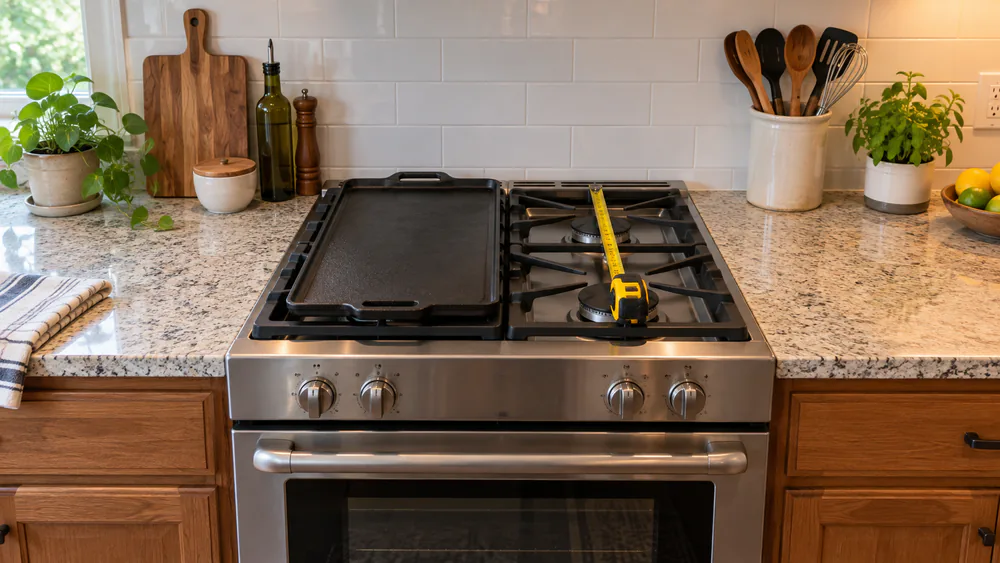
Measure your burner spacing before you pick a size.
Match the cooking surface to your burners
Start with the stove, not the griddle. Measure the distance across the two burners you plan to cover, then compare it with the plate's length. A shorter plate such as the Double Play fits a close bridge zone but can miss widely spaced burners.
Next separate three measurements that listings blur together. Nominal size is the name on the box. Overall footprint includes handles and edges. Usable cooking area is the flat surface left after channels, ridges and handles. Do not multiply outer dimensions and call it cooking space.
The Pro-Grid shows how much the gap can be. The overall footprint is 20 x 10.5 inches, but the inset panel is 16.56 x 7.93. Always plan meals around the smaller number.
One more point: allow for handle clearance. The Pit Boss and Camp Chef both extend beyond their nominal cooking sizes once the handles are included.
Check gas, electric, glass-top, and induction compatibility
Cast iron works on gas and electric coils without trouble. It is also induction-compatible as a material, which is why Lodge documents its plates for induction stovetops. Material compatibility does not guarantee that an oversized griddle satisfies your appliance manual, however.
Glass and ceramic tops need extra care. Lift the plate rather than dragging it, because rough iron can scratch the surface. A heavy plate that overhangs the burner also concentrates heat unevenly, so read your cooktop manual about maximum overhang.
If the maker has not documented induction or glass-top fit, as with the Pit Boss and Camp Chef on household cooktops, treat it as unknown. Unknown is not incompatible, but it is a reason to check the manual first.
On induction, flatness matters as much as material. A plate that rocks on the glass will heat unevenly and may not be detected at all. Set it down empty and press gently at the corners before you cook. A plate that wobbles on a cold cooktop will wobble when it is hot.
For outdoor use, confirm grill fit separately. The Camp Chef CGG24B is documented for named 16-inch systems, and you cannot assume it fits a different model.
Choose a flat or reversible cooking surface
A reversible plate gives you a flat face for pancakes and eggs and a ridged face for meat and vegetables. Five of our six picks are reversible, and that flexibility is worth having if you cook varied meals.
The trade-off is the ridged side. Grooves and tight corners are harder to clean, and the Double Play showed this clearly. The flat face is the one you will use most, so make sure it is smooth and large enough for your usual meals.
A single flat round plate, such as the Lodge L9OG3, gives up grilling but wins on weight, simplicity and one-burner fit. If you mostly cook tortillas and pancakes, you may never miss the ridges.
Do not use both faces at once. Cook on one side at a time and flip the plate between uses.
Think about how you actually cook. If you grill indoors a few times a year, the ridged side may stay unused, and a flat plate will be easier to wash. If you want sear marks on steak, chicken thighs or zucchini without firing up the grill, the ridged side earns its space on the shelf.
A griddle is only as good as the stove it fits and the arm that has to lift it.
Compare weight, handles, edges, and grease management
Weight is the quality that surprised us most. The plates range from about 4.6 lb for the round Lodge to a figure over 20 lb for the large outdoor plates, and published weights conflict on several models. Treat any listed weight as a range and verify it before you buy.
Handles matter just as much. Inset handles, like the Pro-Grid's, cost cooking space. Raised handles, like Viking's, help with lifting but make storage bulkier. A long integral handle keeps your hand away from heat on a small plate.
Edges and grease control come next. A shallow lip lets food escape and leaves little room for fat. A grease channel or trough helps, but none of these is a deep drip pan, so expect to pour off fat during fatty cooking.
Warning. Hot cast iron stays hot for a long time. Use dry oven mitts, lift with both hands on heavy plates and never move a loaded griddle across a glass top.
Compare seasoning, enamel, and maintenance needs
Every griddle here is preseasoned bare cast iron. Seasoning is baked-on oil, and it improves with use. Enamel is a different thing: a porcelain layer bonded to the iron that tolerates acidic ingredients. Do not apply bare-iron restoration steps to enamel.
Acidic foods can erode young seasoning, and shallow griddles suit dry or shallow frying better than simmering sauces. That is why a griddle is a poor substitute for a skillet when a recipe has liquid.
Warranty terms differ more than they should. Lodge offers Made Right limited lifetime coverage for casting defects, cracking and warping, but excludes rust, pitting and seasoning problems. Viking offers limited lifetime coverage with its own exclusions. Check what your plate covers.
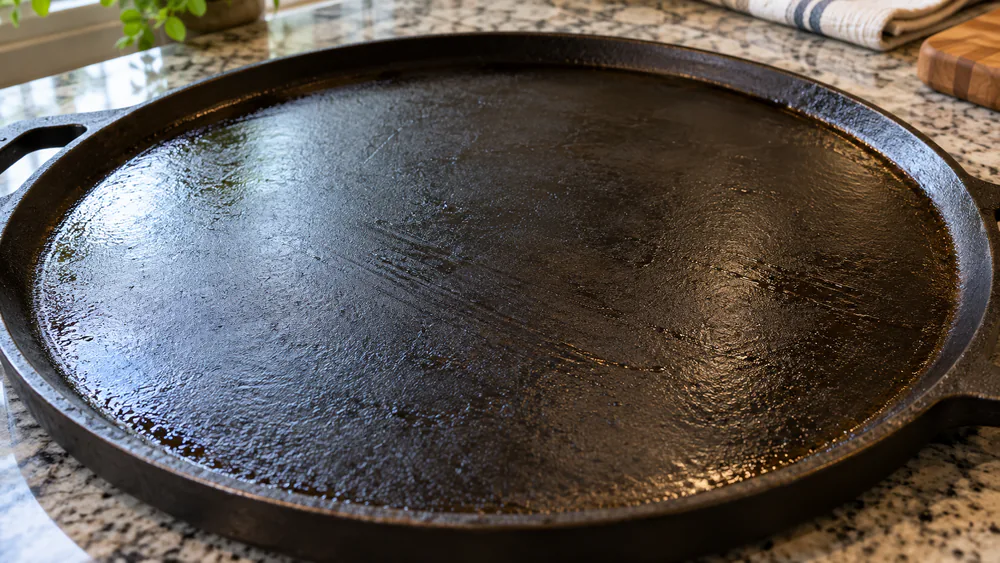
A thin, even film of oil is the foundation of good seasoning.
How to Use and Care for a Cast Iron Griddle
Good care is the difference between a plate that gets better each year and one that rusts in a cabinet. The rules are simple, and they apply to every griddle in this guide.
Preheat and manage heat across the cooking surface
Cast iron heats slowly and unevenly at first, so give the plate time. Start on low to medium heat and let the whole surface warm up before food goes on. On a two-burner plate, expect the area over each burner to run hotter than the middle.
Rotate the griddle or shift your food to compensate. Pancakes and eggs like medium heat, while burgers and ridged-face searing need a hotter plate. Once hot, cast iron holds heat well, so you can ease off the burner.
If you cook on a gas stove, a large plate over two burners will show a cool seam in the middle. Turn the burners to different settings, or slide the food across the plate, until the browning looks even. On a grill, preheat with the lid closed so the iron comes up to temperature along its whole length.
Use a thin film of oil, not a pool. Pour off excess fat as it collects, particularly on shallow plates.
Clean, dry, and maintain the seasoning
Wash the plate by hand. Dish soap is acceptable, and a scraper or nylon brush removes stuck food. Avoid long soaks and the dishwasher. Dry it completely, then wipe on a light film of oil.
When the surface looks dull or food starts to stick, rebuild the seasoning. Restoring cast-iron seasoning comes down to a few steps. Wash and dry the plate thoroughly, rub on a very thin film of cooking oil and wipe away the excess. Excess oil leaves a sticky residue.
Then bake it upside down in an oven at 450-500 F for 1 hour and let it cool in the switched-off oven. Do not override a plate's own lower temperature limit. That matters for the Viking, which has a 400 F limit.
Store the plate somewhere dry, with a paper towel between it and anything stacked on top. Small rust spots are a cleanup job, not the end of the plate, but they signal that moisture got in. Keep acidic foods such as tomato sauce off a young surface, and save them for a seasoned skillet.
Cast Iron Griddle FAQs
Can a cast iron griddle replace a skillet?
For flat foods, yes. Pancakes, eggs, tortillas, burgers and sandwiches all cook well on a griddle. For anything with liquid, a skillet is better, because the low edge cannot hold a sauce and acidic ingredients can wear down young seasoning.
What can you cook on a cast iron griddle?
Breakfast is the obvious start: pancakes, French toast, eggs, bacon and sausage. Beyond that, the flat face handles quesadillas, grilled sandwiches, smash burgers and sauteed onions and peppers, and the ridged side suits chicken, steak and vegetables.
Does a griddle need a different oil than a skillet?
No. Use a high smoke point oil such as canola or vegetable oil, in a thin film, for both cooking and the post-wash rub. A pooled layer turns sticky on the surface.
Can you use a cast iron griddle in the oven or on a grill?
Yes for the Lodge plates, which are documented for the oven, grill and campfire. Check the maker's limit first, because the Viking stops at 400 F in the oven and broiler. The Pit Boss and Camp Chef are meant for outdoor grills and compatible stoves.
Final Verdict: Which Cast Iron Griddle Should You Buy?
Match the plate to the cook. Choose the Double Play if you want the cheapest reversible plate and your burners sit close together. Choose the round Lodge if you cook on one burner or want something light. The Pit Boss and Camp Chef make sense for crowds and outdoor cooking, where size matters more than convenience. Everyone else should stay with the Pro-Grid.
The Viking is the plate we would buy last. A premium tier does not remove sticking or the seasoning work, and a Lodge does the same job. If you are weighing it against the Pro-Grid, read the care section before you decide.