As an Amazon Associate we earn from qualifying purchases. We may earn a commission from links on this page, at no extra cost to you. Learn more.
If you brew filter coffee, buy the Baratza Encore. If you pull espresso, buy the Baratza Encore ESP or the MiiCoffee DF54 instead. Everything else in this guide is a variation on those two decisions. A grinder shapes the cup more than the brewer does, because every extraction depends on how evenly the beans break apart and how precisely you can move the setting. We judged each grinder on grind consistency, ease of dialing in, noise, and cleanup.
How We Tested Coffee Grinders
We judge each grinder the way a barista would: adjust the grind, weigh the dose, brew, taste, and repeat until the pattern is clear, and our scoring leans on three questions. How even is the grind at the settings people actually use? How easy is it to move from one brew method to another? And how much fuss does the grinder add to a weekday morning? Browse the rest of our kitchen appliance reviews if you are also shopping for the brewer that goes with it.
Because each grinder suits different brew methods, we score the filter models on filter coffee and the espresso-capable models on both, rather than asking one grinder to do everything.
Sources, Evaluation Criteria, and Evidence Limits
Our awards are editorial judgments, not laboratory scores. We did not run a standardized decibel, retention, or extraction measurement across the lineup, so we describe noise, static, and mess as workflow observations rather than numbers. Static and retention shift with roast level, grind setting, and how clean the chute is, so your counter may behave differently from ours.
Where a spec comes from the manufacturer, such as burr size, number of settings, or warranty, we say so by stating the published figure. Where we describe how a grinder behaves in the hand, that is what we saw in use. We kept the two apart on purpose. A burr diameter on the box tells you about the hardware; it does not tell you whether the grounds come out even.
The brewers and scale we use to judge a grinder: filter, immersion and espresso.
Grind Consistency, Adjustment, and Everyday Usability
Grind consistency is the headline criterion. We looked for clean, even grounds at filter settings and for fine, repeatable steps at espresso settings, because a grinder can excel at one and struggle at the other. Adjustment came next: how many steps there are, how easy they are to find, and whether you can move between methods without guessing.
Everyday usability covers everything else a barista notices. We checked how the grounds container handled static, how easy the parts were to pull apart and clean, whether the hopper or single-dose bin suited the routine, and how loud the motor was in a quiet kitchen. A grinder that is slightly better on paper but irritating at 6:30 a.m. does not win here.
Best Coffee Grinders at a Glance
Six grinders earn an award, and each suits a different cup. The table compares the practical differences so you can narrow the field before reading the full reviews.
Product
Best use
Supported brew methods
Burr / drive
Adjustment
Capacity / workflow
Main limitation
Baratza Encore
Everyday filter
Drip, pour-over, immersion
40mm conical, electric
40 steps
Hopper; confirm capacity for your revision
Loud; not enough fine control for demanding espresso
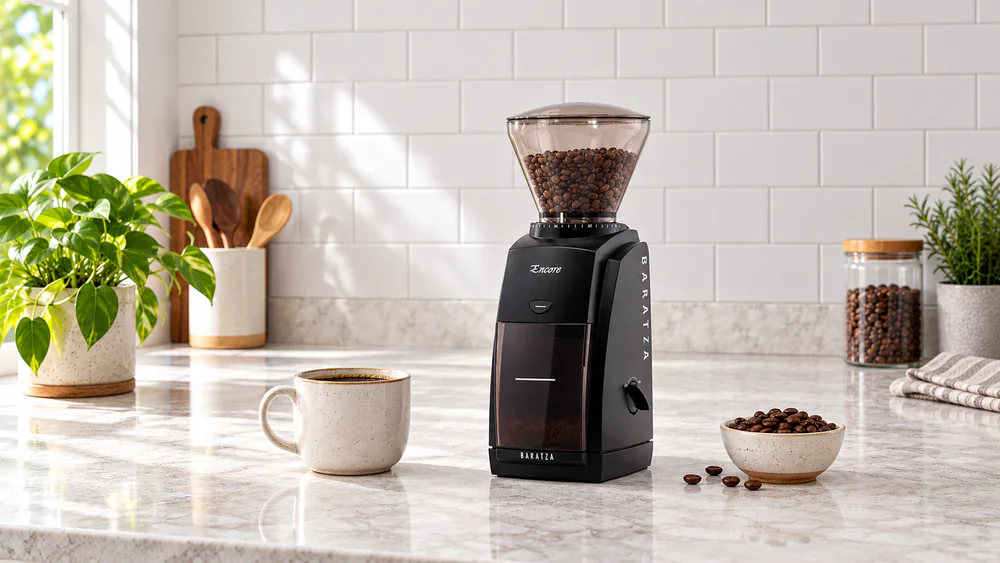
The Baratza Encore is the grinder we would hand to most filter coffee drinkers. The controls are straightforward, the grounds come out consistently for drip and pour-over, and the parts come apart for cleaning and replacement, which counts for a lot over years of use.
Consistent grounds for drip, pour-over, and immersion brewing
Simple on/off switch and front pulse button
Removable upper burr and replaceable parts
Not the grinder for demanding espresso
Specifications
Burrs
40mm hardened alloy steel conical
Adjustment
40 usable grind settings
Best for
Everyday filter coffee
Warranty
1-year limited, US and Canada
Who It Suits and How It Performs
The Encore suits anyone who wakes up, scoops beans, and wants a good filter cup without a lecture. It runs on a hopper, so you fill it, set the dial, and grind. That routine is what we mean by low fuss. The controls are plain enough that a houseguest can use it without instructions or a menu to navigate.
In our kitchen the daily routine was easy and the filter grounds were consistent. When we tipped the grounds bin over a paper filter, the angled sides let the coffee pour out with relatively little spilling, which sounds minor until you do it half asleep. The detachable parts make routine cleaning and reassembly simple, with no complicated interface in the way. Repairability is also a stronger longevity argument than any promised lifespan: replacement parts and repair support are central to the Encore platform, and the burrs are removable.
A word on the family, because the names blur together. The original Encore is a filter grinder. Its marketing sometimes mentions espresso, but the original does not give you the fine control a demanding espresso basket needs. If espresso is the goal, the Encore ESP, reviewed below, is the model in this family built for it.
The angled grounds bin pours cleanly into a filter.
Drawbacks and Key Specifications
The Encore is loud, because the plastic housing lets the grinding noise through and the unit can move on the counter while it runs, so it is not the one to pick for a quiet apartment. Cleaning also needs care since the hopper gasket and the burr-carrier tabs have to line up properly when you put everything back together, which takes a moment to learn and then becomes routine.
On paper, the Encore uses 40mm hardened alloy steel conical burrs and offers 40 usable grind settings. Some descriptions count the zero endpoint as an extra position, but we use the 40-setting specification. The hopper is roughly 8 oz on the original configuration we looked at, though hopper sizes differ across revisions, so check what ships with yours. The warranty is 1-year limited for US and Canadian use and covers manufacturing defects, not wear or a grinder that has not been cleaned.
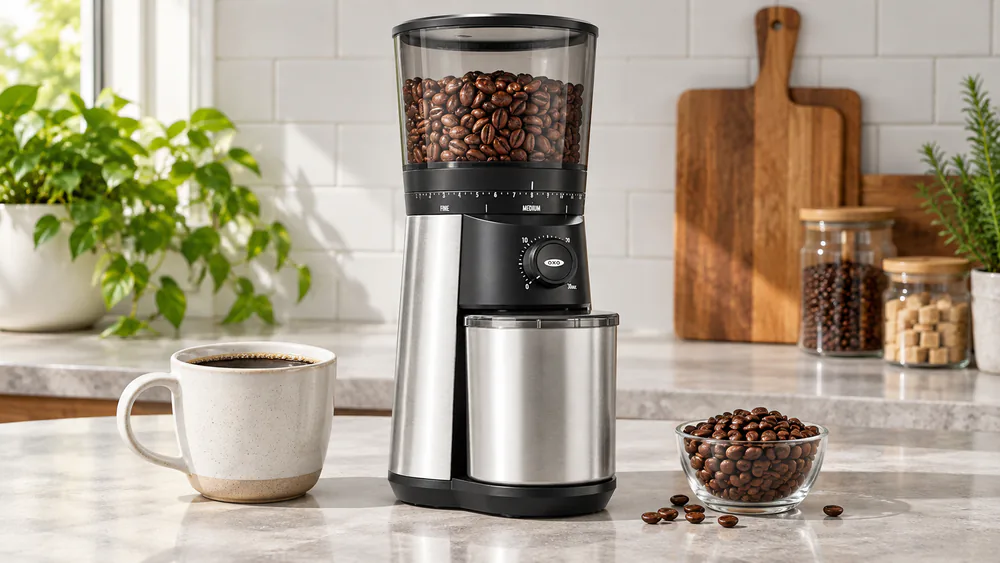
The OXO Brew is the best budget coffee grinder here because it makes repeat morning batches almost effortless. A simple timer dial starts the same grind every day, the metal grounds cup tames static, and the large hopper holds plenty of beans. It is a filter grinder first and an espresso grinder not at all.
Timer dial with a remembered setting and one-touch start
Stainless steel grounds cup that reduces static cling
UV-tinted removable hopper with a bean trap door
Best for filter coffee, not espresso
Specifications
Burrs
40mm stainless steel conical
Adjustment
15 main settings plus intermediate clicks
Hopper
12 oz
Dimensions
6.8 x 11.8 x 14.8 inches
Who It Suits and How It Performs
This is the grinder for the household that brews a full carafe or a big pour-over most mornings and wants to spend less on the grinder than on the coffee. Set the timer, press the button, and walk away. The metal grounds cup reduces static cling, and the removable hopper makes access straightforward, so swapping beans or emptying the leftovers takes seconds.
The timer is the feature we kept coming back to, because a simple dial makes repeated morning batches easy to start and the grinder remembers the last setting, which suits people who do not want to think about their grinder. In regular daily use the standard model can stay dependable, though that is an observation about workflow and not a promise about service life.
The removable hopper and metal grounds cup are the practical highlights.
Drawbacks and Key Specifications
The coarse end is the weak spot. The coarsest settings produce a less even mixture, with large particles mixed in, which matters for French press and cold brew where you want uniform chunky grounds. For medium settings used in drip and pour-over, it holds its own across the board.
Espresso is not a sensible use. Reaching a fine grind is not the same as having the step-by-step precision unpressurized espresso demands, and the 15 main positions, even with intermediate clicks, do not give you that. Treat the published count as 15 main positions and do not add the intermediate clicks to it. The burrs are 40mm stainless steel conical, the hopper holds 12 oz, and the published dimensions are 6.8 x 11.8 x 14.8 inches. We could not confirm a motor wattage or a warranty document for this exact standard model, so check the box before you rely on either.
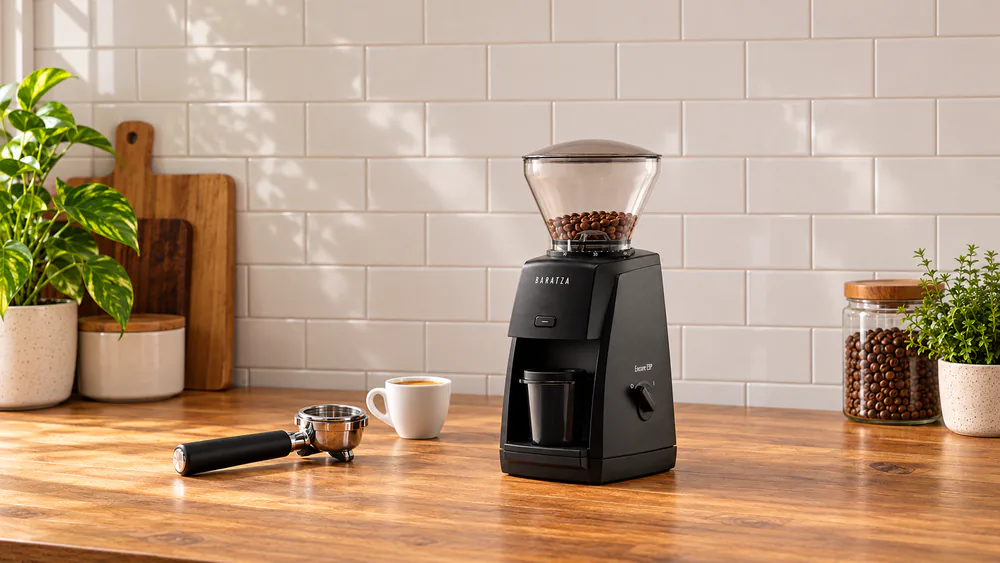
The Baratza Encore ESP is the best coffee grinder for espresso at this level because it adds fine steps to the Encore formula. Settings 1-20 move in small espresso increments, settings 21-40 cover filter brewing, and the grind works for both. It is the grinder we would pick for someone starting a home espresso setup.
Fine espresso steps on settings 1-20
Filter settings from 21-40 for pour-over and drip
Quick-release burr for tool-free removal
No timer, so hopper dosing takes attention
Specifications
Burrs
40mm hardened alloy steel conical
Espresso range
Settings 1-20
Filter range
Settings 21-40
Warranty
1-year limited, US and Canada
Fine Steps, Dosing Cup, and the Dial-In Loop
The finer steps are the whole point of the ESP, and they make dialing in a nonpressurized basket much more practical than with the original Encore. The barista's loop is to weigh a dose, grind, pull the shot, taste, and move the dial one step at a time, and with smaller steps that loop converges on a good shot instead of overshooting it.
It is not just an espresso machine accessory, either. The grind works well for filter coffee as well as entry-level espresso, which makes it the sensible single grinder for a household that switches between a morning espresso and an afternoon pour-over. The M2 burr design improves on the original Encore platform, and the quick-release burr, hopper adjustment, pulse button, and on/off switch carry over the easy handling of the family. An included dosing cup helps with single doses.
If you are choosing between this and the MiiCoffee DF54, the ESP is the quicker espresso grinder in practice, while the DF54 is the one that feels more like a purpose-built single-dose tool. We cover that trade below.
The ESP has no programmable timer, and that adds attention to hopper-fed dosing. You are the timer. Fine grounds can also stay inside between doses, so single dosing is less clean than the dosing cup suggests. If you plan to weigh in a fresh dose for every shot and change beans often, expect some leftover grounds from the previous coffee.
The plastic chamber and impeller feel less substantial than a metal-bodied single-dose grinder. Hopper capacity depends on the version, with published figures running around 230 g to 300 g, so we do not assign it a fixed number. Be careful with the names, too. The Encore ESP is a different model from the Encore ESP Pro, and we only describe the ESP here. The warranty is 1-year limited for US and Canadian use.
4. Best Coffee Grinder for Pour-Over and Drip Coffee
The Fellow Ode Gen 2 makes the cleanest-tasting filter coffee in this lineup, with clear, balanced flavors and little oversize or fine material in the grind. It is a single-dose grinder with automatic stop, and it suits the pour-over drinker who weighs beans for every cup. It cannot make espresso.
Clear, balanced filter cups with a tidy grind
Single-dose bin with automatic stop
Anti-static system and magnetic grounds cup
Filter only: no espresso
Specifications
Burrs
64mm stainless steel flat Gen 2 Brew Burrs
Adjustment
31 steps across 11 labeled settings
Load bin
100 g
Dimensions
239 x 105 x 248.3 mm
Power
140W
Warranty
2-year standard
Flat Burrs, Single Dosing, and the Knocker
If you spend your mornings with a V60, a Chemex, or an AeroPress, the Ode Gen 2 is where this guide points. It handles pour-over, drip, AeroPress, French press, and cold brew, and it does the finer filter work with a flat-burr consistency the conical-burr budget picks cannot match. The cup tastes clean, with little muddiness or harsh bitterness at filter settings.
The single-dose workflow keeps the routine tidy. You weigh the beans, drop them in the bin, and the grinder stops by itself when it is done, which reduces supervision. Effective static control makes changing beans easy, and the compact body feels heavy for its size, which keeps it planted on the counter. The grinding sound is subdued, though when we flicked the knocker to clear the last grounds it added a sharp metallic snap.
Pour-over grounds from the Ode Gen 2 look uniform, with little dust.
The Ode makes no espresso grounds, so it has no place in an espresso setup, and static can return when grounds cover the anti-static pins, and brushing the exit chute restores cleaner output. The cup lid can be fiddly, and small amounts of grounds can still reach the counter. The 100 g load bin is a single-dose design, so there is no hopper to fill and walk away from.
Gen 1 static complaints should not be assigned wholesale to Gen 2, but Gen 2 still needs its chute cleaned now and then. The standard Brew Burrs described here are different from the optional SSP burrs. The burrs are 64mm stainless steel flat, with 31 steps across 11 labeled settings. It measures 239 x 105 x 248.3 mm, runs on 140W, and carries a 2-year standard warranty.
The 1Zpresso K-Ultra is the best manual coffee grinder we used, and one of the few hand grinders that credibly spans espresso and filter coffee. The external dial makes changing methods quick, and the filter cups taste sweet and well-balanced. Be ready to do the work, especially for espresso.
External dial, no hidden clicks to count
Folding handle and carrying case for travel
Magnetic cup and tool-free disassembly
Wrist effort rises for espresso
Specifications
Burrs
48mm heptagonal conical steel
Adjustment
100 clicks per rotation, 20 microns per click
Weight
700 g
Dimensions
19.5 x 18.5 x 6 cm
Warranty
1-year limited
Who It Suits and How It Performs
The K-Ultra rewards people who travel, brew in a small space, or simply like the ritual of hand grinding. The external dial makes changing brew methods quick without counting hidden clicks, so the move from a French press to an espresso basket does not turn into a puzzle. Light and medium roast filter cups combine sweetness, acidity, and body, which is what a good hand grinder should deliver.
Handling is a strength. The magnetic cup and tool-free disassembly make daily use and cleaning convenient, and the folding handle with its carrying case makes storage and travel practical. It packs easily alongside a French press, and the grinder can move between filter and espresso routines. Hand grinding also avoids the motor noise of an electric grinder, a quiet bonus early in the morning.
The folding handle and case are why this hand grinder travels well.
Drawbacks and Key Specifications
Grinding requires wrist torque, especially for espresso. If you grind a shot every morning, that effort adds up, and a motorized grinder will feel like a relief. Static can leave coffee around the burr exit, which means a tap and a brush. The grip covering can scuff, and the handle knob is a durability weak point we would keep an eye on.
The K-Ultra is also a small-batch tool. Its nominal capacity is 35 to 40 g, but bean size and roast density change what fits, and larger batches may need two fills. The 48mm burrs move 20 microns per click across 100 clicks per rotation. The grinder weighs 700 g, measures 19.5 x 18.5 x 6 cm, and has a 1-year limited warranty. Brush and dry-clean it, and do not wash or soak it.
The MiiCoffee DF54 is the single-dose grinder to buy if you want flat burrs, a stepless dial, and an aluminum body that serves both espresso and filter coffee. Its stock burrs make satisfying espresso and filter cups, and the metal housing feels sturdy. It asks for a bit more maintenance than the Baratza picks.
Stepless dial for fine espresso adjustment
Single-dose workflow with bellows and anti-popcorn disc
Aluminum body with plasma anti-static system
Chute needs regular brushing
Specifications
Burrs
54mm stainless steel flat
Capacity
20 g without bellows, 50 g with bellows
Power
150W
Dimensions
7 inches deep, 4.5 inches wide, 12 inches high
Included
58mm dosing cup
Warranty
1-year
Stepless Dial, Bellows, and Chute Upkeep
The DF54 suits the person who weighs every dose and rotates between beans. Single dosing means beans go in for each brew rather than sitting above the burrs, so changing coffees is quick. A stepless dial lets you creep toward the right espresso grind in tiny increments rather than jumping between fixed steps, and the bellows help push grounds out of the chamber.
We found the stock burrs capable of satisfying espresso and filter coffee, and the metal housing feels sturdy. Filter cups are enjoyable, though flavors can taste less distinctly separated than with a larger premium flat-burr grinder like the Ode Gen 2. That is a fair trade at its tier. For espresso, it is slower than the Encore ESP, which is worth knowing if you pull several shots in a row.
Static is the recurring complaint. Coarse light-roast grinding can create static despite the anti-static system, and brushing the chute can resolve increasing static and restore a cleaner flow of grounds. Chute clogging can interrupt the routine, including with dark decaf. Hardware revisions differ here, so a clog on older hardware does not tell you how often a revised unit will clog. Confirm the version you receive, since the v1.5 anti-popcorn disc is revised, and earlier units changed chute and declumper geometry.
Low retention is achievable with the DF54, but less than 0.1 g is not a guaranteed result for every bean and setting. The dosing-cup supports feel slightly flexible, and the cord needs to sit in its underside channel for the base to rest flat. Earlier hardware requires unscrewing the dial indicator before you can reach the burr chamber. The 54mm burrs and 150W motor are published figures, as is the 50 g bellows capacity.
How to Choose the Right Coffee Grinder
Start with your brew method, then decide how much hands-on work you want. Burr type and brand come after. The picks above follow that order, and the same logic works for any grinder you are considering.
Match the Grinder to Espresso, Filter Coffee, or French Press
Espresso is the most demanding method because it needs fine particles and fine adjustment, so you want small steps or a stepless dial to move one tiny increment between shots. Filter methods like drip and pour-over tolerate bigger steps but reward even grounds, while French press and cold brew want coarse, uniform grounds, which is where many budget burrs struggle.
For espresso, start with the Encore ESP, the DF54, or the K-Ultra. For pour-over and drip, the Ode Gen 2 and the Encore lead. Batch brewers should look at the OXO. If you switch between methods, favor a grinder with an external, easy-to-find dial.
Tip. Budget for the grinder before the espresso machine. A great machine with a weak grinder will never produce a great shot, but a good grinder lifts a modest machine.
Burr vs. Blade Grinders
For anything beyond occasional use, choose a burr grinder, since burr grinders control particle size through a set gap between the burrs, while blade grinders chop the beans with much less control, producing a mix of dust and chunks. So even a budget burr model is a better fit than a blade grinder.
There is a catch, because burr design alone does not rank cup quality: alignment, the burr geometry, and the quality of the adjustment all matter, and for espresso, a grinder needs fine adjustment as well as fine particles.
Flat vs. Conical Burrs
Flat burrs, like those in the Ode Gen 2 and the DF54, tend to give a cleaner, more distinct cup in filter coffee. Conical burrs, as in the Encore, OXO, and K-Ultra, are common in budget and hand grinders, are forgiving, and can offer a rounder body. Neither shape wins on its own. A well-made conical beats a poor flat, and the quality of the adjustment mechanism often matters more than the shape.
A burr's shape matters less than how precisely you can move the dial. For espresso, adjustment steps decide more than burr size.
Manual vs. Electric Grinders
A manual grinder costs less than an electric model of similar grind quality, is quiet, and travels well, but the trade is effort, since espresso grinding takes real wrist torque and batches for a family take time. Choose manual if you brew one or two cups, travel, or enjoy the ritual. Choose electric if you brew for several people or want a hands-free morning.
Hopper Capacity, Single Dosing, and Retention
A hopper stores beans above the burrs, so you fill it once and grind on demand. Single dosing means weighing the beans for each brew and loading only what you need. Timed dosing runs the grinder for a set period rather than weighing the output. Hoppers are convenient, while single-dose designs are better when you change beans often.
Retention is the grounds left in the grinder after a dose, and it matters when you change beans or grind size, because stale grounds from the last coffee end up in the next cup. Expect some retention from every grinder, and a bit more from hopper models.
Noise, Static, Cleaning, and Replacement Parts
Plastic housings transmit more noise, and static changes with roast, setting, and chute cleanliness. Look for grounds containers that tame static, parts you can remove without tools, and a brand that sells replacement burrs and parts. Repairability is a better longevity argument than any promised lifespan.
Budget and Long-Term Value
Spend on the part that matters for your brew method. A filter drinker can stay at the budget end and be happy. An espresso drinker should put more of the total budget into the grinder than the machine. The premium picks, such as the Ode Gen 2, buy cleaner flavor and better workflow, but a mid-priced Encore is a solid choice that stays serviceable for years.
Other Coffee Grinders Worth Considering
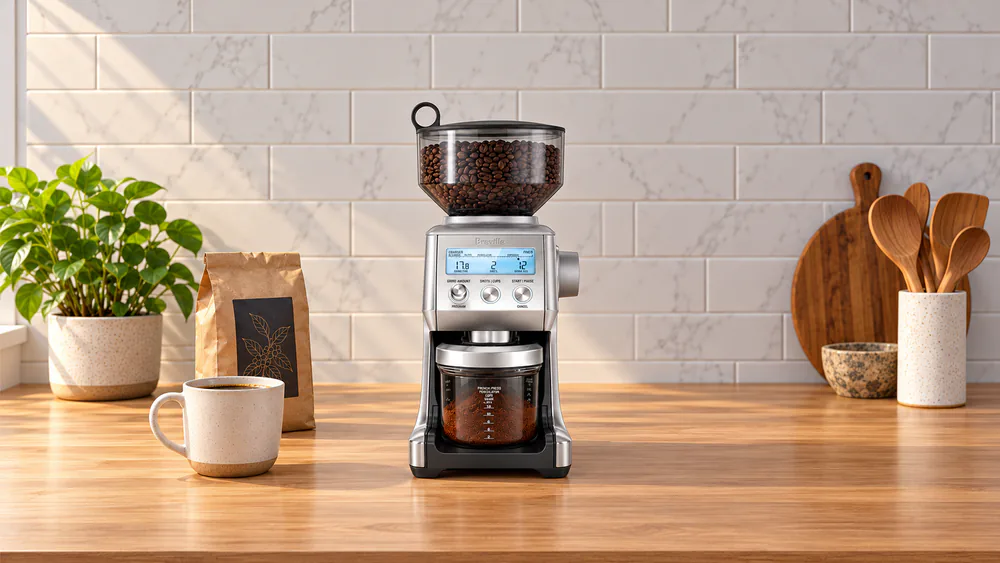
The Breville Smart Grinder Pro is the timed-dosing alternative, and it is worth a look if you want a grinder that tells you what to do. It offers 60 grind settings, a programmable timer in 0.2 second increments, an 18 oz hopper, and a 165W motor, with a 2-year limited warranty. The LCD and brew-range labels make initial adjustment approachable, and the portafilter activation button makes direct dosing convenient.
We did not give it an award because its trade-offs outweigh the convenience for most buyers. Fine grounds can collect internally and come out in clumps when changing to a coarser brew setting, and the operating sound is intrusive enough to matter in a quiet kitchen. Static in the supplied catch container can scatter grounds during transfer, and the catch container can shift under vibration if it sits loosely beneath the outlet. A stalled grind may require removing the beans and dry brushing the burr area; follow the manual and unplug the grinder first.
Against the Encore ESP, the Breville gives you timed dosing and a bigger hopper but costs you retention and noise. If you want a timer, choose it. If you want the quieter, simpler routine, stay with the Baratza.
7
Breville Smart Grinder Pro
4.2
Timed dosing, a large 18 oz hopper, and 60 settings, held back by retention when switching brew methods and a loud motor.
Clean the grinder on a routine, and do it dry: unplug it, empty the hopper or bin, remove the upper burr where the design allows, and brush out the burr chamber and exit chute. Coffee oils turn stale, and built-up grounds cause static and clogs, which is why a quick brush is the first fix for most static complaints on the Ode Gen 2 and DF54.
Reassembly deserves attention. On the Encore, the hopper gasket and burr-carrier tabs have to line up after you clean. The K-Ultra comes apart without tools, and you should brush and dry-clean it, never wash or soak it. Follow its disassembly and zero-calibration instructions. A stalled Breville needs the beans removed and the burr area dry-brushed after unplugging.
Warning. Always unplug an electric grinder before you reach into the burr chamber, and never run water through the motor housing or burrs. Wear and lack of cleaning are excluded from the Baratza warranty.
A dry brush through the chute fixes most static and clumping.
Coffee Grinder FAQs
Can one grinder handle both espresso and filter coffee?
Yes, if it has fine steps for espresso and a wide range for filter. The Encore ESP, the DF54, and the K-Ultra do both. The original Encore and OXO are filter grinders, and the Ode Gen 2 is filter only.
How much should you spend on a coffee grinder?
Spend according to your brew method. A filter drinker can choose a budget or mid-priced electric grinder. An espresso drinker should put more of the total budget into the grinder than into the machine, because adjustment precision decides the shot.
What grind size should you use for French press and cold brew?
Coarse and uniform. Aim for the coarse end of your grinder's range and brew to taste. A grinder that produces many fines at coarse settings, such as the OXO, will give a muddier cup.
When should you replace the burrs?
When the grind gets uneven, you have to keep moving the dial finer to get the same results, or the grinder starts to feel rough. There is no universal schedule, so judge by performance. Choose a brand that sells replacement burrs.