As an Amazon Associate we earn from qualifying purchases. We may earn a commission from links on this page, at no extra cost to you. Learn more.
A hotel buffet that runs out of waffles at 7:30 a.m. loses guests faster than one that runs out of coffee, and the machine behind the counter decides which one you get. We scored ten commercial waffle irons on output, heat recovery, plate durability, cleanup, footprint and the electrical demand it puts on your kitchen. The ranking sits alongside our waffle maker reviews and is written for operators who need a machine that lasts.
Ten machines are too wide for one table, so this grid lines up the five picks most operators will actually cross-shop. The other five get the same detail in their own reviews below.
Criteria
Waring WW200
VEVOR 2460W
VEVOR 1230W
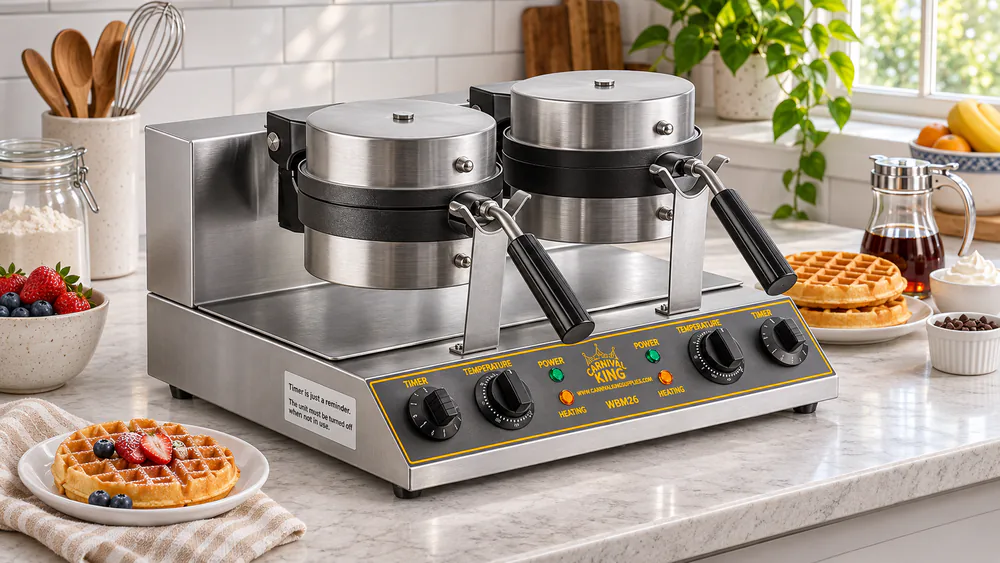
Carnival King WBM26
Waring WW180X
Voltage
120V
Not stated by maker
Not stated by maker
120V
120V
Wattage
1400W
2460W
1230W
2200W
1200W
Plates
2 x 7-inch Belgian
2 x 7-inch round
1 round
2 x 7 1/2-inch round
1 x 7-inch Belgian
Output
50 per hour
Not stated by maker
Not stated by maker
40 per hour
25 per hour
Rotation
Rotary
Two fixed heads
Rotatable body
180 degrees
Rotary
Timer
Ready lights and beep
Independent controls per head
Ready beep
Separate timers
Ready lights
NSF
Listed
Not confirmed
Not confirmed
Not confirmed
Listed
Our rating
4.5
4.1
3.8
4.0
4.2
How We Tested Commercial Waffle Makers
We score every pick on the same six criteria so cafe, hotel buffet and food truck operators can compare the machines consistently. The routine we hold each machine to is the one the trade uses: seasoning where the maker calls for it, a full warm-up, then batches paced to your real rush.
Output and heat recovery come first: a machine that loses heat between waffles slows service and lengthens the queue. Plate durability and release come next, then cleanup, footprint, and the electrical load each machine puts on a kitchen. We weigh the parts that fail first in this trade: hinges, handles, cords, and the nonstick coating on the plates.
Cleanup gets real weight in our scoring. A machine that takes ten minutes of scrubbing at close is a machine your line cook will resent, and resentment shows up as skipped maintenance and shorter plate life. The routine is to wipe plates while warm, brush grid corners, and re-season with a thin coat of oil.
Every machine is held to that same checklist, so a rating gap reflects a real difference in output, heat recovery, release and cleanup rather than a different test.
Warning. Check the electrical spec before you buy. A 2200W or 2460W machine pulls a heavy load on a 120V circuit, and a 208V or 240V unit needs a matching receptacle. Have an electrician confirm your breaker load first.
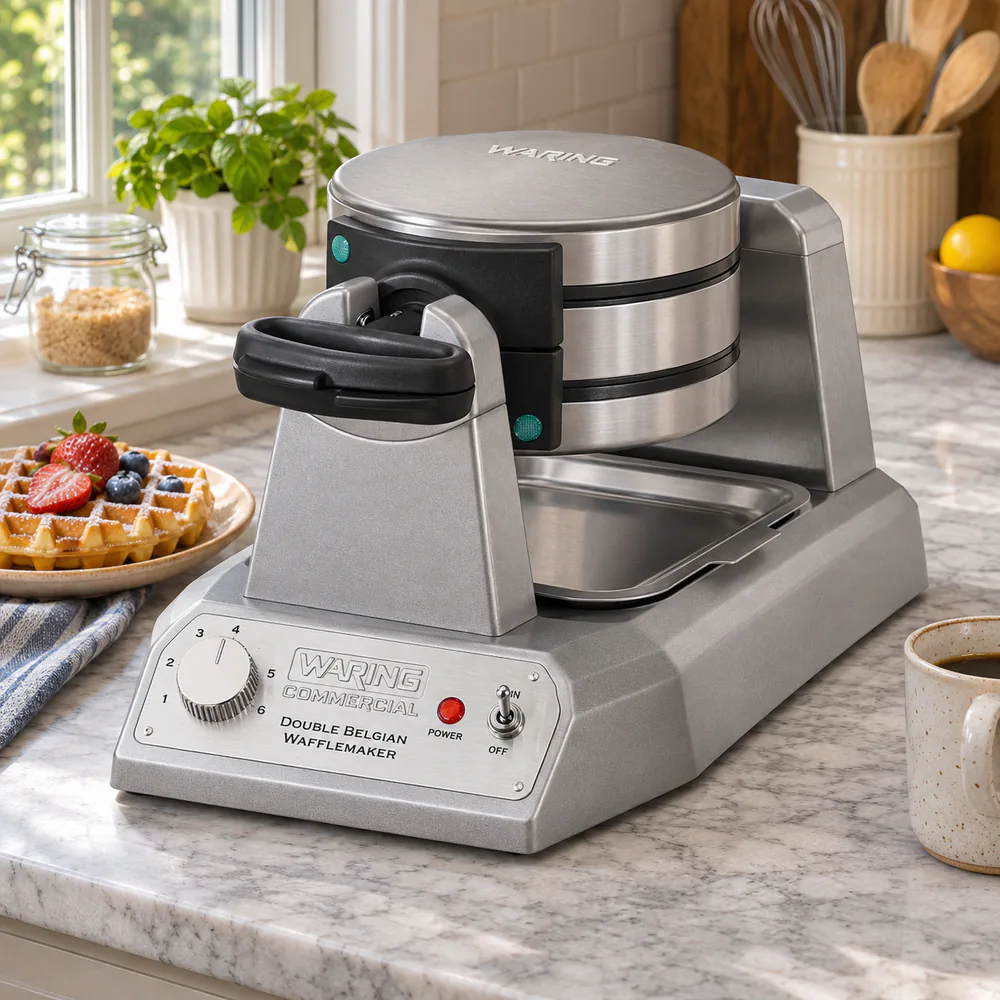
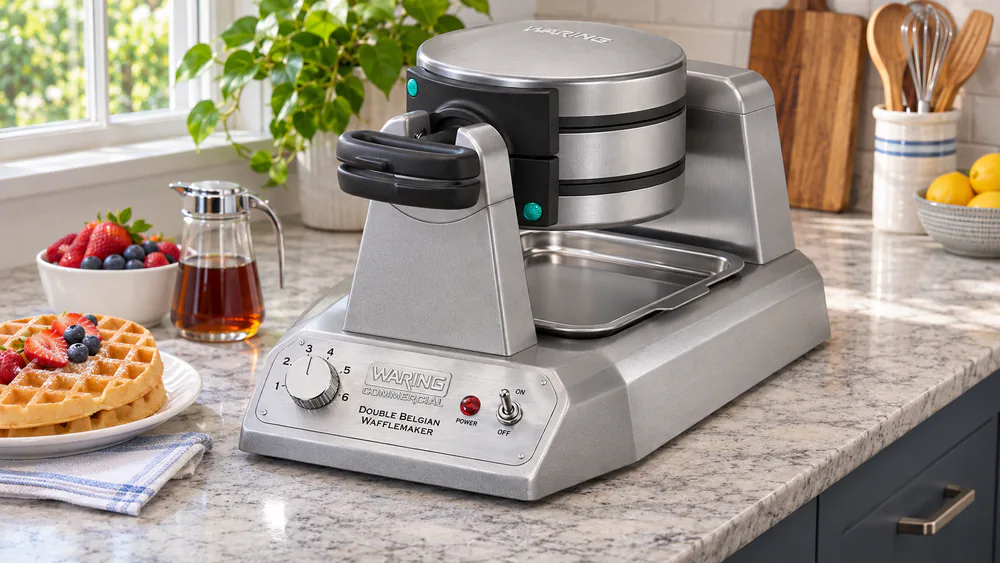
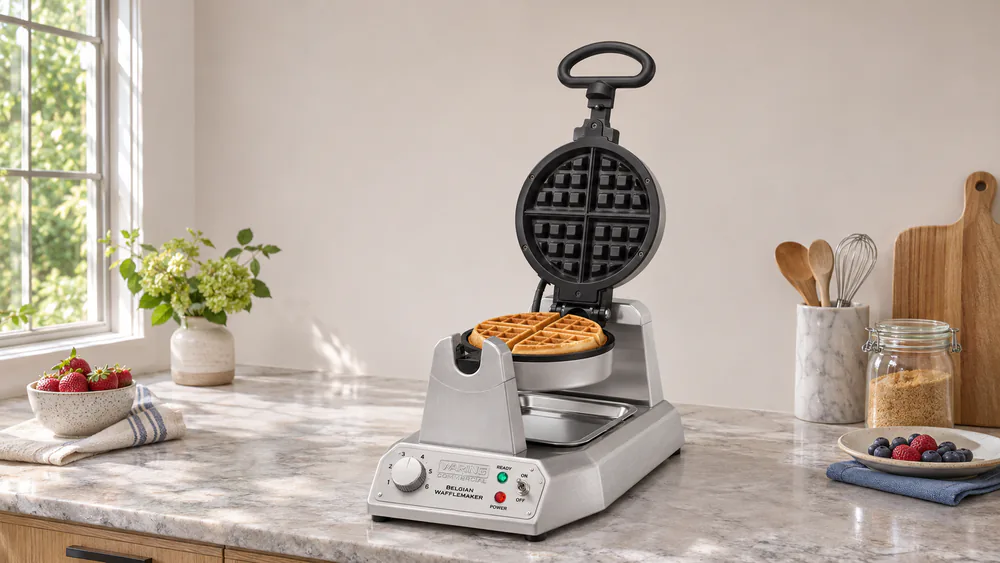
The WW200 is the machine we would put on a cafe counter first. It is rated for up to 50 waffles per hour, and at a breakfast-rush pace it turns out roughly 45 to 48 an hour. The triple-coated plates release with a light tap, and the vertical design leaves room next to an espresso machine. The catch is consistency: some units fail within months of heavy use, so register the 1-year warranty on day one.
Pros
Up to 50 waffles per hour from two 7-inch Belgian grids
120V, 1400W on a standard NEMA 5-15P outlet, no special wiring
NSF and cETLus listed
Removable, dishwasher-safe drip tray
Vertical footprint of about 10.45 inches wide saves counter room
Cons
Build durability is inconsistent, with some units dying inside two months
Needs initial seasoning, which trips up first-time users
Weighs about 19 lb, so it is not a grab-and-go unit
In our kitchen the WW200 settled into a rush pace of roughly 45 to 48 waffles an hour, and the plates released with a light tap. The warm-up is about four to five minutes, short enough to switch it on when you unlock the door. Cleanup is easy on the nonstick plates, and the drip tray lifts out and goes through the dishwasher. Seasoning the plates before first use is the step first-time users tend to skip, so build it into your opening checklist.
Who Should Buy It
Cafes and small hotels that need real volume from a 120V outlet. It fits operators who want NSF paperwork for the inspector without rewiring anything.
Who Should Skip It
Anyone who cannot tolerate downtime. If a dead machine at 8 a.m. means lost sales, buy a spare or choose a unit with a longer track record.
2. VEVOR 2460W Dual-Head - Best Double-Head for High Volume
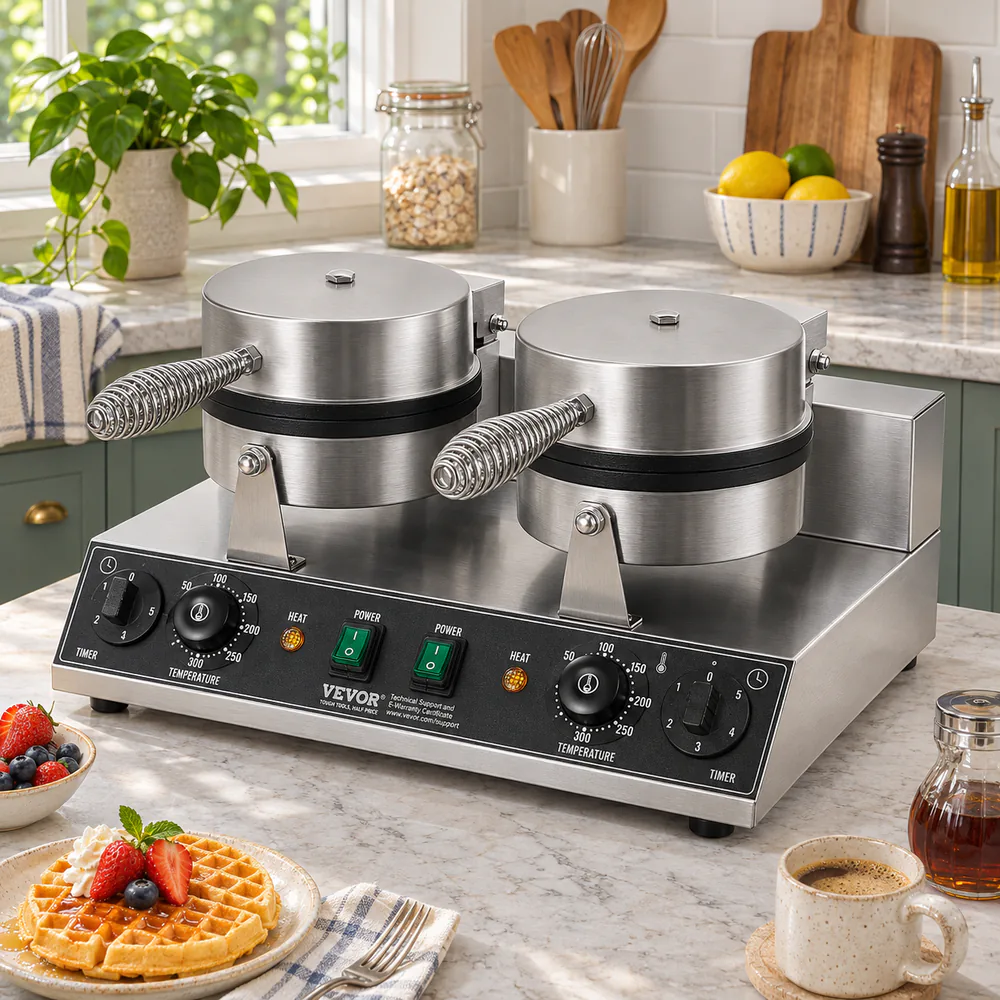
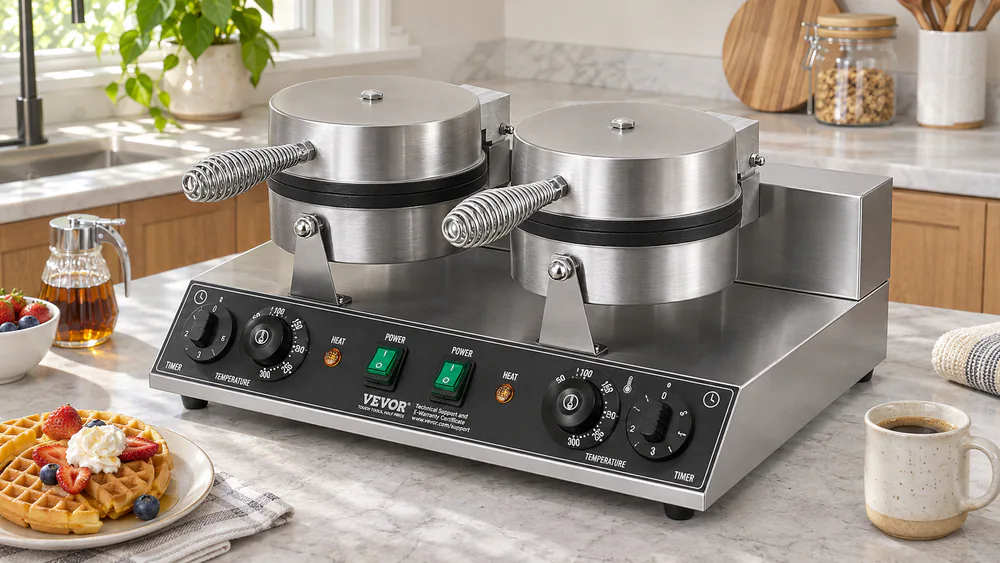
This is our dual-head workhorse. Each head has its own control panel, so one side can run crisp at 380F while the other stays softer, and heat recovers in about 25 seconds per head. The 2460W draw is high for one 120V circuit, so check your breaker load. The plates are non-removable, which means cleanup happens in place with a soft brush and damp cloth, and the 21 lb body makes that a chore.
Pros
Two heads with independent control panels, 122 to 572F range
Quick recovery of about 25 seconds per head
Spiral stainless handles, rubber feet, and spill channels
Accessories included
Budget-tier cost for a two-head machine
Cons
2460W total is a heavy load on a single circuit
No NSF listing confirmed
Non-removable plates make cleaning slow
Large footprint of about 19.69 x 18.5 inches eats counter space
Where the WW200 runs one style, the 2460W splits the job. We set one head crisp at 380F and the other softer, and heat recovered in about 25 seconds per head. A cafe selling both crisp Belgian-style waffles and softer breakfast waffles can run both at once without compromise. The hinge between the plates and the spill channels keep overflow off the counter, which is a small thing that saves real cleanup time.
Who Should Buy It
Busy counters that sell two waffle styles at once, or kitchens with a dedicated circuit and room to spare.
Who Should Skip It
Operators who require NSF-listed equipment, and anyone short on counter space or amperage. At about 21.4 lb it is not a machine you move daily.
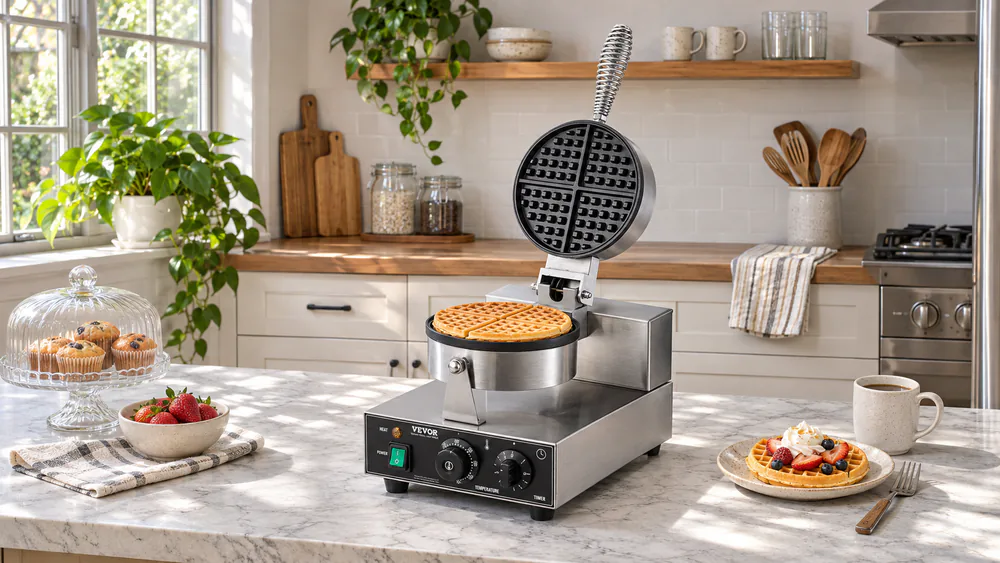
On the VEVOR 1230W the plates reach ready in about four minutes, and a single round head is plenty for a small cafe or a weekend stall. Round units like this take about six minutes per waffle and wipe clean, but heat can run uneven between the top and bottom plates. The fix is simple: leave the lighter side 30 seconds longer. Watch the coating, because wear is the first sign of aging on budget units.
Pros
Lowest-priced pick in this roundup
1230W with a 122 to 572F range
Ready beep and audible alerts
Rotatable body and spill channels
Wipes clean after service
Cons
Uneven heat between top and bottom plates
Some units develop durability problems
Grids are not removable
No NSF listing confirmed
When top and bottom plates cooked unevenly, we left the lighter side 30 seconds longer and the waffle came out right. The plates reached ready in about four minutes. The stainless handles have a spiral grip that stays comfortable under repeated use, and the rubber feet keep the body planted on a wet counter. For the money it is a sensible way to learn how much waffle volume your menu actually sells.
Who Should Buy It
New operators testing a waffle program before committing real money. It earns its keep on slow mornings.
Who Should Skip It
Anyone planning to run it all morning, every day. At that duty cycle the coating wear and temperature drift will show up first.
4. Carnival King WBM26 - Best Rotating (Flip) Belgian
The WBM26 is a true two-waffle rotary with a timer for each side, so two waffles with different start times stay under control during a rush. It is rated for up to 40 waffles per hour on two 7 1/2-inch grids that rotate 180 degrees. The weak spot is longevity: it can lose heat on one side after several months of use, and the nonstick grids can be hard to clean. It also needs more counter than a single unit.
Pros
Separate timers for each side
120V, 2200W total (1100W per side), two NEMA 5-15P plugs
Up to 40 waffles per hour
7 1/2-inch grids, 180 degree rotation, drip trays
Cons
Can lose heat on one side after several months
Grids can be hard to clean
Footprint of 19 3/4 inches wide by 21 inches deep
NSF status not confirmed
Stepping up from the single-head units, the WBM26 gave us separate timers for each side. During a rush two waffles with different start times stayed under control, without overcooking the first one. The cost is counter space and two outlets, since each side has its own plug, and the grids can be hard to clean. Skip it on a tight counter or if the inspector wants NSF paperwork, which we could not confirm here. It suits operators who want rotary browning and independent timing.
5. Waring WW180X - Best for Hotels and Breakfast Buffets
For a buffet, the WW180X is the easiest machine on this list to live with. It recovers heat in about 25 seconds between waffles and makes around 25 an hour. That output is enough for one unit per buffet station. The rotary action gives even browning with little babysitting, so guests can often make their own with light supervision. It is NSF and cETLus listed.
Pros
Rebounds in about 25 seconds between waffles
120V, 1200W, standard NEMA 5-15P plug
NSF and cETLus listed
Rotary action browns evenly
Single 7-inch Belgian grid, about 1-inch waffles
Cons
Only 25 waffles per hour, so not for a heavy a la carte line
Plates carry just 90 days of warranty coverage
Single grid limits throughput
The 1200W draw is the lowest of the Waring pair, which makes it easy to run several stations on shared circuits without tripping a breaker. The machine itself carries a 1-year limited warranty, but the plates are covered for only 90 days, so check them early.
Who Should Buy It
Hotels and buffets running one machine per station, where consistency matters more than raw output.
Who Should Skip It
High-volume cafes that need to cook dozens of waffles an hour from one counter spot.
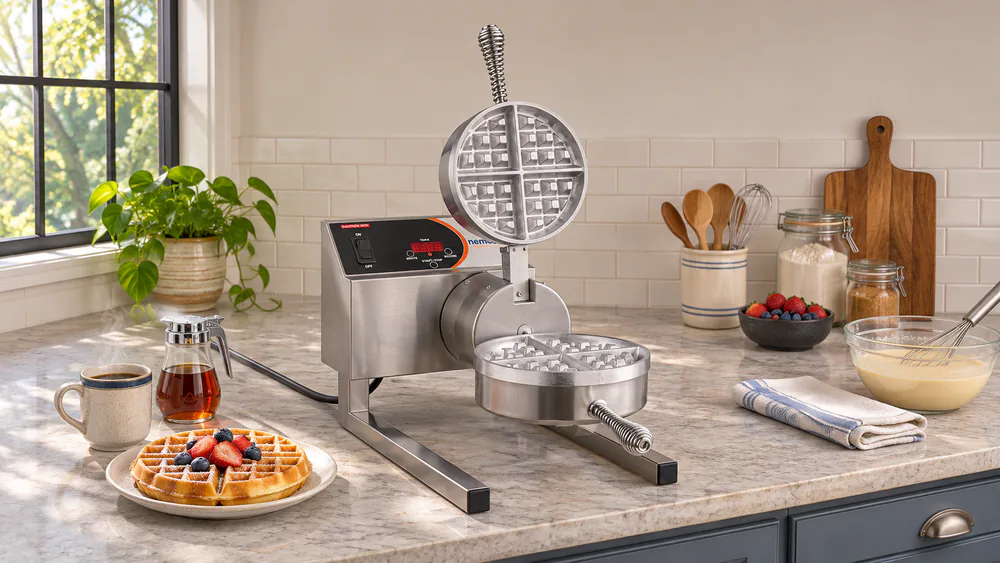
The 7000A-S is compact and tidy, with a top-mounted digital panel, LED countdown, audible alarm, and a floating hinge. Output is modest at up to 20 thin 7-inch waffles per hour. Preheat is the drawback: it takes roughly 12 minutes, which hurts when you need to start cooking right after opening. If you plan the morning around that, it is a quiet, dependable small machine.
Pros
Compact: about 10 inches wide by 18.38 inches deep
120V, 890W, NSF listed
Digital temperature and timer with LED countdown
SilverStone nonstick grids
Cons
About 12 minutes to preheat
Up to 20 thin waffles per hour
Thin waffles, not deep Belgian pockets
The digital timer is the best on a compact unit in this group, because the countdown removes guesswork for newer staff. Start it early and it is ready when the first order comes in.
Who Should Buy It
Small breakfast spots and bakeries with tight counters and a predictable opening routine.
Who Should Skip It
Kitchens that fire the first order within minutes of opening.
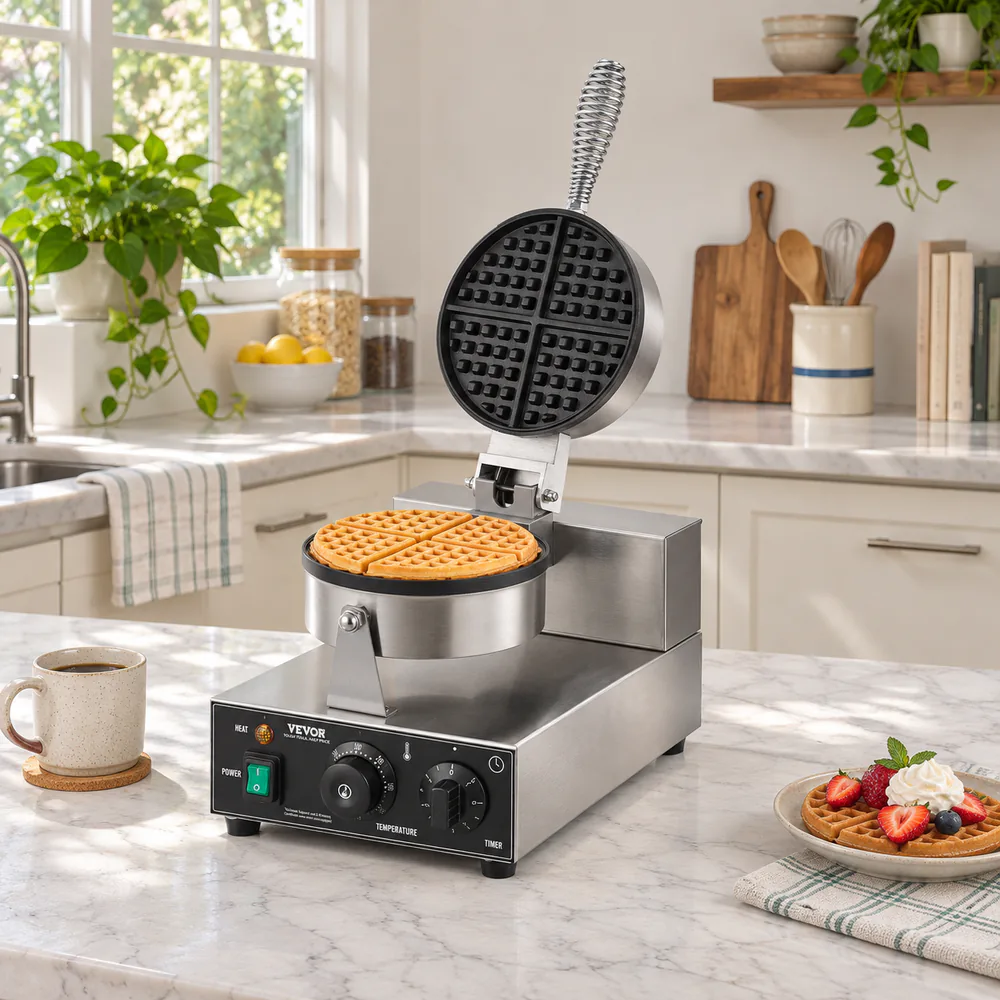
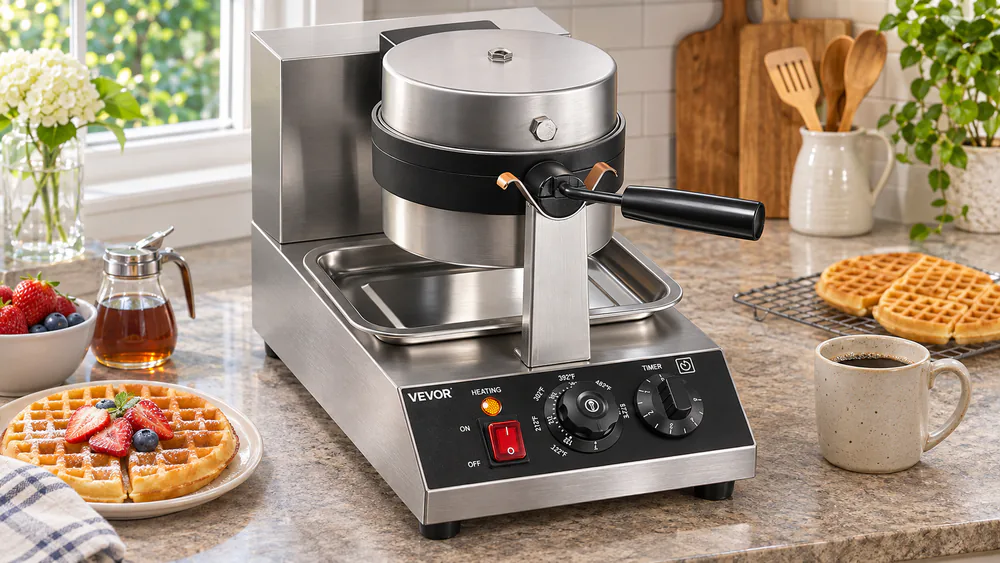
Food truck work rewards low weight and fast cleanup, and the 1300W rotatable does both well. At 18.8 lb it is light enough to strap down in a truck, and it wipes clean in under a minute. The knob and timer take a handful of waffles to learn, so run a practice batch before your first event. Heat ranges from 122 to 572F, with a diversion groove for overflow.
Pros
Light enough to strap down at 18.8 lb
Stainless body, 1300W
Wipes clean in under a minute
Ready and beep lights, overflow groove
Cons
A short learning curve on the knob and timer
No NSF listing confirmed
Single round plate limits volume
A truck rewards the opposite of the WBM26: low weight and fast cleanup. At 18.8 lb it was light enough to strap down, and it wiped clean in under a minute. The knob and timer took a handful of waffles to learn, so run a practice batch before your first event. Confirm your generator or shore power can feed 1300W beside the rest of your equipment. Permanent kitchens that need NSF paperwork should look elsewhere, since NSF is not confirmed and the single round plate caps volume.
8. Nemco 7030A - Best for Waffle Cones and Specialty Work
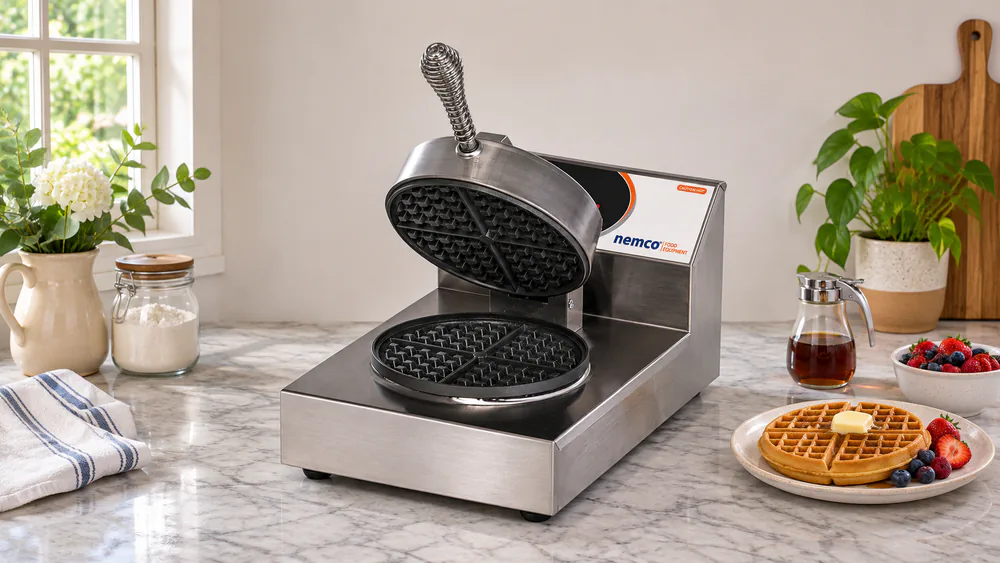
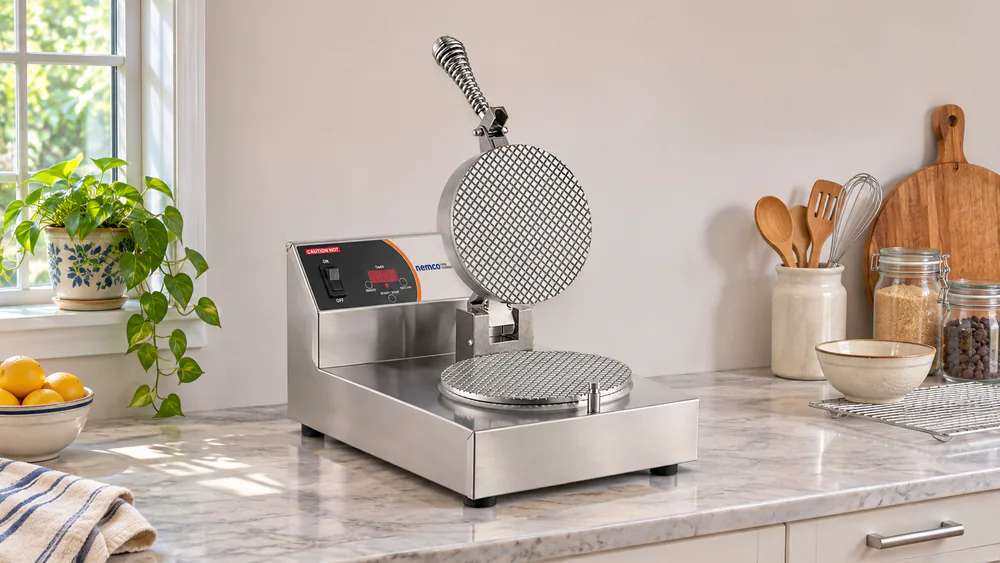
We could not verify a dedicated waffle stick or lolly maker, so this slot goes to the Nemco 7030A cone maker, the specialty option we can stand behind. It is rated for up to 60 cones per hour from one 7-inch grid on 120V. Programmable digital controls and a coiled spring cool handle make it comfortable to work. The concern is durability: it can show problems in high-volume service.
Pros
Up to 60 cones per hour
Programmable digital controls and LED countdown
Coiled spring cool handle
Cast aluminum grid
Cons
120V supply required
Can show durability issues in high-volume service
Makes cones, not Belgian waffles
The top-mounted panel and audible alarm keep a busy cone station on schedule. Treat it as a dedicated specialty tool rather than a general waffle iron.
Expect about a 12-minute preheat before the first cone, so switch it on well before the doors open. The 7-inch top and bottom cast aluminum grids give cones uniform thickness and even golden color, and that consistency is what you are paying for.
Who Should Buy It
Ice cream shops and dessert counters that sell cones all day.
Who Should Skip It
Anyone who needs a general-purpose breakfast waffle maker or only has 120V power.
The 7020A-208 is the splurge pick, and it is a specialist's tool. The 7-inch cast aluminum grid lifts out without tools for thorough cleaning, which is a real advantage. The tradeoff is that the uncoated aluminum needs seasoning and upkeep. It runs on 208V at 980W with a NEMA 6-15P plug, so you need the right receptacle before it arrives. Output is up to 20 waffles per hour.
Pros
Grids lift out without tools
NSF and ETL listed
Waffles about 1 1/4 inches thick
Compact at 10 x 18 3/4 x 10 5/8 inches
Cons
Needs a 208V circuit and NEMA 6-15 receptacle
Uncoated aluminum needs seasoning and upkeep
Only 20 waffles per hour
Highest-priced pick here
The 19.5 lb body is compact for its class.
The grids lift out without tools, making deep cleaning easier than on the fixed-plate machines here. The bare cast aluminum still needs seasoning and regular upkeep. If your kitchen already has 208V service and a cook who will season the grid after each deep clean, it rewards that care.
Who Should Buy It
Kitchens that already have 208V service and a cook who will maintain the grid.
Who Should Skip It
Standard 120V kitchens and anyone wanting a nonstick plate.
10. Cuisinart Double Flip WAF-F40NAS - Best Light-Commercial Home Crossover
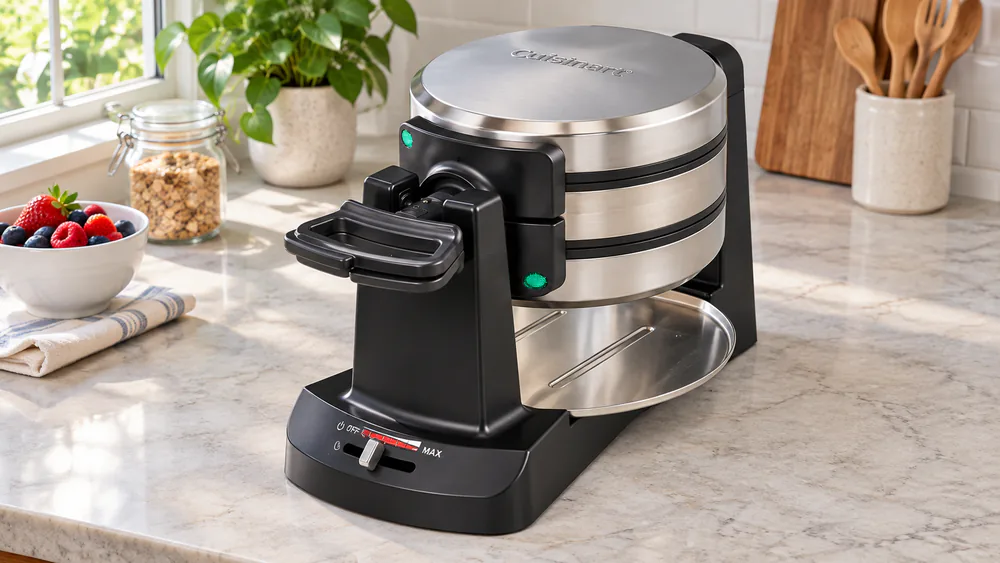
What this machine cannot do is hold up to commercial service, and that decides everything else. It is the one pick here without NSF listing, and we include it only as a crossover for light use. It makes two 1-inch-thick Belgian waffles at a time on a flip rotary with PFAS-free ceramic nonstick and a 5-setting browning control, and at 1400W and 13.4 lb it is easy to move. A home iron pulled into a catering gig warps its plates and loses heat each time the lid opens, so it suits small bed and breakfasts and occasional catering, not a kitchen cooking waffles all morning.
Pros
Two 1-inch Belgian waffles at once
PFAS-free ceramic nonstick, 5-setting browning
1400W, 120V household use
3-year limited warranty
13.4 lb, easy to carry
Cons
Not NSF-listed, a consumer product
Plates can warp and lose heat under constant use
Availability can vary, since Cuisinart labels the older WAF-F40 discontinued
The 3-year warranty is longer than anything else here, which tells you how Cuisinart expects it to be used: a few mornings a week, not all day.
Treat it as a weekend-brunch iron with a long warranty, and plan to replace it if your volume grows.
How to Choose a Commercial Waffle Maker
The right machine follows from your volume, your electrical service, and how much cleanup time you have. Start with the numbers, then the plates.
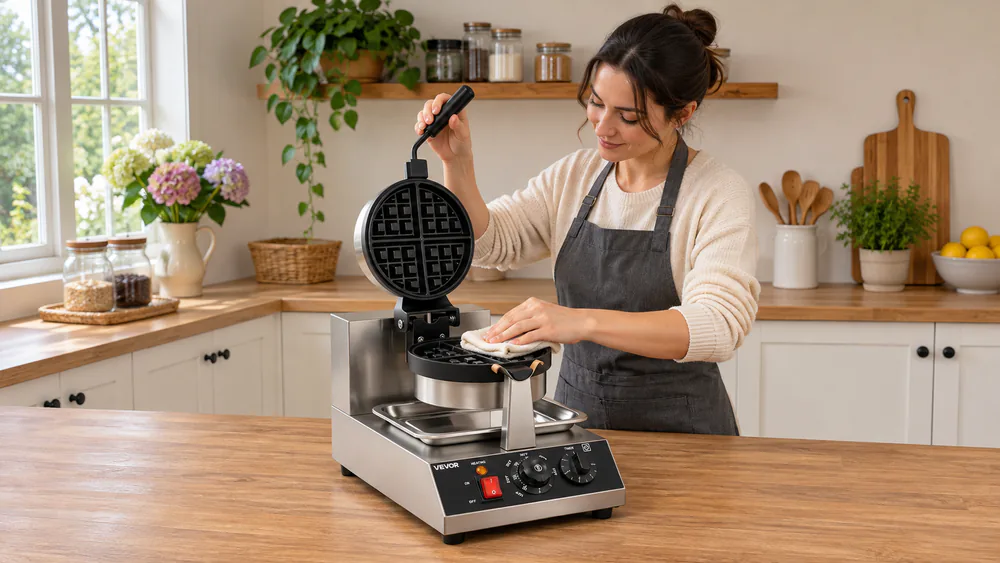
Wiping warm plates is the standard routine on non-removable units.
Output (Waffles per Hour) and Duty Rating
Match output to your peak hour, not your average one. Our top pick is rated for up to 50 waffles per hour, the WBM26 for up to 40, the WW180X for up to 25, and the Nemco irons for up to 20. VEVOR does not publish a waffles-per-hour figure, so judge those units by plate count and heat recovery.
Duty rating matters as much as the headline number. Non-stick coating wear is the first sign of aging on budget units, followed by temperature drift. A machine that hits its rated output on day one but drifts by month three costs you more than a slower unit that holds steady.
Voltage, Wattage and Circuit Requirements
Most machines here run on 120V and a standard outlet. The Nemco 7020A needs 208V; the 7030A runs on 120V. The WBM26 draws 2200W through two plugs, and the VEVOR 2460W is a heavy single-circuit load. VEVOR pages never state voltage plainly, so confirm it before you buy.
Wattage and circuit capacity decide whether a machine runs all morning or trips the breaker at 8:15.
Grid Type and Waffle Style (Belgian, Round, Stick)
Belgian grids make thick waffles with deep pockets, around 1 inch thick. Thin grids, like the Nemco 7000A-S, make a lighter, crisper waffle. Cone makers shape a different product altogether. Pick the style your menu needs first, then shop machines that make it.
Commercial plates are mostly non-removable because removable plates hurt heat transfer. The routine is wiping warm plates with a damp cloth, brushing grid corners, and re-seasoning with a thin coat of oil.
NSF Certification and Cleaning
Of the machines here, the Waring WW200, Waring WW180X, Nemco 7000A-S, and Nemco 7020A-208 are NSF listed. We could not confirm NSF status for the VEVOR units, the WBM26, or the 7030A. If your health inspector requires it, check before you buy.
Budget vs Long-Term Cost
The cheapest units wear their coating first. A mid-priced NSF unit with a warranty usually costs less over a year than a budget unit you replace. Register your warranty the day it arrives.
Home Flip Model vs True Commercial Unit
A home flip model looks similar, but it has lighter plates and lower wattage. Pulled into a catering gig, it warps its plates and loses heat each time the lid opens, which is why commercial units need heavier plates and higher wattage.
Frequently Asked Questions
What does the plate warranty actually cover?
Read it before you rely on it. The Waring WW180X carries a 1-year limited warranty on the machine but only 90 days on the plates, and some WW200 units fail within months of heavy use, so register the warranty on day one.
Which plug and receptacle does a 208V machine need?
The Nemco 7020A-208 uses a NEMA 6-15P plug, so it needs a matching 208V receptacle. A standard 5-15 outlet will not take it, so have an electrician install the right one before delivery.
Is a flip model the better choice for batter-heavy volume?
A rotating model such as the Carnival King WBM26 spreads batter evenly and browns with little babysitting, and its separate timers help when you load sides at different times. It needs more counter and two outlets.
How often should I season uncoated aluminum grids?
Uncoated cast aluminum like the Nemco 7020A needs seasoning and upkeep, and a thin coat of oil after each deep clean is the routine we recommend.
Do I need NSF paperwork for the health inspector?
Many inspectors ask for it at sign-off. The WW200, WW180X, Nemco 7000A-S and 7020A are listed, so keep the spec sheet on file. We could not confirm NSF status for the VEVOR units.
Belgian or standard plates, which suits a cafe menu?
Belgian grids make thick waffles about 1 inch thick with deep pockets, so they suit a menu built around toppings, like the Waring WW200 and WW180X. Thinner grids, like the Nemco 7000A-S, give a lighter, crisper waffle. Choose by the waffle your menu sells.
Will a home waffle maker survive cafe use?
Not for long. A home iron pulled into a catering gig warps its plates and loses heat each time the lid opens, which is why commercial units need heavier plates and higher wattage. A model like the Cuisinart Double Flip suits occasional catering only.
Final Verdict
If you need one machine for a cafe, hotel, or small restaurant, buy the Waring WW200 and register the warranty immediately. If you run two styles at once and have the power, take the VEVOR 2460W. If budget rules, the VEVOR 1230W is the place to start.
For buffets, the Waring WW180X is the steadiest choice, and food trucks should look at the VEVOR 1300W. The Cuisinart is a home iron: keep it for light use only.