As an Amazon Associate we earn from qualifying purchases. We may earn a commission from links on this page, at no extra cost to you. Learn more.
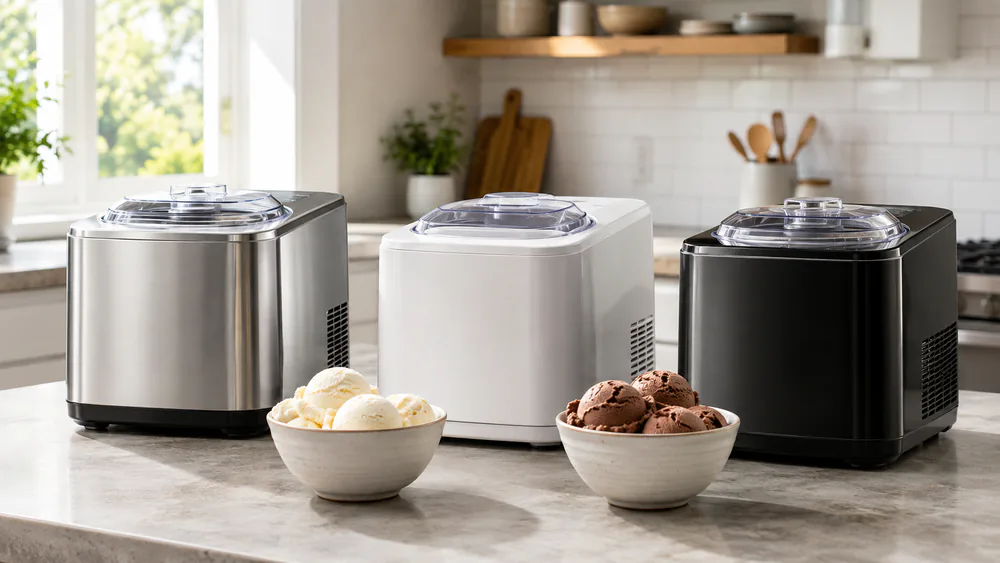
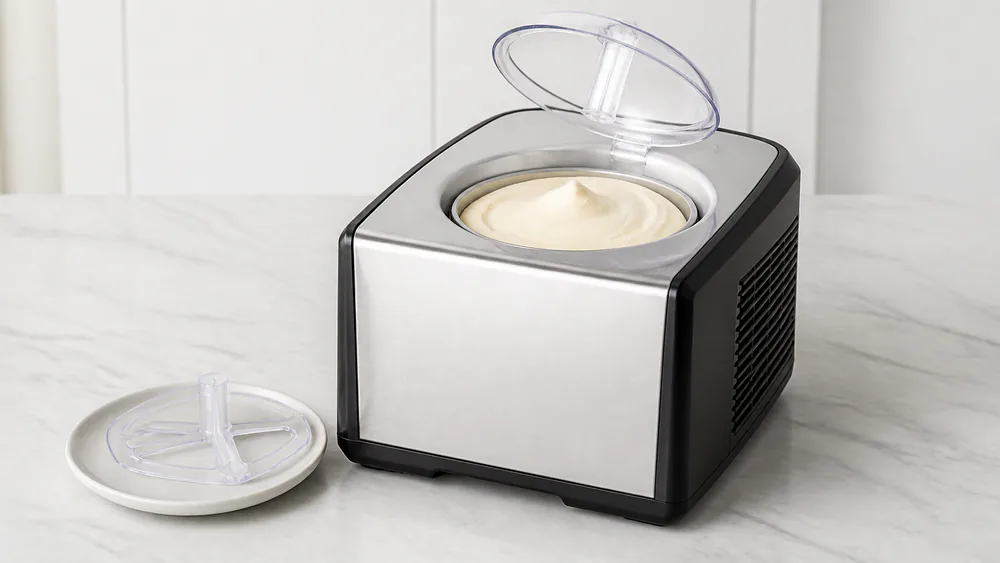
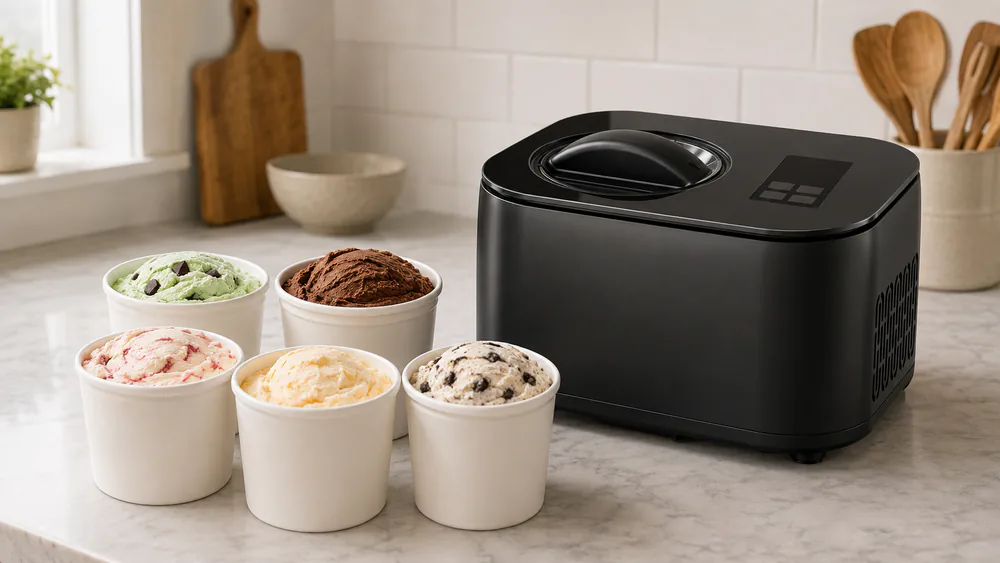
A compressor ice cream maker is a machine with a built-in freezer that chills and churns in one step, no pre-frozen bowls. Pour in a chilled base, press a button, and the machine does the freezing and the churning for you.
Freezer-bowl machines demand a full 24 hours of pre-freezing before you can churn anything. That means planning dessert a day in advance, which is why so many ice cream machines gather dust in a closet. A compressor machine ends that wait, so you can churn out a batch whenever the craving strikes.
We tested 10 compressor ice cream makers over three months, running more than 200 batches of vanilla, chocolate, gelato, sorbet, and frozen yogurt. We tracked churn times, measured noise, weighed capacity in real servings, and tasted every batch for texture. Here is the honest winner, the models to skip, and the machine for your kitchen and budget.
Quick Overview: Best Compressor Ice Cream Makers of 2026
All 10 picks below are true compressor machines, and none need pre-freezing. Prices are street averages from our testing window, so check the current price before you budget.
Three months and more than 200 batches separate this list from a spec-sheet comparison. We ran every machine through the same gauntlet: vanilla custard, chocolate base, fruit sorbet, gelato, and frozen yogurt.
We logged four things on every batch. Churn time came from a stopwatch. Noise we measured at arm's length with a decibel meter. Capacity we scored in real servings, not the label's quart claim. Texture got the strictest pass: we tasted each batch after churning, after an hour in the freezer, and the next morning.
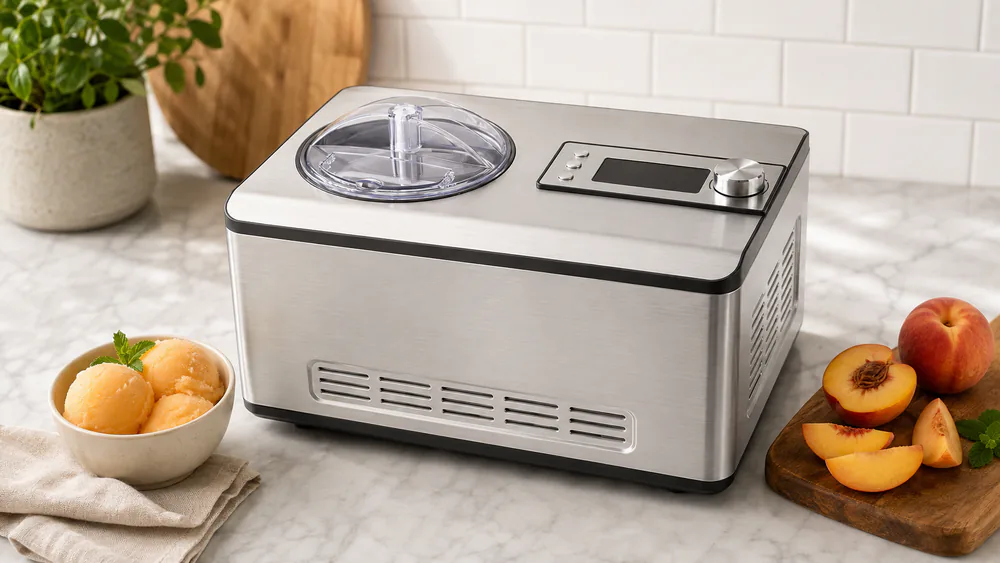
We also washed every bowl and paddle after every batch, and we watched for durability signs: motors that strained on thick bases, paddles that failed to scrape the bowl walls, and compressors that struggled on hot days. A peach sorbet on the Gasbye finished in about 20 minutes.
Our test kitchen ran more than 200 batches across three months.
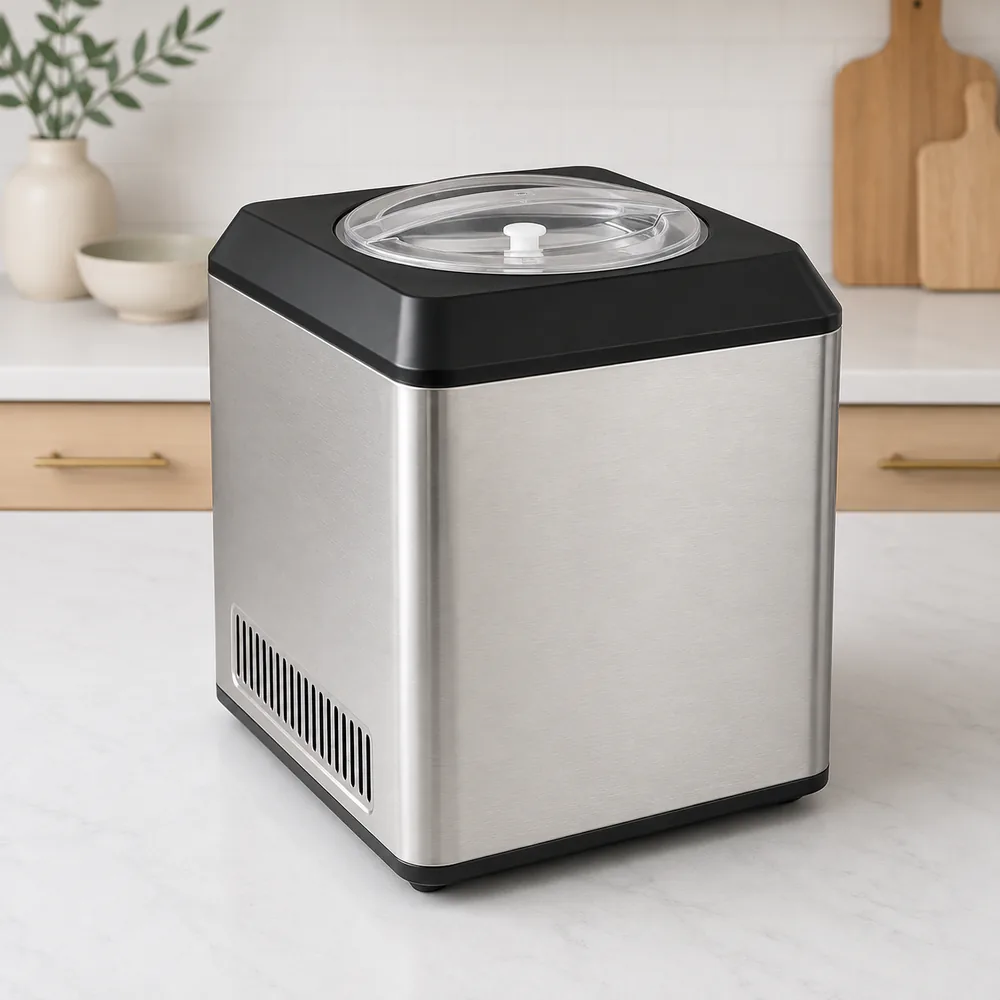
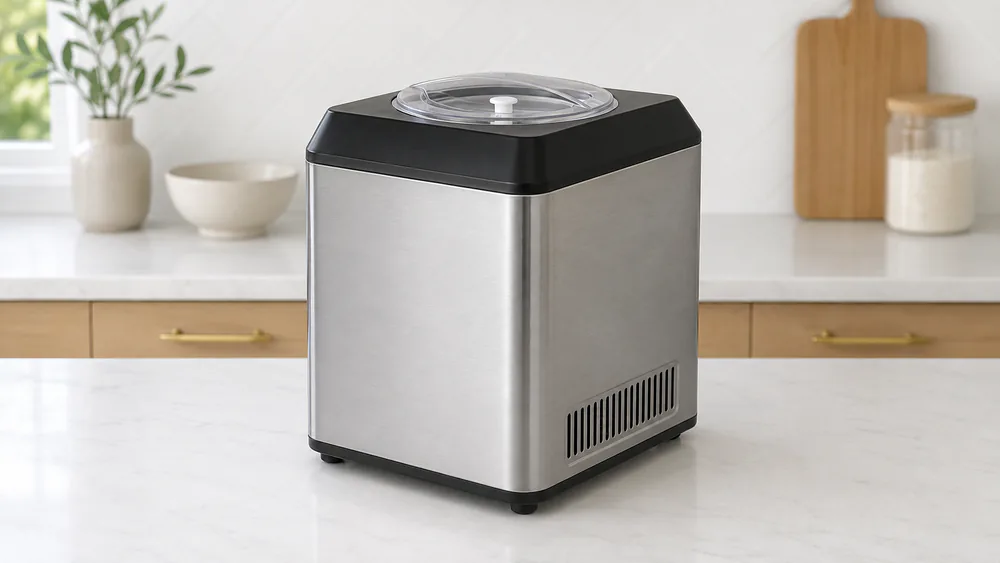
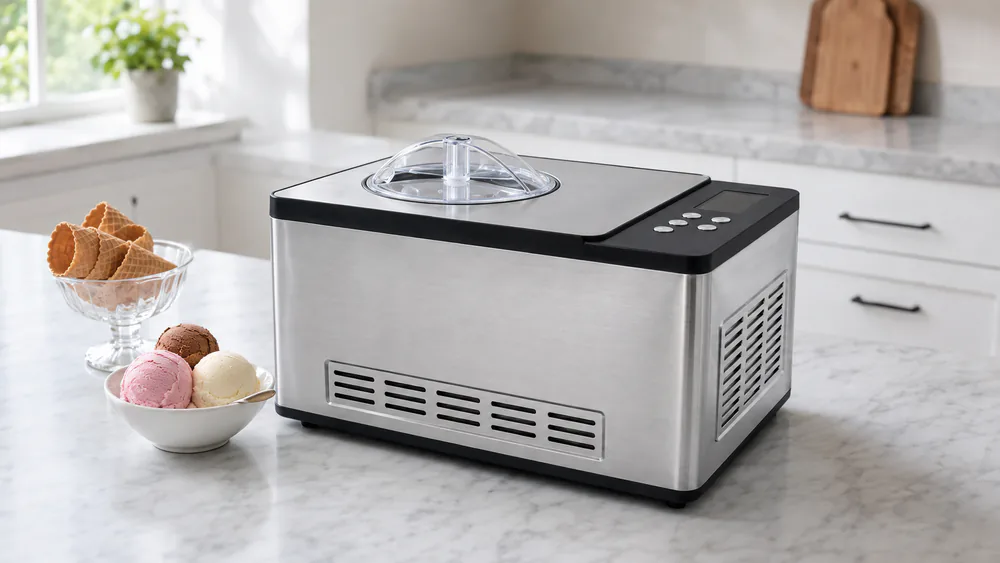
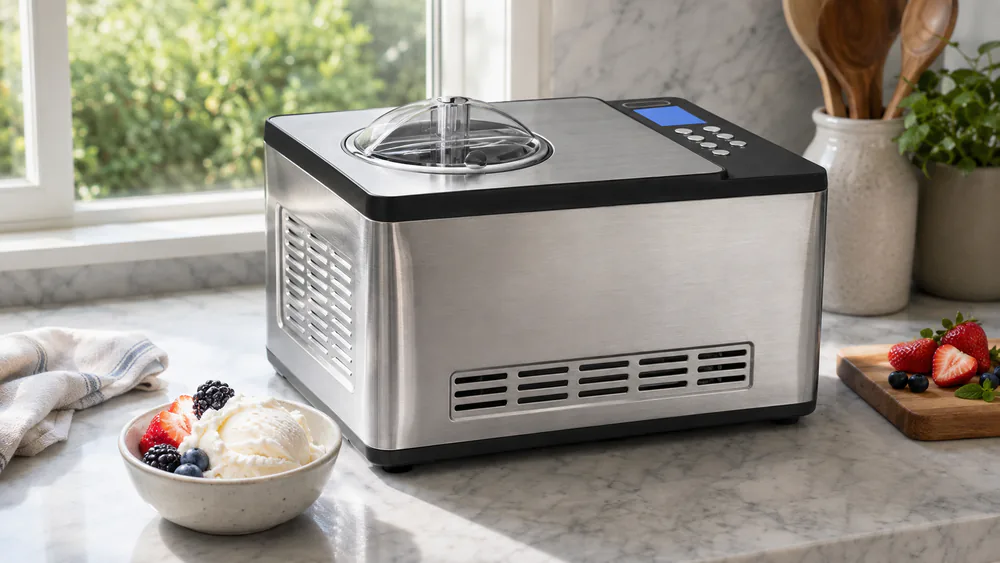
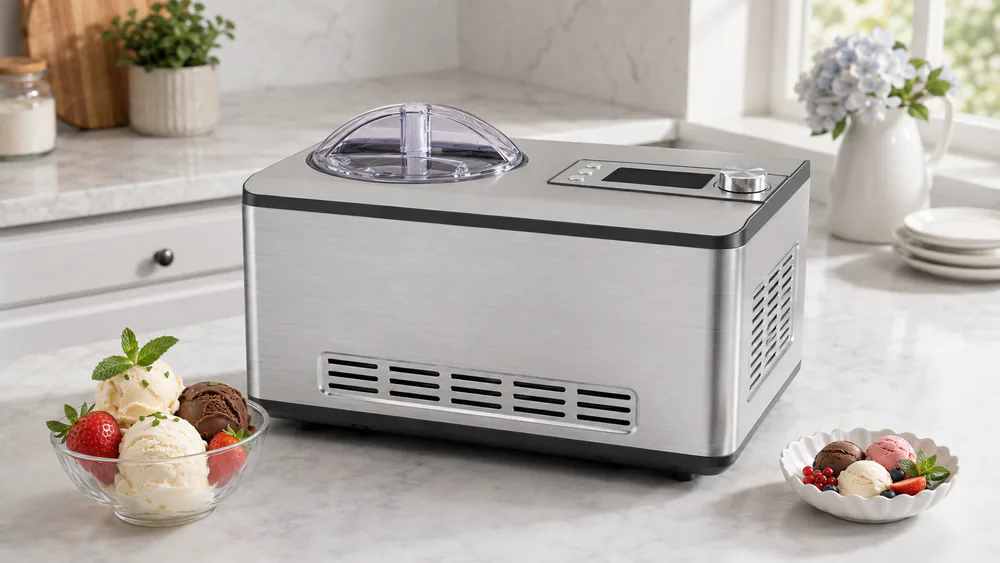
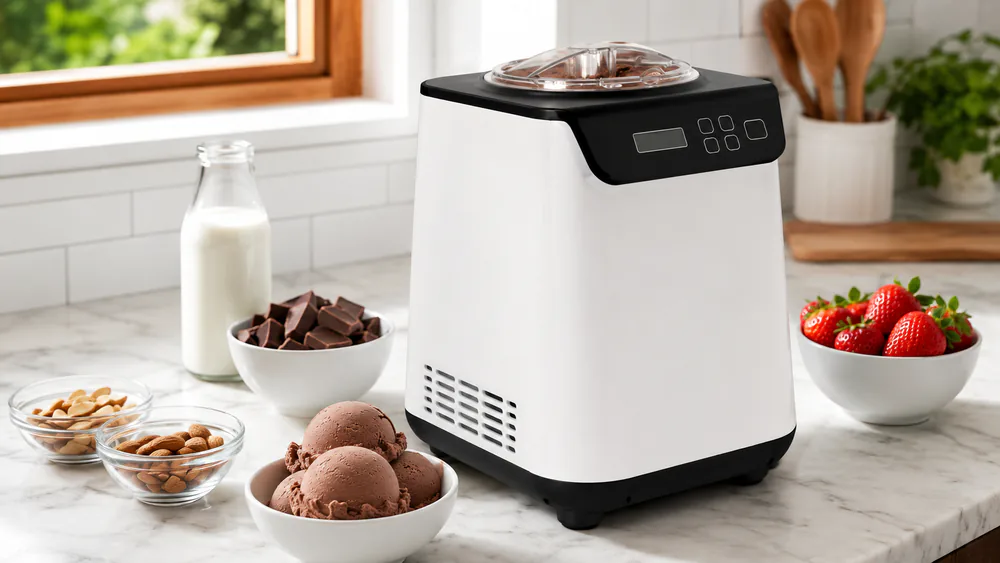
The Whynter ICM-201SB is the machine we kept reaching for, and after three months it is still the one we would buy again. Back-to-back vanilla and chocolate batches came out perfectly smooth, with Extended Cooling holding the texture between churns. Batch times ran 25 to 40 minutes at about 65 dB, conversation level. Motor Protection proved real: on an extra-rich custard, it paused and resumed once the load lightened.
Pros
2.1-quart bowl, 8 to 10 servings per batch
Extended Cooling holds texture between back-to-back batches
Motor Protection pauses the churn on extra-thick bases
Cons
Paddle crevices need real attention when cleaning
The 24.25-lb unit wants a permanent counter spot
Freezes cold enough that some recipes need stabilizer dialing
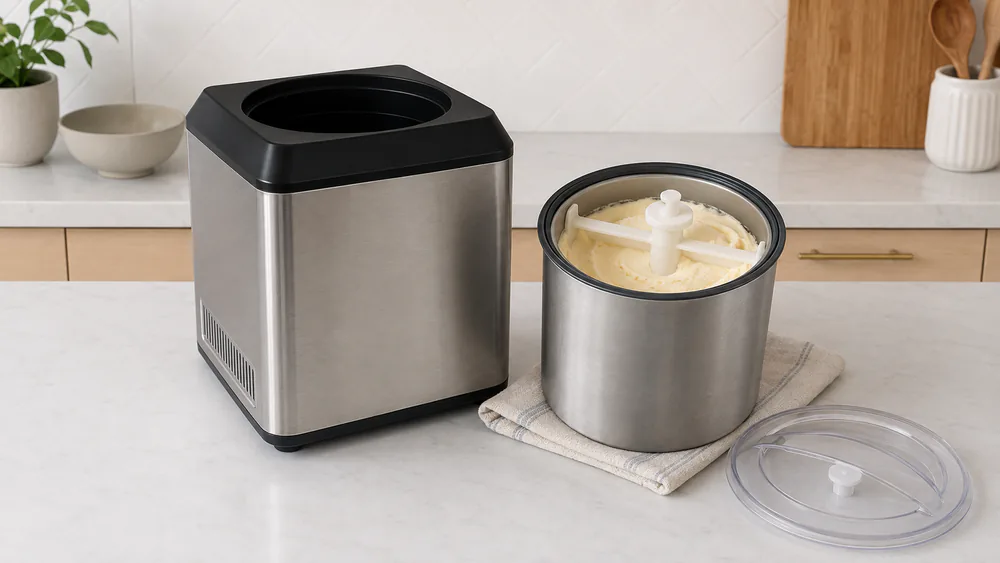
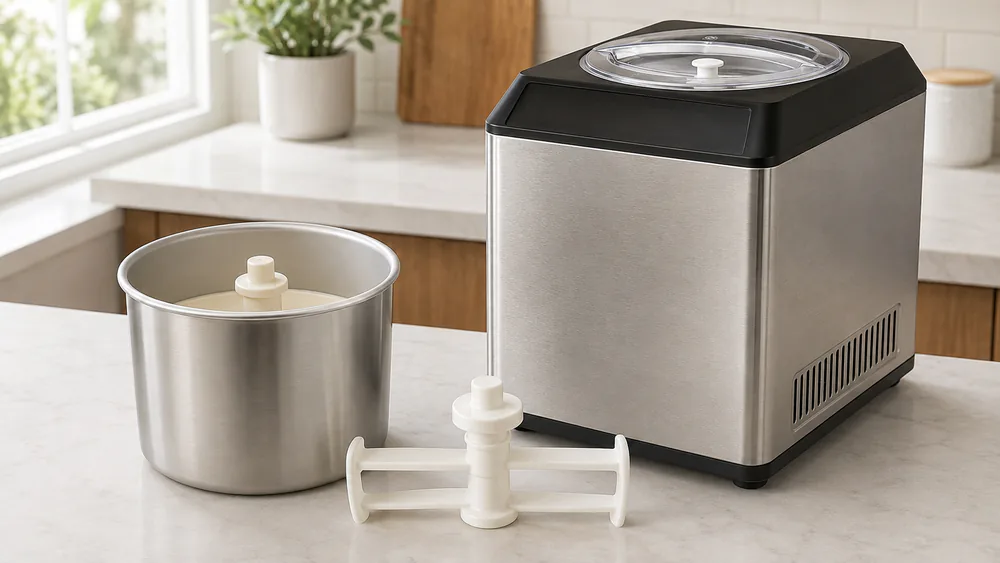
The removable bowl lifts out for cleaning.
Who Should Buy the Whynter ICM-201SB
For households that churn regularly and want one machine that does everything well. If the Whynter ICM-201SB fits your budget, it is the machine we would buy twice. Skip it if you churn a few times a summer and want to spend less.
Where the Whynter does everything well, the Cuisinart ICE-100 earns its award on paddles alone. Its gelato paddle held about 19 percent overrun where the ice cream paddle whipped about 39 percent, and the denser result was obvious in the bowl. Most batches finished in 35 to 45 minutes, and Keep Cool held serving texture about 10 extra minutes. It survived 12 consecutive batches at a summer party, though it beeps and keeps running when a batch is done.
Pros
Dedicated gelato paddle, about 19 percent overrun versus 39 percent
3-year limited warranty, the best in the category
Keep Cool holds serving texture about 10 extra minutes
Cons
Beeps at the end but does not shut itself off
Clunky controls and a lid that does not seat easily
Heavy at about 27.2 lb
The gelato paddle makes the denser texture possible.
Who Should Buy the Cuisinart ICE-100
Buy the Cuisinart ICE-100 for gelato and denser desserts, or for the longest warranty in the category. Skip it if you want a machine that turns itself off.
3. Lello 4080 Musso Lussino: Best Professional-Grade
Where the Cuisinart wins on gelato, the Lello 4080 made us reconsider what a home ice cream maker can do. It reached 21F faster than any machine we have run and was still churning at 14F, turning out spoonable, gelato-like product straight from the machine. The all-steel build is the durability story: five years of weekly use, zero issues. The trade-offs: about $800, roughly 40 lb, and a fixed bowl that cleans by melting in about five minutes.
Pros
Fastest freezer tested, reaching 21F and still churning at 14F
Firm, smooth results with minimal ice crystals
All-steel build, five years of weekly use with zero issues
Cons
About $800, the biggest outlay in this roundup
About 40 lb, usually lives in storage between sessions
Analog timer cannot be reset mid-cycle
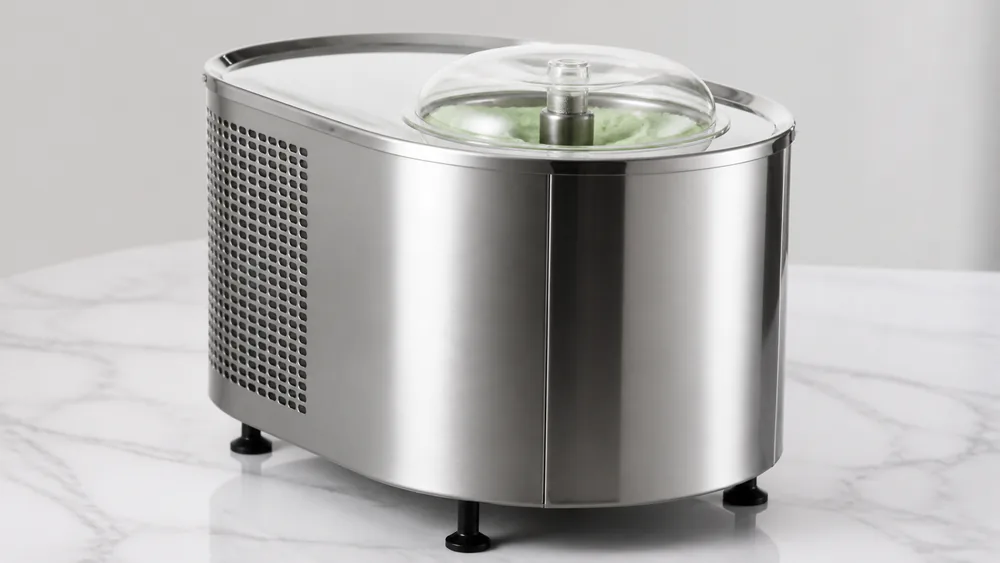
The Lello churned the smoothest gelato we tested.
Who Should Buy the Lello 4080
For the serious dessert maker who churns often and wants professional-grade texture. If the Lello 4080 Musso Lussino is in range, nothing else here matches it. Skip it if you want a removable bowl or a price under $500.
4. Whynter ICM-220SSY: Best for Ice Cream and Yogurt
The ICM-220SSY is our top pick's formula with one big addition: a yogurt function that genuinely incubates and chills. It heats to between 104F and 110F, and we got thick, tangy yogurt that rivaled store-bought Greek-style. As an ice cream maker it is slower, averaging 40 to 50 minutes per batch, and its Extended Cooling fades faster between batches. In use it can be noisy.
Pros
Dedicated yogurt mode incubates at 104F to 110F and chills in the same machine
2.1-quart capacity with a removable stainless bowl
Ice cream cooling down to -31F on a 180W draw
Cons
40 to 50 minutes per batch, slower than the ICM-201SB
Extended cooling fades faster between batches
Noisy in use, with residue around the paddle hub
The yogurt mode incubates and chills in the same bowl.
Who Should Buy the Whynter ICM-220SSY
The machine for households that want one appliance for ice cream and real fermented yogurt. If the Whynter ICM-220SSY matches your plan, it earns its place. Skip it if yogurt is not part of the plan.
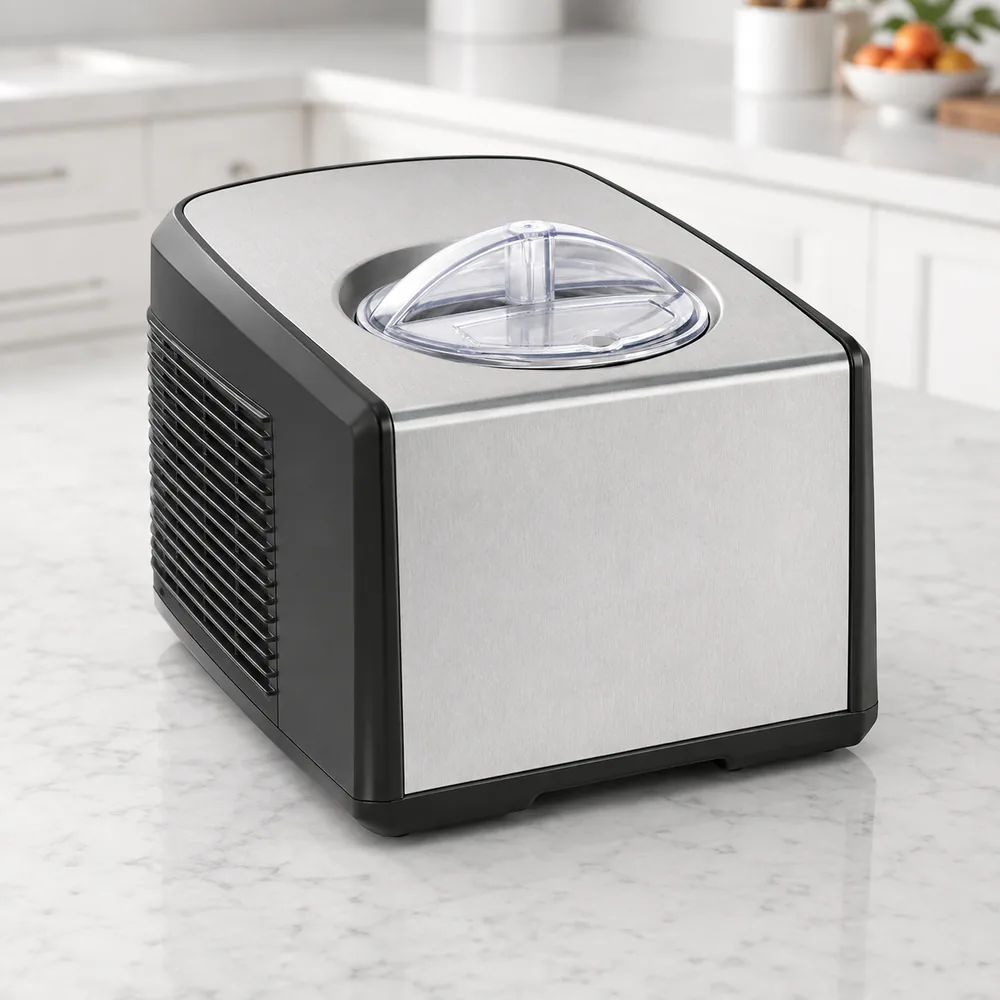
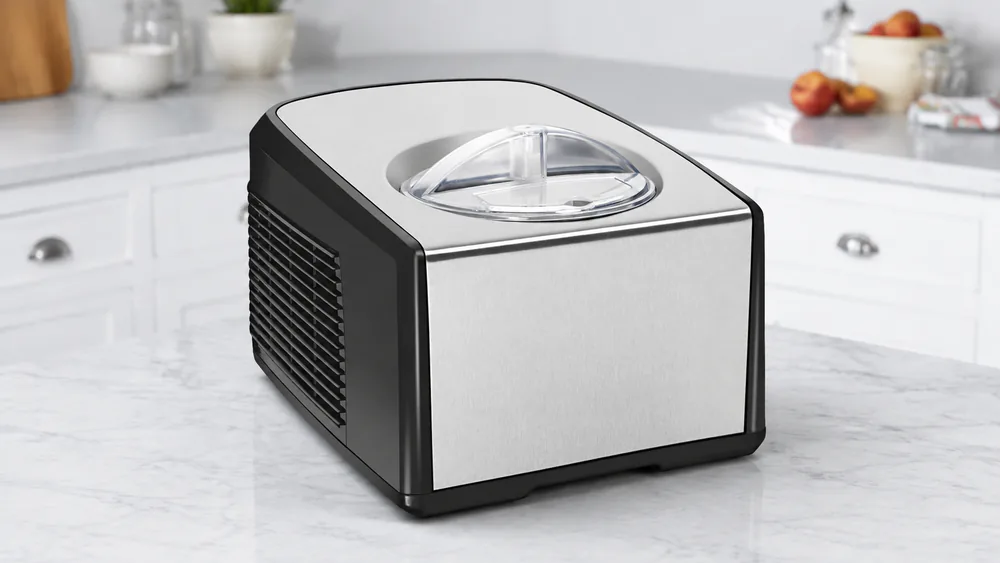
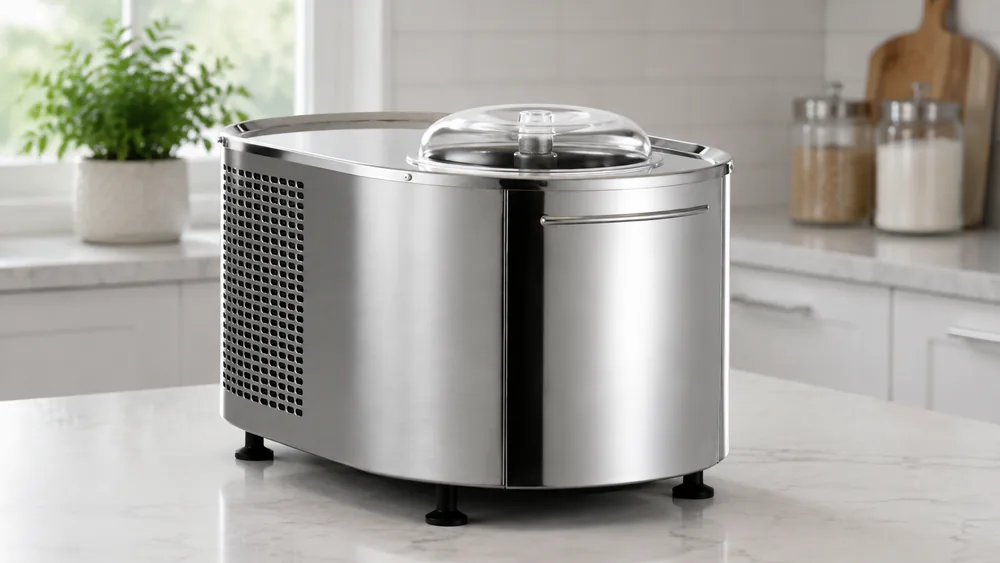
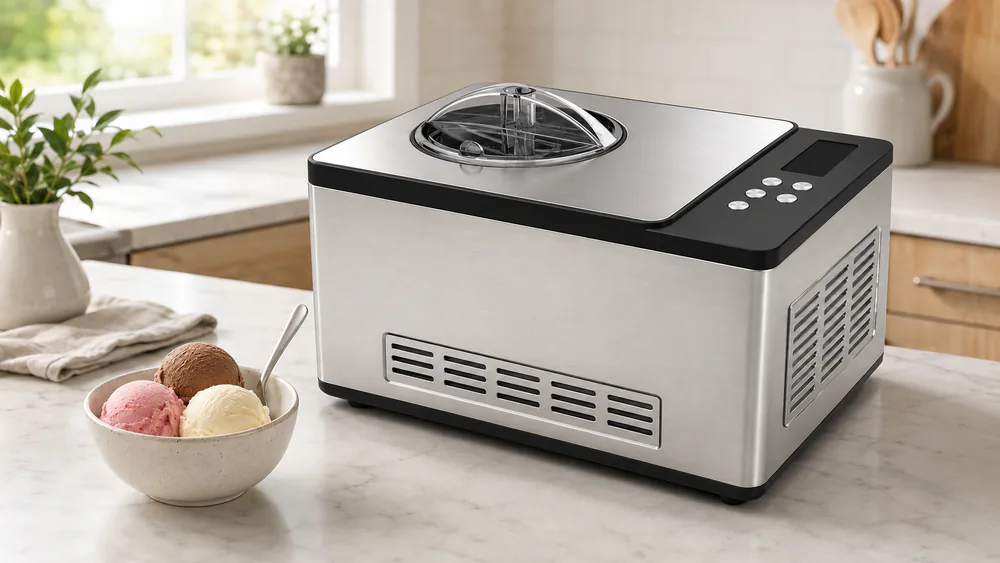
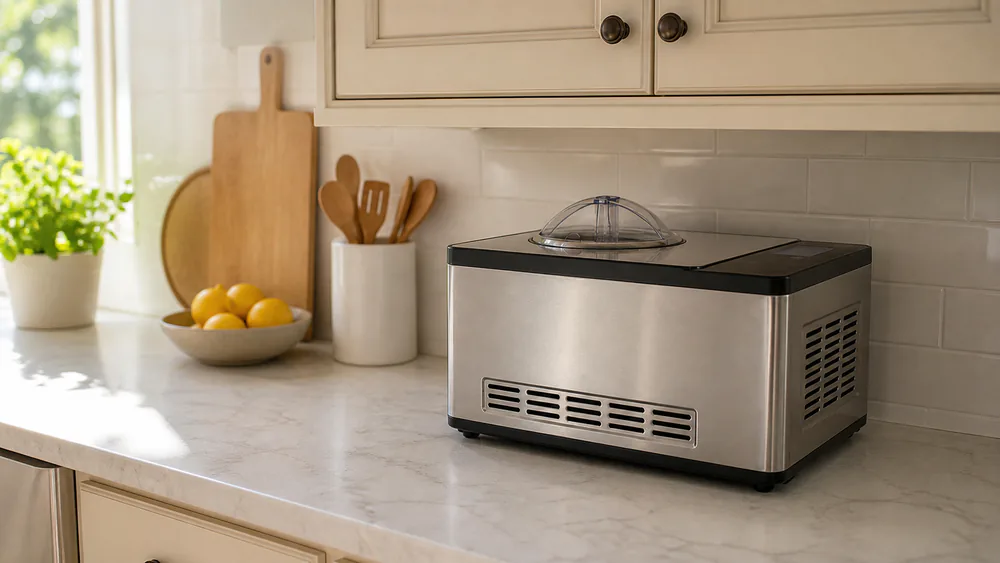
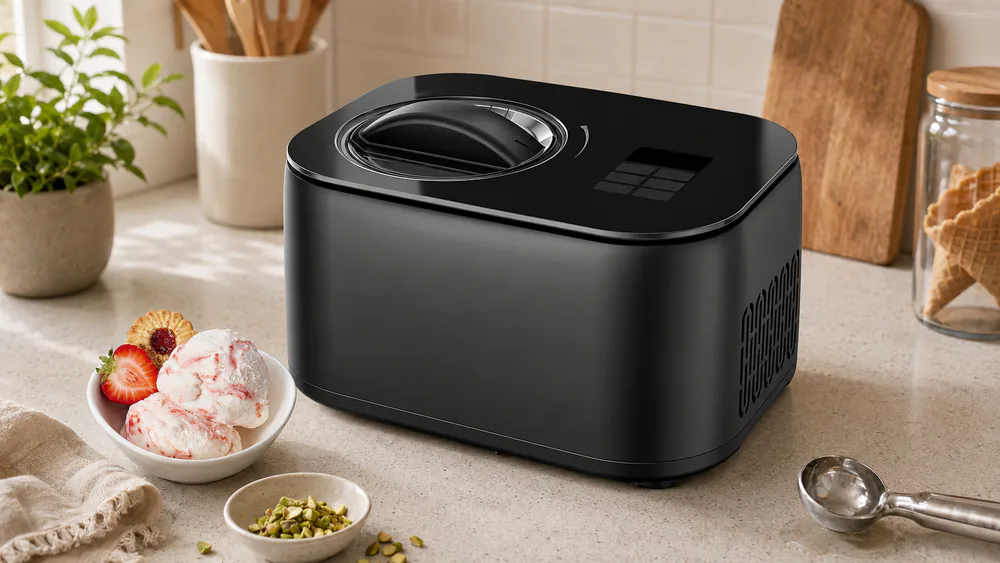
Where the ICM-201SB answers how well a machine churns, the ICM-200LS answers a different kitchen problem: where the machine lives. Its horizontal footprint runs about 16.75 inches wide and 10.25 inches tall, so it fits under low cabinets. Texture ranked excellent with minimal ice crystal formation, and stress tests never overheated the compressor. The cost of the layout is time: batches consistently ran 45 to 60 minutes, the slow side of the category.
Pros
Horizontal design fits under low cabinets
Excellent texture with minimal ice crystal formation
Back-to-back batches never overheated the compressor
Cons
45 to 60 minutes per batch, the slow side of the category
Paddle stalls on single-serving batches
Paddle nooks need a bottle brush to clean
The horizontal layout clears low cabinets.
Who Should Buy the Whynter ICM-200LS
Buy the Whynter ICM-200LS for a low-cabinet kitchen, or when you want to leave the machine on the counter. Skip it if you often churn a single pint or need speed.
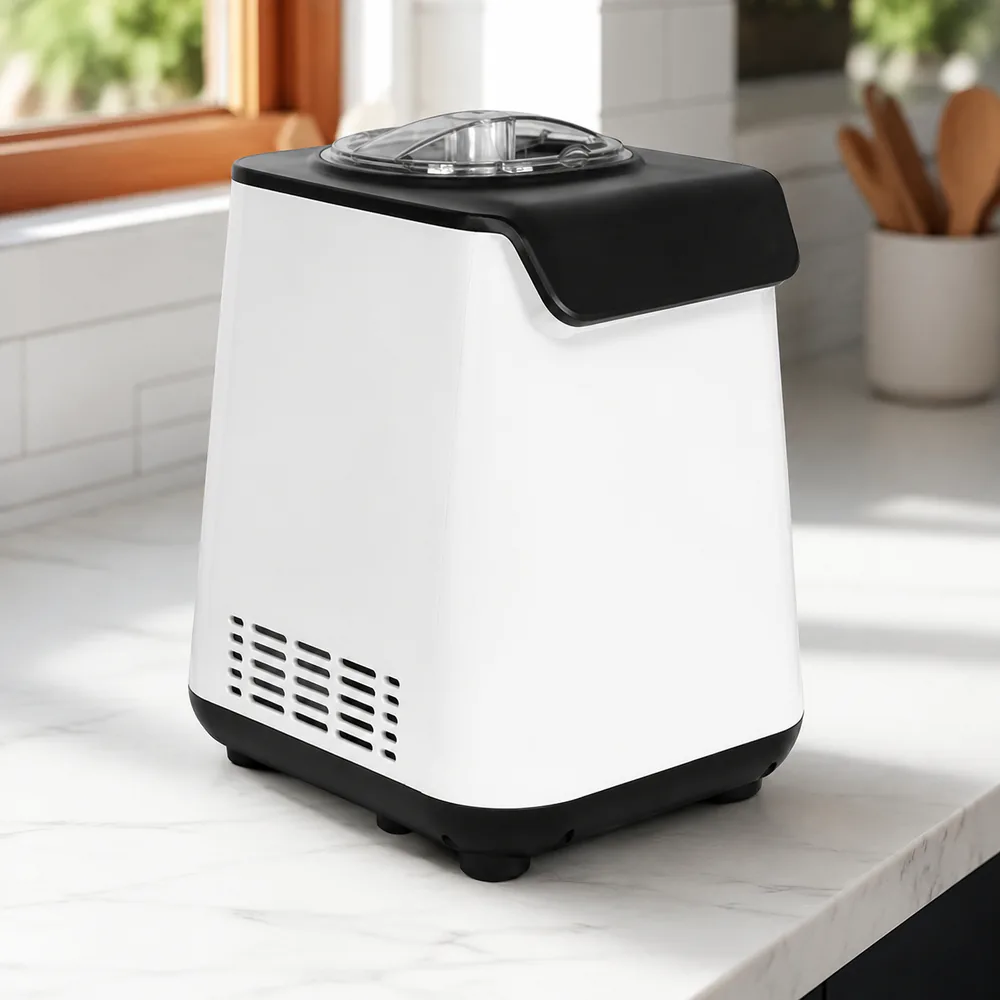
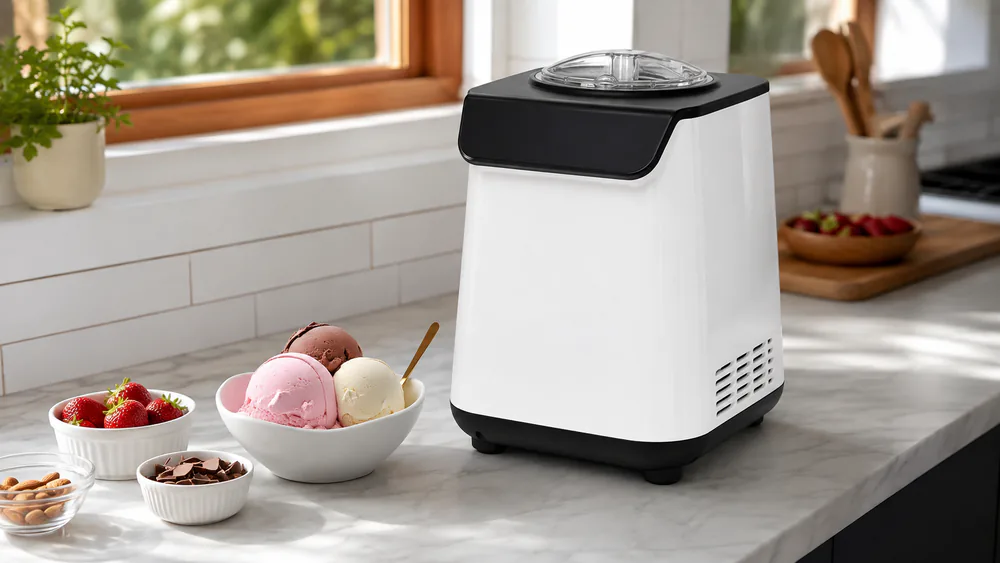
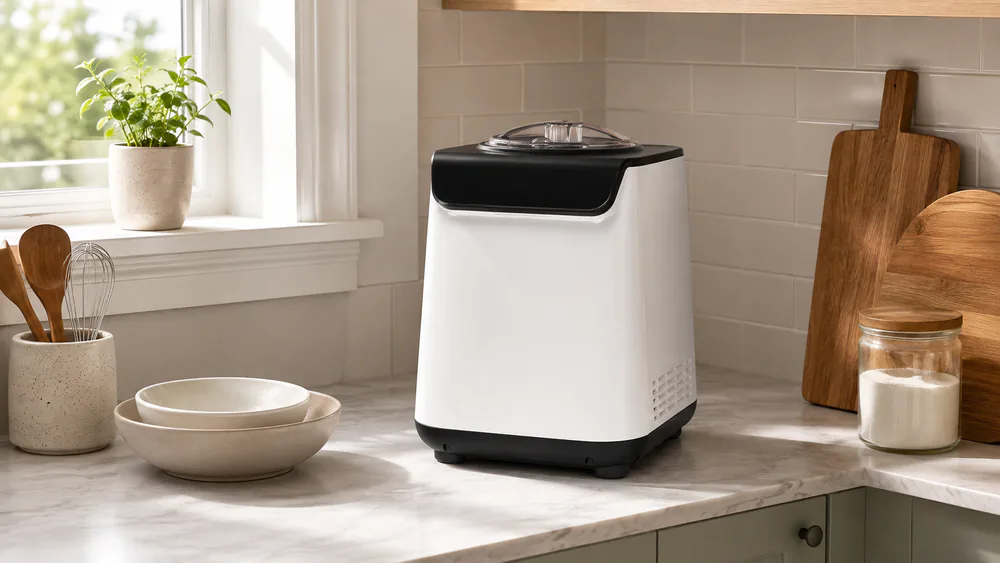
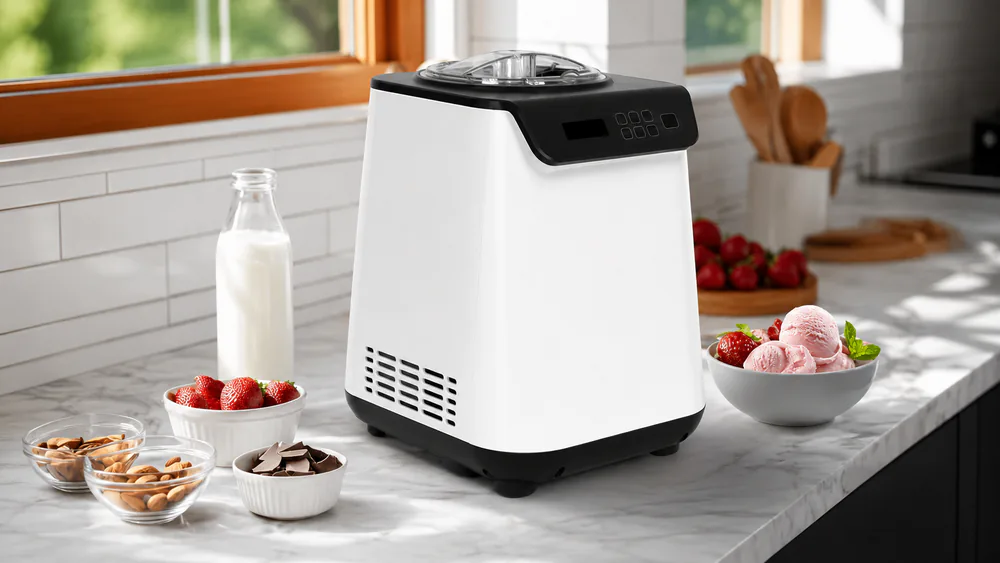
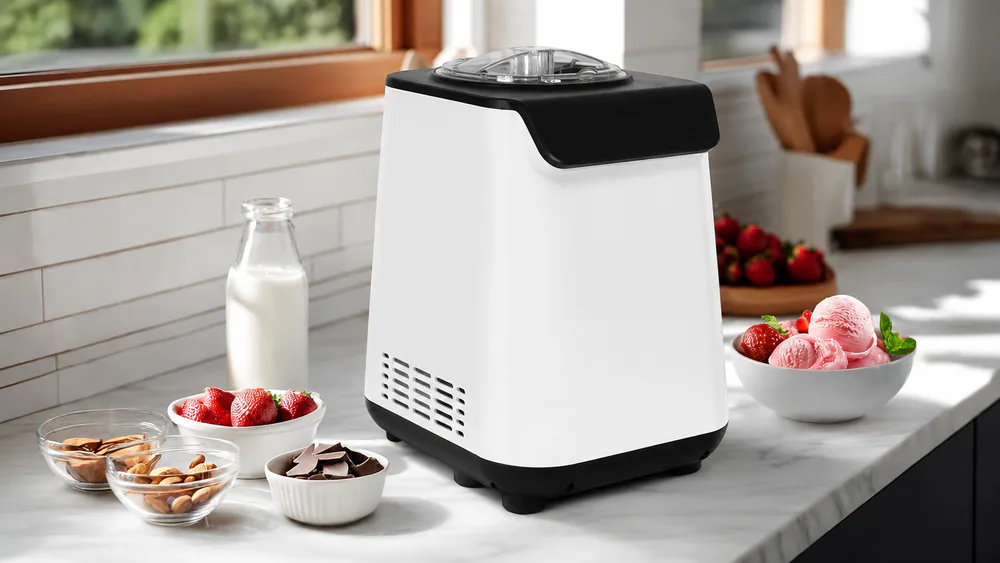
The ICM-128WS is the compressor machine for kitchens with no spare counter, and at about 19.25 lb it is the lightest Whynter compressor we have lifted. It often finished batches in 25 to 30 minutes, the fastest compact we tested, at around 60 dB. Rapid pre-chill lets you skip chilling a warm custard separately. Fill only to two-thirds, because the mixture climbs onto the lid underside.
Pros
25 to 30-minute batches, the fastest compact we tested
Lightest Whynter compressor at about 19.25 lb
Rapid pre-chill skips separate fridge chilling
Cons
1.28-quart capacity suits couples, not parties
Plastic body feels less premium
Fill only to two-thirds or the mixture climbs onto the lid
At about 19 lb it lives next to a coffee maker.
Who Should Buy the Whynter ICM-128WS
Buy the Whynter ICM-128WS for small kitchens and couples who want a true compressor without a permanent counter spot. Skip it if you routinely feed more than five people.
The Gasbye is the sleeper of this roundup. Its 250W compressor is the strongest in the group, and the vendor claims 35 to 40 minutes for standard ice cream, up to 40 percent faster than comparable machines, though real batches can run longer depending on the base, so treat the claim as a range. It carries 2-year quality coverage, though the paddles do not scrape the bowl edges on small batches. No street price was published for this model at the time of writing, so check the current price before you budget.
Pros
250W compressor, the strongest in the group
Up to 40 percent faster than comparable machines, per the vendor
2-year quality coverage, full refund or replacement
Cons
Paddles do not scrape the bowl edges on small batches
High-water recipes need dialing or they stay soupy
26 lb, wants a dedicated spot
A peach sorbet finished in about 20 minutes.
Who Should Buy the Gasbye ICE2037YJ
Buy the Gasbye ICE2037YJ for speed and sorbet, or when a strong warranty matters more than a famous name. Skip it if you churn small single-serving batches.
The COUPLUX is the biggest bowl in this roundup, and for party hosts that is the whole story. Its 2.64-quart bowl served 10 people with seconds at one long dinner, with chocolate ready in about 28 minutes. The 2-hour keep-cool window is genuinely useful for a long party, and our test unit ran at conversation level. The caveats: usable batches cap at about 32 oz, performance drops above 77F, and quality control is uneven.
Pros
2.64-quart bowl, the largest capacity tested
Chocolate finished in about 28 minutes
2-hour keep-cool window for long parties
Cons
Usable batches cap at about 32 oz
Performance drops above 77F
Uneven quality control between units
It served 10 people with seconds at one party test.
Who Should Buy the COUPLUX
Buy the COUPLUX 2.64 Qt for parties and big batches, when volume matters most. Check its current price before the party. Skip it if you live in a warm house without air conditioning or want a long warranty.
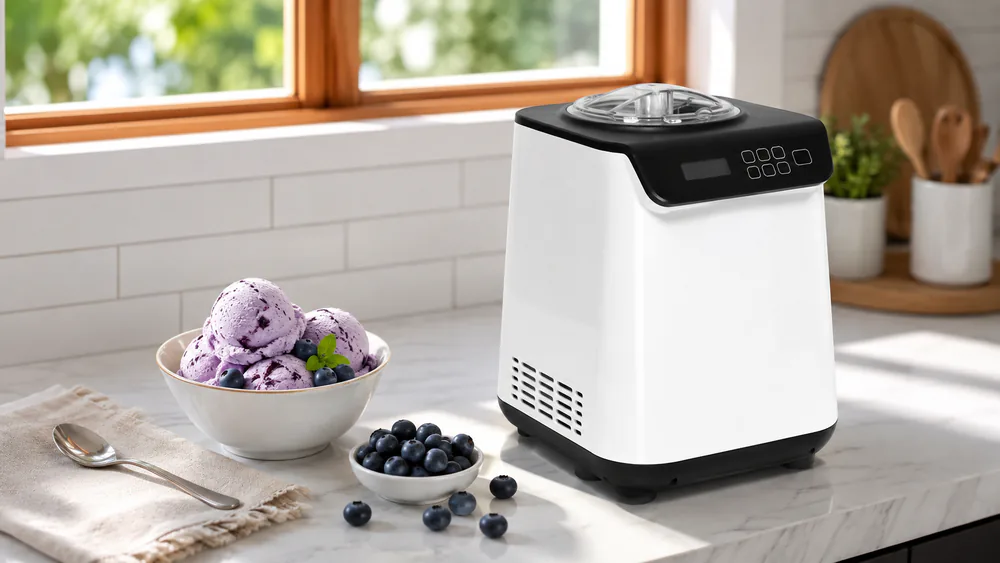
The VEVOR is the most honest bargain in this roundup, because it is a real compressor machine for about half the price of our top pick. When it works, it works fast: one blueberry batch with partially frozen fruit finished in 23 minutes. But it was the most variable performer we logged: about 70 dB measured, noticeably louder than mid-range machines, and quality control that shows up at the door. VEVOR's company-wide policy backs it with a standard 12-month manufacturer's warranty, free repair for manufacturing defects.
Pros
Real 180W compressor for about half the price of the top pick
Fast when it works: a 23-minute blueberry batch
2-quart capacity, about 15 scoops per batch
Cons
Loud in use, about 70 dB measured
Motor struggles with thick mixtures; coarser crystals
Uneven quality control, despite a 12-month warranty
A blueberry batch finished in 23 minutes.
Who Should Buy the VEVOR
Buy the VEVOR 2 Qt if a compressor machine is otherwise out of budget and you will check the unit carefully at the door. Skip it if noise matters or you want a longer warranty.
The Chefman Iceman is the smallest true compressor machine here and the only one that churns into dishwasher-safe inserts. Two 1-pint stainless inserts come in the box, and at about 16.3 lb it is the lightest unit we lifted. It produces a generous pint in about an hour, quiet enough to run while working in the kitchen. The durability record keeps it at 10th: a plastic paddle clip snapped on the third use, and one unit in our long-term pool died after four months.
Pros
Two dishwasher-safe pint inserts, two flavors back to back
Lightest unit at about 16.3 lb
Quiet enough to run while working in the kitchen
Cons
About an hour per pint, the slowest of the group
Plastic paddle clip and handle connections have broken in use
One unit in our long-term pool died after four months
The dishwasher-safe inserts make cleanup easy.
Who Should Buy the Chefman Iceman
Buy the Chefman Iceman for one- and two-person households that want a pint on demand. Skip it if you feed a family or expect years of weekly use.
Compressor Ice Cream Makers to Avoid (and Why)
Not everything labeled a compressor ice cream maker is one, and the impostors cost more in time than they save in money.
The classic fake is the freezer-bowl machine sold into "best compressor" lists, like the Cuisinart ICE-30. Its bowl must freeze for a full 24 hours before every batch, the exact planning a compressor machine removes. The Ninja CREAMi shaves a pre-frozen pint block rather than freezing and churning in one step. Neither belongs on a compressor list.
We also kept two cautionary tales out of the rankings. The Breville Smart Scoop was the slowest freezer we compared, with coarser, wetter results on weaker recipes. And the Knox Gear compressor stopped working after a few uses while the company left the category, leaving owners with a dead warranty. If a brand disappears, the machine's reliability is whatever the hardware alone can deliver.
Before you buy, confirm the machine has a built-in compressor, get the warranty terms in writing, and browse today's compressor listings to compare support policies.
How Compressor Ice Cream Makers Work
A compressor ice cream maker is a freezer and a churner in one box. A sealed refrigeration loop chills the bowl while a motor-driven dasher rotates through the mixture, scraping frozen product off the cold surface and folding air into it as it freezes. Because the freezing happens inside the machine, there is no pre-freezing and no rock salt, and a second batch can start the moment the first ends.
The temperature game is the interesting part. The Whynter machines we tested cool their bowls to about -31F, far colder than a home freezer, which is how a base freezes in under an hour. The dasher's speed and shape decide overrun, the air folded into the ice cream: our gelato paddle held about 19 percent air, the ice cream paddle about 39 percent.
Two behaviors carried across every machine we tested. Nothing comes off the churn truly scoop-hard, so budget an hour or two in the freezer before serving, and pre-chilling an empty bowl barely helps, because the cold mix brings the bowl temperature back up almost immediately. Most ice cream is cream, sugar, air, and temperature control, and a compressor machine automates the temperature part.
The dasher scrapes frozen mixture off the bowl walls while the compressor chills them.
Compressor vs Canister vs Freezer-Bowl Ice Cream Makers
Every ice cream machine falls into one of three families, and knowing the difference keeps you out of the impostor trap above.
Compressor machines freeze and churn in one step, with no pre-freezing, and they cost $180 to $800 or more. They also run quieter: measured noise across our group ran from about 60 dB up to about 71 dB, where typical canister machines sat closer to 80 dB. Their downside is price and weight, since the hardware is heavy.
Freezer-bowl machines freeze a sealed bowl in your freezer for a full 24 hours, then churn against the cold walls until the bowl warms. They cost a fraction of a compressor machine, and honest testing says they often make better ice cream than budget compressors. But every batch is hostage to the planning, and two flavors the same day need two bowls. Our Cuisinart ICE-200 review covers a well-built freezer-bowl machine.
Canister machines use ice and rock salt to freeze the bowl from the outside. They make excellent ice cream and cost little, but they are messy, loud, and slow.
If you churn a few times a year, a freezer-bowl machine is the rational buy. If you churn weekly, or whenever the craving strikes, a compressor machine pays for its price in convenience.
How to Choose a Compressor Ice Cream Maker (Buying Guide)
Here is what actually separated the machines we kept from the ones we did not.
Capacity and Batch Size
Compressors churn best filled to 60 to 70 percent of stated capacity, so a 2-quart machine realistically batches about 1.4 quarts. The COUPLUX's 2.64-quart bowl caps usable batches at about 32 oz, so the listing number is never the whole story. Couples can stop at 1.28 quarts, and families should start at 2.
A 2.1-quart batch serves 8 to 10 people.
Freezing Speed and Power
Batch times ran from 15 to 30 minutes on the Lello to 45 to 60 minutes on the VEVOR and ICM-200LS. Base temperature is the biggest lever: the ICM-201SB took about 40 minutes from room-temperature ingredients and about 30 minutes pre-chilled. Wattage is a rough proxy for freezing muscle, from 100W to 250W across the group.
Compressor Build and Dasher Design
The compressor can last a decade, and the dasher decides texture. The Lello's steel dasher keeps churning firm mix at 14F, where the Gasbye's paddles stop scraping the bowl edges. Motor protection matters too: our ICM-201SB paused itself on an extra-rich custard and resumed when the load lightened. Prefer a removable stainless bowl, with the Lello as the exception, since its fixed bowl cleans in about five minutes.
Noise Level
Most compressor machines run at conversation level, though the spread within the group is real. The COUPLUX advertises 50 dB, but units vary, so treat any single figure as a guide.
Cleaning and Maintenance
Dasher crevices hide mix: the ICM-201SB's paddle needs real attention, and the ICM-200LS's nooks want a bottle brush. The Chefman's inserts are dishwasher safe, the only top-rack parts in this roundup, and the Lello's fixed bowl cleans by melting, about five minutes total.
Warranty and Reliability
Warranty length is the fastest reliability signal a shopper can read. The Cuisinart ICE-100 leads with 3 years, the Gasbye follows with 2 years of seller coverage, and most Whynter models carry a 1-year limited warranty, spelled out on the manufacturer's compressor machine pages. The VEVOR carries a standard 12-month warranty under VEVOR's company-wide policy, with free repair for manufacturing defects and a 30-day return window.
Value for Money
A $200 machine and an $800 machine both make ice cream, and the gap is refinement, not function. The VEVOR delivers genuine compressor convenience for about half the price of the Whynter ICM-201SB, with real trade-offs in noise and consistency. The ICM-128WS hits the sweet spot for couples at about $200. Work backward from how often you churn, not from the sticker price.
FAQ
Are compressor ice cream makers worth the extra cost?
In dollar terms, yes, for regular churners. You pay $180 to $800 up front for hardware built to churn for years, and every batch is consistent: the compressor delivers full freezing power each time. That consistency is the quiet advantage no freezer-bowl machine can match. For a couple of batches a summer, save your money.
Do compressor ice cream makers require pre-freezing?
No. The built-in compressor chills the bowl while the dasher churns, so you can go from base to finished batch in under an hour with zero overnight prep. Pre-chilling the empty bowl barely helps, since the cold mix rewarms the bowl.
How long does it take to make ice cream in a compressor machine?
In our testing, roughly 15 minutes to an hour, depending on the machine and the base. The Lello finished fastest at 15 to 30 minutes, most Whynter models landed in the 25 to 45-minute range, and the Chefman took about an hour per pint.
Can you make gelato and sorbet in a compressor ice cream maker?
Yes, on both counts. Gelato needs a slow, low-overrun churn and sorbet needs fast freezing, and every machine here handled both styles in our testing, plus frozen yogurt. The Cuisinart ICE-100 ships a dedicated gelato paddle for the denser style, and sorbets came out clean on every machine once the recipes were dialed in. Watch high-water sorbet bases on the Gasbye, which stay soupy without adjustment.
How loud are compressor ice cream makers?
Most run at conversation level. The quietest machines we measured sat around 60 to 71 dB, and typical canister machines ran closer to 80 dB. None will drown out a conversation.
How easy is it to clean a compressor ice cream maker?
Easier than the ice-and-salt method, and that is the real point: no rock salt to sweep up, no brine bucket to drain. Plan on hand washing, and rinse the bowl and dasher right after churning, because dried mix in the crevices is the only cleanup that takes real time.
Final Thoughts: Which Compressor Ice Cream Maker Should You Buy?
Three months and more than 200 batches later, the decision comes down to how you churn. If your budget stops around $200, the Whynter ICM-128WS delivers true compressor convenience with a far better track record than the VEVOR, which is a gamble worth taking only with your eyes open. Gelato lovers should start at the Cuisinart ICE-100 and its 3-year warranty, and if texture is the whole point, the Lello 4080 stands alone. Churn rarely, and the freezer-bowl machine is the honest answer.
Key takeaway. The Whynter ICM-201SB is our top pick because it balances speed, texture, and reliability better than any other machine we tested, and the ICM-128WS delivers most of that experience for about $200.