As an Amazon Associate we earn from qualifying purchases. We may earn a commission from links on this page, at no extra cost to you. Learn more.
Every machine here grinds its own beans, and the real choice is how much of the process you want to control. We sorted each one by that question: hands-on portafilter, assisted portafilter, or one-touch fully automatic. We judged how the grinder is adjusted, how the milk gets made, and how much cleanup each routine leaves behind.
If you want the wider field, our espresso machine reviews cover machines with and without built-in grinders. This roundup covers only integrated-grinder machines, and we ranked them by the job each one does best rather than by a single score.
How We Tested These Espresso Machines With Grinders
We judged these as daily-routine appliances rather than showpieces. The questions were the same for every pick. How easy is the grinder to adjust? How repeatable is the dose? How good is the milk? How much work does cleanup take once the novelty wears off?
Hands-on and assisted portafilter machines were judged on how forgiving the dose and puck preparation are. Fully automatic machines were judged on drink variety, milk-system cleaning and how much attention a rushed morning demanded. We read each model against its own manual for cleaning and descaling prompts, because the routines differ more than the marketing suggests.
Awards here are editorial category picks. They reflect which machine best fits a particular routine, not a single scored winner for every kitchen. The star ratings on each review express how well the machine does the job it is awarded for.
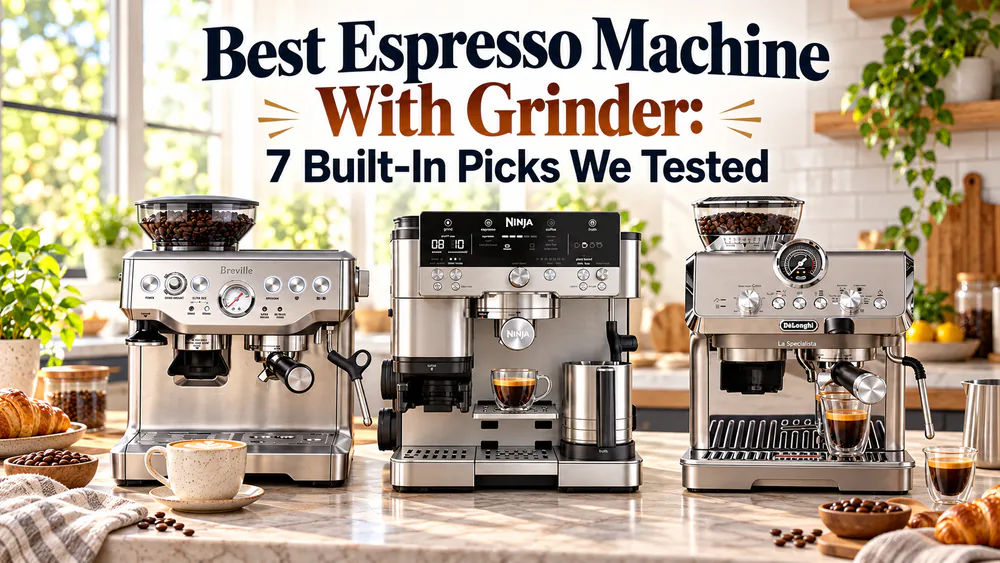
Seven espresso machines with built-in grinders, side by side.
Best espresso machines with grinders at a glance
The table below sorts the seven picks by workflow, milk method and the main compromise. We left out dimensions wherever published figures disagreed on orientation, because a wrong width is worse than a blank cell.
The Ninja was the machine we would hand to a mixed household. The guided dose and grind process is approachable without constant manual checking, and the supplied funnel and tamper produce a flat puck with little mess. The espresso has a rich taste and a substantial crema layer, and the drink menu covers coffee, cold brew and milk drinks too.
Weight-based dosing with grind recommendations
Separate grinding and brewing stations
4 milk presets, hot and cold
Built-in accessory storage
Specifications
Grinder
25 grind settings
Power
1650W
Water tank
70 oz
Warranty
1-year limited
Why it earns this pick
Drink variety is the strong point. Coffee and cold brew sizes run from 6 to 18 oz, and there are 4 milk presets: steamed milk, thin froth, thick froth and cold foam. Dairy and plant-milk choices are both covered, so one machine serves the espresso drinker and the person who wants a tall iced coffee. For a household where tastes differ, that range is worth more than any single spec.
The workflow is the other reason. Weight-based dosing tells you what to grind, and the manual assisted tamp keeps you involved without demanding a perfect technique. Grinding and brewing happen at separate stations, which keeps the process tidy. The built-in accessory storage keeps baskets and tools from spreading across the counter, and the hopper lifts out, which makes emptying beans or switching roasts simple. The body feels sturdy, and the setup instructions make the first morning approachable.
Tradeoffs and who should skip it
The body is bulky and heavy to move around a small counter. Published dimensions vary between color pages, so allow extra refill clearance and check your cabinet before you buy. There is also no dedicated hot-water outlet, which adds a separate step for an Americano or tea.
If your counter is tight, look at the Philips pick below. If you want to learn manual milk steaming, the Breville Barista Pro gives you a real wand and more room to grow. The Ninja is the best fit for people who want variety and consistency more than a craft hobby. Return terms depend on the product and purchase channel, so confirm them when you order. We would hand it to a kitchen that shares one machine among several people.
2. Breville Barista Express BES870XL: Best budget pick
The Barista Express is the classic way into real espresso. Careful dialing in rewards you with sweet espresso and dense crema, but manual grinding, tamping and steaming add up to a substantial learning curve. It is the budget pick for people who want a proper portafilter machine, not the cheapest machine here.
Conical burr grinder with manual tamp
Pressure gauge and programmable shot volume
Manual steam wand and hot-water outlet
Removable tank and drip tray
Specifications
Grinder
16 grind settings
Portafilter
54mm
Power
1600W
Warranty
1-year limited
What you get for the price
You get a conical burr grinder, a 54mm portafilter with single and double baskets, and both single-wall and dual-wall options. A pressure gauge, PID-controlled Thermocoil heating, pre-infusion and programmable shot volume round it out. The manual steam wand and hot-water outlet mean you can make Americanos and milk drinks without extra gear.
Day to day, the removable drip tray and hidden tool compartment simplify routine cleanup. The tank is nominally 67 oz, though the measured fill differs from that number, and the machine gives no low-water warning. You need to glance at the tank before a morning round of drinks.
Compromises to consider
Setup can splash water on the surrounding counter during the initial flush. The stainless finish shows fingerprints and loose grounds readily. Milk and coffee residue also collect around the wand tip and under the filter basket if you skip those crevices, so a quick wipe after every session pays off.
Gaskets and seals are wear items on any machine like this. Leaking or unusually loud buzzing deserves inspection rather than being accepted as normal operation. Compared with the Barista Express Impress, you give up dose feedback and the assisted tamp, which is the main reason a beginner might spend more. If you enjoy the process and expect to practice, this is the value choice.
3. Breville Barista Express Impress BES876: Best for beginners
Where the Barista Express leaves dosing to you, the Impress removes the most common beginner error, uneven puck preparation. Dose-level feedback makes it easy to see when the basket needs more coffee, and the tamp lever reduces one variable. Milk steaming still needs technique, so this is a gentler start, not a push-button machine.
Intelligent dosing with next-dose correction
Assisted tamp lever with dose-level feedback
Pressure gauge and manual steam wand
Clear labels on the front panel
Specifications
Portafilter
54mm
Power
1750W
Water tank
2L
Warranty
2-year limited
How it guides grinding, dosing and brewing
The grinder sets the dose for you and corrects the next one if the basket came up short. The pressure gauge shows whether your grind is in range, and the assisted tamp lever finishes the puck. The front panel is busy, but clear labels make it less intimidating than it looks. The tank and main body feel substantial rather than flimsy.
The model specification lists 25 grind settings, and you should use that figure if you see a conflicting summary elsewhere. The 54mm portafilter takes single and double baskets in single-wall and dual-wall styles, the same options as the Barista Express.
What you still need to do yourself
Milk is manual. The tamp lever helps with the puck, but silky foam still takes practice at the wand. The tall body can make hopper access awkward beneath cabinets, so measure overhead before you commit.
Dosing can also stumble. Beans can bridge in the hopper and interrupt dosing, and after a feed interruption the automatic adjustment can need several brews to settle again. Stirring the hopper if it stops feeding is a reasonable habit. Keep an eye on the tank too, since it needs deliberate checks to avoid running empty.
A premium alternative in this family is the Barista Touch Impress. It adds guided grind setup, queued milk and an automatic milk system, while still being a portafilter workflow that makes you move the handle between grinding, brewing and steaming. We did not rank it because we could not verify an exact buy listing for the current edition.
4. Breville Barista Pro BES878: Best for hands-on espresso
Where the Impress assists the tamp, the Barista Pro is the machine for people who want to see and shape the shot. The display makes grind adjustments visible while dialing in, and the shot timer gives useful feedback for successive shots. Fast warm-up and strong milk frothing keep the daily routine responsive.
30 grind settings with timed dosing
LCD with shot timer
ThermoJet heater, ready in about 3 seconds
Manual wand for silky milk once learned
Specifications
Grinder
30 grind settings
Portafilter
54mm
Power
1680W
Water tank
67 oz
Warranty
2-year limited
Grinder adjustment and brewing control
With 30 grind settings, the Pro lets you move in finer steps than the Barista Express. That matters when a new bag of beans needs a small correction. The ThermoJet heater reaches extraction temperature in 3 seconds, though that is heater readiness, not a finished drink. The 54mm portafilter takes single and double baskets in single-wall and dual-wall styles.
There is no pressure gauge, so the timer and the taste in the cup are your feedback. Good espresso still depends on learning to dial in the beans, and no screen can do that for you.
Learning curve and daily workflow
The LCD takes some initial learning despite its straightforward controls. After that, the routine is fast. The manual wand can make silky milk once the technique is learned, and the drip tray is easy to remove and wash.
The wide body requires a dedicated stretch of countertop. Nothing is automatic here: grinding, tamping and steaming are all yours. If you want the assist, step down to the Impress. If you want the manual control and quicker heat, the Pro is the sweet spot of this lineup.
5. De'Longhi Magnifica Evo ECAM29084SB: Best for easy milk drinks
Stepping away from portafilters, the Magnifica Evo is the easiest route to a milk drink in this roundup. The simple setup and direct drink buttons suit a rushed morning, and the automatic milk system makes light, airy foam without a scorched taste. It cannot match a skilled hand on a steam wand, but it is far less work.
7 recipes on direct buttons
LatteCrema removable milk carafe
Pre-ground bypass and removable brew unit
Automatic rinse and milk-clean prompts
Specifications
Grinder
13 grind settings
Dimensions
9.45 W x 17.32 D x 14.17 H in
Water tank
60 oz
Bean hopper
8.8 oz
Power
1250W
Warranty
2-year US
Milk preparation and drink options
There are 7 recipes, including espresso, coffee, over ice, cappuccino, latte macchiato, hot water and My Latte. My Latte is useful for changing the coffee-to-milk balance by varying the milk added, and the carafe markings simplify measuring milk for a drink. The internal dosing and tamping are automatic, and strength and length can be adjusted from the controls.
The 13 grind settings are fewer than on the portafilter machines, but that matters less when the machine controls the dose and tamp for you. The 8.8 oz hopper is small, so expect to top it up often in a busy house.
Milk-system cleaning and limitations
The post-drink milk-clean reminder makes the rinse hard to overlook. Rinsing the carafe after use does not replace taking apart and washing the milk-contact parts, so plan a few minutes for that every day you use milk.
The automatic milk texture does not offer the same finesse as a skilled manual steam wand. If microfoam art matters to you, pick the Barista Pro. The 2-year US warranty gains an extra year through qualifying product registration. Keep this machine separate in your mind from the La Specialista Arte Evo, which is a manual portafilter machine from the same brand and a very different daily routine.
6. Philips 3300 LatteGo EP3347/90: Best for small kitchens
Where the Magnifica Evo takes more counter, the Philips earns its place with a slim body and easy cleanup. The narrow footprint helps on a crowded counter, though the hopper still needs clearance overhead. The milk carafe clips on easily and is quick to rinse, and operation is relatively subdued compared with older machines in the same family.
Ceramic burr grinder with 12 settings
Tube-free two-piece LatteGo milk system
Front-access tank and grounds container
Removable brew group
Specifications
Dimensions
246 W x 433 D x 371 H mm
Water tank
1.8L
Bean capacity
275g
Drinks
6 selections
Warranty
2-year
Footprint and access to beans and water
At 246 mm wide, about 9.7 inches, this is a slim machine, though we do not claim it is the narrowest on the market. The tank and grounds container are front-access, so you do not need to pull the machine out to service it. The 1.8L tank and 275g hopper are modest, which suits one or two drinkers.
Allow room above the machine to open the hopper lid. A shallow cabinet is the usual problem, and it is worth measuring before the box arrives.
Capacity and workflow tradeoffs
The 6 selections are espresso, coffee, iced coffee, cappuccino, latte macchiato and hot water. The foam suits cappuccino better than a low-foam flat white. The iced-coffee program can taste less lively than expected, and the first brews can be watery before the machine settles into consistent extraction.
There are no saved user profiles, so shared users must adjust preferences themselves. Removable milk parts and the drip tray make cleanup straightforward, though the flashing-light instructions for descaling take more interpretation than a text screen. AquaClean filters can extend descaling intervals, and the machine has a removable brew group for service access. It also comes with a 2-year warranty on new goods bought through an authorized US dealer.
Where the Philips keeps things slim and simple, the Jura is the splurge pick, and it is built for repeat drinks without effort. The drink controls are clear even though the screen is not touch-operated, and the milk-drink outlet dispenses coffee and foam into the same cup without repositioning. A ground-coffee bypass makes occasional decaf simpler than emptying the hopper.
17 drink options on a 3.5-inch display
Milk hose with integrated cleaning programs
Ground-coffee bypass
CLEARYL Smart+ filter recognition
Specifications
Dimensions
11 W x 17.6 D x 13.8 H in
Water tank
64 oz
Bean capacity
280g
Power
1450W
Warranty
2 years or 6,000 brewings
What the upgrade adds
You get 17 drink options, programmable drinks, the Pulse Extraction Process and P.A.G.2 grinding. The 3.5-inch display uses physical buttons, not a touchscreen. Integrated cleaning and descaling programs, a monitored drip tray and filter recognition handle much of the upkeep. This 15646 is the 2023 model generation, so do not assume later E8 features apply to it.
Repeated coffees are convenient, since the machine works through back-to-back drinks without attention. Compared with the Magnifica, you get a larger menu, programmable drinks and a service network. You also give up the Magnifica's simplicity.
Ongoing costs and limitations
The drip tray needs frequent emptying, and the milk hose adds a cleaning task after milk drinks. Jura says to clean the milk system each day milk is used, with the specified milk cleaner and machine cleaning tablets. The automated programs still need supplies and your preparation, so budget for those as a running cost.
Automatic milk foam offers less fine texture control than a manual steam wand. The US limited warranty covers 2 years or 6,000 coffee brewings, whichever comes first, and includes parts, labor and ground transport to and from repair facilities within the continental US, subject to conditions. Care relies on internal cleaning programs and authorized servicing rather than a consumer-removable brew unit.
The milk-drink outlet fills the cup without repositioning.
Semi-automatic or fully automatic: which suits your routine?
The split comes down to what you enjoy. If the ritual is the point, a portafilter machine rewards you. If the goal is coffee in the cup with minimal effort, a super-automatic does the job. Neither is created equal for every kitchen, and the honest answer depends on who is making the drinks at seven in the morning.
Criterion
Hands-on or assisted portafilter
Fully automatic
Your role
Dose, tamp and often steam
Pick a drink and press
Milk
Manual wand or automatic system
Carafe or hose
Grinder control
16 to 30 settings
12 to 13 settings on the models here
Learning curve
Steeper
Gentle
Hands-on brewing and assisted portafilter machines
The Barista Express, Impress, Pro and the Ninja belong here. You control the grind, the dose feedback and the puck, so the result improves as your technique does. Expect a learning curve of some weeks before the cup is consistent, and expect the occasional bad shot along the way.
The cost is time. Dialing in each new bag, wiping the wand and rinsing baskets are all part of the routine. The reward is better control over strength, temperature and milk texture, and for many people the ritual is half the appeal.
One-touch brewing with a super-automatic machine
The Magnifica, Philips and Jura grind, dose, tamp and brew internally. A ground-coffee bypass handles decaf. The tradeoff is less control over milk texture and a cleaning routine built around carafes, hoses and internal programs. Do not assume their pressure-brewed coffee matches paper-filtered drip.
For a household where several people want different drinks at different times, this is the lower-friction choice. The machine does the same thing every time, and the only skill you need is knowing which button to press.
How to choose an espresso machine with a built-in grinder
Start with the routine you actually have on a Tuesday morning, not the one you imagine on a weekend. Then match the grinder, the milk method and the counter to it.
Grinder adjustment, dosing and bean switching
Grind setting count is not a quality score. Bean freshness, roast, dose and extraction still determine the useful setting, and automatic dose guidance does not remove the need to taste and adjust. More settings give finer steps, which helps hands-on cooks. Fewer settings are fine when the machine handles dose and tamp.
Bean switching depends on the hopper. The Ninja hopper lifts out. The De'Longhi La Specialista Arte Evo, an unranked alternative, has a fixed hopper that makes switching beans inconvenient, and its grinder is not readily removable for routine burr cleaning. Its US model also has just 8 grind settings, and the grinder and brewing cycle are clearly audible rather than discreet.
Pros
One footprint instead of two machines
Grinding and brewing are set up to work together
Fewer parts to store and wipe down
Cons
A separate grinder can be upgraded or serviced independently
A grinder fault can sideline the whole machine
Fixed hoppers make frequent bean switching harder
Milk frothing and the drinks you make
Manual wands give the most control, but you must learn them. The Barista Pro can make silky milk once you learn the technique. Automatic systems trade finesse for ease. The Magnifica makes light foam, the Philips favors cappuccino, and the Jura offers less texture control than a wand.
If you drink mostly straight espresso or Americanos, milk matters less and the grinder and portafilter should drive your choice. If lattes are the daily order, put the milk system first.
Heating and back-to-back milk drinks
The Barista Pro heater reaches extraction temperature in 3 seconds, which is heater readiness, not a finished drink. Portafilter machines brew and steam in sequence, so a second milk drink takes extra minutes. Fully automatic machines handle repeat drinks more smoothly, since they move from one cup to the next without handle changes.
Counter space, access and capacity
Measure width, depth and the clearance above the hopper and tank. The Impress and Philips need overhead room, the Pro needs a wide stretch of counter, and the Ninja is bulky. A 1.7L to 2L tank suits a household of one or two, and a larger one saves refills for a family.
Think about where you will fill the tank. A front-access tank is easy; a rear tank means pulling the machine forward every time.
Cleaning costs, warranty and service options
The warranties in this lineup run 1 to 2 years. The Express and Ninja carry a 1-year warranty, the Impress, Pro and Philips 2 years, and the Jura 2 years or 6,000 brewings. The Philips and Magnifica have removable brew groups, while the Jura relies on internal programs and authorized service. A removable part does not guarantee a longer life or a lower repair cost.
Warning. Do not put ground coffee in a bean hopper. Use the bypass chute on a fully automatic machine, or the pre-ground basket on a Breville portafilter machine.
Cleaning and maintaining the machine and grinder
Coffee-oil cleaning, descaling and milk cleaning are three different jobs. Follow your model's own prompts and do not transfer a tablet or backflush routine between unrelated designs.
Daily care for milk parts and coffee residue
Wipe and purge manual wands right after steaming, because milk dries onto them quickly. Rinse portafilter baskets, empty the drip tray and grounds bin, and wash carafe or hose parts that touch milk. On the Magnifica, rinsing the carafe is not enough. On the Jura, clean the milk system every day you use milk.
Rinsing is not cleaning: any part that touches milk needs to come apart and be washed.
Grinder cleaning and descaling for your model
Some grinders are not designed for routine burr cleaning, so check whether yours is removable before you plan to brush it out. Use the model's descaling prompt, and use AquaClean or CLEARYL filters where the machine supports them. The Philips flashing-light sequence takes more interpretation, so keep the manual nearby.
Grounds and loose beans collect around any integrated grinder. A soft brush and a quick wipe each week keeps the work area tidy. Treat leaking or unusually loud buzzing as a reason to stop and inspect rather than carry on.
Rinsing the basket and wiping the wand takes a minute and prevents buildup.
Frequently asked questions
Is a built-in grinder worth it compared with a separate grinder?
For most home cooks, yes. One machine saves counter space and keeps grinding and brewing in one workflow. A separate grinder can be upgraded or serviced independently, so it suits people who want to tinker. An integrated design is not automatically cheaper to repair.
Can an espresso machine with a grinder make regular coffee?
Some can. The Ninja has coffee recipes distinct from espresso, including classic, rich and over-ice. The Magnifica, Philips and Jura offer coffee selections, but their pressure-brewed coffee is not identical to paper-filtered drip. Breville portafilter machines make espresso that you can dilute with hot water.
How many grind settings do you need?
Fewer than you think. Our picks range from 8 to 30. More steps help when you are dialing in manually, but bean freshness, roast and dose matter more than the count.
Can you use pre-ground coffee or switch to decaf?
Yes on most. The Magnifica, Philips and Jura have a ground-coffee bypass. Breville baskets accept pre-ground coffee in manual dose mode. Never put grounds in the hopper. We did not verify a pre-ground procedure for the Ninja, so check its manual.
Final verdict: choose the machine that fits your routine
Buy the Ninja Luxe Cafe Premier ES601 if you want one machine to handle espresso, coffee and milk drinks with guided dosing. Choose the Barista Express Impress if you want to learn espresso, the Barista Pro if you already enjoy tinkering, the Magnifica or Philips for push-button milk drinks, and the Jura if you will accept consumables for a broad one-touch menu.