As an Amazon Associate we earn from qualifying purchases. We may earn a commission from links on this page, at no extra cost to you. Learn more.
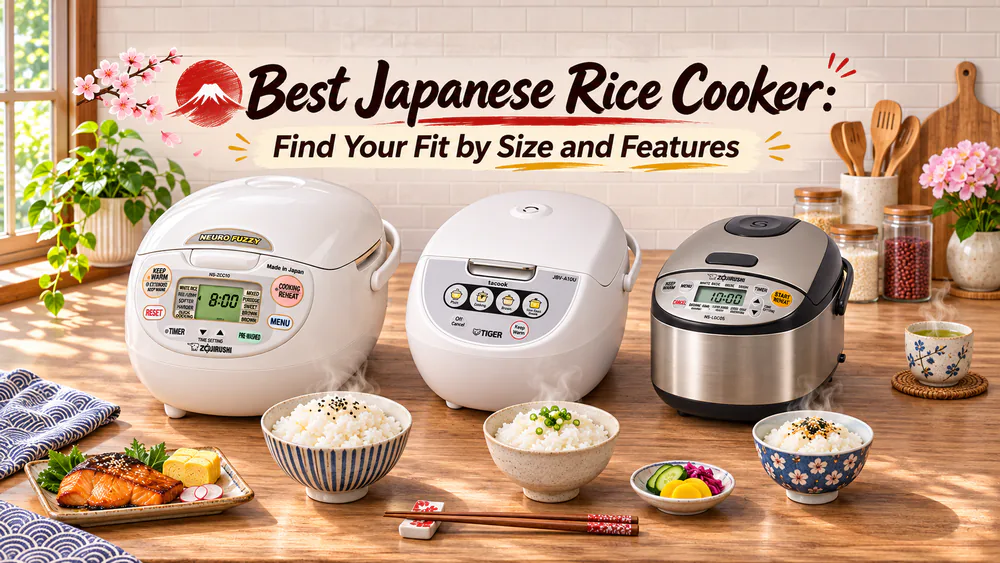
In a family kitchen, a rice cooker has to turn out the same pot of rice every time, wipe clean fast, and survive a week of rushed dinners. We rated five Japanese-brand cookers against that routine, weighing rice texture, keep-warm behavior, cleanup, capacity, and how easy the controls are for a busy household. Our lead pick is the Zojirushi NS-ZCC10 Neuro Fuzzy, because it cooked evenly and cleaned up without fuss.
"Japanese rice cooker" can mean three different things, and the difference matters when you shop. A Japanese brand describes the maker, "made in Japan" describes where the unit was built, and "Japanese-style" on its own tells you neither. Two of our five picks are built in Japan. The other three come from Japanese brands but are made in China. You can browse more models in our rice cooker reviews if none of these fit.
How We Tested These Rice Cookers
We rate rice cookers the way a family lives with them: plain white rice for weeknight dinners, brown rice when you plan ahead, and the occasional rushed batch when dinner runs late. The ratings below combine what we found about each model with a check against the manufacturer's published data.
We weight each cooker on five things. First, rice texture across the menus that matter most: white, brown, and jasmine where the cooker offers it. Second, how the rice held up on keep-warm during a delayed meal. Third, cleanup, including the pan, inner lid and steam vent. Fourth, how easy the controls were to learn. Fifth, how much counter and cabinet space the cooker takes.
Every model here is a 120V US version, and we checked each against the manufacturer's published specifications for capacity, power, and warranty. We also tracked something most roundups skip: the minimum batch each cooker handles well. A 10-cup cooker is a poor fit for one cup of rice.
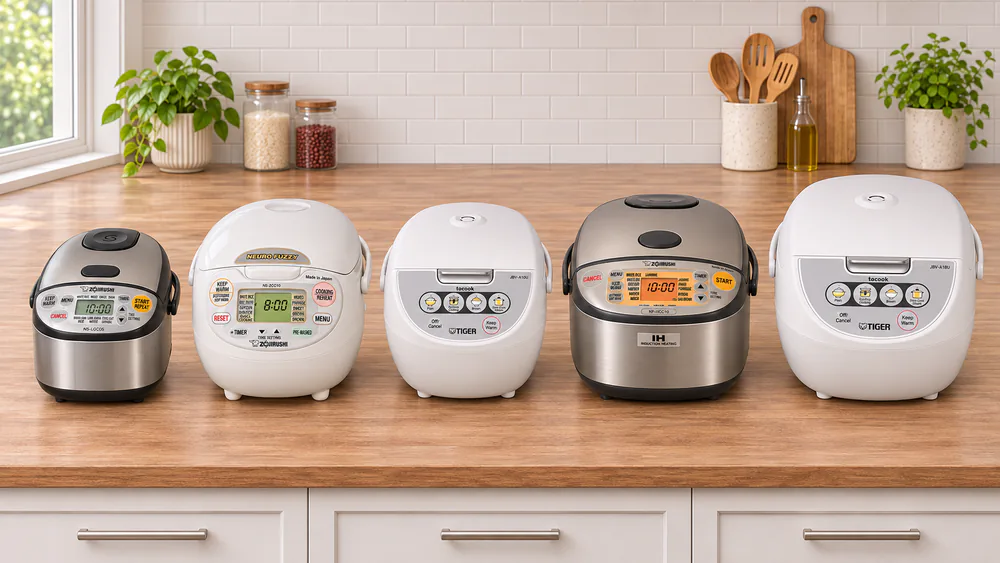
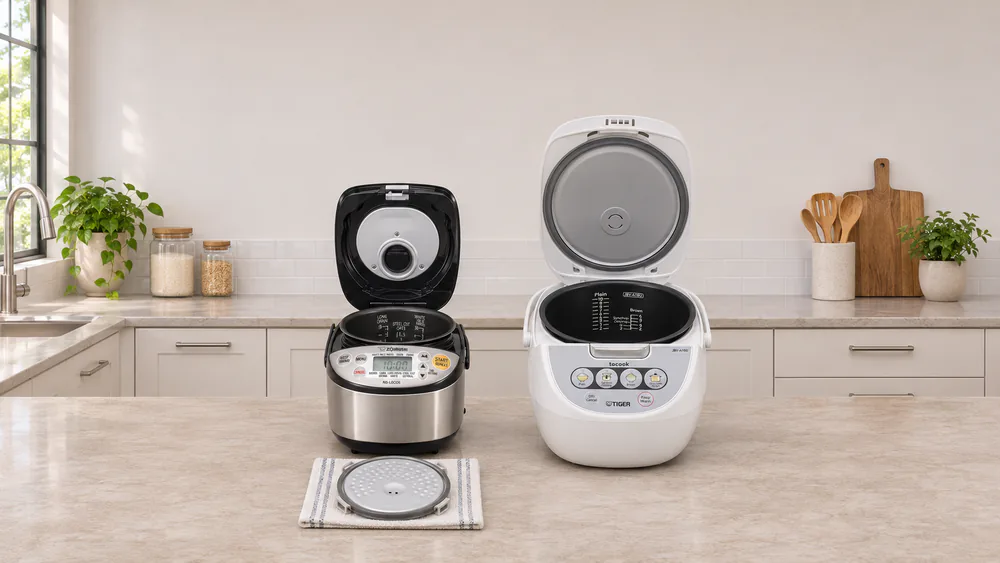
The five cookers in this roundup, from the compact NS-LGC05XB to the large JBV-A18U.
Best Japanese Rice Cookers at a Glance
Here is the whole lineup side by side. Capacity always refers to uncooked rice, measured in the supplied 180mL rice cup, not a standard US measuring cup.
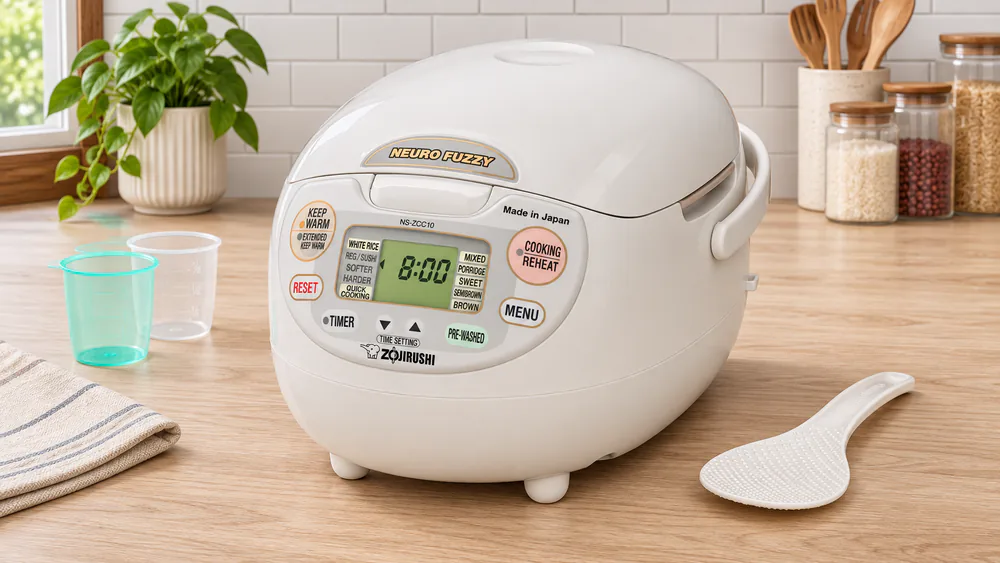
This is the cooker we would buy again for an everyday family kitchen. Rice cooked evenly, the rounded nonstick pan wiped clean with a soft sponge, and short-grain rice stayed pleasantly chewy on keep-warm without a hard bottom during a delayed meal.
The NS-ZCC10 holds 5.5 cups of uncooked rice, runs at 120V, and is rated at 680W. It pairs Neuro Fuzzy control with conventional heating and is made in Japan. The menu list is the longest of the five: white texture choices, sushi, mixed, porridge, sweet, semi-brown, brown, rinse-free and quick.
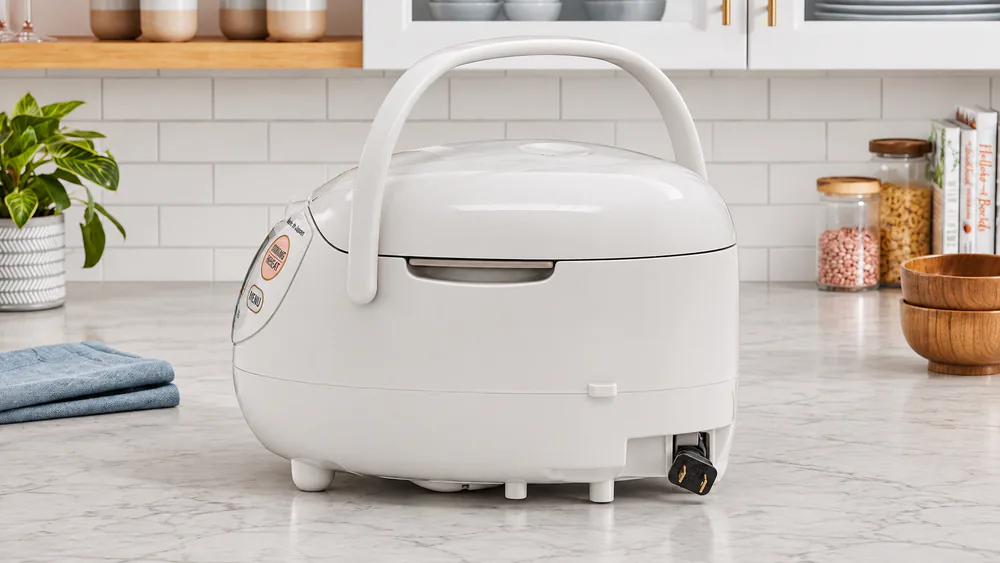
The bowl, removable inner lid and steam vent were all straightforward to wipe clean. The retractable cord and carrying handle also make putting it away easier, which matters when counter space is shared with a toaster and a coffee maker. Two measuring cups come in the box, one regular and one for rinse-free rice.
Brown rice needs advance planning on this machine. The convenience comes from unattended cooking and the ready-at timer rather than speed. If your stovetop rice already turns out well, expect the improvement to be about convenience more than a dramatic taste transformation.
Pros
Cooked evenly and kept short-grain rice chewy on keep-warm
Removable inner lid, bowl and steam vent are easy to clean
Retractable cord and carrying handle simplify storage
Wide menu range with a ready-at timer and extended keep-warm
Made in Japan with a 1-year limited warranty
Cons
Brown rice cycles are slow, so plan ahead
The manual is long, and reading it pays off
Clock battery service goes through customer support
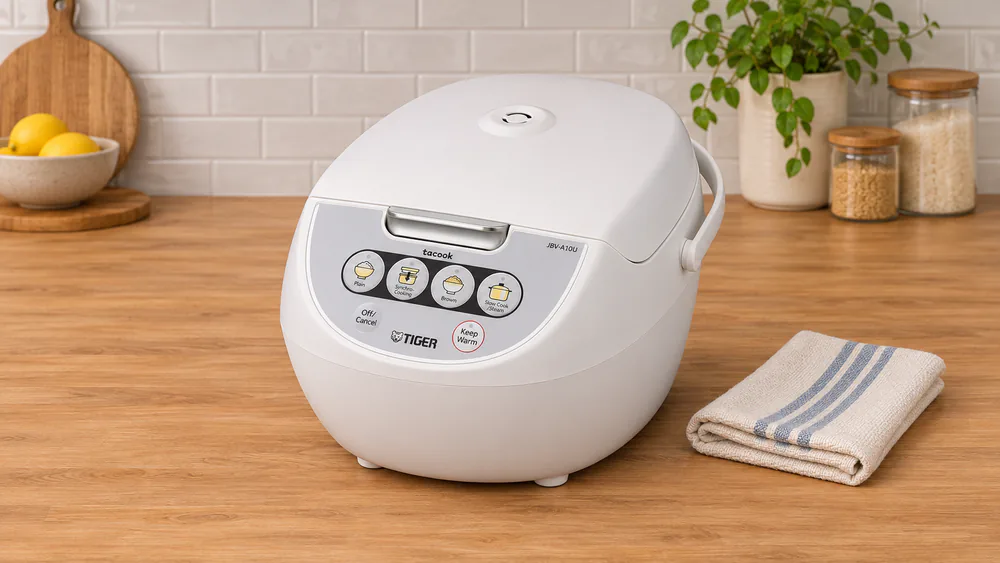
The JBV-A10U offers a more affordable micom cooker than the Zojirushi above, with a shorter menu list. Rice released cleanly and the pot wiped out with gentle cleaning, and the simple buttons made everyday rice easy.
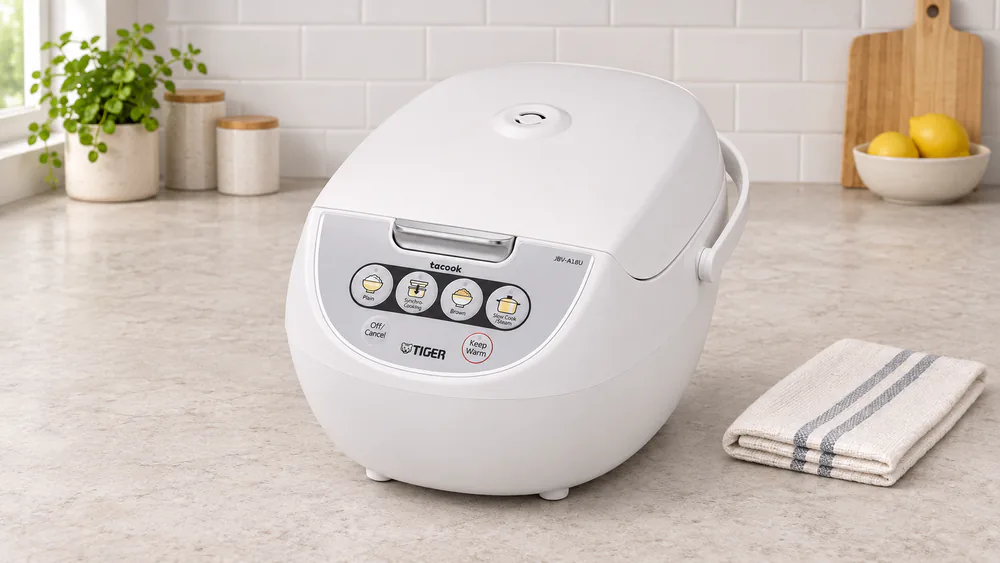
It holds 5.5 cups of uncooked rice at 672W and 120V, and it measures 10.6 x 13.9 x 8.4 inches. The control is micom with conventional heating, with plain, brown, synchro-cooking and slow cook or steam settings. The pan is 1.0mm coated aluminum, lighter than the Zojirushi pans. It is made in China.
The upper tacook tray is the feature we liked best. A small rice-and-vegetable meal comes together in one cooking cycle, though the tray limits rice to 1-2 cups. Brown rice tops out at 3.5 cups, and plain rice keeps warm for up to 12 hours.
The tradeoffs are real. There is no clock and no completion sound, so you get little timing feedback. That makes coordinating the rest of dinner less convenient, and starting the rice first helps. The nonstick pan can also pick up scratches, so use the supplied paddle and hand wash the removable parts.
Pros
Simple buttons make everyday cooking easy
Tacook tray cooks a small rice-and-vegetable meal in one cycle
Rice releases cleanly and the pot wipes out easily
1-year warranty in the US and Canada
Cons
No clock, countdown or completion sound
Nonstick pan can scratch, and the controls are a potential wear point
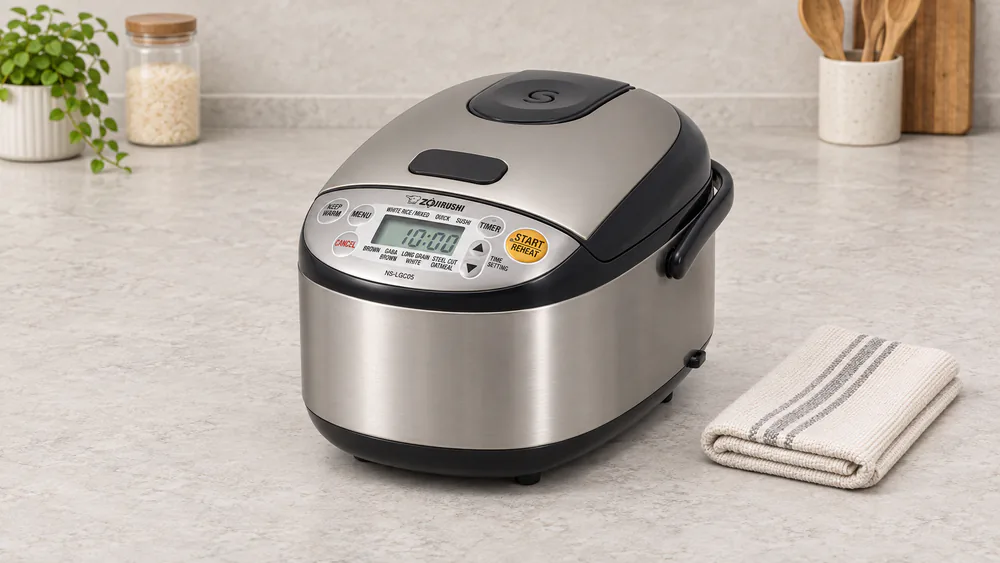
Stepping down in size from the two 5.5-cup models, this is the sweet spot for anyone downsizing. This compact cooker produced consistent rice texture. Its handle, small body and retractable cord make cabinet storage practical.
It holds 3 cups of uncooked rice, draws 450W at 120V, and measures 9-1/8 x 11-7/8 x 7-1/2 inches. Fuzzy logic runs bottom, side and lid heaters. The minimum batch is just 0.5 cup, which is the lowest of the group. Menus cover white or mixed, sushi, brown, GABA brown, long-grain white, steel-cut oatmeal and quick. The unit is made in China and carries a 1-year limited warranty.
Menu selection is straightforward, and the start melody is noticeable in a quiet kitchen. Rice and cereals cleaned out easily. Fuzzy logic does not rescue a bad water ratio, though. Incorrect proportions still produced wet, mushy rice, so measure carefully.
Basmati and jasmine work on the long-grain or white program with an appropriate water ratio, but neither has its own preset. Unfamiliar grains take some experimenting beyond the basic manual recipes. A batch this size will not feed a crowd, so large households should look at the 5.5-cup models.
Pros
Smallest footprint of the five, with a handle and retractable cord
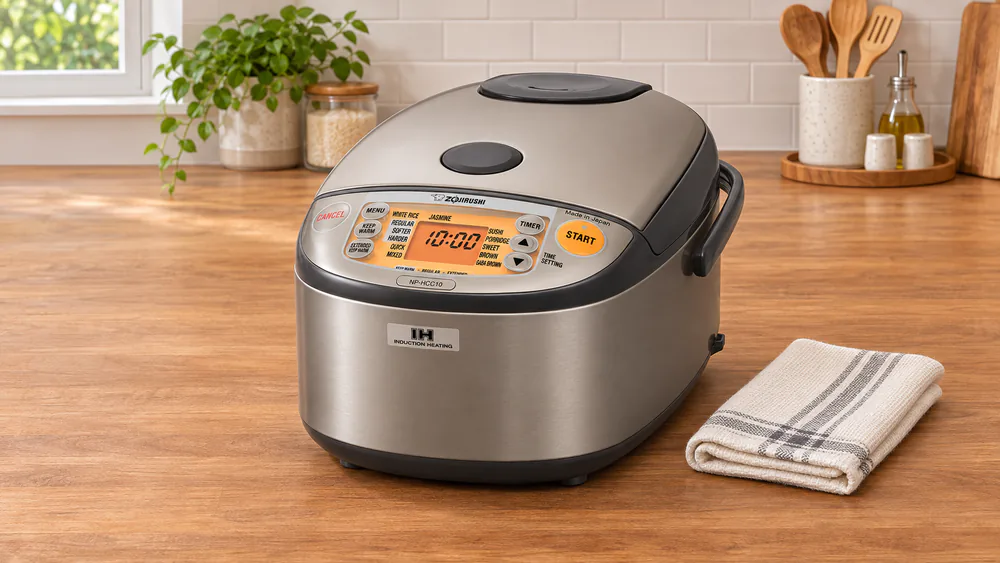
Back at full size, the NP-HCC10XH earns its place for cooks who eat a lot of brown and specialty rice. Brown rice developed an even, tender texture with a distinct bite, and GABA brown rice tasted nutty and mellow, with a softer, fluffier texture than we expected from brown rice.
This is the only induction cooker in the group, with computerized control. It holds 5.5 cups of uncooked rice, draws 1230W at 120V, and measures 10 x 14 x 8 inches. It is made in Japan. The menus include regular, softer and harder white, jasmine, mixed, sushi, porridge, sweet, brown, GABA brown and quick. It has normal and extended keep-warm, and the delay timer stores 2 settings. It does not offer pressure cooking.
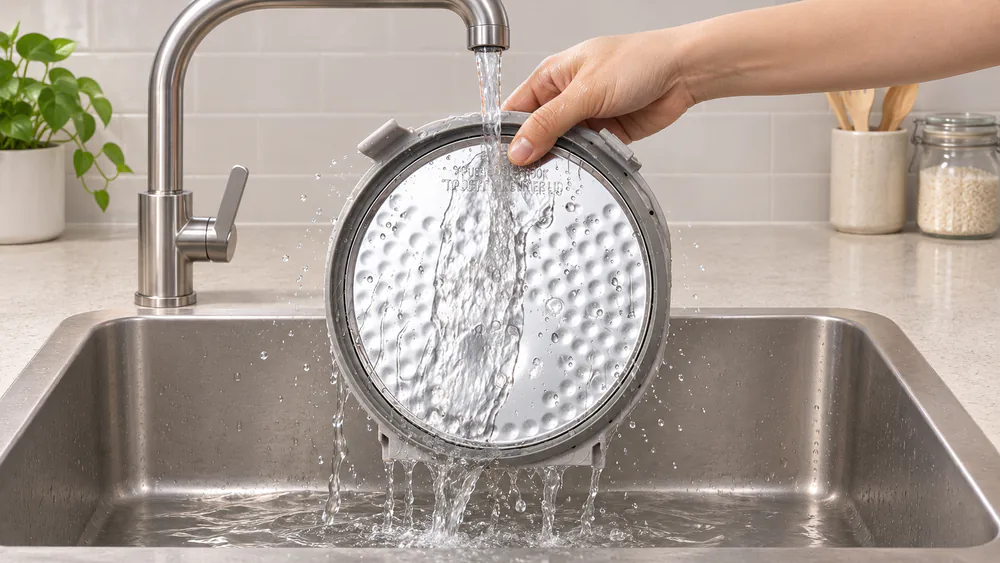
Jasmine mode gave consistent results, and quick mode stayed useful when dinner was rushed. Sticky rice released readily from the pan, and the removable inner lid simplified daily cleaning. With hand washing, the pan coating stays intact. Draining the vent and cleaning the inner lid become part of the routine.
Budget is the obvious hurdle. This is the splurge pick, and it needs more counter space than the others.
Pros
Even, tender brown rice and mellow GABA brown rice
Dedicated jasmine and softer or harder white settings
Removable stainless inner lid keeps cleanup simple
Made in Japan with a 1-year limited warranty
Cons
The most expensive model here
Substantial footprint
Induction does not mean pressure cooking
Cleaning the inner lid and draining the vent is part of the daily routine.
After the induction splurge, the JBV-A18U is the plain, large-batch answer for feeding a crowd. It holds 10 cups of uncooked rice, and the large nonstick pot is easy to wipe clean despite its size. The short button layout is easy to learn for everyday cooking.
Power is 941W at 120V, and it measures 11.9 x 15.1 x 10.0 inches, so give it real counter room. Like the smaller Tiger, it uses micom control with conventional heating, a 1.0mm coated aluminum pot, and plain, brown, synchro-cooking and slow cook or steam settings. It is made in China. Brown rice tops out at 6 cups, and plain rice keeps warm for up to 12 hours.
Brown rice came out tender with some chew rather than collapsing into mush. The tacook tray handles 2-4 cups of rice for a combined meal. Saucy food can leave residue on the tray plate that needs soaking before wiping, and the tray plate should not stay inside during keep-warm.
The minimum batch is 2 cups of plain rice, and there is no delay timer. That makes it a poor choice for one or two eaters.
Pros
10-cup capacity for big families and batch cooking
Easy-to-learn buttons and a pot that wipes clean
Tender brown rice with some chew
1-year warranty in the US and Canada
Cons
2-cup minimum batch
No delay timer
Large footprint on the counter
How to Choose a Japanese Rice Cooker
Start with the household, then the rice you eat most, then the counter space. The sections below walk through each choice in the order we weigh them.
Japanese brand, made in Japan, or Japanese-style: What do you mean?
A Japanese brand is about the company. Made in Japan is about the factory. Japanese-style alone proves neither. The NS-ZCC10 and NP-HCC10XH are built in Japan, while the NS-LGC05XB and both Tiger models are made in China. A Japan-built cooker is not automatically better, and a China-built one from a Japanese brand is not automatically worse. Judge the menus, heating, and support for the exact model you plan to buy.
Capacity: Uncooked cups, cooked yield, and household size
Capacity is the number most shoppers misread. Maximum capacity describes raw rice measured in the supplied 180mL cup, not cooked rice and not a US measuring cup. Cooked volume varies with the rice variety, the water, and how much each person eats. Appetites and rice expansion differ, so size the batch around the actual meal rather than counting people.
Think about the minimum too. The NS-LGC05XB and NP-HCC10XH handle 0.5 cup. The NS-ZCC10 and JBV-A10U start at 1 cup, and the JBV-A18U starts at 2. A cook who often makes one small portion should not buy a 10-cup machine. Tray modes narrow things further, since the A10U tray takes 1-2 cups of rice and the A18U tray takes 2-4.
Heating and controls: Conventional heat, micom, induction, and pressure
These are two separate ideas. Micom means microcomputer control, and fuzzy logic adjusts the cooking process as it runs. Induction describes how the pot is heated, using electromagnetism. A cooker can have both computerized control and induction, and the NP-HCC10XH does.
Pressure is a third choice. Pressure IH cookers heat the pot electromagnetically and also cook under pressure. Paying for induction does not automatically buy pressure cooking, and none of the five picks here has it.
Note. Fuzzy logic and induction can coexist in one cooker. Compare the exact model's menu and heating, not the buzzwords on the box.
Rice settings, cooking time, and keep-warm features
Match the menu to what you cook. White and brown cover most weeknights. Jasmine, sushi, GABA brown, porridge and oatmeal modes widen the range, but they only help if you will use them. Cooking time changes with the batch and the selected program, so avoid expecting one universal dinner countdown. Quick modes and GABA brown cycles are different planning choices.
Keep-warm limits also matter. Tiger limits plain-rice warming to 12 hours and says to remove the tacook plate first. Follow each manual rather than assuming rice can sit for days.
Inner pot, cleaning, replacement parts, and warranty
All five pans are nonstick, and every manual calls for hand washing with a soft sponge and no metal utensils. A removable inner lid, as on the Zojirushi models, makes daily cleanup quicker than the fixed lid on the Tigers. Replacement pans and lids are model-specific, so check the exact model number before ordering. Official parts catalogs exist, but stock can change. Warranties are 1-year on all five, and they apply to eligible US and Canada purchases.
Maximum capacity counts raw rice in the supplied 180mL cup, so judge a cooker by its minimum batch as much as its maximum.
Regional models: Voltage, instructions, and local support
All five picks here are 120V US versions. Match the appliance rating to your local supply. The US versions are not interchangeable with every domestic Japanese or overseas version, so confirm local-language instructions and warranty eligibility before importing a model.
Zojirushi vs Tiger vs Panasonic and Toshiba
The documented differences between these brands come down to specific models, not blanket rankings. Among our five, the Zojirushi cookers offered a longer menu list, removable inner lids, and ready-at timers. The two Tigers offered a tacook tray, a lower cost of entry, and the only 10-cup option, but no delay timer and fixed lids.
Zojirushi's NS-ZCC10 and NP-HCC10XH are built in Japan, and Tiger's JBV models are built in China. The Zojirushi NS-LGC05XB stood out for small batches, while the JBV-A18U suited big families on a smaller budget.
Panasonic documents conventional microcomputer, induction, and pressure-induction designs. Compare the actual regional model rather than assigning one technology to the whole brand. Toshiba has a regional US rice cooker range, so check local model menus, support and voltage rather than assuming Japan manufacture. We did not include a Panasonic or Toshiba in our five.
Frequently Asked Questions
Is a premium Japanese rice cooker worth the extra cost?
It depends on how often you cook rice. If you cook it several times a week and want more texture choices and a timer, the extra cost of a Zojirushi pays off. If you cook it occasionally, the Tiger JBV-A10U handles everyday rice well.
Can it cook jasmine, basmati, brown rice, and other grains?
Yes, with limits. The NP-HCC10XH has a jasmine setting. On the NS-LGC05XB, basmati and jasmine use the long-grain or white program with a suitable water ratio. Brown rice is on every model, and other grains take some experimenting.
Do I need a different water ratio for rinse-free rice?
Yes. Rinse-free rice is processed so you skip washing, and it generally needs a little more water than washed rice. Use the cooker's marked water lines for that setting and the measuring cup made for it. The NS-ZCC10 ships with a separate rinse-free cup for this reason.
What if my rice cooker has no clock or completion sound?
Work backward from dinner. The Tiger JBV-A10U has no clock and no completion sound, so start the rice first and let it sit on keep-warm while you finish the rest of the meal. Plain rice keeps warm for up to 12 hours on the Tigers, though fresher is better.
How long should a rice cooker last?
We cannot promise a number of years. Hand washing, avoiding metal utensils, and protecting the nonstick pan help. The Tiger JBV-A10U pan can scratch, so use the plastic paddle.
Final Verdict: Which Rice Cooker Fits Your Kitchen?
Our top choice is the Zojirushi NS-ZCC10, and the reasons are in its review above. The choice among the others is about fit. Choose the NS-LGC05XB for a small kitchen or the JBV-A10U to spend less. The NP-HCC10XH suits cooks who eat brown and jasmine rice often and consider induction worth the splurge. Choose the JBV-A18U if you regularly cook for a crowd.
Whichever you choose, read the manual and measure the water with the supplied cup. Both matter more than any feature on the box.