As an Amazon Associate we earn from qualifying purchases. We may earn a commission from links on this page, at no extra cost to you. Learn more.
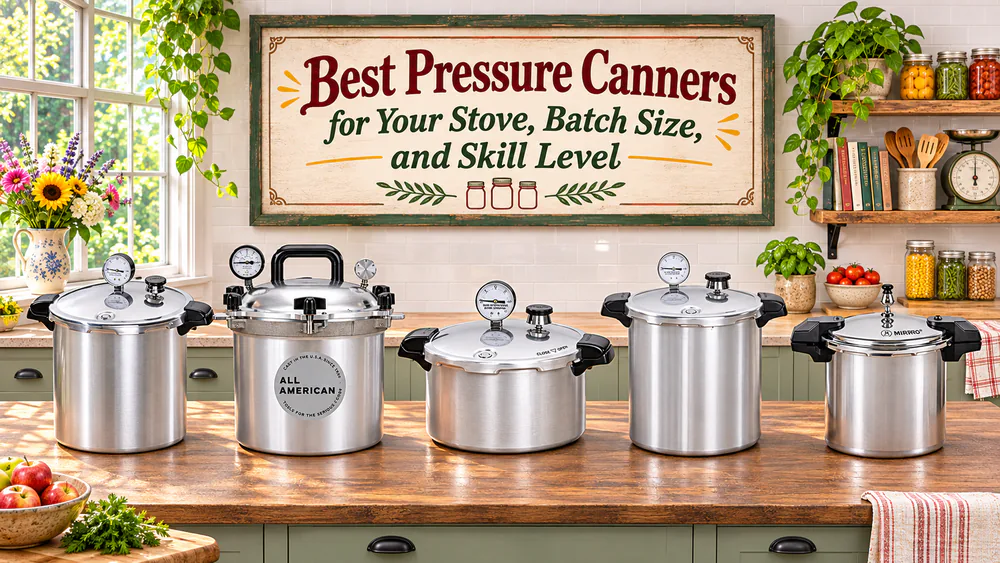
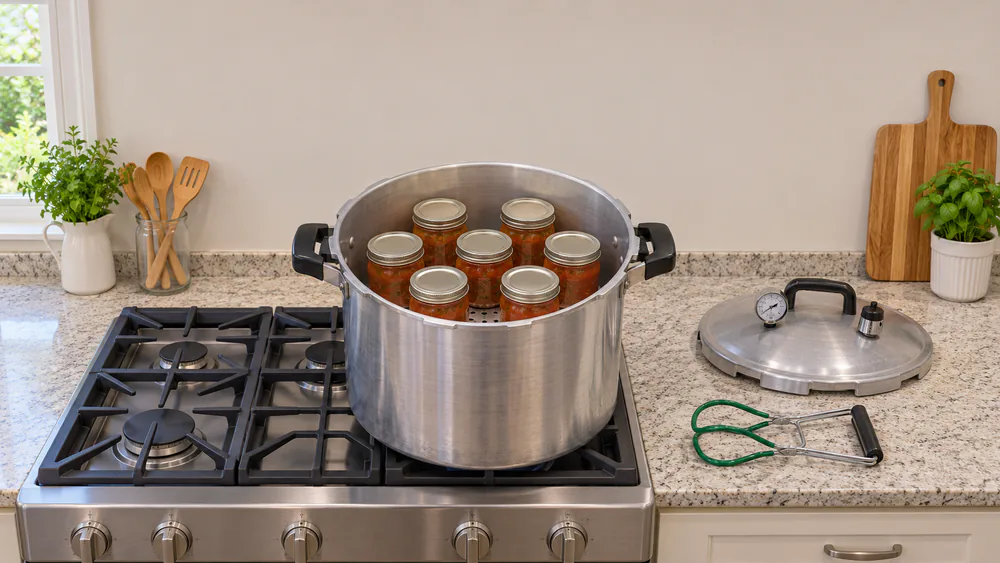
A pressure canner is the only home appliance that lets you preserve low-acid foods such as green beans, stock, corn, and meat in jars, because it reaches temperatures a boiling water bath cannot. The choice comes down to three practical questions: how many jars you process at once, what kind of stove you own, and how comfortable you are managing a gauge. Along the way we found that the pot itself matters as much as the pressure control, since a canner that is awkward to lift, wash, or fit under a hood tends to sit unused.
We rated all five on the same checklist of capacity, stove fit, pressure control, handling, and upkeep, and we weigh each one by how it behaves in a real kitchen rather than by its box claims.
If you are also weighing a multipurpose appliance, our pressure cooker reviews cover the cooking side, but a canner is a different tool with different rules, and we explain that gap below.
Best Pressure Canners at a Glance
Five models cover nearly every home kitchen. Jar counts describe separate alternative loads, not a mix, and stacked counts assume a second rack.
Model and use case
Jar capacity (quarts / regular pints / half-pints)
Gauge and control
Cooktops
Empty weight
Principal tradeoff
Presto 01781 23-Quart: most non-induction kitchens
7 / 20 stacked / 26 stacked
Dial gauge, manual burner adjustment
Gas, coil, approved smooth-top; no induction
10.32 lb
Tall body is awkward at the sink and in storage; gauge needs care
All American 921: long-term repairable ownership
7 / 18 stacked / 26
Weighted regulator plus reference dial
Gas and electric; flat-top conditional; no induction
Published figures conflict; confirm the exact unit
Heavy handling and lid alignment
Presto 01755 16-Quart: smaller batches
7 / 10 / uncertain (sheet lists 13)
Dial gauge, manual burner adjustment
Gas, coil, approved smooth-top; no induction
9.25 lb
No quart jars in water-bath use
Presto 01784 23-Quart: induction kitchens
7 / 20 stacked / 26 stacked
Dial gauge, manual burner adjustment
Gas, coil, smooth-top, induction; some portable units unsuitable
10.32 lb
Stove limits still apply
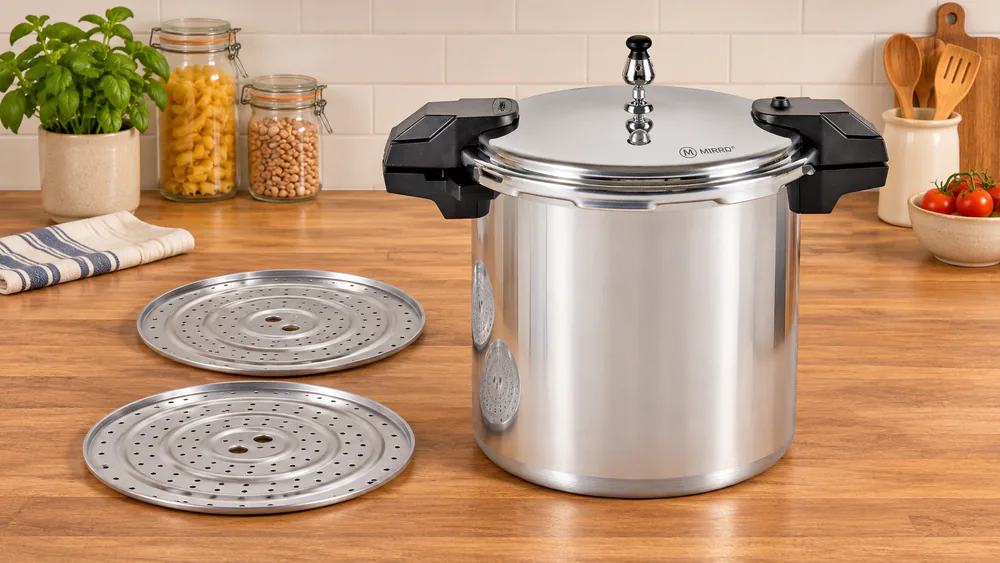
Mirro 92122A 22-Quart: weighted-gauge alternative
7 / uncertain, published counts conflict / uncertain
Weighted regulator
Gas best; coil conditional; no flat-top or induction
Provisional 15 lb; confirm
Lid alignment and poor coil contact
How We Rate These Pressure Canners
We judge a canner the way a canning day actually unfolds: loading the rack, locking the lid, holding a steady pressure on the burner, cooling, unlocking, and then washing a hot, heavy pot in a home sink. Each model is scored on five things: how many jars it handles, how well it fits a real stove, how easily the pressure is controlled, how it handles when loaded and when stored, and how simple the seals and parts are to maintain.
We do not publish batch counts or testing hours for these five models. Our handling notes draw on specifications and our knowledge of each design, and we flag disagreements between published figures.
Loading the rack is where jar capacity and pot height show up first.
Sources, selection criteria, and evidence limits
Specifications such as jar counts, empty weight, and burner limits come from each manufacturer's published sheet. Where two published sources disagree, we say so rather than pick a number, and we mark those cells in the table. Gauge and processing guidance comes from university extension material and the National Center for Home Food Preservation, never from our own improvisation.
Two limits are worth stating up front. First, no agency approves a specific canner brand, so any "USDA approved" wording on a box describes the preservation method, not an endorsement of the pot. Second, we do not offer a universal canning procedure here. Processing time and pressure depend on the food, jar size, packing method, gauge type, and your elevation, and your canner's instruction book and tested recipes govern all of it.
1. Presto 01781 23-Quart: Best for Most Home Canners
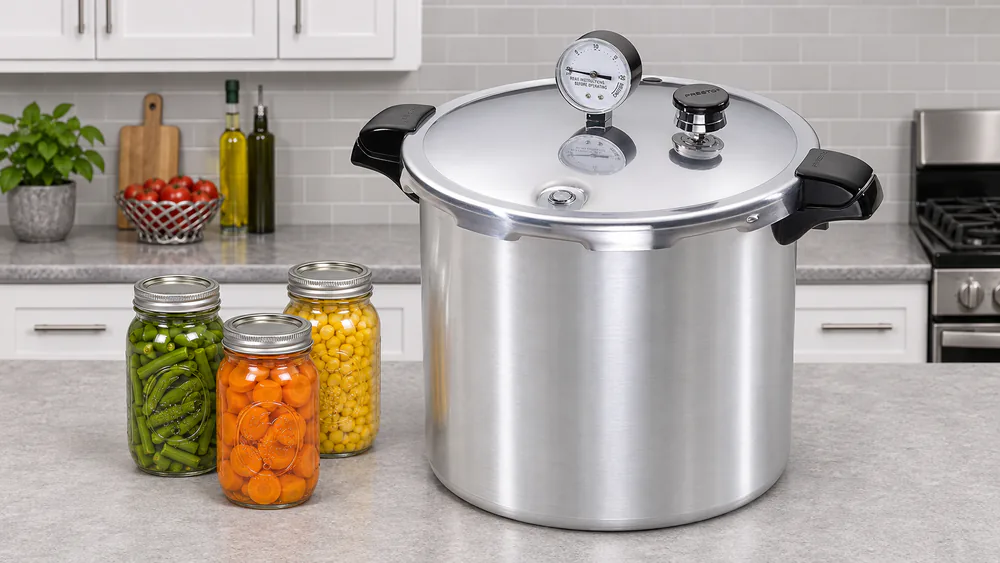
The 23-quart Presto 01781 is the canner we would hand to most people starting out, with the widest stove fit and the largest everyday capacity here. It asks for steady burner attention and a gauge you check every year, and it will not work on induction.
Holds 7 quart jars under pressure, regular or wide mouth
Fits 20 regular-mouth pints with double stacking
Replaceable lid gasket and serviceable vent parts
Water-bath canning accommodates quart jars as well as smaller jars
Fits household range burners rated 12,000 BTUs or less
Specifications
Liquid capacity
23-quart
Quart jars
7
Regular-mouth pints
20 stacked
Half-pints
26 regular-mouth, double stacked
Empty weight
10.32 lb
Control
Dial gauge, manual burner adjustment
Warranty
12-year limited
Capacity, cooktop fit, and pressure control
The 01781 holds 7 quart jars in a single layer, and with a second rack it fits 20 regular-mouth pints or 26 regular-mouth half-pints. Stacked pint batches are easier to arrange with that additional rack, and we would buy one at the same time. Wide-mouth pints drop to 16 when stacked, which matters if you can wide-mouth jars exclusively.
The body suits gas, electric coil, and smooth-top ranges, provided the burner is rated at 12,000 BTUs or less. It will not run on induction, so induction kitchens should skip to the 01784. We keep the 01781 at the top of the list because it fits the widest range of ordinary stoves while staying light enough to move when it is empty.
Pressure is controlled by hand. A dial gauge tells you the pressure, and you adjust the burner to hold it. That is a learning curve, not a barrier, but it is also where the model asks the most of you. Dial gauges require an accuracy check every year, and gauge faults can prevent reliable pressure monitoring: an off-zero needle, or one that does not move at all, both turn up on this model. We treat a gauge test as part of buying and owning it, not as proof that every unit fails.
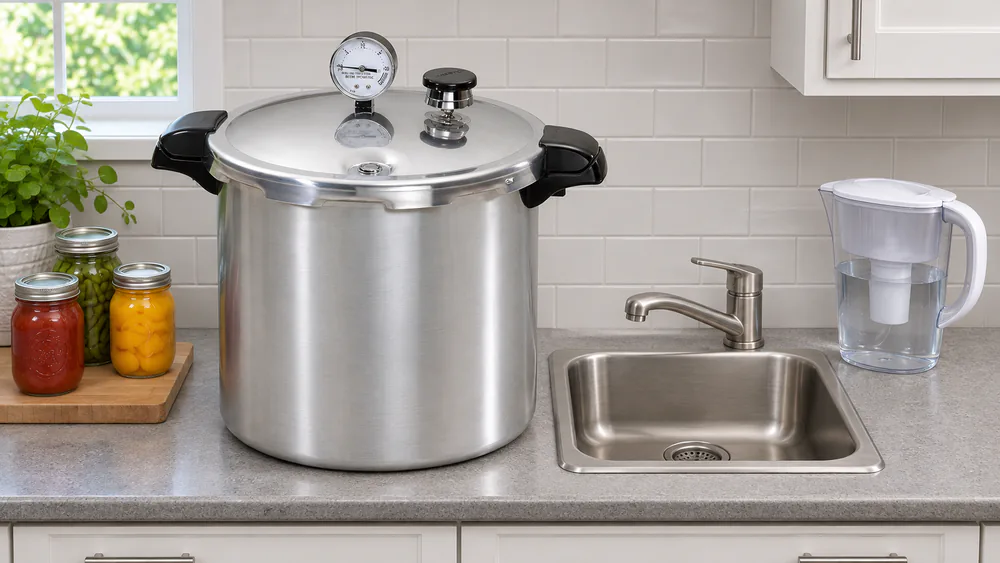
The honest annoyance is height. The tall pot is awkward to fit beneath a faucet or into a sink, so plan on filling it with a pitcher. Published outside dimensions vary with how they are measured, so check handle clearance and shelf height against the current specification sheet.
Strengths, limitations, and who should buy it
Buy the 01781 if you have a gas, coil, or approved smooth-top stove, want the largest everyday capacity at a mid-priced tier, and are willing to learn burner control. Skip it if you cook on induction or if a tall pot will not fit your sink or storage.
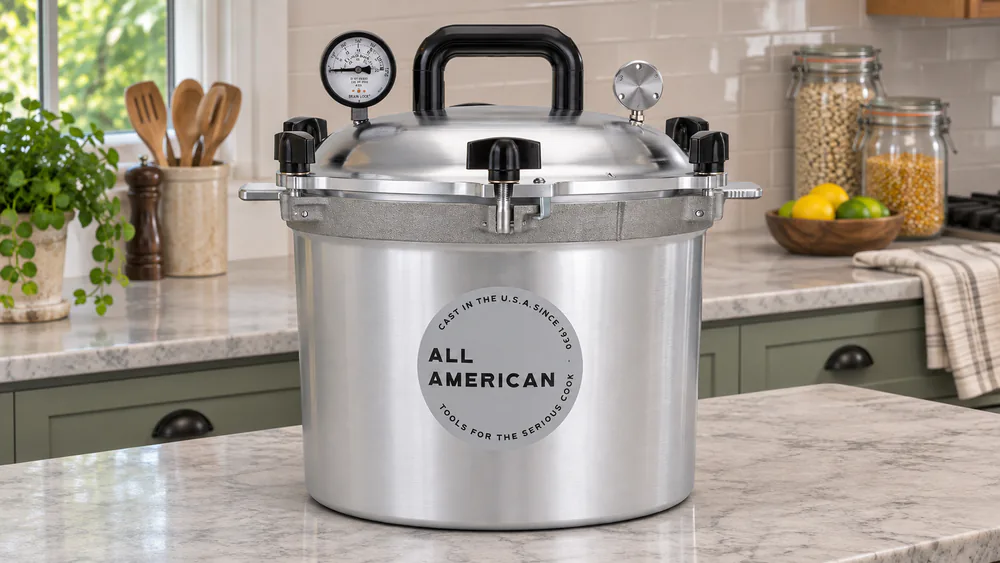
The All American 921 is the premium, repairable choice, and the heavy casting steadies heat even on a cycling coil burner. The trade is a pot that is hard to lift and wash, and a lid that takes practice to seat.
Gasket-free metal-to-metal seal
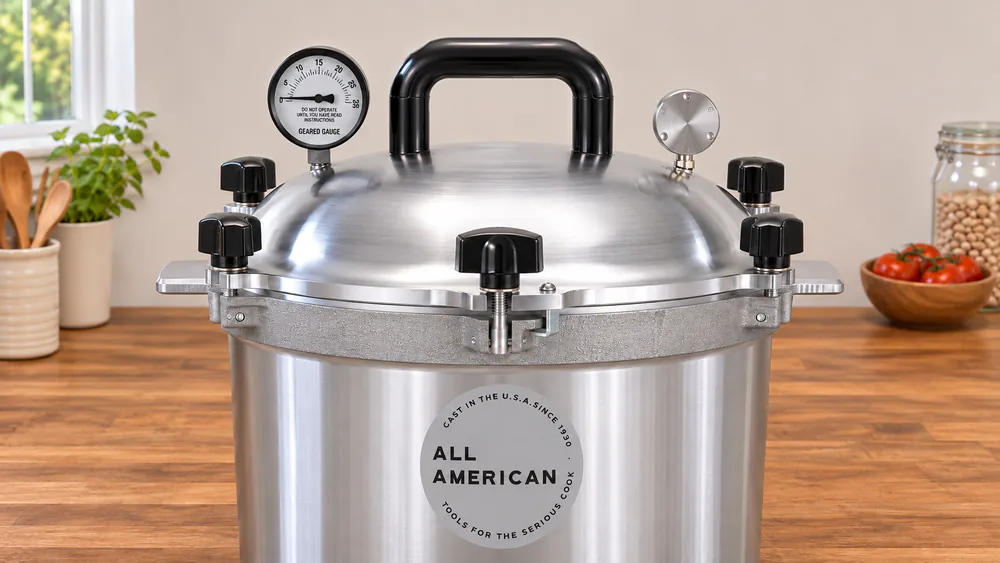
Weighted regulator with 5, 10 and 15 PSI settings, plus a reference dial
2 canning racks included
Overpressure plug and replaceable components
Made in the United States
Specifications
Liquid capacity
21.5-quart
Quart jars
7 regular or wide mouth
Regular-mouth pints
18 stacked
Wide-mouth pints
16 stacked
Half-pints
26 regular-mouth
Control
Weighted regulator at 5, 10 and 15 PSI
Empty weight
Published figures conflict; confirm the unit
Heavy casting, metal seal, and upkeep
The 921 has a 21.5-quart chamber that handles 7 quart jars, 18 regular-mouth pints, or 26 regular-mouth half-pints, and 2 racks come in the box. Its weighted regulator offers 5, 10 and 15 PSI settings, and a reference dial confirms the reading. Because the regulator rocks and rattles to tell you pressure is holding, it is less sensitive to the gauge drift that troubles dial models.
The cast body steadies heat on a cycling coil burner, where lighter pots wander. The heavy body also makes draining and washing awkward in a small sink, while the lid takes practice to align evenly and avoid steam leaks. Plan to practice with water before your first real batch.
There is no gasket to replace, but gasket-free does not mean maintenance-free. The metal sealing surfaces need to be kept clean and lubricated as the instructions say, and the wingnuts need periodic lubrication too. Weight figures conflict across published sources, from about 17.75 pounds to 22, so we will not quote one. Verify the exact unit and your range's load limits before you plan lifting or cooktop loading.
On cooktops, the 921 is a gas and electric pot. Flat-top suitability differs between the maker's copy and more cautious guidance, so read both the canner manual and your range manual before putting it on glass. It is not an induction canner.
The warranty is limited lifetime coverage for eligible household purchases sold on or after September 1, 2024, with proof of purchase required. The pressure gauge, overpressure plug, wingnuts, clamp hardware and racks are excluded, so read the terms before counting on it for those parts.
Who should commit to the 921
Choose the 921 if you expect to can for decades, want weighted-regulator control, and have the strength and counter space to handle a heavy pot. It is the premium option here, and it makes the most sense for committed canners rather than someone trying it once.
Pros
Gasket-free metal-to-metal seal with replaceable components
Heavy casting steadies heat on a coil burner
Weighted regulator at 5, 10 and 15 PSI with a reference dial
7 quarts, 18 stacked pints, and 2 racks included
Cons
Heavy to lift, drain, and wash in a small sink
Lid alignment takes practice and can leak steam if seated unevenly
Sealing surfaces and wingnuts need regular lubrication
Premium tier, and flat-top use depends on your manuals
Tightening the wingnuts in opposing pairs is how the lid seats evenly.
3. Presto 01755 16-Quart: Best for Smaller Batches
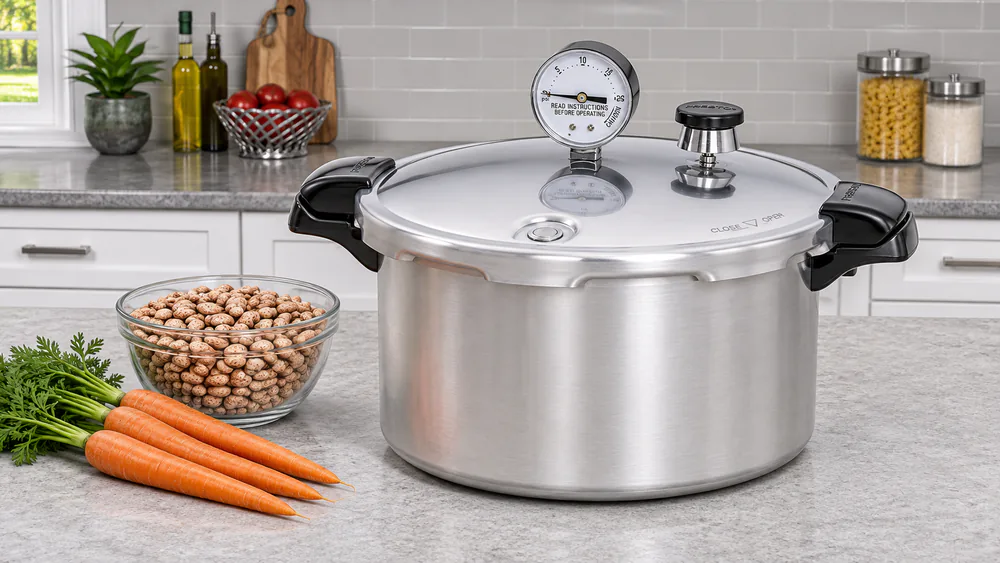
The 16-quart 01755 is the budget pick and the easiest to live with. The shorter body is easier to wash and fits beneath a low hood, though the light pot needs more burner corrections than the heavy All American.
Holds 7 quart jars under pressure, regular or wide mouth
Shorter body fits under a low hood and is easier to wash
Replaceable gasket, dial gauge and serviceable vent parts
Also useful for small water-bath batches of pints and half-pints
Fits household range burners rated 12,000 BTUs or less
Specifications
Liquid capacity
16-quart
Quart jars
7
Regular-mouth pints
10
Wide-mouth pints
8
Half-pints
Uncertain; current specification gives 13
Empty weight
9.25 lb
Control
Dial gauge, manual burner adjustment
Warranty
12-year limited
Why the small pot still takes quarts
The 16-quart pot still holds 7 quart jars, which surprises people who assume the smaller name means fewer quarts. The difference shows up in pints: 10 regular-mouth or 8 wide-mouth in a single layer, compared with 20 and 16 on the tall 23-quart Prestos. Half-pint counts are murkier. The specification gives 13 regular-mouth half-pints, a product description gives a different number, and the real answer depends on jar shape, so test-fit your own jars.
At 9.25 lb empty and with a lower profile, the 01755 is the canner we would pick for a small kitchen. The shorter body is easier to wash, it fits beneath a low hood, and it slides into a cabinet that a tall pot would never enter. The same pot is useful for small water-bath batches and for pressure cooking, though water-bath use is limited to pints and half-pints, because quart jars fit only under pressure.
The trade is control. The light body needs more burner corrections than the heavy All American, and excessive burner output can warp the base. Keep the flame to what your range rating allows, which is 12,000 BTUs or less, and watch the dial rather than the heat setting. The dial needs the same yearly accuracy check as the tall Prestos.
Who the 01755 suits
Buy the 01755 if you have a low hood or small storage, process mostly pints, or want the cheapest way into pressure canning from this list. Skip it if you want the capacity to run big batches of pints, because the 23-quart models do double the work per load.
Pros
Shortest and lightest pick at 9.25 lb empty
Easier to wash and fits under a low hood
Still holds 7 quart jars under pressure
Budget tier with a 12-year limited warranty
Cons
Only 10 regular-mouth pints per load
Light body needs frequent burner corrections, and too much heat can warp the base
Water-bath use is limited to pints and half-pints
Half-pint capacity is uncertain, so check jar fit
4. Presto 01784 23-Quart: Best for Induction Kitchens
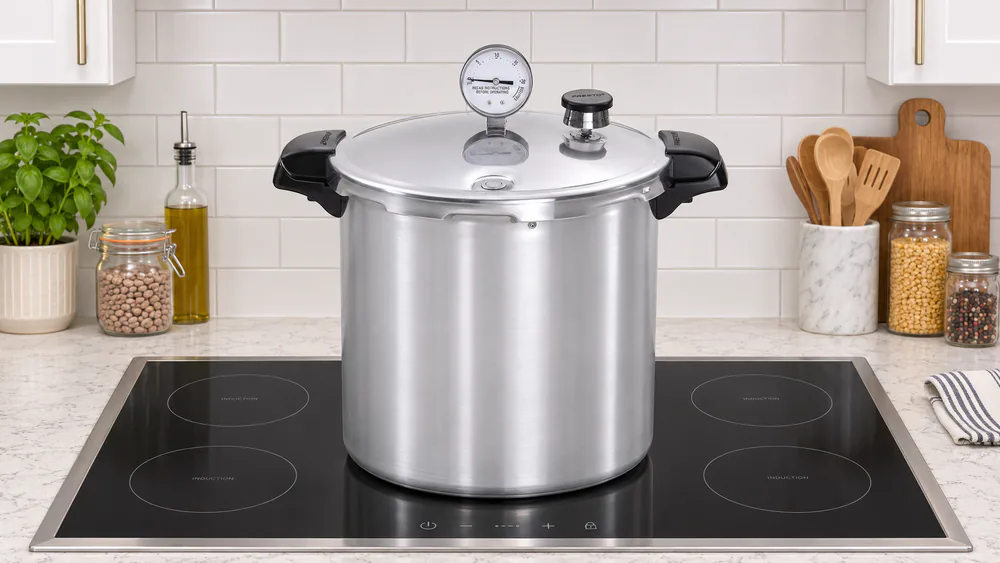
The 01784 is the 01781 rebuilt for induction. Its handling and burner-control demands closely resemble the standard tall Presto. If you cook on induction, it is the pick that keeps large-batch capacity, with one catch about portable burners.
Stainless-clad base supports gas, coil, smooth-top and induction
7 quart jars under pressure
20 regular-mouth pints with double stacking
Replaceable gasket, dial gauge, and serviceable vent parts
Water-bath canning accommodates quart jars as well as smaller jars
Specifications
Liquid capacity
23-quart
Quart jars
7
Regular-mouth pints
20 stacked
Half-pints
26 regular-mouth, double stacked
Empty weight
10.32 lb
Dimensions
17.50 inches wide x 13.50 deep x 15.50 high
Warranty
12-year limited
What the induction base changes
The numbers match the 01781: 7 quart jars, 20 regular-mouth pints with double stacking, 26 half-pints, and 10.32 lb empty, with the same outside dimensions of 17.50 inches wide, 13.50 deep, and 15.50 high. What changes is the stainless-clad base, which lets the pot work on induction as well as gas, coil, and smooth-top ranges. The induction base preserves useful large-batch capacity, which is rare, because most induction-ready cookware is built far smaller.
The catch is that some portable induction units are unsuitable, and fit needs attention before you rely on one. A full-size built-in induction cooktop and a canner of this width are a better match than a small countertop plate. Check the unit's power output and the pot's footprint against the burner, and read the canner's own instructions.
The limits match the standard tall Presto: burners rated at 12,000 BTUs or less, a dial gauge that wants a yearly check, and a tall pot that is awkward at the sink.
Who needs the 01784
Buy the 01784 only if you cook on induction or plan to. If you have a gas, coil, or smooth-top range, the 01781 does the same job at a lower tier, and there is no reason to pay the premium for an induction base you will not use.
Pros
Works on induction as well as gas, coil, and smooth-top stoves
The Mirro is a conditional pick. This budget pot offers weighted pressure control without the cost of a premium cast body. Its lid can take several attempts to align and lock, and its concave base may make too little contact with an electric coil to heat adequately. We recommend it for gas stoves and nowhere else.
Weighted pressure control at 5, 10 and 15 PSI
Locking lid with steam-release protection
Cool-touch handles and removable gasket
2 cooking racks included
Polished exterior wipes clean
Specifications
Liquid capacity
22-quart
Quart jars
7
Pints and half-pints
Published counts conflict; confirm jar fit
Control
Weighted regulator at 5, 10 and 15 PSI
Empty weight
Provisional 15 lb; confirm
Cooktops
Gas best; coil conditional; no flat-top or induction
Where the Mirro asks for patience
The Mirro offers weighted settings of 5, 10 and 15 PSI, ships with 2 racks, and holds 7 quart jars in a 22-quart body. The polished outside is straightforward to wipe clean, and the cool-touch handles make it easier to move than the metal on some competitors.
The rest of the picture is less tidy. Pint and half-pint counts differ across published specifications, partly because sources mix single-layer and stacked loads, so we will not quote one. Weight is also provisional: 15 pounds is the working figure, but shipping and empty weights are not consistently distinguished. Check both against the exact model before you plan shelf space.
Using it takes patience. Aligning and locking the lid can take several attempts, and maintaining the weighted regulator action can require frequent burner adjustments. The concave bottom is the larger worry. On an electric coil it can make poor contact, and on flat-top or induction surfaces it is unsuitable. Gas is the less problematic fit.
We could not confirm current replacement-gasket and regulator part numbers or stock, and the advertised warranty needs current confirmation. Those are real ownership questions for a pot with a removable gasket, so verify parts support for your exact model before buying.
Who should accept the Mirro's quirks
Buy the Mirro if you own a gas range, specifically want a weighted regulator, and are comfortable with a learning curve around the lid. For a first-time canner on an electric stove, the Presto 01781 is the safer starting point.
Pros
Weighted control at 5, 10 and 15 PSI without a dial to test
7 quart jars in a 22-quart body, with 2 racks included
Polished exterior wipes clean easily
Budget positioning
Cons
Lid can take several attempts to align and lock
Weighted regulator action may need frequent burner adjustments
Concave base can fail to heat on an electric coil, and is unsuitable for flat-top or induction
Weight, small-jar counts, warranty, and parts availability all need confirmation
How to Choose a Pressure Canner
The five factors below work together: your stove and planned batches determine which pots suit you, while weight, storage, and upkeep determine how practical they are to own.
Jar capacity versus pot volume
Quart volume on the label is liquid capacity, not jar capacity, so a 23-quart canner does not hold 23 quart jars. The number that matters is how many of your actual jars fit upright on the rack, and whether they fit in one layer or need a second rack. For USDA-style processes, a canner has to accommodate at least 4 upright quart jars with the lid secured, which every pot here clears easily.
The more useful split is jar size. All five models hold 7 quart jars. The difference is in pints: 20 stacked on the tall Prestos against 10 on the 01755. If you mostly can pints, the larger pot roughly doubles what you finish per load, and if you mostly can quarts, the smaller pot gives up nothing. Count the jars you actually put up in a season before paying for capacity you will not fill.
Dial gauges versus weighted gauges
A dial gauge shows pressure on a face, and you adjust the burner to hold it. A weighted gauge regulates mechanically: the weight rocks or jiggles on the vent pipe at its set pressure, and you adjust the burner to keep that motion within what the model's instructions describe. Dial canners such as the Presto 01781, 01755 and 01784 give you the reading; weighted canners such as the All American 921 and Mirro give you a sound and a motion to watch.
The practical difference is upkeep. Dial gauges require an accuracy check every year, and a faulty one can mislead you without any obvious sign. Weighted gauges have nothing to drift, though you still need to learn what the right action looks like. Also note that a counterweight on a dial canner is not automatically a selectable weighted gauge, so use only a conversion that the manufacturer says is compatible.
A weighted regulator is easier to read from across the kitchen, while a dial gives a precise number if you test it annually.
Warning. Pressure canner gauges and processing times depend on your altitude, your jar size, and the food. Always match your recipe to your gauge type and elevation, and never assume a sealed lid proves the food is safe.
Gas, electric, glass-top, and induction compatibility
Gas and electric coil are the easiest matches. Smooth-top ranges are more conditional: the Presto models list approved smooth-top use but ask you to confirm range limits, the All American depends on both manuals, and the Mirro's concave base is unsuitable for flat surfaces. Induction needs a magnetic base, which in this lineup means only the 01784.
Look at the maximum burner rating too. The Prestos here are rated for household range burners of 12,000 BTUs or less, and a hotter burner is how a thin base ends up warping. Before you buy, check your range manual for the weight a glass top can carry, since a loaded canner is far heavier than the empty figures in our table.
Empty weight, loaded handling, and storage
Empty weight is only the beginning. Add the water, the jars, and the food, and any of these pots becomes a heavy, hot object. The Presto 01755 at 9.25 lb and the 01781 at 10.32 lb are manageable; the All American 921 is considerably heavier, and its published weights conflict, so lift one before you decide.
Tall pots need a deep shelf, and a low hood limits what fits under it. If it is too heavy to move safely after processing, you can let it cool on the switched-off burner, since natural cooling is part of the process and you should never force-cool it or force-open the lid.
Gaskets, metal-to-metal seals, and replacement parts
A gasket seal, as on the Presto and Mirro models, is simple to replace and inspect but is a part that wears. A metal-to-metal seal, as on the All American, has nothing to replace, but it needs clean, lubricated sealing surfaces and careful lid seating. Either way, check that parts for your model are in stock before you buy, and keep vent openings clear. Presto lists the sealing ring, vent parts and dial gauge as serviceable for the models here, which is a real point in their favor.
What to Know Before Choosing an Electric Pressure Canner
A countertop appliance sounds easier than a stovetop pot, but the reality is more conditional, which is why none of our five picks is electric.
Dedicated canners versus electric multicookers
An electric multicooker is not interchangeable with a stovetop pressure canner. Heat-up, processing, and cooling profiles differ, and those profiles are exactly what a safe process depends on. A multicooker with a "canning" button on its panel is still a multicooker, and extension guidance warns against using it for low-acid foods in jars.
Dedicated digital canners are a separate category from multicookers. They are built for jar processing, but they come with model-specific instructions that do not transfer to a stovetop canner or to a different electric model. If you are looking at any electric pressure canner, you are buying into that one appliance's tested processes and nothing else.
What model-specific evidence and instructions establish
The evidence for a given electric canner is model-specific. A university statement from March 2021 about an older digital model explains why you should ask for model-specific support, but it cannot vouch for every later appliance. We also cannot find a blanket, current independent validation that covers every dedicated electric canner on sale today.
Note. USDA and the National Center for Home Food Preservation do not approve specific home-canner brands, and a manufacturer's claim of meeting guidance is not agency certification. Treat "approved" wording on packaging as a description of the method.
So if you want an electric canner, read the exact model's manual first, use only the processes it specifies, and do not apply stovetop recipes or times to it. For the stovetop pots above, the same rule applies from the other side: match your recipe to your canner type.
What Ownership and Maintenance Involve
A canner is a long-term appliance, so the question after "does it work" is "can I keep it working." The answer comes down to a few small habits, repeated each season.
Gauge checks, seals, and replacement parts
Before each canning season, inspect the seal, make sure the vent openings are clear, and confirm the dial gauge reads accurately. On gasket models, look for cracking, flattening, or a lid that no longer seats evenly. On the All American, clean and lubricate the metal sealing surfaces and wingnuts as the instructions say. Any model with a dial gauge should be tested every year, and a gauge that sits off zero or does not move should be replaced, not guessed at.
Practice a dry run with water so you know what steady pressure looks like on your burner.
Where to find processing and altitude instructions
We do not publish processing times, because they vary by food, jar size, packing method, gauge type, and elevation. For tested recipes and altitude adjustments, start with research-based home-canning guidance from the National Center for Home Food Preservation, then follow the instruction book that came with your canner. When pressure drops below the specified level during a process, you return to pressure and restart the full processing time.
Sources and Author Expertise
Spec figures come from manufacturer sheets, safety guidance from extension and NCHFP material, and the judgments about handling, fit, and upkeep are ours. Where we could not confirm something, such as Mirro part numbers or exact All American weight, we say so in the review.
Pressure Canner FAQs
How do I know if my dial gauge has gone bad?
Test it every year, and watch for a needle that sits off zero or does not move at all. Either fault means the gauge should be replaced, not guessed at.
Can a loaded canner damage a glass-top range?
It can if the range is not rated for the weight, since a loaded canner is far heavier than the empty figure. Check your range manual for its load limit and read the canner's cooktop guidance before you start.
Can a pressure cooker replace a pressure canner?
No. A pressure cooker, including an electric multicooker, has different heat-up, processing, and cooling behavior, so it cannot stand in for a canner in low-acid recipes. See our electric canner section for why model-specific instructions matter.
Is it safe to speed up cooling by forcing the lid open?
No. Natural cooling is part of the process, so let the canner cool on the switched-off burner and never force-cool it or force-open the lid.
Does a pressure canner need to be full?
A full canner is not essential, but physical size and minimum food load are different questions. Follow your canner's instructions and the tested process for your recipe, and never skip the specified water or heat cycle because the batch is small.
What accessories do I need to get started?
A jar lifter, canning funnel, jars and lids, a rack, a timer, and heat protection. The 01781 also benefits from an extra rack for stacked pints.
Final Verdict: Which Pressure Canner Should You Choose?
Pick by stove first, then by batch size. Induction means the 01784. A low hood or small cabinet points to the 01755. Gas with a taste for weighted control suits the Mirro, and a decades-long commitment suits the All American. Everyone else should buy the 01781.