As an Amazon Associate we earn from qualifying purchases. We may earn a commission from links on this page, at no extra cost to you. Learn more.
A rice cooker with a steamer pairs a heated inner pot for grain with an upper tray or basket that cooks vegetables, fish, or dumplings on the same cycle. Some models only steam on their own, while others let you cook rice and steam food at the same time, and that difference decides how useful the extra tray really is.
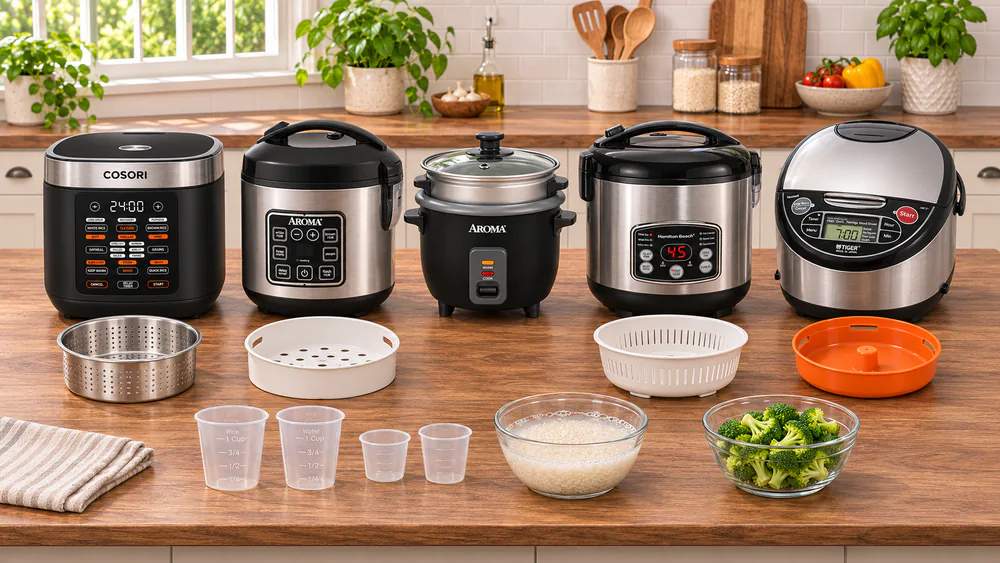
We compared the COSORI CRC-R501-KUS, Aroma ARC-914SBD, Aroma ARC-363-1NGB, Hamilton Beach 37548, and Tiger JAX-T10U-K on rice texture, tray capacity, and cleanup.
What we noticed first is how much the steamer changes a weeknight. Broccoli steamed over a pot of cooking rice saves a pan, and a sticky pot that releases cleanly saves the scrubbing that usually follows. In this guide we walk through five models, how they handled rice and vegetables, and which one we would buy again. If you want to see the wider field first, our rice cooker reviews cover models with and without steaming trays.
Our Top Picks at a Glance
Here are all five picks side by side. Each column links down to its full review, and the rows show the numbers that matter most for a rice cooker with a steamer: rice capacity, basket material, and whether you can run rice and steam together.
10 cups per the manual and spec panel, though the product FAQ words it as cooked
4-cup
3-cup white rice
7-cup
5.5-cup, rice only
Cooked yield
Unknown, not confirmed
Up to 8-cup
Up to 6-cup white rice
Up to 14-cup
About 11 cups
Included basket
Stainless steel, 3.0-quart
Steam tray, material unverified
External aluminum tray
Steam and rinse basket, material unverified
BPA-free tacook plate
Rice and steam together
Not confirmed in the US manual
Yes, 2 cups uncooked maximum
Yes, exact limit unverified
Yes, exact limit unverified
Yes, 1-2 cups uncooked
Inner pot
Ceramic-coated nonstick
Nonstick
Nonstick
Nonstick, current copy says ceramic
Fluorine-coated aluminum
Main limitation
Bulky, capacity label conflict
Less rice room with tray in use
No timer or true Off setting
Archived model, stock varies
Tray meals are far smaller than rice-only batches
How We Tested These Rice Cookers with Steamers
We judged each cooker on the things that decide whether it earns counter space. For every model we looked at rice texture, how much room the tray really leaves, how easy it is to add and remove the basket, and how much work cleanup takes afterward.
We also weighed the details that matter after the first week of use: a handleless pot that is awkward to lift when hot, a hinge that traps condensation, and a nonstick coating that has to survive nightly washing. Where a manufacturer manual sets a rule, such as a rice limit under the tray, we followed it rather than guessing.
One point shapes every verdict below. A separate steam program is not the same as simultaneous cooking. Several of these cookers can steam food by itself with water in the pot, and only some are documented to cook rice and steam together. We say which is which for each model, and where the manual leaves a combined-load limit unstated, we say so rather than fill the gap.
The five cookers set up for a side-by-side rice and vegetable session.
The Best Rice Cookers with Steamers
These are editorial picks, ranked by who each one suits, not by a numerical score. That is why you will not find star ratings in the boxes below.
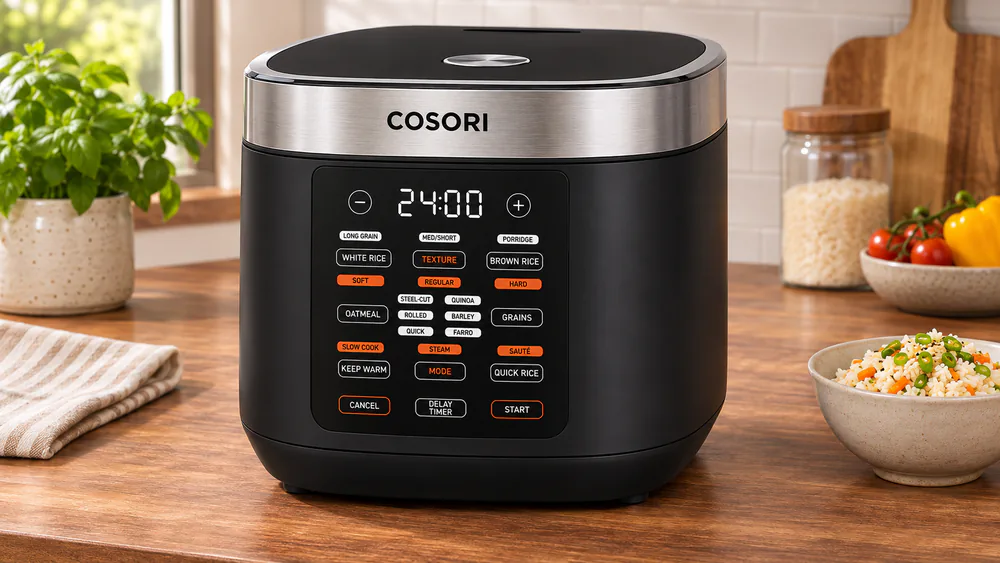
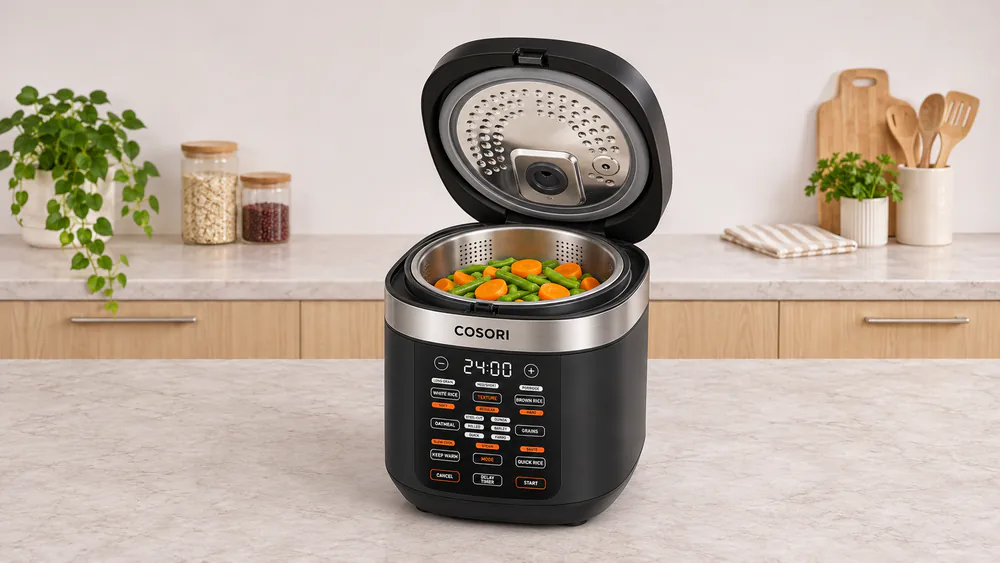
The COSORI is the cooker we would hand to someone who wants one machine for rice, oatmeal, grains, and steamed sides. Sticky grains release easily from the ceramic-coated pot, reducing after-dinner scrubbing, and cooking residue rinses easily from the removable top components.
Fuzzy logic adjusts heat and timing for white and brown rice
Included 3.0-quart stainless steel steam basket
Automatic 24-hour keep warm plus a delay timer
Top-rack dishwasher-safe accessories
Slow Cook, Saute, Quick Rice, and oatmeal functions
Specifications
Power
1000W
Dimensions
12.3 x 10.6 x 9.2 in (depth x width x height)
Rice capacity
10 cups uncooked per the US manual
Warranty
2-year limited
This is the pick with the most open questions, and we want to be direct about them. The product page labels the 10-cup capacity as uncooked in one place and cooked in another, so use the manual and the inner-pot markings for your grain, and do not count on a doubled cooked yield. The US manual documents water-only steaming, but it does not spell out a combined rice-and-basket procedure or a maximum rice load, so we treat simultaneous use as unconfirmed. Treat the steam basket as a steam-on-its-own tool unless your manual says otherwise.
The body is the other cost. It takes substantial counter space and feels heavier to move than a basic switch cooker. The handleless inner pot is awkward to lift when hot, and the thin steel basket can dent if you press it against the pot edge. The many controls also take more familiarization than a single Cook switch.
Pros
Ceramic-coated pot releases sticky grains easily
Stainless steel basket and a generous 3.0-quart size
Slow cook, saute, and grain programs beyond plain rice
Removable lid parts and top-rack dishwasher-safe accessories
Cons
Capacity labeling conflicts on the product page
Simultaneous rice-and-steam use is not confirmed in the US manual
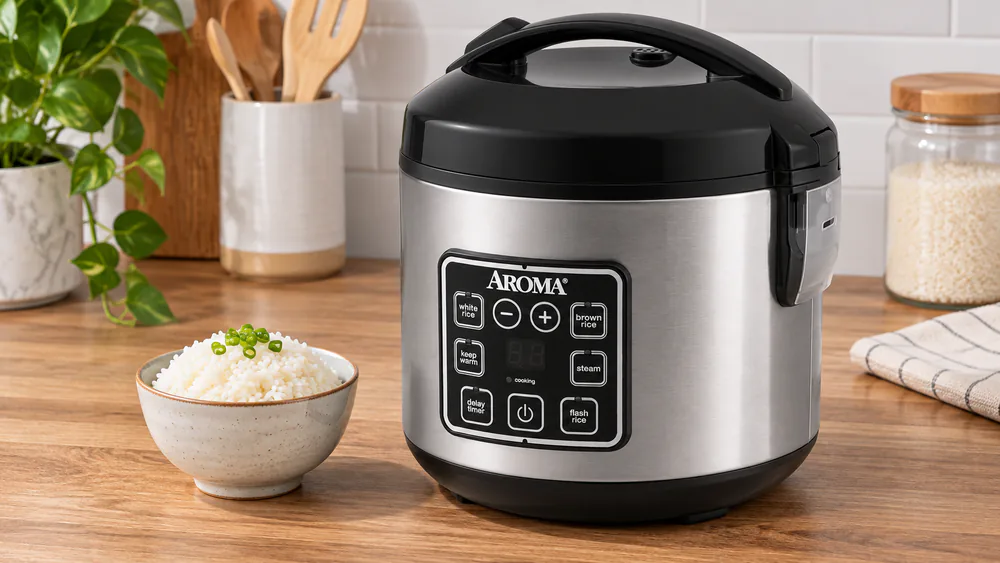
Where the COSORI leaves the combined load unconfirmed, the ARC-914SBD documents a 2-cup rice limit and gives you digital controls and a real steam tray without leaving the budget tier. Jasmine rice comes out as distinct, fluffy grains, basmati is fragrant and a touch dry, and brown and sushi rice keep a tender, chewy texture. Flash Rice is faster, but it trades some texture for speed.
White Rice, Brown Rice, Steam, and Flash Rice settings
Sensor Logic temperature control
15-hour delay timer and automatic Keep Warm
Supplied steam tray, rice cup, and spatula
Documented simultaneous rice and steaming
Specifications
Uncooked capacity
4-cup
Cooked yield
up to 8-cup
Rice with tray in use
2 cups uncooked maximum
Warranty
1-year
The 2-cup limit is the number to remember. If you want to steam and cook rice together, the steam-tray timing and rice limit in the manual caps rice at 2 cups uncooked, so the 4-cup ceiling only applies when the tray stays out. That suits a dinner for two with a side of vegetables better than a big family batch.
The pot feels thin and light, though rice releases easily and cleanup is straightforward. Opening the lid quickly can send condensation down the side, which adds a wipe-down step. Power-on failures can occur, so reliability is a limitation of this model; register its 1-year warranty. The steam-tray resin and the exact pot coating are not confirmed in the support record.
Pros
Digital controls and a delay timer at a budget tier
Jasmine rice comes out fluffy with distinct grains
Rice releases easily and cleanup is straightforward
Supports rice and steaming together
Cons
Only 2 cups of uncooked rice with the tray in use
Thin, light pot
Power-on failures can occur
Condensation runs down the side if the lid opens fast
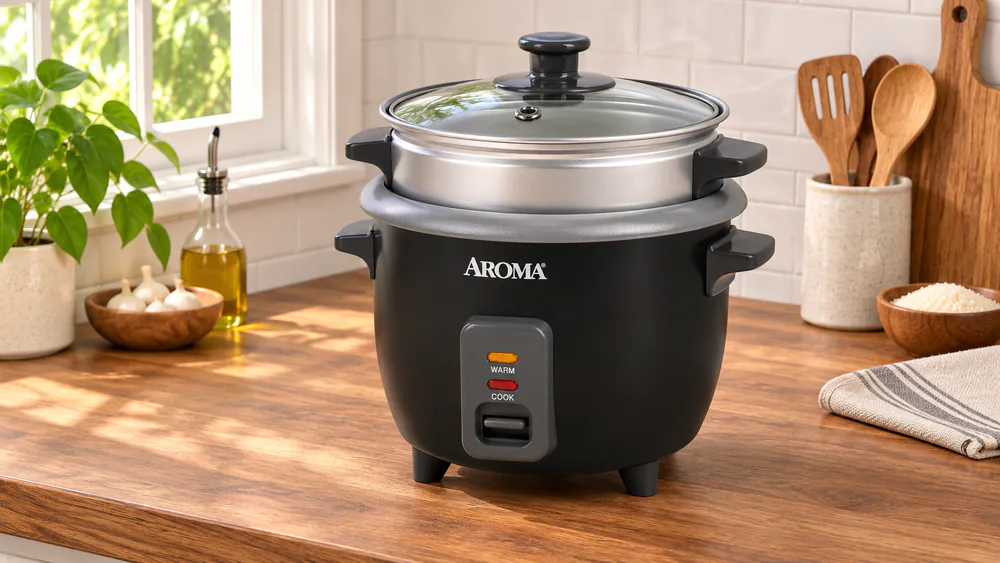
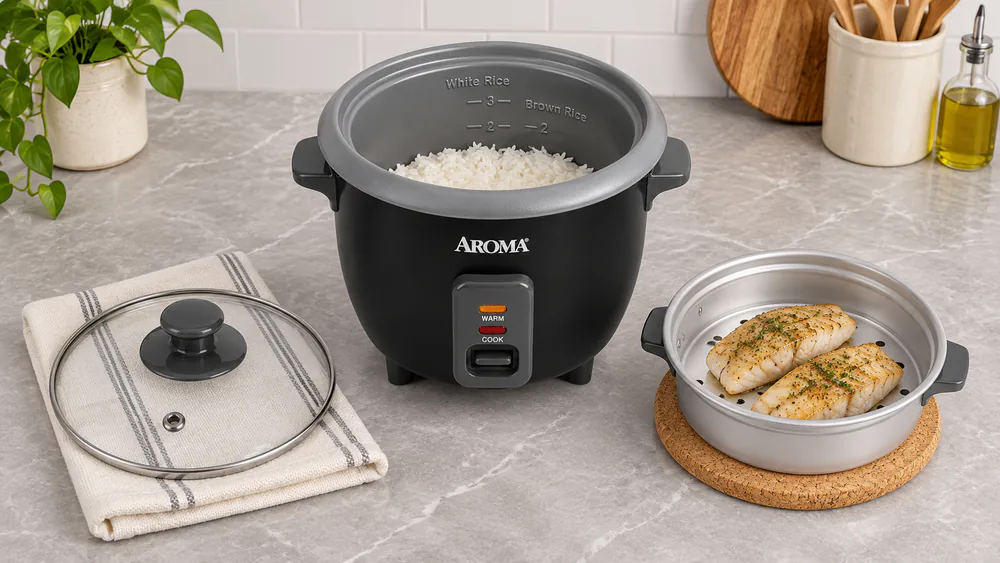
Where the ARC-914SBD adds digital controls, the ARC-363-1NGB is the simplest cooker here, and that is exactly its appeal. One Cook/Warm switch runs the whole show, the glass lid lifts off so you can watch the food, and the small body leaves useful prep space on a crowded counter. It suits small meals better than bulk cooking.
Single Cook/Warm switch with automatic Keep Warm
Tempered glass lid that lifts off for easy cleaning
External aluminum steam tray
Removable nonstick pot
Rice and food can cook together
Specifications
Uncooked capacity
3-cup white rice
Cooked yield
up to 6-cup white rice
Power
300W
Supplied rice cup
3/4 of a standard US cup
That last spec trips people up. The supplied rice cup equals 3/4 of a standard US cup, so match your water to the cooker's markings rather than a normal measuring cup, and see the rice cup measurements and basic steaming steps in the manual. Faint water marks take care to read, and the light body may need steadying when you press Cook.
There is no timed steam program. To steam food on its own, add water to the pot and food to the tray, check doneness, then switch to Warm; unplug the cooker to turn it off. Extended Warm holding can dry or brown the bottom rice layer, so unplug it after serving. The combined rice-and-food limit is not stated clearly, so keep the rice load modest.
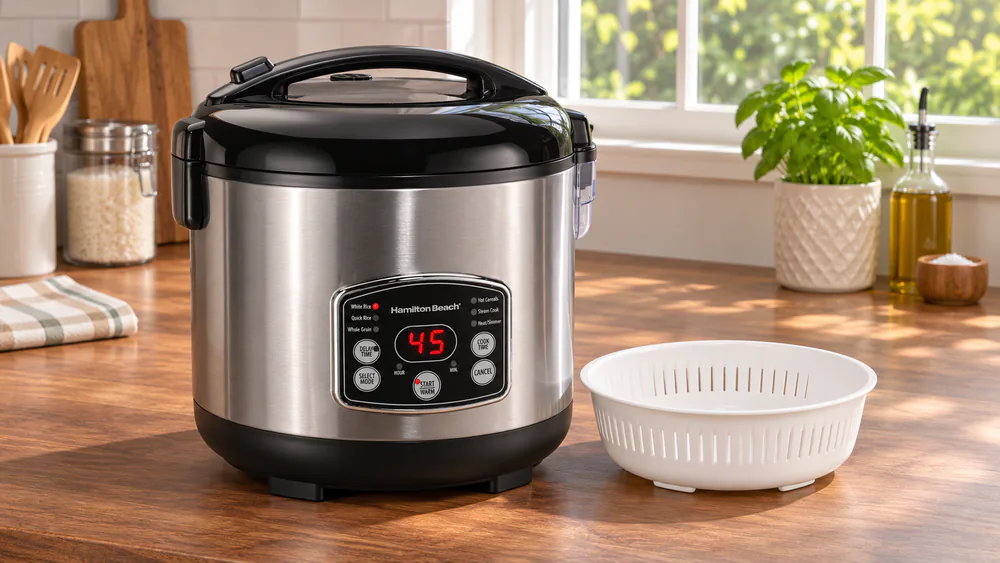
The compact Aroma suits one or two people, while the Hamilton Beach 37548 is our pick for families who need more capacity. Broccoli steams successfully over cooking rice, which reduces the number of pans needed for dinner, and the basket doubles as a rice rinser. The digital interface is straightforward, and the rice can cook without boiling over.
White Rice, Quick Rice, Whole Grain, Steam Cook, and Hot Cereals settings
Basket that doubles as a rice rinser
Automatic Warm and a delay start
Nonstick removable pot
Simultaneous steaming supported
Specifications
Uncooked capacity
7-cup
Cooked yield
up to 14-cup
Power
500W
Dimensions
10.75 x 10.75 x 11.06 in (depth x width x height)
Japanese-style white rice can have good texture here without the expense of a premium cooker. The pot is easy to clean, but inaccurate water measurement can produce overcooked rice, so level your rice and trust the markings. Its wider body is less convenient on a crowded counter than a small switch cooker.
Before you order, know that this is an archived model. The manufacturer marks it no longer available, and retail stock may still exist, so check the exact model and the warranty terms from the seller. The combined rice-and-steam limit is not verified, and delay-start descriptions disagree between 11 and 15 hours, so rely on the controls and manual that come with your unit. Current product copy describes a ceramic nonstick coating, while older documentation says only nonstick, so confirm the pot you receive.
Pros
Large 7-cup uncooked capacity feeds a family
Steams broccoli and other vegetables over cooking rice
Pot is easy to clean
Good texture on Japanese-style white rice
Cons
Archived model with retailer-dependent availability
Wide body is awkward on a crowded counter
Inaccurate water measurement can overcook the rice
Combined rice-and-tray limit is not verified
5
Tiger JAX-T10U-K
Best Rice Cooker for Simultaneous Rice and Steaming
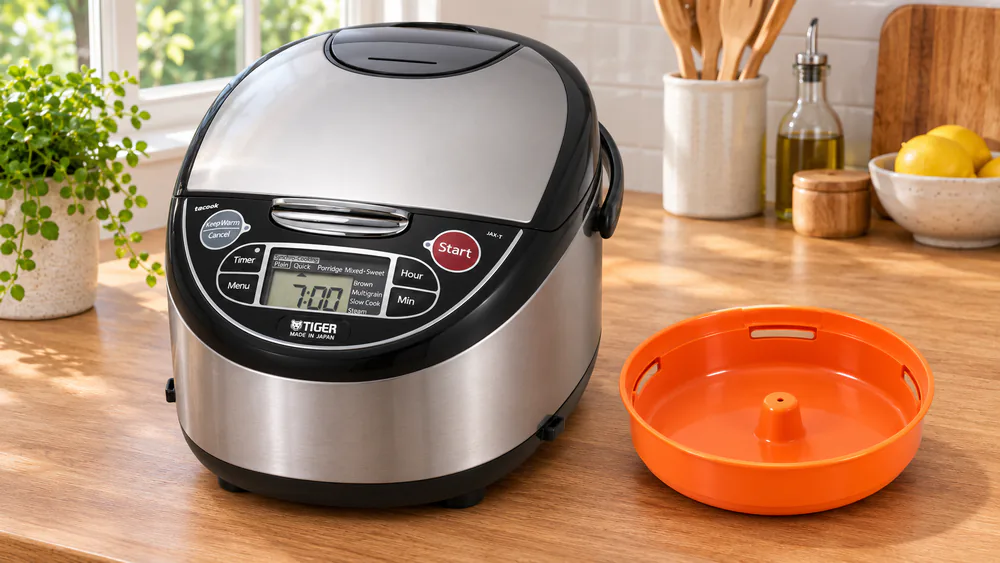
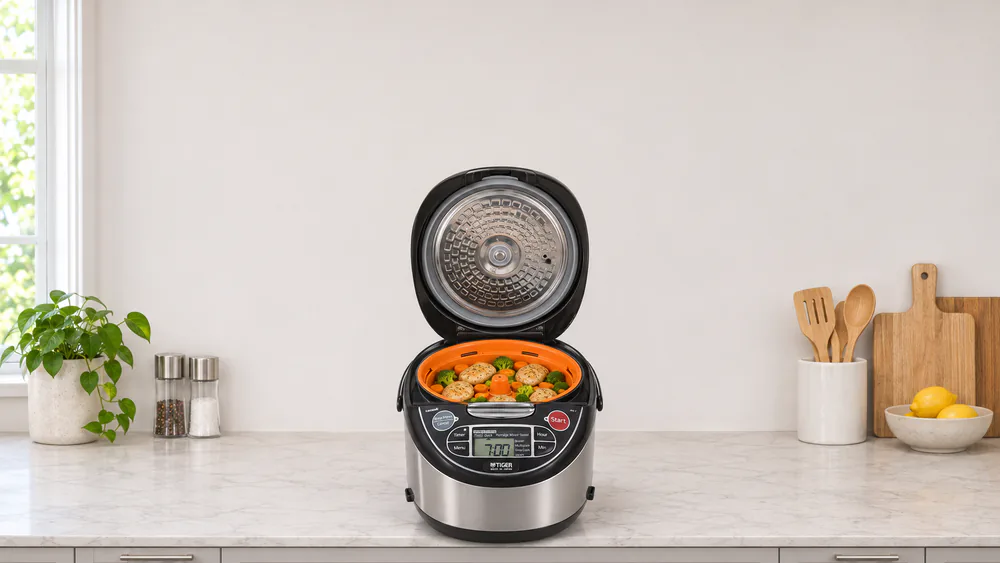
Where the Hamilton Beach leaves its combined limit unverified, the Tiger JAX-T10U-K is the most deliberate design here. Its tacook plate sits above the rice, and the Plain/Synchro-Cooking setting is built for cooking rice and a main dish in one go. Japanese-style rice is the strength; brown, long-grain, and quick-cooked rice are less consistently impressive.
Micom heat and timing control
Plain/Synchro-Cooking plus Quick, Brown, Porridge, Steam, and Multigrain settings
BPA-free tacook plate
Up to 12-hour keep warm for suitable plain rice
Removable inner lid and steam cap
Specifications
Uncooked capacity
5.5-cup, rice only
Rice with tacook plate
1-2 cups uncooked
Power
641W
Dimensions
13.7 x 10.1 x 8.2 in (depth x width x height)
Warranty
1-year limited
The catch is how small a combined meal is. With the plate installed you use 1-2 cups of uncooked rice, so the 5.5-cup rice-only maximum does not apply, and the tacook rice limits and loading instructions also say to spread ingredients evenly, avoid stacking, skip the timer for concurrent cooking, and remove the plate before keeping rice warm. Follow the supplied cookbook recipes for combined meals.
The standard cooking routine can feel slow when dinner needs to be ready quickly. Condensation around the hinge adds a fiddly cleaning area even though the inner lid and steam cap detach, so dry that spot carefully. Heavy use can eventually wear the nonstick coating, and the pot is hand-wash only. Replacement-pot questions go through the place of purchase, so keep your order details.
Pros
Purpose-built Synchro-Cooking for rice and a main dish together
Excellent with Japanese-style white rice
Micom control with many rice and porridge programs
Detachable inner lid and steam cap
Cons
Combined meals are limited to 1-2 cups of uncooked rice
Standard cycle can feel slow
Hinge traps condensation and the coating can wear with heavy use
Hand-wash pot and a premium tier
How to Choose a Rice Cooker with Steamer
Most of the differences between these models come down to five questions. Answer them before you look at a single feature list.
Cooked vs. Uncooked Capacity and Space for the Steam Tray
Rice capacity is the number shoppers misread most. A "10-cup" cooker might mean 10 cups of uncooked rice or 10 cups of finished rice, and those are very different pots. Match the rice you measure to the supplied cup and the markings inside your exact model, because that cup is often smaller than a standard measuring cup.
Tray space is a separate question. Rice-only capacity says nothing about how much food fits in the basket, or about how many adult servings you get.
Note. Always check which cup a manual means. The ARC-363-1NGB cup is 3/4 of a US cup, and the Tiger cooker drops from 5.5 cups of rice to 1-2 cups once its tacook plate is installed.
Included Steamer Basket and Simultaneous Cooking Support
This is the heart of the decision. Steaming on its own needs only water in the pot and food in the tray. Steaming while rice cooks needs a model whose manual supports it, and usually a reduced rice load.
Two of our picks, the Aroma ARC-914SBD and the Tiger JAX-T10U-K, document the combined method with a stated rice limit. The COSORI documents standalone steaming only, while the Aroma ARC-363-1NGB and Hamilton Beach 37548 support combined cooking with limits we could not verify. Check the manual for your exact model before you stack food over rice.
Inner Pot and Basket Materials
A stainless steel basket resists staining and odors, while a plastic or aluminum tray can be lighter and cheaper. A ceramic-coated or fluorine-coated pot releases rice well, but any nonstick surface wears with heavy use, so avoid metal utensils and abrasive pads. If a material is not named in the product record, treat it as unknown rather than assuming.
Fuzzy Logic, Rice Programs, Controls, and Keep Warm
Fuzzy logic and micom control adjust heat and timing as the rice cooks, which helps with brown rice and finicky grains. It does not add tray space, and it does not prove that a cooker can steam and cook rice at once. Extra programs such as slow cook, porridge, and oatmeal are welcome, but a single Cook switch is faster to learn. Keep warm is useful for a few hours, though long holding can dry the bottom layer.
Cleaning Access, Replacement Parts, and Counter Space
Look for a removable inner lid, a detachable steam cap, and accessories that go in the dishwasher. Hand-wash pots take more effort, and the places where condensation collects, like a hinge, need drying. A manufacturer parts catalog shows the maintenance parts you can order, but it does not guarantee future stock. Also measure your counter, because a cooker with a tray can be wider and taller than it looks.
How to Cook Rice and Steam Food Together
The method differs by model, so treat this as a general frame and let your manual decide the details.
Check Your Model's Instructions and Basket Capacity
Start with whether your cooker supports combined cooking at all. Some only steam when the pot holds water and no rice. The rice cooker steaming and cleaning instructions for the COSORI show the water-only method, for example. Then find the maximum rice allowed with the tray installed, and keep food in a single, even layer.
Plan When to Add the Basket for Each Food
Timing keeps delicate food from going soggy while it waits on the rice. Following the sequence in the ARC-914SBD manual works as a good template:
Rinse the rice, then add the rice and water as instructed.
Start the rice program.
Load the tray with food cut to a similar size.
Add the loaded tray near the end of the rice cycle, using the food timing guide.
Check doneness, then remove the hot tray carefully.
Fluff the rice and serve.
Dense vegetables like carrots go in earlier than broccoli florets or fish.
Clean the Tray, Lid, and Steam Vent After Use
Let everything cool first. Wash the pot, basket, inner lid, and steam cap, and dry around the hinge or vent, where moisture collects. Check whether your pot is dishwasher safe, since the Tiger coated pot is hand-wash only, and keep the outside of the pot dry before it goes back into the cooker.
Frequently Asked Questions
Can every rice cooker steam vegetables?
No. A basic cooker with only a cook-and-warm switch usually has no tray. A rice program or keep-warm button alone does not prove steaming support, so look for an included basket and a water-only steaming procedure in the manual.
Can you steam food without cooking rice?
Often yes, if the instructions give a water-only method. You add water to the pot and food to the tray, then watch for doneness. Models like the Aroma ARC-363-1NGB have no timed steam program, so check the food yourself.
What size rice cooker with steamer does a family of four need?
Aim for roughly 7 cups of uncooked capacity or more for rice-heavy dinners, because the tray and a reduced combined rice load eat into the pot. A smaller cooker is fine if you cook rice and vegetables in separate rounds.
Is a rice cooker with steamer different from a dedicated food steamer?
Yes. A dedicated steamer is built around steam, usually with larger or stacked trays and no rice program. A rice cooker with steamer is a rice cooker first, so its tray is smaller, but it saves a second appliance.
Final Verdict: Which Rice Cooker with Steamer Should You Choose?
If you want one cooker to do the most, buy the COSORI CRC-R501-KUS and plan to steam separately from the rice. Its ceramic-coated pot and steel basket make it the best overall pick, and it is the one we would reach for most often.
If the combined method matters, the Aroma ARC-914SBD is the budget digital choice, with a clear 2-cup rice limit, and the Tiger JAX-T10U-K is the premium pick for recipe-led meals. The Aroma ARC-363-1NGB suits one or two people on a small counter, and the Hamilton Beach 37548 fits families if you can find the model in stock. Whichever you choose, read the rice limit for your exact model first, and you will get fluffy rice and tender vegetables with peace of mind.