
Kitchen Appliances
Can You Slow Cook in a Rice Cooker?
As an Amazon Associate we earn from qualifying purchases. We may earn a commission from links on this page, at no extra cost to you. Learn more.
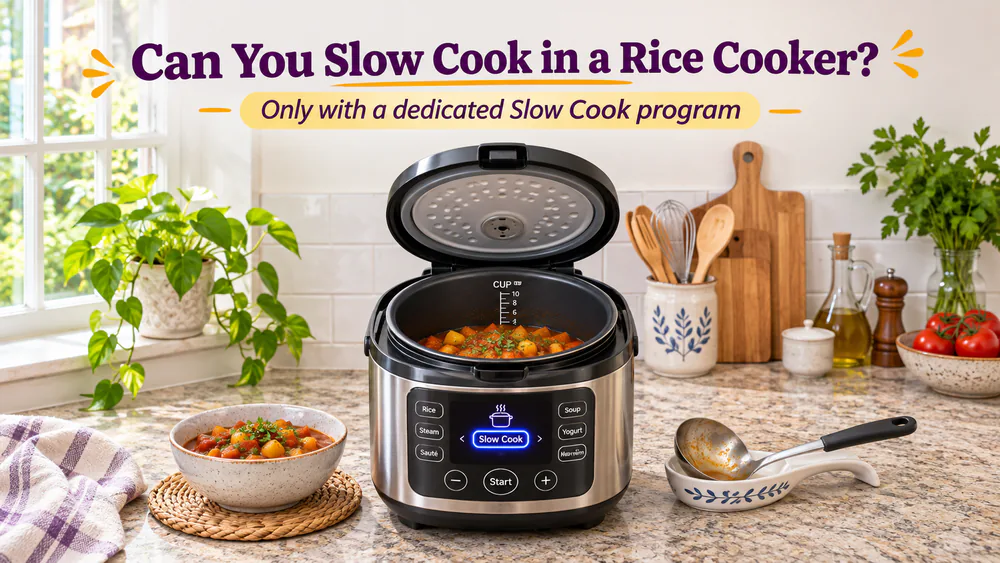
If your rice cooker has a dedicated Slow Cook program, yes. Use that program, not Keep Warm. If it only has Cook and Warm, the short answer is no, because those two settings can't hold a timed, low, steady heat. Below, we explain how to tell which kind you own, how to use the function, and what to cook.
Check Whether Your Rice Cooker Supports Slow Cooking
Start with the control panel, but don't stop there. A digital display and a row of buttons look impressive, yet a digital panel alone doesn't prove the cooker can slow cook. Available modes on multi-function models can include rice, steam, slow cook, saute-then-simmer, oatmeal and keep warm. The only reliable answer is your model's manual, which matters across all rice cookers because features vary so much.
Keep in mind that two settings are easy to confuse. Slow Cook applies cooking heat over a set time. Keep Warm only holds food at serving temperature after it is already cooked, and it must never be used to cook raw ingredients.
Models With a Dedicated Slow Cook Function
On a cooker with a real Slow Cook program, the manual describes how the heat behaves. The Yum Asia Fuji provides one model-specific example. Its Slow Cook program starts hotter, then lowers the heat, and switches to Keep Warm when the cycle ends. It heats to around 95 C before dropping to around 85 C. Those are Fuji's stages, not a rule for every rice cooker.
The Fuji's default Slow Cook time is 2 hours, and you can adjust it up to 8 hours. It has one time adjustment rather than separate Low and High buttons. Its cooking-capacity table lists 1.5 litres for Slow Cook, which is a separate measure from its rice-cup capacity.
Your model will differ. That is the point: read what yours says about heat stages, time range and capacity before you plan a meal.
Basic Cook-and-Warm Models
A basic cooker works differently. The Aroma ARC-302NG is a good example. It stays in Cook until the liquid has evaporated, and its manual tells you not to leave it unattended. That behavior doesn't give you a timed low-heat program.
On the other hand, it can seem tempting to switch between Cook and Warm by hand and call it slow cooking. We wouldn't. Warm is a holding setting, and food that sits at the wrong temperature while it is meant to be cooking is a food-safety problem. The same goes for wedging a switch or toggling it repeatedly to trick the cooker.
Use this quick checklist to sort your own cooker:
- Search the manual for the words "slow cook" or "stew," not just "porridge" or "soup."
- Look for a time you can set on that program, not only a rice timer.
- Check whether the manual lists a capacity for slow cooking, separate from rice cups.
- Confirm that Keep Warm is described as a holding step after cooking.
- If none of this appears, treat the cooker as rice and steaming only.
Warning. Slow Cook cooks food. Keep Warm only holds cooked food hot. Don't use Keep Warm to cook raw meat, poultry or beans, even if a recipe elsewhere says it works.
How to Use a Rice Cooker's Slow Cook Function
The process is simple once you've confirmed the program exists. The key difference is that you must follow the rice cooker's limits rather than assume a conventional slow-cooker recipe will fit. Go in this order.
Check the Manual and Choose a Suitable Recipe
Open the manual first and find the Slow Cook page. Look for the recommended dishes, the maximum fill and the timing range. Then pick a recipe built for that function, ideally one the manufacturer provides.
A recipe written for a conventional 6-quart slow cooker rarely fits a small inner pot. Choose a smaller batch, or scale the recipe down before you start. We cover the adjustments in a later section.
Prepare the Ingredients and Follow the Fill Limits
Thaw meat, poultry and seafood safely before cooking, since frozen cuts spend too long in the temperature danger zone. Cut ingredients into even pieces. Put vegetables in first, because they take longer to cook than meat, and layer the meat on top.
On fill levels, general slow-cooker guidance calls for the pot to be half to two-thirds full. A rice cooker's own program-specific maximum still wins. If the manual gives a smaller figure for Slow Cook, follow it, as that general fraction can't override the rice cooker's specified capacity.
Start cooking right after you finish preparing. Don't leave the filled pot sitting on the counter for hours.
Select the Settings and Check Doneness
Here is the sequence we follow:
- Add the ingredients, with vegetables on the bottom, and the liquid the recipe calls for.
- Close the lid and select Slow Cook, not Cook or Keep Warm.
- Set the time the recipe or manual suggests, within the program's range.
- Keep the lid closed as directed. Each opening lets cooking moisture escape, so check on purpose rather than by habit.
- Near the end, test the food, not the clock. Elapsed time alone doesn't establish that meat is safe.
Use a food thermometer in the thickest part of the meat, away from bone, fat and gristle. Safe minimum internal temperatures are 165 F (74 C) for all poultry, 160 F (71 C) for ground beef and pork, and 145 F (63 C) for whole cuts of beef, pork, veal and lamb. Rest those whole cuts for 3 minutes after they reach temperature.
When the program ends, many cookers switch to Keep Warm. That's fine for holding a finished meal for serving, not for finishing a raw one.
What Can You Slow Cook in a Rice Cooker?
Supported slow-cook programs suit the same family of dishes that a conventional slow cooker handles. These are function-specific examples. They are not permission to run every dish on Cook or Warm.
- Soups and broths with chopped vegetables
- Stews and casseroles
- Chili and curry
- Dhal and other lentil dishes
- Suitable cuts of meat, in pieces that fit the pot
- Oatmeal and porridge, where your model has a mode for it
Fish is the exception worth knowing. It cooks quickly and falls apart if it simmers for hours, so add it later in the cycle, or use a steaming program if your cooker has one.
Be careful with dried beans. We don't have verified guidance for preparing raw dried kidney beans in a rice cooker, so use a recipe written for your model or reach for canned beans instead.
Meat dishes also need realistic expectations. The pot on many rice cookers is deep and narrow, which makes browning chuck beef a batch job because the base doesn't give you the spread-out surface of a frying pan. And in a Cosori, a slow-cooked chuck sauce can taste finished while the beef fat is still chewy and the meat falls short of melting tenderness. That is one model and one dish, but it is a good reminder that tougher cuts may need more time or a smaller piece size than you expect.
Tip. Brown the meat in a separate pan if your cooker's pot is deep and narrow. Then add it to the pot with the vegetables and liquid.
How to Adapt a Slow Cooker Recipe for Your Rice Cooker
Most slow cooker recipes assume a large, wide pot and two clear settings, Low and High. A rice cooker offers neither. Adapt the recipe carefully and keep the batch within your cooker's limits.
Account for Cooking Modes and Temperature Control
There is no universal conversion from a slow cooker's Low or High time to a rice cooker program. Heating stages, controls and quantities differ by model, so use a recipe and timing meant for the supported program wherever you can.
Fuji's manual gives one model-specific estimate: a conventional recipe that takes 7 to 8 hours in a slow cooker can take 3 to 4 hours in the Fuji. Treat that as a starting point for that cooker only. Food quantity, cut size and doneness still decide when the dish is ready.
Keep in mind that a "slow cook" label doesn't guarantee a barely visible simmer all the way through. On the Bamboo, for example, the liquid can boil over during the hot opening phase of Slow Cook. Stay nearby for the first stretch and watch the pot.
Check Capacity, Liquid Requirements and Cooking Time
Capacity is the first thing to shrink. Rice-cup markings on the inner pot don't tell you how much stew it can hold. Use the capacity the manual lists for Slow Cook, and cut a family-size recipe down to match. The Fuji's 1.5 litres is far below what most slow cooker recipes assume.
Liquid is the second. Requirements depend on the recipe and the cooker, so a fixed extra-water rule or a set liquid reduction is unsupported. Lid design, how much moisture the food holds and the cooking program all change how much liquid remains. Follow the model's own recipes and fill limits, and check the pot partway through.
Time is the third. Treat any converted time as a guess, then test for doneness with a thermometer instead of trusting the clock.
Common Problems and What to Check
No single cause explains every problem across every model. Before you blame a sensor or a switch, check the selected program, the recipe quantity, the liquid and the manual. Don't wedge a switch down or keep toggling between Cook and Warm to force a result.
Food Sticks or Liquid Runs Low
Check three things first. Did you select Slow Cook, or did the cooker sit in plain Cook until the liquid evaporated? Is the batch too small or too large for the pot? Did the recipe call for enough liquid for that specific cooker?
Sticking often means the cooker has moved into a hotter stage than you expected. If liquid runs low, remember that every lid opening releases moisture. Keep the lid closed unless the recipe asks you to stir.
Cleanup matters here too. The nonstick bowl on the Cosori releases porridge and compote residue easily with warm soapy water and a soft sponge, though the removable inner lid and steam cap add crevices to clean. On the Bamboo, the bowl and lid wash easily, but condensation collects around the hinges and bowl recess, so wipe it after you open the lid. A boil-over is the bigger headache: overflowing oatmeal in a small Yum Asia cooker can leave sticky residue in parts of the base that you can't reach, which is far harder than washing the removable bowl.
The Cooker Switches Modes or Food Remains Undercooked
If the cooker flips to Warm early, look at the program and the quantity before anything else. A cooker that finished its cycle will move to Keep Warm by design, and a Fuji-style program does that when the time runs out.
If the food is still undercooked, don't leave it on Warm and hope. Warm is not a cooking mode. Instead, restart the supported program for more time, check the temperature with a thermometer, and cut the pieces smaller next time.
Large cuts follow the manual's limits. If the manual doesn't mention them, choose smaller pieces.
Is Your Rice Cooker Suitable for the Meal You Want to Make?
Ask three questions. Does the manual name a Slow Cook program? Does the program's capacity fit the batch you want? Does the dish match what that program is meant for?
If yes to all three, a soup, stew or chili is a reasonable fit. If your cooker has only Cook and Warm, use it for rice and keep the stew for a real slow cooker or a stovetop pot. That's the honest answer, and it avoids a spoiled dinner.
Frequently Asked Questions
Can You Use Keep Warm Instead of Slow Cook?
No. Keep Warm holds cooked food at serving temperature, and it must not be used to cook raw ingredients. Some online advice suggests switching between Cook and Warm as a workaround, but food safety guidance separates cooking from hot holding. Use a real Slow Cook program or another appliance.
Can You Slow Cook Meat in a Rice Cooker?
Yes, if your model has a Slow Cook program and the manual allows it. Thaw the meat first, keep to the capacity and size limits, and check the thickest part with a food thermometer. Poultry needs 165 F, ground beef and pork 160 F, and whole cuts of beef, pork, veal and lamb 145 F plus a 3-minute rest.
Can You Use a Delayed Start for Slow Cooking?
Not for a perishable meal. Some cookers offer a delay timer, but having the button doesn't make it safe. Food safety guidance is to start a prepared slow-cooked meal immediately, so meat and dairy shouldn't sit raw at room temperature before the cycle begins.
Read next
Is Your Rice Cooker Suitable for the Meal You Want to Make?
Explore our kitchen guides for more help choosing and using your appliances.