As an Amazon Associate we earn from qualifying purchases. We may earn a commission from links on this page, at no extra cost to you. Learn more.
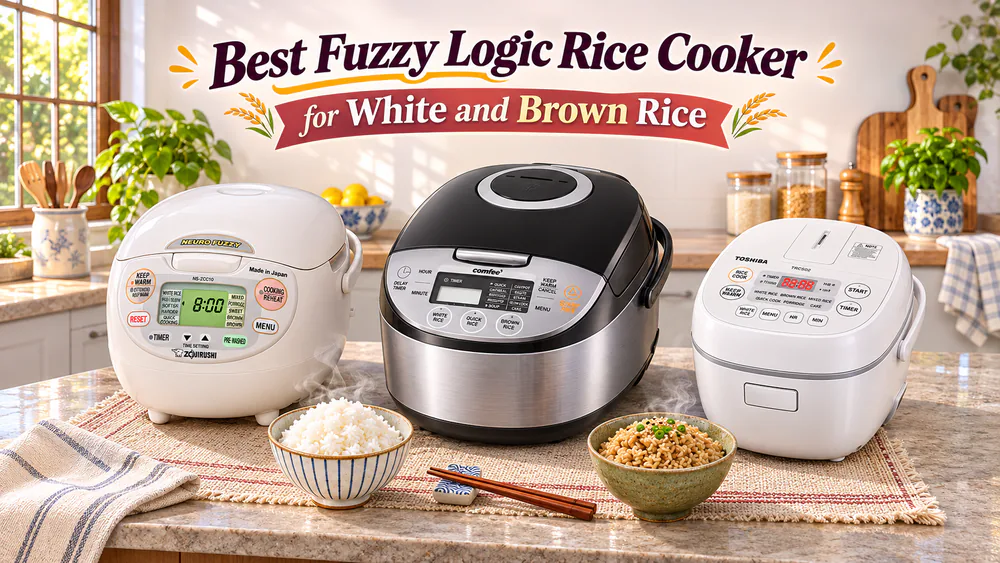
We judged seven fuzzy logic rice cookers on the things that decide whether dinner works: how the white and brown rice turns out, how the keep-warm setting behaves, and how much work the cleanup takes. The payoff of a good fuzzy logic cooker is simple. You measure, press a button, and the cooker adjusts its own heat so the rice comes out even, with no scorched bottom and no gummy top.
Our picks range from a compact three-cup cooker to a ten-cup family model, and from Zojirushi's Neuro Fuzzy line to budget and multi-cooker alternatives. Everything below is a pick we would put on our own counter, with the trade-offs spelled out. You can read how we scored them in the next section, and if you want the wider field first, start with our rice cooker reviews.
How we tested these fuzzy logic rice cookers
We scored every cooker on four things, in this order: rice texture, keep-warm behavior, cleanup, and how much counter space it asks for. White rice is the baseline, because it exposes uneven heating fast. Brown rice and sushi rice come next, since they punish a cooker with weak programs. Then we look at the details that matter every week, such as how the lid comes apart, how clear the water lines are, and how the cord stores.
Our judgments combine each maker's documented programs and specs with the cooking, keep-warm, and cleanup behavior we describe in each review. We do not put a fixed number of weeks or batches on any single cooker, because the rankings rest on how each one handles the same everyday rice jobs, not on a lab schedule.
Selection criteria and evidence sources
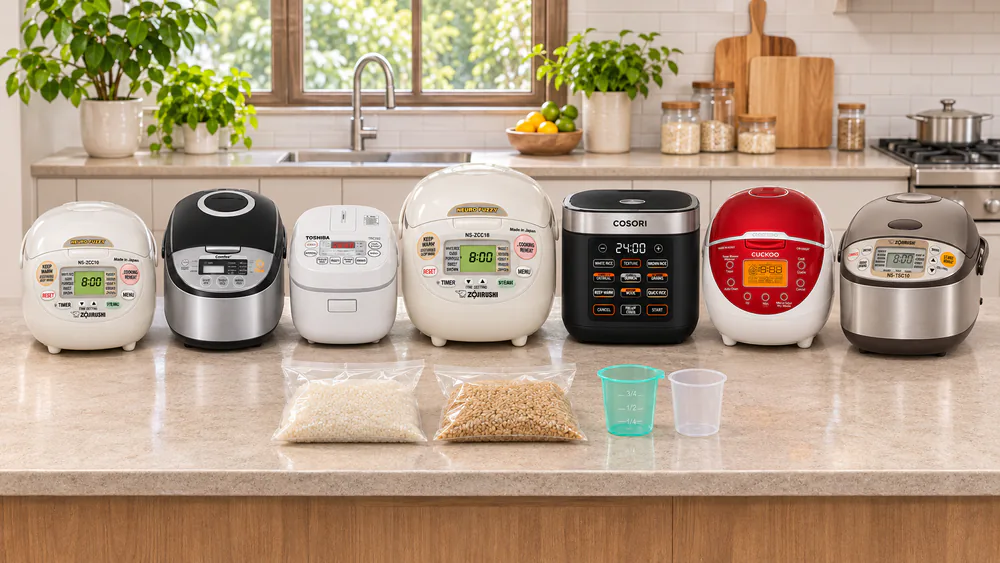
To make the shortlist, a cooker had to use fuzzy logic or a Micom microcomputer that the maker describes as fuzzy logic. It also had to be a model you can buy in the US today with a current manufacturer page. That left us with three Zojirushi models, one CUCKOO, one COSORI, one Toshiba, and one COMFEE.
We used the manufacturer's rated capacity, power, warranty, and manual guidance for every spec in this article. Where a maker's own documents disagree, such as cooked versus uncooked capacity on the large cookers, we say so and use the uncooked figure. Cooked yield changes with the rice and the water, so uncooked cups are the honest way to compare.
The seven cookers we compared.
What our testing shows and its limits
Our editorial rankings are judgments, not lab measurements. We did not use a thermometer rig or run a head-to-head timing study, and we have no lifespan data for any of these cookers. A cooker that makes great rice in our kitchen can still behave differently with a different rice brand or a different water ratio.
We also have not opened the housings to inspect internal parts, so we say nothing about wiring or seals. What we can speak to is the cooking, the keep-warm behavior, the controls, and the cleanup, and that is what the rankings rest on.
Note. Cooked and uncooked capacity are not the same thing. Every capacity in this article is the uncooked rice measured with the cup that comes in the box. A cooker rated for 5.5 uncooked cups makes noticeably more cooked rice than that.
Best fuzzy logic rice cookers at a glance
Seven cookers, one table. Use the capacity column first, because it narrows the field faster than any other spec. Then check the limitation column, which is where each cooker asks for a compromise.
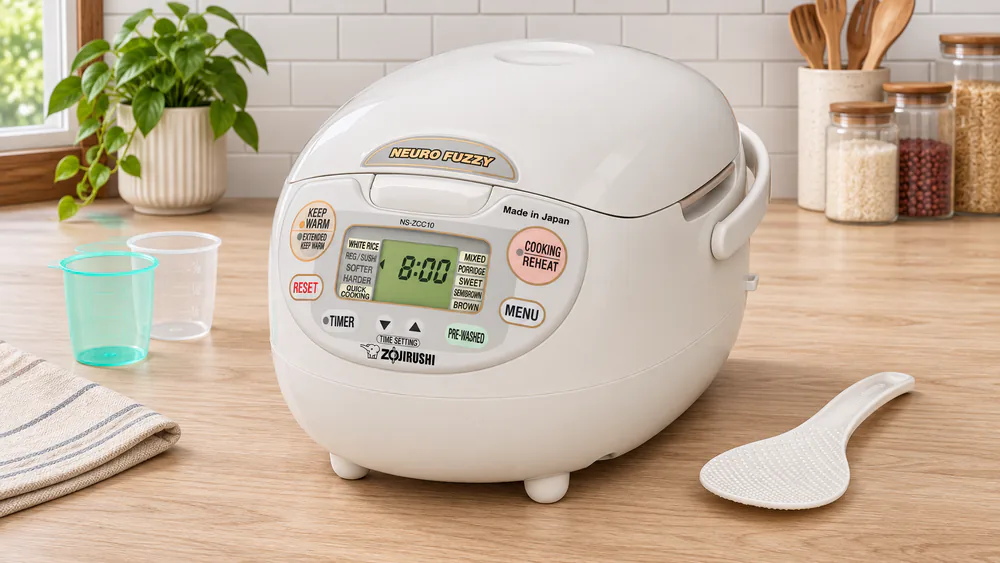
This is the cooker we would buy for a household that cooks rice most days, and the one we measure every other pick against.
Sushi rice is tender and cohesive, jasmine stays fluffy
Curved pan cooks evenly with no hard bottom crust
Keep-warm holds a pleasantly chewy texture through a staggered meal
Retractable cord makes storing it less awkward
Specifications
Capacity
5.5 cups uncooked short-grain white rice
Power
680W
Heating
Direct heat, Neuro Fuzzy control
Minimum batch
1 cup white rice
Brown rice range
1-4 cups uncooked
Warranty
1-year limited
Setting the clock and keeping rice warm
Two habits made this cooker work better in our kitchen. First, we set the clock before touching the timer. The timer counts backward from the hour you want the rice ready, so a wrong clock quietly means dinner at the wrong time. Second, when a pot was going to sit on warm through a long dinner, we mounded the leftover rice in the center of the pot instead of leaving it spread out, and the rice stayed moist rather than drying at the edges. Neither tip appears in the quick-start steps, but both make the lengthy manual worth reading.
Programs and setup
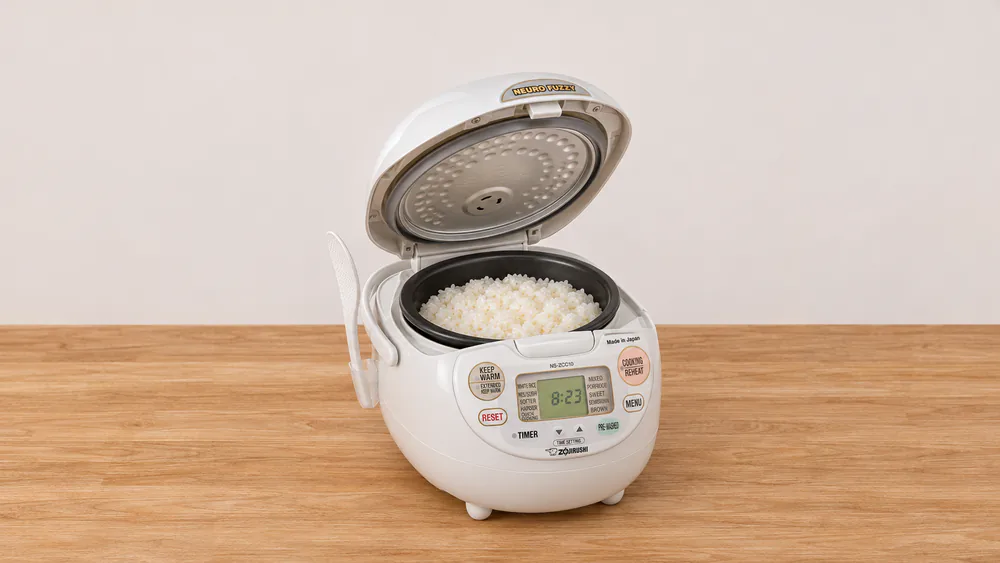
The menu covers white and sushi in soft or firm, mixed, porridge, sweet, semi-brown, brown, rinse-free, and quick, plus regular and extended warming and a reheat setting. The inner lid and spherical pan are removable, and the maker's catalog lists a replacement pan and inner lid.
Pros
Excellent sushi and jasmine rice from one cooker
Even cooking in the spherical pan, no hard crust
Keep-warm holds texture through a long meal
Inner lid, bowl, and vent are easy to clean
Retractable cord and replacement pan and inner lid in the maker's catalog
Cons
Brown rice cycle is slow
Texture gain over careful stovetop cooking is modest
Needs counter clearance beyond its stated footprint
Who should buy it and who should skip it
Buy it if rice is a staple and you want one cooker to handle short-grain, long-grain, and brown without retuning. Skip it if you cook rice twice a month or need a cooker that also bakes and slow cooks. For small households, the Toshiba below is a better fit.
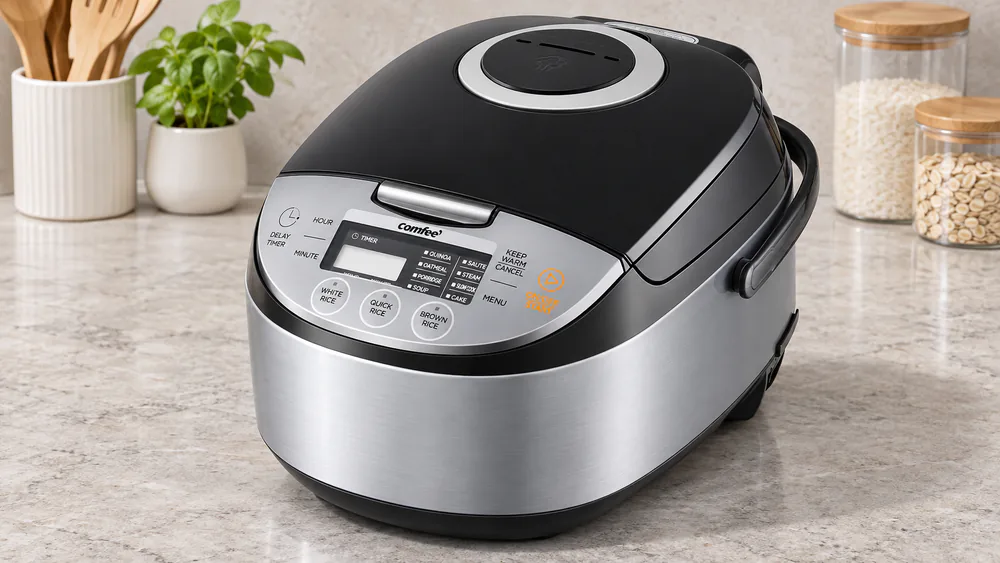
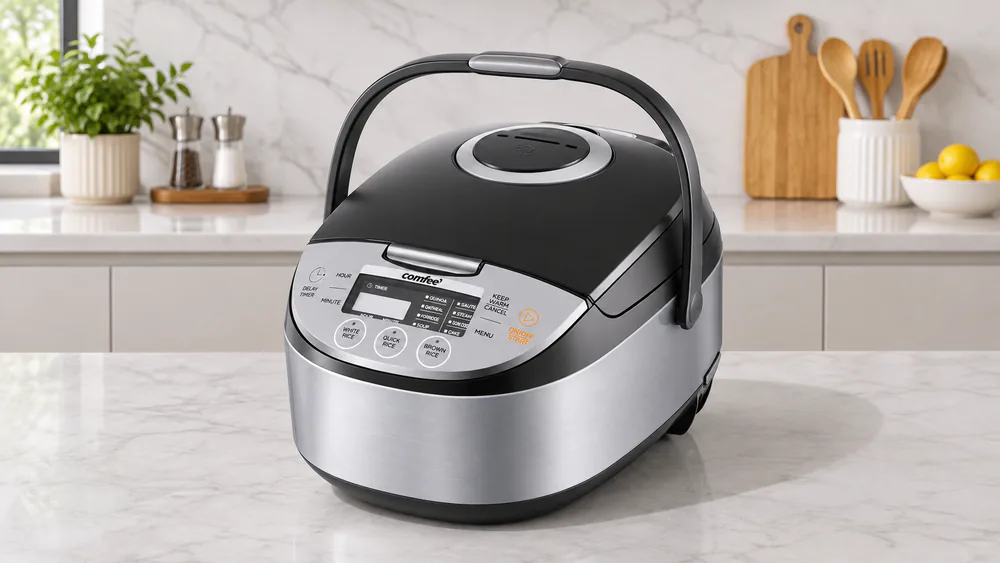
2. COMFEE' 6-Cup Fuzzy Logic Rice Cooker: Best budget candidate
The COMFEE is the cheapest way into fuzzy logic here, and it lacks the polish of the Zojirushi models.
Rice cooks evenly with little intervention
Touch panel wipes clean easily
Nonstick pot releases rice without prolonged scrubbing
Carry handle for moving and storing
Specifications
Capacity
6 cups uncooked, 12 cups cooked
Power
619W
Programs
11 cooking programs
Timer
24-hour delay timer
Warranty
1-year manufacturer
What happens when you lift the lid
The moment to plan around is the lid. When we opened the COMFEE after a cycle, condensation released onto the counter around the cooker. It was not a flood, but it was enough to make us keep a towel next to the cooker and tip the lid away from the touch panel instead of straight up. Once the lid was off, the nonstick pot let go of the rice without a long scrub, and the carry handle made it easy to move the cooled cooker into the cabinet.
Programs and footprint
Fuzzy logic comes with an LCD touch panel, automatic warming, a removable inner lid and steam valve, and a measuring cup and rice spoon. The 11 programs extend into quinoa, oatmeal, soup, saute, steam, slow cook, and cake. Menu names differ between regional product descriptions, so do not count on a dedicated sushi or pasta button. Published dimensions also differ by region, so confirm the exact size for the unit you buy before you clear cabinet space.
Pros
Fuzzy logic at the lowest entry cost here
6 cups uncooked with 11 programs and a 24-hour delay timer
Pot releases rice easily, touch panel wipes clean
Carry handle helps with storage
Cons
Lid opening can drip condensation
Menu names and dimensions vary by regional listing
Less refined texture control than the Zojirushi models
Who should buy it and who should skip it
Buy it if you want fuzzy logic on a tight budget and cook mostly white rice. Skip it if you need sushi-grade texture or a clearly documented footprint for a tight cabinet. In that case, go to the NS-ZCC10 above.
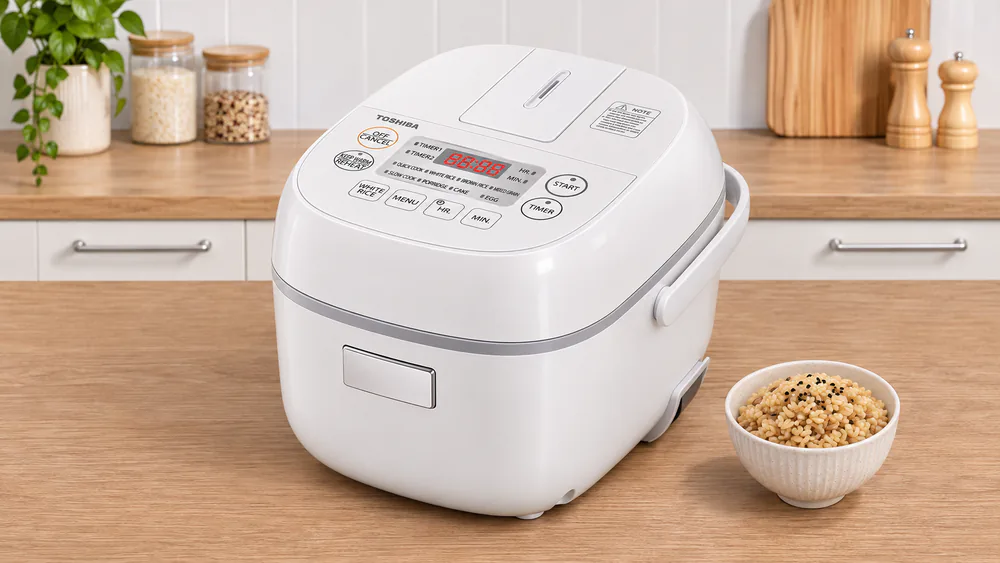
3. Toshiba Mini 3-Cup Rice Cooker: Best for small households
The Toshiba Mini has fewer rice programs than the NS-ZCC10, but its smaller size makes it a sensible pick for one or two people.
Compact body fits small counters
Rice stays hot without drying out while it waits
Porridge and oatmeal work well
Detachable cord and removable steam vent
Specifications
Capacity
3 cups uncooked
Programs
8 cooking functions
Timer
24-hour delay timer
Care
Nonstick pot, hand wash
Warranty
1-year limited
Menu, accessories, and care
The Toshiba Mini combines fuzzy logic with digital controls, keep-warm and reheat, a nonstick pot that needs hand washing, a removable steam vent, and a detachable cord. It includes a measuring cup, spatula, and soup ladle. Its eight functions cover white, quick, brown, mixed grain, slow cook, porridge, and either cake and egg or saute and steam, depending on which product copy you read. Follow the model's manual rather than assuming extra presets.
The weakness is the regular cycle, which felt long for a three-cup batch. If you cook for one, that wait is easy to live with. If you cook for three or four people, you will run out of pot first, and the NS-ZCC18 or COSORI is the better direction.
Pros
Easiest cooker here to place on a small counter
Keeps rice hot without quick drying
Handles porridge and oatmeal alongside rice
Detachable cord and 24-hour delay timer
Cons
Only 3 cups uncooked
Regular cycle feels slow for the batch size
Nonstick pot is hand wash only
Who it suits
Buy it if you live alone or cook for two and want fuzzy logic without a large footprint. Skip it if you regularly serve more than two, or if you need a full set of rice-specific programs.
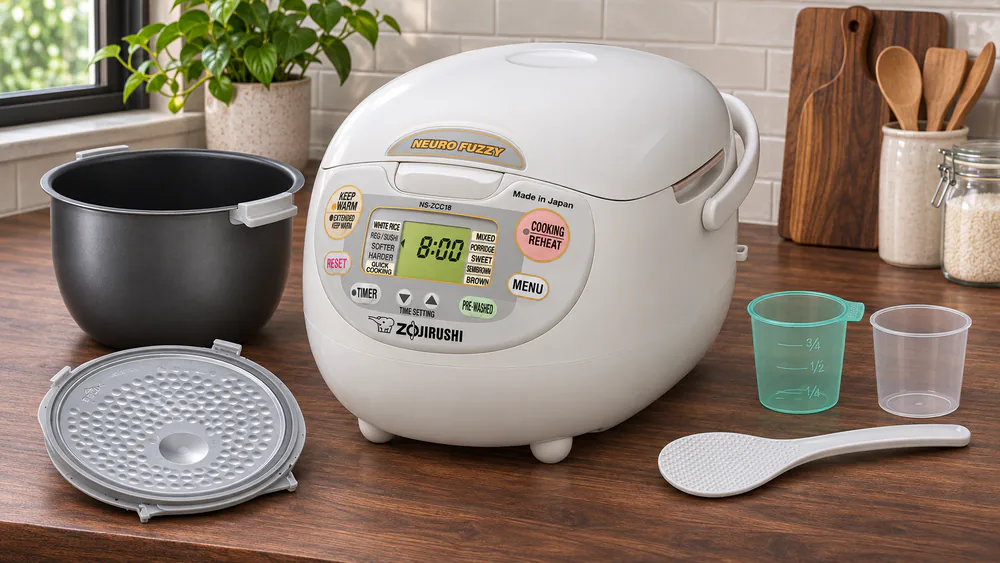
4. Zojirushi NS-ZCC18 Neuro Fuzzy: Best for large households
Measure your counter before anything else, because the NS-ZCC18 is the NS-ZCC10 scaled up and the extra depth is what you will notice first.
Meal-prep brown rice with separate, tender grains
Removable inner lid washes more easily than a fixed cover
Pan handles make lifting the inner pot easier
Same Neuro Fuzzy rice menu as the NS-ZCC10
Specifications
Capacity
10 cups uncooked (manufacturer rating)
Power
1000W
Minimum batch
1 cup white rice
Brown rice range
2-8 cups uncooked
Warranty
1-year limited
Depth, handles, and the brown rice minimum
The body is not especially wide, but it takes meaningful prep space from front to back, so measure the counter and the cabinet shelf before you order. Use the 10 uncooked cup rating when you plan, because cooked-yield wording is inconsistent across product descriptions. The brown rice range also starts higher than on the smaller model: you need at least 2 cups uncooked, so this is not the cooker for a single brown rice portion. The menu, spherical nonstick pan, direct heating, timer, retractable cord, and regular and extended warming all match the NS-ZCC10.
Pros
10 cups uncooked handles meal prep and big families
Brown rice cooks tender and separate in large batches
Removable inner lid and pan handles
Replacement pan and inner lid in the manufacturer's catalog
Cons
Deep body takes real counter space
2-cup minimum for brown rice
Higher cost than the smaller Zojirushi models
Buy it if you cook for four or more people or batch-cook grains for the week. If you usually make small portions, the NS-ZCC10 serves you just as well.
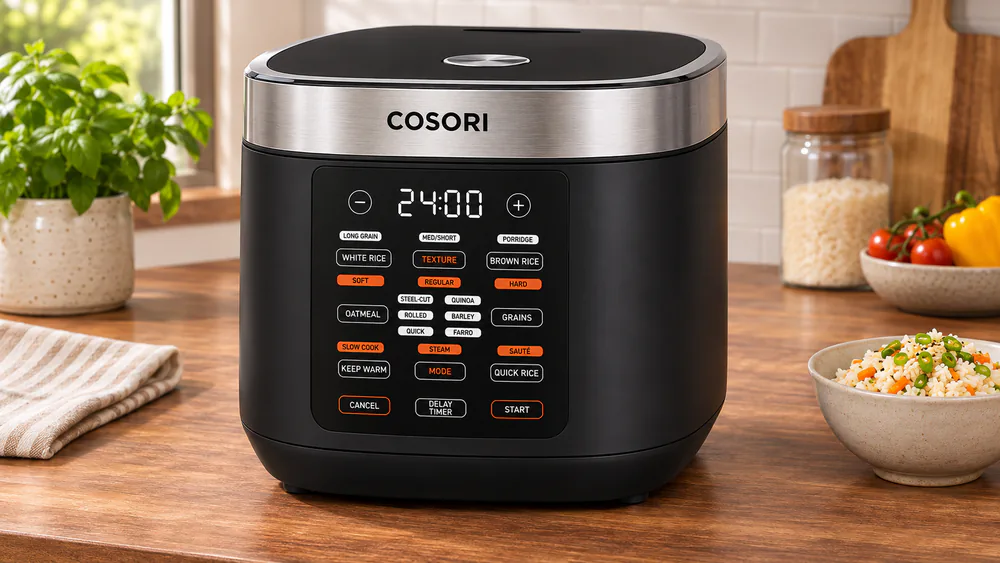
5. COSORI 10-Cup Rice Cooker: Best for versatile cooking
Unlike the rice-only Zojirushi models, the COSORI is a multi-grain cooker with a saute step, and it is a good all-rounder rather than a rice specialist.
Saute aromatics in the same pot before cooking
Coated pot sheds rice residue readily
Dishwasher-safe accessories
2-year limited warranty
Specifications
Capacity
10 cups uncooked (US manual rating)
Power
1000W
Programs
18 cooking functions
Dimensions
12.3 inches deep, 10.6 wide, 9.2 high
Timer
24-hour keep-warm and delay timer
Warranty
2-year limited
Sauteing first, and reading the water lines
The step we reached for most was the saute. We browned onions or garlic in the pot, then added the rice and liquid without moving anything, which meant one fewer pan to wash. The part that slowed us down was the water markings, which were hard to read in dim light, so we learned to measure under the brighter light over the counter. And because there is no pot line for a single cup, the manual's grain-to-water ratio is the guide when you cook 1 cup.
Coating, programs, and storage
The COSORI uses fuzzy logic with a heating plate and top and bottom temperature sensors. The pot is ceramic-coated nonstick, which is a finish, not a solid ceramic pot, and it needs the same gentle utensils as any other coating. The 18 functions include white and brown rice with texture options, oats, quinoa, barley, farro, quick rice, steam, slow cook, and saute, and a stainless steamer and detachable lid and steam cap come with it. Storage takes more depth than a compact cooker. Capacity wording conflicts between the manual and the website, so we use the manual's 10 uncooked cups and do not promise a cooked yield. If you buy direct from COSORI, the store advertises a 30-day return window.
Pros
Saute, steam, and slow cook in the same pot
Handles brown rice, oats, quinoa, barley, and farro
Pot cleans easily, accessories are dishwasher safe
2-year warranty is the longest here
Cons
Water markings hard to read in dim light
Large body needs storage depth
Capacity and cooking-stage details conflict between manual and website
Who it suits
Buy it if you want one appliance for rice, grains, and one-pot meals, and you value the longer warranty. Skip it if rice texture is your whole priority, since the Zojirushi models are better rice specialists, or if you live with a small cabinet.
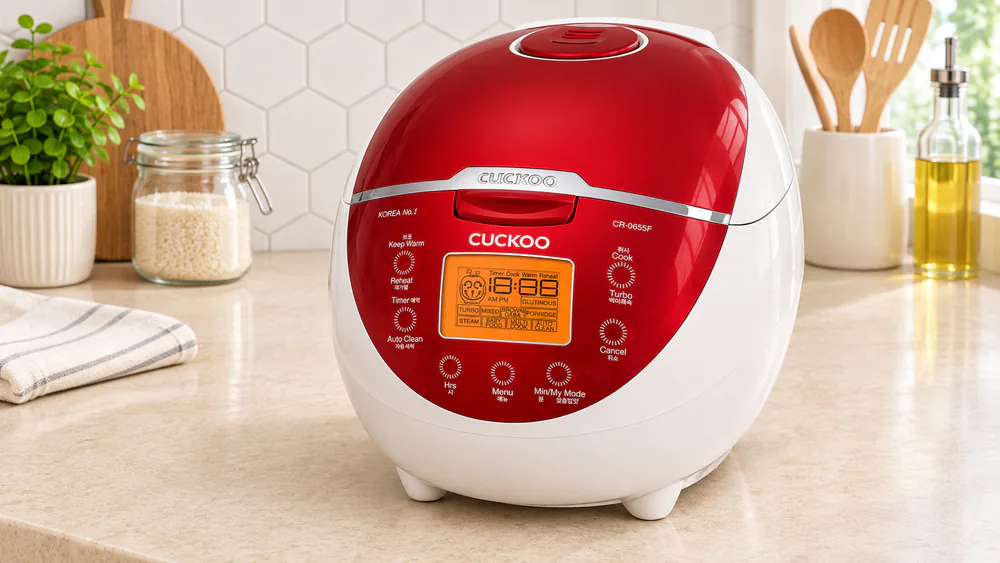
6. CUCKOO CR-0655F Micom Rice Cooker: Best midrange candidate
The Zojirushi models lean on tuned defaults, but the CUCKOO hands you the controls, at the cost of a fussier cleanup routine.
My Mode tunes rice softer or firmer
Nonstick bowl releases rice easily
White/glutinous, mixed/brown, GABA, and porridge programs
Auto-clean and delay timer
Specifications
Capacity
6 cups uncooked, 12 cups cooked
Dimensions
13 L x 9.4 W x 8.7 H inches
Heating
Heating plate, non-pressure
Voice guide
None
Warranty
1-year limited
Putting the steam cap back together
Cleanup is where the CUCKOO asks the most of you. After washing, the steam cap took care to reassemble, and we slowed down to seat each piece rather than forcing it. The drainage dish then added its own emptying and cleaning step on top of washing the bowl. We also noticed spitting at the steam outlet with turbo mode or high water levels, so we avoided adding too much water.
Programs and replacement pot
The CR-0655F is a Micom fuzzy logic cooker with a heating plate and no pressure cooking. Programs include white and glutinous, mixed and brown, GABA, porridge, steam, multi-cook, and turbo, plus warming, reheat, and a delay timer. Program totals are counted differently across listings, so compare the named functions rather than a single number. The nonstick coating can bubble or peel over time, so replacement-pot support matters. The maker catalogs a replacement pot, but one compatibility sentence contains a different model code, so confirm the part number before you order.
Pros
My Mode makes texture easy to tune
Nonstick bowl releases rice cleanly
6 cups uncooked in a moderate footprint
Auto-clean, warming, and delay timer
Cons
Steam cap is fiddly to reassemble
Drainage dish adds a cleaning step
Turbo and high water levels can spit
Coating can bubble or peel, so check replacement pot fit
Buy it if you want to adjust texture to your family's taste and do not mind a few extra cleaning steps. Skip it if you want the simplest possible cleanup, or if you rely on voice prompts, since this model has no voice guide.
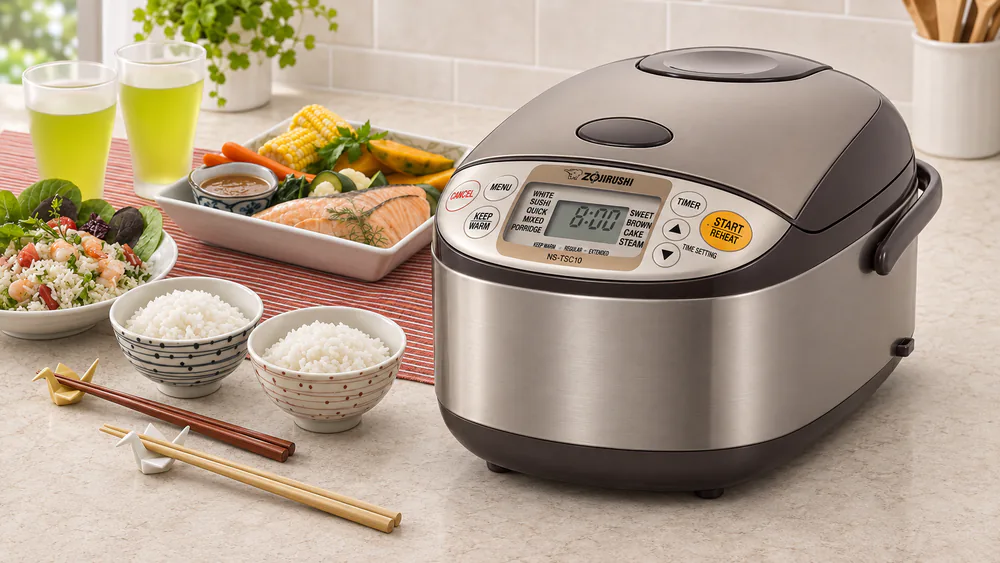
7. Zojirushi NS-TSC10 Micom Rice Cooker: Best Neuro Fuzzy alternative
The NS-TSC10 is the Zojirushi that asks you to plan ahead and rest your rice, using Micom fuzzy logic and conventional heat instead of Neuro Fuzzy and direct heat.
Small batches cook as evenly as large ones
Sushi rice releases cleanly
Retractable cord reduces loose cable
Steaming basket included
Specifications
Capacity
5.5 cups uncooked short-grain white rice
Power
610W
Dimensions
10-1/8 x 14 x 8-1/2 inches (W x D x H)
Heating
Conventional heat, Micom fuzzy logic
Warranty
1-year limited
Resting quick-cycle rice and seating the lid
The quick cycle taught us to wait. Rice we opened immediately came out tackier than we wanted, and a short rest with the lid closed improved the texture. The standard cycle rewards planning ahead, so we never treated this as a last-minute cooker. Putting the pot back in had its own quirk: the lid needed an extra nudge before the pot seated easily. The handle, buttons, and hinge felt sturdy through regular use, though the cord retraction can become slower over time.
Programs and storage
The NS-TSC10 covers white and sushi, mixed, porridge, sweet, brown, quick, cake, and steam programs, with regular and extended warming, reheat, and a timer. It has a stainless exterior and a removable lid. It is made in China, while the NS-ZCC models are made in Japan. The accessories do not all nest inside the cooker at once, so expect a small storage puzzle.
Pros
Even cooking at small and large batch sizes
Sushi rice releases cleanly, easy routine cleanup
Steaming basket and cake setting add range
Retractable cord keeps the counter tidy
Cons
Long standard cycle needs planning
Quick-cycle rice needs a rest
Accessories do not nest inside at once
Costs about as much as the NS-ZCC10 without Neuro Fuzzy
Buy it if you want a Zojirushi with a steaming basket and do not need Neuro Fuzzy, and skip it if rice quality is your only goal, because the NS-ZCC10 offers more for similar spending.
What fuzzy logic means in a rice cooker
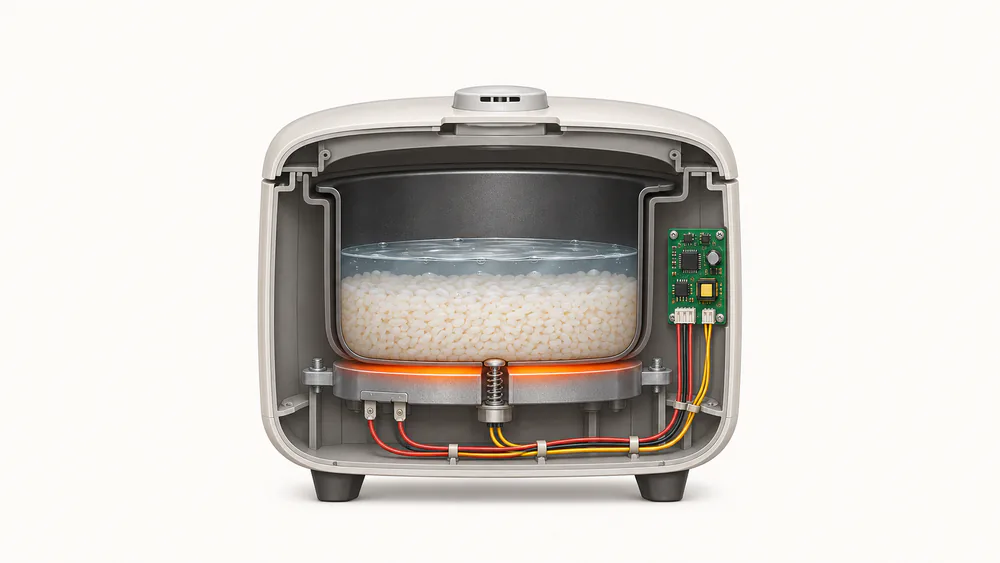
Fuzzy logic is a way for a cooker to make small decisions on its own. Instead of a single on-off thermostat, it reads the temperature and adjusts heat and timing as the rice cooks. The practical result is more forgiving rice, particularly when you change batch size or switch between white and brown.
Fuzzy logic, Micom, and Neuro Fuzzy explained
These three terms overlap. Fuzzy logic describes the automatic control. Micom means microcomputer control, and the Micom models in this roundup use fuzzy logic as well. Neuro Fuzzy is Zojirushi's own implementation of the idea. Not every Zojirushi uses it, since conventional models also exist.
So a Micom cooker is not worse by definition. In our picks, the NS-TSC10 and CUCKOO are Micom cookers, and both make good rice. What you gain with Neuro Fuzzy is a more refined set of programs and, in the NS-ZCC models, direct heating with a curved pan.
How fuzzy logic differs from induction heating and pressure cooking
Fuzzy logic describes control. Induction describes how heat is generated, and the two can exist in the same cooker. Pressure is a separate cooking mechanism. None of the seven cookers here uses induction heating or pressure, so if you see those words on a listing, you are looking at a different class of cooker.
For a typical household, fuzzy logic is the sweet spot. It adds consistency over a basic one-button cooker without the cost and complexity of an induction pressure model.
How to choose a fuzzy logic rice cooker
Start with the household, then the rice, then the counter. Those three decisions eliminate most of the field before you ever compare features. If you want to confirm a ratio before you buy, check rice cooker water ratios by rice type first.
Uncooked capacity, cooked yield, and minimum batch size
Buy for uncooked cups. A 3-cup cooker suits one or two people, a 5.5 to 6-cup cooker suits most families of three or four, and a 10-cup cooker suits large households and meal prep. Minimum batch matters as much as maximum. The Zojirushi NS-ZCC10 and NS-ZCC18 both cook 1 cup of white rice, but the NS-ZCC18 needs 2 cups of brown rice at minimum.
Cooked yield varies with the rice and the water, and makers label it inconsistently. Plan with the uncooked figure and treat any cooked number as a loose guide.
Rice settings, cooking time, and texture preferences
Look for the rice you actually eat. If you cook sushi rice and jasmine, a cooker with soft and firm settings and a sweet or mixed program is worth the extra cost. If you eat mostly brown rice, plan your time, because the NS-ZCC10 takes much longer on brown rice than most people expect, and we would plan for a similar wait on the other brown rice programs.
Texture control also matters. CUCKOO's My Mode and COSORI's texture options let you adjust, while the Zojirushi models lean on well-tuned defaults.
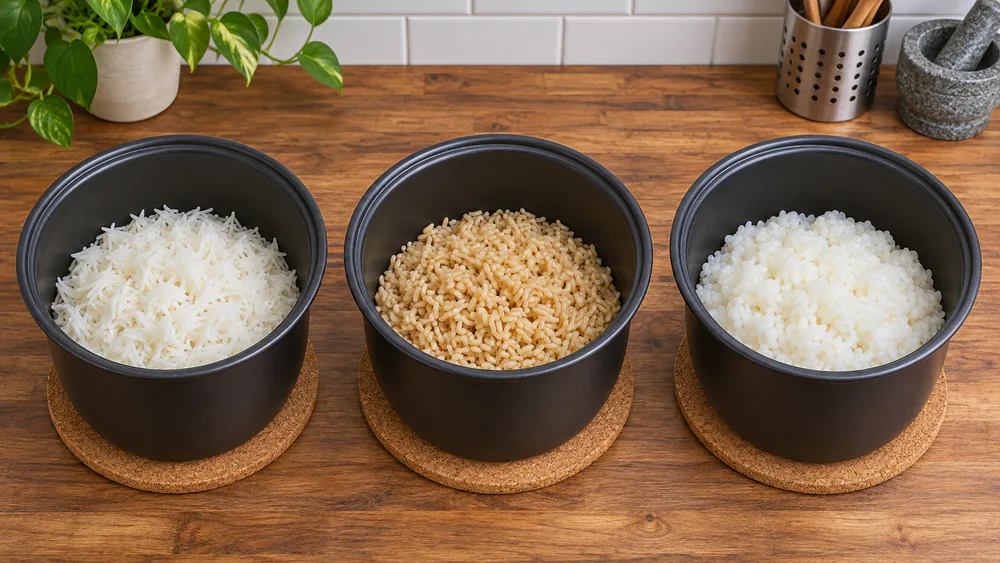
White, brown, and sushi rice each ask something different of the cooker.
Keep-warm features, timers, and everyday controls
Keep-warm is where good cookers separate. The NS-ZCC10 held a pleasantly chewy texture through a staggered meal, and the Toshiba kept rice hot without drying it quickly. A timer maximum is not a promise that texture stays unchanged for that long, so do not plan to hold rice all day.
Check the controls too. Clear water lines, a readable panel, and a delay timer you can set without the manual save time every week. COSORI's markings were hard to read in dim light, and the Zojirushi timer depends on the clock being set correctly.
Inner pot coatings, cleaning, and replacement parts
Every pot here is a nonstick finish, and COSORI's is ceramic-coated. That does not make it solid ceramic or immune to wear, so use a soft utensil and wash gently. Wash the removable lid and vent after each use, remove starch from the vents, dry the pot's exterior, and keep the sensor contact area clean.
Replacement parts are worth checking before you buy. Zojirushi's catalog includes a replacement cooking pan and inner lid for the NS-ZCC models, and CUCKOO catalogs a replacement pot for the CR-0655F. For the other models, we could not confirm replacement-pan availability, so do not assume it.
Price, warranty, and long-term value
Value here falls in tiers. The COMFEE is the cheapest, the Toshiba, COSORI, and CUCKOO sit in the middle, and the Zojirushi models sit at the premium end, with the NS-ZCC18 the biggest splurge. Paying more buys better rice programs and keep-warm behavior more than extra features.
Warranty tells a story too. COSORI offers 2 years, and the others carry 1 year. A coating that wears is the usual long-term complaint with any nonstick pot, which is why replacement pans carry real value. If you cook rice weekly, a premium Zojirushi with parts support is the safer long-term buy. If you cook it occasionally, a budget model costs less per use.
Common mistakes
The most common mistake is buying on cooked capacity. A listing that says 10 cups may mean cooked, and the real uncooked capacity can be half of that. Always check uncooked cups.
The second mistake is measuring with a US cup. Use the supplied 180mL rice cup and the water line for your grain. Mixing measuring tools is a quiet way to get mushy rice from a good cooker.
Fuzzy logic adjusts the heat, but it does not measure for you.
The third mistake is treating the timer as a hold button. Rice kept warm for many hours dries and yellows no matter what the maker's timer says. Cook closer to serving time and use warming for the length of one meal.
Is a fuzzy logic rice cooker worth buying over a basic one?
If you cook rice weekly, yes. The cooker adjusts heat for different batch sizes and rice types, so results stay consistent when you switch grains. The gain over careful stovetop cooking is convenience more than a dramatic texture jump. If you cook rice rarely, a basic cooker is enough.
How long can rice stay on keep-warm?
Longer than a meal is a gamble. A timer maximum is not a promise that texture stays unchanged for that long, so rice held for many hours dries and yellows. Plan keep-warm for the length of one dinner, and mound leftover rice in the center of the pot to help it stay moist.
Does a dead clock battery stop a Zojirushi from cooking?
No. On the NS-ZCC models, a depleted clock battery only affects timekeeping while the cooker is unplugged. Cooking still works after you reset the clock while it is connected, and battery replacement is a service task, not a reason to retire a working cooker.
Can the nonstick pot go in the dishwasher?
Not by default. The Toshiba's pot needs hand washing and the COMFEE is listed for hand washing, while the COSORI's accessories are dishwasher safe. Check your model's manual for the pot itself, use soft utensils, and wash the removable lid and vent after each use.
What should I do if my rice comes out too soft?
Check your measuring first. Use the supplied 180mL rice cup and the water line for your grain, not a US measuring cup, because mixing tools is a quiet way to get mushy rice. On the NS-TSC10, quick-cycle rice also improves with a short rest before opening the lid.
Final verdict: Which fuzzy logic rice cooker should you choose?
Think of the choice as a household question rather than a ranking. For one or two people, the Toshiba Mini is the right size. For three or four people who want the best rice, the NS-ZCC10 fits. For six or more or serious meal prep, step up to the NS-ZCC18. If you want fuzzy logic on the lowest budget, the COMFEE is the pick, and the COSORI is the one if you want a single pot for rice, grains, and sauteing.
The CUCKOO suits texture tinkerers, and the NS-TSC10 suits someone who wants a Zojirushi with a steaming basket. Whichever you choose, measure uncooked cups with the supplied cup, and check counter depth and replacement-pan options before you buy.