As an Amazon Associate we earn from qualifying purchases. We may earn a commission from links on this page, at no extra cost to you. Learn more.
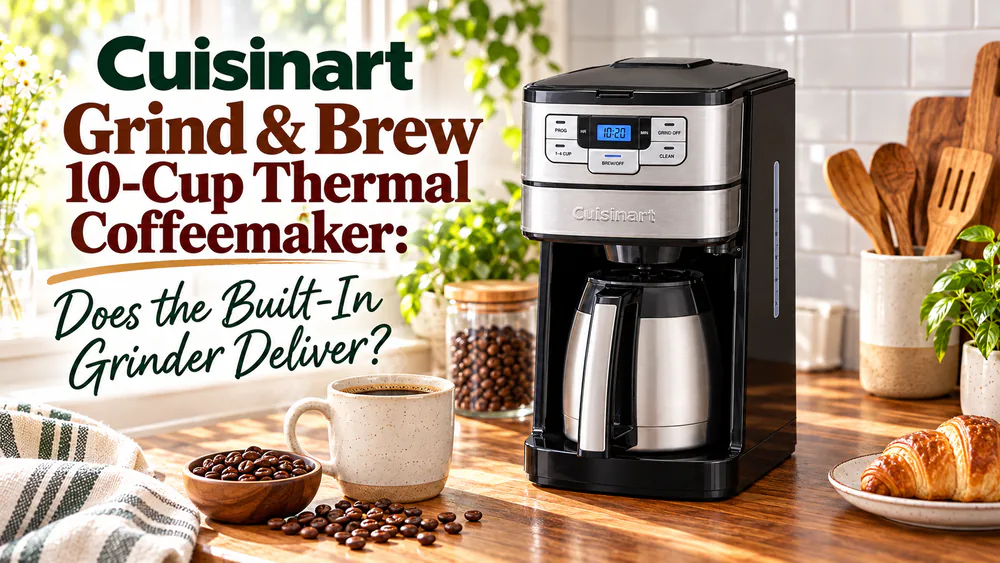
The Cuisinart Automatic Grind & Brew 10-cup thermal coffeemaker (model DGB-450NAS) grinds whole beans and brews them into an insulated carafe, all from one countertop machine. You fill the water, add beans, press a button, and get coffee. It can also start itself on a 24-hour timer, so a pot is ready when you wake up.
What we noticed first is the trade. Freshly ground coffee tastes satisfying and the programmed morning pot is genuinely convenient. The price of that convenience is a loud grinder and a wet grinder chamber you have to dry after every pot.
We reviewed it the way we review everything in our kitchen appliance coverage: by asking whether the daily routine feels better or worse than a plain drip brewer.
This is a good fit if you want fresh-ground coffee with almost no morning effort. The coffee tastes satisfying, the timer makes a prepared pot easy, and the thermal carafe keeps it warm between servings. We would skip it if you sleep near the kitchen or hate washing and drying small parts.
Grinds whole beans or brews pre-ground coffee
24-hour programmable start
1-4 setting for small batches
Double-wall insulated thermal carafe
Permanent gold-tone filter included
Specifications
Capacity
10 cups (5 oz each)
Grinder
Blade, fixed medium grind
Carafe
Thermal
Warranty
Limited 3-year
Pros
Freshly ground flavor from a single machine
Programmable start for a prepared morning pot
Thermal carafe keeps coffee warm without a hot plate
Pre-ground option with the grinder switched off
Simple button controls
Cons
Grinding is loud enough to wake a sleeper nearby
Condensation collects in the grinder cup and lid
Opaque carafe hides how much coffee is left
Fixed medium grind, with no strength selector
Beans must be added for every batch
How We Tested This Coffee Maker
We judged the machine on the things that decide whether you keep using it: taste, how loud the grinding is, how the carafe pours and holds heat, how easy it is to fill, and how much work cleanup takes.
We looked at how the coffee tastes, how the grinder sounds, how the carafe keeps heat, and how much drying the grinder parts need, using our own judgment of the daily routine rather than a lab protocol.
Cleanup effort weighs heaviest in our judgment, because that is where grind-and-brew machines win or lose.
Which Cuisinart Grind & Brew Model Is This?
Cuisinart sells several machines with similar names, and shoppers mix them up. This review covers the DGB-450NAS, which is the current US product designation for the DGB-450 family. It is the 10-cup thermal version.
Note. Some retail titles for this machine incorrectly describe a glass carafe. The DGB-450NAS is the thermal model, so check the model number and the carafe photos before you order.
Model Number and Key Specifications
The numbers below are the ones we could confirm for this exact model. A rated "cup" is about 5 oz, so the 10-cup rating works out to roughly 50 oz. That is about four 12 oz mugs on paper, though the grounds absorb some water and your real yield depends on mug size and dose.
Cuisinart DGB-450NAS specs
Model
DGB-450NAS
Capacity
10 cups (about 5 oz per cup)
Carafe
Double-wall insulated thermal
Grinder
Blade, fixed medium grind
Programming
24-hour start
Small batch
1-4 cup setting
Filters
Permanent gold-tone filter and charcoal water filter
Dimensions
8.13 x 9.98 x 15.5 in (lid closed)
Warranty
Limited 3-year
How It Differs From the DGB-650BC, DGB-850 and DGB-2
The DGB-650BC is a separate, older 10-cup thermal model, not another name for the DGB-450. It is discontinued in the US manufacturer catalogue, and we do not apply its details to our machine.
The DGB-850 is also discontinued. It uses a burr grinder with a half-pound storage hopper and offers regular, bold and extra-bold strength settings, none of which the DGB-450NAS has.
The DGB-2 is a single-serve machine with a conical burr grinder and a reusable filter cup, built for one mug at a time. It is a different kind of brewer, not a smaller version of this one.
Grinder and Brewing Features
Whole-Bean Grinding and Pre-Ground Coffee
The blade grinder runs at a fixed medium grind. There is no grind-size dial, and there is no strength selector. You control strength by how many beans you add, and you add them for each batch.
When you want pre-ground coffee, put it in the filter basket and select Grind Off. This is also the quieter way to brew, and it is the backup plan if the grinder ever gives trouble.
Use either a paper filter or the permanent filter, never both together. The permanent filter can pass fine sediment, so a paper filter gives a cleaner cup if that bothers you.
Programmable Brewing and Small Batches
The 24-hour timer is the feature that makes the machine feel useful. Load the water and beans at night, set the start time, and the pot is ready when you walk in. Programming is simple and uses plain buttons.
The 1-4 setting suits a couple of mugs. Brew Pause lets you pour early, but you need to return the carafe within 20 seconds to avoid overflow.
Coffee Quality and Thermal Carafe Performance
Flavor, Consistency and Brew Temperature
Freshly ground coffee tastes satisfying from this machine, and it is the main reason to choose it over a standard drip brewer. Because the grind size is fixed, results depend on your beans and dose rather than on tuning. Once you find a dose you like, it repeats well.
We have no measured brew-temperature curve for this exact model, so we will not quote one.
Heat Retention, Pouring and Practical Capacity
The thermal carafe keeps coffee warm between servings. It does not guarantee a fixed temperature or heat for an entire day, so plan to drink within a few hours. Preheat the carafe with hot water first, which the manual recommends and which matters most for small batches.
Because the carafe is opaque, you cannot see how much coffee is left. You learn by weight and by the sound of the pour. On capacity, expect about four generous mugs from a full pot, with the caveat that the exact count depends on your mug size.
Setup and Everyday Use
Filling, Controls and Countertop Clearance
Setup is easy. Do a water-only rinse before the first brew, then fit the filter and carafe. If the lid is not seated correctly, the machine beeps and refuses to run, which is a helpful signal rather than a fault.
The machine stands 15.5 inches tall with the lid closed. Under low cabinets, that height makes filling awkward. Pulling the machine forward on the counter makes filling and cleaning much easier.
Grinder Noise and Morning Convenience
Grinding is the loudest stage, and it is loud enough to disturb someone sleeping near the kitchen. That matters because the timer exists to brew before you wake.
If your bedroom shares a wall with the kitchen, use the timer with pre-ground coffee and Grind Off. You lose the fresh-grind advantage on those mornings, but you keep the quiet and the ready pot.
Cleaning and Maintenance
Cleaning the Grinder, Filter Basket and Carafe
Cleaning is the real cost of ownership. Steam rises into the grinder chamber, and condensation collects in the grinder cup and lid. That adds a drying step after every pot, or damp grounds can cling to the parts.
The manual says to clean and dry the removable parts after every use. You can wash the grinder basket, lid, filter basket and cover by hand or on the dishwasher's upper rack, and the carafe and its lid are upper-rack safe as well. Keep water away from the exposed motor area.
If the grinder ever runs noisily without grinding beans, routine surface cleaning may not solve it. Switch to pre-ground coffee while you sort it out.
Descaling and Routine Care
A red CLEAN indicator tells you when it is time to descale using the self-clean function. Descaling clears mineral buildup, but it does not replace washing coffee residue off the removable parts.
Replace the charcoal water filter every 60 days or 60 uses, and more often if your water is hard. We do not give a vinegar ratio here, because we have not verified one for this model. Follow the supplied manual instead.
Tip. Wipe out the grinder chamber and dry the cup and lid right after you pour the first mug. By the time you finish breakfast, the parts are dry and ready for tomorrow's beans.
Customer Reviews: Living With It Day to Day
What Works
Freshly ground coffee tastes satisfying, and programming makes a prepared morning pot convenient. The thermal carafe keeps coffee warm between servings, though it does not hold a fixed temperature or stay hot all day.
What Wears on You
Grinding is loud enough to disturb someone sleeping near the kitchen. Condensation collects in the grinder cup and lid, and the opaque carafe hides how much coffee remains. The grinder can also run noisily without grinding beans, and routine surface cleaning may not fix that.
We cannot give a typical lifespan or a failure rate for this model. Replacement grinders, grinder lids, filter baskets and water-filter holders are catalogued, though stock varies. The limited 3-year warranty covers the machine.
A grind-and-brew machine trades a little of your morning for fresher coffee. The grinder cleanup is the price.
Value and Alternatives
Other Grind-and-Brew Coffee Makers
The DGB-450NAS sits in the middle of the range. The 12-cup DGB-400NAS is the cheaper sibling with a glass carafe, the same footprint and similar blade-grinder behavior. Its grinding is loud and its chamber needs cleaning after each pot. Our Cuisinart 12-cup Grind & Brew review covers that machine in full.
If you only brew one mug at a time, the DGB-2 costs more and brings its own fuss: the reusable cup must be emptied between drinks, and loose grounds can spill. Choose it for single servings, not for filling a thermal pot.
A Separate Grinder and Drip Coffee Maker
A standalone burr grinder and a simple drip brewer give you better control of grind size and fewer parts to dry inside a hot machine. The cost is two appliances and more counter space. Choose the all-in-one if you value one-button simplicity, and choose the pair if you care more about grind quality than convenience.
Common Questions Before Buying
Does the 24-hour timer work with the grinder?
Yes. Load the water and beans the night before, set the start time, and the machine grinds and brews on schedule. Switch to Grind Off with pre-ground coffee if the noise would wake someone.
Can I leave beans in the grinder overnight?
There is no storage hopper. You fill beans for each batch, so load them just before the timer starts rather than keeping a supply in the machine.
Which Cuisinart Grind & Brew has a hopper and strength selector?
The discontinued DGB-850 has a half-pound sealed hopper, a burr grinder and regular, bold and extra-bold settings. The DGB-450NAS has none of these.
Is the DGB-450NAS still sold, and is the carafe glass?
Its manufacturer page is active, but some retail titles wrongly say glass. Confirm the thermal carafe in the photos before you order.
Is the carafe dishwasher safe?
The manual lists the carafe and lid as upper-rack dishwasher safe, along with the grinder basket, lid and filter basket.
Final Verdict: Is It Worth Buying?
If the grinder noise or the drying routine sounds like too much, the 12-cup DGB-400NAS is the cheaper glass-carafe alternative with the same footprint, and a separate burr grinder paired with a plain drip brewer is the better route for grind control.
Key takeaway. Best fit: a household that wants a ready pot on a timer. Decisive trade-off: a loud grinder and daily drying. Skip it if you sleep near the kitchen or want adjustable grind and strength.