As an Amazon Associate we earn from qualifying purchases. We may earn a commission from links on this page, at no extra cost to you. Learn more.
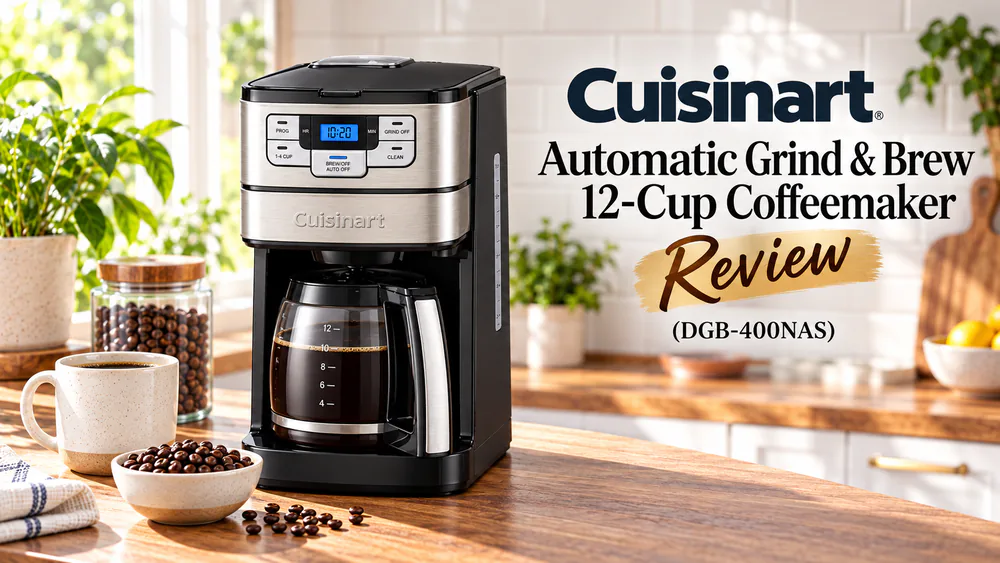
If you want fresh-ground coffee but have no room for a separate grinder and no patience for a multi-step routine at 6 a.m., an all-in-one machine is tempting. The Cuisinart DGB-400NAS promises exactly that: beans go in at night, and a full pot is waiting in the morning. What we wanted to know was what that convenience costs you in noise, cleanup and cup quality.
We ran it as part of our look at kitchen appliances that promise to shave minutes off the morning. The short version is that the coffee is pleasant rather than exceptional, and whether the trade-offs are acceptable depends on how you start your day.
Quick verdict: Who is this coffee maker for?
The DGB-400NAS suits a household that drinks one full pot most mornings and wants whole beans ground right before brewing.
Fresh beans, a programmable start and a 12-cup glass carafe in one footprint are the reasons to buy this machine. The coffee has a lively aroma and a fuller flavor than stale pre-ground coffee, and the labelled controls are easy once the brew time is set. The trade-offs are just as clear to us: the grind phase is loud enough to intrude on a quiet early-morning kitchen, the blade grinder produces uneven particles, and the grinder parts need to come out and be cleaned after every pot.
How We Tested the Cuisinart Grind & Brew
We score every appliance with a motor the same way: performance first, then noise, then how much work it asks of you every day, and finally whether it is built to keep going. For this machine that meant four questions: how the coffee tastes, how loud the grinder is, how easy the controls are to live with, and how much cleanup each pot creates.
We checked limits and care steps against the manufacturer's manual for this exact model, and we kept findings from other Cuisinart models out of the scoring so nothing here is borrowed from a different machine.
Which Cuisinart Grind & Brew model are we reviewing?
Cuisinart sells several Grind & Brew machines, and the model numbers are easy to confuse. This review covers the DGB-400NAS only: the 12-cup version with an integrated blade grinder and a glass carafe. We have kept specifications from other models, including the DGB-900BC, DGB-550BKP1 and DCC-1200, out of this article so that nothing here is borrowed from a different machine.
DGB-400NAS specifications at a glance
Cuisinart DGB-400NAS specifications
Model
DGB-400NAS
Capacity
12-cup glass carafe
Grinder
Integrated blade grinder
Timer
24-hour programmable brew start
Auto-off
Adjustable from 0-4 hours
Small batch
1-4 cup setting
Dimensions
8.13 in long x 9.98 in wide x 15.5 in high
Filters
Permanent gold-tone filter or #4 basket paper filter
Water filter
Charcoal filter
Warranty
3-year limited warranty
A "cup" here means roughly 5 oz, so the 12-cup label does not translate into twelve full mugs. Nominal capacity works out to about five 12 oz mugs before brewing losses, and the real yield depends on your mug size, how full you fill it and how much water the grounds hold back.
How it differs from other 12-cup Cuisinart models
The DGB-400NAS uses a blade grinder, not a burr grinder, and that single design choice shapes most of what follows: the noise, the grind consistency and the cleanup. If you want a grinder with more control, look at the other models in our Cuisinart coffee maker with grinder guide rather than assuming they share the same hardware. Always confirm the exact model number before you buy.
Grinding and brewing performance
Grinder design, consistency and noise
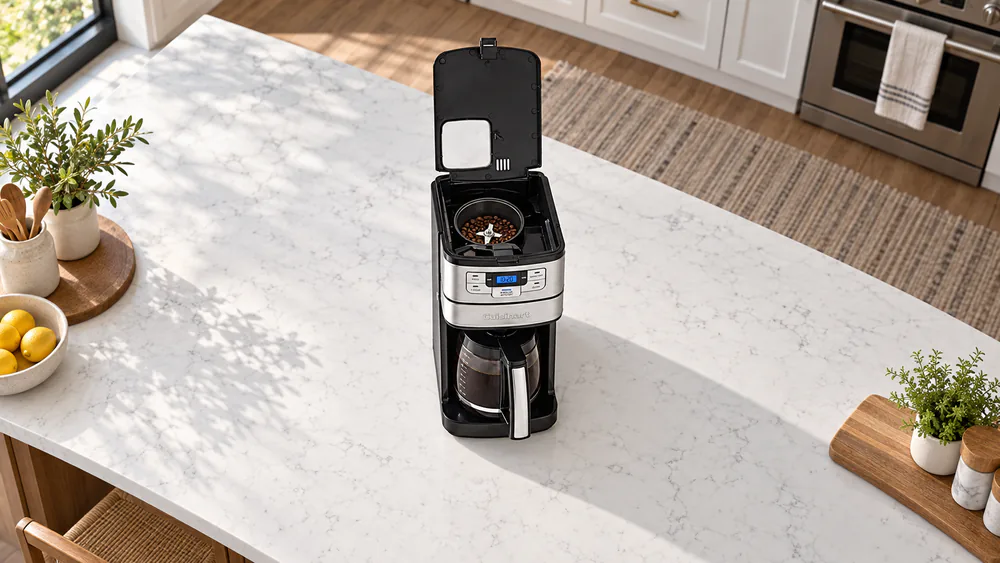
The grinder is the heart of this machine and also its weakest point. Whole beans drop into a chamber, the blade chops them, and the grounds fall into the filter basket. Because a blade chops rather than crushes to a set size, the grind contains both small particles and coarse fragments. That limits how evenly the coffee extracts, and a few beans can remain unground after the cycle.
Noise is the issue we would flag first. Grinding is a sharp, conspicuous sound, even though the brewing stage afterward is unobtrusive. In a quiet early-morning kitchen the grind phase intrudes, so this is not the machine to set for a 5:30 start if a bedroom shares a wall with the counter. Cuisinart does not publish a decibel figure for this model, and we are not going to invent one. What we can say is that you will hear it.
Filling the grinder takes some care, too. Pour beans in carelessly and a few can spill into the adjacent water reservoir. The manual caps whole beans at 14 level scoops and pre-ground coffee at 16 level tablespoons, and a heavily loaded full-pot brew can overflow the grounds basket and leave grounds in the carafe. Stay under those limits and the problem largely goes away.
Keep beans below the 14-scoop limit and away from the reservoir.
Coffee flavor, temperature and batch size
Fresh-ground beans make a real difference. The coffee has a lively aroma and a fuller flavor than stale pre-ground coffee from a tin, and for everyday drinking it is pleasant. The uneven blade grind does cap the balance you can get from good beans, so a bright single-origin will taste more muddled here than it would from a burr grinder and a pour-over cone. Taste depends on the beans you buy.
For smaller batches, use the 1-4 cup setting. The small-batch mode heats the water twice, which is how the machine compensates for brewing less coffee. Since a nominal cup is about 5 oz, four cups gives you roughly two mugs. If you only make one mug a day, a single-serve machine is a better fit.
Everyday use and programmable features
Setting up a scheduled brew
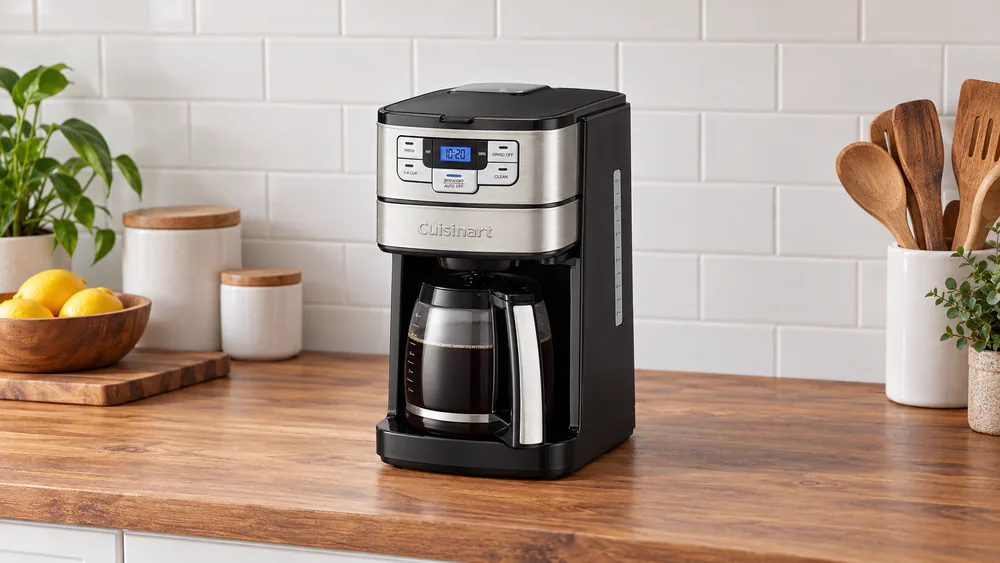
Programming is straightforward. Set the clock, hold the Program button to enter your start time, then press Program again to arm the timer. A blue light confirms it. The auto-off can be adjusted from 0 to 4 hours so the warming plate does not scorch a pot you forgot about. The labelled controls are easy once the desired brew time is set.
Two interlocks are worth knowing about. The reservoir lid and grinder lid must both be seated, and missing parts trigger beeping. Never add water with the grinder basket removed, and keep the carafe in place for brewing. If you use Brew Pause to pour a cup early, return the carafe within 20 seconds or the basket will overflow.
Using pre-ground coffee and the carafe
When you want to skip the grinder, put pre-ground coffee in the filter basket and select Grind Off. The limit is 16 level tablespoons. It is a useful escape hatch on mornings when the noise would be a problem.
For filters, use either a #4 basket paper filter or the Cuisinart permanent filter, never both.
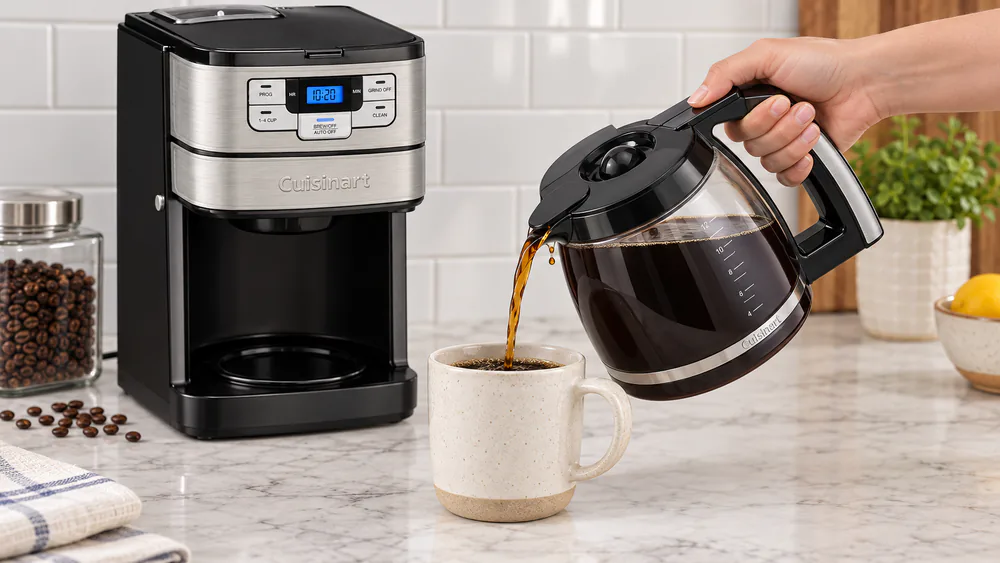
The glass carafe pours well enough, but it can dribble down its side, which leaves a mess outside the cup. A slow, careful pour helps. The marketing calls it dripless, and in our kitchen that only held when we poured deliberately.
A slow pour keeps the carafe from dribbling.
Pros, cons and owner feedback
Main advantages and trade-offs
The strongest case for the DGB-400NAS is convenience. One machine replaces a grinder and a drip brewer, saves counter space, and delivers coffee ground minutes before it hits the water. The programmable start, the small-batch setting and the Grind Off bypass make it flexible, and the controls are clear. The 3-year limited warranty is a reassuring extra.
Pros
Beans are ground immediately before brewing, with a Grind Off option for pre-ground coffee
24-hour programmable start and adjustable auto-off
1-4 cup setting for smaller batches
Permanent gold-tone filter included, with paper filters also supported
Labelled controls that are simple once the clock and timer are set
Cons
The grind phase is conspicuously loud
Blade grinding mixes fine particles with coarse fragments
Grinder parts need removal, cleaning and drying after each use
The carafe can dribble when you pour
Where the machine falls short
Three things hold the DGB-400NAS back. The grind is loud. The grinder needs removing and cleaning between uses, which is the main daily maintenance burden. And small crevices in the removable parts make cleanup fiddlier than emptying a conventional drip filter.
Those drawbacks have limits. The noise lasts only for the grind phase, and the cleanup is a chore, not a failure. Cuisinart publishes no figure for how long the motor or seals last, so we make no claim about long-term durability. Replacement grinder baskets and lids are catalogued by Cuisinart, though availability varies.
One machine replaces a grinder and a drip brewer, and the price of that tidy counter is a little daily routine.
Cleaning and maintenance
Keeping the grinder and the water path in good shape is most of the ownership work, so here is what the routine involves.
Cleaning and drying the grinder after brewing
This is where the machine asks the most of you. Condensation from brewing makes fine grounds cling inside the grinding chamber, which adds cleanup after each pot. The manual says to clean and dry the removable parts after every use. Baskets, covers and the carafe are top-rack dishwasher safe, which helps, but the small crevices still need a brush or cloth.
There is a knock-on effect for back-to-back brewing. Because cleaning and thorough drying sit between consecutive whole-bean pots, the integrated grinder is really built for one fresh pot per morning. Cuisinart does not lock you out of a second pot, but drying the grinder is what slows you down. For a second round, Grind Off with pre-ground coffee is the faster path.
Descaling and filter care
The machine tells you when it needs descaling: the CLEAN light comes on. Remove the charcoal filter first, then run a mix of 1/3 white vinegar and 2/3 water, and rinse with fresh water afterward. There is also a self-clean mode for the cycle.
Replace the charcoal water filter every 60 days or 60 uses, and sooner if you have hard water. Soak a new filter for 15 minutes before installing it.
Value and alternatives
This is a mid-priced, basic grind-and-brew machine, so the useful question is what else would suit you better.
Splitting the job gives you better control. A separate grinder lets you choose a more consistent grind, and a standalone drip brewer has fewer parts to clean. The cost is a bigger footprint and one more appliance to wash. If grind quality matters most to you, that route wins. If counter space and a hands-off morning matter more, the all-in-one wins. For a broader view, see our best 12-cup coffee makers.
Frequently asked questions
Can I adjust the grind size?
No. The built-in blade grinder is preset for medium grinding and has no selectable grind-size control. The small-batch button changes brewing behavior, not the grind.
What does the warranty cover?
The DGB-400NAS carries a 3-year limited warranty from Cuisinart. Return eligibility and shipping charges depend on the seller you buy from.
Will it fit under my cabinets?
It measures 8.13 inches long, 9.98 inches wide and 15.5 inches high, so measure the gap under your upper cabinets before you buy.
Is the carafe dishwasher safe?
Yes. The removable baskets, covers and carafe are top-rack dishwasher safe.
How often should I change the charcoal water filter?
Every 60 days or 60 uses, and sooner with hard water. Soak a new filter for 15 minutes before installing it.
Final verdict: Is the Cuisinart Automatic Grind & Brew worth buying?
If this machine is not the right fit, there are two clear next steps. A mid-priced separate grinder paired with a simple drip brewer gives you better grind control and a quieter morning. If you only want a mug or two, the single-cup DGB-30 or the thermal-carafe 10-cup model linked above may suit you better. Otherwise, the DGB-400NAS is a practical choice for one fresh pot a day.