
Kitchen Appliances
Air Fryer vs. Convection Oven: Which Is Better for You?

As an Amazon Associate we earn from qualifying purchases. We may earn a commission from links on this page, at no extra cost to you. Learn more.
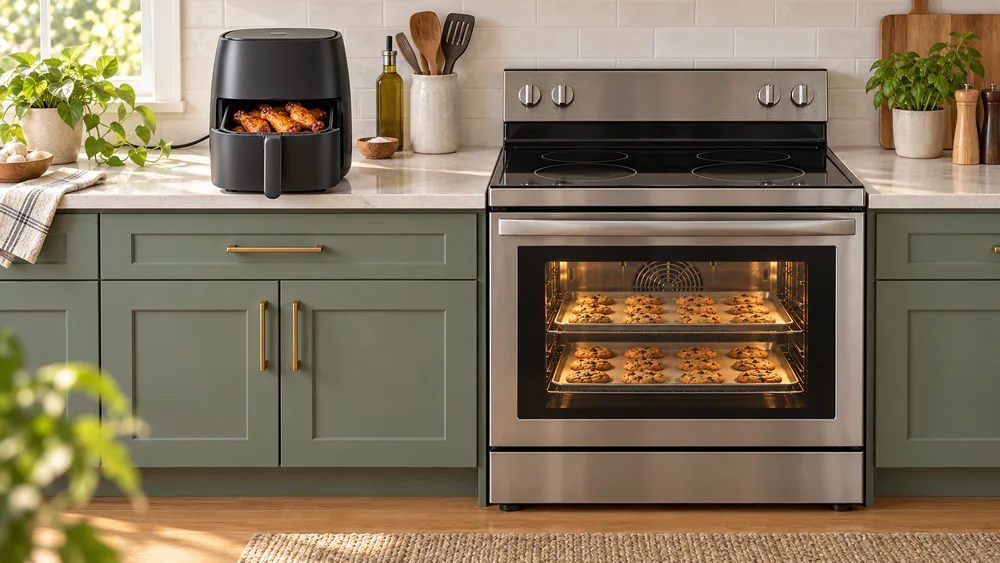
An air fryer is a compact countertop appliance that cooks with hot air. A heating element sits above the food, and a powerful fan blasts heat around a basket at high speed, so food turns out crisp with a fraction of the oil a deep fryer needs. A convection oven is a full-size oven with a built-in fan that circulates hot air through a large cavity.
So are they the same machine? An air fryer is, at its core, a small convection oven. The real differences live in fan speed, capacity, and cost. In our kitchen, nonstick basket coatings have started to flake after about six months of regular use. Durability is one of the trade-offs we consider when comparing these appliances.
What Is an Air Fryer?
An air fryer is a small countertop appliance built around a basket or tray. Most baskets hold 2-6 quarts (dual-basket models reach 9-10), and a typical unit draws 1500W, topping out at 400F.
How Air Fryers Work
A heating element sits above the food, and a fan spins at 2,000-3,500 RPM, far more aggressive than a full-size oven's convection fan. With about a tablespoon of oil, a single layer of food develops a crisp, browned exterior that reads as fried.
What Air Fryers Do Best
Speed and crispness are the two strengths. Most models preheat in about 2-5 minutes, and some need no preheat at all. The category is young: the widely reported debut came in 2010 at the IFA trade show in Berlin, though some brand histories date it to 2005. U.S. sales grew 76% from January 2020 through December 2021. A good unit turns out genuinely crispy wings and fries without deep frying, but only in a single layer; crowd the basket and crispness dies.
What Is a Convection Oven?
A convection oven, on the other hand, is a full-size oven with a fan in the rear wall. Most modern ranges and wall ovens have it, split into convection bake and convection roast modes.
How Convection Ovens Work
Heating elements sit at the top and bottom of the cavity, and a rear fan moves hot air over the food. Convection bake uses the lower element, roast uses both, and true convection adds a third element around the fan. The fan turns at 300-800 RPM, gentle next to an air fryer, and a typical electric oven draws 3,000W.
What Convection Ovens Do Best
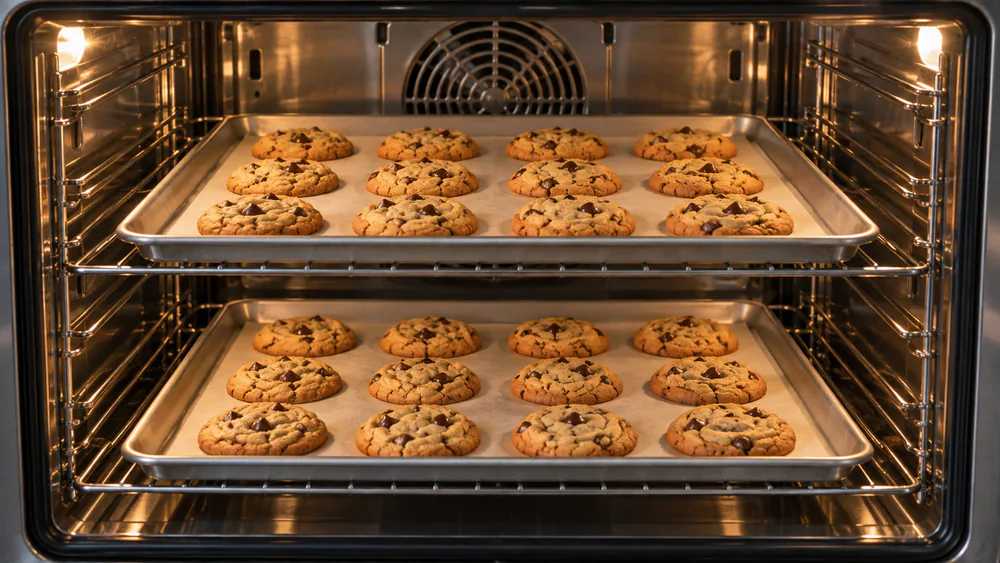
Capacity is the superpower. A full-size oven holds multiple dishes and trays at once, with 60-80 L of usable space. Convection's real payoff is multi-tray batches that finish evenly, which is why it shines for cookie bakes and holiday roasting. The fan removes moisture from the oven, so delicate bakes can develop dry edges unless you lower the temperature about 25F. Crowded pans can also block airflow and cause uneven browning.
Air Fryer vs. Convection Oven: Side-by-Side Comparison
Here is how they stack up.
| Feature | Air Fryer | Convection Oven |
|---|---|---|
| Size & capacity | Compact basket, 2-6 qt (dual-basket models to 9-10 qt) | Full-size, 60-80 L single ovens, multiple racks |
| Preheating speed | About 2-5 minutes; many models skip preheat | 10-15 minutes |
| Cooking time | About 20-25% faster than a conventional oven | About 25% faster, or drop the temperature 25F |
| Airflow & crispiness | Fan at 2,000-3,500 RPM; crisp exterior with about a tablespoon of oil | Fan at 300-800 RPM; gentle circulation, softer crust |
| Oil usage | 70-80% less oil than deep frying | Little to no added oil |
| Energy efficiency & cost | 1,200-2,000W; 0.875 kWh (about $0.26) for a small meal | 2,200-4,000W; 3.0 kWh (about $0.90) for the same meal |
| Cleaning & maintenance | Removable basket and tray, dishwasher-safe on most models | Racks plus a self-cleaning cycle on most models |
| Best for | 1-2 people, quick meals, crisping, small kitchens | Families, multi-tray batches, baking and roasting |
Air Fryer vs. Convection Oven: The Key Differences
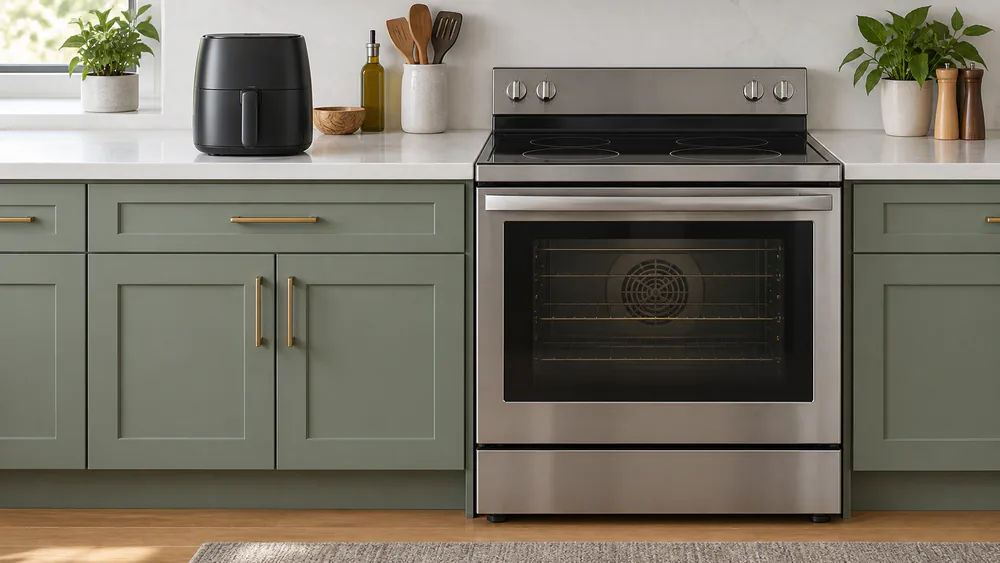
Five practical questions separate these two machines: size, speed, oil, cleanup, and energy.
Size and Capacity
Air fryer baskets typically hold 2-6 quarts, and a 2-quart model fits about four large wings, so compact units are one-person machines. A convection oven holds multiple dishes and trays at once.
Cooking Speed and Crispiness
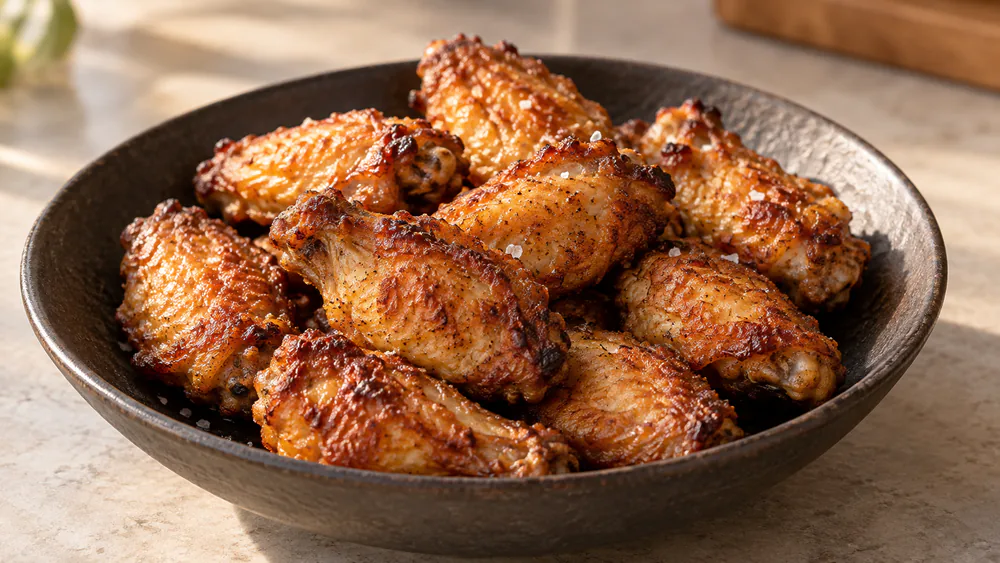
Air fryers cook most foods 20-25% faster than a conventional oven and preheat in about 2-5 minutes. A full-size convection oven takes 10-15 minutes just to preheat. Fan speed explains the gap: 2,000-3,500 RPM in the fryer versus 300-800 RPM in the oven. Chicken wings take roughly 25-30 minutes at 375F from fresh and 10-15 minutes from frozen, though cook times vary with model, batch size, and wing thickness.
Oil, Health, and Nutrition
Air frying uses 70-80% less oil than deep frying, typically a tablespoon or less per batch. Convection cooking needs little to no added oil, and both skip deep-frying's calorie load. The food you put in either machine decides how healthy the meal is, which is the point of why fried foods are less healthy, per Healthline.
Cleaning and Maintenance
An air fryer's basket and crisper tray pop out for a quick rinse, and most are dishwasher-safe, though stuck-on grease needs a soak. A convection oven means racks, a large cavity, and a self-cleaning cycle on most models. The fryer wins the daily cleanup; the oven wins the deep-clean.
Warning. Dishwasher cycles visibly accelerate the breakdown of a nonstick basket coating. Hand-wash the basket and crisper tray and soak stuck-on food; that habit is the difference between a basket that lasts and one that flakes.
Energy Efficiency and Cost
An air fryer draws 1500W; a full-size electric oven pulls 3,000W. In a measured comparison, a 7L air fryer used 0.875 kWh (about $0.26) for a small roast-chicken meal, versus 3.0 kWh (about $0.90) in a full-size electric oven. That is roughly 50% less energy. For big meals the math flips: convection is 20-30% more energy-efficient than a conventional bake, though savings depend on the oven's insulation.
Which Should You Choose: Air Fryer or Convection Oven?
It depends on who you feed and what you cook most often; the lists below name the right machine.
Choose an Air Fryer If...
- You usually cook for one or two people.
- You want dinner in 15 minutes without heating up the whole kitchen.
- You live on crispy food: wings, fries, nuggets, reheated leftovers.
- Your counter is small and you cook in single layers.
Most basket models sell for $60-$250, with street pricing moving week to week. Our best air fryers of 2026 guide ranks the models we would buy.
Choose a Convection Oven If...
- You cook for four or more, or you meal-prep for the week.
- You batch-bake cookies, sheet cakes, or multiple trays at once.
- You roast whole birds and large cuts on a regular basis.
- You want one appliance that also broils, proofs, and self-cleans.
A convection oven handles most air-fryer jobs at bigger scale if you adjust times and temperatures.
Do You Need Both?
Not necessarily. A convection oven with an air-fry mode can approximate basket results, usually with a softer crust and a longer preheat. If noise matters to you, the quietest models run below about 53 dB, comparable to a quiet conversation. Many end up with both: the fryer for quick batches, the oven for big meals. If you are choosing one, let portion sizes decide.
Frequently Asked Questions
Is an air fryer basically a convection oven?
Yes. An air fryer cooks like a convection oven, but its smaller cavity and stronger fan help it cook food faster.
Is an air fryer healthier than a convection oven?
Both cook with hot air and little oil, so neither adds the calorie load of deep frying. The air fryer's edge is texture: crispy results with about a tablespoon of oil or less.
Does an air fryer cook faster than a convection oven?
Usually, yes. The basket's small cavity heats up in 2-5 minutes, while a full-size oven takes 10-15 minutes just to reach temperature.
Can you bake in an air fryer like a convection oven?
Yes, for small batches. A 2-6 qt basket fits a few muffins or cookies at a time; a convection oven handles the same jobs on multiple racks. Lower the temperature about 25F when moving a recipe from a conventional oven.
Are air fryers more energy-efficient than convection ovens?
For small meals, yes. In a measured comparison, the air fryer used 0.875 kWh to the oven's 3.0 kWh for the same small roast-chicken meal. For a holiday spread, the oven stays the practical choice.
Do I need an air fryer if I already have a convection oven?
Not strictly. A convection oven with an air-fry mode can approximate basket results, usually with a softer crust and longer preheat. For one or two people, the basket fryer is faster and easier to clean. Try your oven's air-fry setting first.
The Bottom Line
Which is better for you: the air fryer or the convection oven? It comes down to who you cook for. Choose the air fryer for speed, crispness, and countertop convenience when you feed one or two. Choose the convection oven for capacity, multi-tray batches, and real baking when you feed a family. Neither is wrong; they serve different kitchens. Match the tool to how you cook and either will serve you well.
Key takeaway. An air fryer is a small convection oven with a much stronger fan. Pick the air fryer for fast, crisp meals for one or two; pick the convection oven for big batches and real baking. For most weeknights, the air fryer is the faster choice; for families, the oven stays essential.
Read next
Ready to upgrade your kitchen?
Match the tool to how you cook: quick, crispy batches for one or two, or big family meals in the oven.