
Recipes
Anti-Inflammatory Bread Recipes: Whole-Grain, Low-Sugar Loaves for Gut Health

As an Amazon Associate we earn from qualifying purchases. We may earn a commission from links on this page, at no extra cost to you. Learn more.
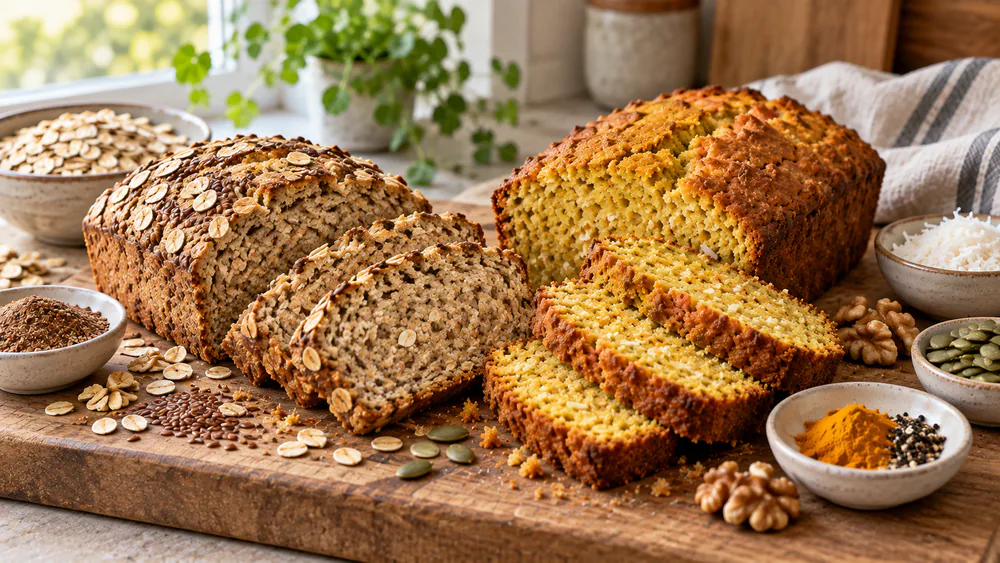
Anti-inflammatory bread is simply a loaf built from whole grains, ground flax, and warm spices instead of refined white flour and added sugar. The payoff shows up in a single slice: nutrient-dense fiber, healthy fats, and a crumb that leaves you satisfied rather than spiking and crashing an hour later. In our test kitchen we bake these loaves the way we bake everything, by weight and with an eye on the crumb, and they have become the bread we reach for on quiet weekday mornings.
The recipes below start with one reliable flax and oat loaf, then branch into gluten-free, banana, and coconut-turmeric variations. Every loaf leans on the same idea: ingredients with real anti-inflammatory properties, kept low in sugar and rich in whole grain. Let's start with what makes a bread anti-inflammatory.
What Makes Bread Anti-Inflammatory?
A bread earns the label from what goes into the bowl, not from any single miracle ingredient. Whole grains, seeds, and healthy fats each support gut health, while refined flour and added sugar do the opposite. Choose well and you build a loaf that nourishes instead of one that only fills.
Key Ingredients That Fight Inflammation
Flax is the anchor. Its anti-inflammatory action comes from alpha-linolenic acid, lignans, and fiber working together, which is why it appears in nearly every loaf we bake. In one peripheral-arterial-disease trial documented in the flaxseed and omega-3 research, 30g of milled flaxseed daily for six months lowered systolic blood pressure by about 10 mm Hg. That is a study dose, not a per-slice promise, but it tells you flax is worth building around.
Oats bring soluble fiber, chiefly the beta-glucan that feeds gut microbes. Turmeric adds curcumin, whose anti-inflammatory properties may benefit people with inflammatory conditions. Olive oil, walnuts, and pumpkin seeds round things out with healthy fats. Pair turmeric with a pinch of black pepper: the piperine helps your body use the curcumin, and it does not make the loaf taste peppery.
Ingredients to Avoid
Refined white flour strips out the bran and germ, losing the fiber that makes bread gut-friendly. Added sugar and syrups drive the blood-sugar swings these loaves avoid. We also skip refined seed oils in favor of olive oil, coconut oil, or the fat that comes from nuts and eggs. Read the label: if sugar sits near the top, the bread is working against you.
Health Benefits at a Glance
The scientific evidence supports claims about the ingredients, rather than the finished bread. Flax delivers ALA and lignans. Oats contribute beta-glucan, with roughly 3 grams a day the level most consistently linked in research to lower inflammatory markers, though that varies by study. Turmeric offers curcuminoids that show promise, even if the evidence is not yet conclusive.
A finished loaf will not cure anything, and we would never promise that. What it does is stack nutrient-dense, whole-food ingredients into something you actually enjoy eating every day, which is the only way any healthy habit sticks.
Note. Turmeric appears generally safe by mouth when kept under 8 grams a day, but that is a guidance figure that varies by person, and supplements are unregulated. A teaspoon baked into a whole loaf sits comfortably below any concern.
Ingredients for Anti-Inflammatory Bread
Here is the base flax and oat loaf, the one we bake most often. It is gluten-free, high-fiber, and forgiving once you understand how the binders behave.
Dry Ingredients
- 2 cups oat flour
- 1 cup gluten-free all-purpose flour
- 1/4 cup ground flax seeds
- 2 tablespoons psyllium husk
- 1 packet active dry yeast
- 1 teaspoon salt
The psyllium husk and ground flax do the heavy lifting here. Together they give the dough enough structure to rise and hold, standing in for the gluten that wheat would normally supply. Skip them and the loaf falls flat.
Wet Ingredients
- 2 eggs
- 1 1/2 cups warm water
- 2 tablespoons olive oil
- 1 tablespoon apple cider vinegar
- 2 tablespoons coconut sugar
The vinegar sharpens the crumb and helps the yeast along, while coconut sugar keeps sweetness gentle and unrefined. Warm water, not hot, wakes the yeast without killing it.
Optional Anti-Inflammatory Add-Ins
- 1 teaspoon turmeric plus a pinch of black pepper
- 1/2 teaspoon ground ginger
- 1/2 teaspoon cinnamon
- 1/4 cup chopped walnuts
Stir any of these into the dry mix. Turmeric turns the crumb a warm gold, ginger and cinnamon add cozy spice, and walnuts fold in extra healthy fats and a little crunch.
Tools and Equipment You'll Need
Nothing exotic, but a few tools earn their place. A kitchen scale is the one we would never skip: weighing flour is the single biggest upgrade to any loaf, and it costs less than a good pan. You will also want a large bowl, a whisk, a 9x5 loaf pan lined with parchment, and a wire rack. A stand mixer helps if you bake often, but a sturdy spoon and clean hands do the job.
How to Make Anti-Inflammatory Bread (Step by Step)
The method is straightforward. The only real discipline is patience at the end, because these loaves punish anyone who slices too soon.
Step 1: Prep and Measure the Ingredients
Weigh your dry ingredients into one bowl and whisk them so the flax, psyllium, and yeast distribute evenly. In a second bowl, combine the eggs, warm water, olive oil, vinegar, and coconut sugar. Line your loaf pan with parchment now, while your hands are clean, so you are not scrambling later.
Step 2: Mix and Combine the Dough
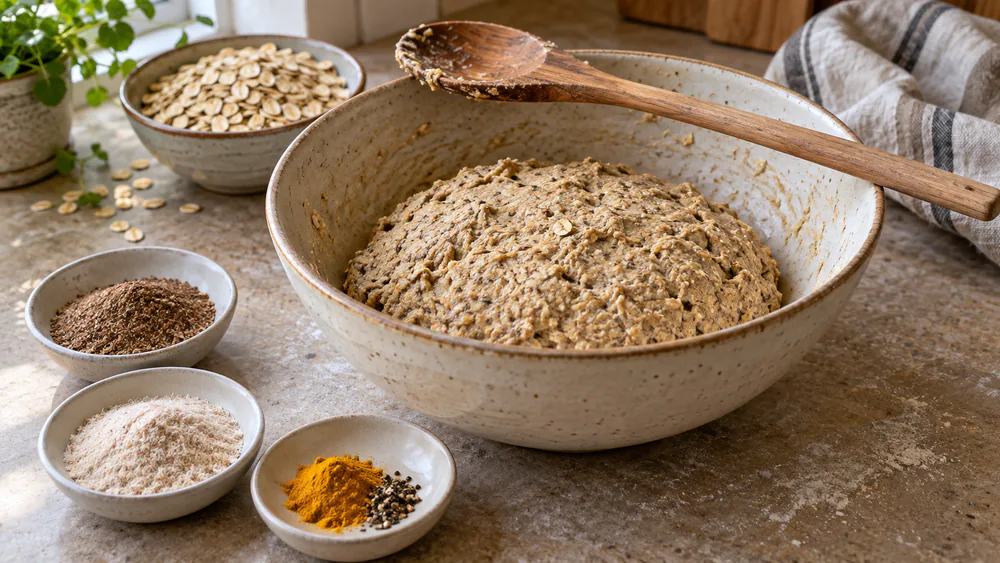
Pour the wet mix into the dry and stir until no floury pockets remain. The dough will look wetter and stickier than a wheat dough, and that is exactly right: the psyllium and flax need that moisture to set up. Give it a minute to rest, and you will feel it firm slightly as the binders hydrate.
Step 3: Shape, Rest, and Proof
Scrape the dough into the lined pan and smooth the top with a wet spatula. Cover it loosely and let it rise in a warm spot for about two hours, until it has climbed noticeably up the pan. Gluten-free doughs rise more slowly and modestly than wheat, so do not expect a dramatic dome.
Step 4: Bake and Cool
Bake at 350F for about 1 hour, until the top is firm and a skewer comes out clean. Bake time shifts from roughly 35 minutes to a full hour depending on loaf size, pan, and oven, so trust the skewer over the clock. Then the hard part: let the loaf cool completely on a wire rack before slicing. Cut it warm and the tender crumb tears rather than slices.
Tip. This flax and oat loaf comes out with a slightly moist, tender crumb and tastes best toasted rather than fresh-sliced. A quick pass in the toaster the next morning brings out the nutty flax and firms the slice up beautifully.
Tips for the Perfect Loaf
A few habits separate a good loaf from a great one. Weigh your flour rather than scooping it, because a packed cup can add fifty grams and dry the bake out. Let the dough hydrate for a minute or two after mixing so the psyllium can work. The flax and oat loaf is substantial enough that even a small slice is satisfying. That is the fiber talking.
For the spiced version, keep the black pepper in even if it feels odd. It is the standard move to make turmeric's curcumin more usable, and the amount is far too small to taste.
Recipe Variations
The base loaf is only the beginning. Each variation below keeps the anti-inflammatory backbone while changing the flavor and texture, and each one bakes at 350F, which makes them easy to slot into the same afternoon.
Gluten-free grain-free sandwich loaf. Built on almond butter, eggs, coconut oil, apple cider vinegar, golden flaxseed, and coconut flour, this one is mixed entirely in a blender until the eggs froth, which is what gives the batter its lift. It bakes at 350F for 35 to 40 minutes and yields 10 servings. Expect a dense, protein-rich, sturdy slice, more like a sandwich base than an airy wheat bread.
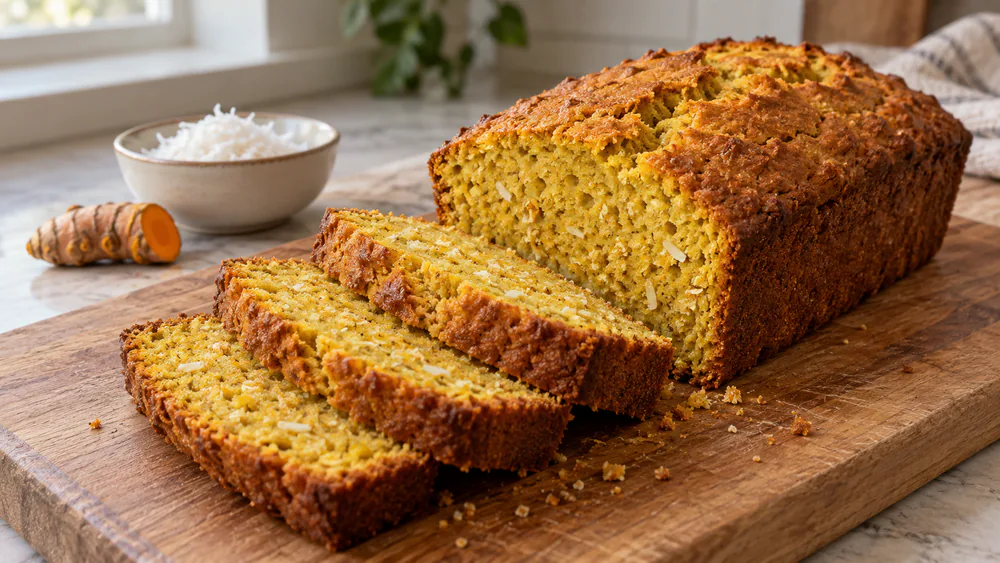
Coconut-turmeric loaf. A buckwheat batter with coconut milk, coconut flakes, rice malt syrup, and 1 tsp turmeric plus that pinch of black pepper and 1/4 teaspoon cinnamon. It bakes at 350F for 45 to 50 minutes. Blend the coconut flakes very fine into the wet mix or the crumb turns coarse, and pull it when the top is crisp and a knife comes out clean.
Grain-free banana bread. Naturally sweetened with 4 mashed bananas plus 1/4 cup honey and no refined sugar, built on 1/2 cup coconut flour. Bakes at 350F for about 50 minutes. Coconut flour drinks up liquid and can turn dry, so bakers pair it with a little tapioca flour, or lean on extra egg and banana, to keep the crumb moist.
Storage and Make-Ahead Instructions
Low-sugar, whole-grain loaves stale faster than supermarket bread because they lack the preservatives and sugar that keep commercial loaves soft. Plan to enjoy them within a few days, or freeze what you will not finish.
How to Store
Keep the flax and oat loaf wrapped airtight in the refrigerator, where it holds for about 5 days. The coconut-turmeric loaf is best within about 3 days airtight at room temperature. Toasting a day-old slice revives it instantly.
How to Freeze
All of these loaves freeze well, which is the real make-ahead move. Slice the cooled loaf first, then freeze the slices with parchment between them so you can pull one at a time. They toast straight from frozen, no thawing needed.
Nutrition Information (per slice)
Per-slice numbers depend on how thick you cut, so treat these as a guide, not a lab figure. As a whole loaf, the flax and oat bread runs roughly 1,224 calories with 48g protein, 33g fat, and about 39g fiber, a creator's estimate that shifts with your slicing.
| Loaf (per serving estimate) | Calories | Protein | Fat | Fiber |
|---|---|---|---|---|
| Grain-free sandwich (10 servings) | ~210 | 9g | 19g | high |
| Flax & oat (whole loaf) | ~1,224 | 48g | 33g | ~39g |
Nutrition estimates for a single slice vary widely with its thickness and the flour blend. Across the whole-grain flax and oat loaves we compared, a slice runs roughly 90 to 260 calories and delivers about 3 to 7 grams of fiber. Treat that as an approximate range rather than a fixed figure, because no single verified per-slice number holds across recipes.
These are self-reported estimates measured per loaf or per serving, not per slice, and they vary with brand and sweeteners. Use them to compare loaves, not to count to the gram.
Frequently Asked Questions
What makes this bread anti-inflammatory?
The ingredients, not the loaf itself. Flax brings alpha-linolenic acid and lignans, oats bring beta-glucan fiber, and turmeric brings curcumin, all with anti-inflammatory properties. Skipping refined flour and added sugar keeps the loaf from working against those benefits.
Which flour is healthiest, and can I make it gluten-free?
Oat flour and buckwheat give you whole-grain fiber, and every recipe here is already gluten-free or grain-free.
Can I make it vegan or dairy-free?
These loaves are already dairy-free. To go fully vegan, swap the eggs for flax eggs (1 tablespoon ground flax plus 3 tablespoons water per egg) and use maple syrup in place of honey. The crumb will be a touch denser but still holds.
How do I store it and how long does it keep?
Wrap airtight. The flax and oat loaf keeps about 5 days refrigerated and the coconut-turmeric loaf about 3 days at room temperature. Freeze sliced portions for longer storage and toast from frozen.
Can I swap the sweetener?
Yes. Coconut sugar, honey, maple syrup, and rice malt syrup are interchangeable by volume in these recipes. All keep the loaf lower in refined sugar than a standard bread, so choose by taste.
Why did my loaf turn out dense?
Usually too much flour or slicing too soon. Coconut-flour loaves bake up dense by nature and crumble if cut warm, so cool completely first. Weighing your flour instead of scooping prevents the packed-cup problem that dries out the crumb.
Conclusion
Anti-inflammatory bread is not a compromise loaf. Built on flax, oats, and warm spice, it is genuinely satisfying, freezes beautifully, and slots into an everyday breakfast. Start with the flax and oat loaf, weigh your ingredients, let it cool fully, then branch out to the coconut-turmeric or banana versions. The bread that nourishes you is the one you will keep baking.
Read next
Ready to bake your next loaf?
Start with the flax and oat loaf, then work your way through the variations that fit your week.