As an Amazon Associate we earn from qualifying purchases. We may earn a commission from links on this page, at no extra cost to you. Learn more.
Trying to slice a crusty sourdough boule without smashing the open crumb? The crackly shell stops a straight edge cold, and a chef's knife just presses the airy interior flat. Sourdough needs a long blade with pointed serrations that bite the crust while wide valleys ride through the crumb. In a month of kitchen prep, we ran seven bread knives through crackly loaves, scored each on edge hold, handle wear, and how easily the steel sharpened back to new, and ranked the ones we would actually buy.
We earn a commission if you make a purchase, at no additional cost to you.
Why Sourdough Needs a Special Bread Knife
Sourdough is a knife paradox. The crust is tough enough to stop a straight edge, while the crumb underneath is a delicate web of holes that a straight blade flattens before it cuts. A bread knife solves the problem with serrations: the teeth bite the shell, and the scalloped valleys between them ride through the crumb without compressing it. Length matters too: a 9 to 10 inch blade crosses a wide boule in one pull, while a shorter blade changes angle mid-cut and leaves ragged end slices.
What to Look for in a Bread Knife for Sourdough
Serration Type: Pointed, Scalloped, or Double-Serrated
For a hard crust you want pointed teeth with wide scalloped valleys: the points bite the shell and the gaps slice the crumb without crushing it. Closely spaced teeth add friction and pile up crumbs, which works against the airy, open structure of a sourdough loaf. Rounded scallops, like the Tojiro's, shed fewer crumbs; double-serrated edges, like the Wüsthof's, grip hard crusts.
Tip. Before you buy, check the tooth spacing. Pointed teeth with wide valleys cut sourdough with less friction and fewer crumbs than fine, closely spaced serrations.
Blade Length: 8 Inches vs. 10 Inches
For sourdough, go long. A 9 to 10 inch blade crosses a wide boule in one pull. Shorter 8-inch blades suit smaller loaves and offset designs, but they change angle on a big round and leave ragged end slices.
Blade Material and Edge Retention
High-carbon stainless steel holds an edge and shrugs off bread acids, and you want a blade that is thin but stiff. Stamped blades like the Mercer and Victorinox are light and affordable but round over sooner; forged steel like the Wüsthof and Shun keeps its edge longer.
Handle, Balance, and Grip
Grip matters on a long bake day. Textured synthetic handles like Mercer's Santoprene and Victorinox's Fibrox stay planted when wet; wood handles look better but get slick. Offset designs raise your hand above the board, though they run short.
Price and Value
You can spend from about $16 to more than $180, and the jump buys real steel and edge retention. A good $50 knife suits most home bakers, and you do not need to cross the $100 line.
A bread knife's serrations are the hardest edge to sharpen, so the pattern you buy is the one you live with.
How We Tested Bread Knives
Our Testing Criteria and Methods
We bought all seven knives ourselves, no free units and no sponsored samples. Every blade went through the same month of real prep in rotation, with an edge check after each session. We scored edge hold, handle wear, and how easily each steel sharpened back to new, then ranked the knives by how they performed on crusty boules.
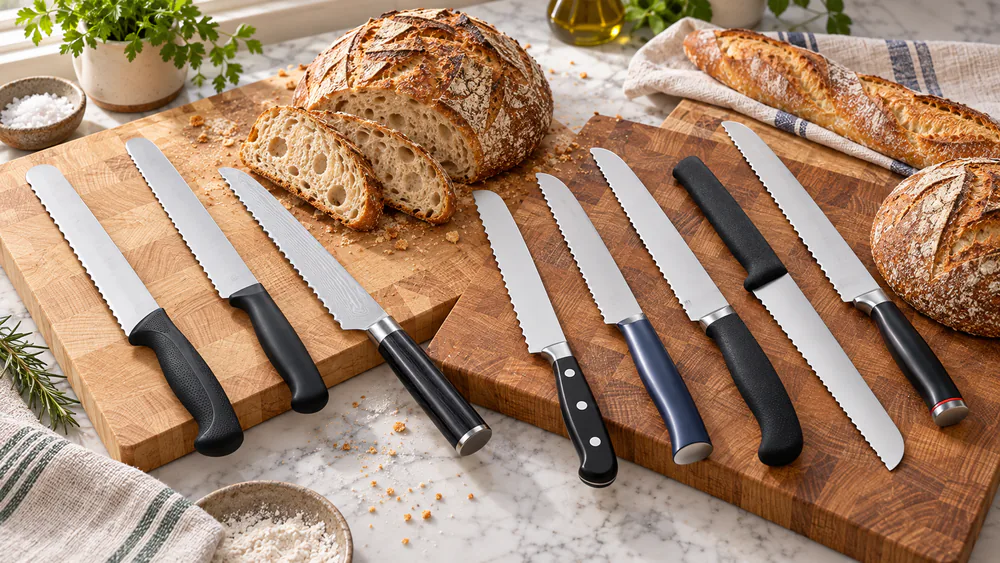
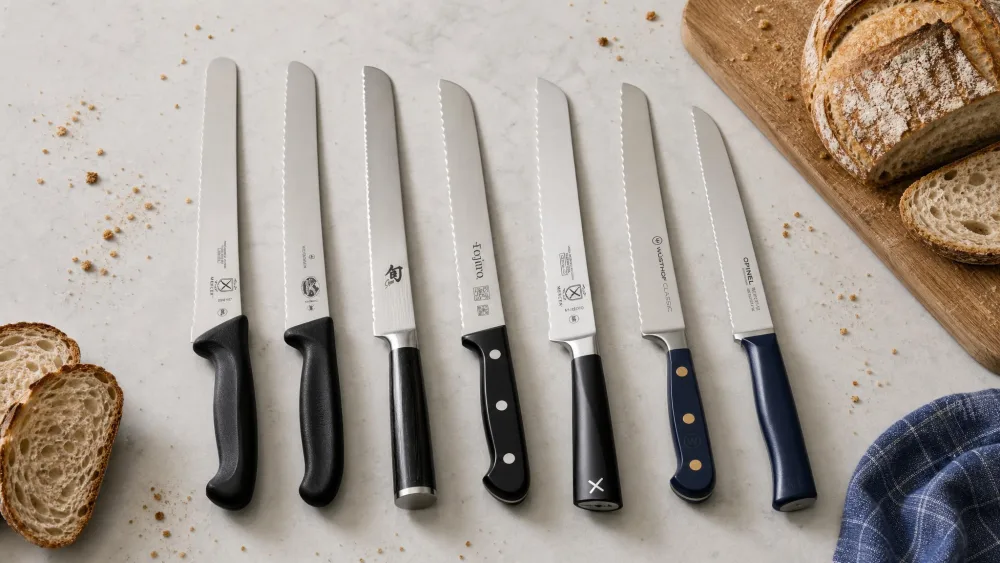
The seven knives in rotation after a month of prep.
The 7 Best Bread Knives for Sourdough
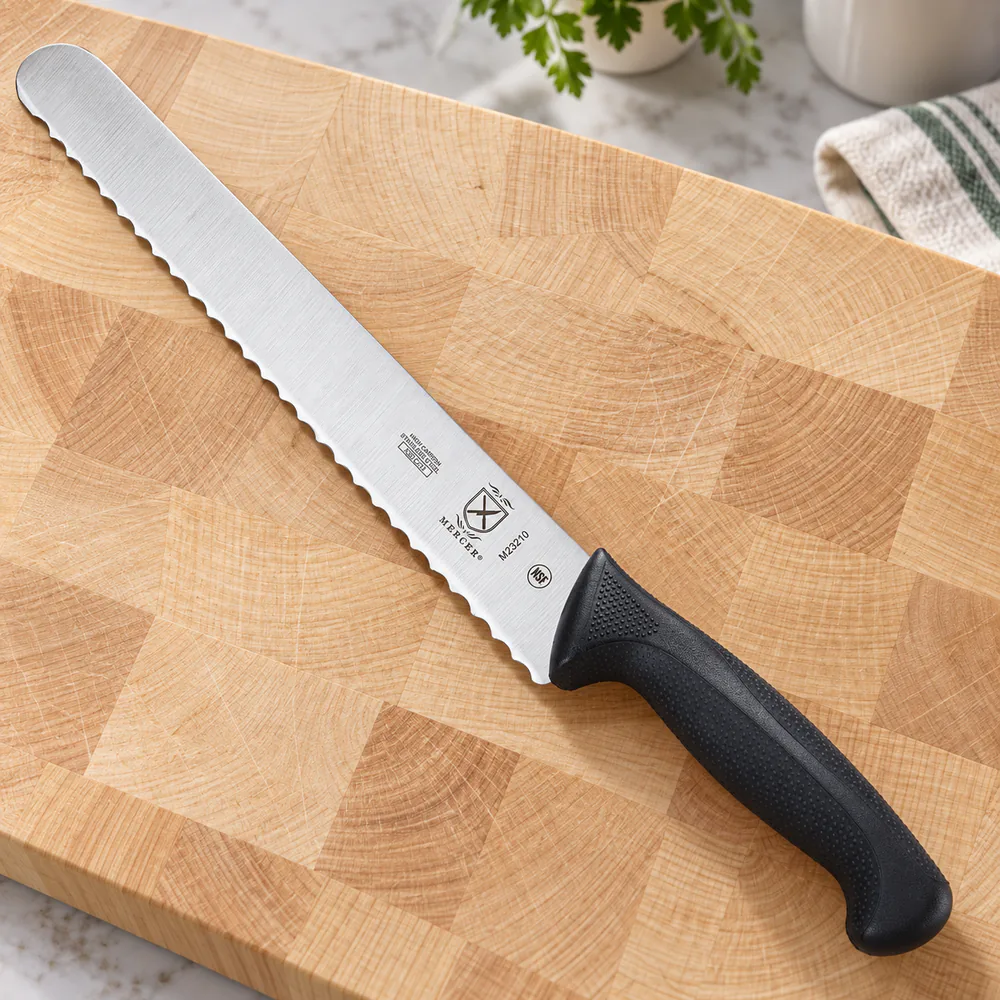
Best Overall: Mercer Culinary M23210 Millennia 10" Bread Knife
The week the Millennia entered our rotation, it pushed our usual German bread knife aside. Through a month of crackly boules it was the blade we reached for first, with thin, unsquashed slices and no crumb pile-up. It is the knife most bakers should start with.
Pros
Wide wavy edge bites through thick crust without crushing the crumb
Around $16, it outperforms blades costing several times as much
Textured Santoprene handle stays grippy and comfortable
Cons
Right-hand ground by default; lefties need the left-hand model
Stamped steel rounds over sooner than forged
Hand wash only, no blade cover included
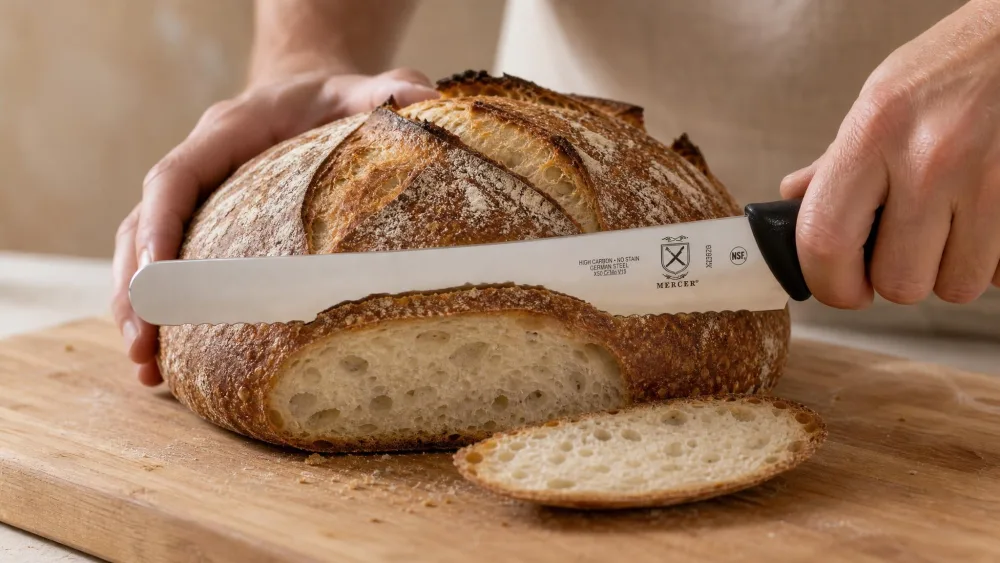
The Millennia slicing a crackled boule.
Best Budget: Victorinox Fibrox 10.25" Serrated Bread Knife
Where the Mercer wins on price, the Fibrox wins on reach. The first loaf we sliced with it sliced clean and straight, the long blade crossing a wide boule in one draw. After several dishwasher cycles the edge still cut clean, the durability test that matters most in a budget knife.
Pros
Sharp out of the box, with clean low-crumb slices
Long 10.25-inch blade crosses wide boules in one pass
Dishwasher safe with a slip-resistant Fibrox handle
Cons
The lightest blade here at 136 g (4.8 oz), so light it verges on too light
Needs extra pressure to get through a very thick bottom crust
Plastic handle looks flimsier than it is
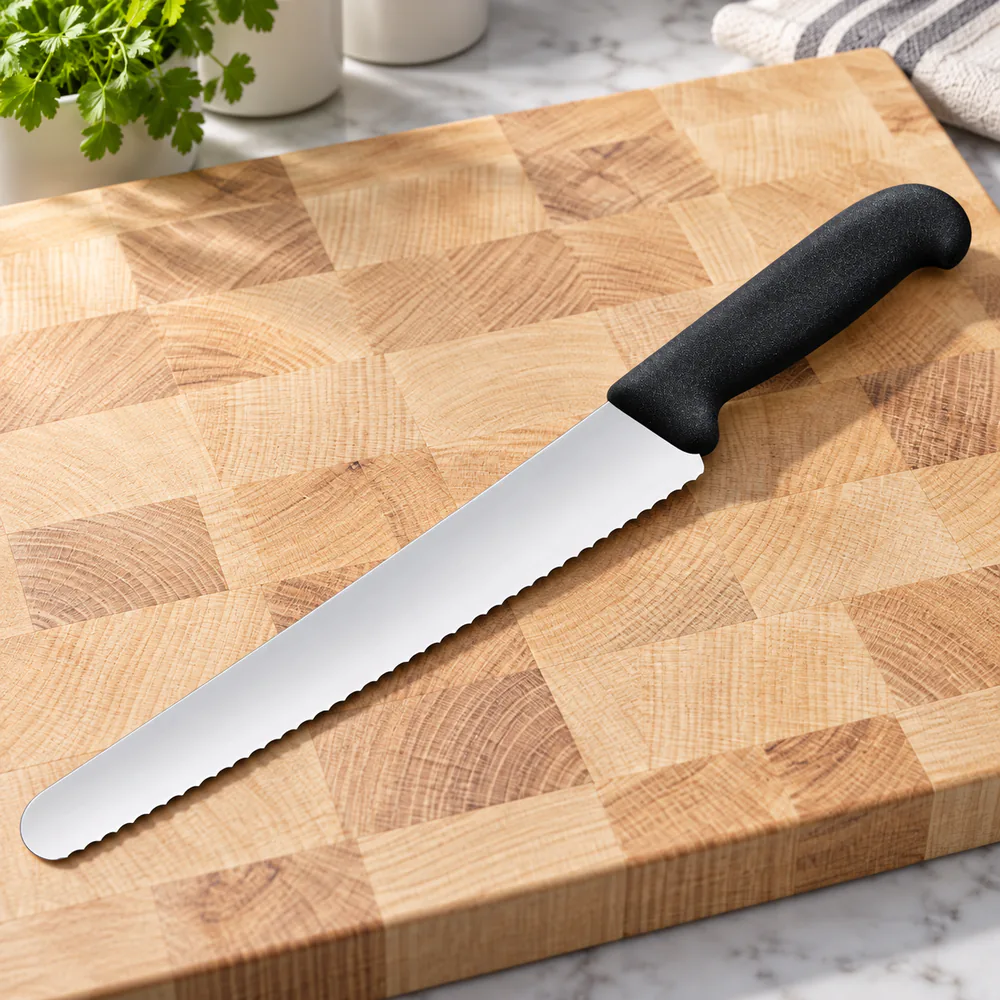
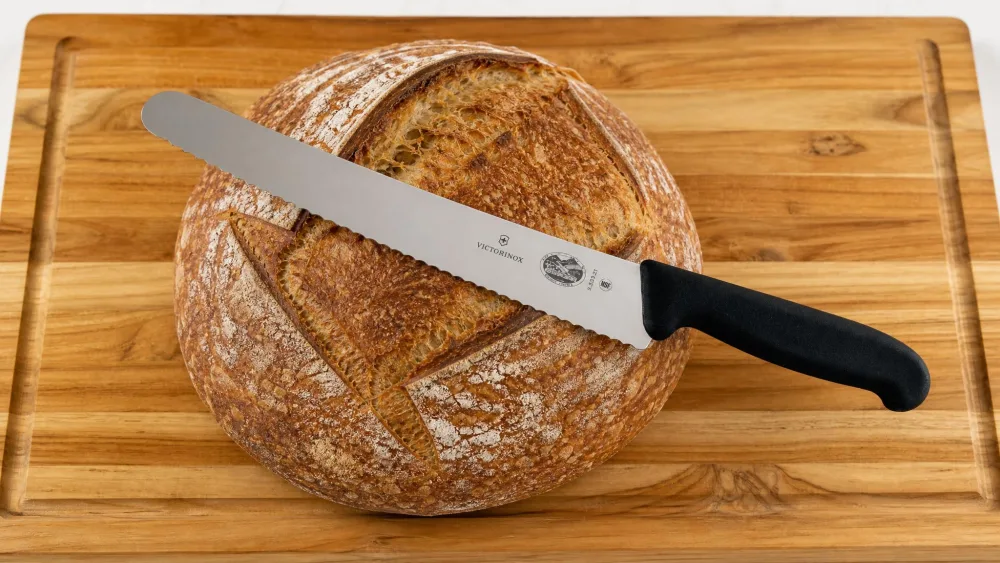
The long Fibrox blade spans a wide boule.
Best Splurge: Shun Classic 9" Bread Knife
Halfway through the month we left a batch of loaves in the oven too long, and the crusts came out extra tough and dark.
The Shun melted through those overcooked loaves without a squashed slice or a sore wrist. That is the moment the price clicks. Its VG-MAX core held the edge all month with minimal upkeep, and the fit and finish are the finest of any knife here.
Pros
Glides through thick crust with no tearing or effort
Wide scalloped valleys slice soft crumb without crushing it
Free lifetime sharpening from Shun
Cons
Expensive for a knife that mainly cuts bread
No protective sleeve included
Wider boules need a slight angle to cross
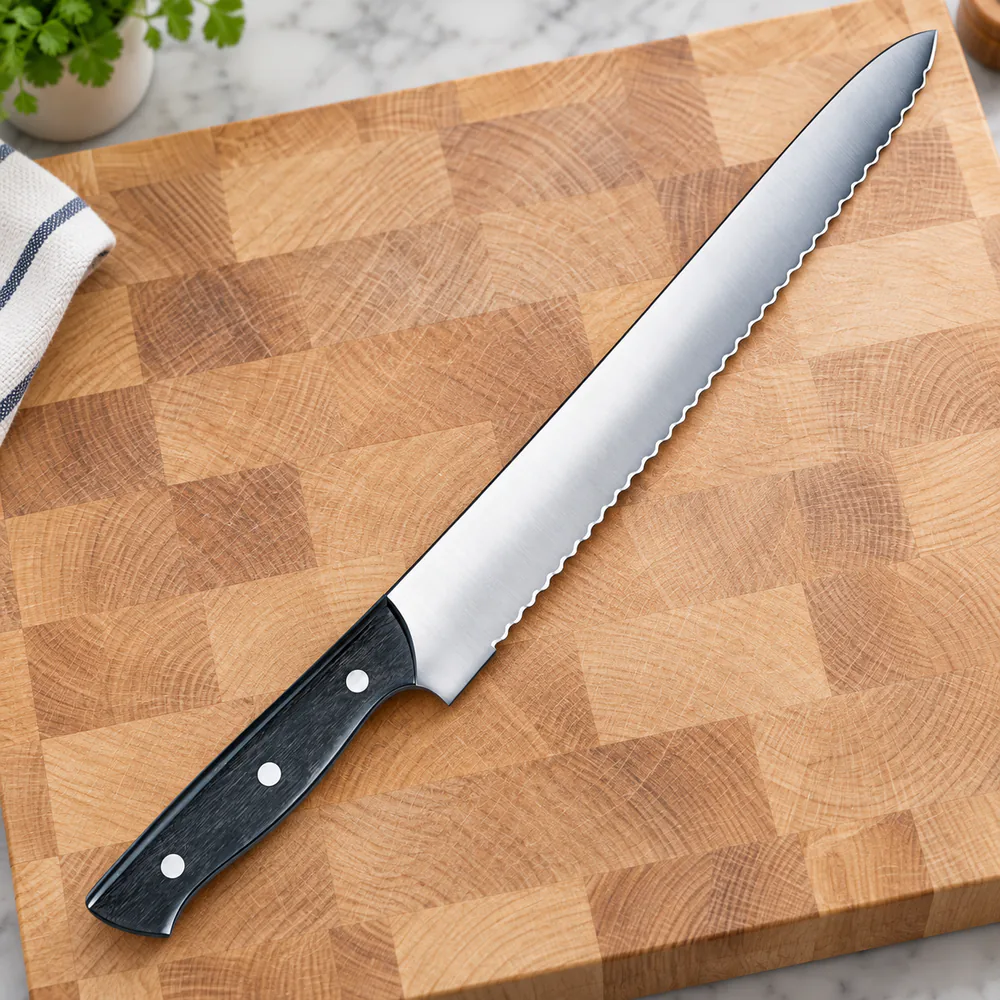
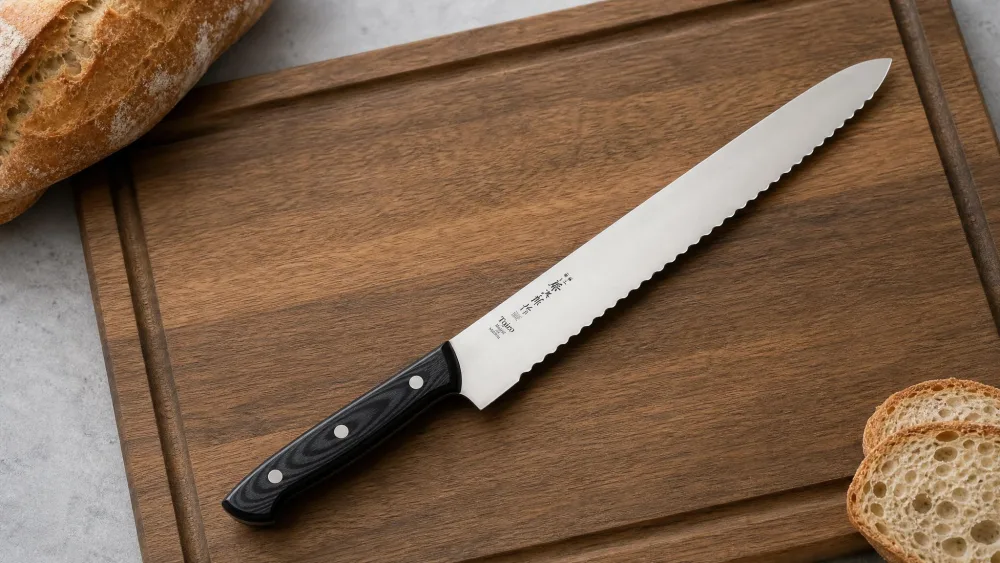
Best Japanese-Style: Tojiro 10.6" Bread Slicer F-687
The first crusty boule we set in front of the Tojiro came apart in a single pull, no sawing and no repeat passes.
The Tojiro is the quiet professional here. The blade's gentle curve reached the tough bottom crust where shorter knives stall, and it stayed light enough that a long bake day never tired our wrist.
Pros
One clean pull yields a slice with no sawing
Rounded scallops keep crumbs low through hard crusts
Molybdenum vanadium steel at HRC 57-59
Cons
Wood handle gets slippery when wet
Too long for a standard knife block
Hand wash only; no soaking or lateral force
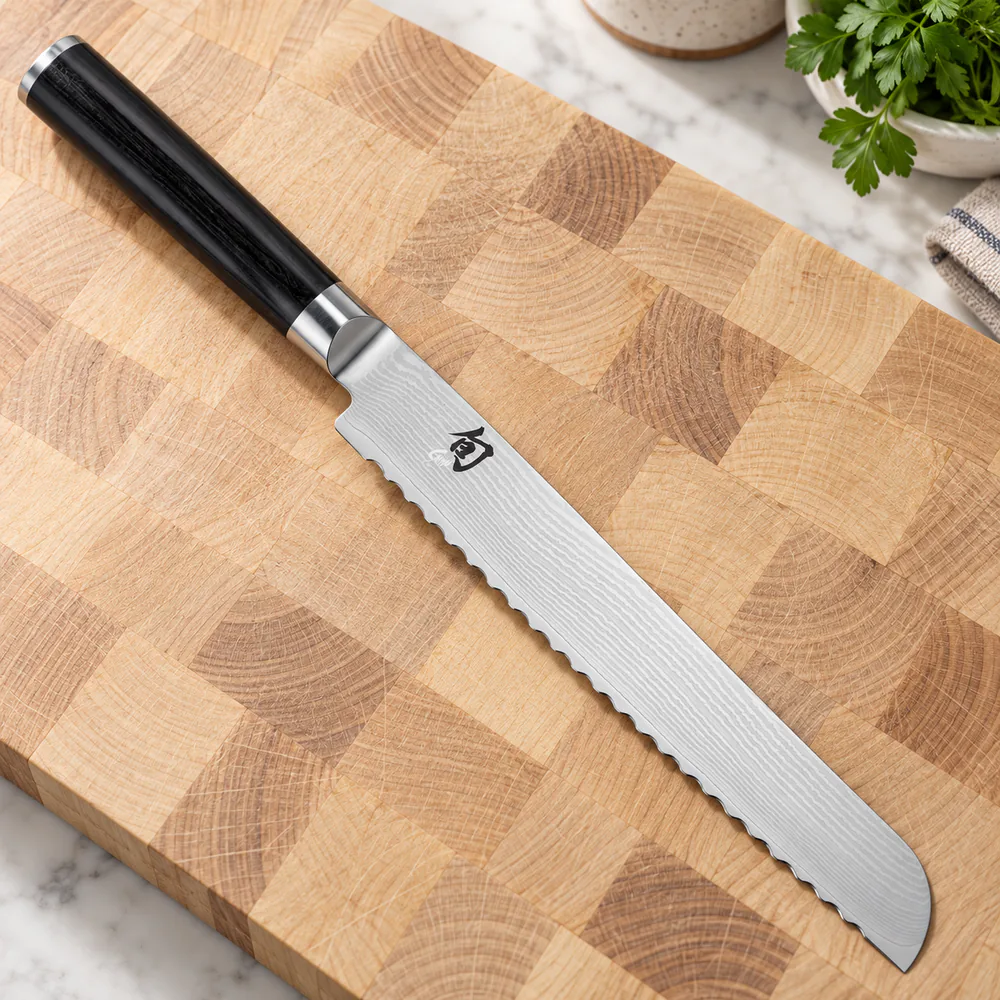
The Tojiro's long blade and black wood handle.
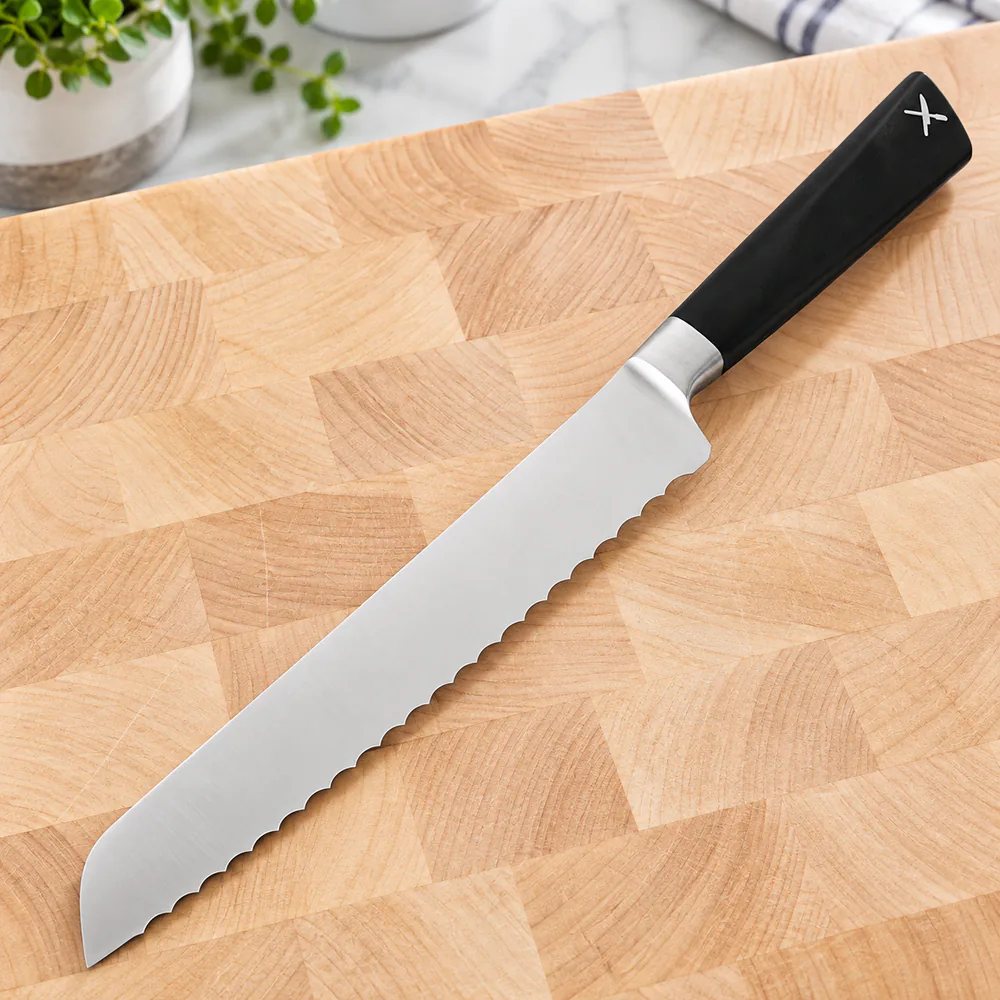
Best Offset Design: Mercer Culinary 8" Züm Bread Knife
The Züm takes the opposite approach from the long Tojiro: it trades reach for height. Slicing with it, our knuckles never once scraped the low board, turning the cut into one smooth draw.
The Züm is the knife we hand to anyone who works on a low board. It pierced tomato skin without smashing the flesh, and the Delrin handle stayed comfortable through a loaf. Size your bake to the 8-inch reach, because it ran short on our widest boules.
Pros
Offset handle keeps knuckles clear of the board
Cuts crust and crumb cleanly without snagging
Precision-forged German steel with a full tang
Cons
8-inch blade is short for large boules
Single-edge ground, not ideal for left-handed cooks
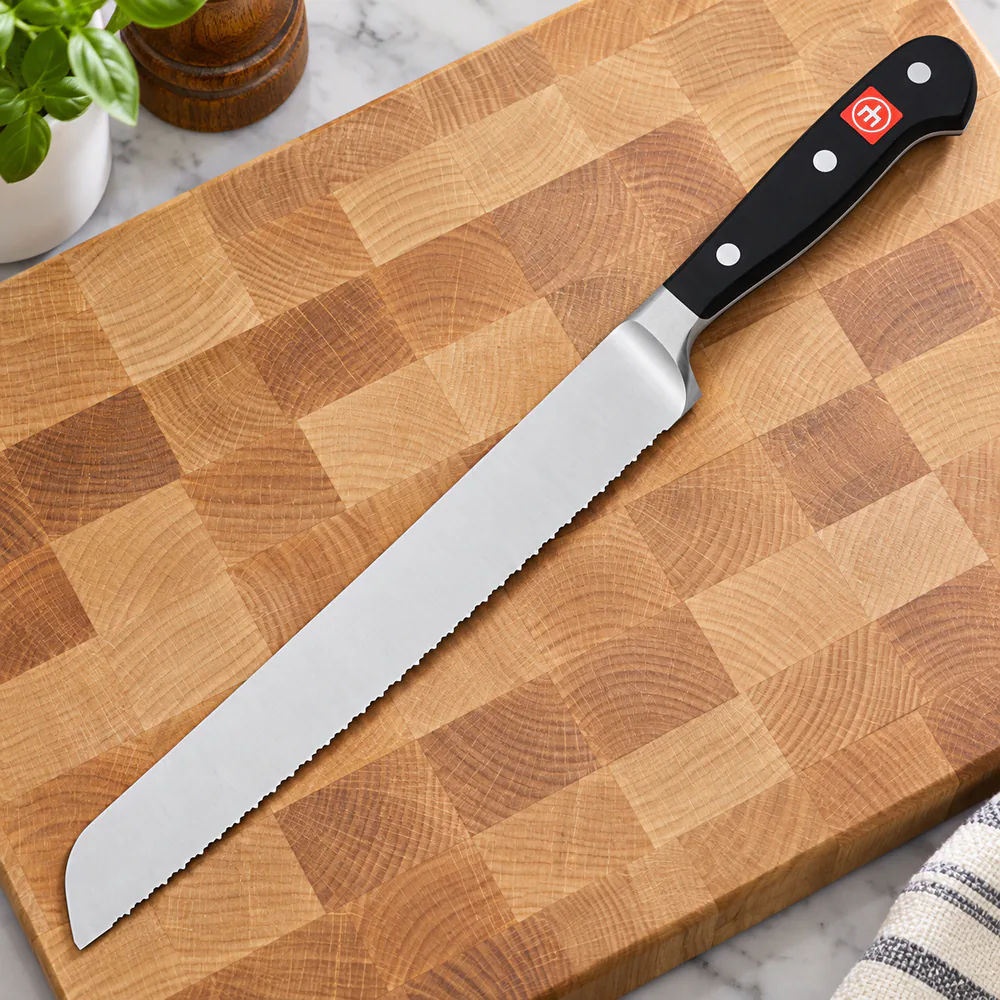
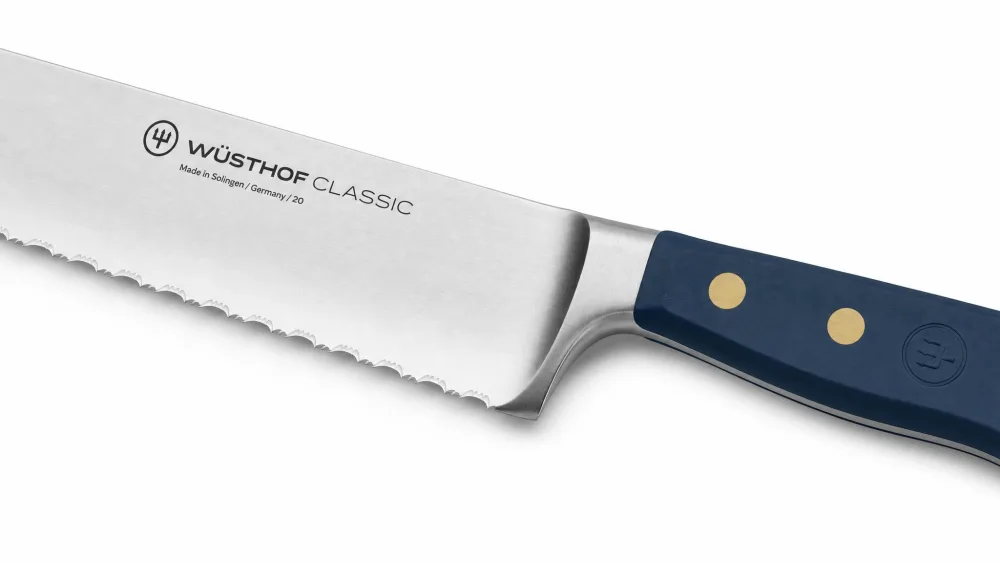
Best for Thick Crusts: Wüsthof Classic 9" Double Serrated Bread Knife
Where the Züm keeps your hand high and short, the Wüsthof is the heavy-duty end. We let a boule sit for a full day, then set the double-serrated edge on the hardened crust. A serration within a serration, it sliced the crust as if the loaf were fresh, with clean cuts and no crumb pile-up.
Pros
Double serrations grip thick, hard crust with little exertion
Edge retention outlasts lighter stamped blades
Forged in Solingen, and these knives do not wear out
Cons
Heavy at 280 g (9.9 oz); overkill for small loaves
About $150 is a serious spend for a bread knife
Angled-back tip can look chipped, by design
The Wüsthof's double-serrated edge in close-up.
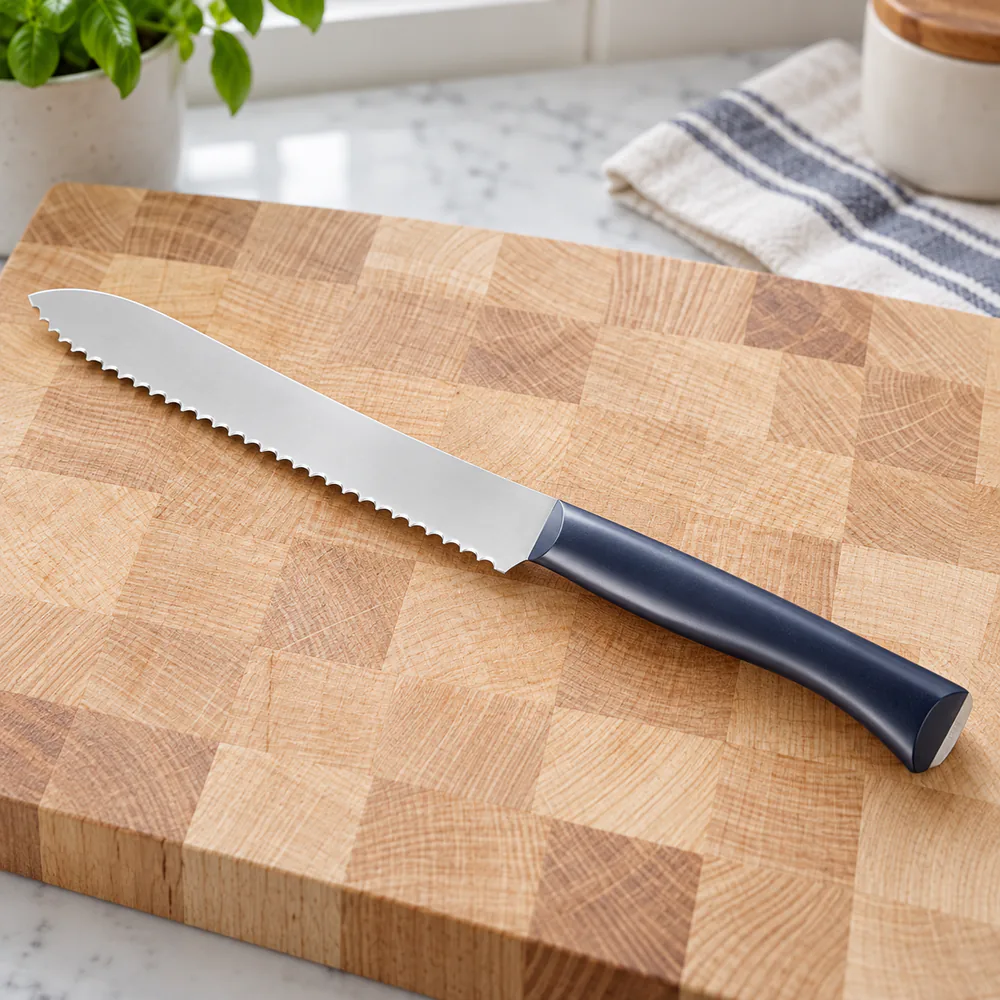
Best Ergonomic: Opinel Intempora 8" Bread Knife
The Opinel feels larger and more substantial in hand than its 8-inch blade suggests, the extra-large handle filling the grip in a way the thinner knives here do not.
The Opinel's pointed tip made the first cut into the crust easier, and the handle stayed comfortable through a loaf. On a wide boule we had to change the slicing angle mid-cut, so it is a comfort-first knife for smaller bakes.
Pros
Extra-large polymer handle is among the most comfortable we have held
Symmetrical V-grip works for right- and left-handed cooks
Full-tang Sandvik 12C27 steel at HRC 57-58
Cons
8-inch blade is too short for wide boules
Teeth do not grip crust as deeply as the longer picks
Costs about $90 to $95, depending on the market
How to Slice and Care for a Sourdough Bread Knife
How to Slice Sourdough Without Crushing It
Start near the heel with a light sawing motion and let the serrations do the work. Do not press down, since force squashes the crumb.
How to Sharpen and Care for a Serrated Bread Knife
Serrated edges rarely need sharpening, but they are the hardest to do well. When the teeth round over, a ceramic rod or tapered sharpener sized to match the tooth spacing can refresh them; see this guide to how to sharpen a serrated knife. Keep the edge out of the dishwasher unless the maker says otherwise.
Note. Serrated edges do their best work while the teeth are fresh. When they round over, many bakers simply replace a budget workhorse.
Bread Knife FAQs
What kind of knife is best for slicing sourdough bread?
A dedicated bread knife with pointed, well-spaced serrations and a stiff 9 to 10 inch blade. A serrated utility knife works in a pinch, but its short blade forces you to change angle on a boule. Curved bakery slicers suit tall loaves; a straight blade also handles tomatoes.
What length bread knife is best for sourdough?
9 to 10 inches for most home bakers. A 10-inch blade spans a 9-inch boule in one draw, so the cut stays even. Measure your widest loaf; if the blade cannot cross it, you will change angle and mash the end slices.
Is a serrated knife better for sourdough than a straight edge?
On a crusty boule, yes. A straight edge presses the crumb flat before it cuts, while serrations grip the shell and ride through the soft interior. The one real use for a straight edge here is scoring dough before baking, where serrations drag and tear.
Why does my bread knife crush sourdough instead of slicing it?
Usually the blade is too short, too dull, or the serrations are too fine and shallow. If the blade skips across the crust, the edge has rounded over; if it bites but squashes, you are pressing too hard. Lighten your hand and saw from the heel.
What is an offset bread knife, and do I need one?
An offset knife drops the blade below the handle line so your hand stays above the board. It helps if you scrape your knuckles, and it gives a better angle on tomatoes. The trade-off is length: most offset blades run about 8 inches, short for a wide boule. Left-handed cooks should check the grind, since many are single-edge for right-handers.
Can I sharpen a serrated bread knife at home?
Yes, with a ceramic rod or tapered sharpener that matches the tooth spacing, working each scallop one at a time. It is slow work, and the tooth pattern you have is the one you are stuck with. We would not sharpen a budget stamped knife when a replacement costs about the same as professional sharpening; a forged blade like the Wüsthof or Shun is worth the effort.
Can I wash a bread knife in the dishwasher?
Only if the maker says so. The Victorinox Fibrox is dishwasher safe, but most forged knives and wood-handled blades like the Tojiro are hand wash only. The dishwasher can dull the edge and warp the handle, so when in doubt, hand wash.
Is an expensive bread knife worth it?
For a few boules a week, no. The forged-steel upgrade pays off when you bake daily, slice hard day-old crusts, or want an edge that holds for years and sharpens back easily. Stamped blades round over sooner under heavy use, so the upgrade buys edge life, not first-day slicing ability.
How do I slice sourdough into clean, even pieces?
Let the loaf cool fully before slicing; a warm loaf compresses and tears more easily. Anchor it on a cutting board, start near the heel with a light draw, and use the full blade length so each cut crosses in one motion.
Final Verdict: Which Sourdough Bread Knife Should You Buy?
If you bake sourdough a few times a week, start with our top pick, the Mercer Millennia, and do not spend more. Bake daily, or slice day-old crusts often, and the forged-steel upgrade to the Wüsthof or Shun pays for itself over a decade of loaves. Buy the longest blade that fits your loaf, and grab a cheap blade guard at the same time. Skip thin, fine-toothed blades and buy deep, pointed serrations. For softer loaves and tomatoes, see our best bread knives for sourdough.