
Knives & Cutlery
Best Knife Sharpening Angle: Chart & 15° vs 20° Guide
As an Amazon Associate we earn from qualifying purchases. We may earn a commission from links on this page, at no extra cost to you. Learn more.
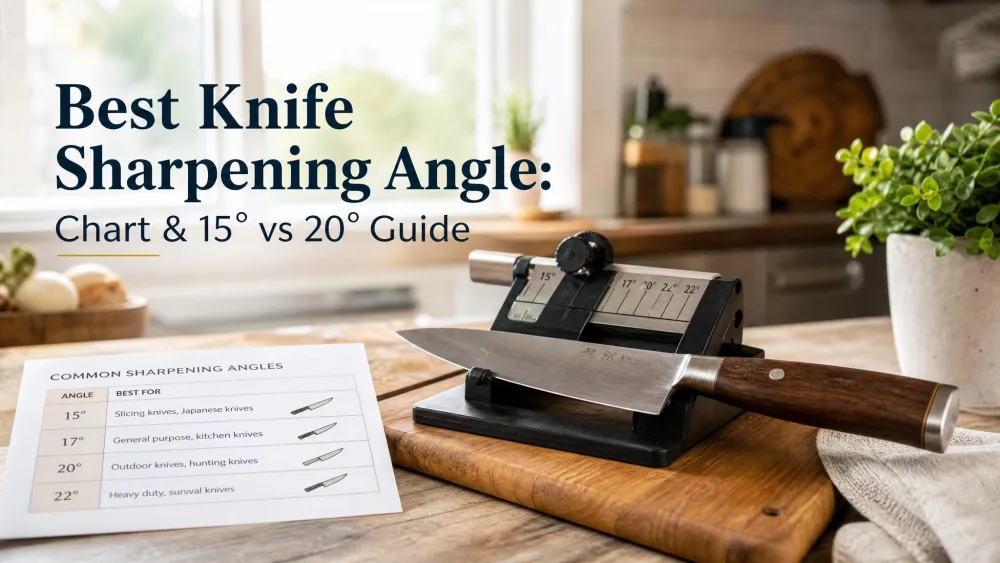
The sharpening angle is the angle between a blade's edge and the stone, measured on one side. Get it wrong and no amount of time on the whetstone will fix a knife that refuses to bite. For most kitchen knives, the practical answer is 15° to 20° per side, and the right number depends on your steel, your blade, and the cutting you do. In our test kitchen we have sharpened hundreds of blades for home cooks, professional kitchens, and outdoor users, and the same trade-off shows up every time: a lower angle cuts with less resistance but dents more easily, while a higher angle lasts longer but takes more effort. This guide covers the angle chart by knife type and brand, the 15° vs 20° breakdown, and the techniques that keep you consistent.
What Is the Best Knife Sharpening Angle? (Quick Answer)
Stated plainly: 15° to 20° per side covers most kitchen knives, and 17° to 20° per side is the range we recommend for a home cook's chef's knife. Japanese knives with harder steel can hold 10° to 15° per side, while pocket, hunting, and outdoor blades sit at 20° to 30° per side. The trade-off between sharpness and durability runs through this guide.
Knife Sharpening Angle Chart (Quick Reference)
The chart below is the fastest way to find your starting angle. Every figure is per side; double it for the inclusive angle.
| Knife type / task | Angle per side (DPS) | Inclusive angle | Best for / notes |
|---|---|---|---|
| Chef's & Western kitchen | 17-20° | 34-40° | All-purpose; durable enough for daily board work |
| Japanese (double bevel) | 10-15° | 20-30° | Thin, hard-steel slicers (gyuto, santoku, nakiri) |
| Japanese (single bevel) | 12-15° on bevel side | Equals one bevel | Yanagiba, usuba, deba; flat side stays untouched |
| Paring | 15-20° | 30-40° | Precision detail work |
| Fillet | 13-17° | 26-34° | Flexible blade, clean flesh slicing |
| Cleaver (light vegetable) | 15-20° | 30-40° | Vegetable prep with a Chinese chef knife |
| Cleaver (heavy bone) | 25-30° | 50-60° | Bone and heavy chopping; resists chipping |
| Pocket / EDC | 20-25° | 40-50° | Hard-use carry edges; light slicing near 18-20° |
| Hunting / outdoor | 22-30° | 44-60° | Durability in field and abuse conditions |
| Serrated | ~15-20° on beveled side | Varies | Only the beveled side of each scallop is sharpened |
| Straight razor | 8-10° | 16-20° | Extreme polish; never sees hard use |
How to Read This Chart (Per Side vs. Inclusive)
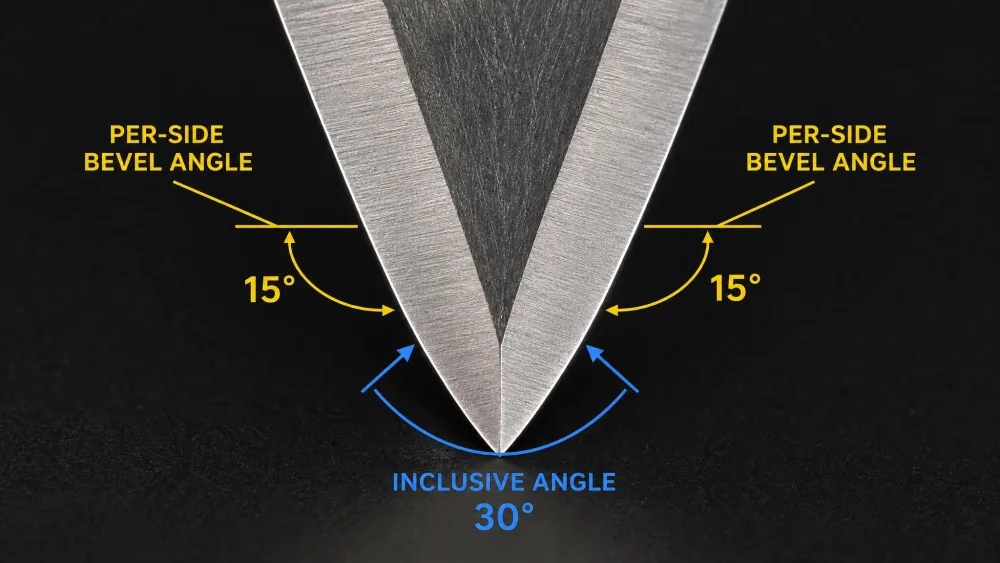
Each row states the angle per side, the angle one face of the edge makes with the stone. A double-bevel knife at 15° per side produces a 30° inclusive edge, since the two bevels meet at the apex. Wikipedia's per-side vs. inclusive angle explains the distinction.
Degrees Per Side vs. Inclusive Angle
Sharpening angles are stated per side, so 15° per side on a double-bevel knife equals about 30° inclusive, and 20° per side equals 40° inclusive. Both figures get quoted, and the mix-up trips up plenty of home sharpeners.
Note. The single-bevel exception: on a yanagiba or deba, only one side is sharpened to the target angle while the other stays flat, so the total included angle equals the one bevel. Most Asian knives sold in the US are double-bevel, both sides at roughly 17°.
Best Sharpening Angle by Knife Type
Knife type sets the starting angle more than any other factor. Ranges below are per side.
Chef's & Western Kitchen Knives
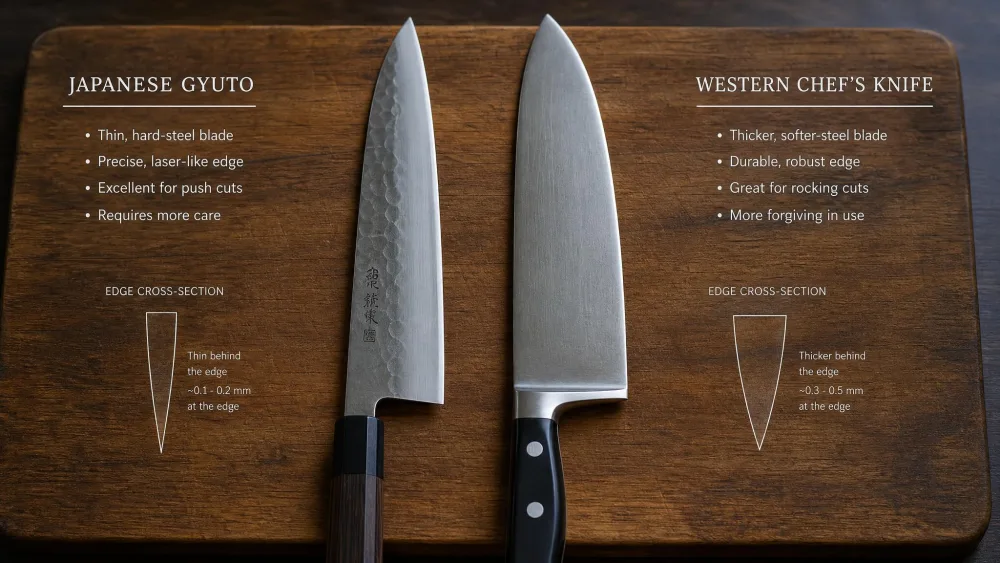
Western chef's and kitchen knives are most commonly sharpened at 17° to 20° per side, and many come from the factory near 20°. Use the lower end for thinner, harder blades and the higher end for rough all-purpose work.
Japanese Knives (Single vs. Double Bevel)
Double-bevel Japanese knives, the gyuto, santoku, and nakiri, are typically sharpened at 10° to 15° per side, with many around 15°. Single-bevel knives like the yanagiba and deba are sharpened only on the beveled side, typically 12° to 15°, while the flat side stays untouched.
Pocket / EDC Knives
Pocket and everyday-carry knives are typically sharpened at 20° to 25° per side. Lighter slicing works well at 18° to 20°, while hard-use edges go up to 25°.
Hunting & Outdoor Fixed-Blade Knives
Hunting and outdoor fixed-blade knives are typically sharpened at 22° to 30° per side for durability during hard field use, at a small cost in cutting ability most users will not notice.
Fillet Knives
Fillet knives are typically sharpened at 13° to 17° per side. The flexible, low-angle edge suits clean slicing of soft flesh; a stiff fillet knife tends to tear.
Cleavers
Light Chinese-style vegetable cleavers are typically sharpened at 15° to 20° per side. Heavy meat and bone cleavers are much more obtuse, typically 25° to 30° per side, so the edge resists chipping on bone.
Sharpening Angle Chart by Brand & Manufacturer
The old shorthand that Western knives are 20° and Asian knives are 15° is too simple. Modern brands vary, so the factory bevel is the better guide.
| Brand | Factory angle (per side) | Notes |
|---|---|---|
| Wusthof | 14° standard; 10° Asian-style | PEtec computer-guided forged edges |
| Zwilling / Henckels | ~15° European | Sharpen at 15-20° on a steel |
| Shun | 16° standard; 22° Western Cook's | VG10/VG-Max 60-61 HRC; SG2 61-62 HRC |
| Global | 10-15° | CROMOVA 18; avoid steel honing rods |
| Victorinox | 15-20° | Hone kitchen knives at 20° on the steel |
| Buck | 13-16°; fillet 10-12°; tactical 20-24° | Match factory bevel; one-blade-width rule |
| Benchmade | ~15-17.5° (30-35° inclusive) | Avoid sharpening below 30° inclusive |
| Kershaw | 20-22° (some 18°) | Keep a consistent 18-22° |
Wüsthof, Zwilling & Henckels
Wüsthof standard blades are sharpened to 14° per side, with its Asian-style santoku and nakiri at 10° per side; its PEtec edge is 20 percent sharper with twice the edge retention. Zwilling recommends about 15° per side for European knives.
Shun & Global
Shun standard knives are factory-sharpened to 16° per side, with the Western Cook's Knife at a wider 22° for tough produce. Shun hardens VG10 and VG-Max to 60-61 HRC and SG2 to 61-62 HRC. Global knives are factory-sharpened at 10° to 15° per side, and Global's care guidance advises against steel honing rods, which can damage its knives.
Victorinox
Victorinox recommends sharpening its kitchen knives at 15° to 20° per side on a whetstone and holding the knife at 20° to the steel when honing.
Buck, Benchmade & Kershaw
Buck grinds most knives to 13° to 16° per side, with fillet knives at 10° to 12° and tactical knives at 20° to 24°. Benchmade comes from the factory at 30° to 35° inclusive and advises rarely going below 30° inclusive. Kershaw blades run 20° to 22° per side and the brand recommends a consistent 18° to 22°.
15° vs. 20°: Which Edge Angle Is Right for You?
Neither 15° nor 20° per side is universally better. The right choice depends on the knife's steel, thickness, and use. A 15° edge cuts with less resistance and feels sharper but is more fragile; a 20° edge has more steel behind the apex and tolerates rougher boards and chopping. That trade-off between sharpness and durability runs through this guide.
In our sharpening, line cooks who prep all day love 15° per side on hard Japanese steel, while home cooks on harsh boards do better at 18°. A pro compromise is a 17° to 18° primary bevel finished with a 20° micro-bevel. If the edge rolls, raise the angle about 2° per side; if it chips, drop 1° to 2° and add a micro-bevel.
Sharpening Angle Ranges Explained (Under 10° to Over 30°)
The angle bands below explain why each knife type lands where it does.
Under 10° (Straight Razors & Extreme Polish)
Straight razors are sharpened at the lowest practical edge angles, around 8° to 10° per side, and never see hard use.
10°–15° (Thin, High-Hardness Blades)
This band suits thin, high-hardness blades such as many Japanese knives. Edges are fine but delicate, and too weak for chopping.
15°–17° (Most Western Kitchen Knives)
Many Japanese and newer European and American knives are factory-sharpened here. It is about the lowest angle recommended for an all-purpose knife designed at 20°.
17°–22° (All-Purpose Kitchen & EDC)
This band covers most kitchen, pocket, and outdoor knives. The 17° to 20° slice is the well-rounded all-purpose zone, with Japanese makers near 17° and Western near 20°.
22°–30° (Outdoor, Hunting & Workhorse Knives)
This band is for outdoor, hunting, and workhorse knives that see abuse. Edges are considerably more durable, with a modest loss in cutting performance.
Over 30° (Heavy-Duty & Beater Blades)
Angles over 30° per side are very durable but cut noticeably less well; they suit machetes, heavy cleavers, and axes.
Factors That Determine the Best Sharpening Angle
Four factors decide the right angle for a knife: use, steel hardness, blade thickness, and your preference and skill.
Knife Use
Intended use is the dominant factor. Slicing favors lower angles; chopping, batonning, and hard outdoor work favor higher angles. A knife that only touches a board can sit at 15°.
Steel Hardness (HRC)
Harder steel, roughly 60 HRC and up, supports a lower edge angle without rolling or chipping; softer steel needs a higher angle. Japanese knives earn low angles partly because makers harden steel to 60-61 HRC.
Blade Thickness
Thicker blades are harder to sharpen to a low angle because more material must be removed. A thick blade may need a higher angle, or thinning behind the edge.
User Preference
Your preference and skill matter too, because a consistent angle beats an exact number. An edge that wanders between 15° and 25° performs worse than a steady 18°.
How to Find Your Knife's Current Factory Angle
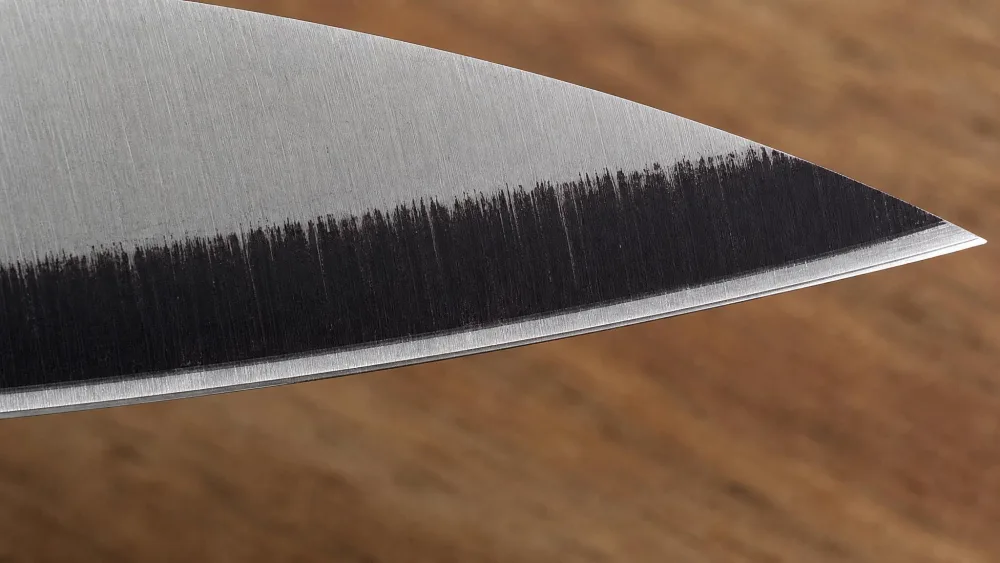
The safest starting point is to match the existing factory bevel. Changing a factory angle removes metal and alters edge geometry, so experiment only on inexpensive knives. The marker test reads your angle: color the bevel with a permanent marker, take one stroke, and check the ink. If ink clears evenly from shoulder to apex, your angle matches; if it stays at the cutting edge, you are too high.
Warning. Re-profile an expensive knife only if you are sure; lowering the angle removes a lot of steel and changes how the knife cuts and lasts. Practice on an inexpensive blade first.
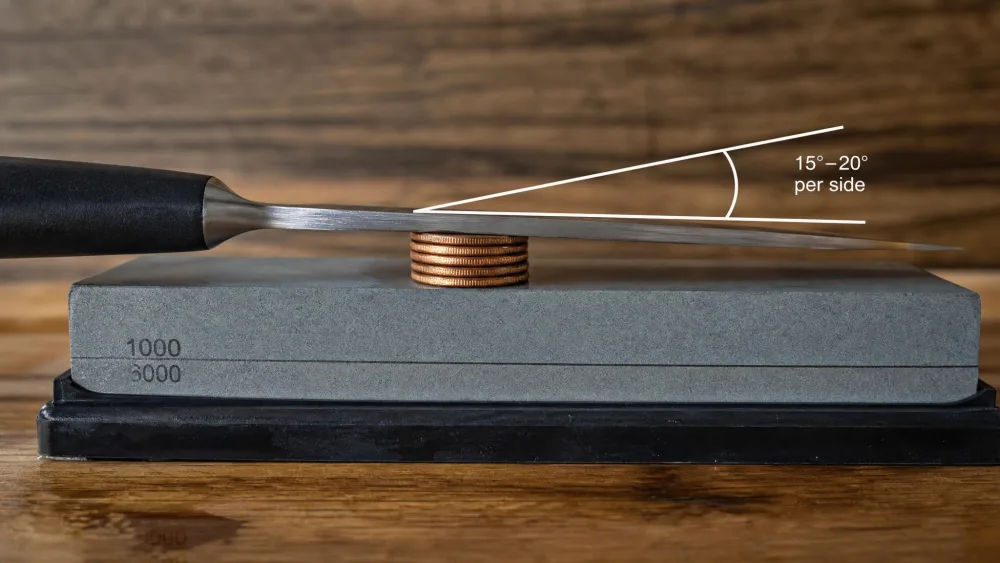
Tip. Set the angle without tools: stack 4 to 6 pennies under the spine of a 1-inch-wide blade for roughly 15° to 20° per side. For precision, raise the spine so its height off the stone equals blade width times the sine of the angle; a 50 mm blade needs about 13 mm at 15° and 17 mm at 20°.
How to Hold the Angle Every Time (Tools & Techniques)
The tool you sharpen with changes how you hold the angle. Freehand gives the most control and the most room for error; guided systems lock the angle.
Freehand on a Whetstone
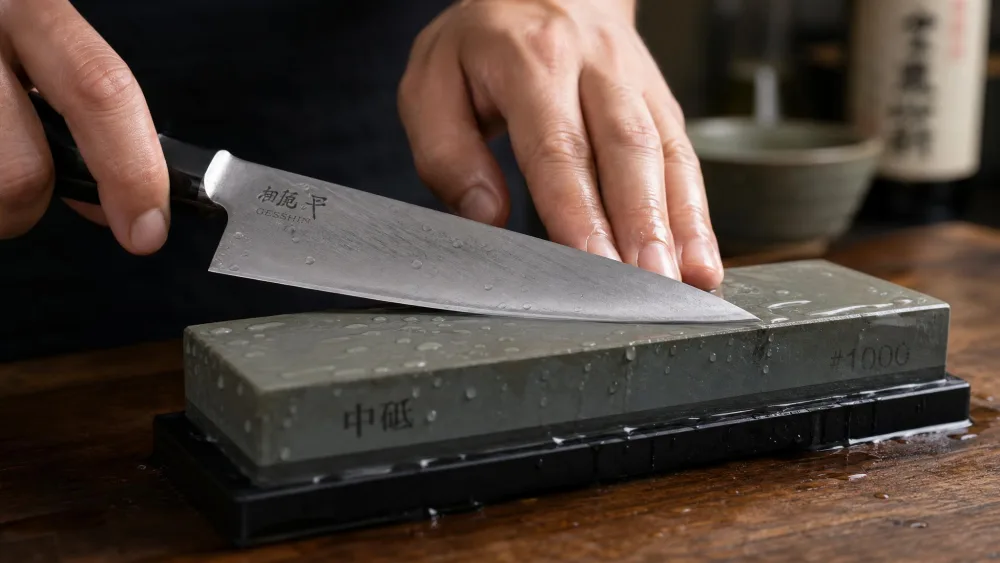
Freehand means holding the blade at your target angle against a stone with nothing but your hands. It is the most flexible method and the one that takes the most practice. The coin trick above gets you close, and the marker test confirms the angle.
Guided Manual Sharpeners
Guided manual sharpeners clamp the blade and run a rod at a fixed angle. The Work Sharp offers 15-30° in 1° increments and carries a 3-year warranty. In our sharpening, the first session with a guided system takes longest as the edge adjusts, but these kits are a game changer for people who struggle freehand. Narrow blades do not clamp well, the O-ring can pop off, and it should be used dry.
Sharpening Jigs and Angle Guides
Jigs and angle guides lock the blade to a set angle, often with discrete settings. The EdgePro Apex offers 10, 15, 18, 21, 24, and 27 degrees per side, and its manual suggests 21° generally and 18° for Japanese-style blades.
Electric Sharpeners
Electric sharpeners use fixed-angle slots, so the angle is built in. They are the easiest option and the fastest way to ruin a good knife if the slot angle does not match your blade.
Pros
- Whetstone: full control over any angle, cheapest long term, no moving parts to wear out
- Guided system: repeatable angle every session, hard to drift, gentle on edge geometry
Cons
- Whetstone: steep learning curve, easy to let the wrist rock off angle
- Guided system: slower per knife, clamping narrow blades can be fiddly
- Electric: fixed angles only, removes metal aggressively, risk to thin edges
How to Sharpen a Knife at the Correct Angle (Step-by-Step)
With your target angle chosen, sharpening comes down to four steps. Consistency matters more than speed, and the burr is your feedback that the edge is forming.
Step 1: Match or Set Your Target Angle
Set the angle before you touch stone to steel. Match the factory bevel with the marker test, or set a new angle with the spine-height method or a guide.
Step 2: Hold the Angle on the Stone
Raise the spine so the blade sits at your target angle, and keep that height constant as you move. Rocking the wrist changes the angle mid-stroke. Press just enough to keep the bevel flat.
Step 3: Sharpen Evenly, Side to Side
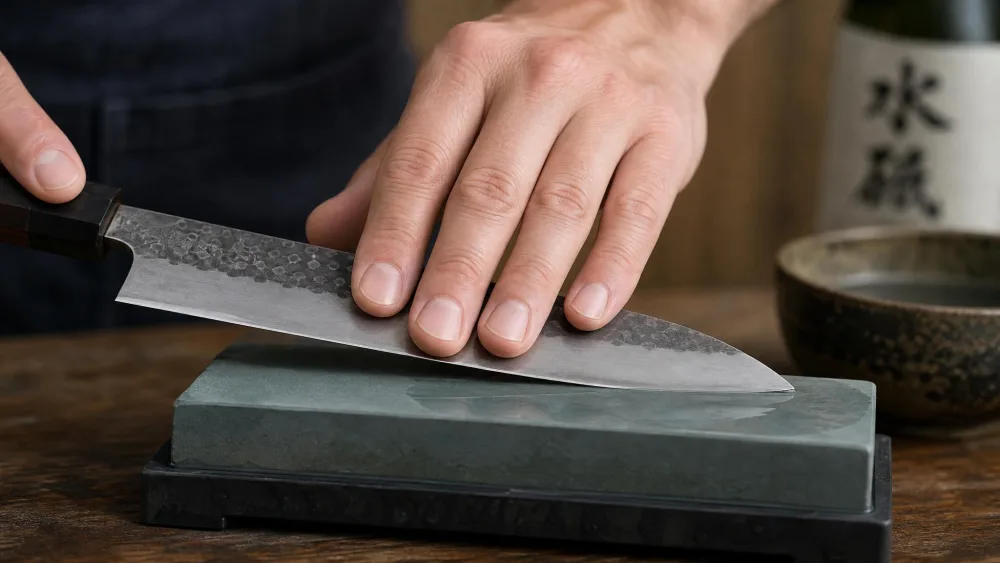
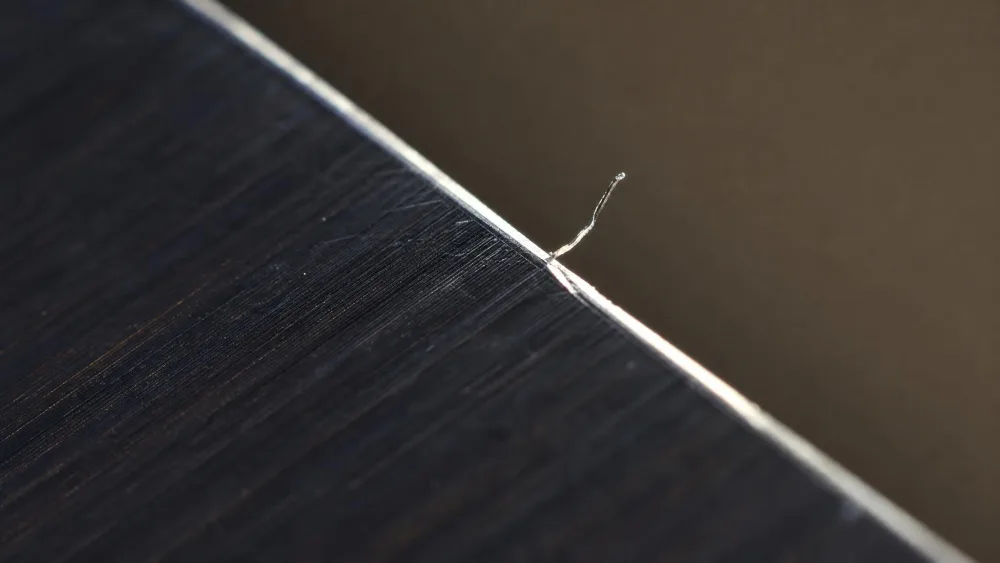
Work one side until you feel a burr, the thin wire of steel that folds over the edge when the bevel is apexed. If a burr forms almost immediately, you are too steep; if you grind 5 to 10 minutes with no burr, the angle is too low. Switch sides and repeat, and stay on the coarse grit until both sides are apexed.
Step 4: Finish with a Micro-Bevel or Strop
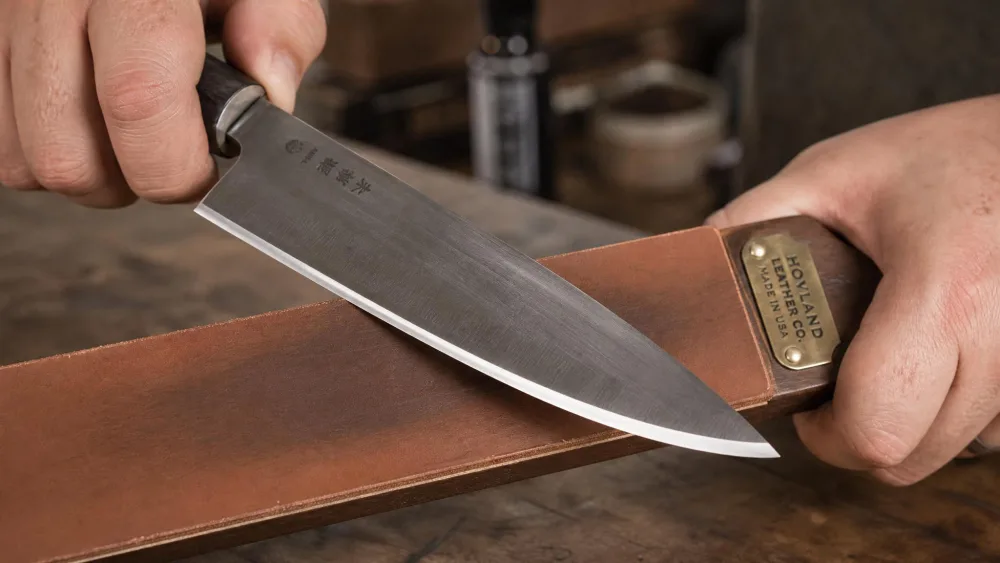
Once both sides are apexed, a micro-bevel 2° to 3° above your main angle, taken off in a few light strokes, fixes micro-chipping without a full re-profile. A few passes on a strop remove the last burr. A knife that goes dull right after sharpening usually has a folded burr left on the edge.
Common Knife Sharpening Angle Mistakes to Avoid
The biggest mistake is trusting the old shorthand that Western knives are 20° and Asian knives are 15°; the actual factory bevel beats the old rule every time. We also see people let the angle wander between 15° and 25° on one blade, and a consistent 18° edge holds up better than that wandering edge.
Board choice is part of edge life. Glass, stone, and ceramic boards wreck edges no matter the angle, so switch to wood or a soft composite board.
Tip. Sharpen only when the edge is genuinely dull, and hone in between. Honing realigns the edge without removing metal, so a weekly pass with a steel extends the time between sharpenings. Sharpening too often removes metal and shortens a knife's life.
Knife Sharpening Angle FAQ
What angle should I sharpen a kitchen knife?
Most kitchen knives belong at 15° to 20° per side; 17° to 20° is the forgiving all-purpose range for a chef's knife.
Is 15° or 20° better for a kitchen knife?
Neither is universally better. A 15° edge feels sharper but dents more easily; a 20° edge lasts longer and tolerates rougher boards. Hard Japanese steel can handle 15°; softer Western steel does better at 18° to 20°.
What angle should I sharpen a Japanese knife?
Double-bevel Japanese knives run 10° to 15° per side. Single-bevel knives like the yanagiba and deba are sharpened at 12° to 15° on the beveled side only.
Is the angle per side or total (inclusive)?
Angles are stated per side. A 15° per-side edge is 30° inclusive; double the per-side figure for the inclusive angle.
Can I sharpen a 20° knife down to 15°?
Yes, but it removes steel and shortens the edge's life. Match the factory bevel when you can, and experiment only on inexpensive knives.
What angle should a beginner use?
Start at 17° to 20° per side on a chef's knife. It is forgiving and leaves room for error while you learn consistency.
Do harder steels allow lower angles?
Yes. Steel at roughly 60 HRC and up holds a lower angle; softer steel needs a higher one.
How do I measure the angle without tools?
Use the marker test to check, or stack 4 to 6 pennies under the spine to set roughly 15° to 20° per side.
What angle do Wüsthof, Shun, Zwilling and Global knives use?
Wüsthof standard blades are 14° per side, Zwilling recommends about 15°, Shun factory edges are 16°, and Global runs 10° to 15°.
Why does my knife get dull right after sharpening?
It usually has a folded burr left on the edge. Form a clean burr on both sides, then remove it.
Final Verdict: Match the Angle the Knife Can Actually Hold
The angle that matters is the one your knife can actually hold. Match the existing factory bevel when you can, favor 17° to 20° per side for most kitchen knives, and let harder Japanese steel drop to 10° to 15° for extra bite. Raise the angle if the edge rolls, drop it if it chips. A steady 18° will out-cut an inconsistent edge that wanders between 15° and 25°. Buy one good chef's knife, learn ten minutes of sharpening, and the angle stops being a mystery.
Read next
Match the Angle the Knife Can Actually Hold
Match the factory bevel, favor 17° to 20° per side for most kitchen knives, and a steady angle beats a wandering one.