Helping you create a kitchen you love.

Knives & Cutlery

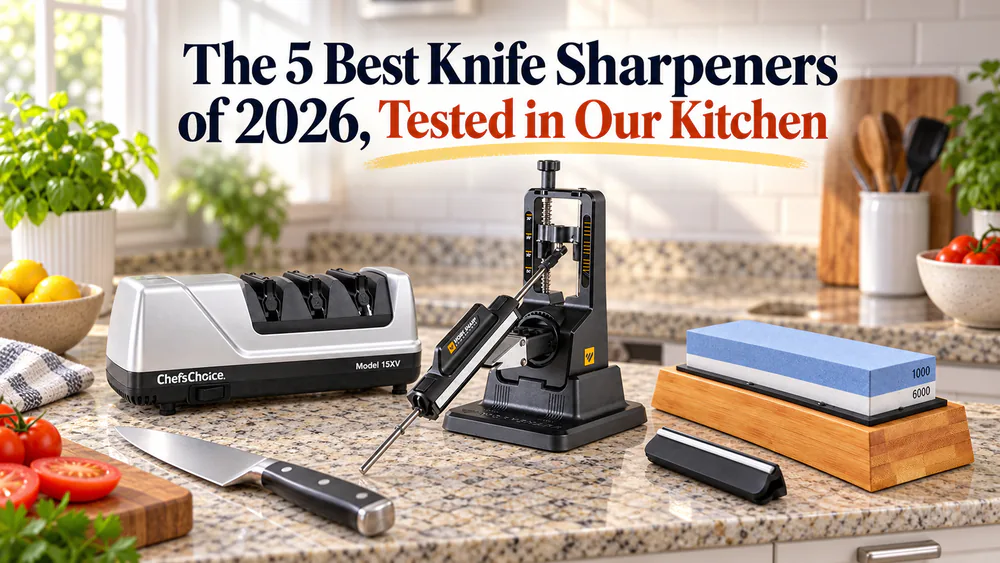
The 5 Best Knife Sharpeners of 2026, Tested in Our Kitchen

As an Amazon Associate we earn from qualifying purchases. We may earn a commission from links on this page, at no extra cost to you. Learn more.

The 5 Best Knife Sharpeners of 2026, Tested in Our Kitchen

After 20 years behind a butcher counter, we know a dull knife is the most dangerous tool in the kitchen. So we run every sharpener we recommend through a month of real prep, checking the edge after each session and resharpening each knife on the tool itself. A knife that needs force to slice a tomato is a knife that will find your finger eventually.

The right sharpener depends on your knives and on how much time you want to spend. An electric handles a whole block in minutes; a whetstone rewards ten quiet minutes with an edge that lasts. We tested electric, guided, whetstone, pull-through, and honing-rod options on German, Japanese, and budget steel, and the five below are the ones that kept blades razor sharp through the whole month.

Note. Street prices as of August 2026, and they move with sales. Every range below is what we verified at the time of writing.

The 5 Best Knife Sharpeners of 2026 at a Glance

Five tools, five different jobs. Here is the quick verdict on each, with the full reviews below.

RankProductBest forPriceRatingBuy
1

Chef'sChoice 15XV Trizor EdgeSelect

Best Overall
Most kitchens, all blade types About $166-$170 4.7 View on Amazon
2

Work Sharp Precision Adjust

Best Guided System
Exact angles on mixed collections About $70-$80 4.5 View on Amazon
3

Sharp Pebble 1000/6000 Whetstone

Best Whetstone
Craft-minded cooks About $38-$40 4.4 View on Amazon
4

KitchenIQ 50009 Edge Grip

Best Budget Pull-Through
Beater knives and rentals About $10-$14 4.2 View on Amazon
5

Utopia Kitchen 12" Honing Rod

Best for Daily Maintenance
Keeping sharp knives sharp About $14-$16 4.4 View on Amazon

We earn a commission if you make a purchase, at no additional cost to you.

Ratings reflect a full month of prep on each tool, not a single session. Read the reviews in order, and if you are still deciding between types, the buyer's guide at the end will settle it.

The 5 Best Knife Sharpeners, Tested and Reviewed

We ranked by category rather than head-to-head, because a whetstone and an electric serve different kitchens. Every pick was scored on edge quality, how the edge held after a week of prep, and how easily the steel sharpened back to new.

1. Chef'sChoice 15XV Trizor EdgeSelect (Best Overall, electric)

Chef'sChoice 15XV Trizor EdgeSelect
1

Chef'sChoice 15XV Trizor EdgeSelect

Best Overall
Check Price on Amazon
4.7/5

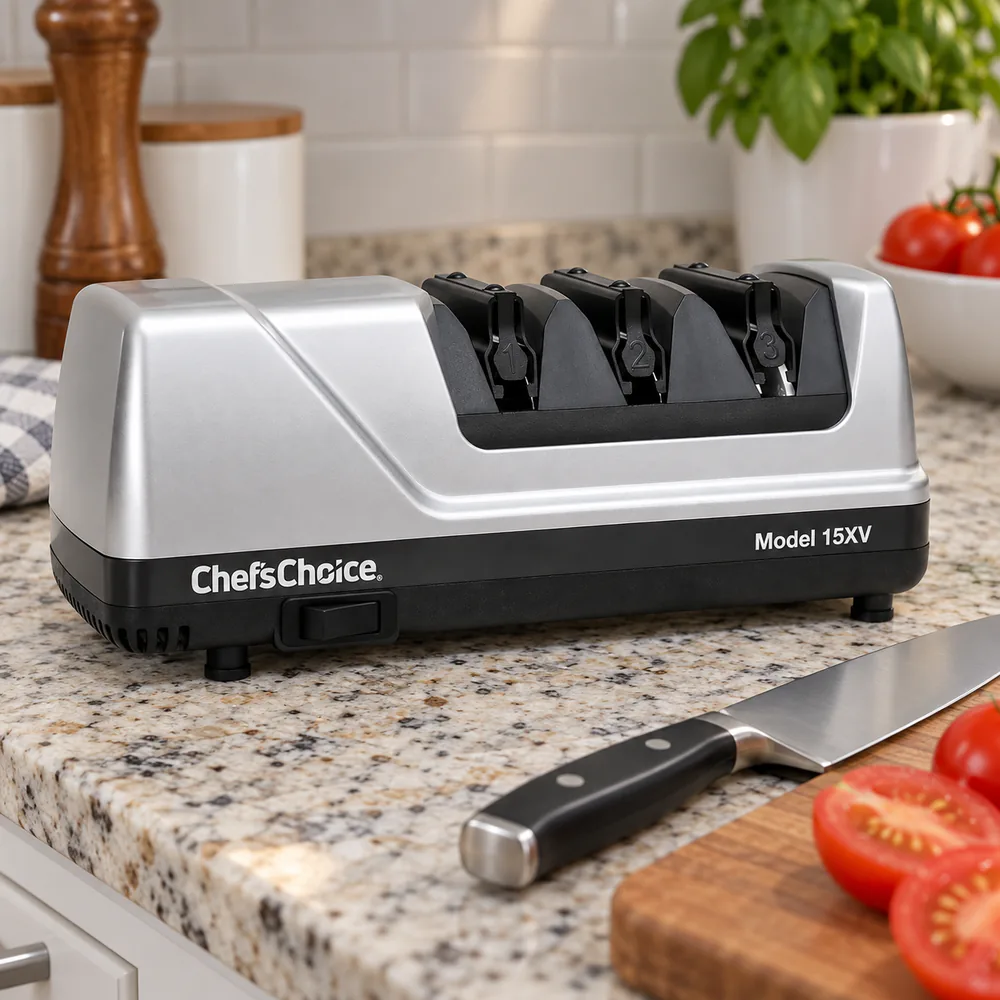
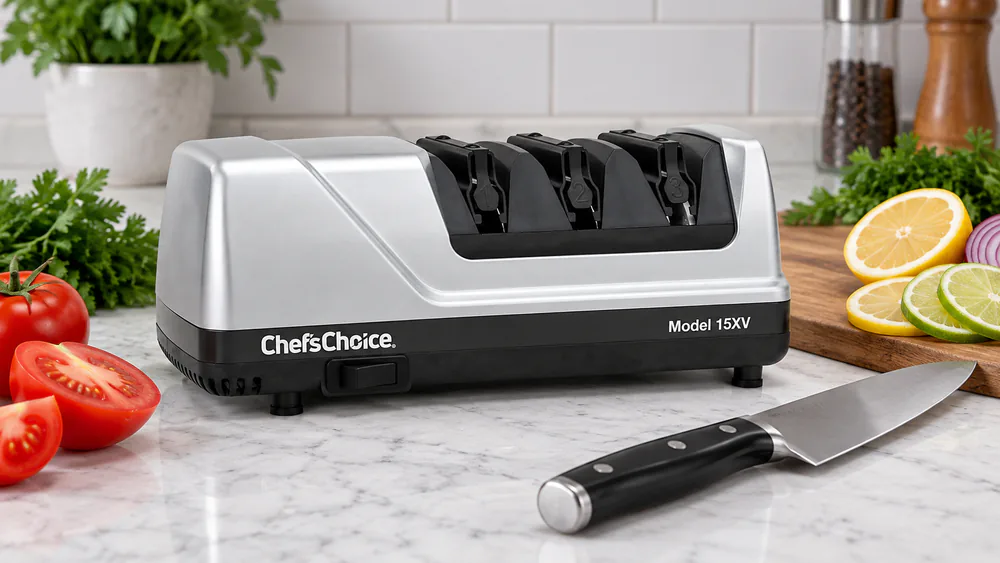
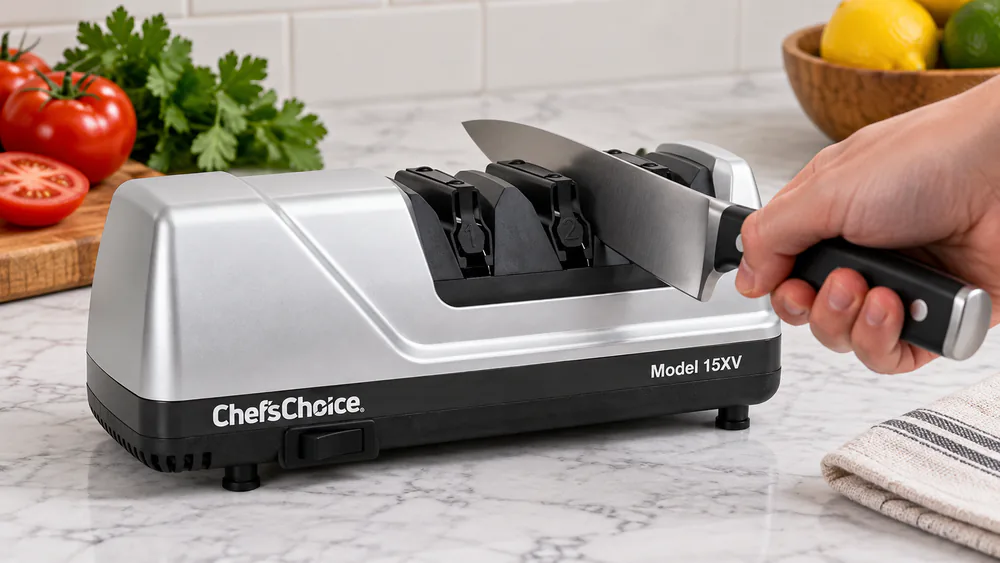
Our top pick is the Chef'sChoice 15XV, and it earned the crown the old-fashioned way: it produced the keenest, most consistent edges of everything we tested, and it did it fast. The first chef's knife through the slots told the story. A few swipes brought a dull blade back to paper-slicing, and the machine converted the knife's 20-degree factory edge to a 15-degree bevel in a couple of passes. The spring guides held the blade firmly, and the unit's weight kept it planted on the counter, so no third hand was needed. Street pricing runs from about $166 to $170 and drifts with sales; Chef'sChoice's product page carries the full spec sheet.

Specifications

Type
Electric, 3-stage EdgeSelect
Angle
15 degrees (converts 20-degree factory edges)
Abrasives
100-percent diamond on conical discs, flexible strop disc for polish
Speed
About a minute for a dull knife, about 10 seconds per touch-up
Price
About $166-$170
Warranty
3-year limited

Pros

  • Keen, consistent 15-degree edges in about a minute
  • Spring guides handle any blade thickness, straight and serrated
  • Final strop stage maintains edges between full sharpenings
  • 3-year limited warranty

Cons

  • Removes more steel per use than manual methods
  • Pricey, and the street price drifts with sales
  • First sessions demand the manual, one routine per blade type

The honest trade-offs come with the territory of a 3-stage electric. The 15XV grinds a whole new edge in about a minute, but it removes more blade material per use than a manual sharpener, so a blade sharpened electrically for years visibly loses height. The machine also demands reading the manual: Western, Japanese, and serrated knives each want a different slot routine, so the first sessions feel fiddly despite the machine doing the work. Once your knives carry the converted 15-degree bevel, the final stropping stage alone handles most touch-ups, and good knives only need a full sharpening once or twice a year.

A chef's knife passing through the spring-guided slot of a gray Chef'sChoice 15XV electric sharpener on a kitchen counter.
A few swipes through the slots brought our dullest chef's knife back to paper-slicing.

2. Work Sharp Precision Adjust (Best Guided System)

Work Sharp Precision Adjust
2

Work Sharp Precision Adjust

Best Guided System
Check Price on Amazon
4.5/5

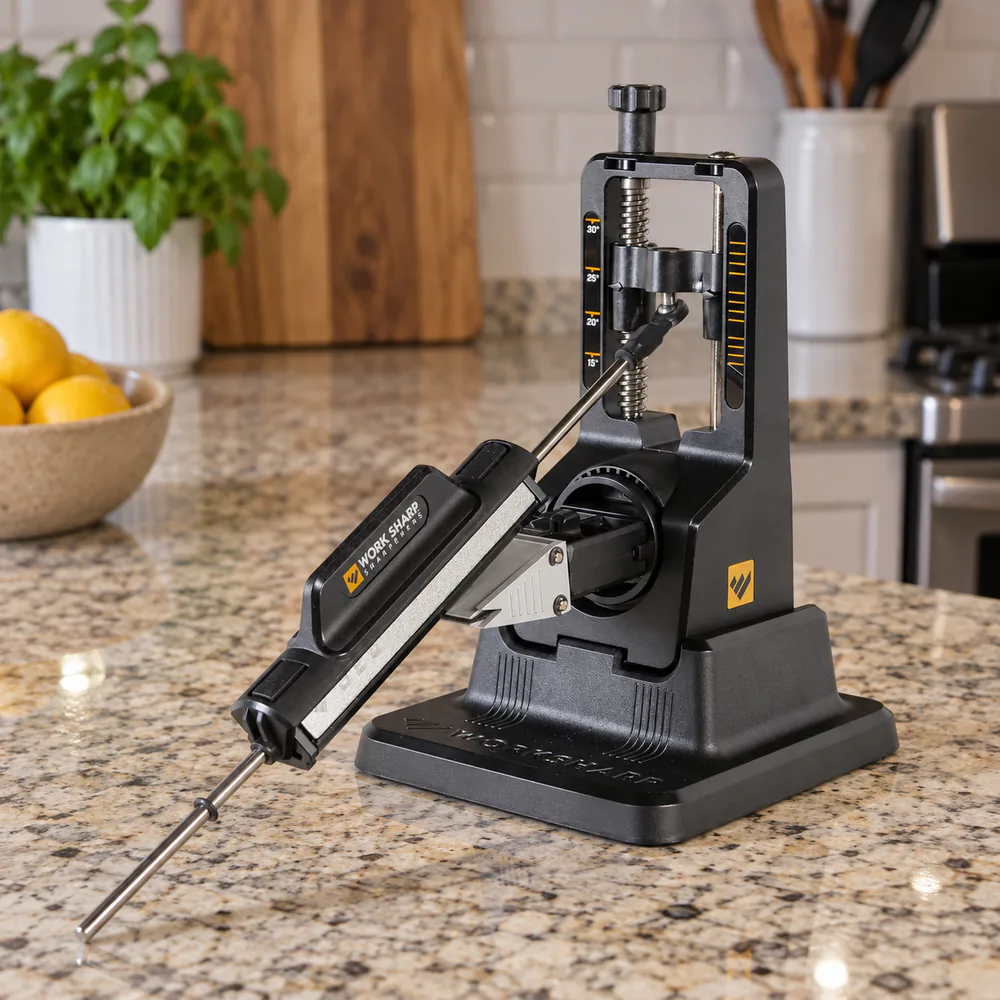
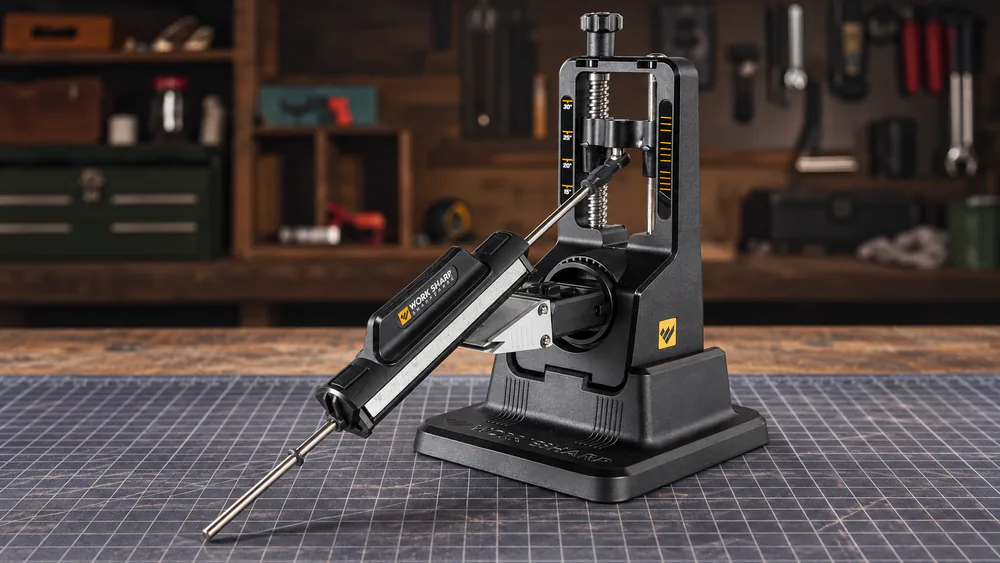
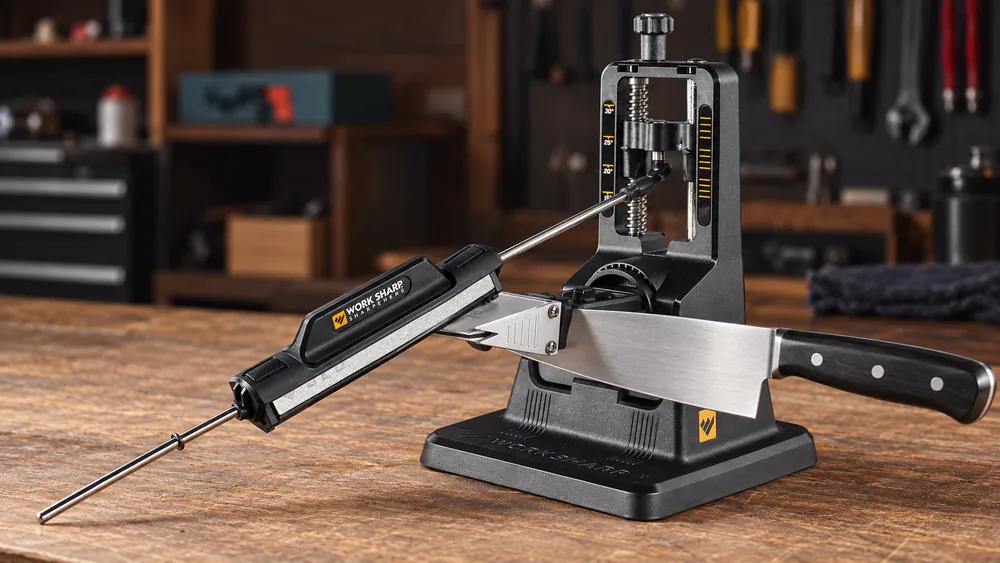
If the Chef'sChoice is the set-it-and-forget-it route, the Precision Adjust is the opposite: full control over the angle at less than half the price. The knife clamps in a benchtop V-block, the threaded tower on the sharpening rod dials in 15 to 30 degrees in 1-degree increments, and a push-button release rotates the whole assembly 180 degrees, so both sides sharpen without unclamping. In our rotation, this took knives from utility dull to shaving sharp with minimal fuss, and the fine ceramic hone got the most use, because you never let knives get very dull in a working kitchen. Street pricing moves week to week, from about $70 on the street to $79.95 at the manufacturer's own store; Work Sharp's product page lists the official price.

Specifications

Type
Manual, guided clamp
Angle
15-30 degrees in 1-degree increments
Abrasives
320 and 600 grit diamond plates plus a fine ceramic hone
Price
About $70-$80
Weight
1.8 lb
Warranty
3-year

Pros

  • Exact, repeatable angle every session
  • Both sides sharpen without unclamping
  • Ceramic hone keeps edges alive between sharpenings
  • Less than half the price of our top pick

Cons

  • Release button takes more force than is comfortable
  • Clamp struggles with very thin blades
  • Angle can drift mid-session under heavy pressure
  • Slow on badly damaged edges

The trade-offs are the clamp and the plastic. The push-button rotation is a real time-saver, but the release takes more force than is comfortable, so slow hands are the rule. The body leans on high-impact plastics where pro systems like the Wicked Edge use metal, and the clamp earns mixed judgment from us: it holds a standard chef's knife well, thinner blades sit less securely, and the angle can drift mid-session if you press hard. Reprofiling a badly damaged edge is also slow on the 320-grit coarse stone; once the geometry is right, normal sharpening is quick if you let the stone do the work without pressing.

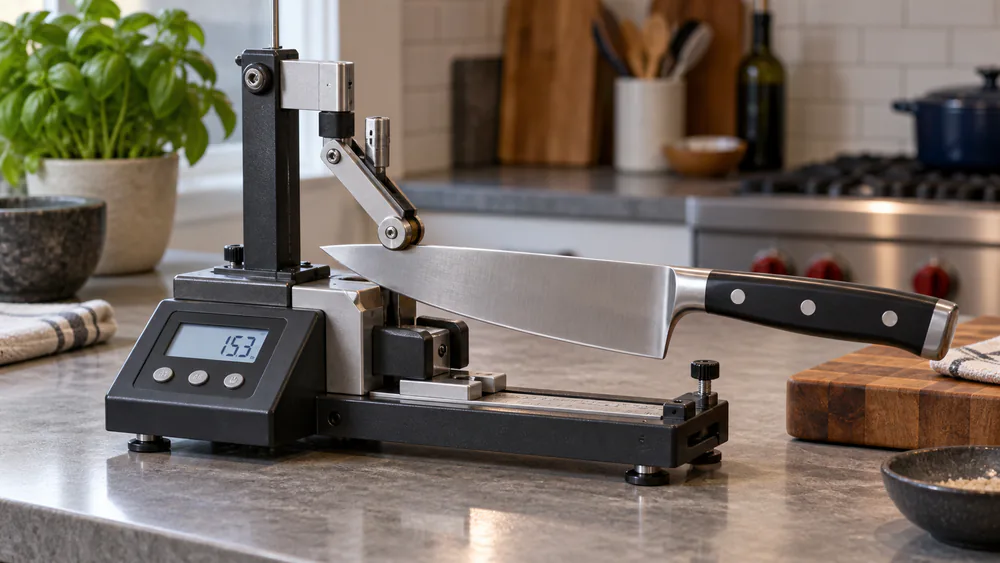
A chef's knife clamped in the Work Sharp Precision Adjust benchtop base, the threaded angle tower visible at the rear.
The threaded tower dials the angle in 1-degree steps, and the clamp flips 180 degrees between sides.

3. Sharp Pebble 1000/6000 Whetstone (Best Whetstone)

Sharp Pebble 1000/6000 Whetstone
3

Sharp Pebble 1000/6000 Whetstone

Best Whetstone
Check Price on Amazon
4.4/5

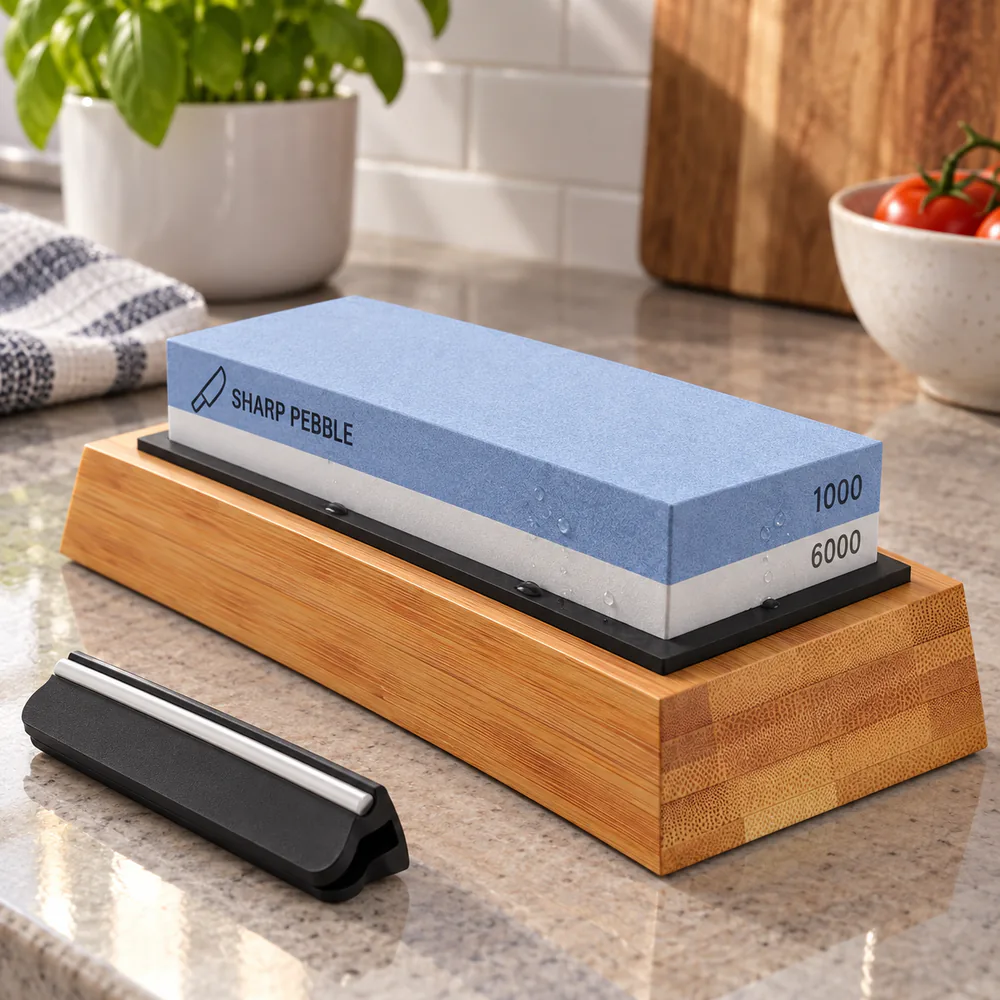
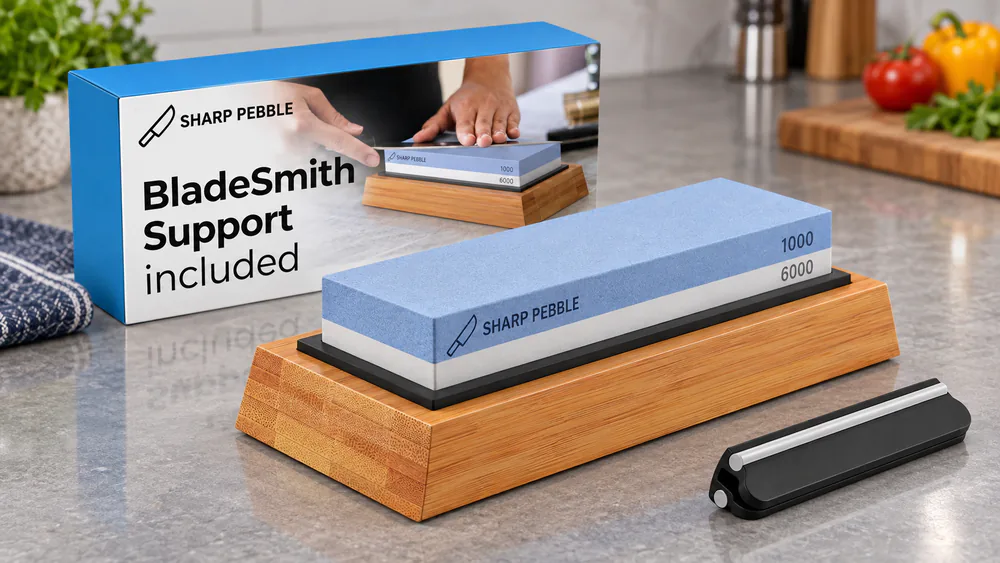
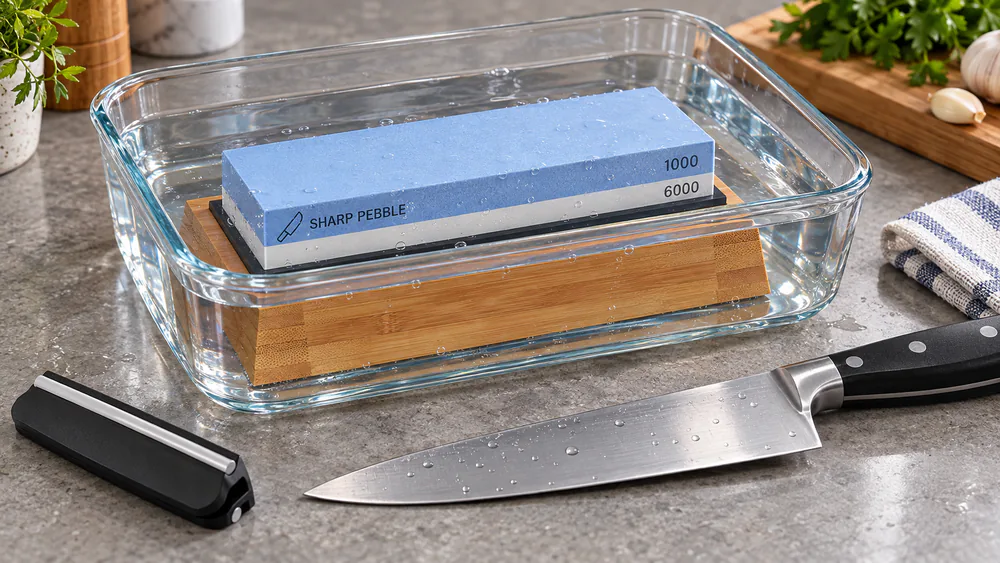
Where the two picks above chase convenience, the Sharp Pebble asks for ten minutes of your time and a little patience, and it pays you back in edge quality. The 6000-grit side restored the factory pop on edges that were not yet dull, while the coarse 1000-grit side was where our badly beaten blades started. The routine is simple: soak the stone for 10 to 15 minutes before use, no oil needed, then clear the slurry as it builds. The included 15-degree angle guide and the raised bamboo base made beginner sessions forgiving, because the stone sits high enough to avoid scraping knuckles and the non-slip base stays put. Street pricing runs about $38 to $40 and moves with sales; Sharp Pebble's product page covers the full kit.

Specifications

Type
Double-sided whetstone (water stone)
Grits
1000/6000 aluminum oxide (corundum)
Angle
Freehand, 15-degree clip-on guide included
Soak
10-15 minutes before use
Price
About $38-$40
Size
18.4 x 5.7 x 2.5 cm, 2.1 lb

Pros

  • 6000-grit side restores factory pop on tired edges
  • Angle guide and bamboo base make first sessions forgiving
  • Water-based sharpening, no oil needed
  • Roughly a third of the price of a premium stone

Cons

  • Needs more passes than costlier stones
  • Aluminum oxide wears and dishes, so flattening is required
  • Freehand angle takes practice, guide or not

The honest caveats are the ones every budget stone carries. Aluminum-oxide stones like this one are cheaper than ceramic but wear faster, and they dish and build slurry quickly, so flattening becomes part of ownership. We also needed more passes than a premium whetstone to get a proper edge, and the one-page manual could use photos. None of that changes the math: this is the cheapest way to learn real sharpening, and the 1000/6000 combo covers the two grits that matter most.

A double-sided 1000/6000 whetstone soaking in water beside a chef's knife on its bamboo base.
Ten to fifteen minutes of soaking, then the coarse side repairs and the fine side polishes.

4. KitchenIQ 50009 Edge Grip (Best Budget Pull-Through)

KitchenIQ 50009 Edge Grip
4

KitchenIQ 50009 Edge Grip

Best Budget Pull-Through
Check Price on Amazon
4.2/5

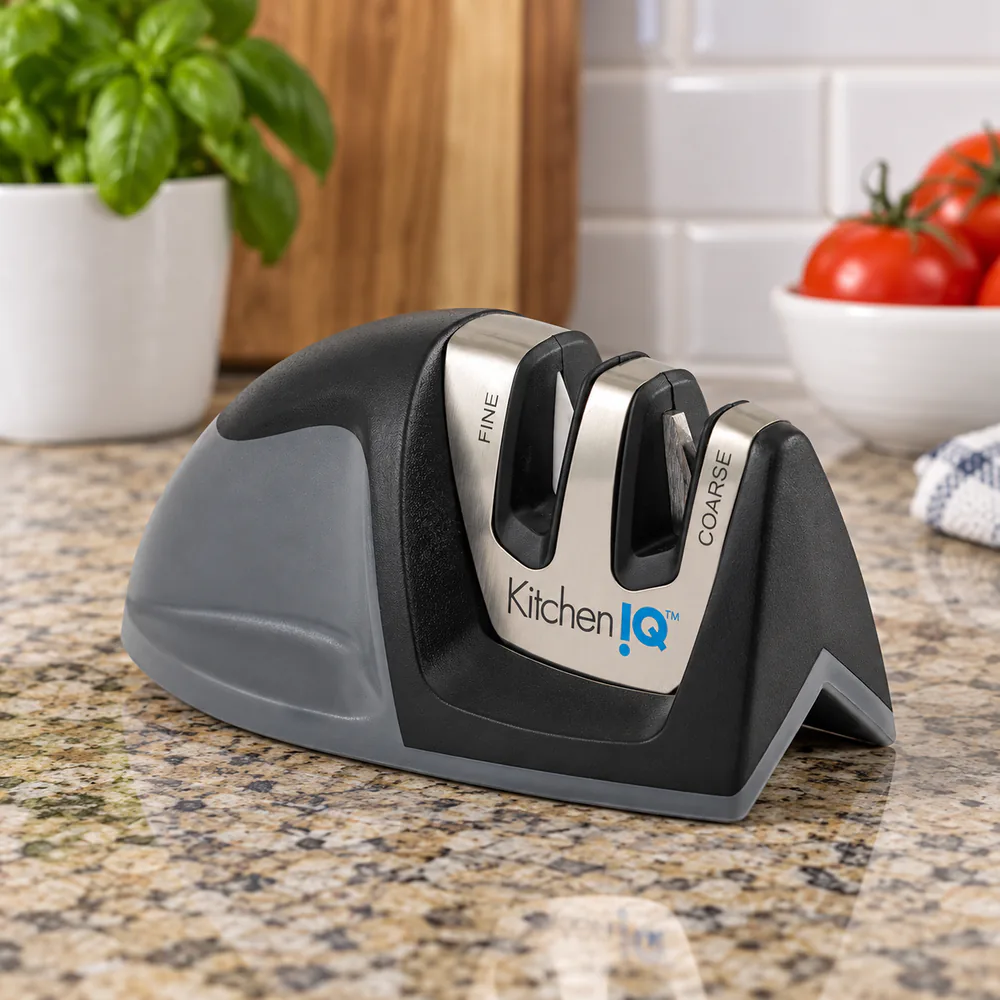
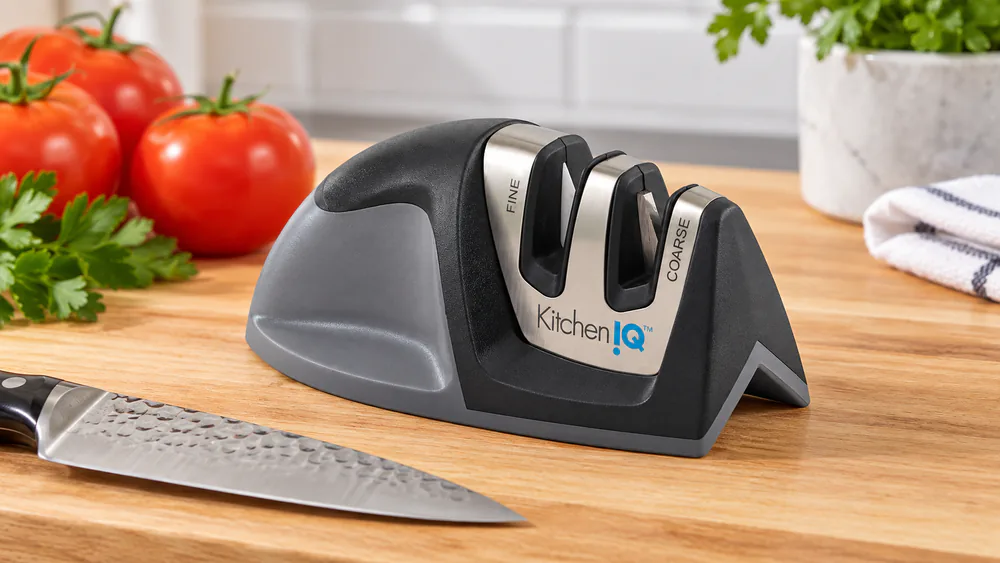
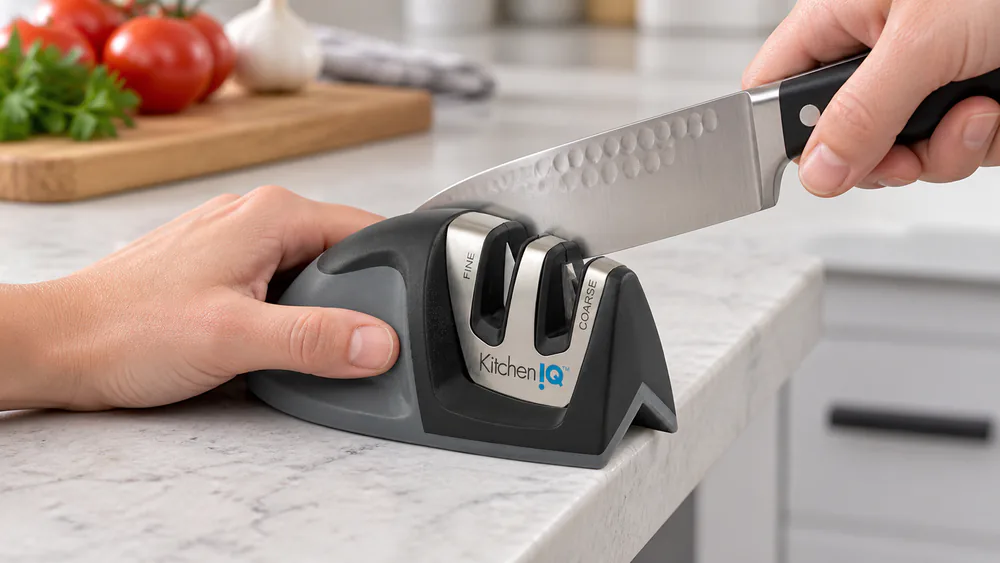
The cheapest pick in this roundup is also the most honest about what it does. The KitchenIQ is basically a more aggressive honing steel: it refines the edge that exists rather than resetting a truly dull one, and it brought the duller knives in our test to a noticeably sharper state for about $10 to $14 on the street. Its patented V edge grip rests on the counter edge so long blade tips do not drag, the non-slip base keeps the unit put, and the whole thing fits in the palm of your hand. The fine ceramic slot left a razor finish on our maintenance knives, while the carbide slot handled the knives we did not care about, the ones that live at the back of the drawer.

Specifications

Type
Manual pull-through, 2-stage
Angle
Pre-set, fixed
Abrasives
Carbide blades (coarse) plus ceramic rod (fine)
Blades
Straight and serrated
Price
About $10-$14
Size
Compact, drawer-storage

Pros

  • About $10, and seconds per blade
  • Fine slot leaves a razor finish on maintained knives
  • V edge grip keeps long blades stable
  • Compact enough for a drawer

Cons

  • Carbide stage chews steel; beater knives only
  • More maintenance than revival
  • Not for Japanese blades
  • Long-term durability unproven

Our caution is the carbide itself. It chews steel and sets a pre-set angle you cannot control, which is fine for a $12 paring knife and wrong for anything you care about, especially Japanese blades. And this is a maintenance tool first: it will not revive a knife that is truly gone, and long-term durability is unproven in our experience.

A hand drawing a knife blade through the KitchenIQ Edge Grip pull-through resting on a counter edge.
The V edge grip rests on the counter so long blade tips do not drag.

5. Utopia Kitchen 12" Honing Rod (Best for Daily Maintenance)

Utopia Kitchen 12" Honing Rod
5

Utopia Kitchen 12" Honing Rod

Best for Daily Maintenance
Check Price on Amazon
4.4/5

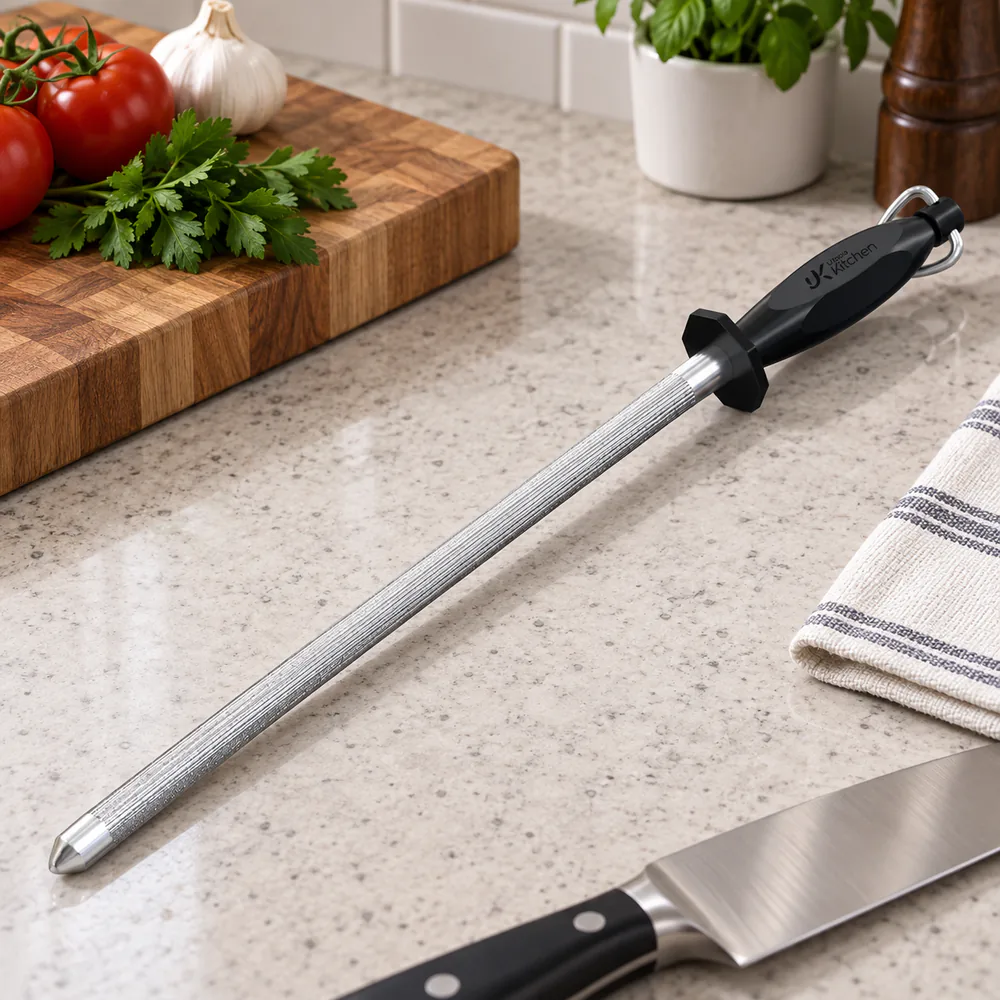
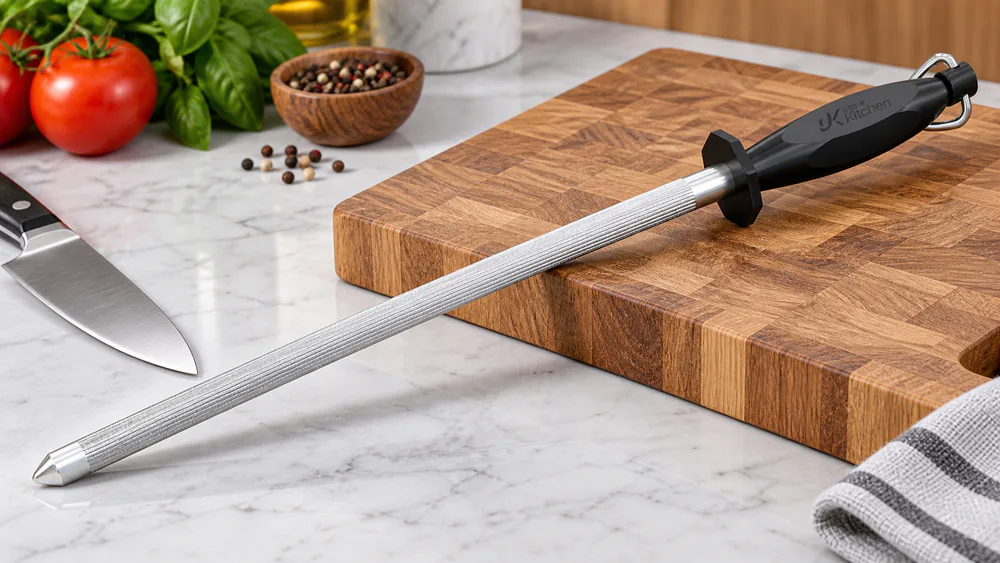
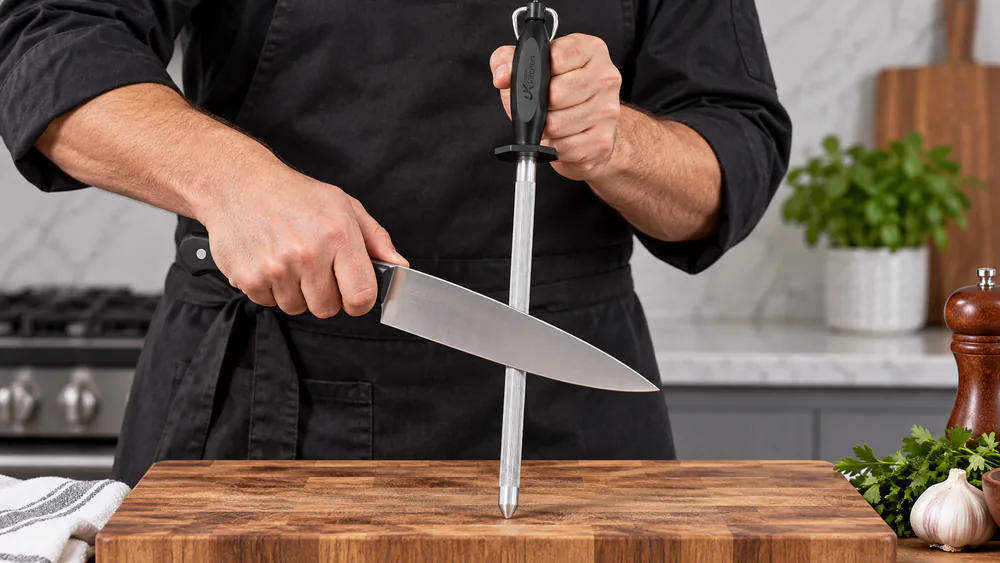
The final pick in our five is not really a sharpener at all, and that is exactly why we recommend it. A honing rod does not sharpen a dull knife; it realigns the edge that is already there. Eight strokes against the steel a week revived our test knives in a few passes, which meant we reached for the real sharpeners far less often. The rod feels solid and well balanced with a comfortable grip, the magnetized surface works on stainless steel edges, and the 12-inch length covers everything from small paring knives to long slicers. The hanging loop keeps it near the board, and at about $14 to $16 on the street, it costs less than one professional sharpening service.

Specifications

Type
Honing rod
Length
12-inch magnetized carbon steel, nickel-chrome plated
Angle
Freehand
Blades
Standard and serrated
Care
Wipe with oiled cloth; not dishwasher safe
Price
About $14-$16

Pros

  • Eight strokes weekly keep a good edge working for weeks
  • Solid, well-balanced feel and comfortable grip
  • Long enough for slicers, fine enough for paring knives
  • Costs less than one professional sharpening service

Cons

  • Will not fix a dull edge; pair it with a sharpener
  • Freehand angle takes a little practice
  • Steel needs a dry wipe after use

The one rule is to set expectations. A hone cannot fix an edge that is gone, and that misunderstanding is the source of most disappointment with rods. Pair this with one real sharpener from this list, and it becomes the tool that keeps that sharpener's work alive for weeks at a time. It is not dishwasher safe, so wipe it with an oiled cloth and hang it up.

A hand drawing a chef's knife along a 12-inch magnetized honing rod held vertically, blade angled at about 20 degrees.
Eight strokes a week on the steel keeps the sharpener's work alive.

Other Knife Sharpeners Worth Considering

Three more tools we tested did not make the five, but each is excellent at a specific job. None of them belongs in a typical home drawer; the right owner will know who they are.

6
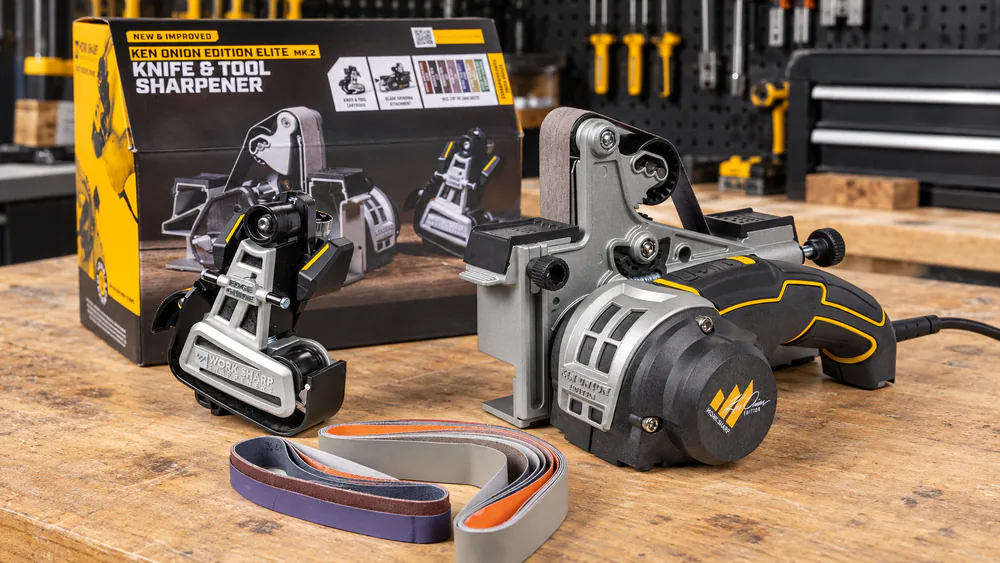
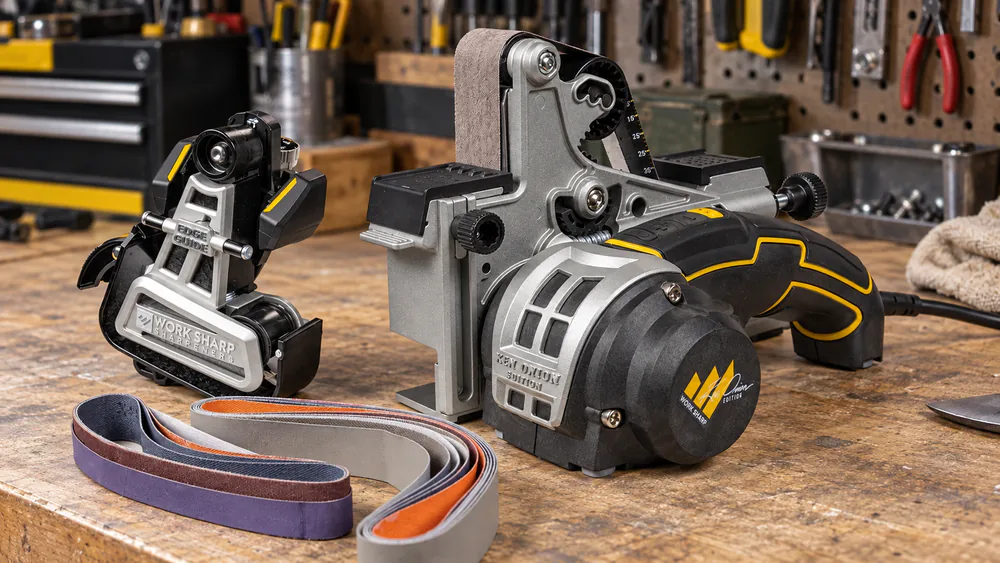
Work Sharp Ken Onion Edition Elite Mk.2

Work Sharp Ken Onion Edition Elite Mk.2

4.3

Fast belt-driven system with 7 speeds, angles from 10 to 35 degrees, and two in-box belt kits; handles knives, scissors, and tools. Bulky, setup-heavy, and pricey.

About $250-$300 Check Price
7
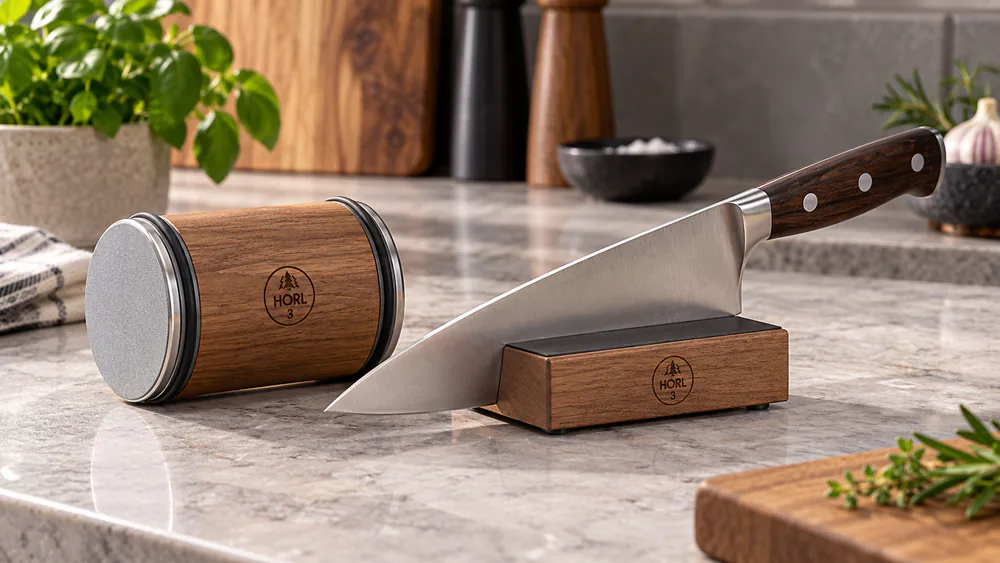
HORL 3 Rolling Sharpener

HORL 3 Rolling Sharpener

4.2

A rolling tumbler that holds the blade magnetically at 15 or 20 degrees while a diamond disc does the work; gentler on steel than any electric, and a handsome piece of the Black Forest.

8
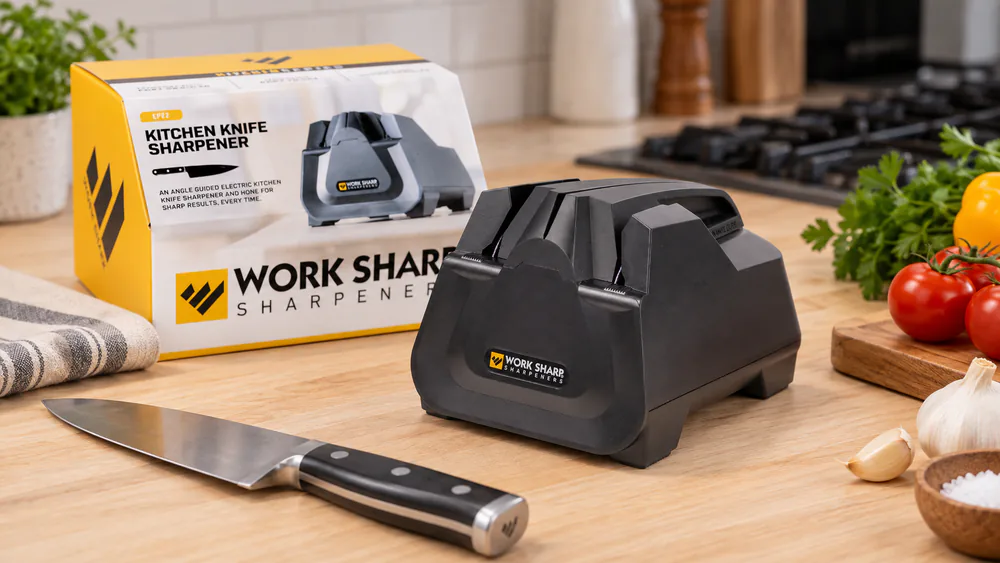
Work Sharp Culinary E2

Work Sharp Culinary E2

4.1

Budget electric with fixed 20-degree guides and a timed one-minute cycle; slow but foolproof, and it handles serrated blades and kitchen shears.

About $50-$60 Check Price

Two notes on the Work Sharp pair. The Mk.2 ships with two belt kits, from coarse P120 up to a 12,000-grit polishing belt, per Work Sharp's product page, and its variable 7-speed motor makes it the most versatile machine here. The Culinary E2's one-minute timed cycle and fixed 20-degree guides make it the gentlest electric on this list; Work Sharp's launch write-up explains the design. Both carry the 3-year warranty Work Sharp puts on its sharpeners. The HORL 3, meanwhile, is the one we reach for when a knife is worth the ceremony: the magnetic block holds the angle while the rolling tumbler does the work, and it is easy from the very first roll.

A Work Sharp Ken Onion Edition Elite Mk.2 belt sharpener on a bench with a knife at the blade grinding attachment.
The Mk.2 is the enthusiast's machine: belts, speeds, and angles for a whole collection.

How We Tested Knife Sharpeners

We learned sharpening the way working kitchens do, as apprentices to the man who serviced every restaurant knife in our neighborhood, the same trade practiced by a professional knife forger and a working butcher and knife maker. That is why we judge a sharpener the way a cook does: how the edge holds after a week of prep, how the tool wears on your hand, and whether the steel comes back easily. Every pick below had to earn its place twice, once on the first edge it cut and again on the last one it cut after a month of use.

Our Testing Process

Every sharpener in this roundup spent a month in our prep rotation, the same test our knives run before we recommend them. We sharpened German chef's knives, Japanese petty knives, and cheap beater paring knives on each tool, checked the edge after every session with an Edge-On-Up PT50 sharpness tester, and then resharpened each knife on the tool itself to see how easily the steel came back. After each session we logged two things: the sharpness reading off the tester, and the practical verdict on whether the edge was still slicing clean a week later. Long-term use is the part of testing that never makes the marketing copy; a sharpener can nail the first session and still fail the tenth week.

A chef's knife edge pressed against an Edge-On-Up PT50 sharpness tester on a test-kitchen counter, the reading scale visible.
Every edge check ran through the same sharpness tester.

The practical tests mattered as much as the numbers: tomato slices, clean paper cuts, and the week-over-week question of whether the edge was still there when we reached for it. At the end of the month we resharpened every knife on the tool it came from and scored how easily the steel came back, because a sharpener that fights you at the end of the month is a sharpener you will stop using.

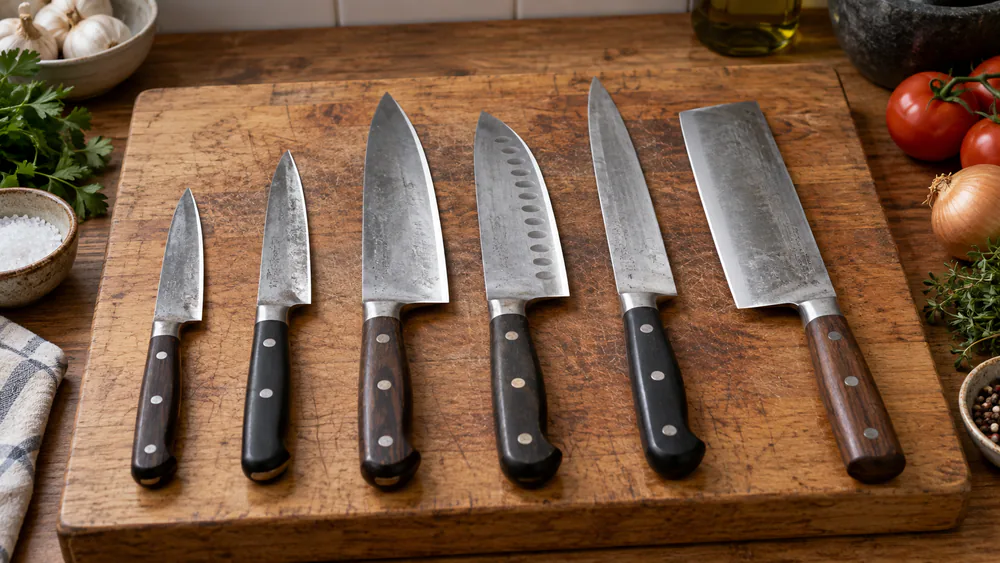
A row of well-used chef's knives lined up on a cutting board after a month of prep, one edge freshly sharpened.
A month of real prep, then the resharpening test that tells us which tools we would keep.

One note on the units themselves, because it belongs in the method: every sharpener in this roundup was bought at retail with our own money, not received as manufacturer samples. The tools are kept or returned at our own cost, and no brand pays for a higher score.

What We Look For in a Knife Sharpener

The five picks above won on the same five criteria, applied to every tool in the same order:

  • Edge quality. The sharpness tester reading, plus the practical slice. A sharpener that only tests well on paper loses points here.
  • Edge retention. How the edge held after a week of real prep. This is the criterion that separates a sharpener from a toy.
  • Metal removal. Aggressive sharpeners shorten blade life. Electrics remove the most steel per use, whetstones the least.
  • Ease of use and learning curve. A pull-through works for anyone in seconds; a whetstone rewards practice. Neither is wrong, but you should know which one you are buying.
  • Versatility and build. Whether the tool handles German, Japanese, and serrated edges, and whether it will still be in the drawer in five years.

Skill level is the hidden fifth dimension of every purchase. If you will never practice, an electric or pull-through is the honest choice. If you enjoy a craft, a whetstone or guided system pays for itself in better edges.

The tests separated the tools quickly. Sharpeners that produced a keen edge but ate blade steel lost marks on metal removal, and tools that needed a second read of the manual every session lost points on ease of use. The five that survived the month were the ones that did their job quietly and got out of the way.

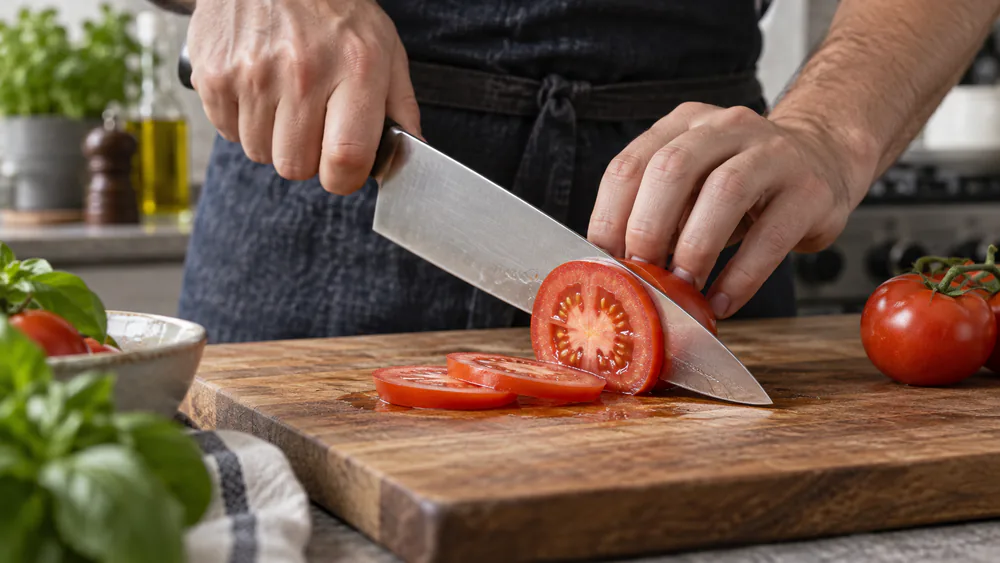
A test-kitchen hand slicing a ripe tomato with a chef's knife a week after sharpening, checking how the edge holds.
The tomato test, one week after the edge was set.

How to Choose the Best Knife Sharpener

The best sharpener is the one that matches your knives and your habits, not the most expensive one in the store. Work through your blade collection first: what steel you own sets the angle you need, and the angle you need rules out whole categories of sharpeners. Then be honest about how much time you will actually spend. The six approaches below cover everything a home kitchen actually sees, so read the type that matches your habits first and check the angle your knives need before you commit.

Types of Knife Sharpeners (Electric / Whetstone / Pull-Through / Guided / Rolling & Honing Rods)

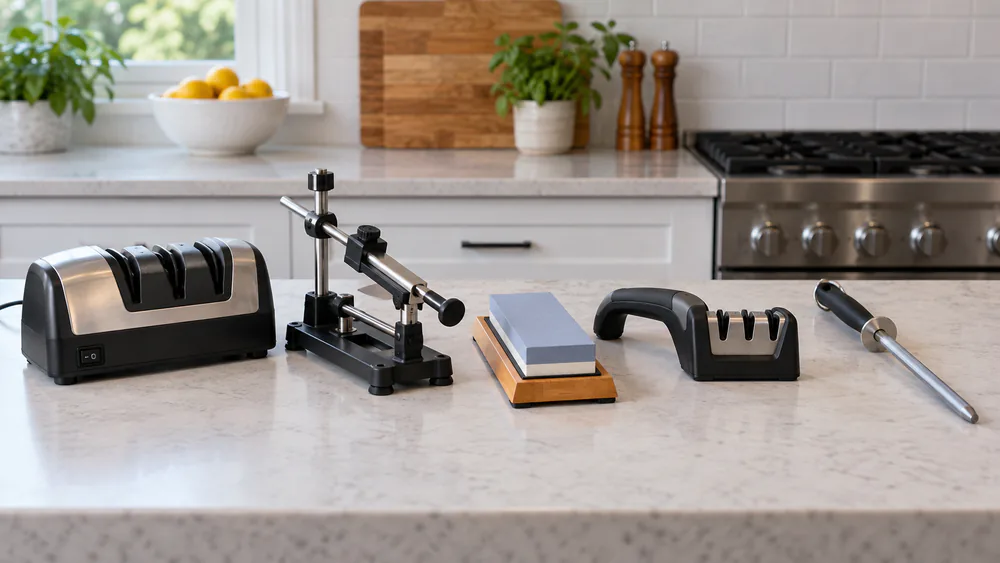
Five knife sharpeners lined up on a counter: an electric, a guided system, a whetstone, a pull-through, and a honing rod.
Electric, guided, whetstone, pull-through, and honing rod: five ways to keep an edge, each with a different job.

Electric sharpeners are the fastest route to a sharp block. A machine like our top pick feeds the blade through spring-guided slots, sets the angle for you, and grinds a new edge in about a minute. The trade-off is metal removal: electrics strip more steel per use than any manual method, so a knife that lives its whole life in an electric will visibly lose height over the years. The deciding question is whether the slots match your knives: fixed-angle machines stay at 20 degrees, while an EdgeSelect-style unit converts blades to a 15-degree bevel. Budget electrics start around $50 with fixed 20-degree guides, like the Culinary E2, and the price climbs to about $170 for a machine that converts your whole block.

Whetstones are the craft option and the cheapest real sharpening there is. A double-sided 1000/6000 combo stone handles nearly everything a home kitchen owns: the coarse side repairs, the fine side polishes. You soak the stone, hold the blade at the angle, and let the slurry do the work; the stone cuts, and your job is keeping the angle steady. The learning curve is real but short, and a sharpening tutorial explains how to hold a whetstone angle better than any manual. If you are deciding between a single stone and a combo, the sharpening community's running consensus on combo stones is that the 1000/6000 pairing covers most kitchens.

Pull-through sharpeners are the quick fix: draw the blade through the slot a few times and get back to cooking. They are cheap, foolproof, and compact enough for a drawer. The catch is that most use carbide blades that chew steel and set an angle you cannot control, which makes them right for beater knives and wrong for anything you care about. The slot is the angle: a two-stage unit's ceramic side runs close to the factory edge, while the carbide side cuts whatever angle the slot happens to hold. The ceramic side is the one you will actually want to use.

Guided systems take the guesswork out of the whetstone by clamping the knife and giving you a rod with a set angle. The Work Sharp Precision Adjust dials 15 to 30 degrees in 1-degree steps, and stop collars on the rod keep you from overrunning the edge. The pocket version of the same idea is the Work Sharp Folding Field Sharpener, a tiny guide-and-stone that rides in a drawer or a camp kit. Guided systems are the best middle ground for anyone who wants whetstone-quality edges without months of practice.

Rolling sharpeners are the newest idea in the category. The HORL3 rolling knife sharpener holds the blade magnetically against a wood block while a rolling tumbler runs a diamond disc along the edge, at a fixed 15 or 20 degrees depending on which end of the block you use. It is easy from the first roll, gentle on steel, and strikingly easy on the eyes; the sting is the price, about $179, more than most knives are worth sharpening, and two angles cover only half of a mixed Japanese and German collection.

Honing rods round out the category, and they are not sharpeners at all. A steel rod realigns a rolled edge, which is the daily maintenance a sharp knife needs. Every kitchen should own one, and most kitchens need nothing else between sharpenings.

Honing vs. Sharpening: What's the Difference?

Honing and sharpening are different jobs that people routinely confuse. Honing realigns the microscopic edge that folds over during normal cutting; it removes no steel, takes seconds, and is the reason a sharp knife stays sharp for weeks. Sharpening grinds a new edge; it removes steel, takes minutes, and is what brings a truly dull knife back. The distinction matters because the wrong tool for the job disappoints: a rod will not fix a dull knife, and nobody wants to sharpen a knife that only needs a few strokes on the steel.

  • Hone when: the knife still bites, but tomatoes feel thicker than they should. Eight strokes per side on the rod, once or twice a week.
  • Sharpen when: honing stops bringing the edge back, or the blade skids across a tomato skin. Pull out the whetstone, guided system, or electric.

A simple test tells you which one you need: if the blade still pushes through a ripe tomato after honing, keep honing. If it squashes instead, it is time to sharpen.

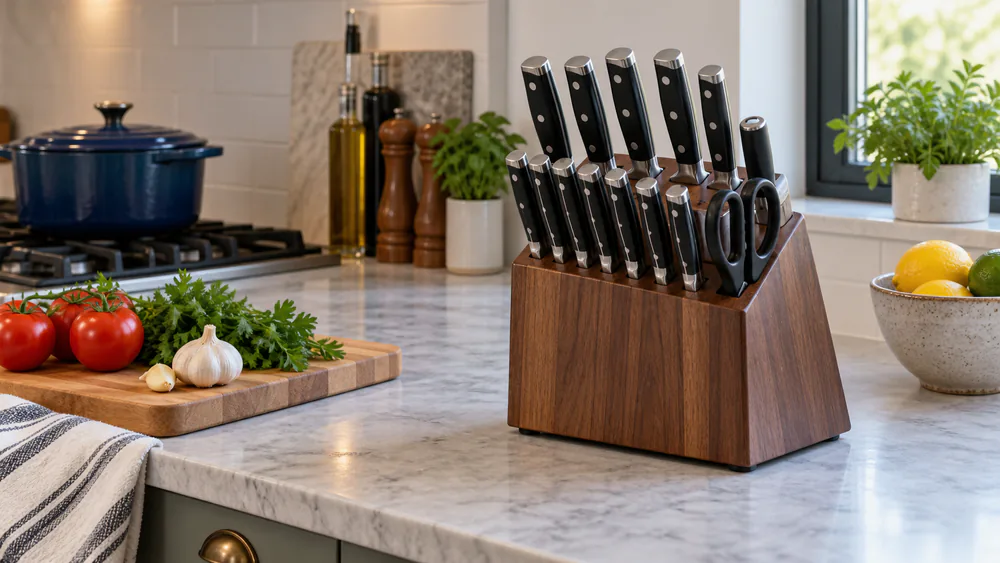
Care between sharpenings is simple and matters more than most people think. Wipe the blade dry after each use, cut on wood or plastic rather than stone or glass, and store the knife in a block or on a magnetic strip instead of rattling loose in a drawer. That routine, plus eight strokes on the steel weekly, is what keeps a sharp knife sharp for months.

A macro view of a knife edge: a realigned edge on the honed side and a freshly ground bevel on the sharpened side.
Honing realigns the edge that exists; sharpening grinds a new one.

Sharpening Angle and Grit: Japanese vs German Edges

The angle you hold is the bevel you get, and the angle belongs to the steel. German knives like Wüsthof and Zwilling run softer steel, usually 55 to 58 on the Rockwell scale, and cut best at a robust 20 degrees per side. Wüsthof's forged lines, from Classic to Epicure, harden their X50CrMoV15 steel to 58 HRC, while the Gourmet entry line sits at 56. Zwilling's FRIODUR lines publish 57 HRC, with the official spec range of 55 to 58 HRC sitting behind that figure. Japanese knives run harder steel and take a finer 15-degree edge: VG-10 is typically heat-treated to 60 to 61 HRC, with some makers taking it to 62, and Shun's proprietary VG-MAX core is hardened to 61 HRC, within a stated tolerance of plus or minus 1 HRC. The hardness difference is the whole story: harder steel holds a thinner edge longer, but chips more easily if you cut into bone or a hard board. Steel hardness and edge-holding are measured on that same scale, and it is the reason your sharpener needs an angle setting that matches the factory edge on your knives.

Grit follows the same logic, and the numbers form a staircase:

  • 1000 grit: repairs damage and sets the new bevel
  • 3000 grit: refines the scratch pattern between sessions
  • 6000 grit: polishes to a razor edge
  • Finer: extra-fine stones take the edge past what most kitchens need

The 1000 and 6000 sides of a combo stone cover both ends of that staircase, and if you want the last word in polish, an extra-fine diamond stone for finishing finishes the job. A knife restored to its factory edge, or better, is the goal of every session.

A knife blade held at a low 15-degree angle against a wet 1000-grit whetstone, water and slurry visible on the stone.
The angle you hold is the bevel you get: 15 degrees for Japanese steel, 20 for German.

Tip. Mark the edge with a felt-tip marker before your first whetstone pass. If the ink wears off evenly along the very edge, your angle is right. If it stays at the shoulder or rubs off above the edge, adjust before you grind.

Japanese steel deserves one extra caution: it chips, so keep it away from carbide pull-through slots, hard boards, and bones. A whetstone or a guided system is the right home for a Japanese edge, and most home sharpeners with a 15-degree setting will maintain it with care.


A full chef's knife block on a kitchen counter after a month of maintenance, every knife edge-up and uniform.
A maintained block: honed weekly, sharpened only when the edge is gone.

Frequently Asked Questions

How often should I sharpen my kitchen knives?

Hone once or twice a week if you cook daily, and sharpen only when honing stops bringing the edge back. For a home kitchen that usually means a full sharpening every two to four months, depending on how hard you are on the steel. Once your knives carry a converted bevel, the final stropping stage of an electric like our top pick handles most touch-ups, and full sharpenings drop to once or twice a year.

Do electric sharpeners ruin knives?

No, but they are the most aggressive common method. Electrics remove more steel per use than a whetstone or guided system, so a blade sharpened electrically for years visibly loses height; you are trading a little blade life for a lot of convenience. Sharpening only when it is needed, and matching the electric's angle to your knives, keeps the trade-off honest. Skip electrics entirely for premium hard Japanese steel you are not comfortable re-beveling.

Are pull-through sharpeners bad for knives?

The carbide slot is the problem: it gouges a new edge at a fixed angle and chews steel, which is fine for a $12 beater and wrong for a good knife. The ceramic fine slot on a two-stage pull-through is much gentler and works well for maintenance. The rule is simple: carbide for the knives you do not care about, ceramic for the ones you do, and nothing from this category on Japanese blades.

What angle should I sharpen my knives at?

Match the factory edge: about 20 degrees per side for most German and Western steel, 15 degrees for Japanese. A guided system or a fixed-angle electric keeps the number honest, and freehand, the felt-tip marker trick shows you where the edge is actually meeting the stone. If you cannot see your knives' factory angle, 20 degrees is the safe default for a Western blade.

Can I sharpen Japanese knives with these?

Whetstones and guided systems are the best home route for hard Japanese steel, and electrics with a 15-degree setting will maintain a Japanese edge with care. Carbide pull-through slots are the one hard no: they are too aggressive for hard steel that chips. Serrated Japanese bread knives are the exception to all of this; they want a ceramic rod or the serrated slot on a good electric.
How much should a good knife sharpener cost?

As of August 2026, about $15 buys a honing rod or a pull-through that maintains an edge, $40 buys a real whetstone that teaches you sharpening, and $70 to $80 buys a guided system that dials exact angles. The $170 electric sharpens fastest and converts your whole block. Above $250 you are paying for belt systems and pro-level machines that most home kitchens will never outgrow, let alone need.

Read next

Sharpen the whole block in about a minute

Our top pick, the Chef'sChoice 15XV, converts every knife in your block to a keen 15-degree edge, with no angle guesswork.