As an Amazon Associate we earn from qualifying purchases. We may earn a commission from links on this page, at no extra cost to you. Learn more.
If your chef's knife crushes a tomato instead of slicing it, the blade is usually fine and the edge is the problem. A good sharpener fixes that in minutes. A bad one makes a dull knife worse, and a dull knife makes every meal slower.
We tested 10 electric, manual, and whetstone sharpeners for sharpness, ease of use, and value, and we checked every edge after real prep rather than a paper test alone. Tomato and carrot slices tell you more than a single clean sheet of copy paper ever will.
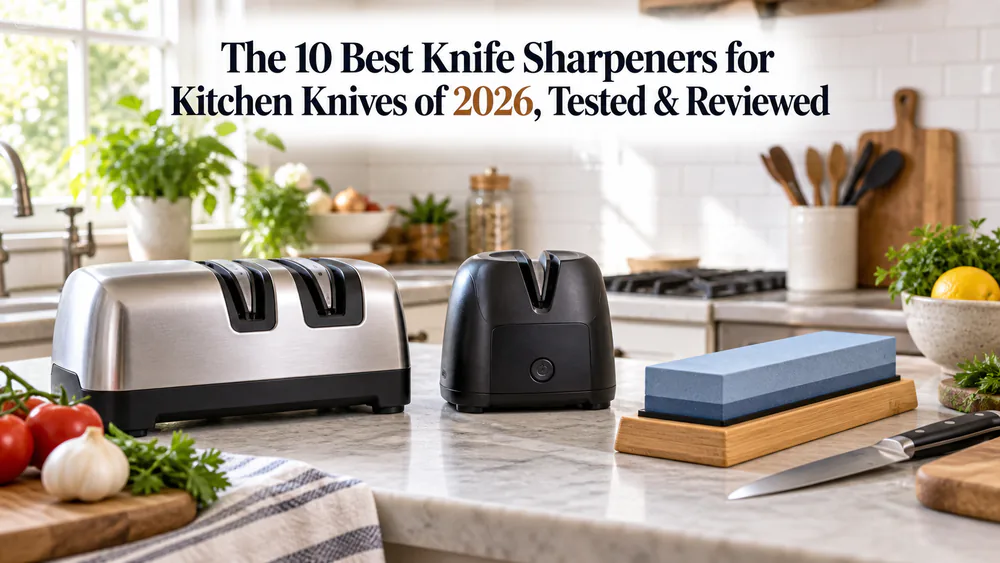
Our test kitchen ran the full range: three-stage electrics, a push-button budget machine, a water-cooled wheel, combo whetstones, a guided manual system, a handheld pull-through, a rolling sharpener, and a honing steel. Every model sharpened the same drawer of well-used kitchen knives. In this guide you will find the 2026 winners, the honest also-rans, and which knife types each pick suits best.
Every sharpener on this list ran a month of real prep in rotation, with an edge check after every session and a scored resharpening pass at the end of the month. All 10 units were bought at retail with our own money, not received as manufacturer samples, and no brand paid for a higher score.
Our Top 3 Picks at a Glance
Rank
Product
Best for
Type
Rating
Buy
1
Chef's Choice 15XV EdgeSelect
Best Overall Electric
Most kitchens; converts 20-degree edges to 15 degrees
Street prices move week to week and vary by retailer, so treat every figure above as a snapshot from our latest checks.
How We Tested the Best Knife Sharpeners
We tested 10 sharpeners across every type a home cook is likely to consider: three electrics (Chef's Choice 15XV, Work Sharp Culinary E2, Presto 08810), two whetstones (Sharp Pebble 1000/6000, Shapton Pro 1000), a guided manual system (Work Sharp Precision Adjust), a handheld pull-through (AccuSharp), a rolling sharpener (The Original Tumbler), a honing steel (Utopia), and a water-cooled machine (Tormek T-1). Each one sharpened the same drawer of chef's, paring, and santoku knives.
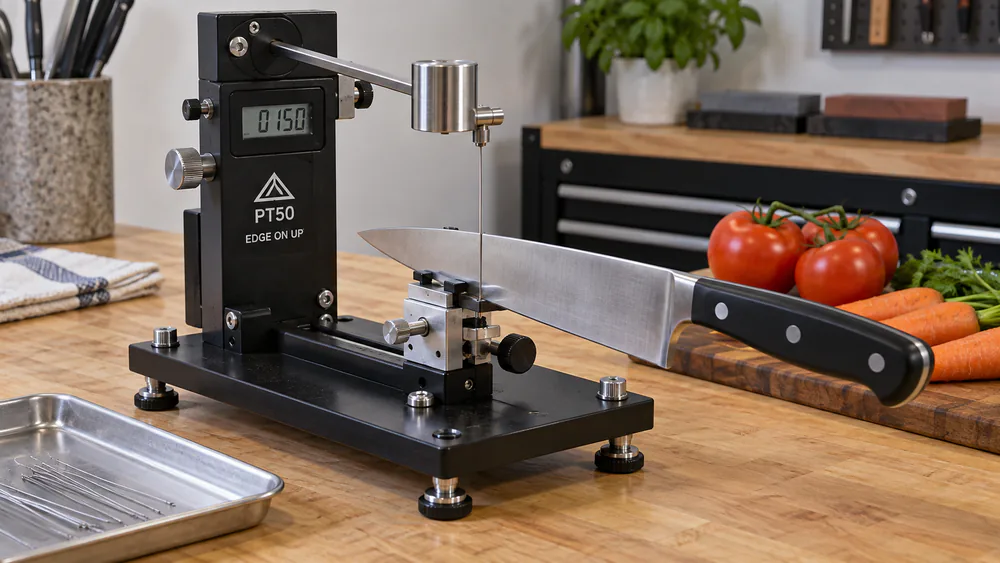
We scored every model on sharpness, ease of use, and value. For sharpness we measured each edge with an Edge-On-Up tester, which records the grams of force needed to cut a certified test wire on the Brubacher Edge Sharpness Scale. Lower numbers are sharper. On that scale, 0 to 50 grams is razor sharp, 50 to 150 is extremely sharp, 150 to 300 is very sharp, 300 to 500 is moderately sharp, and anything over 500 is dull. The same PT50C Home Chef edition runs about $139 if you want to check your own edges at home. Edge checks after real prep told us which edges held and which rolled over in a single dinner.
Every pick also ran the same kitchen gauntlet: paper cuts, tomato slices, carrot slices, and a full sharpen-from-dull pass timed with a stopwatch. Ease of use covers setup, learning curve, noise, and cleanup. Value is the price weighed against how often a knife drawer actually needs the machine, which is why a $12 pull-through can outscore a $420 machine for some kitchens. Our ratings use a 5-point scale, and a pick only earns a high score when sharpness and ease both hold up over time.
Measuring every edge with a sharpness tester before and after prep.
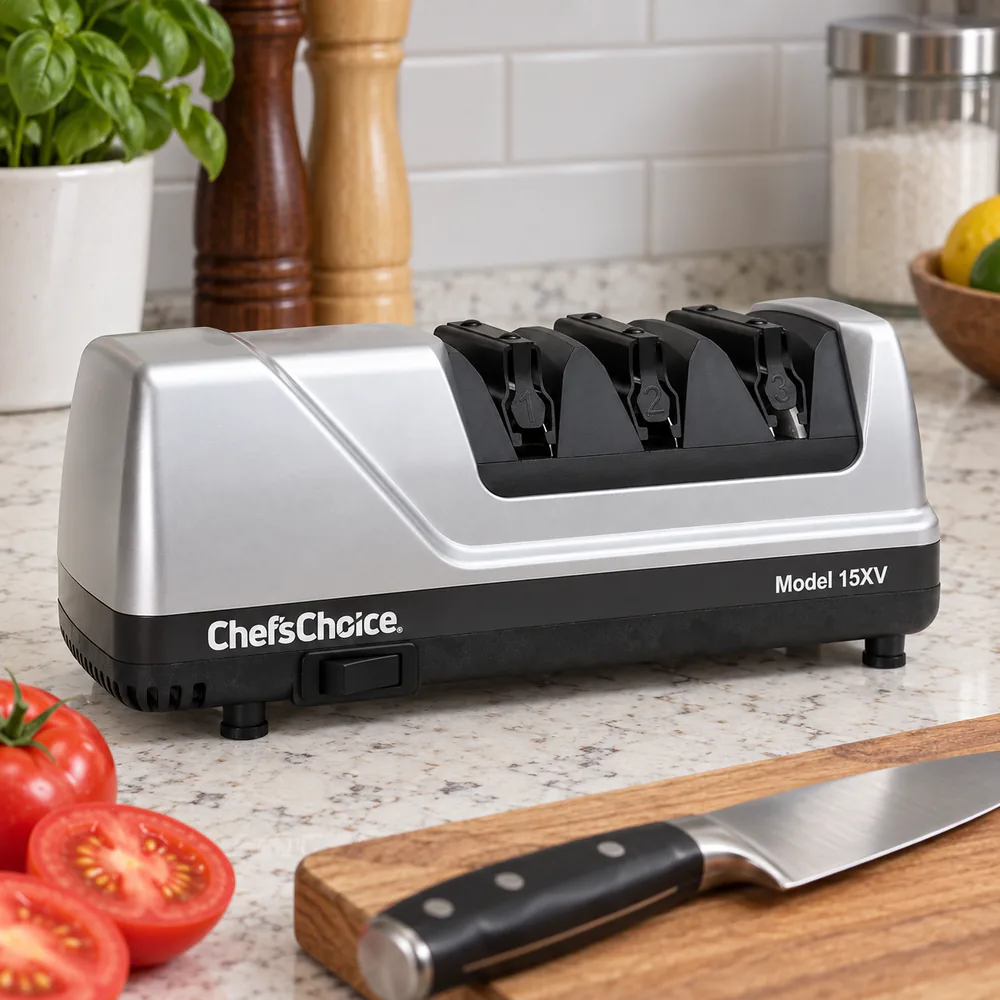
1. Chef'sChoice 15XV EdgeSelect Professional Electric Knife Sharpener – Best Overall Electric
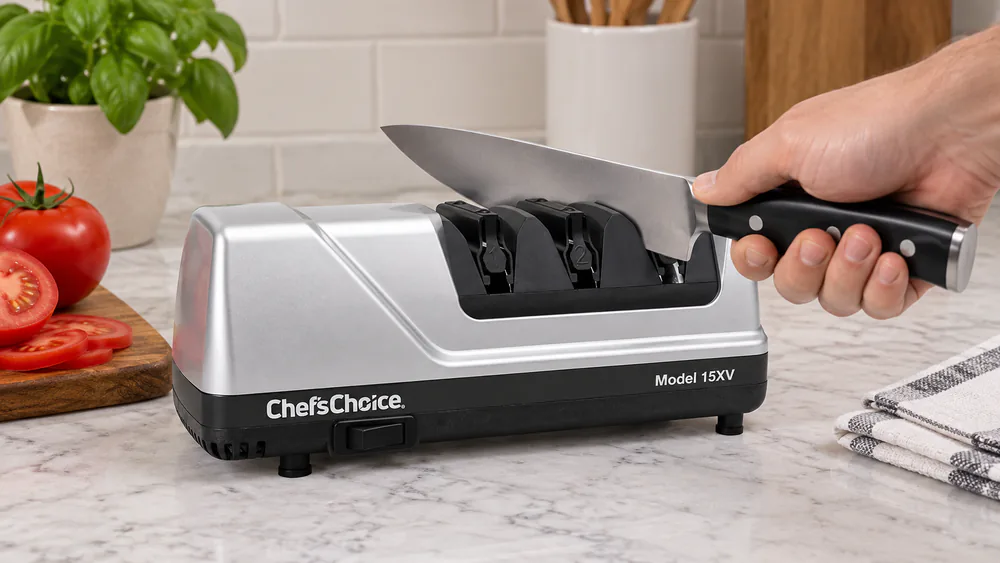
The first time we ran our dullest chef's knife through the 15XV, it came out cutting paper after about 10 seconds of motor time. It is also the sharpener with the steepest learning curve on this list: the same machine that puts a razor edge on every knife in a drawer can scour a blade in seconds if you wing it, so watch a video or read the manual first and practice on a cheap knife before you touch anything expensive.
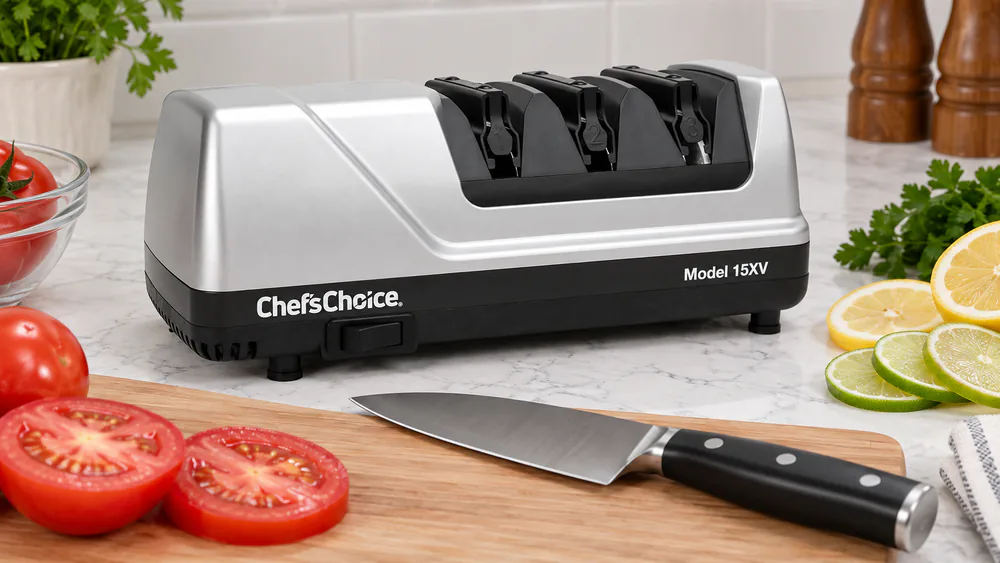
The Chef's Choice 15XV is the sharpener we keep out on the counter, and it is our top pick for most kitchens. It uses a 3-stage system, coarse 100-percent diamond, fine 100-percent diamond, and a patented flexible abrasive stropping stage, and it converts traditional 20-degree factory edges to a 15-degree Trizor XV edge. Converting the whole drawer takes about an hour the first time; after that, resharpening is about 10 seconds per blade. The third stropping stage alone keeps edges sharp for months between full passes.
Pros
Razor-sharp edges from every slot of the 3-stage system
Converts the whole drawer to a sharper 15-degree bevel that holds for weeks
Third stropping stage keeps knives sharp for months between passes
Quietest motor we ran; sturdy enough to stay on the counter
Sharpens straight-edge and serrated knives
Cons
Learning curve: read the manual or practice on a cheap knife first
Slow at repairing chips and won't accept thicker blades
A minority of units wear out diamond wheels quickly
It is genuinely quiet and rock solid on the counter. The honest caveats are that it is slow at repairing chips, it will not accept thicker blades, and durability is the one real split. Most units we tracked held their edges for weeks, but a few diamond wheels wore out quickly, and one brand-new knife came out badly scoured. Follow the manual and you will likely land in the happy majority.
Product specs / key features
The 15XV measures about 10 x 4.25 x 4.25 inches and weighs about 4.2 lb. It runs on 120V at about 1.04A (electrical figures per Wayfair's listing), it is made in the USA by Edgecraft, and it carries a 3-year limited warranty. First-time sharpening takes about 1 minute per knife.
Best For
Homes that want one machine to keep an entire knife drawer sharp, especially when every knife in it wears a traditional 20-degree factory edge.
Not Ideal If
You sharpen thin, high-hardness Japanese steel (see our caution below), or you want a machine that repairs chips and heavy damage, because the 15XV is a finisher, not a rescue tool.
The 15XV's three slots run coarse, fine, then stropping, front to back.
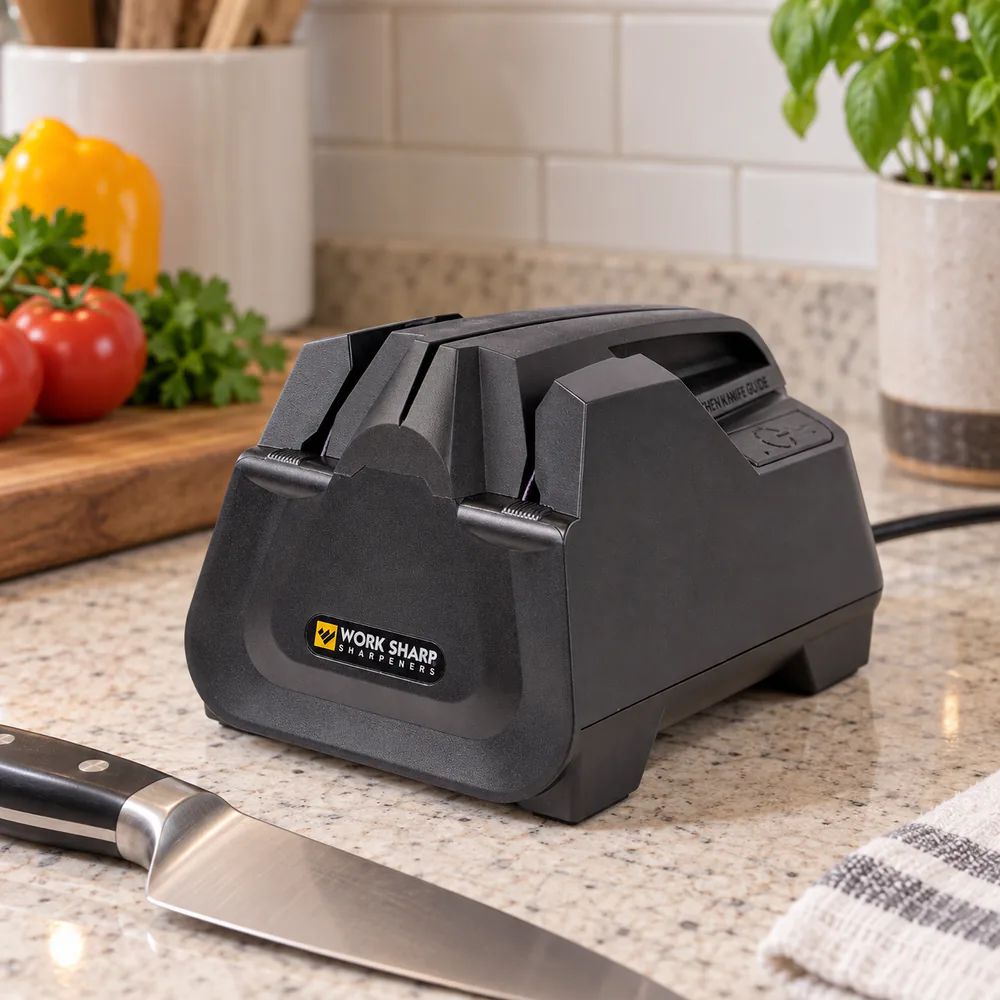
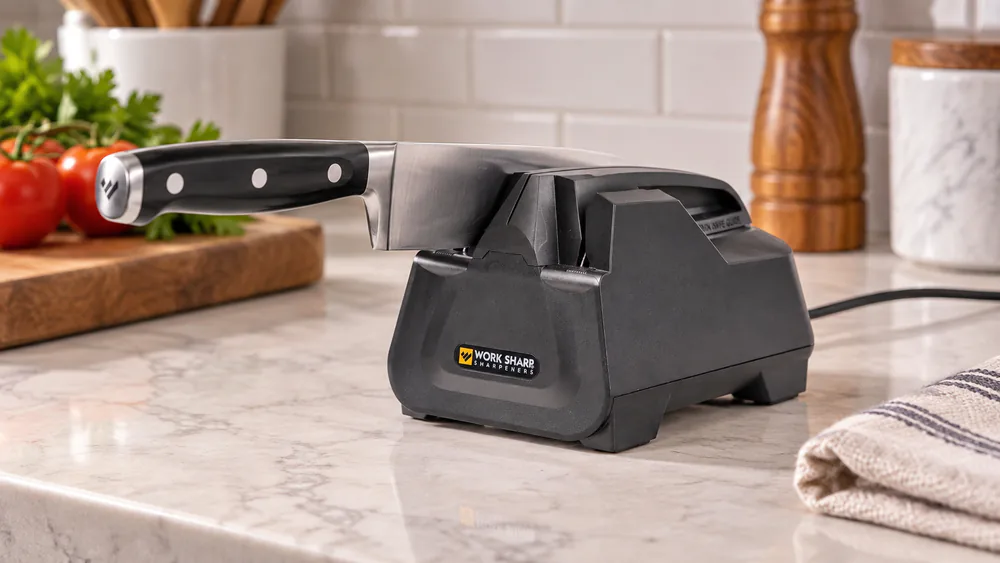
2. Work Sharp Culinary E2 – Best Budget Electric
Where the 15XV demands practice, the Culinary E2 asks for almost nothing. It is a push-button machine: pick the slot, run the knife through, and the motor shuts itself off after a timed cycle. That shutoff is its one real gripe: the cycle ends mid-knife, and bringing one badly dull chef's knife back took about 10 minutes and close to 50 pulls.
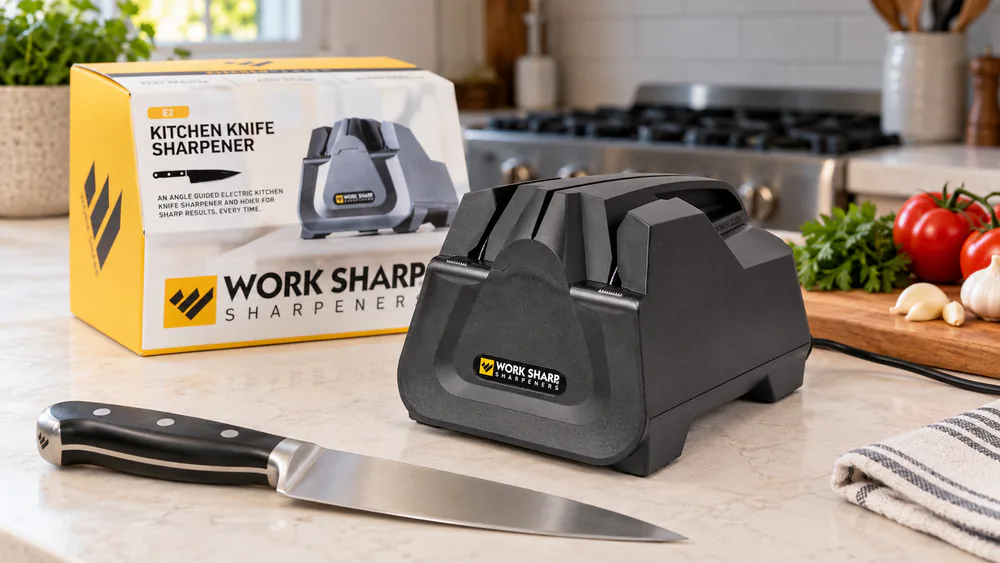
At about $60, the Work Sharp Culinary E2 is the budget electric we would hand to a friend who just wants sharp knives without homework. It is a 2-stage system with flexible P120-grit ceramic abrasive discs plus an integrated fine ceramic honing wheel, per Work Sharp's introduction to the Culinary E2, and the fixed 20-degree angle guides take the guesswork out of every pass. The edge it left was finer and smoother cutting than the similarly priced Chef'sChoice ProntoPro we compared it against, which is why it is a real budget pick rather than a toy.
Pros
Best budget electric on the list at about $60
Fixed guides hold the angle for you
Compact footprint; sharpens serrated, scissors, shears, and cleavers
Cons
Auto-off cuts the cycle mid-knife on long sharpenings
Plastic casing scratches and chips during use
Some units break belts, O-rings, and pulleys early
The footprint is the other win. The unit measures about 5.5 x 4 x 3.5 inches (Knives and Tools' listing documents the footprint), the cord stows in the base, and we sharpened six knives in a single session without clearing the counter. Durability is the sore spot: the plastic casing scratched and chipped during use, with one long session leaving divots across the housing, and some units we tracked broke belts, O-rings, and pulleys after only a few uses. The 3-year comprehensive warranty covers the risk.
Product specs / key features
The E2 runs a single-speed motor rated about 6W per KnifeCenter's listing, sharpens serrated edges, scissors, shears, cleavers, nakiri, and paring knives, and the abrasive discs are user-replaceable. It carries a 3-year comprehensive warranty.
Best For
Budget-minded cooks with mid-price western knives who want an electric they can store in a drawer and use without reading a manual.
Not Ideal If
You expect a lifetime tool, since the plastics and drive parts are the first things to fail, or you want badly neglected knives revived in a single session.
The E2's two slots, sharpening first and honing second, sit on a base small enough for a drawer.
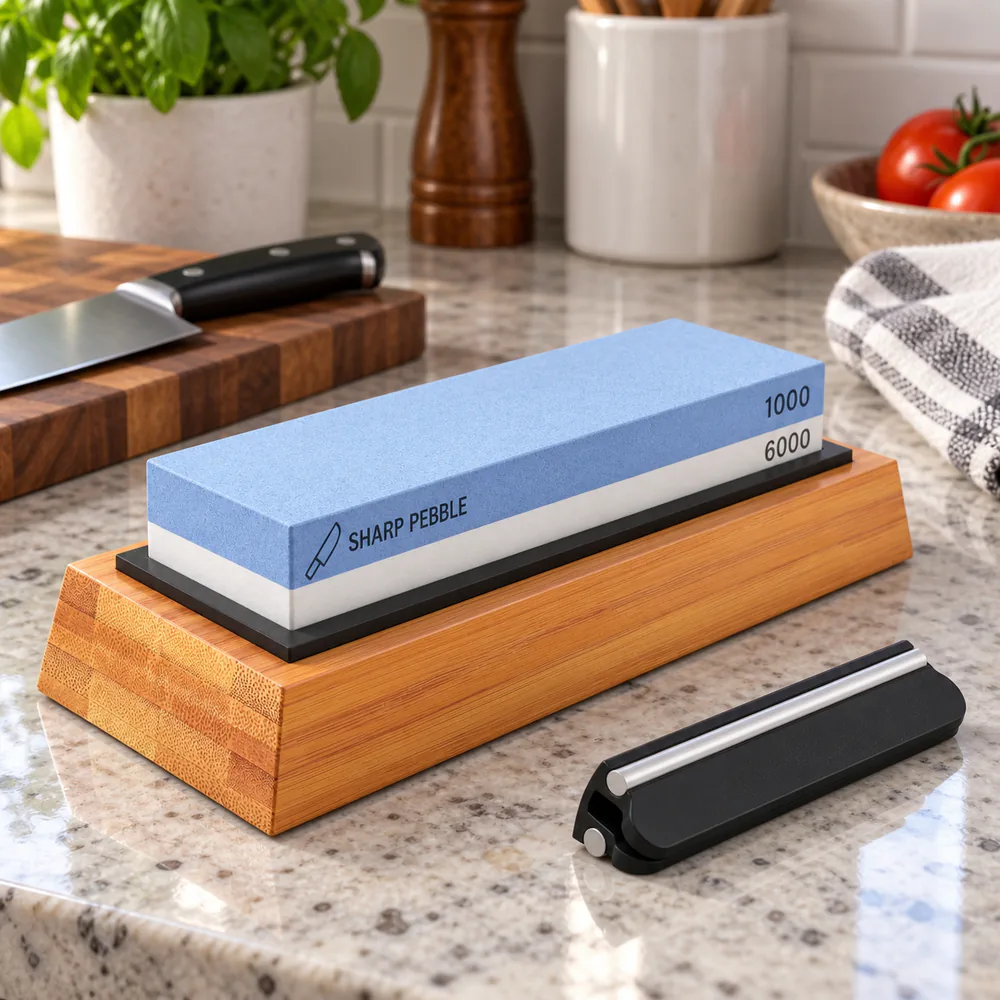
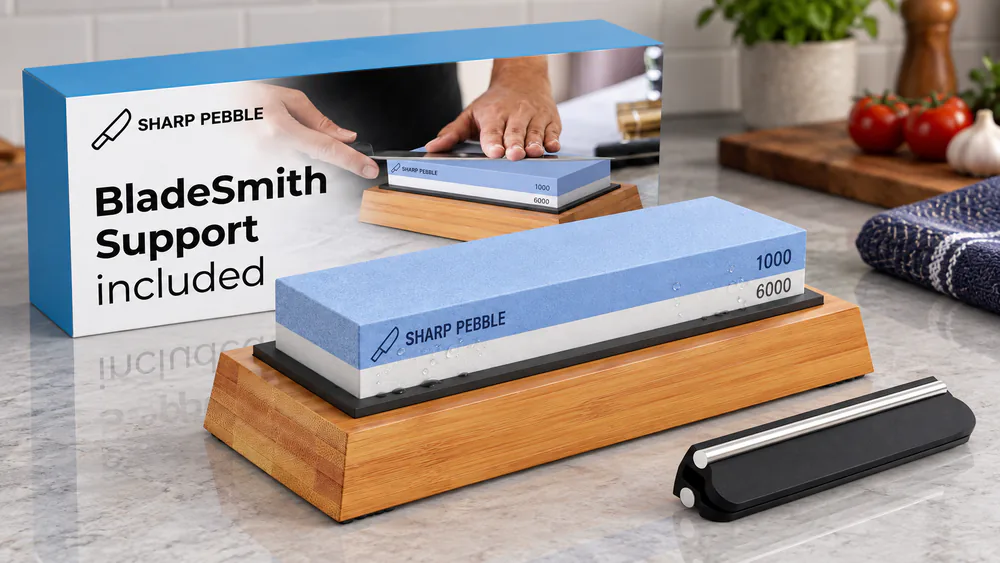
3. Sharp Pebble Premium Whetstone 1000/6000 – Best Whetstone for Beginners
If electrics feel like cheating, the Sharp Pebble is the honest alternative. Its angle guide makes the freehand motion nearly foolproof: first-timers in our kitchen got knives sharp enough to worry about on their first stone session. It is a practice motion rather than a no-skill shortcut, but the guide removes the one mistake that ruins every beginner's first stone: losing the angle.
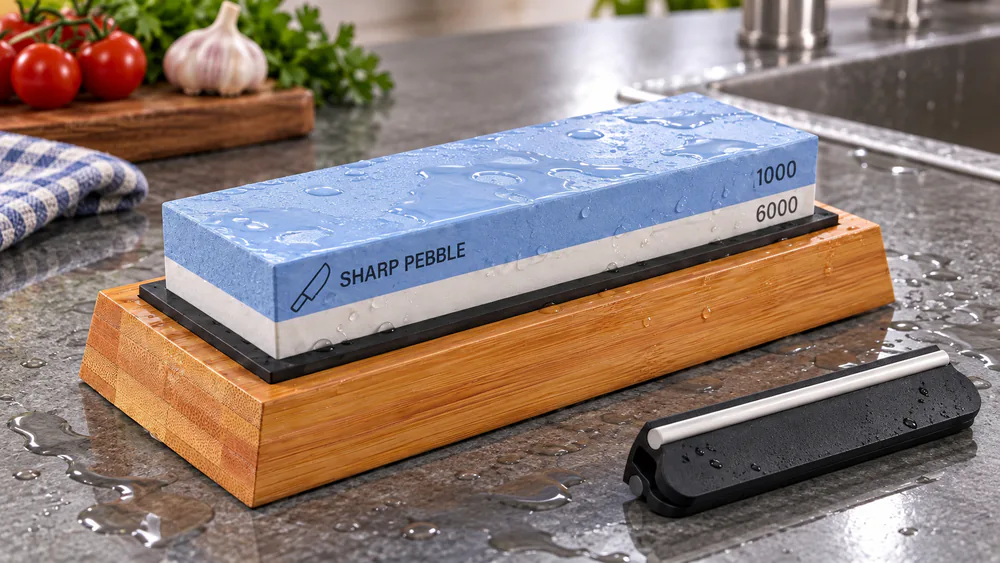
The Sharp Pebble is a dual-grit waterstone: 1000 grit repairs dull or damaged edges, and 6000 grit polishes them to a razor-sharp finish. The kit includes the stone, a non-slip bamboo base, an angle guide, and an instruction manual, and it is water based, so no honing oil is needed. Beginners reach razor-sharp results in about 10 minutes per knife, and the edges it leaves last longer than what electric sharpeners produce, which is the classic whetstone trade: slower work for a longer-lived edge.
Pros
Complete kit: stone, bamboo base, angle guide, and manual
Real 1000/6000 grit range at a starter price
Edges last longer than what electric sharpeners leave
Angle guide makes the freehand motion easy to learn
Cons
About 10 minutes per knife, and the stone work is a practice skill
Bamboo base must be fully dried before storage
Stone wear varies; some 1000 sides wear down quickly
Two quirks come with the bargain. The bamboo base soaks up water, so dry the wooden block completely, even in the sun, before storing it or it stays damp. And stone wear is the split: the vendor claims a flat-keeping composition, but a minority of units we tracked showed the 1000 side wearing down quickly.
Product specs / key features
The stone is a dual-grit waterstone in 1000/6000, water based with no honing oil required. The kit ships with the non-slip bamboo base, angle guide, and instruction manual.
Best For
Cooks who want to learn real sharpening and are willing to spend 10 minutes per knife in exchange for edges that last longer between sessions.
Not Ideal If
You need sharp knives on a timer every day, because the whetstone is the slowest method here, or you cannot commit to drying the bamboo base between uses.
Water on the 1000 side, angle guide at the edge, bamboo base underneath.
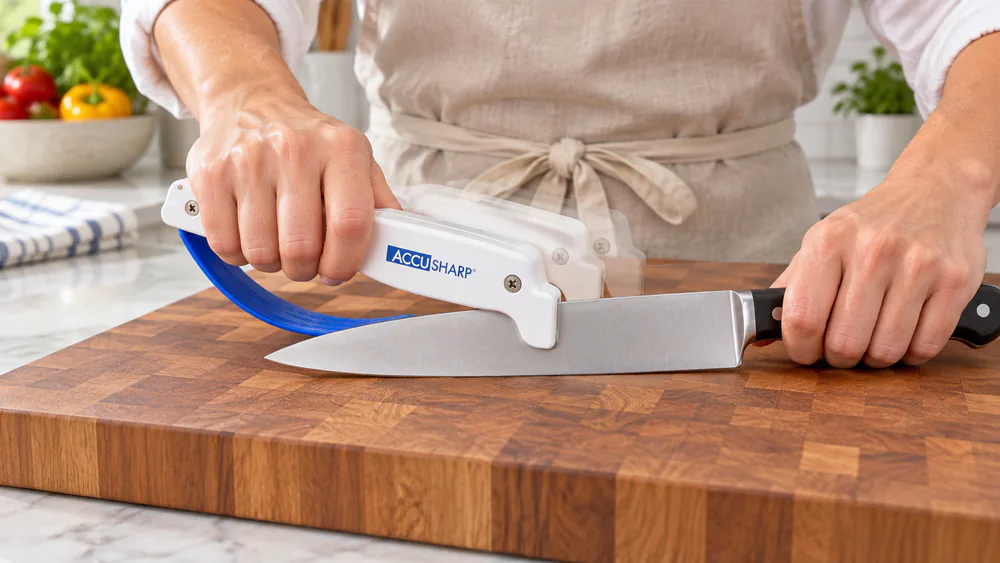
4. AccuSharp Handheld Knife Sharpener – Best Ultra-Budget Pick
The AccuSharp is the opposite of a practice tool. Three or four pulls bring a dull blade back mid-cooking session, and one unit in our rotation had already survived nearly 25 years of daily use in restaurants. It is the sharpener we grab when the tomato slices start crushing and dinner is on the clock.
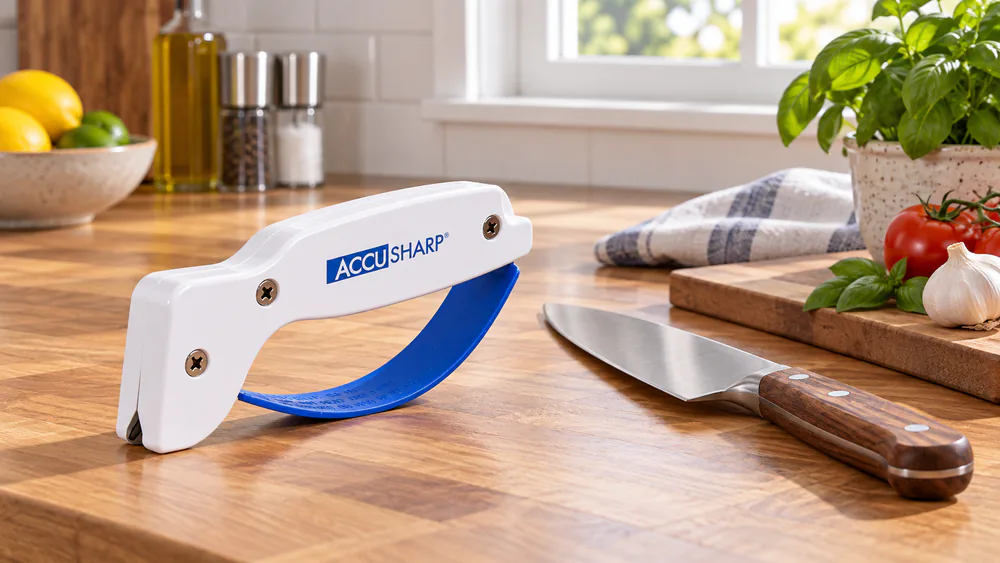
At about $12, the AccuSharp earns its place as a fast fix rather than a finishing tool. Its diamond-honed tungsten carbide blade sharpens most blades in about 10 seconds, and because it sets both sides of the edge at once, the angle comes out consistent every time. The edge it leaves is very sharp but not razor fine, and it dulls again quickly, so we treat it as the tool between real sharpenings. The carbide blades are reversible, and most units go 5 to 10 years between replacements, which makes the lifetime cost close to nothing.
Pros
Unbeatable price for a working sharpener
Sharpens most blades in about 10 seconds
Consistent angle, both sides at once, every time
Nearly indestructible; blades reversible for 5 to 10 years of service
Cons
Edge is sharp, not razor fine, and dulls again quickly
Aggressive carbide can damage good steel if used carelessly
No angle choice at all
The catch is the same thing that makes it fast: the carbide edge is aggressive, and used carelessly it can ruin good blades. We would not put it anywhere near a thin Japanese knife or anything else you care about. It handles straight and serrated edges, scissors, fillet and chef's knives, the handle fits either hand, and the full finger guard is a welcome touch.
Product specs / key features
The AccuSharp uses a diamond-honed tungsten carbide blade, works on straight and serrated edges plus scissors, fillet, and chef's knives, and cleans with soap and water or in the dishwasher. It is the smallest and lightest pick on this list.
Best For
Cooks who want a $12 tool that restores dull blades in seconds, campers, and anyone who sharpens "someday" and means "the day the knife stops cutting."
Not Ideal If
You own expensive or Japanese steel, you want a razor-fine edge, or you need a sharpener that removes chips and heavy damage.
The V-shaped notch holds the blade at a preset angle while the carbide does the cutting.
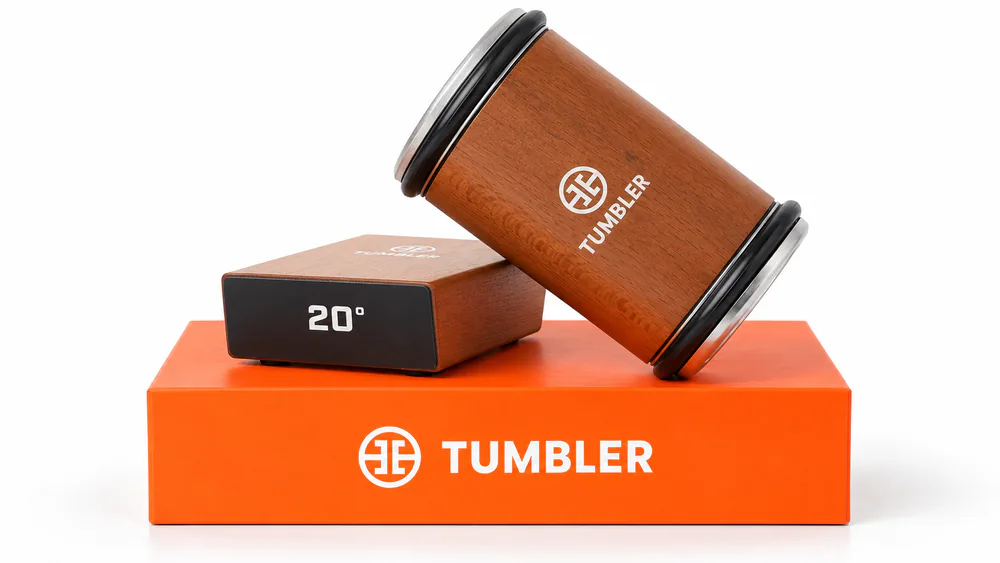
5. The Original Tumbler Rolling Knife Sharpener – Best Rolling Sharpener
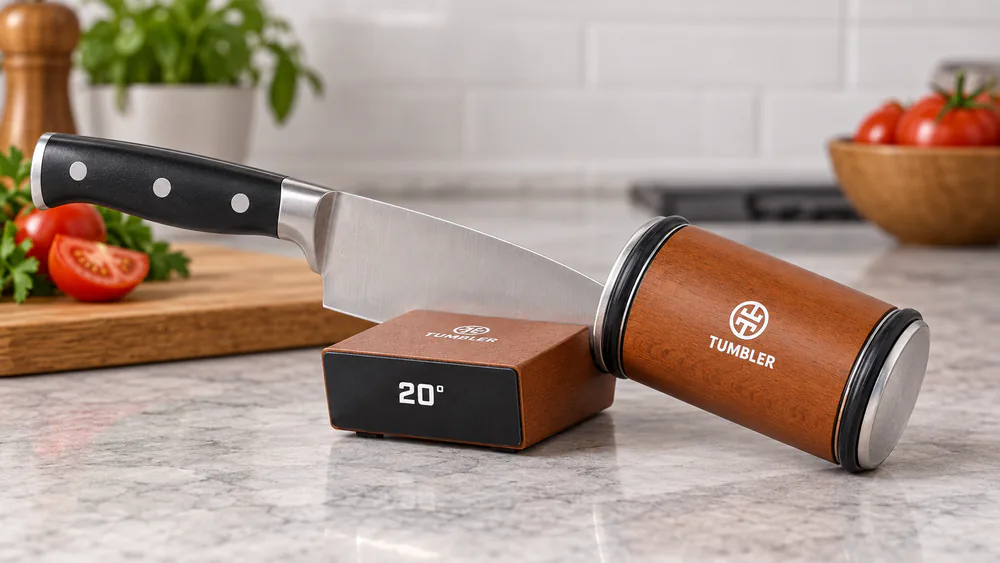
The Tumbler is the most interesting tool on this list and the hardest to love at its price. The rolling motion is genuinely smooth, and the magnetic angle support seats the blade while you roll it over the diamond-plated disc and the stainless steel helix hone. It is the lowest-skill sharpening we tested, and it is a maintenance tool rather than a rescue tool.
The Tumbler works at fixed 15- and 20-degree sharpening angles, with a premium diamond-plated disc that restores edges and a proprietary stainless steel helix disc that hones and refines. Knives came out cutting like razors and stayed sharp for weeks in our hands, and the learning curve is the lowest on this list: roll, count, done. We also saw the rolling disc make its best contact at the blade belly, leaving the tip and heel dull, and narrow paring knives are a poor fit for the roller.
Pros
Roll, count, done: no skill required
Fixed 15- and 20-degree angles via the magnetic support
Keeps maintained knives cutting like razors for weeks
No oil, no water, no mess
Cons
A maintenance tool, not a rescue tool for dull knives
Roller can seize after about 10 uses; disc is not replaceable
Better contact at the belly leaves tip and heel dull
$129 is steep for the base model
Durability is the open question. The roller seized up after about 10 uses in some units we tracked, a few arrived broken out of the box, and the disc is not replaceable, so you are betting on the never-wear diamond claim for the life of the product. It also makes a scratchy grinding noise. At $129 for the base wood model, which skips the leather strop of the pricier kit, that is a lot for maintenance duty, which is why the Tumbler scores below the electrics and stones here.
Product specs / key features
The Tumbler sharpens at fixed 15- and 20-degree angles via a magnetic angle support, using a diamond-plated disc and a stainless steel helix hone. The wood base model is the starter kit without the leather strop.
Best For
Cooks who want razor edges without learning whetstone angles, as long as they keep knives maintained between sessions.
Not Ideal If
You are rescuing a drawer of neglected knives, you sharpen paring knives or wide cleavers regularly, or you want a tool whose wear parts are replaceable.
The knife rides the magnetic support while the roller runs heel to tip.
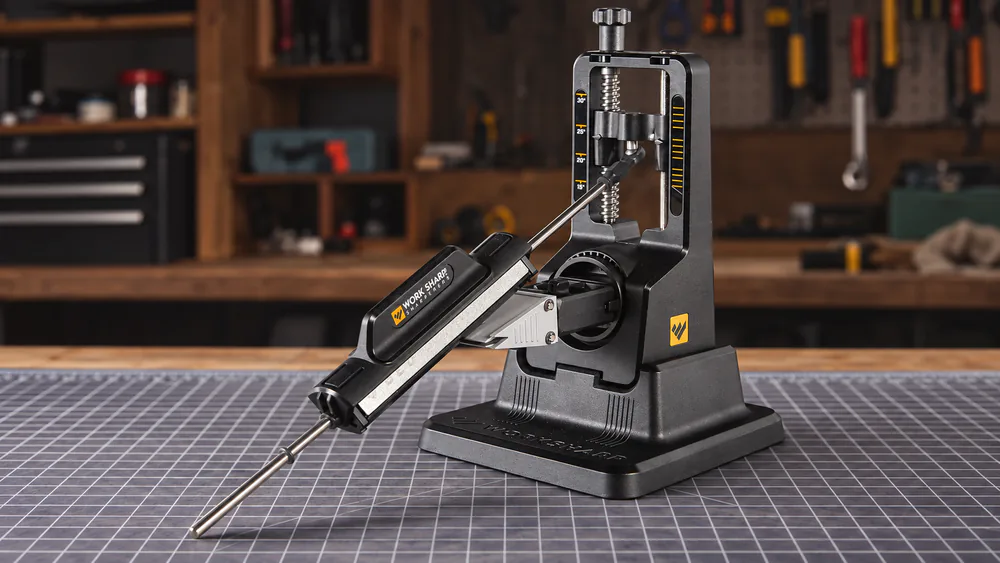
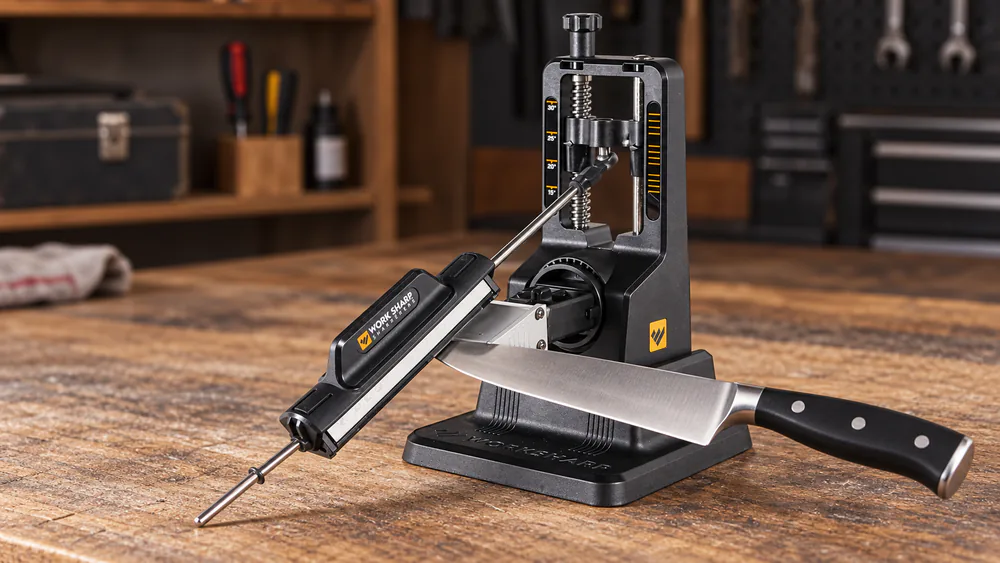
6. Work Sharp Precision Adjust Knife Sharpener – Best Guided Manual System
The Precision Adjust is the pick for cooks who want whetstone control without freehand practice. It delivered razor-sharp results even on D2 pocket-knife steel and made every knife in our test drawer usable again. The price of that control is patience, and one flawed detail: the magnetic clamp.
The Precision Adjust sets the sharpening angle anywhere from 15 to 30 degrees in 1-degree increments, and a tri-abrasive rod indexes between coarse diamond, fine diamond, and fine ceramic. You clamp the blade in a rotating v-block, set the angle, and pass the rod. The results speak for themselves: razor-sharp edges on German and Japanese steels and hard D2, with angles that repeat within a degree when you trust the setting. It is designed, engineered, and calibrated at Work Sharp's facility in Ashland, Oregon, and it carries a 3-year comprehensive warranty. If you want a portable take on the same idea, Work Sharp's Guided Field Sharpener shares the angle-guide DNA in a field package.
Pros
Angles adjustable 15 to 30 degrees in 1-degree increments
Razor-sharp results on tough steels like D2
Whetstone-level control without freehand skill
3-year comprehensive warranty
Cons
Magnetic clamp is the weak point: it wobbles and can work loose
Real angle depends on edge protrusion; shifts on curved blades
Slower than any electric on this list
The magnetic clamp is the weak point. It does not hold every knife securely, it works itself loose mid-sharpen, and the clamp arm wobbles, which lets the blade play during a pass. Some of our testers saw the angle drift; others found the 1-degree increments perfectly repeatable. The real angle also depends on how far the edge protrudes from the clamp, and the contact point shifts on heavily curved blades. Clamp tight, check the setting, and you will land in the repeatable camp.
Product specs / key features
The system clamps blades in a rotating v-block and indexes a tri-abrasive rod between coarse diamond, fine diamond, and fine ceramic. Angle range is 15 to 30 degrees in 1-degree increments, and the warranty is 3 years.
Best For
Cooks who want consistent, repeatable angles on good knives, including harder steels that electrics and pull-throughs are too rough for.
Not Ideal If
You sharpen one knife in a hurry every night, because each blade takes a few minutes of clamping and passes, or you want zero setup fuss.
The v-block holds the blade while the rod travels at the set angle.
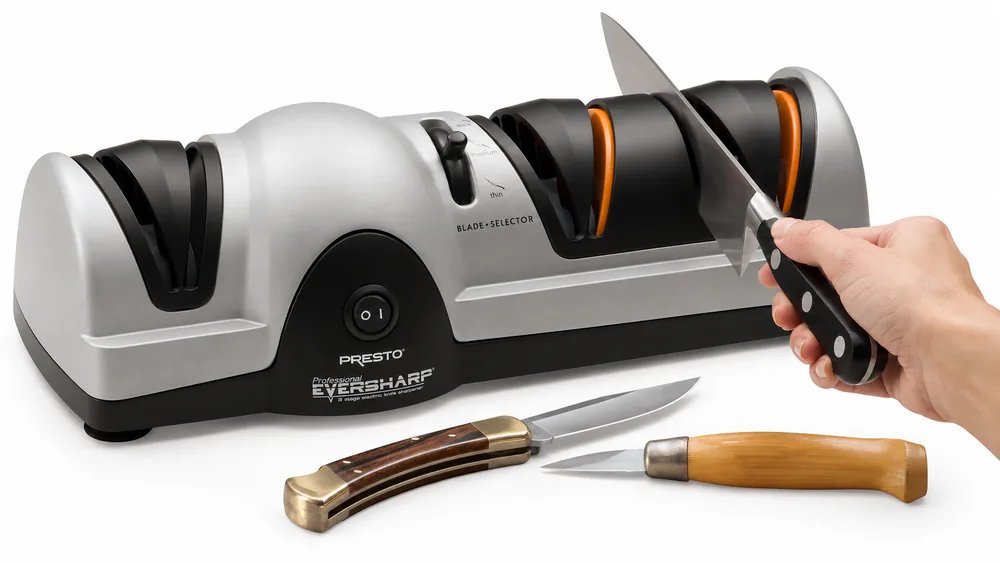
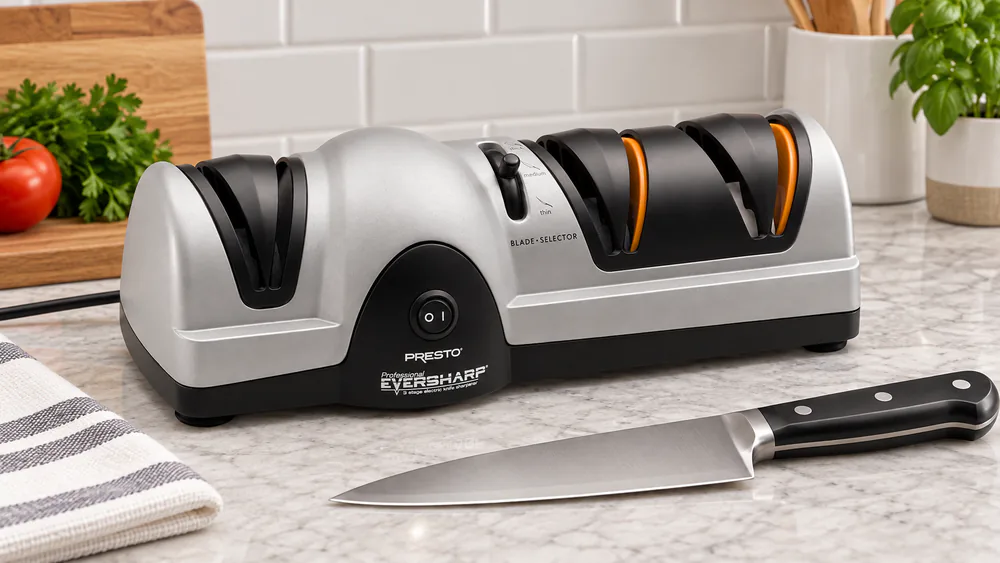
7. Presto 08810 Professional Electric Knife Sharpener – Best Mid-Range Electric
The Presto 08810 has been on kitchen counters for decades, and the reason is simple: it is fast. Our testers described it as roughly 95 percent faster than stone sharpening, and its three wheels produced excellent edges on European and American-style kitchen knives. It is the machine for a drawer full of dull knives.
The 08810 uses an easy 3-stage system: a Sapphirite coarse-grinding wheel, a Sapphirite medium wheel, and an extra-fine-grit ceramic wheel for honing. What sets it apart from cheaper electrics is the blade thickness selector, with settings for thick hunting knives, medium chef's and standard kitchen knives, and thin fillet and paring knives. The blade guides hold the angle for you, a front power switch sits where your hand expects it, and suction-cup feet keep the machine planted. It made dull knives like new, and the edge held a long time between sessions. A minority of blades came out damaged, which is the standard warning for aggressive electrics.
Pros
Fast enough to fix a whole drawer in one sitting
Blade thickness selector protects thin fillet and paring knives
Excellent edges on European and American-style kitchen steel
Edges hold a long time between sessions
Cons
Not for scissors or serrated blades
A minority of blades came out damaged; respect the selector
Bigger and heavier than other electrics on this list
It is not for scissors or serrated blades, and it is the most counter-hungry electric here at about 13.5 x 5.75 x 4.5 inches and 4.46 lb. The motor runs on 120V at 1.0 amp. At about $69, it is the simpler, more forgiving answer to the 15XV's speed.
Product specs / key features
The 08810 runs a 3-stage Sapphirite system with an extra-fine ceramic honing wheel, a front power switch, and suction-cup feet. It measures about 13.5 x 5.75 x 4.5 inches, weighs about 4.46 lb, and runs on 120V, 60 Hz at 1.0 amp.
Best For
Homes with a mixed drawer of alloy, carbon, and stainless kitchen knives, including Santoku, that want electric speed with a little more control over blade thickness.
Not Ideal If
You own scissors or serrated blades you also want sharpened, or you have a thin-bladed knife collection that deserves gentler methods.
The front selector dial sets the slot for thin, medium, or thick blades.
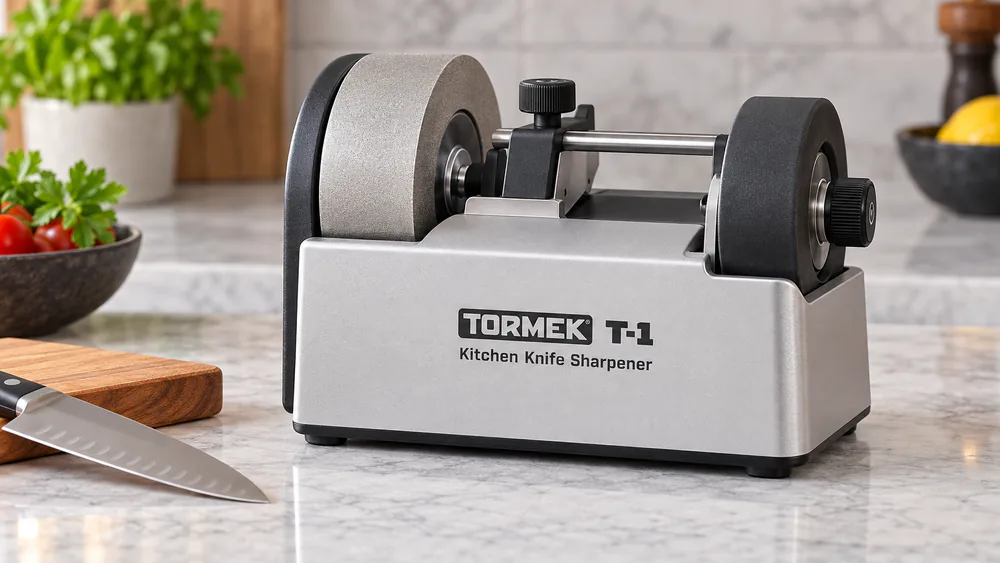
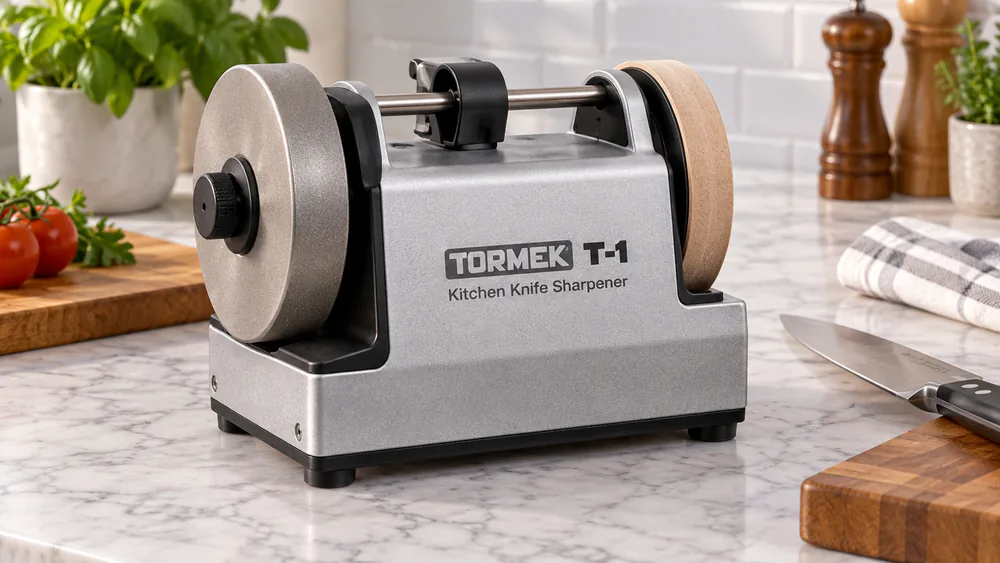
8. Tormek T-1 Kitchen Knife Sharpener – Best Premium Upgrade
The Tormek T-1 is the machine we reach for when we want to fix a knife properly. Its water-cooled wheel runs at 150 rpm, slow enough that the steel never heats up, and quiet enough at about 45 dB that you can hold a conversation over it. It revived a set of 14-year-old knives retired to the drawer, delivering professional sharpness in about five minutes per blade.
The T-1 sharpens on a DF-150 conical diamond wheel at fine 600 grit, and its PW-160 conical composite honing wheel removes the burr and polishes the bevel for maintenance between sharpenings. The patented stepless bevel angle guide runs 8 to 22 degrees per side, and it can set different angles per side, which matters for asymmetric blades. It sharpens all types of steel plus ceramic knives, and it can be used without power if you want to hand-crank it. The precision-cast zinc housing with its solid oak handle is made in Lindesberg, Sweden, and the warranty is an 8-year term: 5 years plus 3 more with free online registration within 90 days.
Pros
Water-cooled wheel never overheats the edge
Stepless angles from 8 to 22 degrees per side, different per side
About 45 dB: whisper quiet
8-year warranty with free registration
Sharpens all steels plus ceramic knives
Cons
About $420 to $428; the most expensive pick here by far
Roughly 12 lb, a permanent countertop fixture
Not for thin, high-hardness Japanese knives
Overkill for a casual home drawer
Two cautions come with the premium. Keep thin, expensive Japanese knives away from the T-1, and understand that at roughly 12 lb this machine becomes a permanent countertop fixture. At $420 to $428 street, it only makes sense if you sharpen often, own knives worth protecting, or have been paying a sharpening service more than the machine costs. If that is you, the Tormek T-1 product page explains the full system.
Product specs / key features
The T-1 runs a DF-150 conical diamond wheel at fine 600 grit (150 x 18 mm) plus a PW-160 conical composite honing wheel (160 x 30 mm), at 150 rpm with 2 Nm torque. The motor is a single-phase AC unit at 60W idle and 120W max input, the machine measures 204 x 196 x 181 mm and weighs about 11.9 lb, and it includes KPP-2 knife protection pads and an EM-15 edge marker.
Best For
Serious cooks and households with expensive knives who would otherwise pay a sharpening service, and anyone who wants professional, water-cooled sharpening at home.
Not Ideal If
You sharpen a mid-price knife drawer twice a year, or your counter space is spoken for, because this machine stays out and it earns that spot.
The T-1's conical diamond wheel and oak-handled zinc housing, ready for a bevel pass.
9. Utopia Kitchen 12-Inch Honing Rod – Best Honing Steel
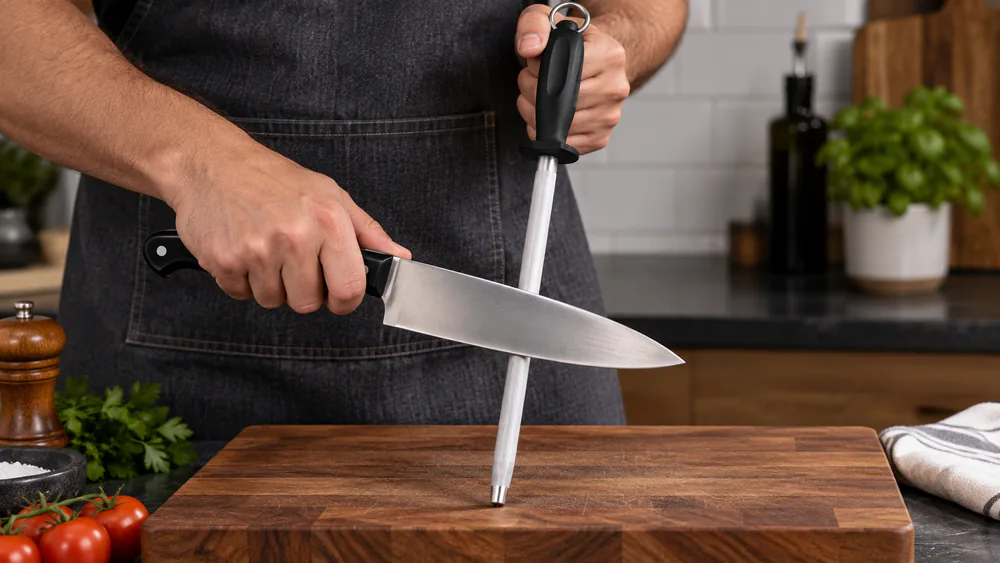
The Utopia rod is more hone than sharpener, and we mean that as a compliment. A few light strokes before cooking realign an edge that has rolled over, and knives cut more smoothly for the rest of the session. It belongs in every drawer that owns any knife on this list.
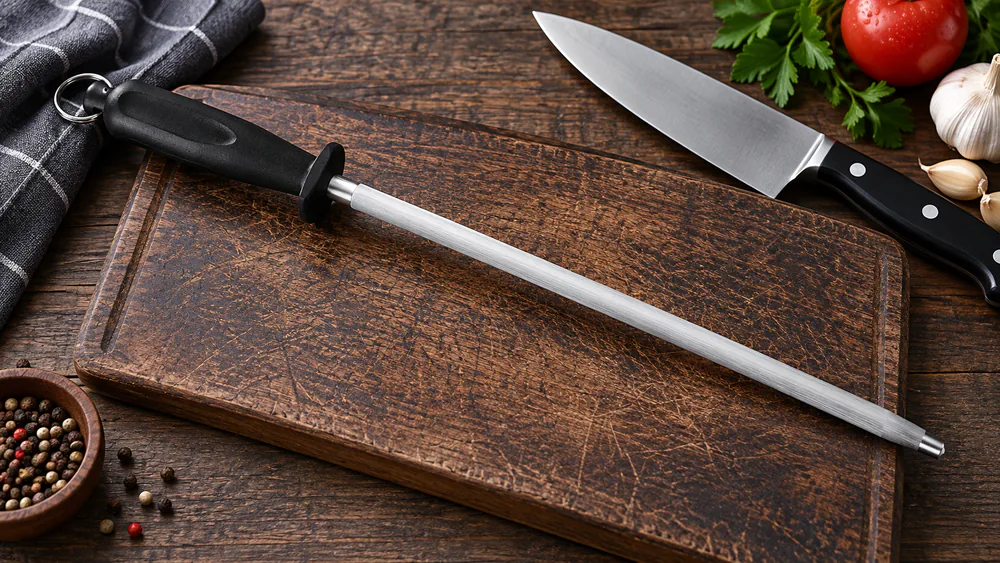
The rod is a 12-inch fine carbon honing steel, nickel-chrome plated and magnetized, and it realigns edges rather than grinding them, so it removes no metal at all. The non-slip textured handle is comfortable, a hanging loop keeps it off the counter, and the anti-slip metal tip braces against a cutting board. We saw razor-sharp results that held longer after a quick hone: a knife that dragged at the start of prep cut cleanly after a few light strokes. The handle is the first failure point, and a few units we tracked lost theirs after a few weeks, so treat it as a replaceable part of a very cheap tool.
Pros
A few light strokes before prep, and the edge cuts clean again
Magnetized, nickel-chrome plated 12-inch steel
Comfortable grip and anti-slip tip for board work
Costs less than a takeout lunch
Cons
Hones, it does not sharpen
Handle is the first failure point on some units
No help for chips or genuinely dull edges
Here is the honest framing: a steel never replaces a sharpener. It fixes a rolled edge, not a dull one, and if you expect the rod to resurrect a neglected knife, it will disappoint you. Bought as a partner for any sharpener on this list, it is the best $15 you will spend.
Product specs / key features
The Utopia is a 12-inch fine carbon honing steel, nickel-chrome plated and magnetized, with a non-slip textured handle, a hanging loop, and an anti-slip metal tip.
Best For
Every kitchen that owns a sharpener, because weekly honing keeps edges cutting longer and makes each real sharpening session rarer.
Not Ideal If
You are looking for a primary sharpener, or you expect a steel to fix knives that will not cut at all.
The rod braces tip-down against the board while the knife edge slides along its length.
10. Shapton Pro 1000 Whetstone – Best Professional Whetstone
The Shapton Pro 1000 is the stone our kitchen would keep if we could keep only one, and it is the pick for cooks past the beginner stage. It needs no soaking, it cuts fast, and it holds its form longer than the water stones we compared it against.
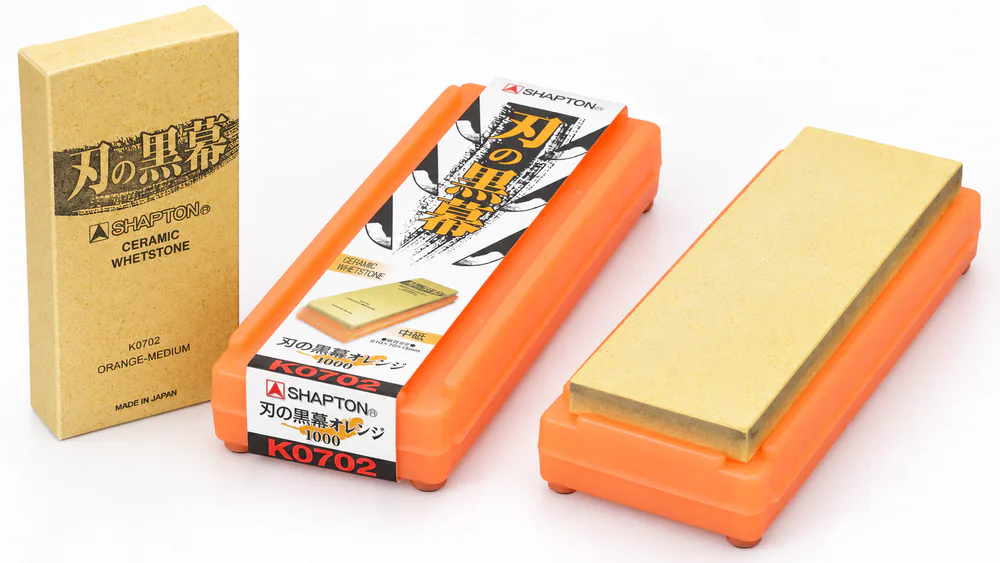
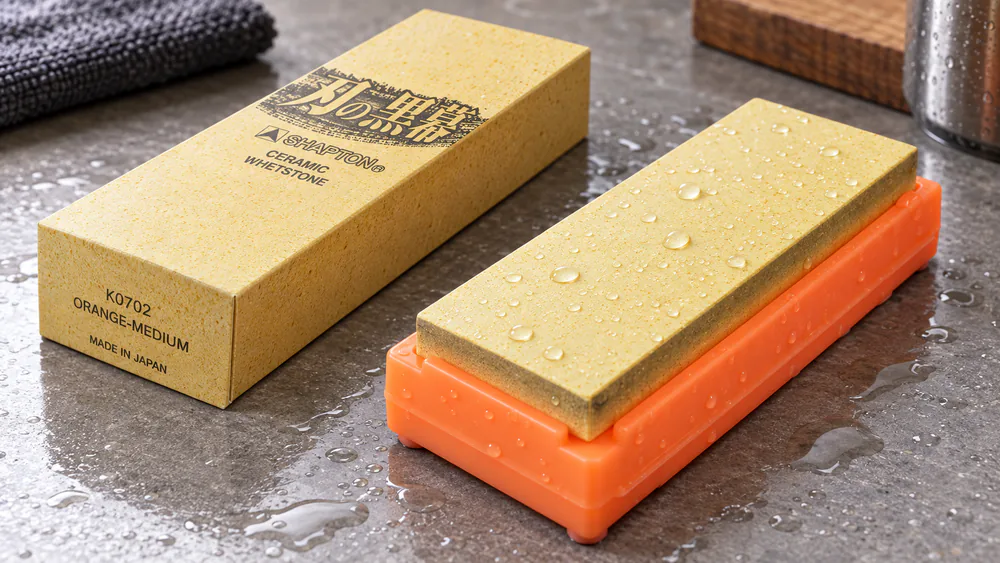
The Shapton Pro 1000 is a #1000 medium grit ceramic whetstone, model K0702, made in Japan and sold as the Kuromaku import. It is a splash-and-go stone: no soaking required, just splash water on it and start, a reputation Chef Knives To Go documents, and the plastic case doubles as a stone holder. In our hands it raised a burr quickly on German stainless and Japanese steels alike, and it cuts faster and coarser than its JIS 1000 rating suggests, closer to a 700 or 800 grit feel, a read on the stone shared across Kitchen Knife Forums. One stone in our rotation survived a 3-foot drop onto tile, and it wears slower than typical water stones.
Pros
Splash-and-go: no soaking, no oil
Fast cutter that raises a burr quickly on any steel
Fast, dense ceramic that outlasts typical water stones
Made in Japan; plastic case doubles as a holder
Cons
Runs coarser than its #1000 rating, closer to 700 to 800 grit
Instructions ship in Japanese only
Single stone, so no separate polishing finish
Two notes for buyers. The Kuromaku import ships with instructions only in Japanese, which matters less than it sounds because the technique is the same as any whetstone. And it is a single stone, so you finish on its own grit rather than polishing on a 3000 or 6000. For a working kitchen, that is a feature: the Pro 1000 is a first stone and a do-almost-all stone, and at about $40 it is the best value on the professional side of this list.
Product specs / key features
The Shapton Pro 1000 is a #1000 medium grit ceramic whetstone, model K0702, measuring 210 x 70 x 15 mm (about 8.3 x 2.8 x 0.6 inches, per Hocho Knife's listing). It is made in Japan, needs no soaking, and its plastic case doubles as a stone holder.
Best For
Cooks who already know basic whetstone technique and want one fast, durable medium-grit stone that handles every kitchen steel they own.
Not Ideal If
You are a complete beginner who wants a guide and a two-stone kit, or you insist on a polished 3000-to-6000 finish straight from the stone.
Water beads on the dense ceramic surface between passes.
How to Choose the Best Knife Sharpener for Kitchen Knives
Once the picks above have narrowed the field, here is how to choose between them. A sharpener is a simple tool with one job, but the differences between types decide how easy, how fast, and how precise the job is. Walk through the four questions below before you buy.
Electric vs Manual vs Whetstone: Which Type Is Right for You?
Electric sharpeners like the Chef's Choice 15XV and the Work Sharp Culinary E2 are the fastest way to a working edge, but they set the angle for you, remove more metal per session than a whetstone, and take up counter space. Manual pull-throughs like the AccuSharp are the same idea in a $12 pocket: fast and aggressive. Whetstones like the Sharp Pebble 1000/6000 are the slowest and most precise, with a learning curve that pays off in longer-lived edges. Rolling sharpeners like the Tumbler split the difference with the lowest skill requirement, but they maintain edges better than they rescue them.
Warning. Never run a thin, high-hardness Japanese knife through an electric sharpener or an aggressive pull-through. The preset angle and fast abrasives can chip or scour steel that costs more than the sharpener.
Understanding Grit Levels
Grit numbers describe how coarse the abrasive is, and lower numbers cut faster and rougher. A 1000-grit stone repairs dull or damaged edges; a 3000 to 6000 grit polishes a razor-sharp finish. That is why combo stones like the 1000/6000 are so popular, and why the Shapton Pro 1000 can stand alone for kitchens that finish with a working cut rather than a mirror polish. For kitchen knives you rarely need anything coarser than 800 grit.
Bevel Angle: 15 vs 20 Degrees
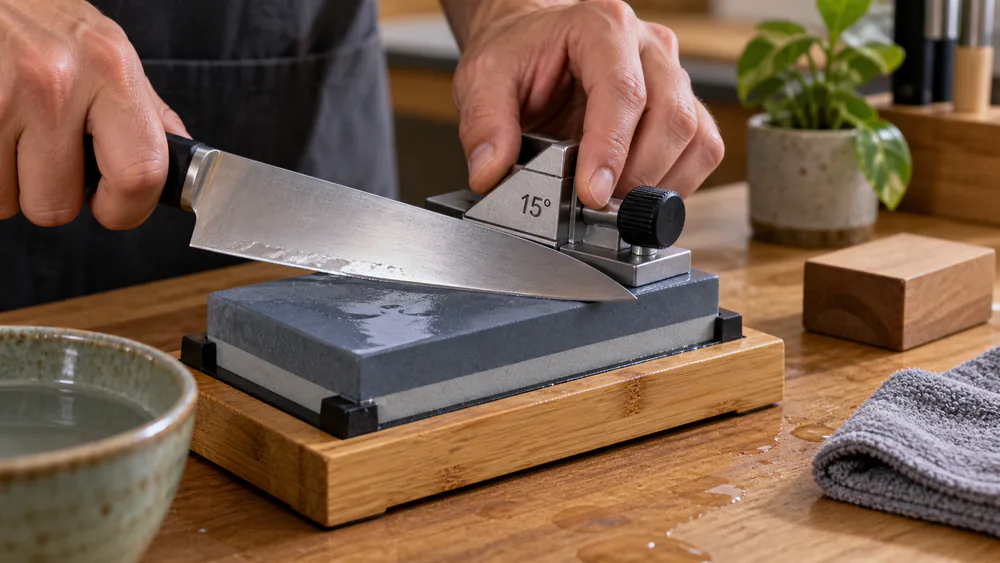
Western knives typically come with a 20-degree bevel, and Japanese knives with a thinner 15-degree bevel that cuts more aggressively and chips more easily. The Chef's Choice 15XV converts a whole drawer of 20-degree edges to 15 degrees, which is either a feature or a commitment, depending on your knives. The Work Sharp Precision Adjust is the tool when you want to choose the angle yourself, from 15 to 30 degrees in 1-degree steps. Fixed-angle systems pick for you, so check the angle before you run a Japanese knife through one.
Honing vs Sharpening: Do You Need Both?
Yes, and most kitchens need both tools. Honing realigns an edge that has rolled over, removes no metal, and takes seconds, so a rod like the Utopia 12-inch honing steel earns its drawer spot with weekly use. Sharpening grinds a new edge and removes metal, and it is what you do when honing stops helping. The cheap rule of thumb: if the knife still cuts but drags, hone it. If it will not cut at all, sharpen it.
Safety Features to Look For
The best safety feature is a sharp edge, because dull knives slip, but good machines add real protections. Look for a full finger guard on handhelds like the AccuSharp, blade guides and a thickness selector on electrics like the Presto 08810, a non-slip base on whetstone kits, and a stable housing heavy enough that the machine does not walk across the counter.
An angle guide set to 15 degrees holds the edge steady against the stone.
Frequently Asked Questions
What is the best knife sharpener for kitchen knives?
The honest answer matches your knives. Our top pick, the Chef's Choice 15XV, suits most kitchens because it is fast and foolproof on western steel. If you cook mostly with Japanese blades, a guided system or whetstone protects the edge you paid for.
Do pull-through knife sharpeners actually work?
Yes, for maintenance. Pull-throughs like the AccuSharp set a preset angle and take a little metal with each pull, so three or four strokes bring a dull western knife back in seconds. They remove more metal than a whetstone and offer no angle choice, so we would not run expensive Japanese steel through one. Treat a pull-through as the fastest fix between real sharpenings.
What knife sharpener do professional chefs use?
The pro pattern is easy to copy: a honing steel for daily realignment and a 1000-grit whetstone for the real sharpening, which is why this list includes the Shapton Pro 1000 and a honing steel. When a kitchen sharpens all day, a water-cooled machine like the Tormek T-1 is the standard, and the professional-grade results are the reason for its price.
How often should you sharpen kitchen knives?
Hone before every serious prep session, or at least weekly, and sharpen when the edge stops cutting cleanly. With normal home use, that lands every three to six weeks; heavy daily use can need it weekly. The easy test: if a ripe tomato still slices without crushing, the edge is fine. If you have to push, it is time to sharpen.
What's the difference between honing and sharpening?
Buy the sharpener first, the steel second. A steel is the cheaper, faster tool, but it only maintains an edge that a sharpener created, so it cannot carry a kitchen on its own. Once your sharpener is sorted, add a steel like the Utopia rod and run a few passes before prep; together they stretch the time between real sharpening sessions.
Are electric knife sharpeners bad for knives?
Not by themselves, but they remove more metal than a whetstone and set one angle for every blade, so they suit mid-price western steel better than thin, high-hardness Japanese knives. Good machines soften the tradeoff with multiple stages, coarse to fine to stropping, which is why our top pick is a three-stage electric. Skip the aggressive single-slot pull-throughs for anything you care about.
Final Thoughts
If you want one tool that keeps a whole western-style knife drawer sharp with the least effort, the Chef's Choice 15XV earns its place on the counter, and the Work Sharp Culinary E2 covers the same job on a budget. If your drawer is mostly Japanese steel, spend the money on a guided system or a whetstone instead, because electrics set an angle those blades should not have to accept.
Our closing advice to every cook is the same: buy one good chef's knife, learn ten minutes of whetstone work, and keep a honing rod in the drawer. Beginners reach a razor edge in about ten minutes on a 1000-grit stone, the Shapton Pro 1000 and the Sharp Pebble both prove it, and the $12 AccuSharp covers the weeks you do not feel like practicing. Skip the rolling sharpeners as a primary tool, keep the rod for weekly honing, and your knives will stay sharp.