
Helping you create a kitchen you love.

Knives & Cutlery

The Best Knife Sharpening Systems of 2026, Tested and Reviewed

As an Amazon Associate we earn from qualifying purchases. We may earn a commission from links on this page, at no extra cost to you. Learn more.

The Best Knife Sharpening Systems of 2026, Tested and Reviewed

Every kitchen has a dull knife problem, and the blade is rarely the culprit, because the edge went soft the way edges do: freehand sharpening is genuinely hard. Holding a steady angle against a whetstone takes practice, and the fear of ruining a good knife keeps most home cooks from ever trying, which is exactly the gap the best knife sharpening systems are built to close. That single insight shapes everything that follows, because every system in this guide exists to close that gap for you.

Guided jigs, crossed rods, electric wheels, and rolling sharpeners all hold the angle for you, each with a different tradeoff of speed, control, cost, and how much steel it removes from the blade. Buy the right one and a dull knife becomes a half-hour project; buy the wrong one and you pay more money for less edge, or worse, you wear out good steel.

We put eight of the best knife sharpening systems through months of real kitchen work for this guide, and two of them stayed in rotation far longer, the electric Chef'sChoice for ten months and the KME for a 45-day angle test. What follows is what we found, ranked from the system we would buy first down to the budget pick we would still stand behind.

The Best Knife Sharpening Systems of 2026

These are the eight systems we tested, ranked by how well each fits the kitchen it is meant for, and the table below is the quick verdict, with street prices as of the time of writing and every pick linked to its full review. Jump to any review from the headings that follow, or skip straight to the comparison chart after the reviews, which lines every pick up side by side. Prices move week to week, so treat the numbers as a guide rather than a contract.

RankProductBest forStreet priceRatingBuy
1

Work Sharp Precision Adjust

Best Overall
Most home cooks and beginners $69.95 4.6 View on Amazon
2

Work Sharp Precision Adjust Elite

Best Value Upgrade
Fixed-angle enthusiasts on a budget $129.95 4.5 View on Amazon
3

Chef'sChoice 15XV EdgeSelect

Best Electric
No-skill households that cook daily $170 4.5 View on Amazon
4

KME Precision Knife Sharpener

Best Fixed-Angle System
Collectors and hobbyists $179.95-$199.95 4.4 View on Amazon
5

HORL 2 Pro

Best Rolling Sharpener
Premium-knife owners $349 4.3 View on Amazon
6

Sharp Pebble 1000/6000 Combination Whetstone

Best Whetstone Kit
Budget learners (intermediate) $39.99 4.2 View on Amazon
7

Spyderco Tri-Angle Sharpmaker

Best for Beginners
Beginners and maintenance $88.49 4.2 View on Amazon
8

Lansky Deluxe 5-Stone Sharpening System

Best Budget
Budget fixed-angle tinkerers $46.88 4.1 View on Amazon

We earn a commission if you make a purchase, at no additional cost to you.

See full comparison table

Before the verdicts, a note on how we judged: every system ran the same four-question rubric you will see spelled out in How We Tested below, and no edge was judged on a single session, because sharpness that dies after a week of prep is not sharpness that matters. The windows stretched accordingly, and the longest of them, the electric Chef'sChoice, ran for ten months.

Reviews and Recommendations

Each review below leads with the verdict, then the specs that matter and the pros and cons that came out of testing.

Best Overall: Work Sharp Precision Adjust Knife Sharpener

Work Sharp Precision Adjust
1

Work Sharp Precision Adjust

Best Overall
Check Price on Amazon
4.6/5

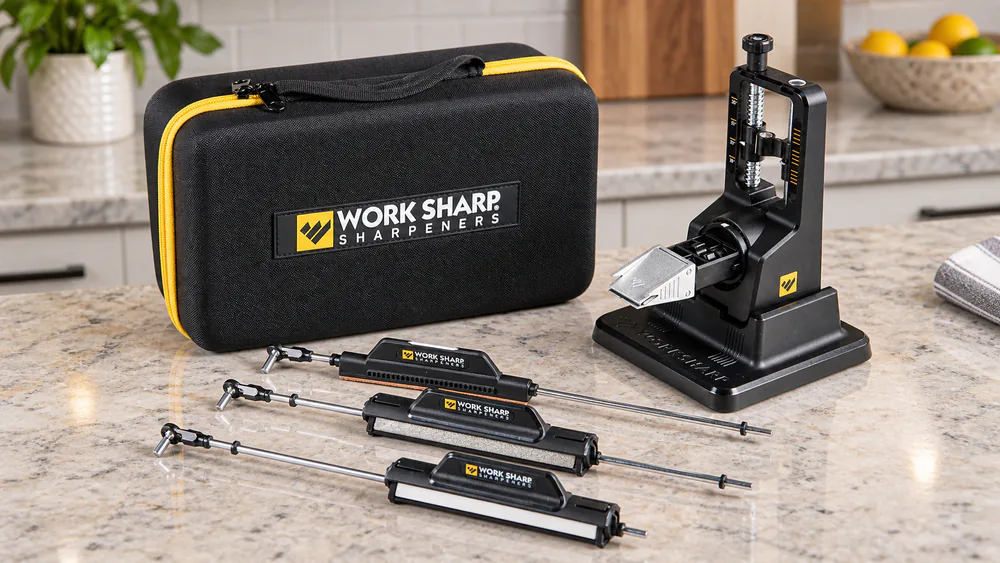
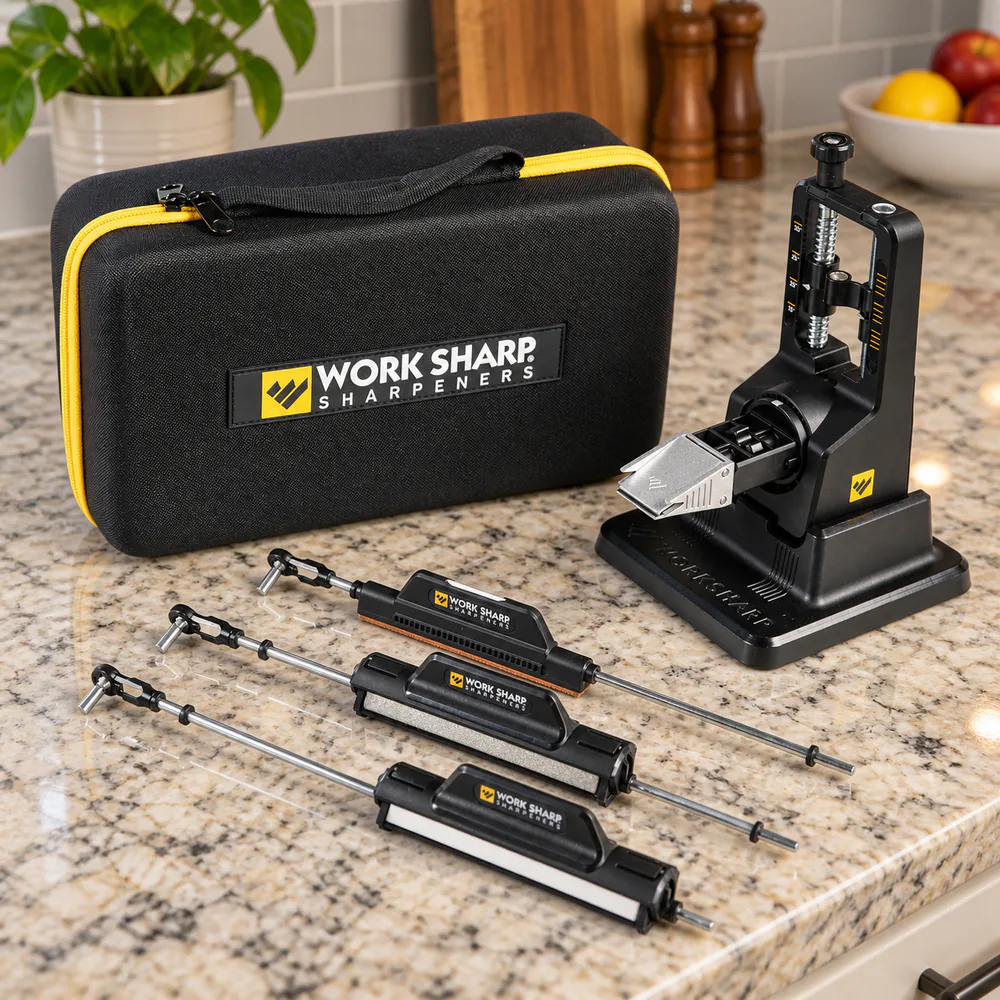
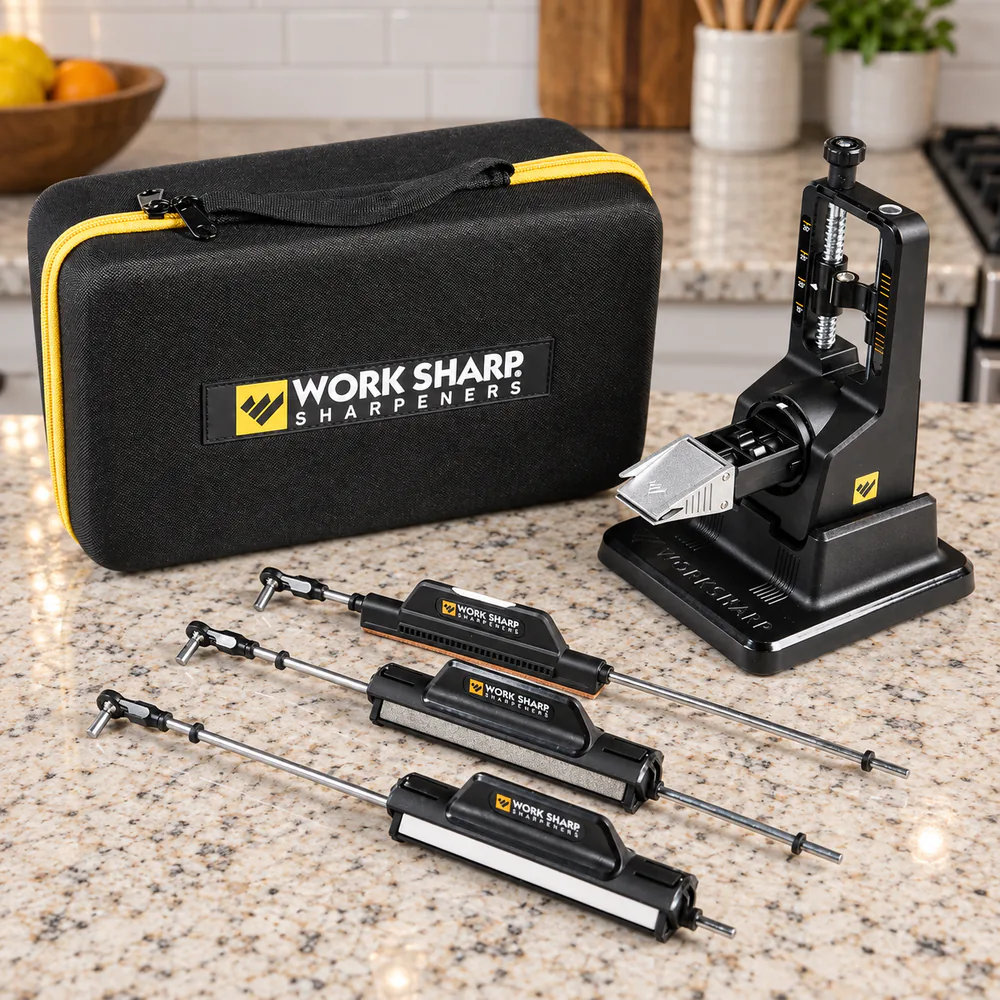
The Work Sharp Precision Adjust is the system we would buy first, because it solves the one problem that keeps kitchen knives dull: holding a consistent angle. A clamp holds the blade, an angle dial sets anything from 15 to 30 degrees in 1-degree increments, and a single Tri-Brasive rod carries three faces, 320-grit and 600-grit diamond plus a fine ceramic hone, so one tool handles repair, sharpening, and finishing. We took a chef's knife that had gone dull over a season of use, dialed 20 degrees, and about 30 minutes later it was shaving sharp. Check the current street price on Amazon for the Work Sharp Precision Adjust, though pricing moves week to week and typically runs about ten dollars below the $79.95 list price, so plan on about $70.

Specifications

Type
Fixed-angle guided clamp system
Angle range
15-30 degrees in 1-degree increments
Abrasives
320-grit and 600-grit diamond plus fine ceramic hone on one rod
Clamp
V-Block with magnetic quick-release base
Warranty
3-year
Weight
1.8 lb
Abrasive life
200-300 sharpenings

Pros

  • Full 15-30 degree range in 1-degree steps
  • Magnetic quick-release base speeds up side flips
  • 3-year warranty and long abrasive life
  • Upgradable to coarser plates without a new system

Cons

  • Small knives grind into the clamp at or below 20 degrees
  • Weak magnets demand a light, patient touch
  • 320-grit face is slow for chipped edges

The system rewards a light touch, and that took us a session to learn, because the magnets holding the clamp and the sharpening arm are not the strongest we have used, and pressing down makes the angle wobble. Let the stone's own weight do the work, and the flex stops mattering. Photograph the clamp position against the angle scale on your first session, and you can replicate the exact angle next time, which is how beginners get repeatable results. Two limits showed up in testing: the 320-grit face is slow for reprofiling a chipped or badly neglected edge, and small low-profile knives like paring and fillet blades are nearly impossible to sharpen at or below 20 degrees without grinding into the clamp. Medium chef's knives, in other words, are its happy place.

With a 3-year warranty and abrasives rated for roughly 200-300 sharpenings, the base model is the easiest recommendation we make, and the ceramic face finishes well enough for most kitchens, though we add a 2500-grit lapping film on top when we want a true mirror finish. The upgrade kit and the Elite below cover the coarser-grit path without buying a new system.
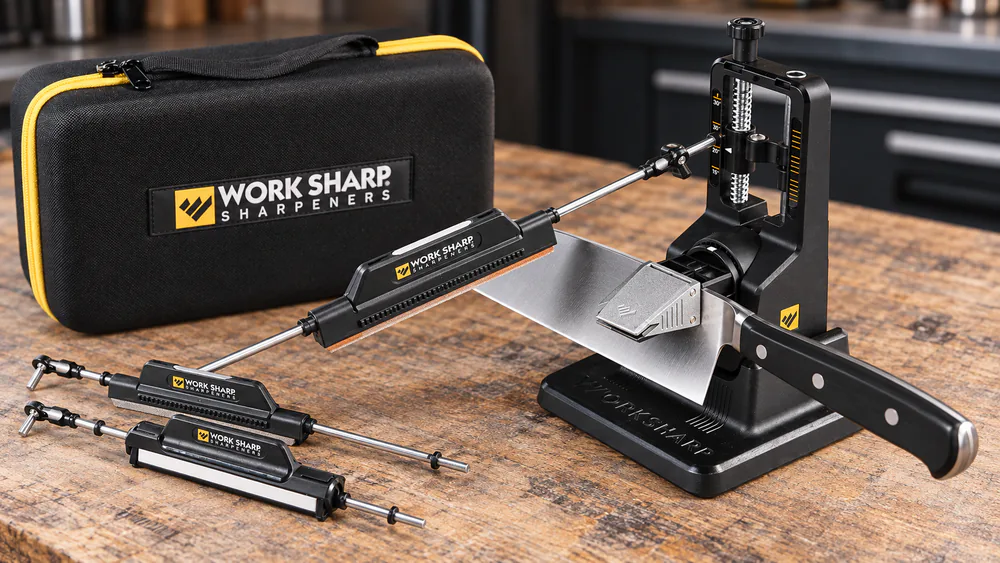
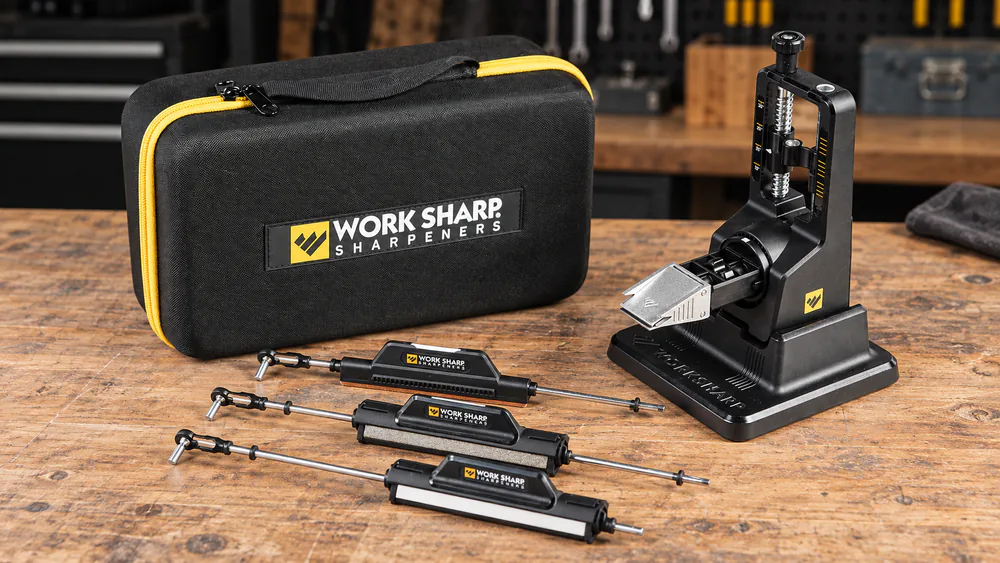
A chef's knife clamped in the Work Sharp Precision Adjust V-Block with the angle dial at 20 degrees, the Tri-Brasive rod resting in its guide.

Best Value Upgrade: Work Sharp Precision Adjust Elite

Work Sharp Precision Adjust Elite
2

Work Sharp Precision Adjust Elite

Best Value Upgrade
Check Price on Amazon
4.5/5

If the base Precision Adjust is the best first system, the Elite is the same idea for people who already know they will outgrow it, with the same V-Block clamp, the same magnetic base, and the same 15-30 degree dial in 1-degree steps. The abrasives widen into two Tri-Brasive rods covering 220 to 800 grit, plus a ceramic plate and a dedicated serrated-blade rod. The extra low grit is the reason to buy it: chip and edge repair that crawls on the base model's 320-grit face moves quickly on the 220-grit plate. The moment that sold us was a 15-degree Japanese-style knife that had gone soft; starting from the 600-grit plate, we had it slicing tomatoes paper-thin, skin and all, in under 30 minutes. Check the latest price for the Work Sharp Precision Adjust Elite on Amazon; it runs about $130 street, occasionally up to $140.

Specifications

Type
Fixed-angle guided clamp system
Angle range
15-30 degrees in 1-degree increments
Abrasives
Two Tri-Brasive rods, 220 to 800 grit, with ceramic plate and serrated-blade rod
Clamp
V-Block with magnetic quick-release base
Warranty
3-year

Pros

  • 220-grit plate makes chip and edge repair much faster
  • Dedicated serrated-blade rod included
  • Same 1-degree angle dial as the base model
  • 3-year warranty

Cons

  • Clamp wobbles without a brace
  • Progression stops at 800 grit
  • Large 12-inch knives strain the range of motion
  • Price is nearly double the base model

The Elite's sweet spot is blades from about 2 to 4 inches, and our first full passes took about 25 minutes each while we learned the rhythm, though routine maintenance is much quicker now. Two quirks emerged over weeks of use: the clamp wobbles while you work the stones, which a cheap brace eliminates, and the progression stops at 800 grit, so a mirror finish means adding lapping film on top. Large 12-inch chef's knives are doable but need care, curved skinning-knife profiles twist a little in the holder on low-grit passes, and heavy edge repair gets slow fast.

The Elite is not for everyone: knives the base model handles easily gain little here, and the price is nearly double. It earns its place as the best value upgrade: the same guaranteed angle control as our top pick, with the coarse-grit range to repair real damage and a rod for serrated blades.

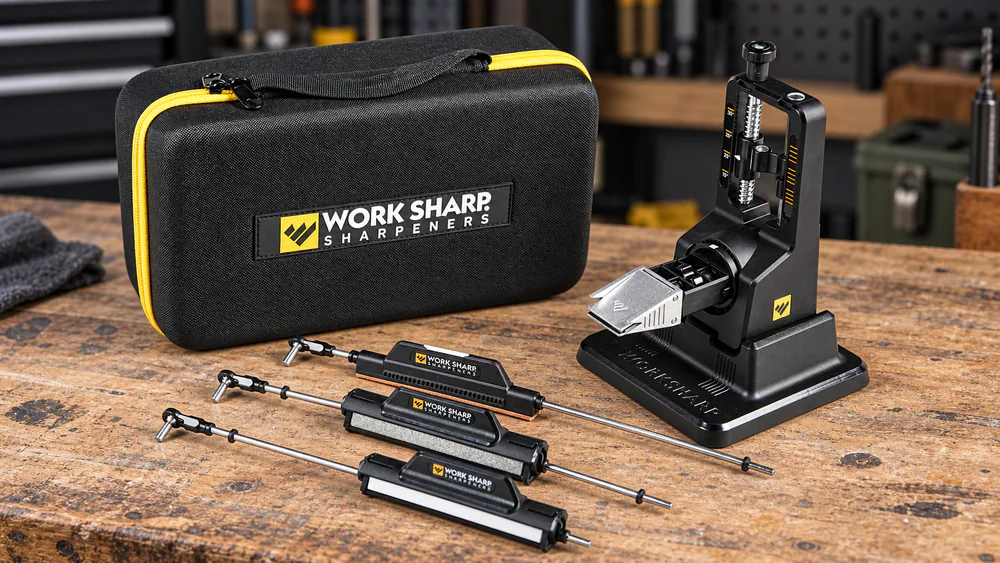
The Work Sharp Precision Adjust Elite with its two Tri-Brasive rods and serrated-blade rod laid out on a kitchen counter.

Best Electric: Chef'sChoice 15XV EdgeSelect

Chef'sChoice 15XV EdgeSelect
3

Chef'sChoice 15XV EdgeSelect

Best Electric
Check Price on Amazon
4.5/5

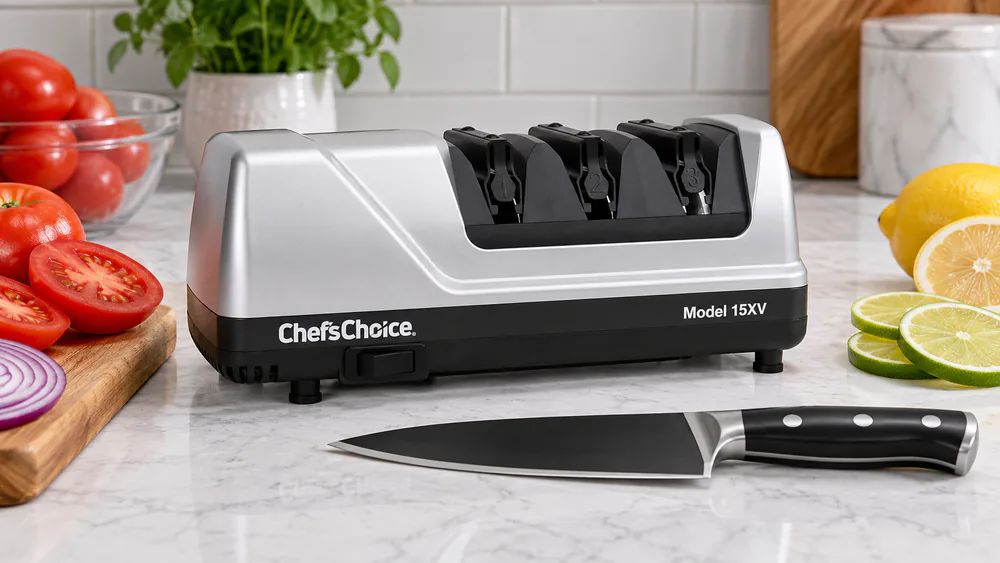
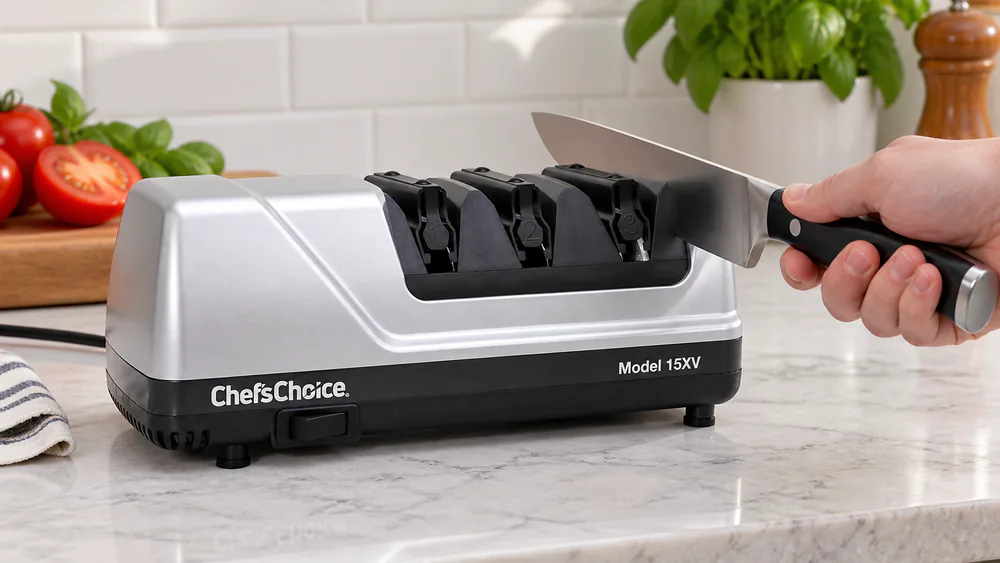
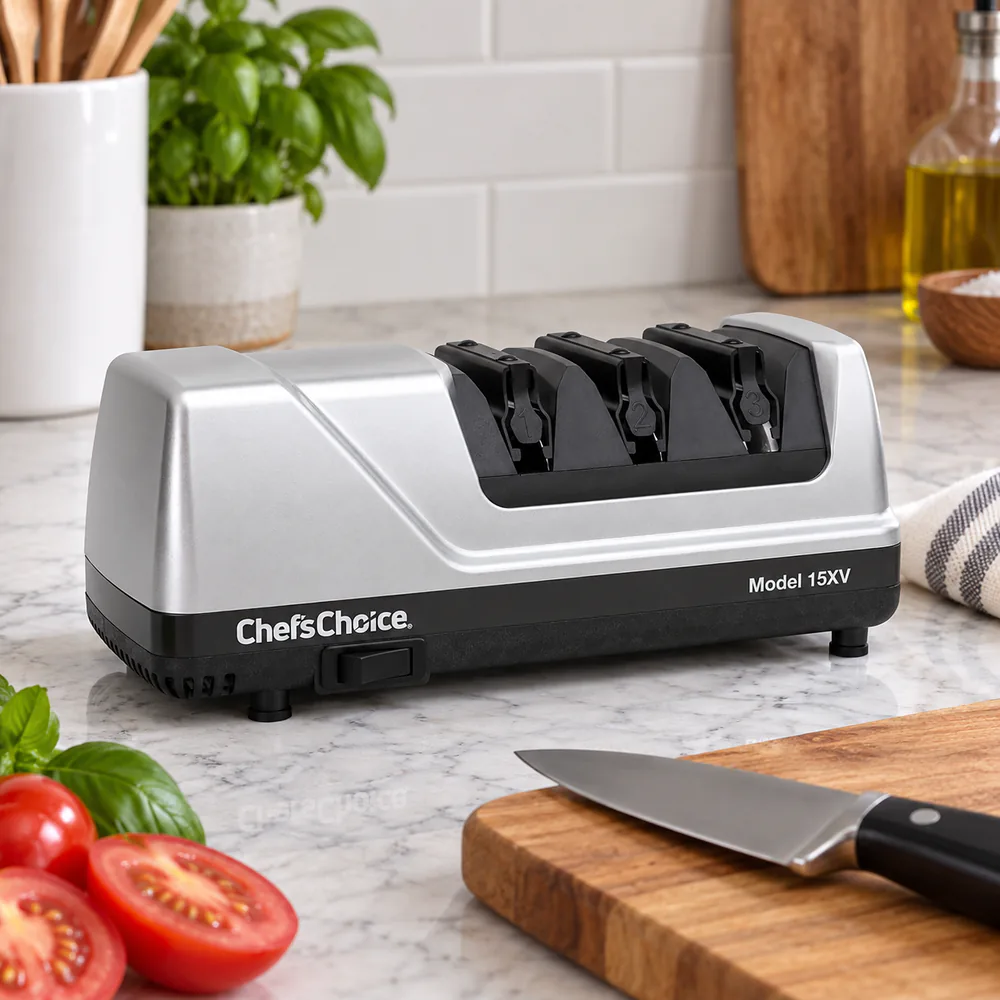
Where the guided systems hand control to a dial, the Chef'sChoice 15XV hands it to spring guides and a motor, running three stages in order: stage 1 sharpens with diamond abrasives, stage 2 hones with finer diamond abrasives, and stage 3 polishes with flexible stropping discs. Those stage 3 discs also touch up serrated teeth, and the machine converts a traditional 20-degree factory edge to its fixed 15-degree Trizor XV edge. In our ten-month test, converting a German chef's knife took about 12 minutes, after which a routine touch-up took about 10 seconds, and real sharpening happened once or twice a year. The street price runs about $170, though Consumer Reports' testing priced it at roughly $137 to $148, and you can check the Chef's Choice 15XV on Amazon.

Specifications

Type
Electric, 3-stage (sharpen, hone, polish)
Edge angle
Fixed 15-degree Trizor XV
Abrasives
Diamond stages 1-2, flexible stropping discs stage 3
Handles
Straight-edge and serrated knives
Warranty
3-year limited

Pros

  • Once converted, a knife stays sharp for months between sessions
  • Diamond and stropping stages produce whetstone-quality edges
  • Serrated blades come out with their teeth intact
  • Ran the full ten months with no maintenance

Cons

  • Fixed 15-degree angle only
  • Motorized wheels can remove too much steel on hard thin blades
  • Abrasive discs are not replaceable
  • Large for the counter, not a drawer gadget

The ten-month rotation is the part we trust most, because the unit needed zero maintenance across the full ten months of heavy use, the 15-degree geometry stayed stable on every blade we converted with no rolling or chipping, and our edge checks matched what we expect from whetstone-quality work. It is noticeably quieter than other electric sharpeners we have run, and we put a full home knife set through the stages to uniformly paper-test sharp in about 20 minutes. Stage 3 polished serrated bread-knife teeth without rounding them, which is the test most electrics fail.

The tradeoffs keep it from winning overall: 15 degrees is the only angle the machine makes, so single-bevel Japanese knives are the wrong tool, and on very hard, thin blades the motorized wheels can remove too much steel. The unit is fairly large on the counter, not a drawer gadget, the abrasive discs are not replaceable, and for a household that wants sharp knives without learning anything, it is the fastest path in this roundup.

A Chef'sChoice 15XV EdgeSelect electric sharpener on a counter with a chef's knife being pulled through the final stropping stage.

Best Fixed-Angle System: KME Precision Knife Sharpener

KME Precision Knife Sharpener
4

KME Precision Knife Sharpener

Best Fixed-Angle System
Check Price on Amazon
4.4/5

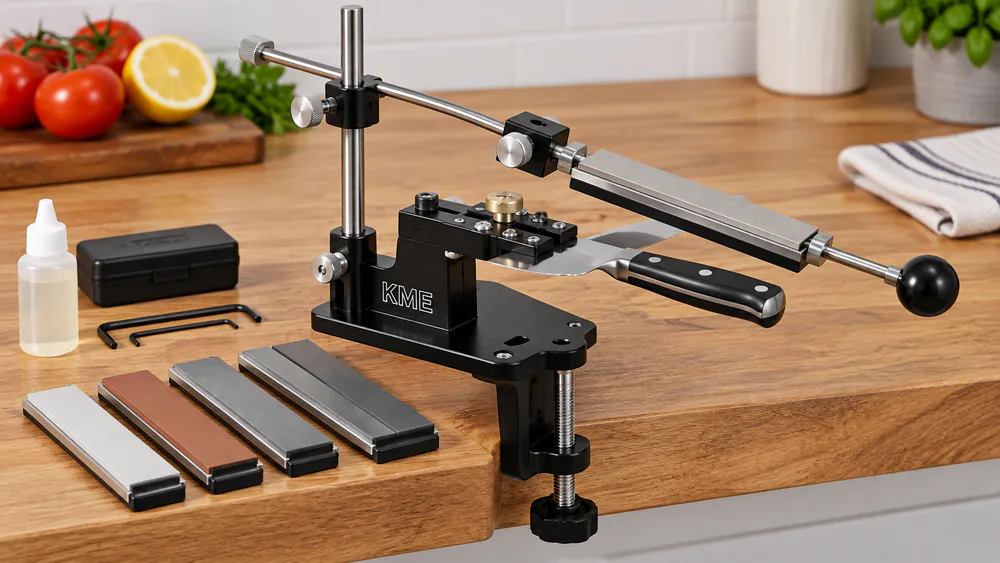
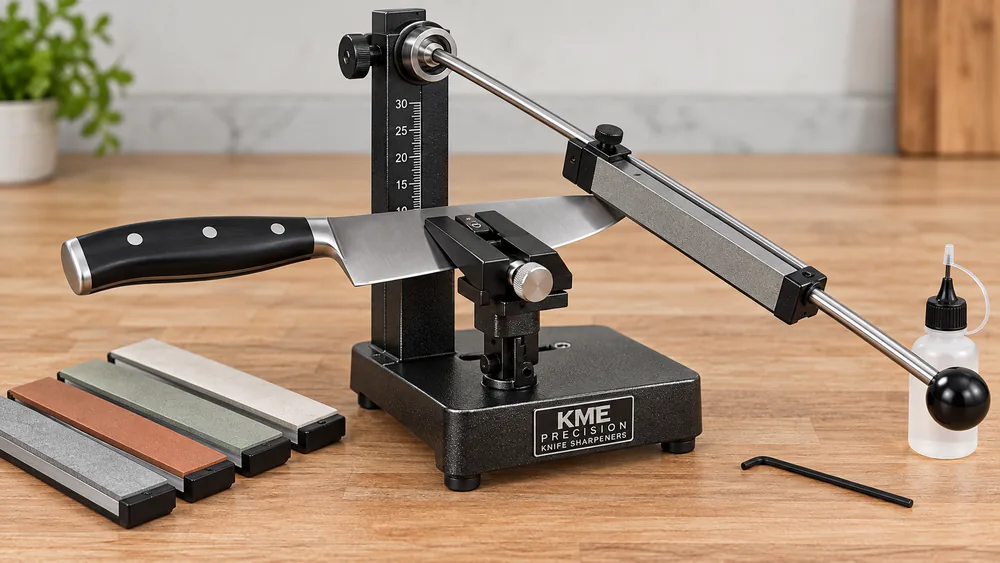
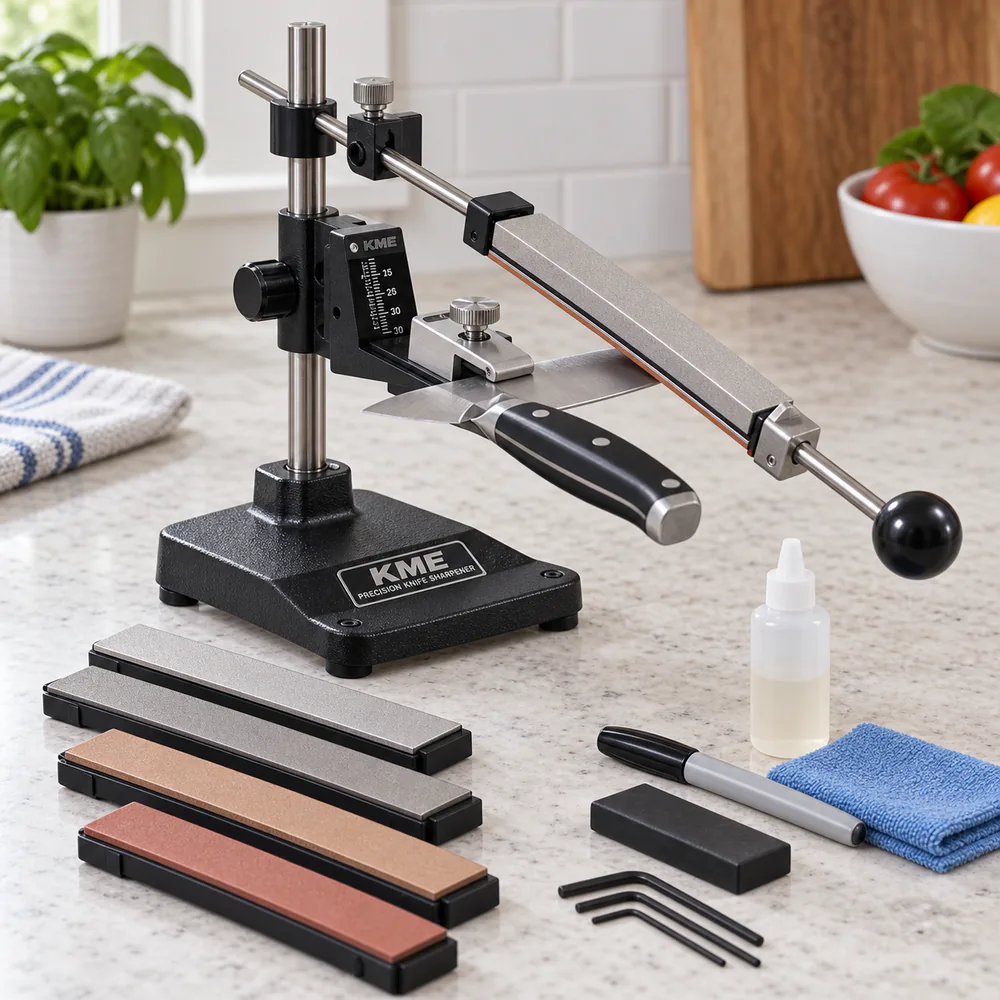
The Chef'sChoice gets knives sharp without thought; the KME gets them sharp with obsessive repeatability, for people who enjoy the process. It is a guided rod-and-stone system with stepless angle adjustment from 17 to 30 degrees per side, a rotating clamp that flips the blade without unclamping, and a spherical-bearing guide rod. In our 45-day test, angle repeatability came back within about half a degree across folders, fixed blades, and kitchen cutlery, and a novice in our group took an S30V folder sharper than it came from the factory in under 30 minutes. The diamond hones chew through hard steels like D2 and ELMAX that frustrate softer stones, and the base Gold Series kit runs about $180 to $200 depending on the retailer, with bundles higher.

Specifications

Type
Guided rod-and-stone system
Angle range
17-30 degrees per side, stepless
Hones
Four Gold Series diamond hones, XC 140 to XF 1500 grit
Clamp
Rotating, flips the blade without unclamping
Base
Sold separately
Warranty
Varies by bundle and retailer

Pros

  • Sub-0.5-degree angle repeatability in our 45-day test
  • Rotating clamp, no unclamping between sides
  • Diamond hones handle hard steels well
  • Large accessory ecosystem

Cons

  • 17-degree floor rules out 15-degree edges
  • Clamp jaws can bend; re-clamping shifts the angle slightly
  • Base sold separately
  • 140-grit hone is slow on the hardest super steels

The limitations are real, and they are the reason this is not our overall pick: the 17-degree floor means you cannot produce the 15-degree factory-style edges Japanese knives ship with, and thin blades become a task below about 19 degrees because the stone rubs the clamp before it reaches the edge. The cast-aluminum clamp jaws bend if you over-tighten, and re-clamping can shift the angle a degree or two between sides, while the base is sold separately, though a couple of dollars of scrap wood and a bolt build a perfectly good one. The 140-grit hone is slow on the very hardest super steels.

If you collect knives, own a wide mix of steels, or want to learn the sharpening craft, the KME is a serious tool, and it has a wide accessory ecosystem: Arkansas stones, ceramics, strops, lapping films, and scissor and axe attachments. There is no standard retail listing for the base kit, so our buy button searches the marketplace for current sellers.

A KME Precision knife clamped in its rotating holder, the spherical-bearing guide rod resting on the angle scale of the frame.

Best Rolling Sharpener: HORL2 Pro

HORL 2 Pro
5

HORL 2 Pro

Best Rolling Sharpener
Check Price on Amazon
4.3/5

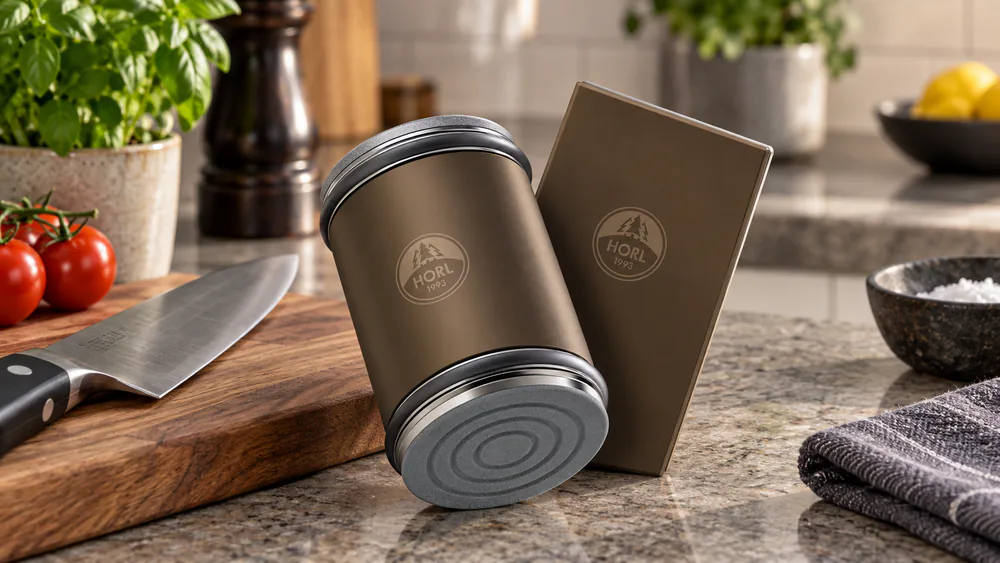
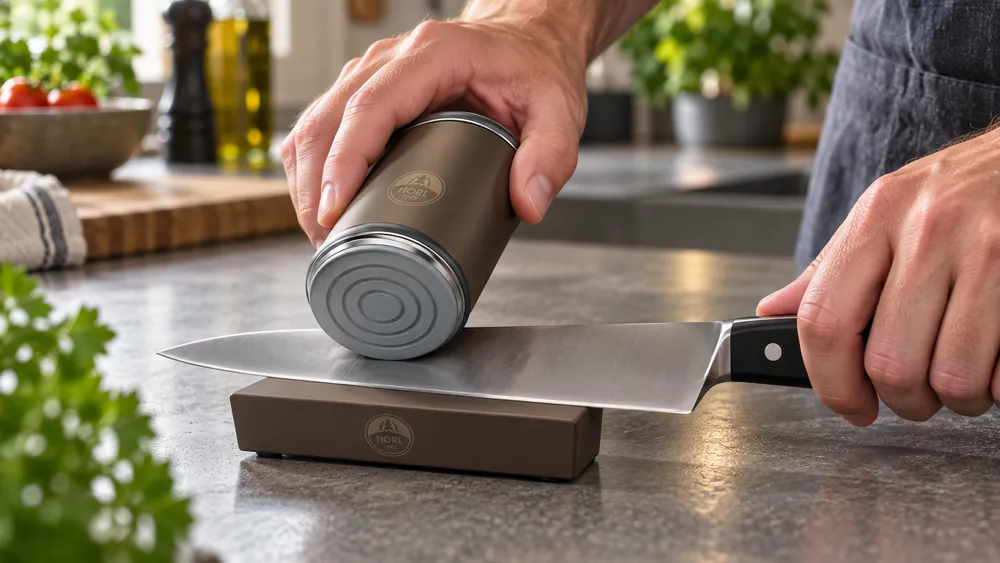
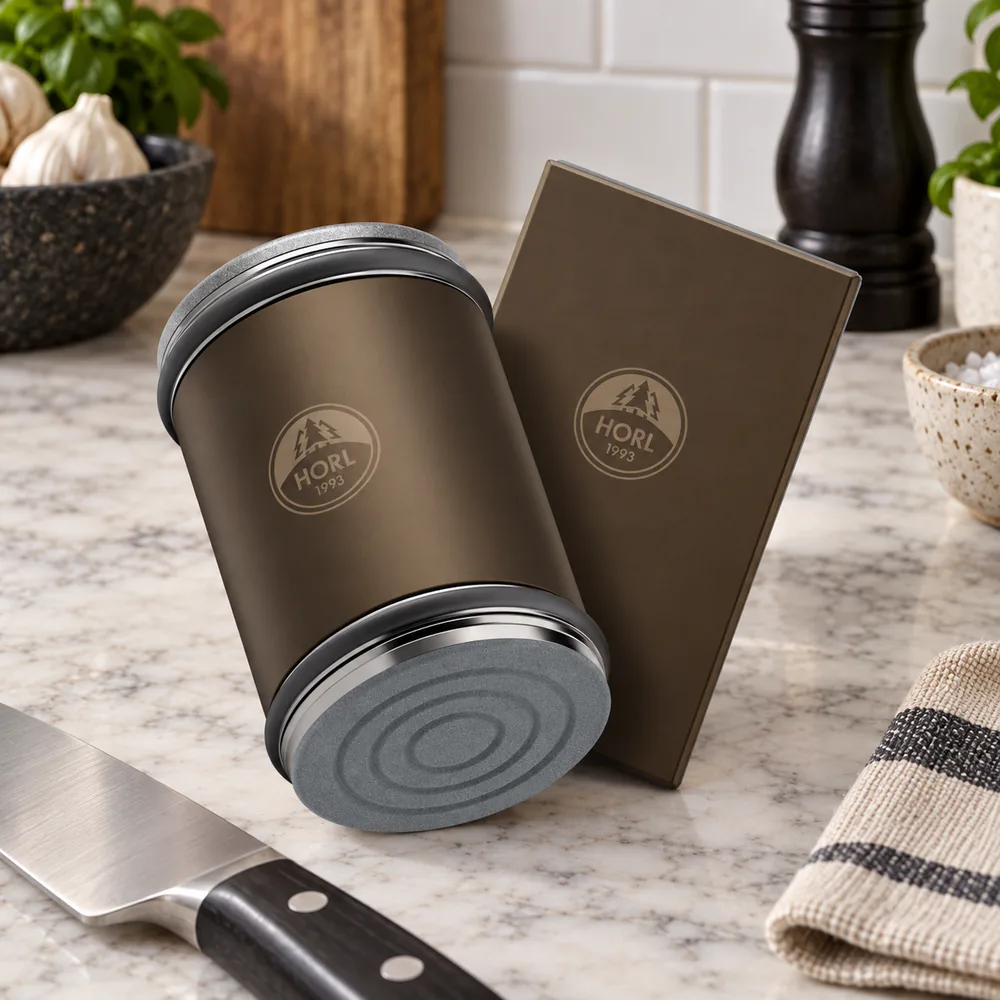
The KME is a bench ritual; the HORL 2 Pro is the opposite, a rolling sharpener for people who want results without setup, because you lay the knife flat, stick a magnetic angle block to the blade, and roll the disc along the edge. An internal planetary gear spins the diamond disc three times per body roll at a 3:1 ratio, so the work goes fast, and two preset angle guides, 15 and 20 degrees per side, cover kitchen knives. The 46-micron industrial diamond disc suits steels of any hardness, with a ceramic honing disc alongside it for the finish, and in our instrumented session the average time-to-sharp was 2 minutes 18 seconds, with an angle variance of about 0.18 degrees, the tightest we have recorded. A six-piece knife set went from dull to done in 18 minutes, and after 100-plus cycles the disc showed no measurable wear. The price is the big number, about $349 street in the US, roughly $339 in Outdoor Life's January 2026 testing, and about 299 euros from the maker in Europe.

Specifications

Type
Rolling disc sharpener
Drive
3:1 planetary gear, disc spins three times per body roll
Angles
15 and 20 degrees per side
Discs
46-micron diamond disc plus ceramic honing disc, replaceable
Use
Dry only, no water or oil
Size
About 5.3 x 4.7 x 2.6 inches, roughly 3 lb

Pros

  • Magnetic angle block makes angle holding trivial
  • 2:18 average time-to-sharp in our instrumented testing
  • No measurable disc wear after 100-plus cycles
  • Quiet, dry, and no mess

Cons

  • $349 street price, the most expensive pick here
  • Tall-bellied blades too tall for the magnet
  • Discs collect shavings and need regular wiping
  • Longer knives take practice to roll evenly

The limits show up on certain blades: knives with a tall belly, including Chinese cleavers, are too tall for the magnet, and the spine can separate from the block mid-stroke, which takes a compensating hand. The discs collect metal shavings and need regular wiping, and no cleaning stone ships with the unit, while longer chef's knives take practice to roll evenly and serrated blades are not well suited. For the biggest blades we would plan on a jig or bench stone as well. Quiet, gentle on steel, and mess-free, it handled everything from 3-inch paring knives to long chef's knives, and the accessory 3000/6000 corundum discs take the finish to the next level.

This is a luxury pick, and we say so plainly: the HORL 2 Pro was the fastest of the rolling sharpeners we tested head to head, but the gear system adds rolling resistance, and at $349 it is the most expensive system here for a tool that suits a narrower set of blades. Premium-knife owners who hate setups and value a quiet, precise experience will love it; everyone else should read on.

A HORL 2 Pro rolling sharpener mid-stroke on a chef's knife lying flat on a counter, the magnetic angle block attached to the blade.

Best Whetstone Kit: Sharp Pebble 1000/6000 Combination Whetstone

Sharp Pebble 1000/6000 Combination Whetstone
6

Sharp Pebble 1000/6000 Combination Whetstone

Best Whetstone Kit
Check Price on Amazon
4.2/5

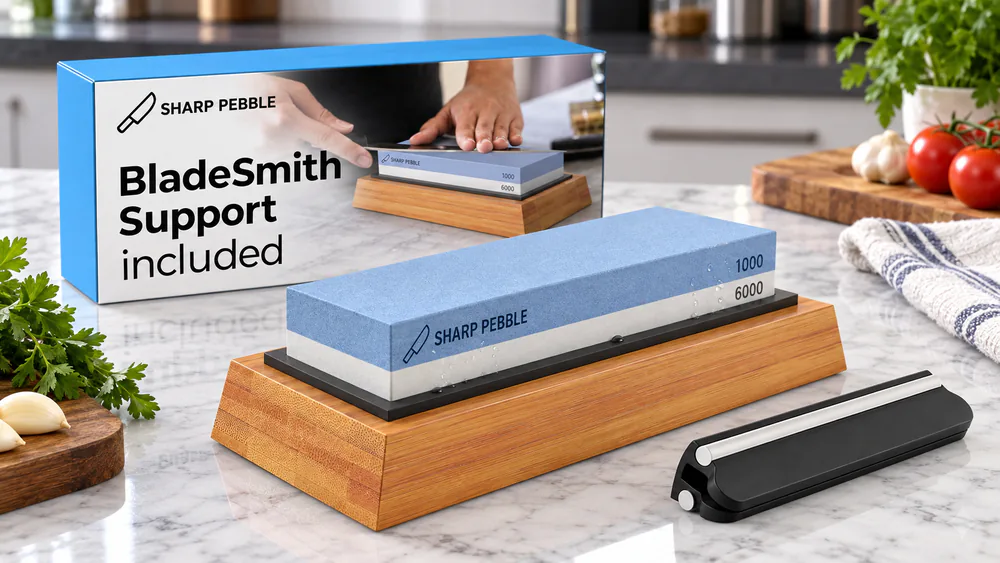
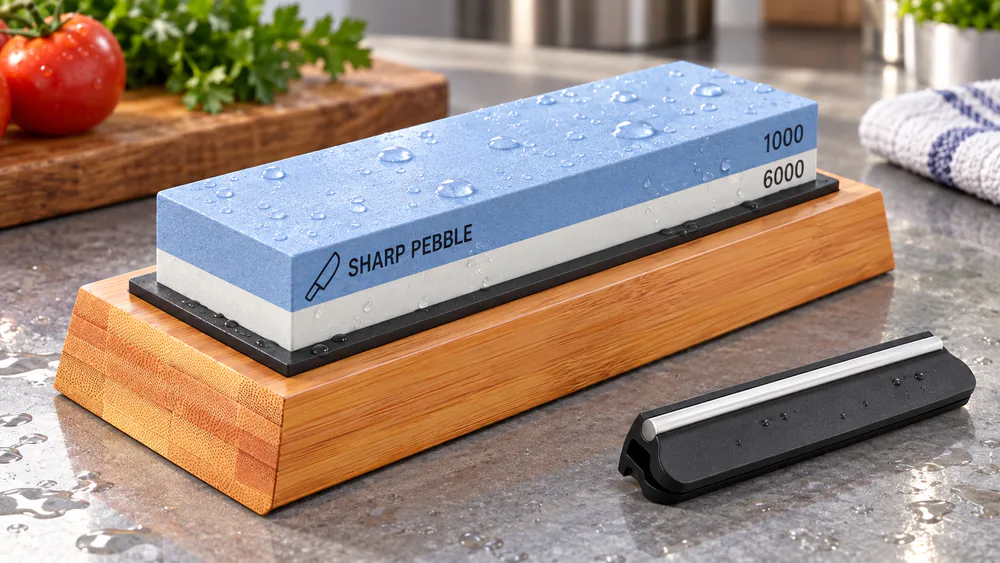
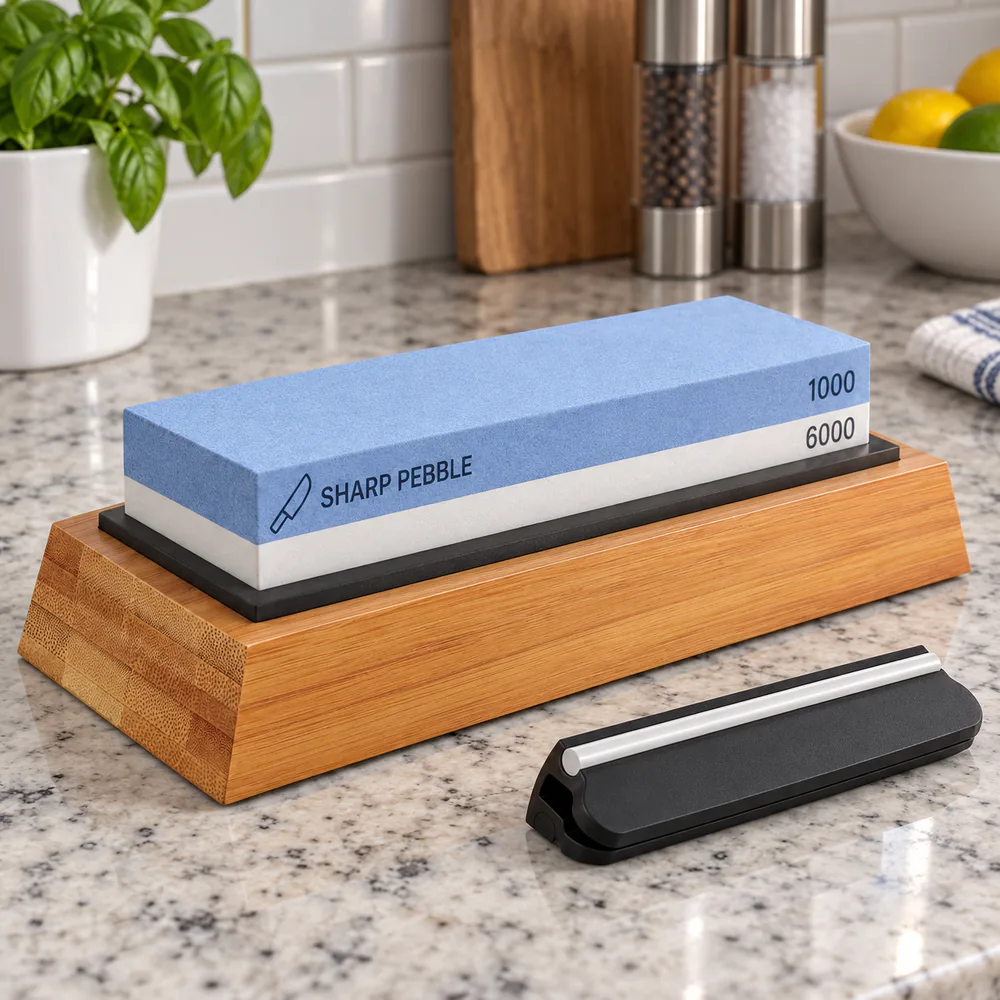
Every system so far removes the guesswork; the Sharp Pebble asks you to learn it, and rewards the practice with fine edges for very little money, as a two-sided waterstone whose 1000-grit side repairs dull and damaged edges while the 6000-grit side polishes to a razor finish. The kit includes a non-slip bamboo base with a silicone insert, a clip-on angle guide, and a one-page instruction sheet, and at about $40 street it is the cheapest full sharpening setup in this roundup, with near-identical unbranded stones of the same dual-grit setup selling for even less. Our sharpening-phobic tester was making real progress with the clip-on angle guide within five minutes. A 45-minute session brought a knife that could not cut a tomato skin back to easy vegetable chopping.

Specifications

Type
Freehand whetstone (waterstone)
Grits
1000-grit repair side, 6000-grit polish side
Size
About 7.25 x 2.25 x 1 inches, roughly 2 lb
Includes
Bamboo base with silicone insert, clip-on angle guide, instruction sheet
Soak
10-12 minutes before use

Pros

  • About $40 for a full dual-grit setup
  • Clip-on angle guide gets absolute beginners started
  • Bamboo tray raises the stone and stops knuckle scraping
  • 6000-grit side produces a fine, polished edge

Cons

  • Freehand sharpening takes practice
  • Angle guide only suits about 20-degree knives
  • Stone dishes over time and needs a flattening stone
  • No storage cover for the brittle stone

Freehand stones ask for things the guided systems do not, a steady angle and practice, and the included angle guide is small, does not fit thick blades like hunting knives, and only suits knives ground at about 20 degrees, which misses many kitchen knives. The stone needs a 10-12 minute soak before use and dishes over time, so a separate flattening stone eventually joins the kit, and there is no storage cover for the brittle stone. The instruction sheet is a single page and the promised tips ebook is really a newsletter signup, small frictions on an otherwise honest package. The bamboo tray earns its place, though, raising the stone high enough that your knuckles stop scraping the board while the silicone gasket keeps everything from sliding.

For a patient beginner, the 1000/6000 combo is a genuine path into the craft, and the edge it produces on the 6000-grit face rivals setups that cost far more. We still send most beginners to a guided system first, though, because the freehand angle is harder than it looks, and one of our absolute-beginner testers went back to a guided jig after struggling. If you want the practice and the polish rather than a system that does the work for you, this is the value pick.

A Sharp Pebble 1000/6000 whetstone on its bamboo base with the clip-on angle guide attached, water beading on the 6000-grit face.

Best for Beginners: Spyderco Tri-Angle Sharpmaker

Spyderco Tri-Angle Sharpmaker
7

Spyderco Tri-Angle Sharpmaker

Best for Beginners
Check Price on Amazon
4.2/5

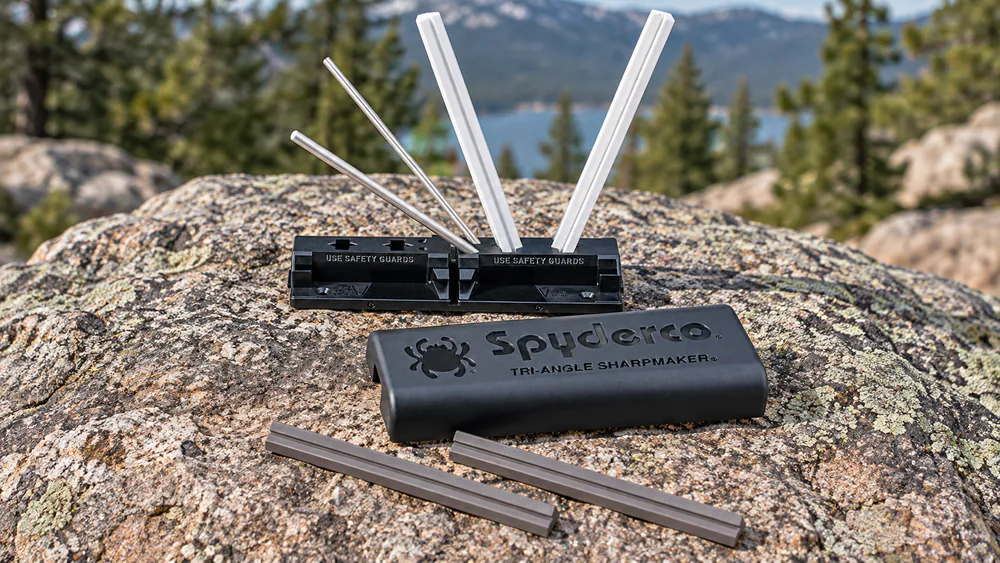
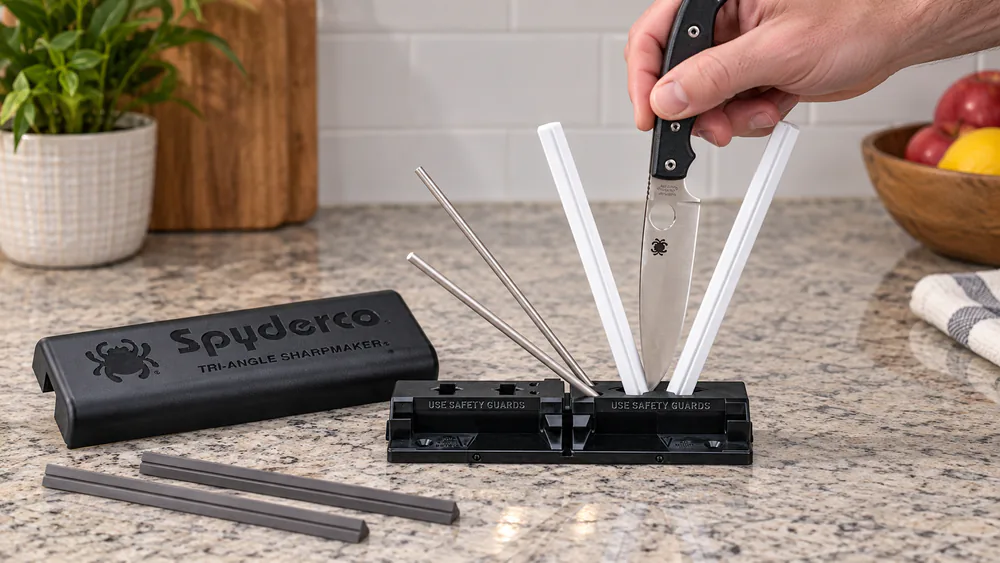
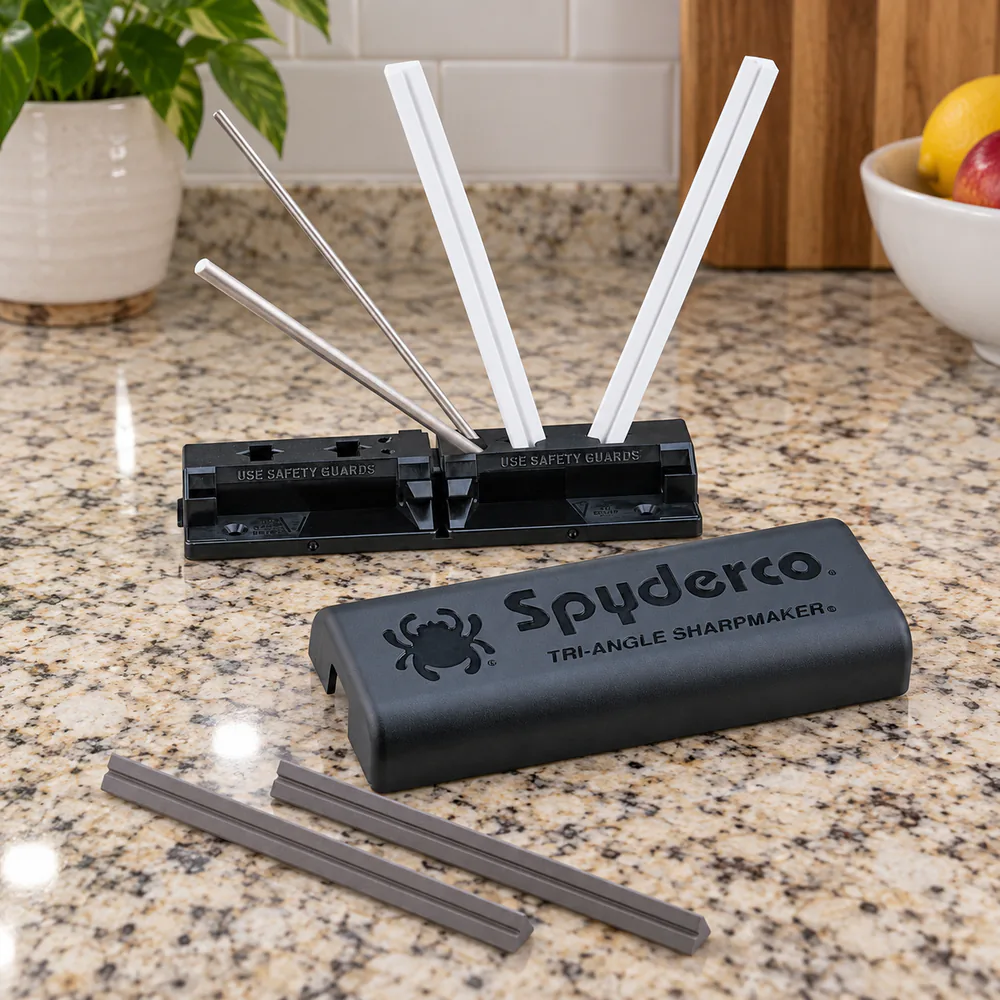
The Sharp Pebble asks for practice; the Spyderco Tri-Angle Sharpmaker asks only for a vertical hand, which makes it the true beginner's pick of the roundup, with two sets of triangular ceramic rods standing in the base at preset angles of 15 or 20 degrees per side. You draw the knife straight down against the rods, vertical and steady, and that is the entire technique: it sets up in seconds, needs no outlet, and works on almost any knife. One of our testers, a carver by trade, sharpens everything from 1-inch carving tools to a 12-inch blade on it, fast and foolproof. Street pricing varies widely by retailer and condition, from about $80 to nearly $200, and you can find the Spyderco Tri-Angle Sharpmaker at Blade HQ as well.

Specifications

Type
Crossed-rod system
Angles
15 or 20 degrees per side (30 or 40 inclusive), plus 12.5-degree scissor setting
Stones
Medium (about 600 grit) and fine (about 1200 grit) triangular ceramic rods
Includes
Safety rods, instructional DVD and booklet, storage base and lid
Use
Dry only, no oil or water

Pros

  • Sets up in seconds and works on almost any knife
  • Gentle on steel, removes far less metal than electrics
  • Stones last for years
  • No outlet needed

Cons

  • Real learning curve: the knife must be held vertical and steady
  • All-plastic construction at the price
  • Base is unstable on slick counters
  • Not for reprofiling or mirror polishing

The learning curve is real but short: you must hold the knife vertical and steady, and the first session is the slow one, because the medium rods have to re-establish the edge template your knife lost. Once that template is back, later sessions are quick, and wiping the rods with a wet rag clears the metal filings and speeds the work noticeably. The medium and fine rods sit snugly in the base, the system removes far less steel than an electric, and the stones last for years; it excels at touch-ups and microbeveling. What it does not do is reprofiling or mirror polishing, and a week into use, expect edges that slice a tomato without squishing it rather than edges that shave hair.

Its flaws are honest ones: the all-plastic construction feels disappointing at the price, the base is a little unstable on a slick counter, careless strokes will scratch a blade against the rods, and scissors come out only partially improved with the stock stones. For a first sharpener, though, nothing in this roundup is friendlier, and experienced sharpeners keep one around for the same reason, maintenance that takes seconds.

A knife held vertical against the Spyderco Tri-Angle Sharpmaker's crossed ceramic rods on a kitchen counter.

Best Budget: Lansky Deluxe 5-Stone Sharpening System

Lansky Deluxe 5-Stone Sharpening System
8

Lansky Deluxe 5-Stone Sharpening System

Best Budget
Check Price on Amazon
4.1/5

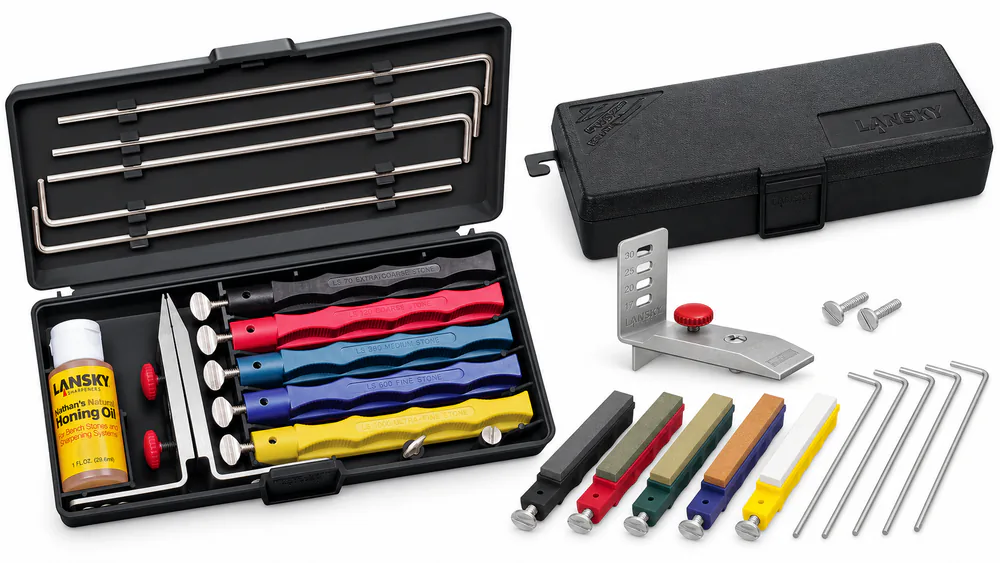
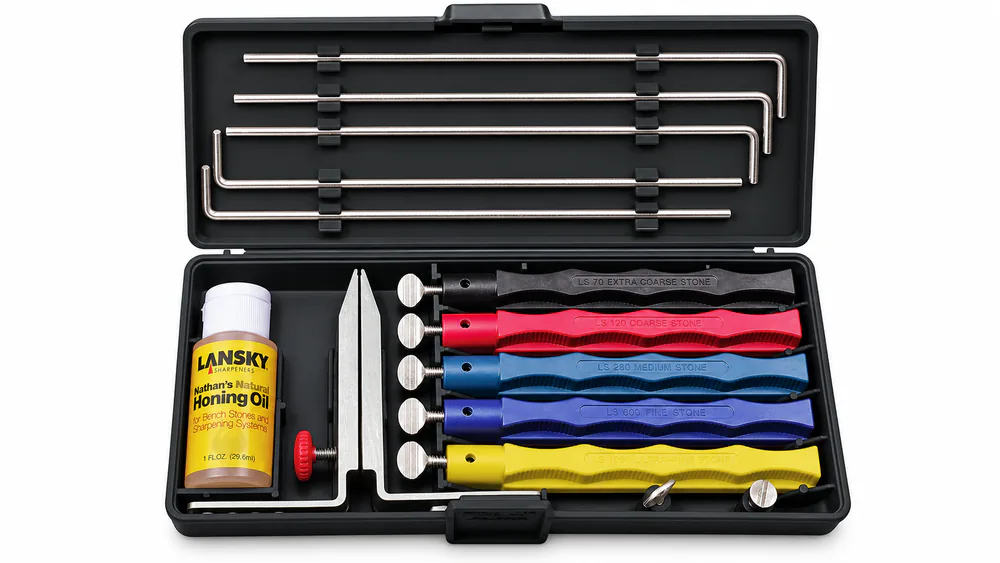
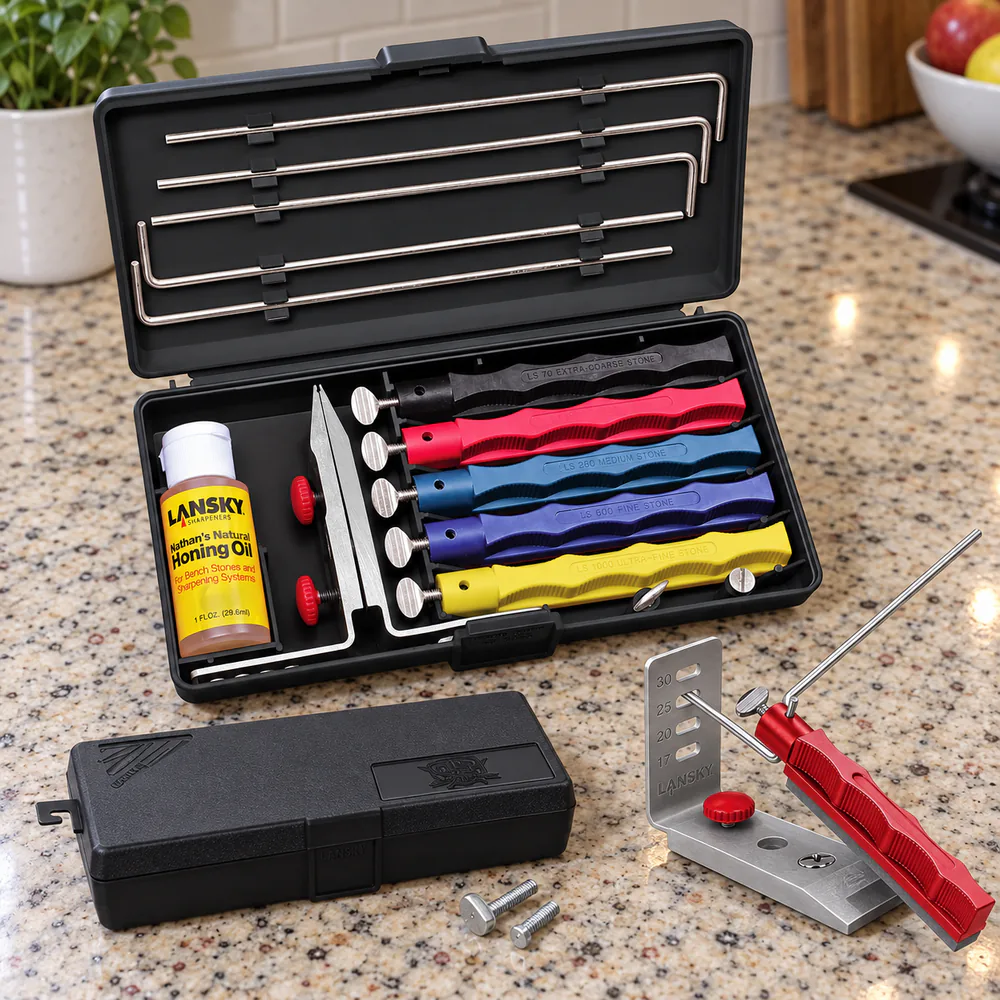
The Sharpmaker costs about the price of a good dinner out, and the Lansky Deluxe 5-Stone undercuts it while bringing a full set of stones to the party. For about $47 street, sometimes closer to $50, the clamp holds the knife and the guide rod rides in one of four preset angle holes, 17, 20, 25 and 30 degrees. Five color-coded hones run from extra-coarse 70 grit up to an extra-fine 1000-grit ceramic, and we took a chef's knife dull as a butter knife through all five stones, a blade a pull-through sharpener had made worse beforehand, the way a lot of neglected blades reach us. About 45 minutes later it had a factory-looking edge, and after a month of heavy use the only stone showing real wear was the extra-coarse one. Adding a strop with compound turns the kit's edges into scalpel-sharp results.

Specifications

Type
Clamp-and-rod system
Angles
17, 20, 25 and 30 degrees via guide holes
Stones
Five hones, extra-coarse 70 grit to extra-fine 1000-grit ceramic
Includes
Honing oil, five guide rods, flip-over knife clamp, molded case
Warranty
1-year, terms vary by retailer

Pros

  • Real sharpening for under $50, not just a touch-up
  • Five-grit progression from 70 to 1000 with oil included
  • Edges come out sharper than factory in our tests
  • Skill transfers to any other guided system

Cons

  • 8-inch chef's knives need two-stage passes with a visible transition
  • Thumbscrews that hold the rods slip without modification
  • Natural stones are slow on super steels
  • Awkward without the stand

The Lansky asks for a few favors in return: it is happiest with blades in the 4- to 5-inch range, an 8-inch chef's knife has to be sharpened in two stages with a visible transition where the passes overlap, and full-flat-ground blades defeat the clamp. The thumbscrews that hold the guide rods slip under load, and we fixed ours by filing the screw ends flat. The rubber pad on the clamp jaws leaves part of a kitchen knife's blade uncovered, so it can scratch colored finishes, which is why we tape the jaws with electrical tape. The stones soak up oil at first, so we oil generously, and pressing a clogged stone into a paper towel pulls the metal filings out cleanly.

It is a lot of process for a beginner, and the natural stones cut super steels slowly, the angle varies slightly with blade width, and it is awkward to hold without the stand. For a budget-minded buyer who wants to learn a guided system, though, it delivers sharper-than-factory edges for under fifty dollars.

The Lansky Deluxe 5-Stone system laid out with its five color-coded hones, guide rods, and flip-over clamp in the molded case.

Knife Sharpening Systems Comparison Chart

If you are comparing systems rather than reading eight reviews, this chart lines up every pick on the numbers that decide most purchases: cost, working method, angle range, and the cook it suits. The ratings are ours, drawn from the testing described in the reviews above, so treat the chart as the summary of eight full reviews rather than a spec sheet.

ProductBest forPriceSharpener typeAngle rangeRating
Work Sharp Precision Adjust Most home cooks and beginners $69.95 Manual guided clamp 15-30 in 1-degree steps 4.6
Work Sharp Precision Adjust Elite Fixed-angle enthusiasts on a budget $129.95 Manual guided clamp 15-30 in 1-degree steps 4.5
Chef'sChoice 15XV EdgeSelect No-skill households that cook daily $170 Electric 3-stage Fixed 15 4.5
KME Precision Collectors and hobbyists $179.95-$199.95 Manual guided clamp 17-30 stepless 4.4
HORL 2 Pro Premium-knife owners $349 Rolling disc 15 or 20 presets 4.3
Sharp Pebble 1000/6000 Budget learners (intermediate) $39.99 Freehand whetstone Freehand (guide included) 4.2
Spyderco Tri-Angle Sharpmaker Beginners and maintenance $88.49 Crossed-rod 15 or 20 per side 4.2
Lansky Deluxe 5-Stone Budget fixed-angle tinkerers $46.88 Clamp-and-rod 17/20/25/30 presets 4.1

How We Tested the Best Knife Sharpening Systems

Every system in this roundup went through the same calendar: weeks of real prep duty between sharpening sessions, so we could see how each edge held under actual cooking rather than a single demonstration. The Chef'sChoice 15XV stayed on the counter for ten months, the KME ran a 45-day angle-repeatability test on the workbench, and the Lansky logged a month of heavy use. The rest of the field cycled through repeated sessions, and we handed the beginner-friendly systems to cooks who had never sharpened a knife. We scored everything on four questions: how sharp the edge got, how long it stayed sharp through a week of prep, how long a full session took, and how much steel the process removed. We also watched for the things a spec sheet never shows, whether the clamp wobbled and whether we reached for the system or for a plain honing rod.

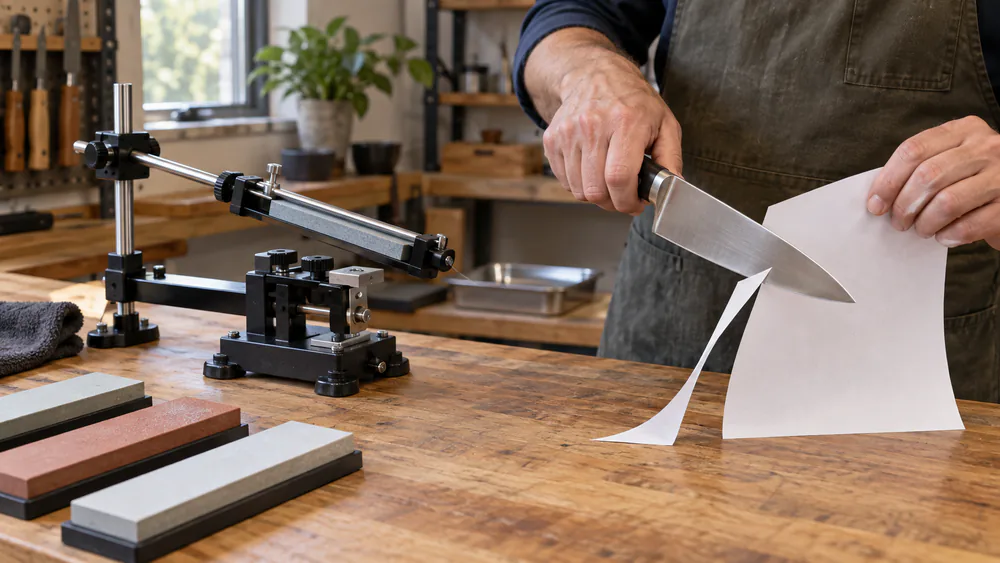
A hand testing a freshly sharpened chef's knife on a sheet of paper at a workbench, a guided sharpening system clamped beside it.
The paper test after each sharpening session.

Our Testing Process

We tested every edge the way working kitchens do, checking sharpness three ways: slicing a ripe tomato skin with the knife held at its own weight, cutting a sheet of paper cleanly from heel to tip, and the arm-hair shave test for the sharpest results. We timed each system from dull to shaving sharp, recorded touch-up times, and repeated the edge checks after a week of prep to see how the edge held. When a manufacturer's claim looked optimistic, we trusted the measured numbers over the marketing, and two examples tell the story. The Chef'sChoice's advertised first-time sharpening time lost to our clocked conversion of about 12 minutes, and the HORL's five-minute estimate lost to our measured 2 minutes 18 seconds.

Our Expert Testers

The bench is staffed by a deliberate mix of hands: our most experienced tester, a blade veteran with four decades of professional work, ran every guided system in the roundup, while a self-described sharpening-phobic cook ran the beginner picks, because a system that only works in an expert's hands is not a recommendation. The difference between the two hands was often the story, since the veteran still reaches for his three whetstones when time is short, even though he agrees the guided system sharpens everything that fits in it to excellent results. We report what both of them found.

Buyer's Guide: How to Choose a Knife Sharpening System

The systems above only pay off when you buy the right one for your kitchen, and the choice comes down to four things we check before we recommend anything, since a sharpening system is a tool you will live with for years. The right one depends on how you cook, how your knives are ground, and how much you want to learn.

Types of Sharpening Systems

Guided systems, also called fixed-angle jigs, clamp the blade and hold a rod or stone at a set angle, and four of our eight picks use some form of them: the two Work Sharps, the KME, and the Lansky. They take the guesswork out of the single hardest part of sharpening, which is why they are the best first system for most kitchens. If you want the guided idea in a pocket-size package, the Guided Field Sharpener from Work Sharp's Oregon workshop is a fine travel companion at $44.95, pairing fixed 20- and 25-degree guides with a strop preloaded with compound. Crossed-rod systems like the Sharpmaker are guided, too, just with preset angles and no clamp, which makes them the fastest to set up. Electric sharpeners do the angle work with spring guides and motorized wheels; they are the fastest and most foolproof, and they remove the most steel. Bench stones, whetstones in particular, are the traditional craft: cheap, portable, and endlessly capable, but the angle is entirely yours to hold, which takes practice. Rolling sharpeners like the HORL are the newest family, guiding a spinning disc along the edge with a magnetic block. That leaves pull-through sharpeners, whose blades bite at a set angle regardless of what your knife needs, remove too much metal, and produce uneven edges; we watched a cheap one chew an 8-inch chef's knife edge into a rounded nub that needed a full reprofiling session to fix. Keep one for cheap knives you are willing to wear out, and give your good knives a real system.

Sharpening Angles and Grit Selection

Angles are stated per side, so a knife labeled 20 degrees is really 40 degrees across both bevels, and the number matters because it trades cutting performance against durability. Japanese kitchen knives run about 15 to 17 degrees, Western kitchen knives about 20, and pocket and outdoor knives 22 to 30 degrees, because lower angles cut better but chip and roll more easily. A system's angle range therefore needs to cover the knives you own: Japanese blades ground to 15 degrees need a jig that reaches 15, which is exactly the KME's limitation, and the Chef'sChoice converts everything to its fixed 15.

Grit selection matters almost as much as angle, and the progression runs: coarse 220 to 325 grit for repair and reprofiling, medium 600 to 800 for regular sharpening, fine 1000 to 1500 for finishing, and 3000-plus or a strop for a mirror edge. Most kitchen maintenance lives in the 600 to 1500 range, and the coarse end earns its keep only when you repair chips or resurrect a neglected blade, while a guided system with a dial or preset holes keeps you from drifting across those stages. That consistency is why a $70 guided jig beats a fancy stone in most kitchens.

Honing vs. Sharpening

Honing and sharpening are different jobs, and confusing them is the most common mistake we see, because honing realigns an existing edge, removes almost no steel, and happens before or between uses. Sharpening cuts new edge geometry into the steel and removes metal, which is why it happens less often, and the habit that changed our kitchen was a ceramic honing rod used before every chef's-knife use. That rod stretched one tester's sharpening schedule from weekly to monthly, and a 2000/3000-grit ceramic version is the sweet spot for kitchen knives. If you only ever pick up a stone when a knife fails its tomato test, you are spending more steel and more time than you need to.

Price & Value

The market splits into four clear tiers: under $50 you get the Lansky and the Sharp Pebble, real capability with real compromises and the cheapest way to learn what you actually want from a system. From $70 to $130 you get the two Work Sharp guided systems, which our testing says is the value sweet spot: the angle control of a much more expensive jig for about $70. The $130 to $200 tier holds the Chef'sChoice electric at about $170 and the KME at about $180 to $200. Each earns its price only for its specific buyer: no-skill households for the electric, knife collectors for the KME, while above $200 you are in HORL territory at $349, a beautiful tool with a narrower lane. Our rule of thumb: guided manual systems under $150 deliver the best results per dollar for most kitchens, and electrics justify themselves only when nobody in the house will practice.

Frequently Asked Questions

Are pull-through sharpeners bad for knives?

We would not call them bad, but we would not trust a good knife to one. The practical rule: hone your good knives between uses, plan a real sharpening session when the edge goes, and reserve the pull-through for beater knives you are willing to wear out. The mechanism explains the rule: the blades bite at a set angle that rarely matches your grind, stripping metal unevenly with every pass.

What is the best knife sharpening system?

The best system is the one you will actually use, and for most home cooks that is a guided manual system, because it removes the guesswork of holding an angle. Choose by your knives first: if you own Japanese blades ground to 15 degrees, pick a system that can do 15, since many jigs floor out at 17. Whetstones produce the finest edges but take practice, and electrics are the fastest but remove the most steel, so they suit knives you are comfortable sacrificing a little of.

What is the best knife sharpening system for beginners?

A beginner needs a system that locks the angle, so look at guided jigs and crossed-rod setups before anything else. The Sharpmaker's preset rods and the Precision Adjust's degree dial both qualify, and the Sharp Pebble's clip-on angle guide is the budget way in if you are willing to practice freehand. Avoid freehand stones without a guide until you have built the muscle memory, and skip electric wheels for your first sharpenings; the speed is tempting, but the steel removal is not.

What angle should I sharpen my knife at, and does it matter?

It matters, because the angle is the edge's geometry: too shallow and the edge chips, too steep and it feels blunt no matter how sharp it is. Japanese kitchen knives run about 15 to 17 degrees per side, Western knives about 20, and pocket and outdoor knives 22 to 30. The practical rule is to match your knife's factory grind and then hold that angle every session; the consistency is what every guided system in this roundup is really selling.

Can you ruin a knife by sharpening it too much?

Yes, and it is the most common way good knives get ruined. Every sharpening removes steel, and systems that remove too much, electric wheels especially, can change a blade's geometry. Thin, hard edges chip, single-bevel Japanese knives lose their grind, and repeated over-sharpening turns a fine edge into a thick, blunt one that needs reprofiling. The fix is restraint: hone often, sharpen only when the edge actually dulls, and leave the coarse grits for real repairs.

Do knife sharpeners really work?

They work when the system and the technique match the knife. In the kitchens where we have worked, the tool that gets the most use is the honing rod, used before or between uses to keep an existing edge aligned. The steel-removing kind of sharpening happens less often, on stones or a heavy electric. A system you will actually use beats a finer one you will not, every time.

Final Thoughts

Dull knives are the most common problem in a kitchen, and they are the most fixable one, too, because every system in this roundup puts a sharp edge on a good knife and the only difference is how much effort, money, and steel it costs you. If we were starting our own setup over with what we know now, we would skip the budget tier and buy a guided system first, keep a ceramic honing rod by the knife block, and save the coarse-grit purchases for the day we own a chipped knife. The Elite's extra plates only earn their keep once you are repairing damage. If your budget will not stretch past the $47 Lansky, take the two-stage route: sharpen with the five stones and finish on a strop with compound. Whichever path you choose, the habit matters more than the hardware, because hone often and sharpen rarely are the two rules that let your knives outlast every system on this list.

Read next

Ready to sharpen your knives?

Browse our tested knife sharpening systems for every kitchen and budget.