As an Amazon Associate we earn from qualifying purchases. We may earn a commission from links on this page, at no extra cost to you. Learn more.
The Japanese knife aisle stacks the decisions high. Steel types multiply: VG-10, SG2, AUS-10, carbon steel, and Damascus. Edge angles run from 9 to 16 degrees. Blade shapes carry names like gyuto, santoku, and nakiri. For a home cook who just wants a set that slices cleanly, the jargon gets in the way before the first cut.
We cut through it. We ran five Japanese knife sets through a month of real prep, checking the edge after each session and scoring how every set held up under daily use. Our criteria were sharpness, edge retention, balance, build quality, and value.
Below are our ranked picks: the sets we would buy again, the ones we would skip, and the buying guidance we wish someone had handed us before we started testing.
We tested five Japanese knife sets over a month of real prep, running the blades through the work a home kitchen does in a week: slicing tomatoes and melon, breaking down chicken, mincing herbs, dicing root vegetables, and carving a roast. We checked the edge after every session and recorded how each set held its sharpness, how the handle wore on the hand in hour three, and how easily the steel sharpened back to new.
Every set on this list was bought at retail with the test kitchen's own money. None arrived as a sponsored review sample, and no brand pays for a higher score, so all five faced the same standard from the first session.
We scored each set on five criteria: sharpness out of the box, edge retention over the month, balance in the hand, build quality, and value for money.
Our Testing Criteria: Sharpness, Edge Retention, Balance, Build Quality, Value
Sharpness out of the box tells you how the factory edge is finished, but it fades fast. Edge retention is the number that matters most: a knife that still glides through a tomato after a week of prep is worth more than one that arrives razor-sharp and dulls in three days. Balance and build quality show up in hour three, when a handle starts to bite or a blade flexes wrong. Value is the hardest score, because a $1,400 set and a $170 set serve very different buyers.
5 Best Japanese Knife Sets of 2026, Tested & Reviewed
Below are our five picks, ranked and reviewed. Every set on this list wins on something and gives up something else, so each review covers the steel, the handle, the storage, and the honest trade-offs.
1. HOSHANHO 7-Piece Magnetic Knife Set: Best Overall
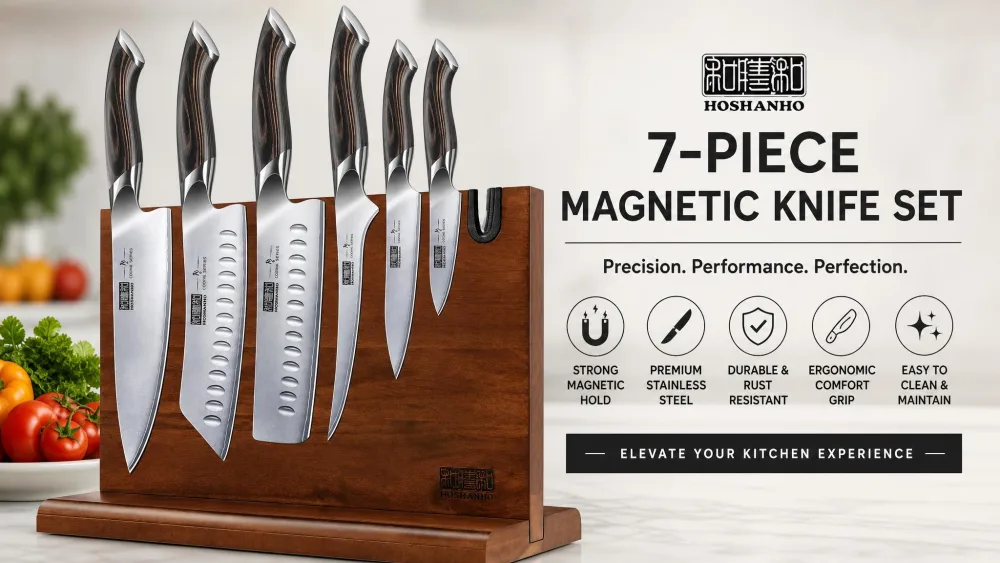
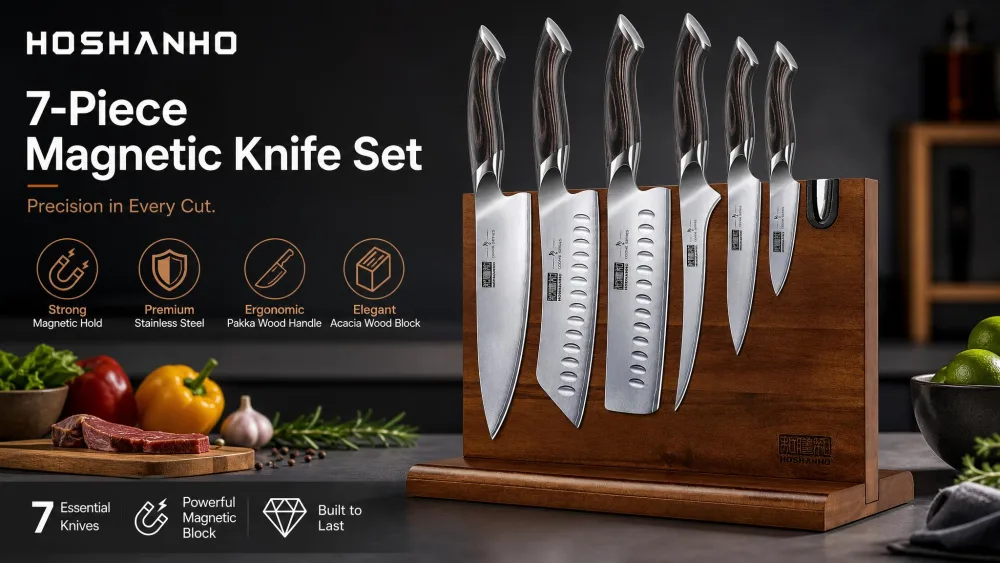
The HOSHANHO 7-Piece Magnetic Knife Set was the set we reached for most during our month of prep. The blades arrive sharp, and the 10Cr15CoMoV steel at 60 HRC held a usable edge through a full week of evening cooking. Cutting melon, squash, and ripe tomatoes went noticeably faster than with the dull knives we keep for comparison.
Pros
VG-10-class 10Cr15CoMoV steel at 60 HRC holds a strong edge
Double-sided magnetic acacia board saves counter and drawer space
Pakkawood handles are comfortable and water-resistant
1-year limited warranty and a gift-box presentation
Cons
Utility knife is prone to chipping on hard use
Magnet hold is uneven on smaller knives
Made in China in Japanese style, not Japan-forged
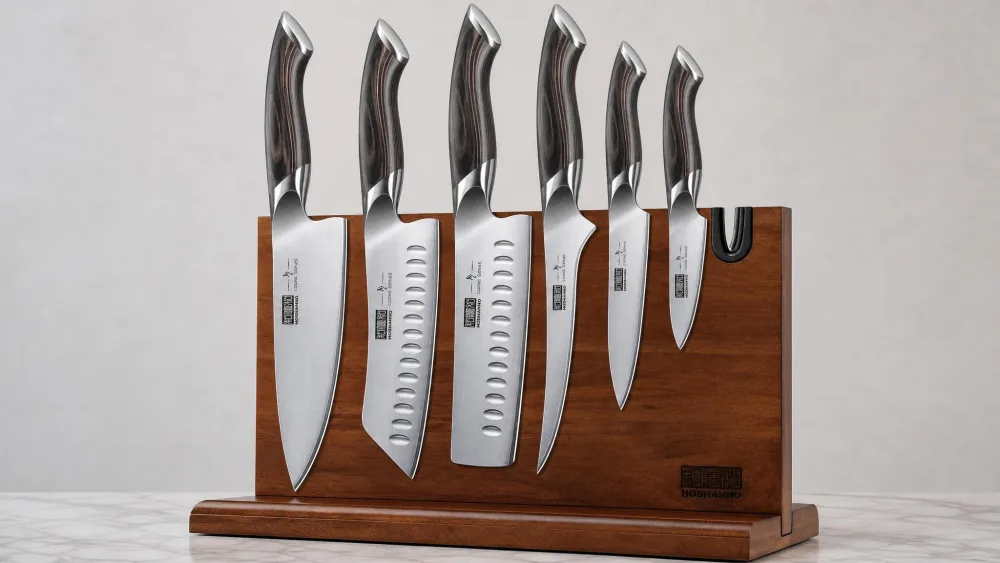
The double-sided acacia magnetic board is the set's storage, and it is the most polarizing part. The magnets hold the chef's, santoku, and nakiri level and easy to grab, but the smaller knives sit less happily. The paring knife slides until you center it on the board, and the hold weakens near the edge, so test the grip before you hang the board on a wall.
The durability weak spot is chipping. Our utility knife picked up a chip during vegetable prep, and the blades want the same care on chicken and hard produce. Hand-wash and dry the blades immediately and the steel stays clean and holds its edge, which is the trade-off for a knife this sharp at this price.
It is also worth knowing the set is made in China in Japanese style, not forged in Japan. The "Japanese" label describes the blade profile, not the country of origin.
Who This Set Is Best For
Home cooks who want a complete magnetic-board set with strong steel, who hand-wash their knives, and who like a value price on a VG-10-class blade.
Who Should Skip It
Cooks who want a slotted block, buyers who care about Japanese provenance, and anyone who needs a set that can handle bone and frozen food without care.
The magnetic board is the set's storage and its most debated feature.
Where the HOSHANHO earns its keep on steel, the next set wins on pure value.
2. imarku 16-Piece Japanese Knife Set with Built-in Sharpener: Best Budget
2
imarku 16-Piece Japanese Knife Set with Built-in Sharpener
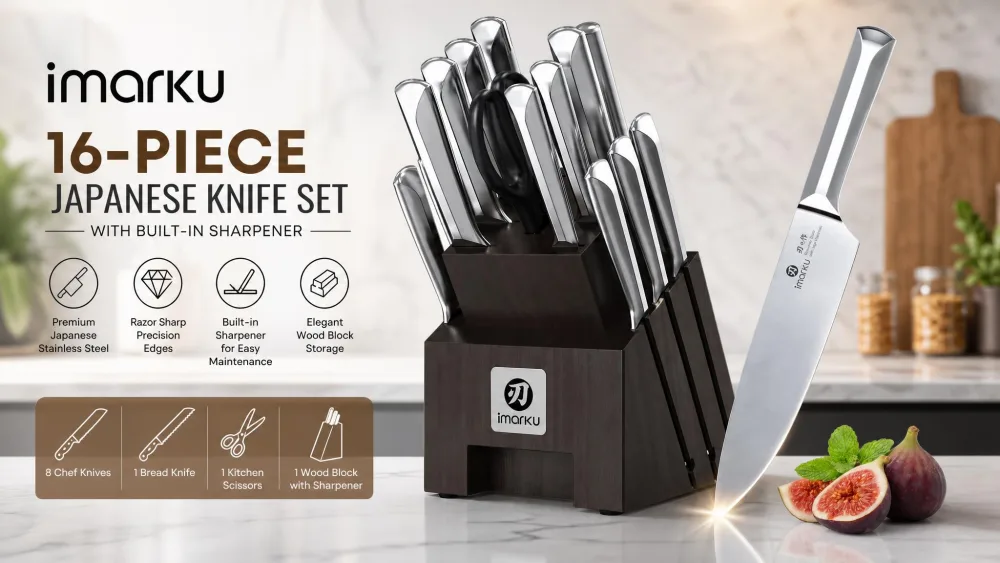
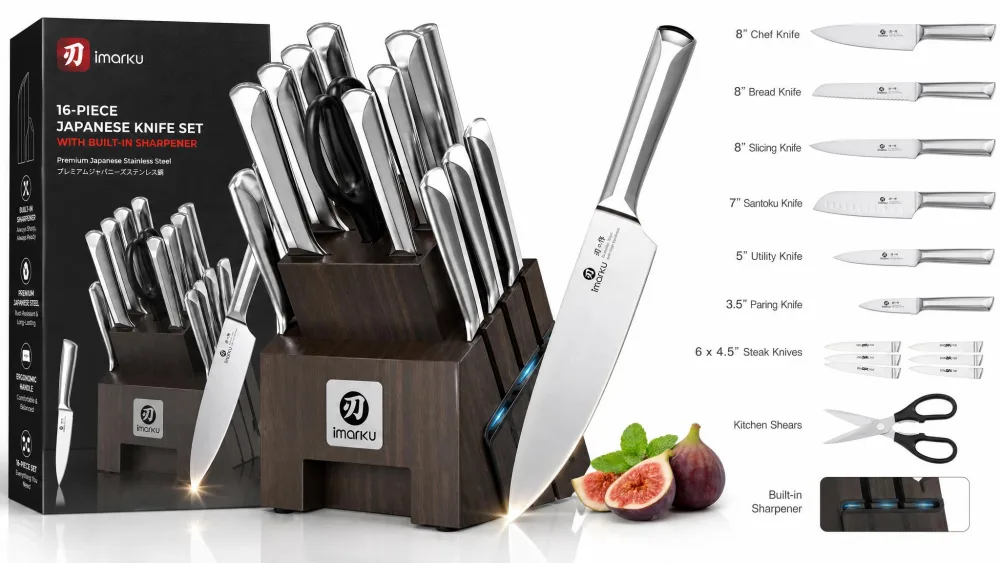
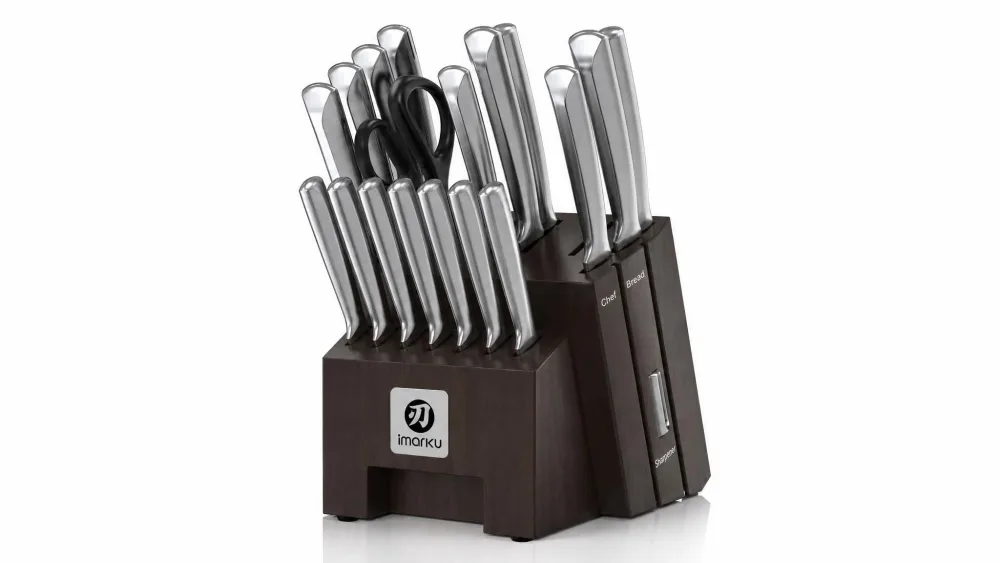
The imarku 16-Piece Japanese Knife Set is the value answer for a first kitchen, and it outperforms its price on the knives that matter. Sixteen pieces for around $170, including a chef's knife, a santoku, a bread knife, a slicer, serrated steak knives, kitchen shears, and a honing steel, all seated in a solid wood block.
Pros
Outstanding value: 16 pieces with a block, shears, and honing steel
Main knives stay sharp for weeks of home use
Built-in sharpening slot is handy for light maintenance
Lifetime product protection
Cons
Serrated steak knives are the weak link in quality
Steel rusts if left wet despite the dishwasher-safe claim
Leans Western in profile despite the Japanese branding
The main knives surprised us. They cut apples, pork loin, and bread with little effort out of the box and stayed noticeably sharp through weeks of home use. The chef's knife and santoku feel full-tang and solid in hand. The built-in sharpening slot on the block is genuinely handy for light maintenance, and it even brought an older knife of ours back to working order. Treat it as a light-maintenance tool, though, because a truly worn edge still needs a whetstone.
The compromises are honest. The serrated steak knives are the weak link in quality and feel thin next to the main blades. Despite the listing's dishwasher-safe claim, we hand-washed every blade, because letting the steel air-dry brought up rust spots. The set also leans Western in profile despite the Japanese branding, so treat "Japanese" here as a style cue rather than a pedigree.
Who This Set Is Best For
Budget buyers setting up a first kitchen who want a complete kit in one box and do not expect restaurant-grade steel at $170.
Who Should Skip It
Cooks who already own good knives and want to add one premium blade, or anyone who refuses to hand-wash cutlery.
Sixteen pieces, a solid block, and a built-in sharpening slot for around $170.
If the imarku is the value play, the Miyabi is the opposite end of the price scale.
3. Miyabi Birchwood GS2 7-Piece Knife Block Set: Best Premium
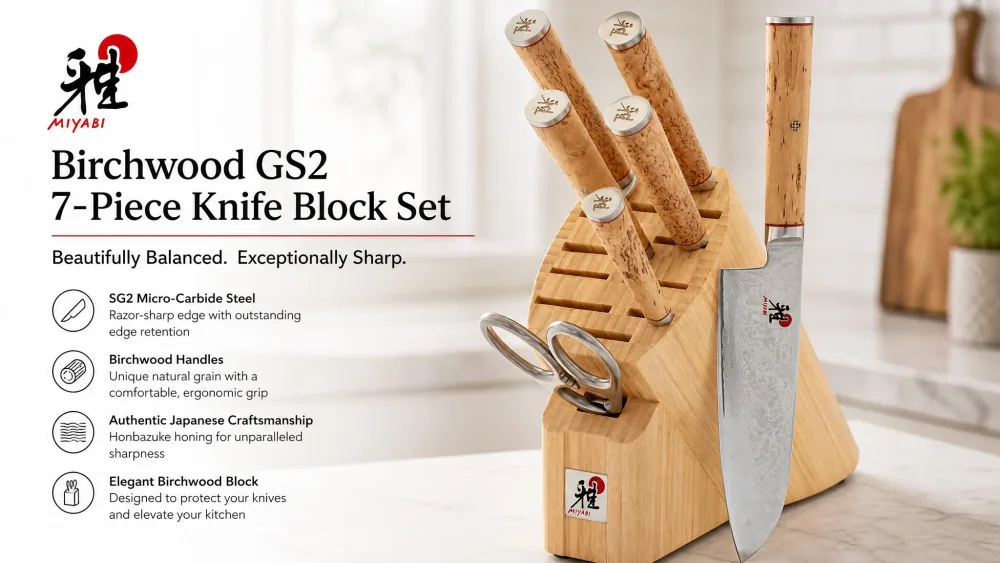
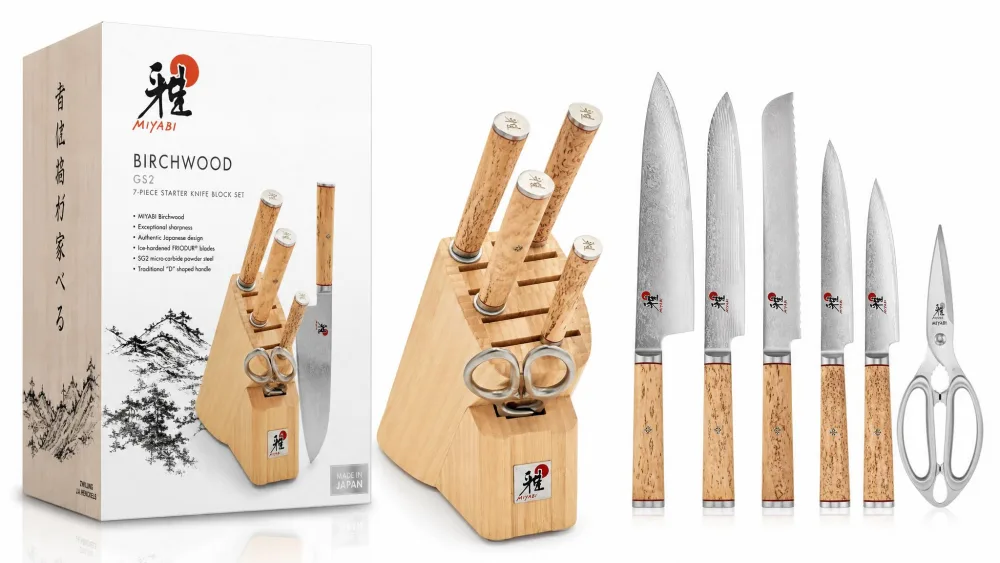
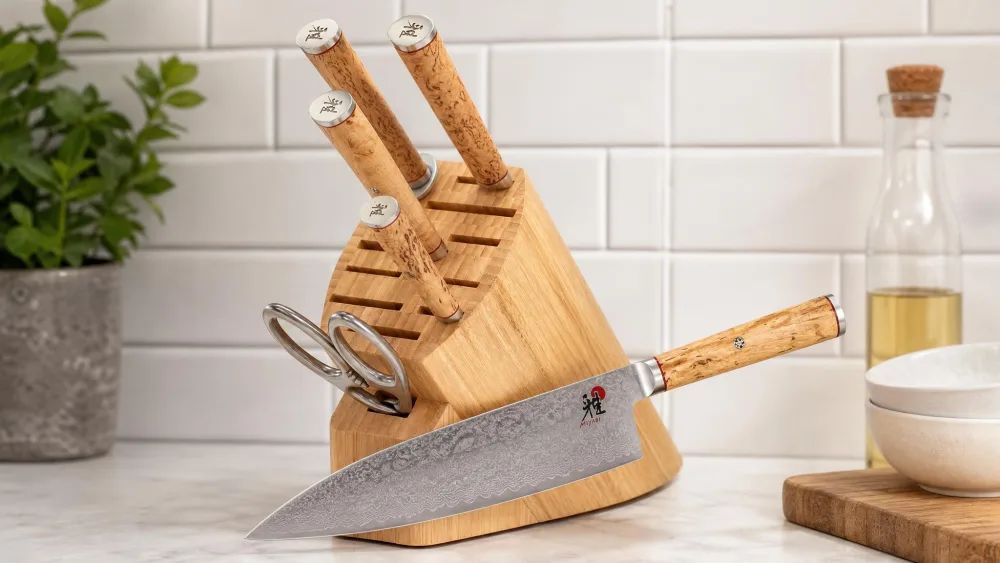
The Miyabi Birchwood GS2 7-Piece Knife Block Set is the most expensive set we tested, and it earns the price where it counts: the edge. The SG2 powder-steel core, ice-hardened to Rockwell 63, arrives extremely sharp, almost too sharp to use casually at first. We ran the 8-inch chef's knife through a week of prep and it barely needed a touch-up, which is exactly what we look for in a premium edge.
Pros
SG2 powder-steel edge, Rockwell 63, holds sharpness remarkably well
101-layer Damascus pattern is genuine and striking
Comfortable Karelian birch handles, lighter than Shun Classic
Limited lifetime warranty
Cons
Very expensive at roughly $1,400
Bundled bamboo block is generic and fits loosely
Accessories quality control can slip
No steak knives in the set
The set is lighter than Shun Classic knives, which we like for long sessions, and the Karelian birch handles are comfortable in an hour-three grip. The 101-layer flower Damascus pattern is genuine, not a printed fake, and it catches the light from across the room. Give the set a week and you stop being careful and start being precise.
Two caveats keep it from a perfect score. The bundled bamboo block is generic and not cut for these knives, so the fit is loose, which feels wrong at this price. Quality control on the accessories can also slip: our set arrived with a generic honing steel instead of the matching birchwood-handle steel. The knives themselves drew no complaints, but at roughly $1,400 the box should match the blades. The set also leaves out steak knives, so budget for those separately.
Who This Set Is Best For
Serious cooks who want maximum edge retention, appreciate fine steel, and can justify a premium price for the knives they use daily.
Who Should Skip It
Budget buyers, beginners still learning to sharpen, and anyone who expects a matched block to arrive tailored to the blades.
The SG2 core and Damascus pattern justify the premium price.
The Miyabi is for the cook who wants the best steel money can buy. The Shun Sora serves a different buyer entirely: the learner.
4. Shun Sora 5-Piece Student Knife Set: Best for Beginners
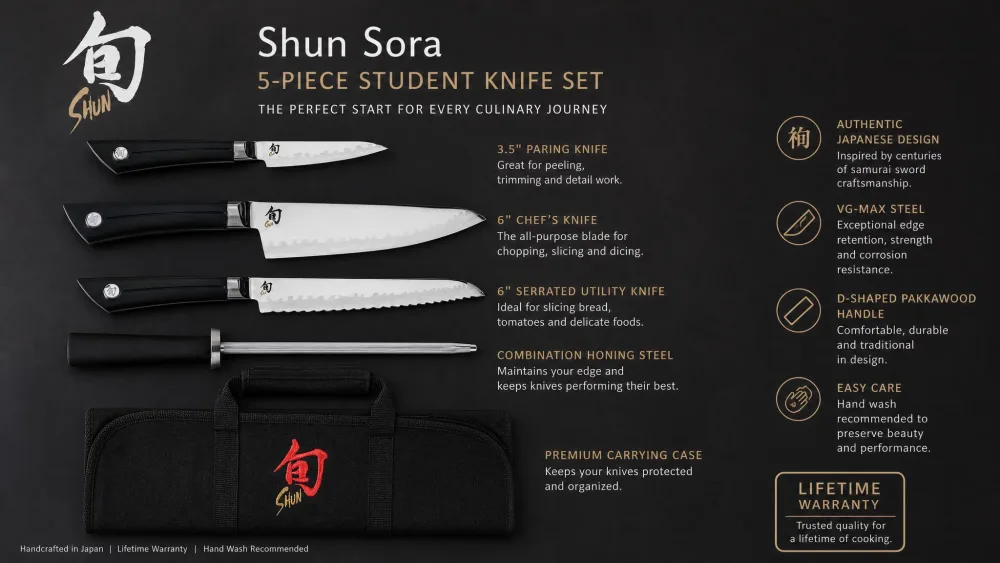
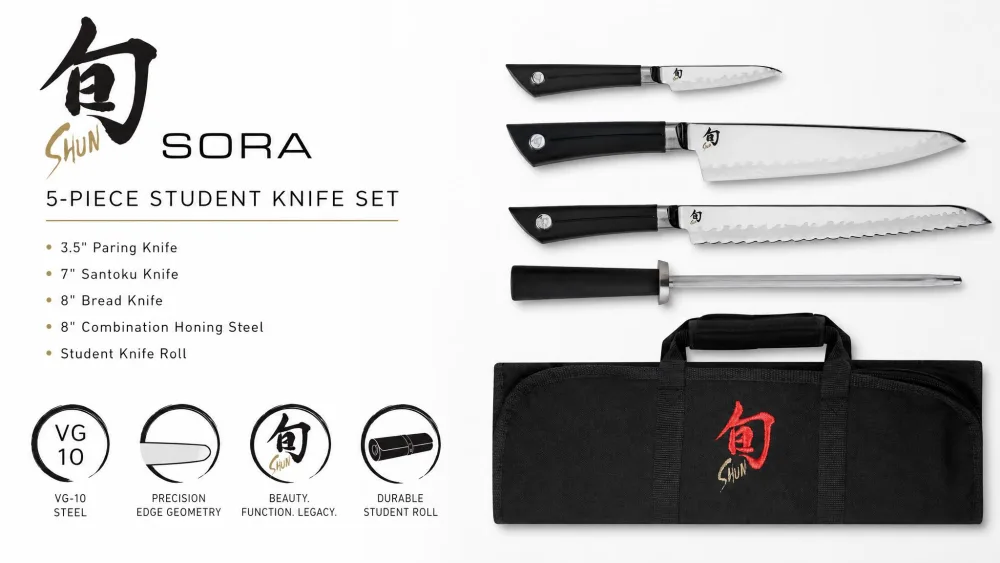
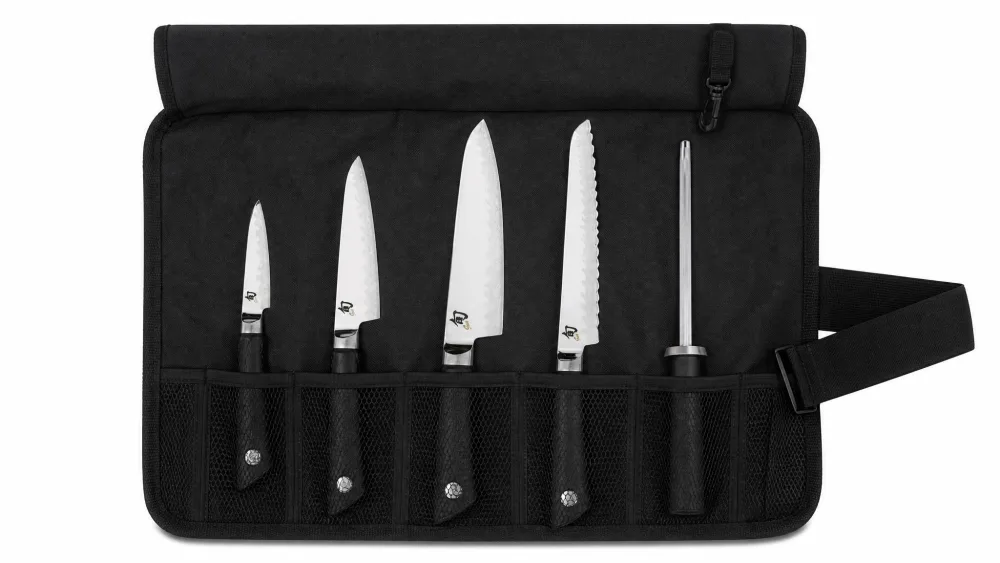
The Shun Sora 5-Piece Student Knife Set is built for a specific buyer: someone learning to cook who wants a real Japanese edge and a set that travels. The knives are sharp and slightly weighted, with a VG-10 cutting edge on a 420J stainless upper, and the 8-slot nylon roll makes the set easy to carry to classes or between kitchens. Shun handcrafts the knives in Seki, Japan.
Pros
VG-10 cutting edge on a tough 420J stainless upper
Portable 8-slot nylon roll for classes and travel
Free lifetime sharpening from Shun
Limited lifetime warranty
Cons
Composite handle feels basic next to the blade
Blades rust if not towel-dried promptly
Ships without protective sheaths
The handle is the compromise. The textured PP/TPE polymer grips well when wet and feels secure enough, but it reads basic next to the blade, and that is the trade-off for the price. The blades also want prompt drying: they develop rust spots if you skip the towel after washing, though the spots wipe clean.
Shun backs the set with a limited lifetime warranty and a free lifetime sharpening program, which is a genuine safety net for a beginner still learning to maintain an edge. Keep in mind the blades ship without protective sheaths, so store them carefully in the roll and mind the tips.
Who This Set Is Best For
Students, culinary-school beginners, and home cooks who want a compact, portable set backed by a sharpening safety net.
Who Should Skip It
Cooks who want a block set, want premium handle materials, or prefer a heavier knife with more forward balance.
The roll makes the set easy to carry to classes.
The Shun Sora is the practical learner's set. The SENKEN Tsunami is the showpiece.
5. SENKEN Tsunami 7-Piece Damascus Knife Set: Best Damascus Steel
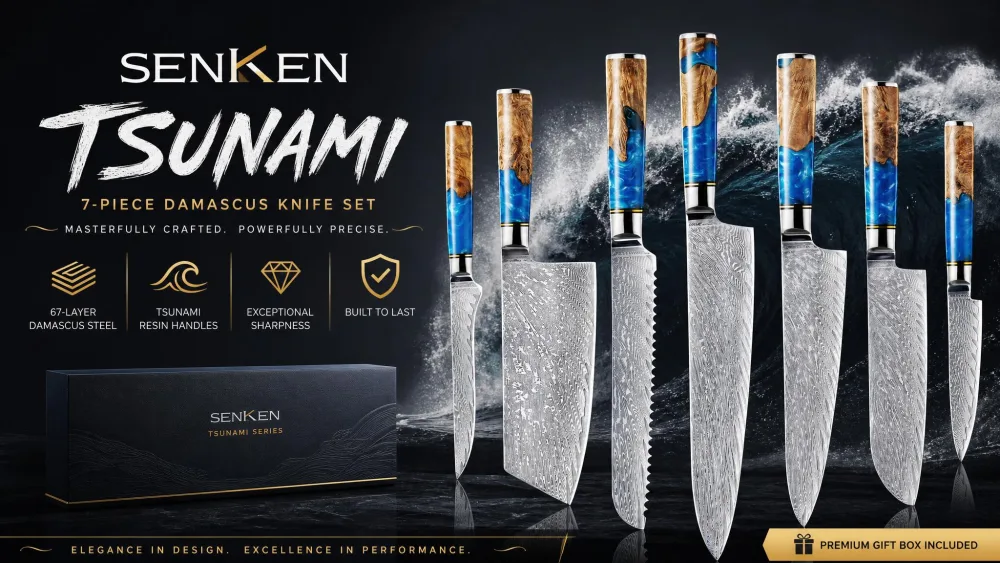
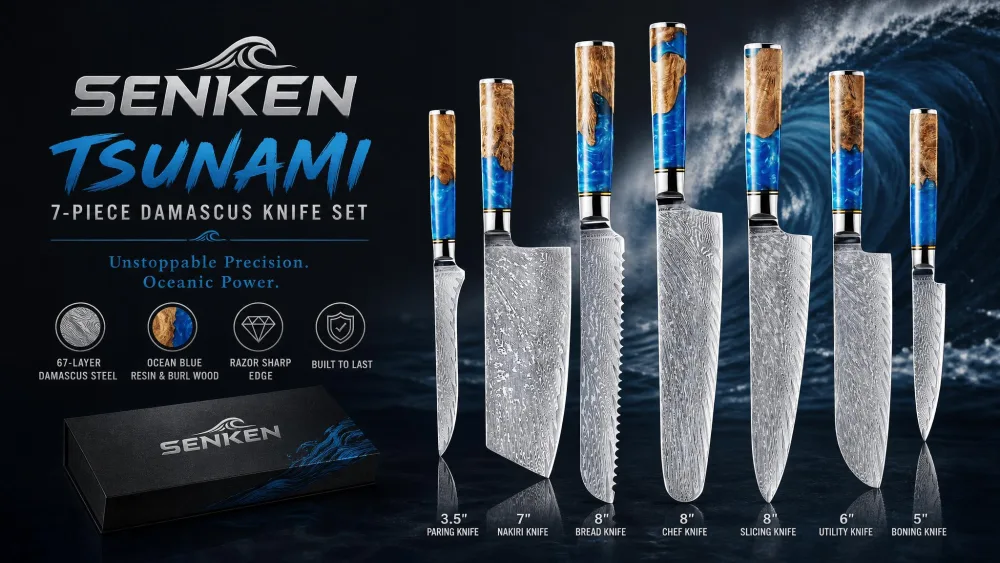
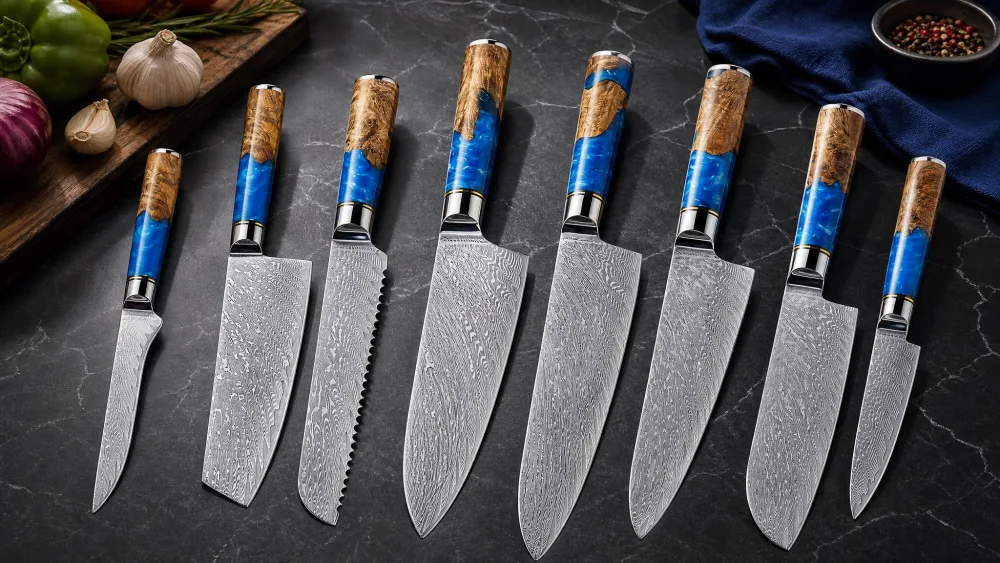
Look at the SENKEN Tsunami 7-Piece Damascus Knife Set on a counter and you understand the appeal before you lift a blade. The 67-layer Damascus pattern catches the light, and the blue resin burl handles are smooth, unique, and comfortable enough to be a conversation piece. This is the set for cooks who want their tools to look like the work they do.
Pros
Genuine 67-layer Damascus with a VG-10 core at HRC 62
Factory edge holds for weeks of daily use
Blue resin burl handles are unique and comfortable
2-year accident protection plan
Cons
Ships without a block or magnetic holder
Hard edge micro-chips on bone, frozen food, or twisting
Needs hand-washing and immediate drying
The edge performs like a Damascus knife should. The VG-10 core at HRC 62 held its factory edge for weeks of daily use, and the pattern is genuine Damascus, not a laser etch. On a heavy prep day we pushed the chef's knife through a big load of protein with only a honing rod for touch-ups, and the edge held while picking up small nicks. The hard edge has a hard personality: it micro-chips if you hit bone, frozen food, or twist the blade mid-cut, and our cleaver dented cutting through a whole cooked chicken.
The set also ships as knives only, with no block or magnetic holder, which surprised us at this price. Budget for a magnetic board or roll. Owners who hand-wash and towel-dry immediately keep the steel clean, and that is the only care routine this set accepts.
Who This Set Is Best For
Cooks who want genuine Damascus steel and a striking set for the counter, and who already own a magnetic board or roll for storage.
Who Should Skip It
Anyone who wants storage included, needs a knife that can hack through bone and frozen food, or prefers stainless that tolerates the dishwasher.
Genuine 67-layer Damascus, no block included.
Japanese Knife Set Comparison Table (2026)
Here is how the five sets stack up side by side. Steel type and set size drive most buying decisions, so those are the columns to read first.
How to Choose the Best Japanese Knife Set: Buyer's Guide
The comparison table above shows how the sets differ; the buyer's guide explains which differences matter. A Japanese knife set is a bigger purchase than a single knife, so it pays to understand the specs before you buy. These are the criteria we weigh most, in the order they matter.
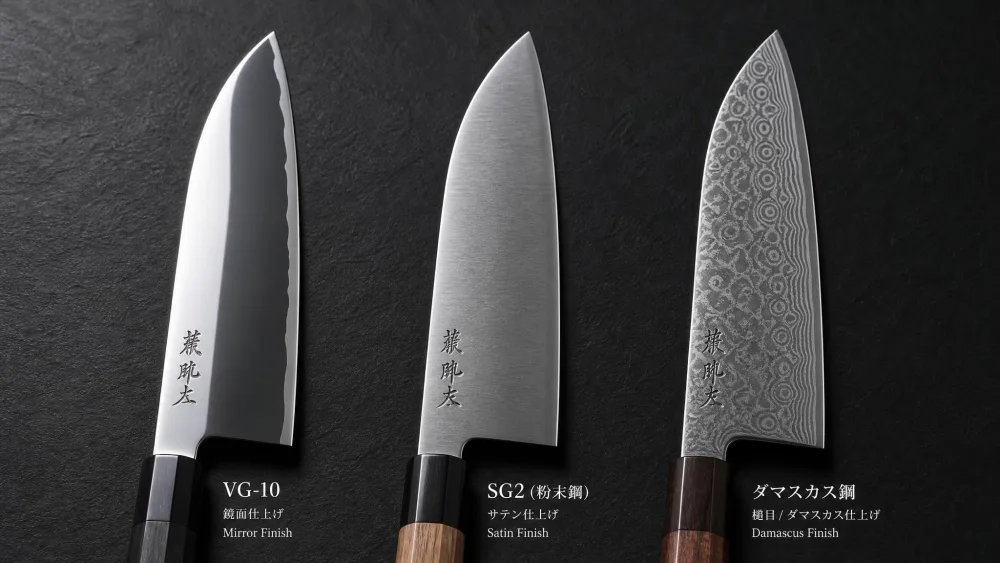
Steel Types Explained: VG-10, SG2, AUS-10, Carbon Steel vs Damascus
Steel is the soul of a Japanese knife, and the name on the blade tells you most of what you need to know.
VG-10 steel is the workhorse of Japanese stainless. It is a Takefu Special Steel alloy with about 1 percent carbon and 15 percent chromium, usually heat-treated to 60 to 62 HRC. It holds an edge well and sharpens easily, but it is less tough than softer steels, so it can chip on bone, frozen food, or prying. You will find it in the Shun Sora and as the core of the SENKEN Tsunami on our list.
SG2 is a powder-metallurgy steel with a micro-carbide structure. It holds an edge longer than VG-10 and can be heat-treated harder, which is why the Miyabi runs at Rockwell 63. It costs more, and it is best for cooks who want maximum edge retention and do not mind the price.
AUS-10 is the tougher, more forgiving option. It runs about 58 to 60 HRC, sharpens more easily, and trades a little edge retention for being harder to chip. It is a sensible pick for a first set or a heavy-handed cook.
10Cr15CoMoV is a Chinese high-carbon stainless that is essentially a VG-10 equivalent at 20 to 30 percent lower cost. In daily kitchen use the difference from VG-10 is small, which is why the HOSHANHO can offer that steel at its price.
Carbon steel, usually white or blue steel, gets harder and sharper than stainless but corrodes easily and chips more readily. Damascus blades, like the Miyabi and SENKEN, laminate a soft cladding over a hard cutting core. The pattern is real structure, but the core steel is what does the cutting.
VG-10, SG2, and Damascus blades look different because they are made differently.
A knife that holds its edge after a week of prep matters more than how sharp it was out of the box.
Knife Shapes in a Set: Gyuto, Santoku, Nakiri, Petty
The Japanese knife tradition has a shape for every job, but a home set only needs a few.
The gyuto is the Japanese take on a Western chef's knife, a double-bevel all-rounder at 8 to 10.5 inches. If your set has one, it will do most of your work. The santoku, meaning "three uses", is a versatile meat, fish, and vegetable blade at 5.5 to 8 inches, and it is the most popular home-cook shape in a set. The nakiri is a flat-edged vegetable chopper with a square tip, built for push-cutting produce. The petty is the Japanese paring and utility knife, the usual partner for a gyuto. The bunka is a santoku variant with a k-tip instead of a sheep's-foot tip.
Specialist single-bevel shapes like the deba for fish, the yanagiba for sashimi, and the usuba for vegetables are genuine Japanese cutlery, but they are not what a home set needs. Every set on our list sticks to double-bevel blades you can use daily without a lesson.
Handle Materials and Ergonomics
The handle is where a set passes or fails the hour-three test. Western-style handles have a bolster and a full or partial tang and run heavier, which suits cooks who like a forward balance. Japanese wa handles are usually ho wood over a hidden tang, octagonal or D-shaped, and easy to replace. Pakkawood is a waterproof resin-impregnated laminate, common on value sets like the HOSHANHO, and it shrugs off water well.
In our testing, a comfortable handle matters more than a pretty one. Look for a grip that fills your hand without spreading your fingers, a weight that settles into a pinch grip, and a material that stays secure when your hands are wet.
Set Size and Storage: Knife Blocks vs Magnetic Holders
How the set stores is as important as how it cuts. Slotted blocks keep edges safe and out of reach, but they trap moisture and can dull a blade on the slot lip. Magnetic boards show the knives and avoid slots, but they leave blades exposed and need a strong, even magnet field. The HOSHANHO uses a double-sided acacia magnetic board, and that board is the most debated part of the set because the hold is strong on the big knives and weaker on the small ones. Knife rolls, like the one in the Shun Sora set, are the portable option and a natural fit for students or cooks with tight drawers.
Build-Your-Own vs Matched Sets: Which Should You Buy?
A matched set is convenient: one box, one style, one storage solution, and usually a better price per piece. The catch is that sets often include shapes you rarely use. Build-your-own means buying a gyuto and a petty, spending more per knife on better steel, and handling your own storage and sharpening. For a first set or a gift, a matched set like the imarku makes sense. For a cook who already knows they live on one chef's knife, building your own is the better long-term move.
Care and Maintenance: Sharpening, Rust Prevention, Dishwasher Safety
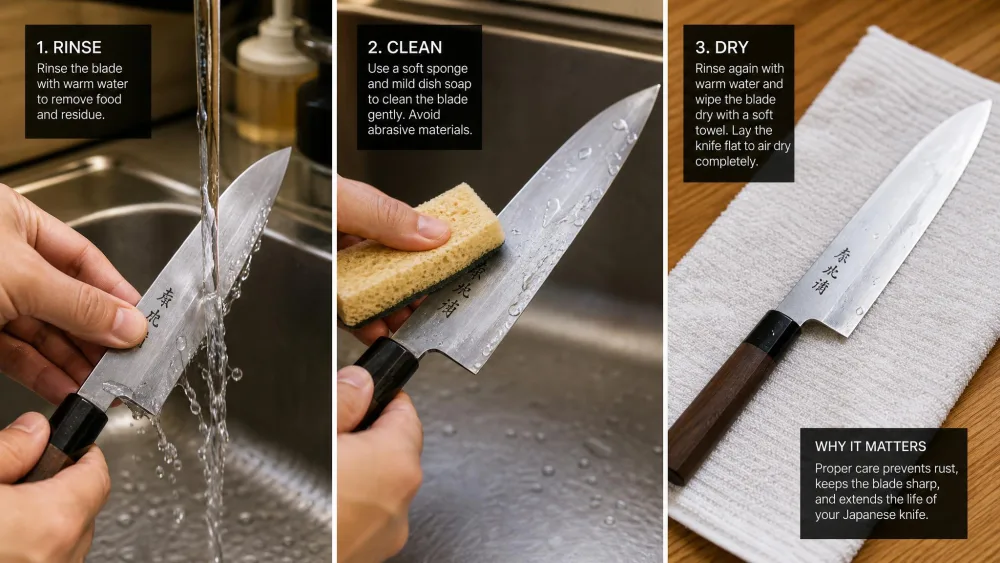
Japanese steel rewards a little discipline. Hand-wash every blade with warm water and dish soap, dry it immediately, and put it away. High-carbon and Damascus blades blemish or spot if you leave them wet, and the Shun Sora showed rust spots when we skipped the towel.
Tip. Sharpen on a whetstone at the factory edge angle, usually 10 to 15 degrees, and run a honing rod between sessions. Skip pull-through sharpeners, which can chip a thin Japanese edge.
Warning. Never put Japanese knives in the dishwasher. Heat, caustic detergent, and clattering against other items dull the edge fast, and high-carbon steel can corrode.
For most home cooks, a honing rod plus a whetstone session every few weeks keeps a set sharp for years.
Hand-wash, dry immediately, and never use the dishwasher.
Frequently Asked Questions About Japanese Knife Sets
Are Japanese knife sets worth it vs buying individual knives?
For a first kitchen, yes, and the per-piece math is the reason. At about $170, the imarku works out to roughly $11 a knife, and that price includes the block, the shears, and the honing steel. A build-your-own gyuto and petty cost more per blade and still leave you to buy a board or roll on top. If you already own a chef's knife you love, skip the set and upgrade that one blade instead.
Which is the best brand of Japanese knives (Shun, Miyabi, Tojiro)?
Shun is the most widely available and backs its knives with free lifetime sharpening, Miyabi pushes edge retention with SG2 powder steel, and Tojiro is a budget favorite among Japanese knife enthusiasts. All three make quality blades; our picks balance that quality against what a home cook actually pays.
Is Miyabi or Shun better?
Miyabi runs harder and holds an edge longer, while Shun's VG-10 is tougher and backed by a free sharpening program that makes long-term care easier. Choose Miyabi if you want maximum edge retention and do not mind hand sharpening. Choose Shun if you want low-maintenance ownership with a safety net.
What's the difference between VG-10 and SG2 steel?
Both are quality stainless, so the pick comes down to how you cook. If you value edge retention and do not mind hand sharpening, SG2 wins. If you value easy maintenance, VG-10 steel is the friendlier choice and where we would start a first set. The Steel Types section above breaks down the numbers if you want them.
Can Japanese knives go in the dishwasher?
No, and the Damascus blades tolerate a dishwasher least. The folded steel in the Miyabi and SENKEN blemishes fastest, and a 60-plus HRC edge can dull noticeably after a single hot, caustic cycle. The imarku is the only set whose listing even claims dishwasher-safe, yet owners still see rust when the steel is left wet. Hand-wash every blade and dry it immediately.
How do I sharpen a Japanese knife set without damaging the blade?
A whetstone at the factory angle, 10 to 15 degrees, with a honing rod between sessions, keeps the edge safe. For a 60-plus HRC blade, follow a grit progression: start around 1000 to reset a dull or damaged edge, refine at 3000 to 5000, and finish at 6000 to 8000 for the polish. Soak a traditional water stone for about 10 minutes first. Hone a few passes each week so a full sharpening session is only needed every few weeks.
Final Verdict: Which Japanese Knife Set Should You Buy?
For most home cooks, our answer is the HOSHANHO 7-Piece Magnetic Knife Set, and you can check its current price to see where it lands. The rest of the list answers different questions. The imarku is the set we would hand to someone setting up a first kitchen, because the price covers everything. The Miyabi is the pick for a cook who wants the best edge money can buy and accepts the $1,400 entry fee. The Shun Sora suits a student or a cook who travels, with Shun's free lifetime sharpening as the safety net. The SENKEN Tsunami is for the cook who wants Damascus beauty and a hard VG-10 edge, and who already owns a magnetic board or roll.
If we were building a kit from scratch on a single budget, we would buy a gyuto, a petty, and a good magnetic strip rather than a matched set. But for a complete set that most home cooks can actually use daily, the HOSHANHO is where we would put our money.
Key takeaway. Our 4.6/5 top pick, the HOSHANHO 7-Piece Magnetic Knife Set, pairs VG-10-class steel at 60 HRC with magnetic storage at a price that undercuts the premium brands. Budget buyers should look at the imarku, and premium hunters at the Miyabi.