As an Amazon Associate we earn from qualifying purchases. We may earn a commission from links on this page, at no extra cost to you. Learn more.
A large pressure cooker is a locking pot that traps steam, raises the pressure, and finishes beans, stew, and brisket in a fraction of the usual time. The "large" part matters when you cook for a crowd, because a pot that holds enough for a family of seven changes how you plan a whole week of dinners. Our pressure cookers cover smaller models too, but this guide stays at 8 quarts and up.
We judged each cooker against the meals a big family leans on most: beef stew, rice, beans, and brisket. The Instant Pot Pro turned out tender stew, and the Presto 01755 gave us creamy beans and tender brisket.
We ranked five cookers by capacity, handling, cleanup, and how safely a busy household can use them. The shortlist mixes two electric multi-cookers, one stovetop cooker, and two bigger stovetop pots that also work as pressure canners.
Best Large Pressure Cookers at a Glance
Here is the whole lineup side by side. Ratings are our own editorial scores out of 5, built from the rubric we explain in the next section, and the fill limits come from each manufacturer's instructions rather than from the size printed on the box.
Criteria
Instant Pot Pro 8-Quart
Instant Pot Duo 8-Quart
Presto 01370 8-Quart
Presto 01755 16-Quart
Presto 01781 23-Quart
Our rating (out of 5)
4.6
4.4
4.2
4.5
4.3
Nominal capacity
8-quart
8-quart
8-quart
16-quart
23-quart
Fill limit, food plus liquid
2/3 ordinary; 1/2 for expanding or starchy foods and soup
2/3 ordinary; 1/2 for expanding or starchy foods and soup
2/3 ordinary; 1/2 for rice, beans, soups, and stews
2/3 ordinary; 1/2 for dry beans, peas, and soup
2/3 ordinary; 1/2 for dry beans, peas, and soup
Type and intended job
Electric, everyday family meals
Electric, basic budget meals
Stovetop dinner cooking
Stovetop batch cooking, also canning
Stovetop preserving, also cooking
Material and heat source
Stainless insert; plug-in base
Stainless insert; plug-in base
Stainless, tri-clad; gas, electric coil, smooth-top; current models also induction
Aluminum; gas, electric coil, suitable smooth-top; no induction
Aluminum; gas, electric coil, suitable smooth-top; no induction
Power
1400W
1200W
Burner-dependent
Burner-dependent; 12,000 BTU ceiling
Burner-dependent; 12,000 BTU ceiling
Dimensions (inches)
14.4 x 13.9 x 14.2
Unknown for the current US revision
Sources conflict; manufacturer sheet 15.06 x 10.68 x 9.25
Sources conflict; manufacturer sheet 17.25 x 13.50 x 12.00
Sources conflict; manufacturer sheet 17.50 x 13.50 x 15.50
Handling
Insert handles; bulky base
Hot insert has no lifting handles
Lid and handle friction possible
Shorter canner, wide body
Tall; awkward sink and storage fit
Cleanup
Dishwasher-safe insert and lid; wipe the base
Dishwasher-safe insert and lid; wipe the base
Handwash per the manual
Handwash; keep the gauge dry
Handwash; keep the gauge dry
Pressure-canning jars
Not recommended
Not recommended
Not a canner
7 quart jars or 10 regular-mouth pints
7 quart jars or 20 regular-mouth pints, stacked
Main limitation
Cost and slow-cook inconsistency
Fewer features; release design varies
Manual burner control and lid effort
Burner monitoring and food restrictions
Size, no induction, annual gauge check
How We Tested These Large Pressure Cookers
We scored every cooker by how our family kitchen actually uses one: a full pot of something hearty, a rushed weeknight, and the cleanup afterward. We scored each pick out of 5 for usable capacity, ease of lifting and moving a full pot, cleanup, safety for nearby people, and suitability for its intended job. Those scores are the ratings you see in this guide.
The staples of a busy household, stew, rice, dry beans, and brisket, set the bar for what a cooker has to handle. Each pot was also scored on whether it can be lifted, carried, and washed up in a real family week.
Safety carried real weight in our scoring. A cooker that we would hesitate to leave within reach of a teenager, or that makes a full pot awkward to carry across the kitchen, lost points no matter how well the food turned out. We also treated cooking and canning as separate jobs, because a pot that does one well is not automatically approved for the other.
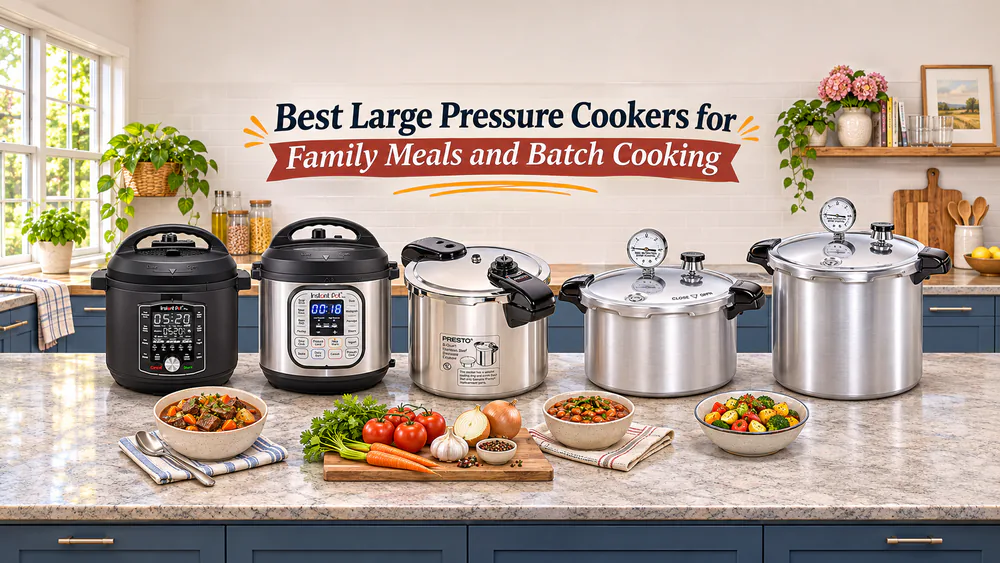
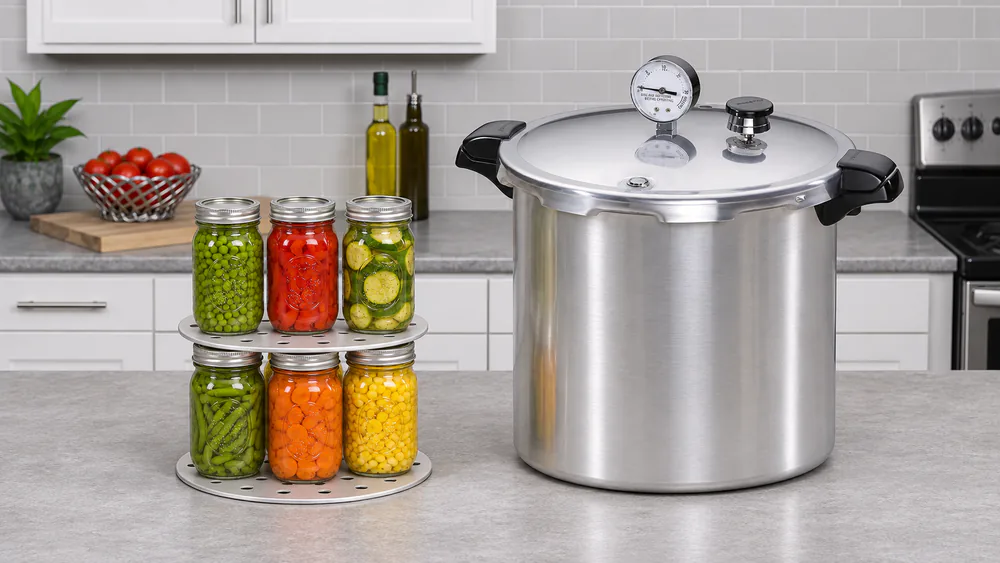
The lineup we scored, from 8-quart electrics to the 23-quart canner.
1. Best Large Electric Pressure Cooker for Everyday Family Meals
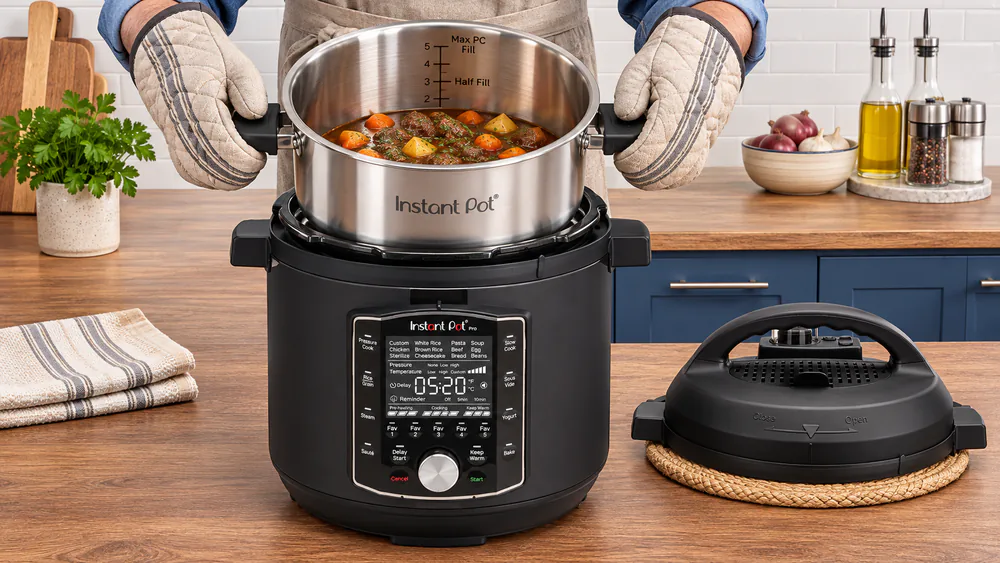
Start with the Instant Pot Pro, the electric cooker we would put on a busy family counter first. Beef stew turns out tender, and it handles weeknight dinners without fuss. It costs more than the other electric pick here, and slow cooking is its weak spot, but for pressure cooking dinner it is the most comfortable large cooker we scored.
Pros
Handles on the stainless insert make a full pot easier to lift and keep it from spinning while you stir
Progress display makes the pressure, cook, and release stages easy to follow
Adjustable saute heat helps you simmer gravy without swinging between too little heat and a boil
Dishwasher-safe lid and insert, with a stainless pot that avoids a worn coating
Cons
Costs more than the other electric pick in this lineup
Slow cooking can be sluggish or stall in preheating on the 8-quart
Busy control panel takes some getting used to
The supplied open rack lets small vegetables fall into the liquid
Capacity and everyday cooking features
The Pro holds an 8-quart nominal liquid capacity, and it draws 1400W from a standard US outlet. It offers 28 customizable programs and 5 favorite settings, covering pressure cooking, slow cooking, sous vide, saute, sterilizing, yogurt, rice, baking, steaming, and keeping food warm. The lid seals automatically, and a separate release switch with a diffusing cover keeps the steam from shooting straight up. It measures 14.4 x 13.9 x 14.2 inches, so check the cabinet or counter space before you commit.
Usable capacity is smaller than the label suggests. Ordinary food can fill the pot to two-thirds, but starchy, expanding, or soupy foods must stay at or below one-half, cooking liquid included. At that half-full limit you get 4 quarts of total food and liquid, which is still plenty for a big pot of chili or a week of rice.
In daily cooking, the covered steam outlet reduces spluttering, although venting is still audible, so this is not a silent cooker. Rice can leave stuck starch on the insert, and the pot washes better if you soak it before scrubbing. The open steaming rack that ships with it is awkward for small vegetables, so use a basket or foil sling for green beans or diced carrots.
Warranty and who it suits
A 1-year limited warranty covers eligible purchases, and in price terms it sits at the premium end of this shortlist.
Choose the Pro if you cook mostly weeknight dinners, and want an electric cooker you can set on the counter and leave alone. Skip it if you mainly want a slow cooker or a stovetop pot for searing.
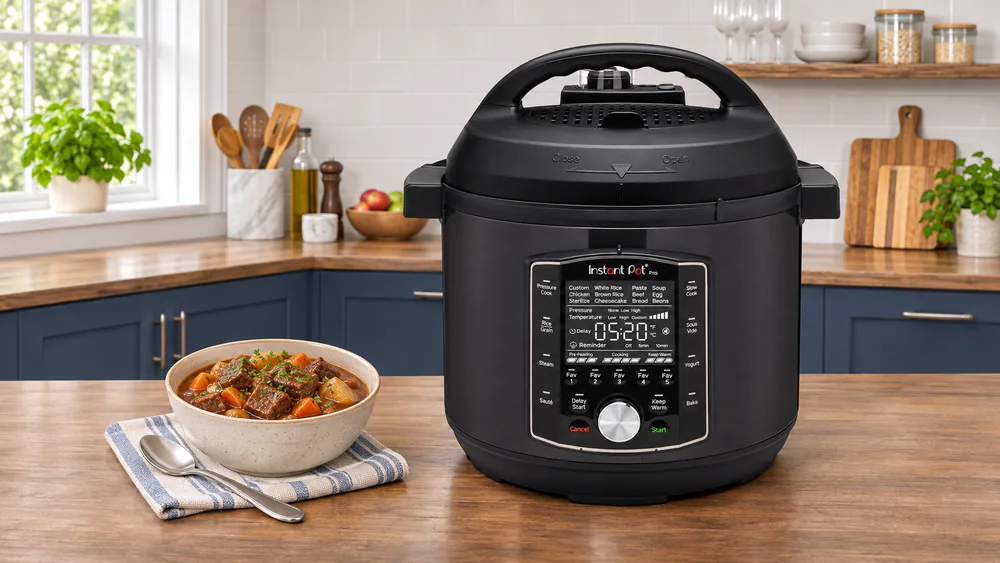
The Pro's stainless insert holding a finished beef stew.
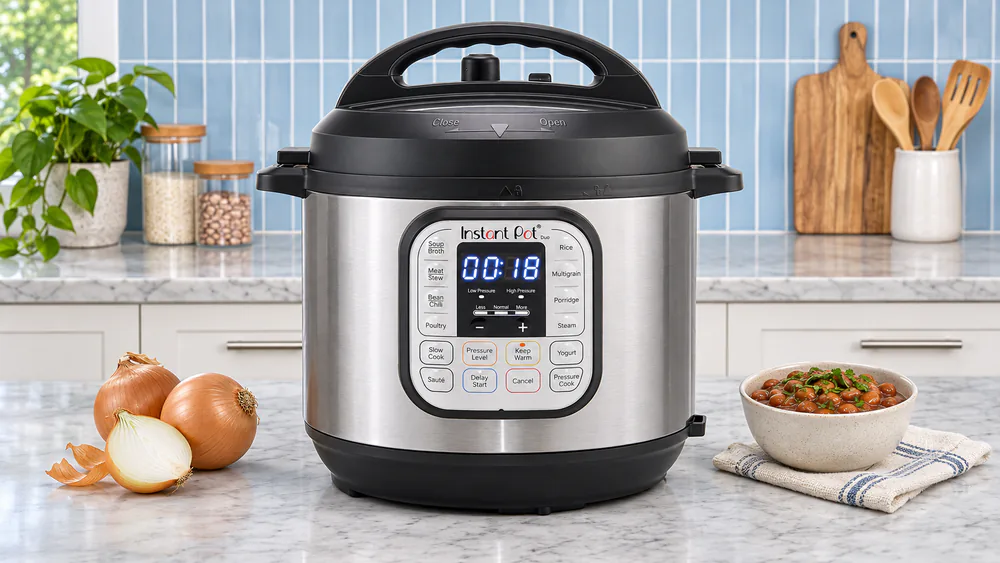
Next to the Pro, the Duo is the budget large electric pick, and it handles the everyday jobs well. Pressure cooking gives tender beans, meat, and starchy vegetables, and browning aromatics in the same insert saves you a separate frying pan. You give up the Pro's polish, but you keep the part of the machine that matters most for dinner.
Pros
Pressure cooking produces tender beans, meat, and starchy vegetables
Saute and pressure cook in the same stainless insert, so there is one less pan to wash
Dishwasher-safe lid and insert, with a wipe-clean base
Overheat protection and a locking lid keep it safe on a busy counter
Cons
The hot insert has no lifting handles
Quick release gives a loud hiss and a hot steam plume
Thick tomato mixtures and stuck-on saute residue can trigger a burn warning
The sealing ring can hold onto strong aromas like curry
Specs and fill limits
It is an 8-quart nominal liquid capacity cooker with 1200W of power and 13 one-touch programs. It pressure cooks, slow cooks, sautes, steams, makes rice and yogurt, and keeps food warm. The stainless steel inner pot has a tri-ply base, and a steamer rack is included. We position it as the budget electric pick in this lineup, though we cannot promise it is the lowest price on any given day.
The fill limits match the Pro's: fill ordinary food to two-thirds at most, and keep expanding or starchy foods and soup at or below one-half. As a general rule for an 8-quart unit, plan on at least 2 cups of thin, water-based liquid, and confirm the exact figure in your model's manual and your recipe.
One detail needs your attention before you buy. We could not confirm exact dimensions, empty weight, or warranty terms for the current US revision, so check the listing for the unit you are ordering, and do not rely on warranty terms printed for an overseas Duo.
Release, lifting and who it suits
Quick release is the part to treat carefully. It makes a startling hiss and a hot steam plume, so keep hands and faces clear and never force a pressurized lid. Release design also depends on the Duo generation: older units use a turning release handle, while newer ones use a separate release switch, so follow the instructions that came with your lid.
Use oven mitts and take your time with a full insert, or choose the Pro if lifting is a concern in your house. Choose the Duo if you want a big electric cooker on a tight budget and you do not need sous vide or a long program list.
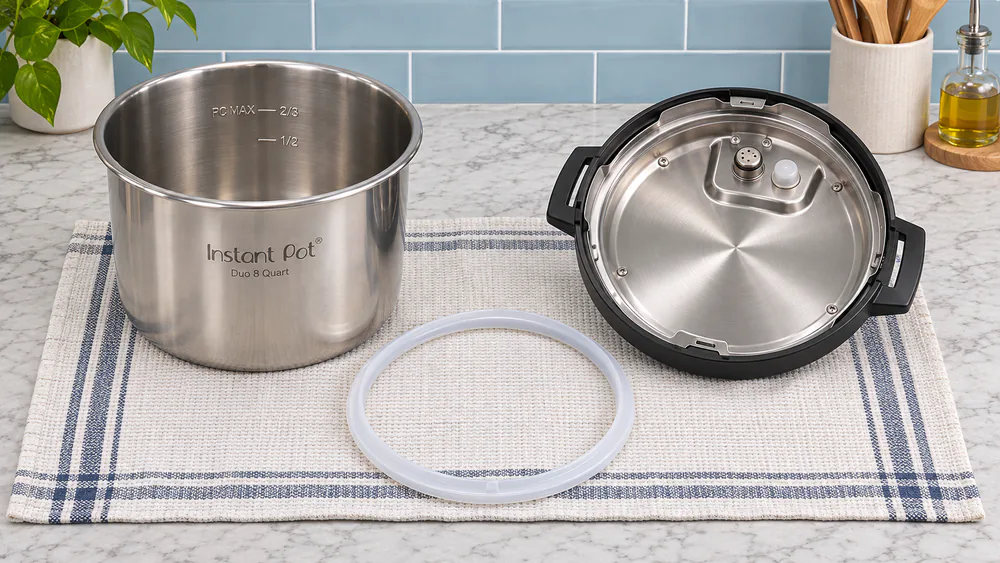
Take the sealing ring out for cleaning, especially after spicy dishes.
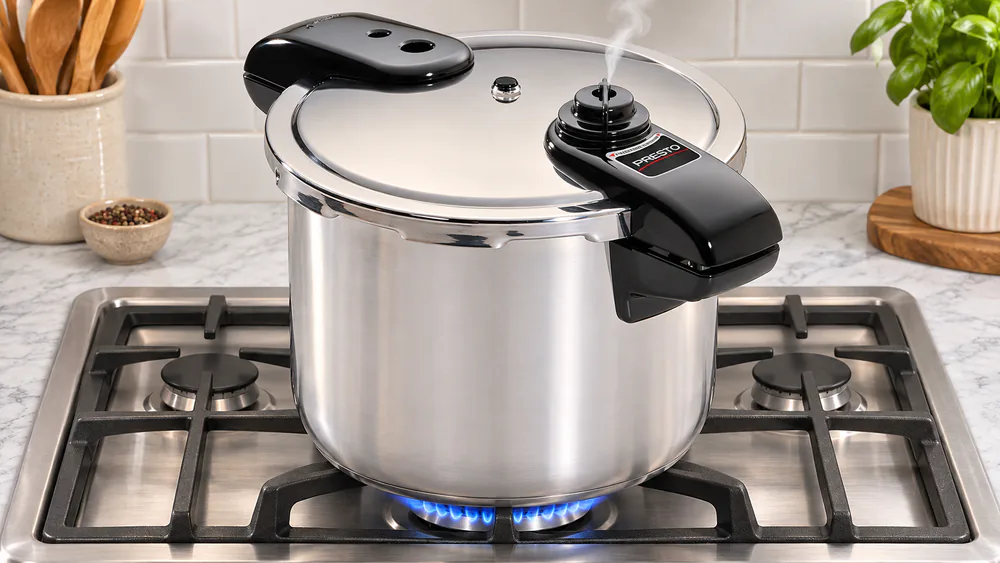
The Presto 01370 needs more attention than the Instant Pots: you control the burner, maintain the handles and seals, and may struggle with a stiff lid even after the pot has cooled. In return you get a stainless stovetop cooker that suits soups, stews, and beans, and a squash curry came out with a deeply seasoned flavor.
Pros
Stainless steel body with an aluminum-core tri-clad base
Works on gas, electric coil, and smooth-top ranges, and current stainless versions also support induction
12-year limited warranty
Steam-release regulator, pressure indicator, locking cover, and overpressure protection
Cons
Handles can loosen or break with use
A stiff lid can make opening awkward even after cooling
You regulate the burner yourself
Handwashing is recommended, and the food chart bans pasta, cereals, and split peas
Cooktop fit, controls and who should buy it
This is an 8-quart nominal liquid capacity pot. It has a steam-release regulator, a pressure indicator that shows when you are up to pressure, a locking cover, overpressure protection, and a stainless steamer basket. The body is stainless steel with an aluminum-core tri-clad base that spreads heat evenly. It runs on gas, electric coil, and smooth-top ranges, and current stainless versions also support induction, so check the model you receive if you cook on induction.
The manufacturer sheet lists 15.06 x 10.68 x 9.25 inches and 7.55 pounds empty. Published measurements differ by source and revision, so measure the exact unit before you plan a tight cabinet fit. Compared with the Instant Pots, the footprint is lower and wider, which many cooks find easier to store.
Fill limits are the same two-thirds maximum for most foods, with a one-half limit for rice, grains, beans, peas, soups, and stews, liquid included. Follow the manual food chart, which prohibits pressure cooking pasta, cereals, split peas, and certain other foaming foods. Use the release method your recipe calls for, never force the lid, and clear the vent before each use.
Choose the 01370 if you already cook on the stove, want a pressure cooker with no electronics to fail, and do not mind watching the burner. It is the wrong pick if you want a start-and-walk-away machine or someone younger will run it without supervision.
Stovetop cookers ask you to manage the flame, which some cooks prefer.
4. Best Extra-Large Pressure Cooker for Batch Cooking
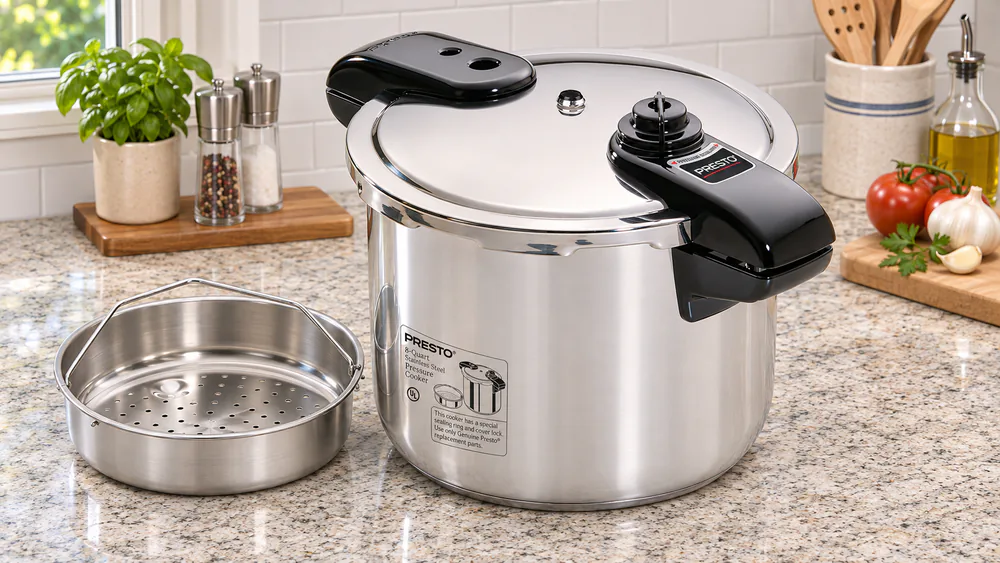
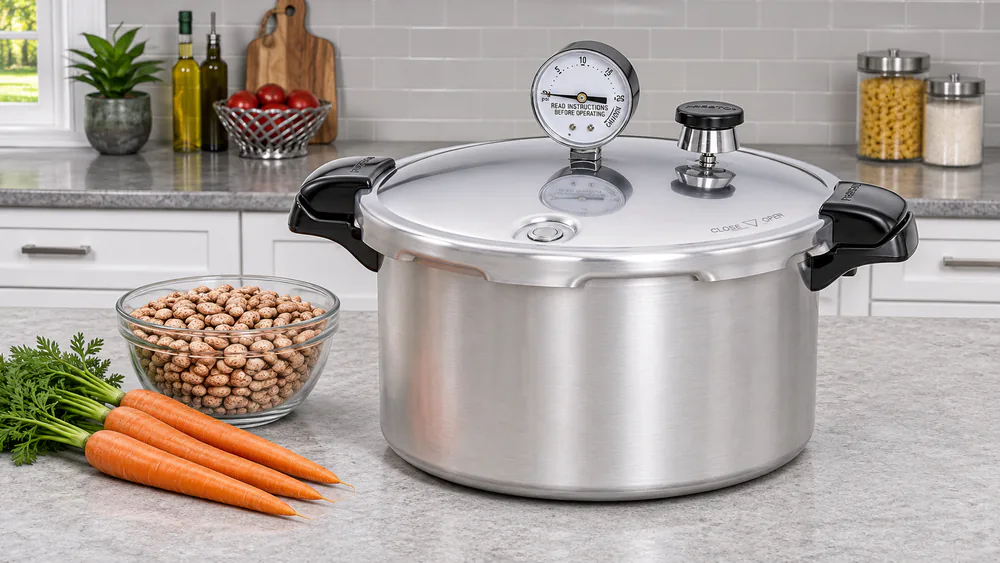
The Presto 01755 takes practice: holding pressure on a burner means dialing in the heat, and a loaded pot still needs careful moving. In return it is the pot we reach for when a single batch has to feed a lot of people. Its broad cooking surface gives brisket more searing room than a narrow electric insert, beans finish creamy without split skins, and brisket becomes tender throughout. Nothing else in this lineup gives you this much real cooking room in a body short enough to handle.
Pros
16-quart nominal capacity with a broad base for searing
Beans finish creamy without split skins, and brisket turns out tender
Handles stay comfortable during stovetop cooking
12-year limited warranty, plus real pressure-canning ability
Cons
Dialing in burner heat to hold pressure takes practice
Moving a loaded pot still needs care
Running it dry can warp the base
Aluminum body does not work on induction, and all parts need handwashing
Fill limits, weight and storage
This 16-quart nominal liquid capacity pot is a stovetop cooker with an aluminum body, a dial pressure gauge, a cover lock, overpressure protection, a removable sealing ring, and a rack that serves for both cooking and canning. It works on gas, electric coil, and suitable smooth-top ranges, but this aluminum model does not support induction. The household burner should be rated 12,000 BTUs or less.
For dinner cooking, the fill limit is 2/3 for ordinary food and 1/2 for dry beans, dry peas, and soup, with liquid included. Even at the half-full limit that leaves a lot of room for a pot of beans or a double batch of soup, and far more space than the 8-quart units.
The manufacturer sheet lists 17.25 x 13.50 x 12.00 inches and 9.25 pounds empty, although published weights and footprints differ, so measure your storage space against the specifications for the model you receive. The body is shorter than the 23-quart, which makes it easier to wash in a standard sink and to find a cabinet for.
Canning, cleanup and who it suits
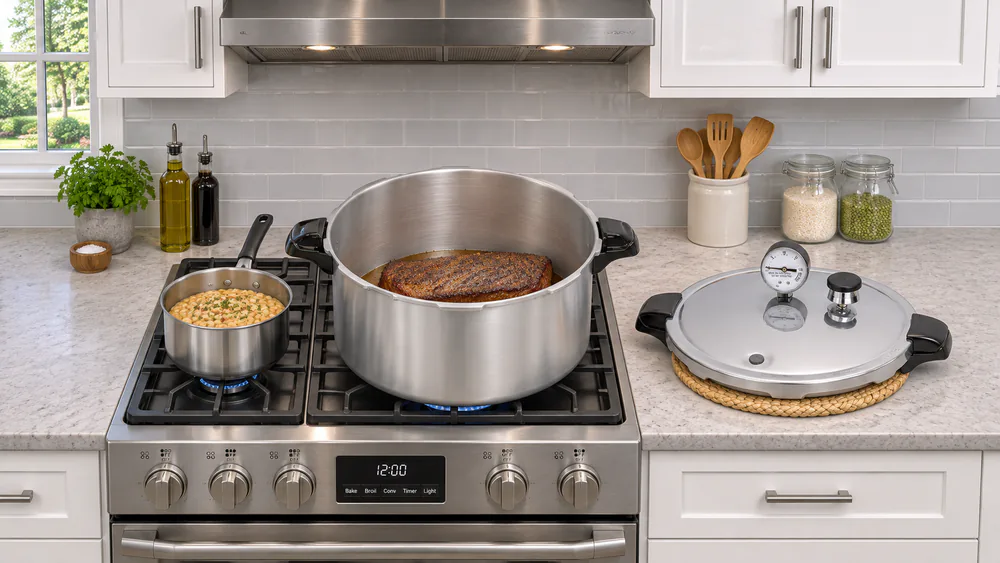
Its broad bottom earned it a high cooking rank because it lets you sear a large cut and pressure cook it in the same pot, something a narrow electric insert rarely has room for.
For preserving, it holds 7 quart jars or 10 regular-mouth pint jars during pressure canning. Boiling-water canning is limited to pint and half-pint jars, because the body is too short to cover quart jars. Cleanup means handwashing every part, keeping the dial gauge out of water, and cleaning the vent and sealing ring. A 12-year limited warranty backs it.
We placed it above the bigger canner because we mainly judged these on dinner cooking, and this one is the easier of the two to live with. It sits in the mid-priced range of this shortlist. Choose it if you batch cook beans, stock, or roasts on the weekend and cannot find the room in an 8-quart.
The wide base gave us room to sear a brisket before pressure cooking.
5. Best Large Pressure Canner and Cooker for Preserving
Last, the Presto 01781 is the right buy only if you preserve. It is a big stovetop pot built around canning, and its extra height buys stacked pint capacity rather than extra quart-jar capacity. The first canning run has a learning curve, though the sequence becomes much easier to follow once you repeat it. For ordinary dinners, the 16-quart is simpler to live with.
Pros
Holds 7 quart jars, or 20 regular-mouth pints when stacked, for pressure canning
Supports boiling-water canning of quart jars when run according to its manual
The plain interior is fairly easy to wash despite the bulk
12-year limited warranty
Cons
The tall body can be awkward to wash and may not fit under a tap or in a small sink
No induction support, and a 12,000 BTU burner ceiling
Overheating can warp the base
Hardened seals and an annual gauge check are long-term chores
Canning capacity and who should buy it
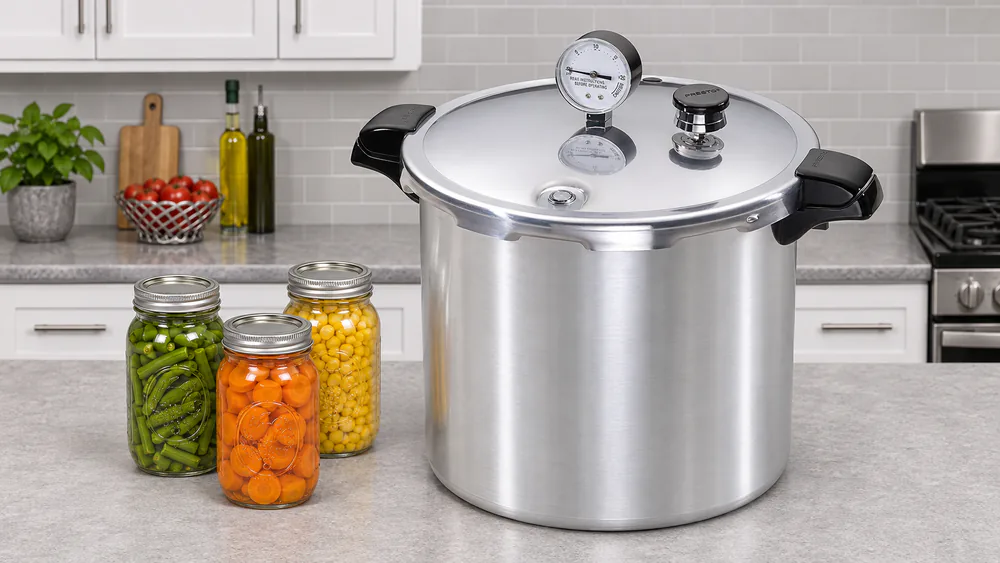
This is a 23-quart nominal liquid capacity stovetop pot with an aluminum body, a dial pressure gauge, a cover lock, overpressure protection, a removable sealing ring, and a cooking and canning rack. Like the 16-quart, it works on gas, electric coil, and suitable smooth-top ranges, but not induction, and it needs a household burner rated at 12,000 BTUs or less.
It fits 7 quart jars, or 20 regular-mouth pints, or 26 regular-mouth half-pints for pressure canning. The maximum pint and half-pint loads require double-decking with an appropriate separating rack, and you should not double-deck for water-bath canning. Both of the canners here hold the same 7 quart jars, so the extra height only helps if you can pints or half-pints.
The manufacturer sheet lists 17.50 x 13.50 x 15.50 inches and 10.32 pounds empty. Some descriptions round the footprint differently, so confirm the handle span and empty weight before planning storage. For cooking, the same fill limits apply: 2/3 for ordinary food, and 1/2 for dry beans, dry peas, and soup.
Ownership comes with chores. Overheating can warp the base, hardened seals need replacing, and you need to check the dial gauge for accuracy before use each year. The first canning run takes a bit of nerve, but the repeated sequence is easy to follow after that. Canning requires natural cooling, so never use a cooking quick-cooling method on jars.
Choose the 01781 if you preserve a lot of food and want the pint capacity. A cook who only wants a roomy dinner pot should buy the 16-quart instead. It sits at the premium end of the shortlist.
The extra height makes room for a second layer of pint jars.
What Size Large Pressure Cooker Do You Need?
The number on the box is a nominal liquid capacity, and it is the starting point rather than the answer. What you can actually cook depends on the fill limit, the recipe, and how much you are willing to lift.
Nominal capacity versus usable cooking capacity
Every cooker here sets two limits. Most foods can fill the pot to two-thirds, and foods that expand, foam, or turn to mush, such as beans, rice, grains, and soup, must stay at or below half. Liquid counts toward both limits.
You also need a minimum amount of liquid to build pressure. For an 8-quart electric unit, the general guidance is at least 2 cups of thin, water-based liquid, and the exact model manual and your tested recipe should overrule that rule of thumb.
Family meals versus weekly batch cooking
For a typical family dinner, an 8-quart electric cooker is the sweet spot. It holds a big pot of stew, chili, or rice, it fits a standard counter, and it lets you cook on a weeknight without hauling out a stockpot. In a large household, that size is the one most likely to earn a place on the counter.
Weekly batch cooking asks for more room. Beans, stock, and shredded meat for the freezer fill a pot quickly, and that is where the 16-quart earns its place. Remember that a 16-quart pot filled only to one-half still holds roughly twice what an 8-quart does at the same limit.
Batch timing: pressure build, cooking and release
A programmed cook time covers only one stage. Allow for the time the pot takes to build pressure, then the timed cook, then the release. A big, cold, full pot takes longer to reach pressure than a small one, so dinner can arrive well after the number on the display suggests.
Release method changes the result. Some recipes want a natural release, and others want a quick release. Quick release on a full pot of foamy beans or soup can spit, so follow the recipe. For canning, natural cooling is mandatory and you must not force-cool a canner of jars.
When extra capacity creates extra work
Bigger is not always easier. A larger pot is heavier when full, takes more storage space, and costs more to run when you are only cooking a little. It also demands more cleanup, since the biggest cookers here need handwashing and the taller canner may not fit under the tap.
How to Choose a Large Pressure Cooker
Choosing comes down to a handful of decisions about how you cook, where you store the pot, and who in your household will use it. Work through these in order, and the shortlist usually picks itself.
Electric versus stovetop models
Electric cookers manage pressure and heat for you. You press a button, walk away, and the machine holds pressure, then counts down. That set-and-forget convenience makes the Instant Pots our choice for most weeknights. Keep their electrical bases off the stovetop. Electric multi-cookers are also the most forgiving choice for beginners.
Stovetop cookers give you control. You choose the burner, bring the pot up to pressure as fast as the flame allows, and sear in the same body. They are lighter on electronics and hold up for years, but you must watch the burner and the pressure indicator. The bigger the pot, the more that attention matters.
For big batches, stovetop pots have the edge simply because they get larger than any electric model in this lineup. For dinner-in-a-hurry cooking, an electric model is easier to leave alone.
Pressure cooking versus pressure canning
These are two different jobs, and the equipment is not interchangeable. A pressure cooker cooks dinner, while a pressure canner preserves jars of food using a tested process. The two Presto canners here do both, but the electric multi-cookers are not canners. Tested canning processes should not be moved to an electric multi-cooker. A "sterilize" button is not evidence that a machine can safely pressure can.
Warning. Home canning needs a tested, food-specific process with altitude adjustments, venting as directed, and natural cooling. Follow the safe pressure-canning procedure, including a yearly dial gauge accuracy check, and never force-cool a canner of jars.
Quart size alone does not determine jar capacity. Both canners here fit 7 quart jars, and the taller model simply adds pint capacity. Decide what you will can before you decide how tall a pot you need.
Materials and cooktop compatibility
Stainless steel is durable, cleans well, and resists scratching, which is why the electric inserts and the 01370 use it. The stainless 01370 has a tri-clad base and works on induction in current versions. Aluminum is lighter and heats quickly, but the two canners are aluminum and do not work on induction.
Controls and safety features
Look for a locking lid, a pressure indicator, overpressure protection, and a release that keeps steam away from your hands. The electric cookers add overheat protection and a progress display on the Pro. The stovetop pots add a regulator and a dial gauge.
Household habits matter as much as hardware. Keep hands and faces away from steam, never force a pressurized lid, do not move an operating cooker, and keep the electrical base off the stovetop. In a house with children, we would keep young cooks away from release time entirely, and we would not hand an unsupervised teenager a stovetop canner. Quick release is the moment to stand back.
Handling, storage, cleaning and replacement parts
A cooker you cannot lift or store is a cooker you will stop using. Look at the empty weight and footprint, and remember a full pot weighs far more. Check each pot against your sink and cabinet before you buy.
Cleaning splits along the same lines. The Instant Pot lids and inserts are dishwasher safe and the base wipes clean, while the Presto manuals call for handwashing and keeping the gauge dry. Seals take up odors and harden with time, so keep spares for savory and mild dishes.
Replacement parts are model-specific, covering seals, plugs, gauges, and handles. Match the stamped model number when you order, and make sure the maker still sells parts for the pot you own.
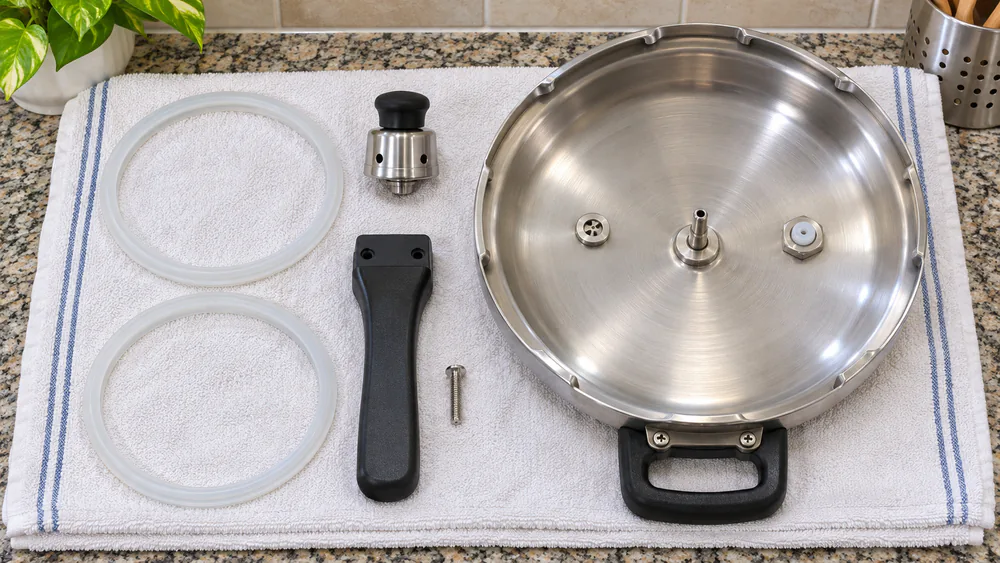
Seals and handles are the parts most families end up replacing.
Large Pressure Cooker FAQs
What should you do if the lid will not lock or the cooker will not come to pressure?
Stop and release any pressure by the method in your manual, then check that the sealing ring is seated and undamaged and that the vent is clear. Never force a lid. If the problem continues, match the stamped model number and order a model-specific replacement seal from the maker.
How do you know when to replace the sealing ring?
Replace it when it hardens, cracks, or stops sealing, since seals take up odors and stiffen with time. Match the stamped model number when you order, and follow your manual for how often to swap it.
Do these cookers work on an induction cooktop?
Only the Presto 01370 in its current stainless versions, so check the model you receive. The two aluminum Presto canners do not support induction, and the Instant Pots use their own plug-in base.
Is releasing steam safe around kids?
Treat it as an adult-only step. Quick release is loud and sends out a hot plume, so have everyone step back, keep hands and faces clear, and use the release method your manual specifies.
Does a dial gauge need to be tested?
Yes. The Presto canners use a dial gauge, and it should be checked for accuracy before use each year. Follow the maker's instructions for how to have it tested, and replace it if it is off.
What should you check before buying an extra-large model?
Check your burner type and the 12,000 BTU ceiling, whether the pot fits your sink and cabinet, its empty weight, and what you actually plan to cook. Confirm the footprint of the exact unit, since published sizes differ.
Do canning recipes change at higher altitude?
Yes. Use a tested, food-specific process with altitude adjustments, vent as directed, and allow natural cooling. Confirm the exact pressure and time for your elevation in a tested recipe before you can.
Final Verdict: Which Large Pressure Cooker Fits Your Kitchen?
Pick the cooker that matches the largest batch you cook regularly, not the largest number you can find. If you have the room, a strong two-pot setup is an electric 8-quart for weeknights and the Presto 01755 for weekend batches, since the two cover different jobs without much overlap. Buy the Presto 01781 only if canning is on your calendar, and buy the Presto 01370 if you want a durable stovetop cooker without electronics.