As an Amazon Associate we earn from qualifying purchases. We may earn a commission from links on this page, at no extra cost to you. Learn more.
The best Tiger rice cooker is the one that matches how many people you feed and how much fuss you want at the control panel. A bigger, fancier cooker does not automatically make better rice.
Tiger sells everything from a single-switch heating-plate cooker to an induction model with a long list of grain programs. The names make it hard to tell them apart, and the model suffixes are easy to mix up. This guide sorts the five U.S. models worth shortlisting by size, heating method, and the limits you should know about before you buy. If you want to compare other brands as well, our rice cooker reviews cover the wider field.
How We Tested These Tiger Rice Cookers
We score each cooker on the things that decide whether you keep using it: how the rice turns out, how easy the controls are, how much cleanup follows, and how the cooker fits a real weeknight schedule. Rice texture comes first, then brown rice and the grain programs where a model offers them.
Every model is held to the same criteria, including the batch limits, program list, and operating limits Tiger publishes for it.
We also weigh the small things that annoy you at 6 p.m.: whether the lid springs open, whether condensation drips on the counter, whether starch foams through the vent, and whether the cord stores neatly. Keep-warm is judged on how the rice looks and feels later, not on the number of hours printed on the box.
One note on measuring. Every Tiger uses its own 180mL rice cup, not a standard baking cup, and every capacity in this guide counts dry rice in that cup. Use the matching water lines inside the pot and the numbers line up.
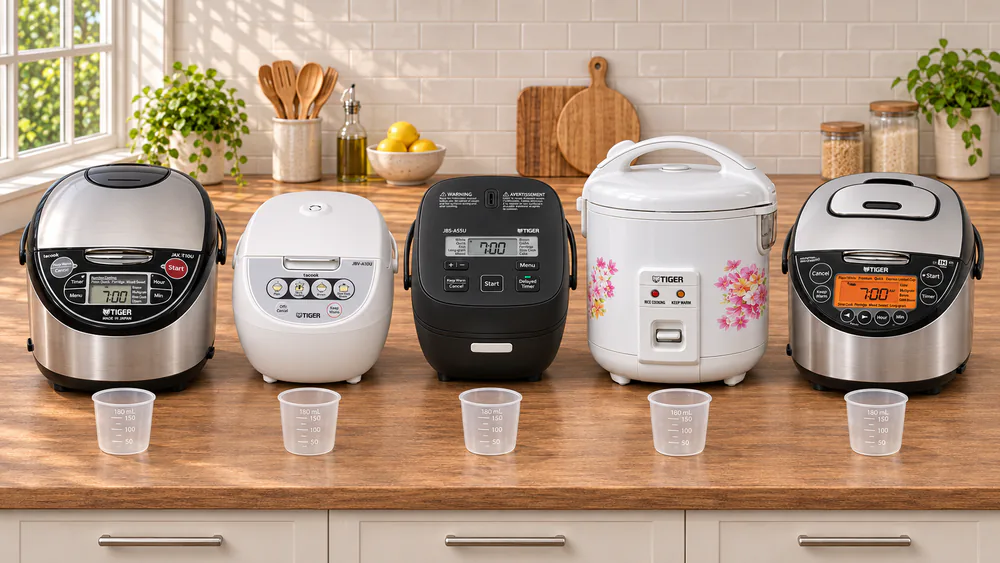
The five Tiger models in this guide, each with its own measuring cup.
Best Tiger Rice Cookers at a Glance
Here is the shortlist in one table. The JAX-T10U and JBV-A10U share a 5.5-cup capacity, so their menus and timers will likely decide which suits you.
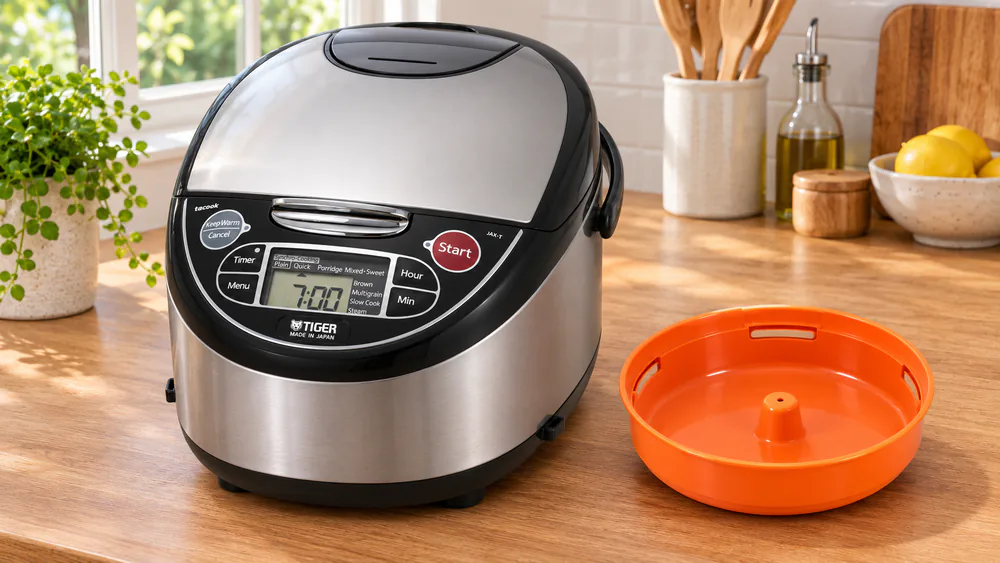
Brown rice finished chewy-tender in the JAX-T10U, and mixed grains cooked evenly with no hard pieces left in the bowl. Porridge came out creamy. This is the cooker we would hand to someone who cooks more than plain white rice, because the menu covers plain, quick, mixed, brown, slow cook, porridge, sweet, steam, and multigrain, plus the Tacook plate for cooking a side dish above the rice.
Pros
Micom control with plain, quick, mixed, brown, porridge, sweet, steam, and multigrain programs
Tacook plate cooks a side dish above the rice
Two finish-time presets and a removable inner lid and steam cap
Advertised keep-warm of 12 hours
Cons
Condensation can drip when you open the lid
The cord does not retract
Tacook rice batches are limited to 1-2 cups
It is not perfect. Opening the lid can leave condensation to wipe off the counter, and the cord does not retract, so it adds clutter in a drawer. The removable inner lid and steam cap make starch cleanup easier, and that matters more over months than it sounds. If you can live with those two small annoyances, this is the Tiger we would buy first.
The JAX-T10U draws 641W, weighs 6.8 lb, and measures 10.1 x 13.7 x 8.2 inches (width, depth, height), so it fits under most cabinets with the lid closed. Plain rice runs from 1 to 5.5 cups, brown rice from 1 to 3.5 cups. The inner pot is 1.5mm thick and made of fluorine-coated aluminum, and the cooker is made in Japan. Its 5.5-cup capacity is the one to remember: do not confuse it with the larger 10-cup JAX-T18U.
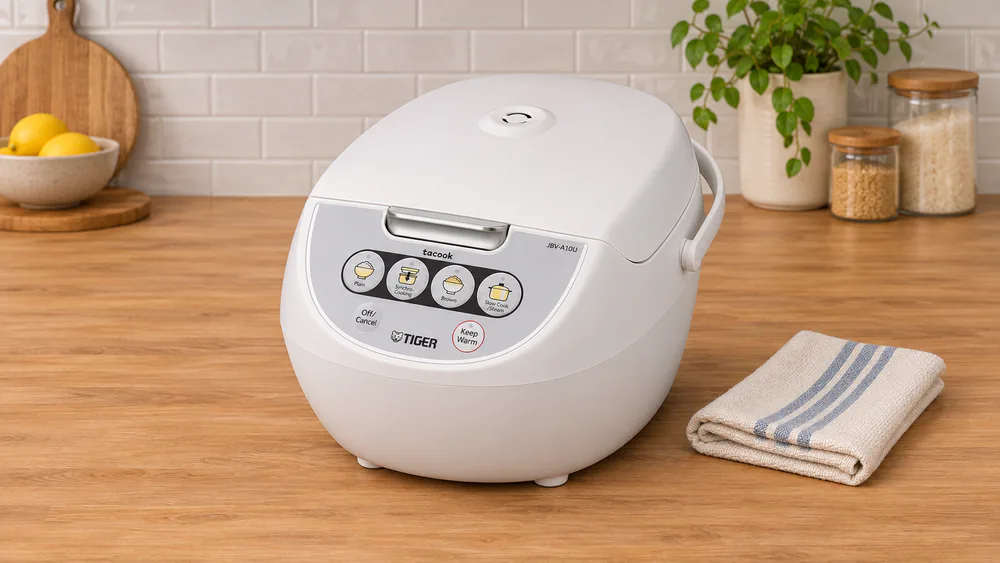
Where the JAX-T10U layers in timers and menus, the JBV-A10U strips them out, and it was the easiest Tiger to learn. The buttons are simple and obvious, white rice stayed soft during warming without a hard, burned bottom, and brown rice finished tender, though the longer cycle needs planning ahead. The bowl and steaming plate wash easily by hand.
Pros
The lowest-cost route to a 5.5-cup Micom cooker with a Tacook plate
Plain, brown, slow cook/steam, and synchro-cooking in simple button controls
Soft white rice during warming without a burned bottom
Cons
No countdown display or delayed-finish timer
The lid springs up when released and is awkward to wipe
Made in China, unlike the other four models
The trade-off is the missing countdown. With no timer display or delayed finish, dinner timing is less convenient, and you have to start the cooker when you want rice to begin, not when you want it to finish. Condensation also collects around the rim when the lid opens, so keep a cloth nearby. The lid springs upward quickly when released, so steady it with your other hand, and wiping the attached lid is awkward.
Steaming works well on this model: we noticed that purple carrots steamed above white rice could leave the rice uncolored, a useful result when both foods share a pot. Rinsing matters. Unrinsed basmati can foam starch through the vent and add cleanup, and warm rinse water can lead to mushy rice, so use cold water. The cooker draws 672W, weighs 5.7 lb, and measures 10.6 x 13.9 x 8.4 inches. Plain rice runs 1 to 5.5 cups and brown rice 1 to 3.5 cups. Its pot is 1.0mm thick, thinner than the JAX-T10U's, and a thinner pot is one reason it costs less. Tiger's manual lists plain rice at 22 to 37 minutes and brown rice at 58 to 72 minutes, but grain, water, and starting temperature all shift those numbers.
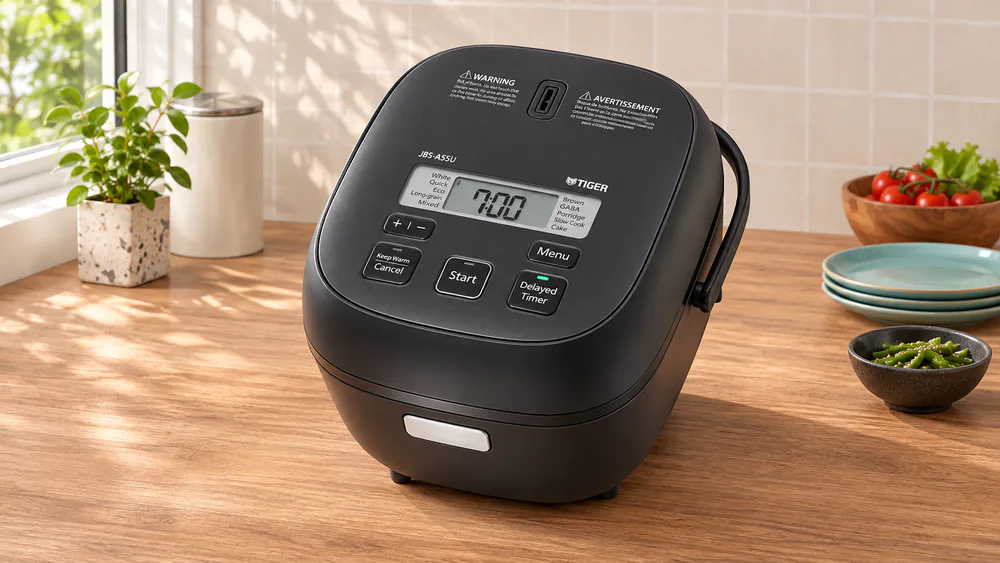
The JBS-A55U is built for one or two people, who may rarely fill a 5.5-cup cooker. It draws 360W, weighs 6.2 lb, and measures 9.7 x 10.9 x 7.6 inches, with the lid open reaching about 15.2 inches, so check shelf clearance.
Pros
Half-cup minimum for plain rice suits one or two people
Wide program list with an LCD and delayed completion timer
Detachable cord and carry handle make storing and moving it easy
Ceramic-coated pot, made in Japan
Cons
Three cups is the ceiling, so it is too small for family dinners
No Tacook plate
Not the same as the JBS-A055, which is a different regional designation
Tiger lists its range as half a cup to three cups of white rice and half a cup to two cups of brown rice, so a small lunch portion does not need a full-size batch. The ceramic-coated inner pot is sold as nonstick, and we can only point to that as a feature.
It offers white, quick, mixed, brown, slow cook, eco, long-grain, porridge, GABA, and cake programs, a delayed completion timer, an LCD, a carry handle, and a detachable power cord. The timer excludes Quick, Mixed, Slow Cook, and Cake, so do not plan on a delayed cake. Buy the U.S. JBS-A55U, not the Japanese JBS-A055.
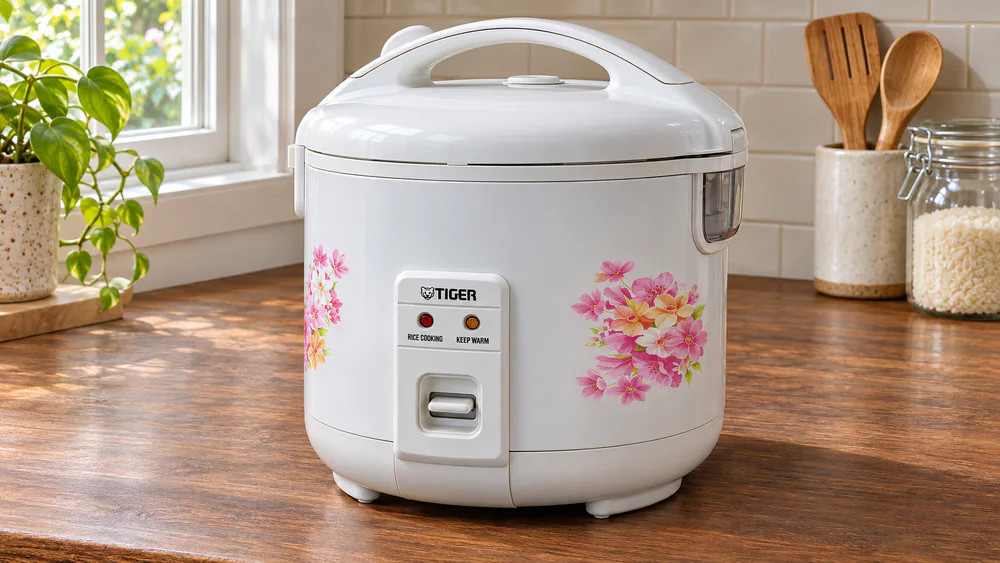
The JNP-1800 has no brown-rice preset, no grain programs, and no delay timer, and that is exactly its appeal. Unlike the menu-driven JBS-A55U, you add rice and water, press the single cook switch, and the cooker switches to warming by itself when the rice is done. When we scooped out a big batch, the pot released cooked rice readily, and the physical switch is simple enough for anyone in the house to use.
Pros
10-cup capacity for large households
Single cook switch with automatic warming
Pot releases cooked rice readily
Retractable cord, spatula, measuring cup, and washable steam vent included
Cons
No brown-rice preset, grain programs, or delay timer
Conventional heating plate gives you less control than Micom or induction
Poor fit for small batches, as the minimum is 3 cups
It cooks 3 to 10 cups of plain white rice, so it is for dinner parties or large families rather than a single cook. If you eat mostly white rice and want a big batch every time, that simplicity is a feature, not a flaw.
The JNP-1800 draws 650W and measures 11.8 x 10.7 x 11.7 inches, so it stands taller than the other models and needs cabinet clearance. Warming is advertised for up to 12 hours. The official page describes a detachable inner lid and gaskets, but check your exact unit before you pull anything apart.
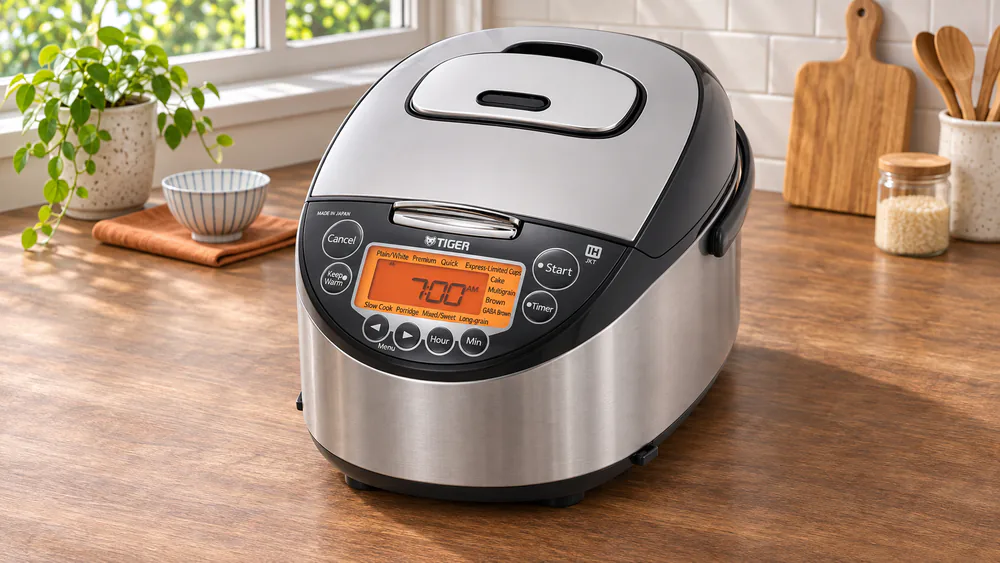
The JKT-D10U has an audible cooling fan during cooking, a drawback to weigh against its strengths; a basic heating-plate cooker does not make that fan noise. In return, rice had distinct grains with a light chew, and brown rice cooked with an even, chewy texture. The difference from the Micom models is real but modest, and it matters most when texture is your priority. If you cook rice daily and notice the difference between good and great, the induction heating is why you would pay more.
Pros
Induction heating with distinct, lightly chewy grains
The longest program list of the five, including GABA brown and Premium
Advertised keep-warm of up to 24 hours
Removable inner lid and steam cap
Cons
Audible cooling fan
No supplied Tacook tray
The premium choice here, and the heaviest at 8.6 lb
It also does not include a Tacook tray, so you give up the rice-and-side trick of the JAX-T10U and JBV-A10U. The program list is the longest here: plain, quick, brown, slow cook, porridge, multigrain, cake, premium, Express-Limited Cups, GABA brown, long-grain, and mixed/sweet.
The JKT-D10U draws 1080W and measures roughly 10.2 inches wide, 14 inches deep, and 8.4 inches high, so allow extra clearance for the lid and steam. Capacity is 5.5 cups uncooked, and the Express-Limited Cups program handles 1 to 2 cups of white rice in as little as 17 minutes, a figure that applies to small white-rice batches and not to full loads or brown rice. The pot is 1.5mm thick and ceramic-powder-coated. Ceramic-coated does not mean solid ceramic or PFAS-free, and Tiger's own disclosure lists this model, so treat coating claims with care.
How to Choose the Right Tiger Rice Cooker
Most buying decisions come down to four questions. How many people do you feed, how much brown rice or other grain do you cook, do you want to cook a side dish with the rice, and does a delay timer matter to you? The sections below go through each one.
Capacity: Uncooked Cups, Cooked Yield, and Minimum Batches
Capacity is the number most shoppers misread. Every Tiger lists capacity in uncooked cups of its own 180mL measure, so 5.5 cups means 5.5 of those cups of dry rice. Cooked yield is larger, but it varies with the rice variety, how much water it absorbs, and how big your serving cup is. Do not plan on an exact doubling.
Note. Check the minimum batch as well as the maximum. The JNP-1800 starts at 3 cups of white rice, the JBS-A55U goes down to 0.5 cups, and the 5.5-cup models start at 1 cup. Brown rice batches are capped lower than white, at 3.5 cups on the JAX-T10U and JBV-A10U, and Tacook batches are capped at 1-2 cups.
For one or two people, the 3-cup JBS-A55U avoids the half-empty-pot problem. For three to five people, the 5.5-cup models are the sweet spot. For a crowd or a weekly batch, the 10-cup JNP-1800 is the one to look at.
Conventional, Micom, and Induction Heating Compared
A conventional cooker like the JNP-1800 heats from a plate under the pot and shuts off with a simple switch. It is the least expensive approach and works well for plain white rice. Micom models, such as the JAX-T10U, JBV-A10U, and JBS-A55U, use a microcomputer to adjust heat through a cycle, which opens the door to brown rice, porridge, and timers. Induction, as in the JKT-D10U, heats the pot itself and gives the finest control, at the cost of a fan, extra weight, and a higher price.
Our takeaway: Micom is the sweet spot for most kitchens. Induction pays off only if you cook rice most days and care about grain separation.
Rice Types, Presets, and Cooking Time
Presets matter if you cook anything other than white rice. The JNP-1800 has none. The JBV-A10U covers plain and brown. The JAX-T10U and JBS-A55U add mixed grains, porridge, and more, and the JKT-D10U has the longest list. Plan around the brown rice cycle, which Tiger's manual puts at 58 to 72 minutes on the JBV-A10U, against 22 to 37 minutes for plain rice. Those are guides, not promises. Rinse your rice with cold water, since warm rinse water can lead to mushy rice, and rinse basmati especially well to keep starch from foaming through the vent. If you want more on ratios and timing, our guides on how long a rice cooker takes and water ratios by rice type go deeper.
Tacook and Simultaneous Cooking
Tacook is Tiger's name for a plate that sits in the pot so you can cook a side dish, such as steamed fish or vegetables, above the rice. In this shortlist, only the JAX-T10U and JBV-A10U supply the plate, which makes it the clearest practical difference for a rice-and-side meal. Rice capacity drops when you use it, to 1-2 cups, so do not expect a full pot of rice and a full tray together. Warm plain rice without the food plate in place, and do not assume the rice-warming guidance applies to mixed dishes.
Keep-Warm Settings and Delay Timers
The advertised keep-warm duration is 12 hours on the JAX-T10U, JBV-A10U, and JNP-1800, and 24 hours on the JKT-D10U. Those are feature limits, not a promise that rice will taste freshly cooked at the end. White rice stayed soft in the JBV-A10U without a hard, burned bottom, which is what you want from a good warmer. Brown rice and mixed grains hold less well, so eat them sooner.
Delay timers are a convenience split. The JAX-T10U offers two finish-time presets and the JBS-A55U has a delayed completion timer, while the JBV-A10U and JNP-1800 have none. If you want rice ready when you walk in the door, that decides it.
Inner Pot Coatings, Cleaning, and Replacement Parts
Pots are coated aluminum or layered metal, so use a soft sponge and nonmetal utensils, and let the pot cool before washing. Keep the lid, vent, and rim clean, and keep grains off the sensor and heating surface. The JAX-T10U and JKT-D10U have 1.5mm pots, the JBV-A10U a thinner 1.0mm pot. Ceramic-coated is not the same as PFAS-free, and Tiger lists the JKT-D10U, JAX-T10U, JBV-A10U, and JNP-1800 in its PFAS disclosure.
Tiger offers official spare-parts support, but match the exact model and part number before you order, and check stock first. We could not verify that any given pot or lid is in stock.
Model Suffixes, Regional Versions, and Warranty Support
Use the full model suffix and electrical rating. The U.S. models here are 120V, and a similar number with a different suffix, like the JBS-A055, is a different regional version. Tiger backs these with a 1-year limited warranty for workmanship defects, but you need proof of purchase and an authorized return, and the coverage applies to U.S. and Canadian residents with 120V products only. Buy from a seller you can return to.
Tiger vs. Zojirushi: Which Fits Your Needs?
Both brands make conventional, microcomputer, and induction cookers, so neither wins every use case. The practical way to decide is at the model level: compare the heating method, the grain menus, the capacity, and the warming controls of the two specific cookers you are considering. Tiger's Tacook plate is a standout for rice-and-side meals, and its range reaches from a basic one-switch cooker to induction. If a Zojirushi model has the specific menu or timer you need, it is a fair alternative, and the same rules about capacity and suffixes apply. Do not pick a brand first and a model second.
Frequently Asked Questions
Are Tiger rice cookers worth the price?
They are for people who cook rice often. The simple models, such as the JBV-A10U and JNP-1800, do one job well. The JKT-D10U costs the most and makes sense only if texture matters to you every day. If you cook rice a few times a month, the budget pick is plenty.
Can Tiger rice cookers cook brown rice and other grains?
Most can. The JAX-T10U, JBV-A10U, JBS-A55U, and JKT-D10U have a brown rice program, and the JAX-T10U and JKT-D10U also offer multigrain or mixed settings. The JNP-1800 is white rice only. Brown rice takes longer and has a lower batch limit than white.
Are all Tiger rice cookers made in Japan?
No. The JAX-T10U, JBS-A55U, JNP-1800, and JKT-D10U are made in Japan, while the JBV-A10U is made in China. Check the listing for the model you buy, since production can differ between versions.
How long do Tiger rice cookers last?
We cannot give a universal lifespan, and nobody can for exact models. Care makes a difference: hand wash the pot with a soft sponge, keep the sensor and heating surface free of grains, and use nonmetal utensils. Official spare parts exist if a lid or pot needs replacing.
Final Verdict: Which Tiger Rice Cooker Should You Buy?
If you cook more than white rice, the JAX-T10U is the one to buy. Choose the JBV-A10U if you want the same capacity and Tacook plate at a lower cost and can live without a timer. The JBS-A55U suits one or two people, the JNP-1800 suits big white-rice batches, and the JKT-D10U is the splurge for texture-focused cooks.