Helping you create a kitchen you love.

Knives

Chef Knife vs Santoku: Blade Shape and Cutting Style

As an Amazon Associate we earn from qualifying purchases. We may earn a commission from links on this page, at no extra cost to you. Learn more.

Chef Knife vs Santoku: Blade Shape and Cutting Style

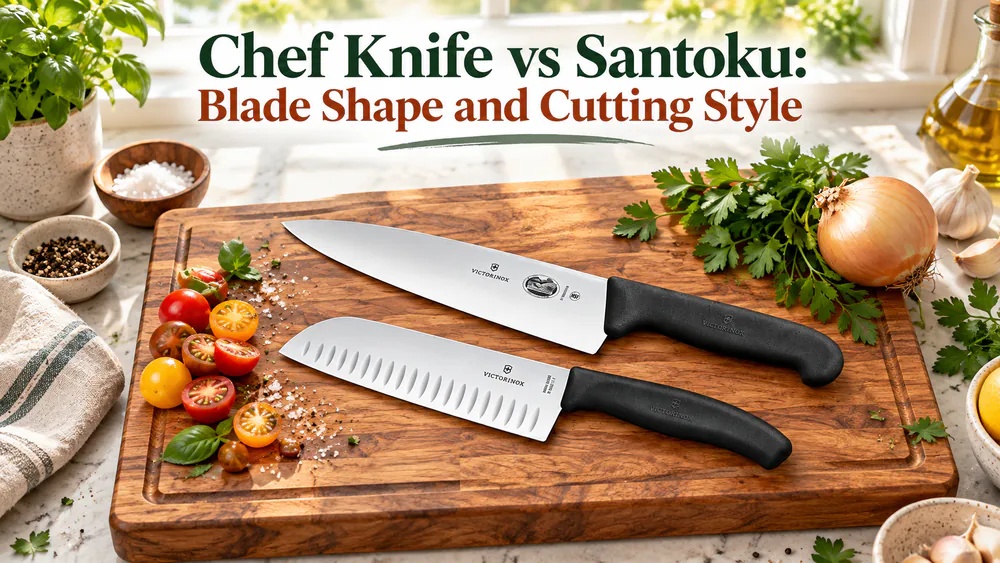
A chef's knife has a curved belly and a pointed tip, so it rocks through herbs and reaches across a big board. A santoku is shorter, with a flatter edge and a rounded nose, so it pushes forward and down through vegetables with a lot of control. The choice comes down to how you move the blade: if you rock, buy the chef's knife, and if you push, the santoku will feel natural.

We put one of each from the same maker through everyday prep, so the shape was the main variable. Both knives are Swiss-made Victorinox Fibrox models, and both handled onions, garlic and soup vegetables well. The real difference was how the blade met the board.

Chef Knife vs Santoku at a Glance

Steel, weight and sharpening angle depend on the individual model, so we left those out of the shape comparison.

CriterionChef knifeSantoku
Edge profileCurved belly, angle varies by modelFlatter working edge, some models curve more
TipPointed and useful for detail workDropped spine and a less pointed nose
Usual lengthCommonly 6 to 10 inches (8-inch example)Commonly 5 to 7 inches (7-inch example)
MotionRocking, slicing and push cutsForward-and-down push cuts; rocking depends on the belly
Food tasksHerbs, garlic, large produce, boneless meatVegetables, fruit, boneless meat and fish
LimitationsLong blades need more board room; not a bone cleaverLess slicing reach and tip access; not a bone cleaver
Board and handling fitMore reach; check handle girth and knuckle clearanceCompact reach; handle fit still matters
Steel and edge angleModel-specificModel-specific
Example we usedVictorinox Fibrox Pro 8-inch Chef's KnifeVictorinox Fibrox 7-inch Granton Edge Santoku

Note. Length ranges are shopping norms, not rules. Shorter and longer examples exist in both shapes, so judge the actual blade in front of you.

What Is the Difference Between a Chef Knife and a Santoku?

The difference is in how each blade meets the board. A chef's knife is built around a curve that lets you pivot the blade. A santoku is built around a flatter edge that lets you drop the blade straight down. Everything else, from tip shape to length, follows from that.

What Is a Chef's Knife?

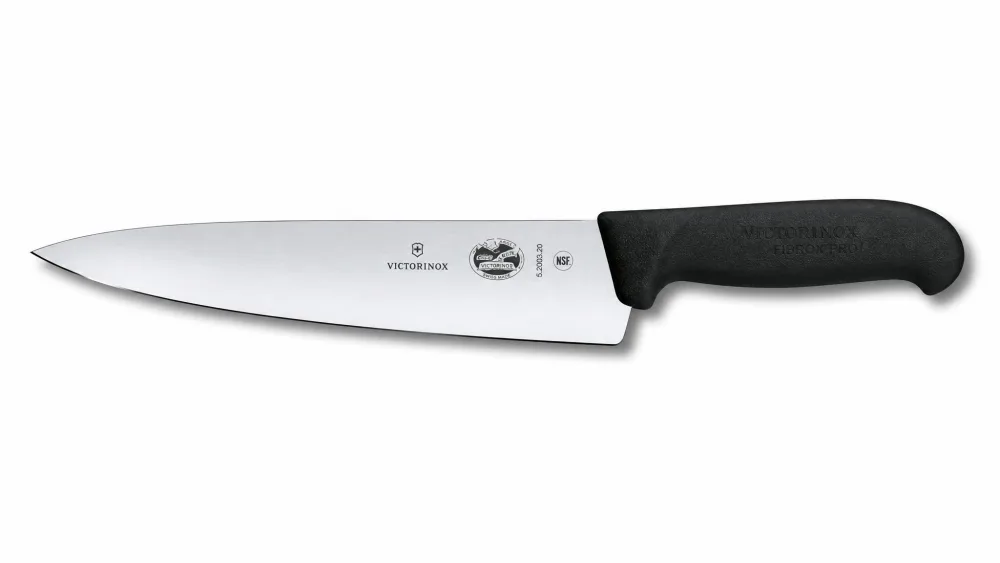
The chef's knife is the all-purpose Western shape and the kitchen workhorse in most homes. It has a curved belly for rocking herbs and garlic, a pointed tip for detailed cuts, and enough length for slicing, push cutting and chopping. Chef knives commonly run from 6 to 10 inches, and 8 inches is the familiar home size.

What Is a Santoku Knife?

The santoku is a Japanese all-purpose shape with a flatter cutting edge and a spine that curves downward toward the tip. It suits controlled forward-and-down cuts through vegetables, boneless meat and fish. Santokus commonly run from 5 to 7 inches. If you want more background on the shape, we cover Japanese knives in a dedicated section of the site.

How Blade Shape and Size Affect Cutting

Blade shape affects how the knife feels from the first few cuts.

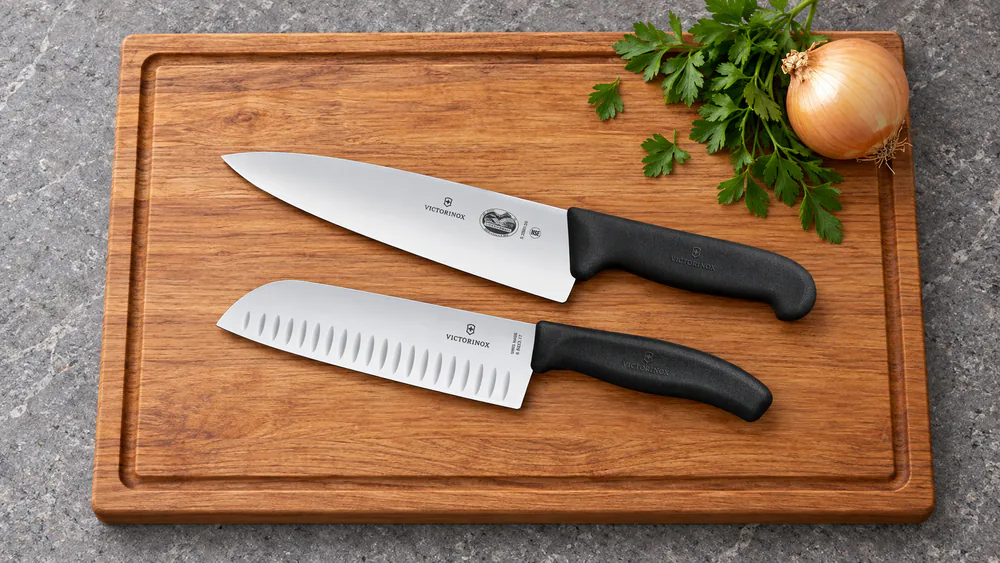
A Victorinox Fibrox 8-inch chef's knife and a 7-inch Granton edge santoku lying side by side on a wooden board, showing the curved belly against the flatter edge and rounded nose
The chef's knife belly curves up toward a point; the santoku edge runs flatter.

Curved Edge vs Flatter Edge: Rocking and Push Cuts

A curved edge lets the tip stay on the board while the heel rises and falls. That is the rocking cut, and it is why a chef's knife is so fast on herbs and garlic. In our kitchen the Fibrox chef's knife rocked comfortably through herbs and handled ordinary chopping and dicing well.

A flatter edge contacts the board along more of its length. That suits a push cut, where you move the knife forward and down in one motion. Some santokus have enough belly to rock, usually the ones that combine a short blade with a curved edge, so check the profile before you assume.

Pointed Tip vs Rounded Tip

The chef's knife tip handles scoring and trimming. The santoku's rounded nose is less useful there. We found the shorter santoku easier to steer in close prep, but we reached for the chef's knife whenever a job needed the point.

Blade Length, Weight and Handle Fit

An 8-inch chef's knife gives you reach across a large onion or a melon. The 7-inch santoku gives up some of that reach in exchange for control. Handle girth, knuckle clearance, balance and grip matter as much as length. The Fibrox chef's knife has a broad blade with useful knuckle clearance, and its textured handle keeps a secure grip when wet. It can feel blade-heavy, though, and the synthetic handle takes adjustment if you are used to a smooth, weighty one.

The Fibrox santoku feels light in use, and its plain handle stays secure with wet or greasy hands. It lacks the substantial feel of a heavier forged knife.

Steel, Edge Angle and Food Release Depend on the Model

Neither silhouette guarantees a sharper edge, better edge retention or lighter weight. Steel, hardness, weight and bevel vary by model, so a santoku is not inherently sharper than a chef's knife. Japanese manufacture does not make a blade a santoku either.

Food release works the same way. The Granton flutes on our santoku may reduce adhesion, but potato, cucumber and carrot slices still clung to the blade in use. Treat the dimples as a small help, not a promise.

Which Knife Works Best for Everyday Prep?

Vegetables, Fruit and Large Ingredients

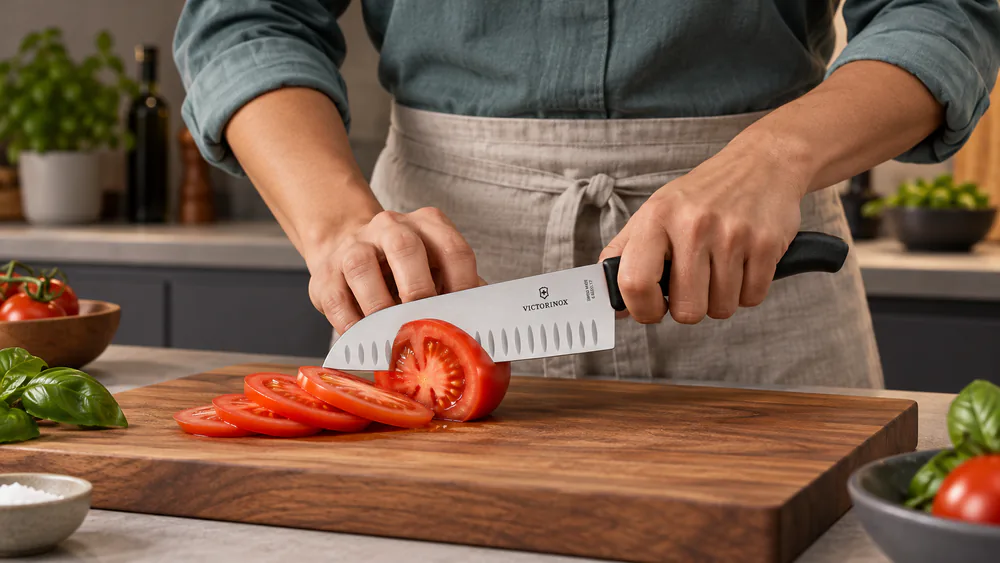
The Fibrox chef's knife slices onions with little pressure, and the long blade clears a big squash or cabbage in fewer strokes. The Fibrox santoku is nimble for vegetable prep and cut thin tomato slices cleanly without heavy downward force. Its shorter blade runs out of reach on large roasts and oversized produce, so big jobs favor the chef's knife.

Herbs, Garlic and Fine Chopping

The curved edge earns its place here. Rock the chef's knife with your free hand resting on the spine near the tip, and a pile of parsley turns into a fine mince quickly. A santoku can mince too, but with a slower push-and-lift motion unless your model has some belly.

Boneless Meat and Fish

Either shape handles boneless chicken, steaks and fish fillets. The santoku's short, controlled stroke is pleasant for trimming and portioning, while the chef's knife gives longer slicing strokes for a roast or a large fillet. For fine peeling or filleting, neither Fibrox does as well as a dedicated, narrower blade.

Which Knife Should You Buy First?

Choose a Chef's Knife If You Prefer Rocking Cuts and More Reach

Pick the chef's knife if you rock the blade, cook for a crowd, or often cut large ingredients. It is the more flexible first knife because the pointed tip and curved belly cover more tasks.

Victorinox Fibrox Pro 8-inch Chef's Knife
1

Victorinox Fibrox Pro 8-inch Chef's Knife

Best Chef's Knife to Start With
Check Price on Amazon

The 8-inch Fibrox Pro is the chef's knife we would hand a new cook. It rocks comfortably through herbs, slices onions with little pressure, and keeps a secure grip when the handle is wet. It cleans quickly with a soapy hand wash and immediate drying, and it sharpens back readily, although careless sharpening can leave visible scuffs on the blade face. The trade-offs are real: it can feel blade-heavy, and the textured synthetic handle takes adjustment if you prefer a smooth, weighty handle.

Pros

  • Curved belly rocks smoothly through herbs and garlic
  • Broad blade gives useful knuckle clearance
  • Handle stays secure when wet
  • Sharpens back readily and cleans quickly
  • Lifetime coverage for material or manufacturing defects

Cons

  • Can feel blade-heavy
  • Textured synthetic handle takes adjustment
  • Better at chopping and dicing than fine peeling or filleting

Choose a Santoku If You Prefer Push Cuts and a Shorter Blade

Pick the santoku if you push-cut, work on a compact board, or find a long blade intimidating. A shorter blade is easier to control, though a shorter chef's knife is another route to the same comfort.

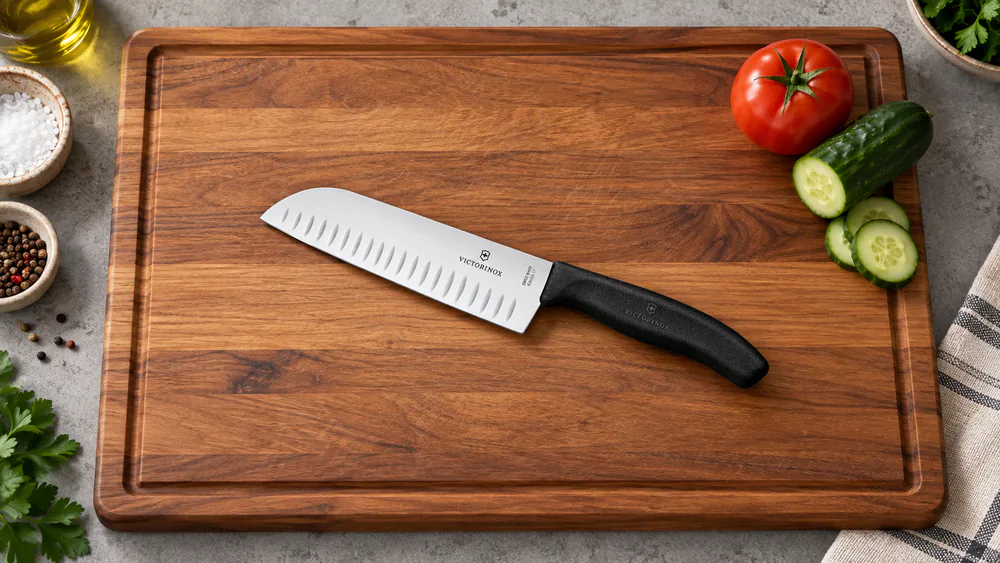
Victorinox Fibrox 7-inch Granton Edge Santoku
2

Victorinox Fibrox 7-inch Granton Edge Santoku

Best Santoku for Vegetable Prep
Check Price on Amazon

The 7-inch Fibrox santoku is nimble for vegetable prep and light in your hand. It cut thin tomato slices cleanly without heavy downward force, resharpened without fuss, and cleaned easily after everyday prep because the smooth construction leaves few crevices for food to collect. The fluted blade did not stop potato, cucumber and carrot slices from sticking, and the shorter blade runs out of reach on large roasts.

Pros

  • Light and easy to steer in close prep
  • Handle stays secure with wet or greasy hands
  • Smooth construction cleans easily
  • Straightforward to resharpen

Cons

  • Shorter blade runs out of reach on large roasts
  • Flutes do not reliably prevent sticking
  • Plain handle lacks the heft of a forged knife
A 7-inch Victorinox Fibrox santoku pushing through a ripe tomato on a wooden cutting board, thin slices fanned out beside the blade
Thin tomato slices came off the santoku without heavy downward force.

Do You Need Both?

Most home cooks do not. The two overlap on vegetables, boneless meat and fish. A second knife makes sense when your prep splits into two jobs: the chef's knife for herbs, big produce and roasts, and a lighter santoku for quick vegetable work or a second cook sharing the board.

Care and Sharpening: What Changes Between Models?

Not much changes between the two shapes. Both need the same basic care, but follow the maker's instructions for your specific model.

  • Hand wash with mild soap and a soft sponge, then dry promptly. Dishwasher-safe materials do not make machine washing the best routine for an edge.
  • Use controlled slicing pressure, avoid sideways twisting, and keep bones and frozen food for tools designed for them.
  • Cut on an edge-friendly board, and protect the edge in storage.

Sharpening advice for one model may not apply to another. A honing angle is not automatically the factory grinding angle, so do not assign one angle to every chef knife and another to every santoku. Follow the instructions for your knife and your sharpener. Both Fibrox knives sharpen back readily, but a careless pass can scuff the blade face.

Sharpening intervals vary a great deal with use, board choice and maintenance. We do not promise a fixed schedule; touch up the edge when cutting performance declines.

Frequently Asked Questions

Is a chef knife or santoku better for beginners?

A chef's knife is the more flexible first knife because it covers rocking, slicing and detail work. A santoku is easier to steer, so it can feel less intimidating if you mostly cut vegetables with a push motion. Pick the motion you will actually use.

Which knife is more comfortable for small hands?

Not automatically the santoku. Handle girth, knuckle clearance, balance and grip matter alongside blade length, and a shorter chef's knife is another option. Hold both if you can, and check that your knuckles clear the board.

Can you rock-chop with a santoku?

Some santokus have enough belly to rock, especially short blades with a curved edge. A flatter model is better used with a push cut. Judge the actual edge profile instead of the name.

Do santoku dimples stop food from sticking?

They may help, but they do not guarantee food release. On our Granton edge santoku, potato, cucumber and carrot slices still stuck to the blade. Moisture and slice shape matter as much as the flutes.

Can either knife cut through bones or frozen food?

No. Neither is a bone cleaver. Keep bones and frozen food for tools made for them, since twisting or forcing a thin blade through them can damage the edge.

Is a santoku the same as a gyuto?

No. A gyuto is a Japanese chef-knife style, while a santoku is shorter and flatter. A knife being made in Japan does not make it a santoku.

Final Verdict: Choose for Your Cutting Style

If you rock the blade or cut big ingredients, buy the 8-inch chef's knife. If you push cut and want a lighter, shorter knife, buy the 7-inch santoku. Match the knife to your motion and learn the sharpening routine for your model.

Read next

Final Verdict: Choose for Your Cutting Style

Explore more kitchen guides to find tools that fit the way you cook.