As an Amazon Associate we earn from qualifying purchases. We may earn a commission from links on this page, at no extra cost to you. Learn more.
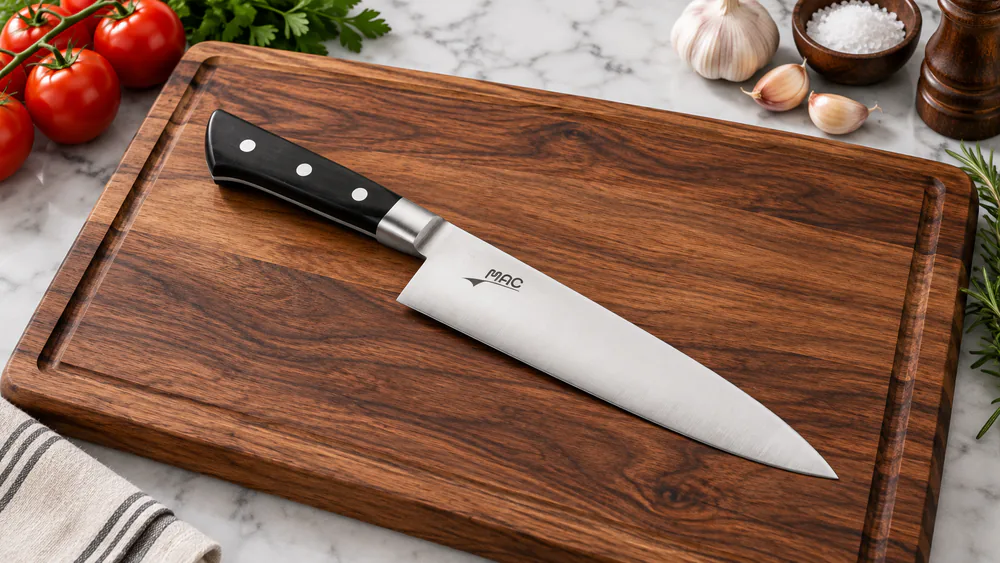
The MAC MTH-80 is the one we would buy first. It pairs a thin, keen edge with a bolstered Professional Series build, and it slices carrots, tomatoes and delicate herbs cleanly with a light hand. It does want careful drying and gentle use.
If that handle or the cost of the Professional line gives you pause, the other four knives here each solve a different problem. This guide walks through all five, explains how the series differ, and shows who each knife actually suits. The picks sit in the same family as the blades in our Japanese knife guides, so you can compare them against the wider field.
Best MAC Chef Knives at a Glance
Here is the short version before the detail. Every knife below is a Japanese-made MAC blade in the 8-inch or 8.5-inch class, and each one earns its place for a different kind of cook.
The MTH-80 is our pick for controlled, precise general prep. The TH-80 is the lower-cost dimpled alternative with a lighter, simpler build. The HB-85 is the lightest chef knife in the MAC range and gives you extra reach without much weight. The MBK-85 is the heavier, French-style Professional blade for cooks who like some heft. The SA-80 swaps the pointed tip for a rounded one and lifts the handle for board clearance.
Model code
Series
Blade length
Distinguishing feature
Best for
MTH-80
Professional
8-inch class (7.88 inches specified)
Dimples and bolster
General prep and controlled precision
TH-80
Chef
8-inch class (7.88 inches specified)
Dimples without bolster
Lower-cost dimpled alternative
HB-85
Chef
8.5-inch class (8.38 inches specified)
Light, narrow gyuto
Low weight with extra reach
MBK-85
Professional
8.5-inch class
French-style taper and plain blade
More heft and a longer plain blade
SA-80
Superior
8-inch class (8.13 inches specified)
Rounded tip and raised handle
Rounded-tip preference and board clearance
The "best for" column is our editorial read of each knife's design, not a promise from the manufacturer. The sections below explain the reasoning.
If you are short on time, the quickest filter is hand size and cutting style. Larger hands and a taste for heft point toward the MBK-85 or the SA-80. Small to average hands and a preference for speed point toward the HB-85 or the TH-80. Everyone else should start with the MTH-80 and see whether the handle suits them.
How We Tested These MAC Chef Knives
We judge a chef knife the way a working kitchen does. Initial sharpness matters less than how the blade handles a full prep session, how comfortable the handle remains, and how easily the steel sharpens to a fine edge. Those three questions drive every verdict in this guide.
Our verdicts rest on each model's published specification, its series construction, and how its design suits the board tasks below. We apply the three questions above to every design, and the ratings here reflect what each knife should do on the board.
We judge each knife against the same set of tasks. Thin tomato slices show how keen the edge is and how much pressure the blade needs. Fine onion dice show how the tip and the first inch of the edge behave. Carrots and herbs show whether the blade wedges or glides. A rocking chop on the board shows whether the profile suits that motion, and a long push cut shows how the knife feels in the pinch grip.
We also read the specification sheets closely, because the model codes are easy to confuse. The MTH-80 and TH-80 look nearly identical in photos, yet one has a bolster and sub-zero-treated steel and the other does not. We kept the two entirely separate, and we never carry an award or a finding from one over to the other.
Our star ratings are editorial scores. They reflect cutting feel, handle comfort, how forgiving the knife is of normal kitchen habits, and how well it fits a clear type of cook. They are not lab measurements, and we do not publish edge-retention hours or sharpness numbers we did not measure. Where a published spec differs between sources, such as exact weight or blade thickness, we give the nominal figure and say so.
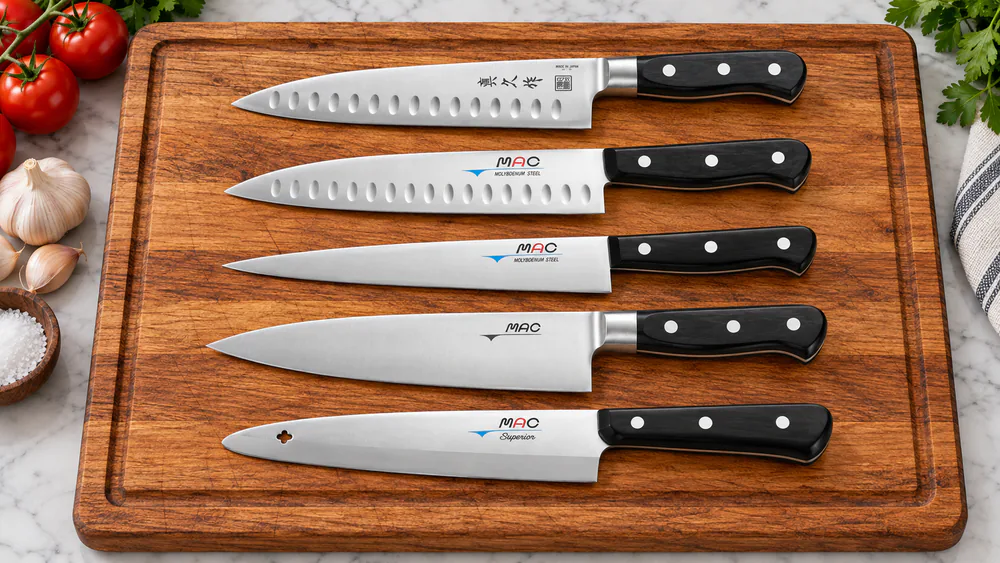
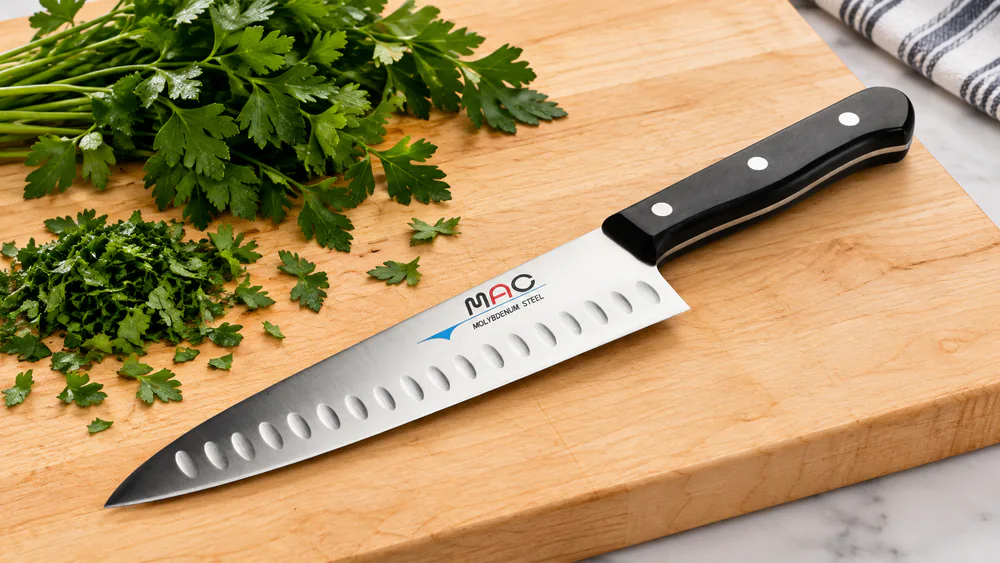
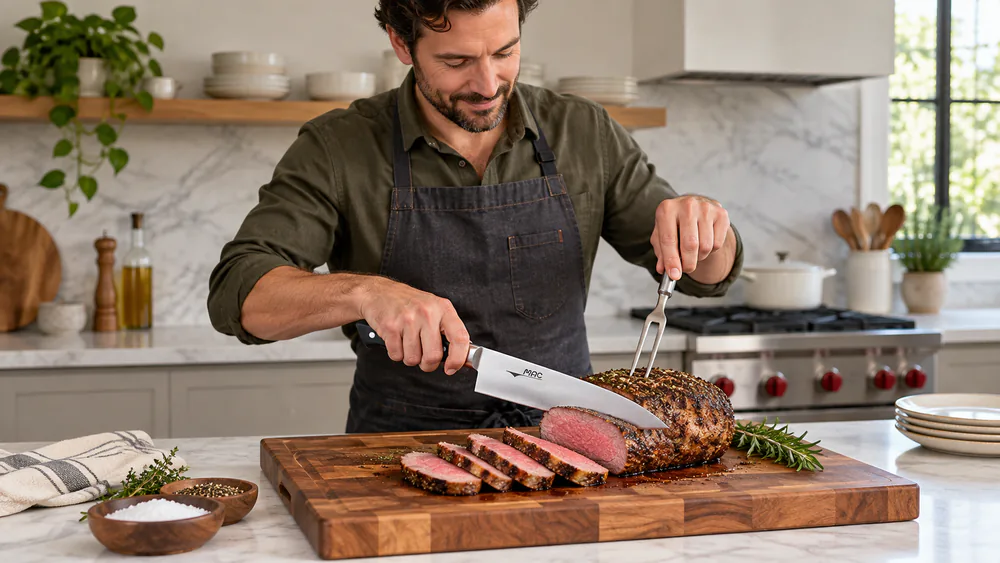
The five picks side by side: pointed gyuto profiles, a French-style blade and a rounded-tip Superior.
Note. MAC sells through many channels, but the 25-year US limited warranty covers only new knives bought from an authorized seller. Check the "Sold by" name on any listing before you buy.
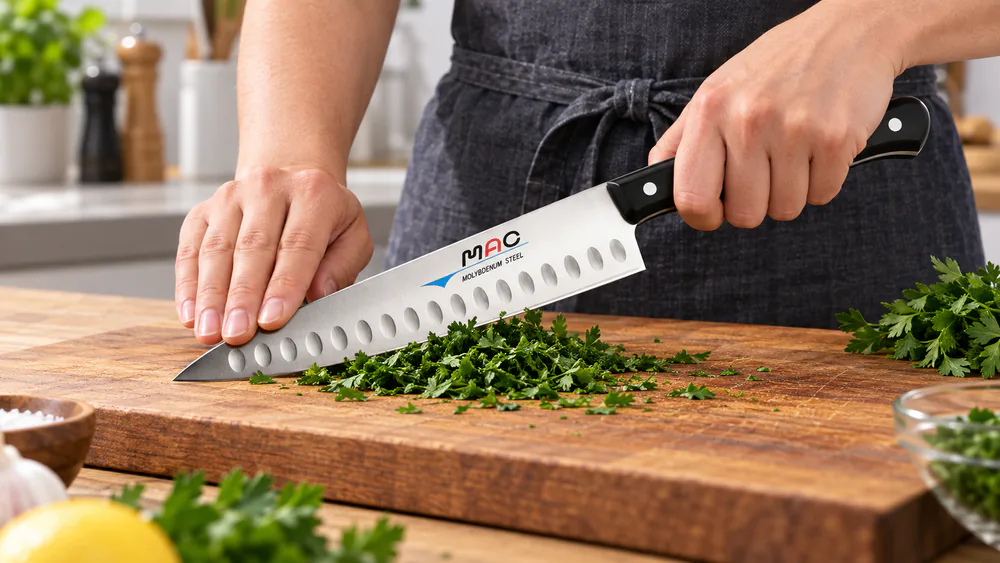
The MTH-80 is the knife we reach for first because it cuts with so little effort. It slices carrots and delicate herbs cleanly, and the edge handles both push cuts and a moderate rocking motion. A light touch gives thin tomato slices and fine onion dice, while heavy pressure just drives the edge into the board. Treat it as a precision slicer and it rewards you.
Pros
Thin, keen edge that slices tomatoes, carrots and herbs cleanly
Balanced feel that makes routine family prep comfortable
Supports push cuts and moderate rocking
Bolstered Professional Series build with sub-zero-treated steel
Narrow profile that maneuvers well around small ingredients
Cons
Short handle can feel cramped in large hands
Dimples give only a modest food-release benefit
A fall onto tile can chip the heel corner
Heavy cutting suits it less than a broader, thicker blade
Who the MTH-80 suits
This knife suits home cooks who spend most of their prep time slicing and dicing vegetables, herbs and boneless proteins. It also suits anyone who has used a heavy German-style blade and wants something noticeably lighter and thinner.
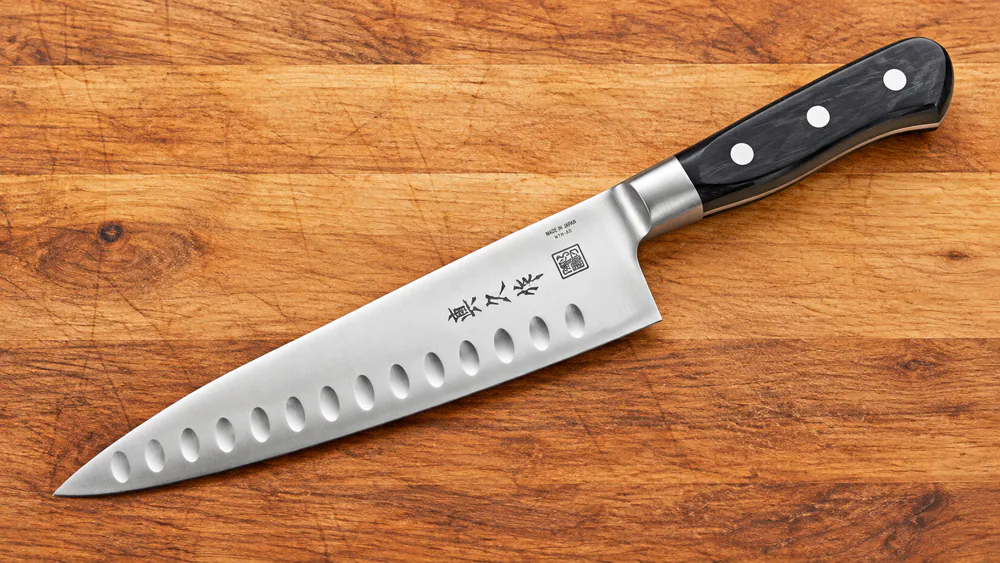
The blade is an 8-inch class knife with a specified 7.88-inch blade, a 12.63-inch overall length and a 1.88-inch blade height. The nominal weight is 6.5 oz, and the nominal thickness is 2.5 mm. Individual samples vary a little, so treat these as the nominal specification.
The handle is the make-or-break detail. It works well in a pinch grip, where your thumb and forefinger hold the blade just ahead of the bolster, and the balance there feels confident. If you have very large hands or you grip the handle with all four fingers wrapped around it, you may want more handle length. We would suggest holding one before you commit if you can.
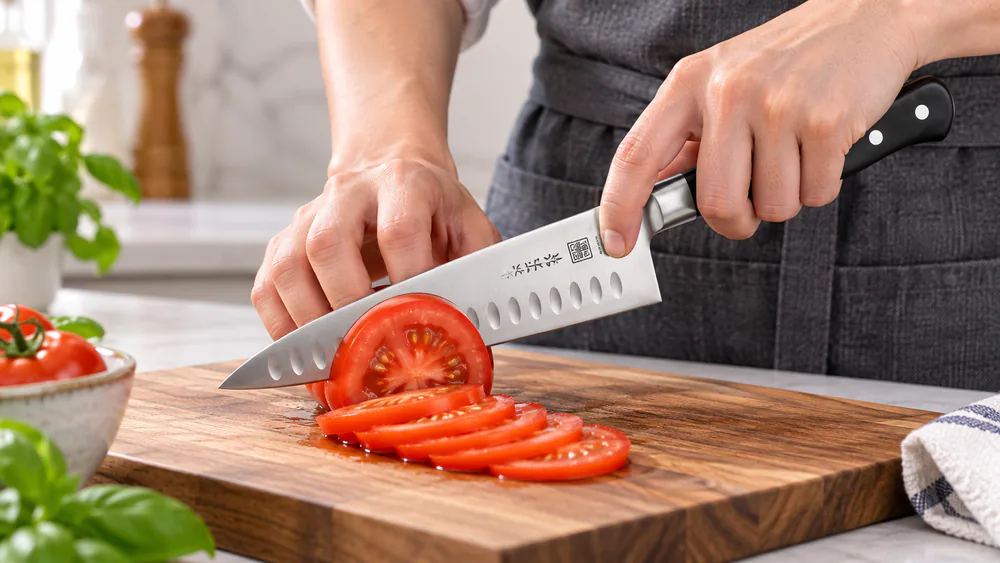
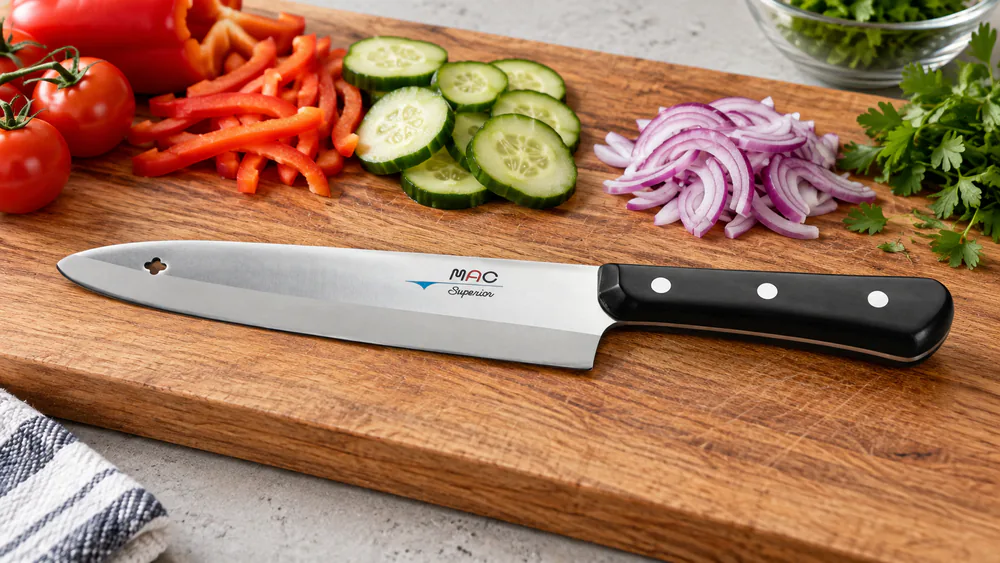
A light touch is all the MTH-80 needs for thin tomato slices.
Strengths and trade-offs
The strength is cutting feel. The edge is thin enough that the knife seems to do the work, and the narrow profile lets you get into small spaces, such as trimming around a pepper or dicing a shallot. The balance is good, so a long prep session does not tire the wrist.
The trade-offs are practical ones. The narrow blade carries fewer chopped ingredients than a broad one, so you will scrape more often when you are dicing a full onion. The dimples are a small help with sticky slices, but sticky slices will still cling to the blade. Do not buy this knife expecting nonstick performance.
Heavier tasks are where the MTH-80 feels least at home. The balanced feel and thin edge make routine family prep comfortable, but very dense produce is better handled by a broader, thicker blade. We think of the MTH-80 as the knife for the soft, juicy and leafy majority of board work, and we would keep a sturdier knife nearby for the rest.
That is not a criticism so much as a job description. A knife this thin earns its keep by being delicate, and it is better to match it to delicate work than to ask it to do everything.
Care matters more with this knife than with a typical stainless blade. Wipe it dry after each use and store it on a magnetic strip or in a wooden block, and discoloration stays under control. The printed logo can wear over long use, but that is cosmetic and the knife stays fully serviceable. Impact is the real weakness, since a drop onto a hard floor can chip the heel corner. That is a reason to treat this as a board knife rather than a prying or scraping tool.
The TH-80 is the sensible alternative when the MTH-80 feels like more knife than you need. It is lighter at 6.0 oz, it has no bolster, and the gradual gyuto taper accommodates both rock chopping and general slicing. The light feel and balance make everyday slicing and dicing easy to control. The compromise is a blade-to-handle transition that feels less smooth than the MTH-80's.
Pros
Light, well-balanced feel that is easy to control
Profile that handles rock chopping as well as slicing
Edge that stays useful through routine chopping with basic maintenance
Lower-cost entry into the dimpled MAC range
Pakkawood handle and molybdenum steel, made in Japan
Cons
Blade-to-handle transition is less smooth and comfortable than the MTH-80
Vegetables can still stick despite the dimples
Small rust spots can appear if it is washed and not dried thoroughly
No bolster and no sub-zero treatment
Who the TH-80 suits
The TH-80 suits cooks who want a dimpled, Japanese-made chef knife in the mid-priced tier and are comfortable with a lighter build. It is an easy first MAC for someone moving up from a department-store knife, because it feels familiar in the hand and cuts far better than most knives at a similar tier.
The official specification lists an 8-inch class blade, a 7.88-inch specified blade length, a 12.65-inch overall length and a 1.90-inch blade height. The blade is 2.0 mm thick and the knife weighs 6.0 oz. Those numbers make it a touch thinner and lighter than the MTH-80 on paper.
It also leans toward the rocking style of cutting. If you chop herbs by rocking the blade across the board, the TH-80's profile handles that comfortably, which is part of why home cooks who move between slicing and chopping like it.
TH-80 compared with MTH-80
These two knives share a blade length class, dimples and a pointed tip, and that is where the overlap ends. The MTH-80 is Professional Series, with a welded bolster and sub-zero-treated steel. The TH-80 is Chef Series, with no bolster and no sub-zero treatment. Keep that straight when you read other reviews, because the two are often mixed up, and an endorsement of one is not an endorsement of the other.
In the hand, the difference shows up at the handle. The TH-80's blade-to-handle transition feels less smooth and less comfortable than the MTH-80's, which you notice most in a long prep session or when you hold the knife in a pinch grip. For short sessions and mixed chopping, the difference is easy to live with.
On care, both knives want to be dried after washing. The TH-80 can show small rust spots if it is left damp. Cleaning those spots off and drying the knife after each use restores it to practical condition, so this is a habit issue rather than a flaw in the steel.
The TH-80 sits in the mid-priced tier and the MTH-80 sits in the premium tier. For a cook who values the smoother handle feel and the extra build, the step up is worth it. For a cook who wants a keen, light dimpled knife and will not miss a bolster, the TH-80 is the easier recommendation.
The TH-80 profile accommodates a rocking chop as well as straight slicing.
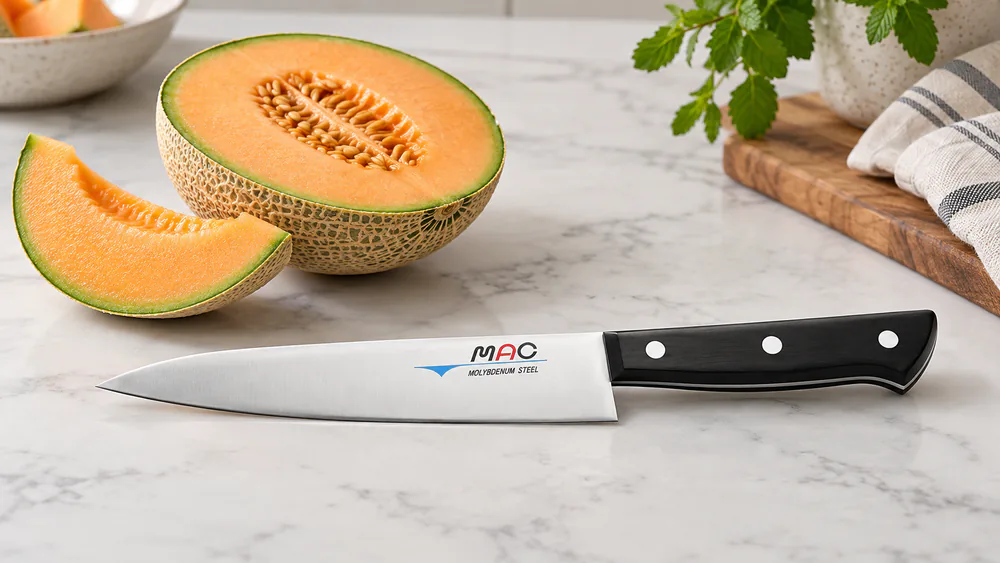
The HB-85 has a plain 8.5-inch class blade instead of the TH-80's dimples and, at 4.9 oz, is the lightest chef knife in the MAC range. The shape and length work well for routine home prep, and the edge holds up usefully between sharpenings. It is also the budget pick of the five. The slim handle can feel too small in larger hands, and the low price does not automatically make it the most comfortable knife.
Pros
The lightest chef knife in the MAC range
Simple profile and length that suit routine home prep
Useful edge retention between sharpenings
Extra blade length without added heft
The most accessible tier of the five
Cons
Slim handle can feel too small in larger hands
Narrower blade at 1.63 inches tall
Not the most comfortable or compelling knife in a head-to-head comparison
Plain blade with no dimples
What the HB-85 gives up and who it suits
The HB-85 suits cooks with small to average hands who care about weight. Anyone with wrist or hand fatigue after long prep sessions will appreciate a knife this light. It is also a good fit for someone who wants the 8.5-inch reach for slicing larger items, such as a melon or a roast, without taking on a heavy blade.
The numbers explain the feel. It has an 8.5-inch class blade with a specified 8.38-inch length, a 12.94-inch overall length, a 1.63-inch blade height and a 2.0 mm thickness. At 4.9 oz, it weighs noticeably less than the other knives in this guide.
Think of it as the budget entry in a good family. It is not a lesser knife in terms of cutting, since the gradual gyuto taper and pointed tip are the same sort of profile as the TH-80's. What you give up is mostly handle comfort and the dimples.
Blade length and handling trade-offs
An extra half inch of blade sounds small, but it changes how the knife behaves. The longer edge lets you draw through a long cut in a single stroke. The cost is a narrower blade, at 1.63 inches tall, which gives your knuckles less clearance over the board than the taller MTH-80 and TH-80.
Because the knife is so light, it feels quick, but it also gives you less momentum for a tough cut. If you like to let a heavier blade fall through a squash, the HB-85 will feel underpowered. If you prefer to guide a light blade through soft ingredients, it feels precise.
The slim handle is the second trade-off. In a pinch grip it is fine, and the knife stays controlled. In a full-hand grip it can feel too small, especially if you have larger hands. Handle fit is personal, so this is the one spec worth testing in person if you can.
Edge retention is a quieter strength. The simple profile gives useful edge retention between sharpenings, and the steel responds to a quick pass on a strop. We would still keep expectations realistic: no thin Japanese-made blade stays sharp forever, and the HB-85 is a knife you maintain rather than one you forget about. Used sensibly, it gives you a low-fuss edge for a long stretch of weeknight cooking.
The HB-85 will not win a comfort comparison against the MTH-80, but it does not have to. It is the choice when weight and the lowest cost in the family matter most.
Where the HB-85 is light and narrow, the MBK-85 is the Professional Series knife for cooks who want more blade and more weight. It has a French-style profile with a slightly curved edge, a faster taper toward the point than a gyuto, and a plain blade with no dimples. The edge is keen and the grip comfortable. The extra reach can feel excessive on a compact home board, which is why it sits fourth despite its quality.
Pros
Keen edge that takes a fresh edge readily and holds it well
Comfortable grip
Professional Series build with a welded bolster
Gentle curve that suits a rocking cut
Light maintenance with a strop or honing tool preserves a working edge
Cons
The extra reach can feel excessive for compact home prep
Heaviest of the five at a nominal 7.2 oz
Longest overall at 13.31 inches, so it needs board space
The splurge tier of the five
Who the MBK-85 suits
The MBK-85 suits cooks who prefer a French-style knife and have the counter space to use it. If your board is generous and you slice large roasts, cabbages or melons, the long, plain blade earns its length. It also suits someone who finds the MTH-80 too light and wants a more substantial feel without moving to a thick German blade.
The specification gives an 8.5-inch class blade, a 13.31-inch overall length, a 1.72-inch blade height and a 2.5 mm thickness. The nominal weight is 7.2 oz. Retail measurements for the blade length vary a little between regions, so treat 8.5 inches as the model class rather than an exact figure.
Sharpening is a pleasant surprise. The steel takes a fresh edge readily and holds it well in ordinary use, and light maintenance with a strop or a suitable honing tool keeps a useful working edge between full sharpenings. That matches what we look for in a knife that a home cook can keep up without a full sharpening kit.
MBK-85 compared with HB-85 and MTH-80
Against the HB-85, the MBK-85 shares the 8.5-inch length and little else. The HB-85 is a light, narrow Chef Series gyuto, while the MBK-85 is a heavier Professional Series French profile with a welded bolster. The MBK-85 weighs about 2.3 oz more and is taller in the blade, so it carries more ingredients and feels more planted. It also costs a good deal more.
Against the MTH-80, the difference is shape and length. The MTH-80 has dimples, a gyuto-style profile and an 8-inch class blade, and it feels nimble. The MBK-85 is longer, plain and a little heavier, and it favors long slicing strokes and a gentle rock. Both are in the Professional Series, so the steel and bolster build are the same sort.
If you want the more versatile everyday knife, the MTH-80 wins. If you already know you like a longer blade and a French curve, the MBK-85 is the better fit. It is a knife for a specific preference, which is why it sits behind the first three for most readers.
Board space matters too. At 13.31 inches overall, the MBK-85 is the longest knife in this guide, and it needs a board with room to swing the tip. On a small apartment counter it can feel like driving a bus down a narrow street. On a large butcher block it feels at home, and that is where we would put it. Cooks who like a calm, deliberate slicing stroke will enjoy that room.
The MBK-85 shines on long slicing strokes, and it wants a generous board.
The SA-80 is the odd one out in this lineup, and that is its appeal. It has a rounded tip rather than a pointed one, a hole in the blade for hanging, and an upswept handle that lifts your knuckles off the board. The factory edge cuts keenly, and the larger handle compared with the older UK-80 can be comfortable. Its profile feels closer to a santoku than a pointed gyuto, so it is capable but less versatile than the TH-80.
Pros
Keen factory edge
Larger, comfortable handle compared with the Original UK-80
Raised handle gives extra knuckle clearance over the board
Sub-zero-treated Superior steel
Rounded tip is friendly for cooks who dislike a sharp point
Cons
No fine pointed tip for detailed work
Can feel less versatile than the TH-80
Profile leans toward santoku territory
Hanging hole is a feature some cooks will not use
Who the SA-80 suits
The SA-80 suits cooks who like the feel of a santoku but want a true chef knife length and shape. It is also a good choice for someone who finds a sharp tip intimidating or who keeps catching their knuckles on the board. If you are weighing the two styles, our chef knife vs santoku comparison explains the differences in detail.
The numbers are straightforward. It has an 8-inch class blade with a specified 8.13-inch length, a 13.06-inch overall length, a 1.79-inch blade height and a 2.0 mm thickness. The nominal weight is 6.0 oz. Slight differences between retailers' figures are normal, so use these as the specification.
One point worth knowing is that the Superior Series is not simply a cheaper Professional line. The steel is sub-zero-treated, the handles are elevated, and the tips are rounded. It is a different design, and you should judge it by its own profile.
Shape, handling and value trade-offs
The rounded tip is the defining trade-off. You lose the ability to pierce or to make fine, detailed cuts at the tip, such as trimming a shallot root or scoring a delicate piece of fish. You gain a forgiving shape that is hard to jab into your other hand or a bag liner.
In general prep, the SA-80 remains capable. It slices and chops well, and the upswept handle gives your knuckles room. Even so, the TH-80 can feel more versatile, because its pointed tip and gyuto taper cover more tasks. The SA-80 is a better fit for a cook who has already decided on a rounded tip.
A word on the hanging hole. It is a feature of the Superior Series, and it gives you a place to hang the knife if you keep your tools on a rail or hook. If you use a magnetic strip or a block, the hole does nothing for you, and it does not interfere with cutting either.
On value, the SA-80 sits in the mid-priced tier alongside the TH-80. The question is which shape you prefer. If you want the greatest range of cuts, buy the TH-80. If you want comfort, clearance and a rounded tip, the SA-80 is the stronger value for you.
The right MAC comes down to four decisions: the series, the blade length and shape, how the handle fits your hand, and how much care you are willing to give the steel. Settle those and the model almost chooses itself.
Before the detail, decide what you cut most. A cook who mostly makes salads, stir-fries and weeknight vegetables has different needs from a cook who breaks down roasts and large melons every weekend. Write that down, and the rest of this section becomes a filter rather than a list of specifications.
Professional, Chef and Superior series
MAC organizes its chef knives into series, and the series tell you more than the model code does.
The Professional Series uses thin, stamped blades with welded bolsters and sub-zero-treated steel, with Pakkawood handles. The MTH-80 and MBK-85 live here. The bolster adds a little weight and protects your fingers, and the sub-zero treatment is part of what separates the MTH-80 from the TH-80.
The Chef Series uses stamped blades without bolsters, with traditional pointed profiles and Pakkawood handles. The TH-80 and HB-85 live here. These knives are lighter, simpler and lower in cost, and they cut very well for the price.
The Superior Series uses sub-zero-treated Superior steel, elevated handles, rounded tips and hanging holes. The SA-80 lives here. It is not an untreated version of the Professional line, so do not treat it as a step down.
If you want the most refined build, buy from the Professional line. If you want the best value for a dimpled or lightweight knife, buy from the Chef line. If you want a rounded tip and knuckle clearance, buy from the Superior line.
Tip. Do not use the model code alone to compare listings. An MTH-80 and a TH-80 look almost the same in photos, so confirm the series and the bolster before you buy.
Blade length, shape and cutting style
Blade length is the first physical choice. The 8-inch class suits most home boards and most hands, and it is the easiest length to control. The 8.5-inch class adds reach for long slicing and big produce, but it needs more board and a more confident grip.
Shape follows from how you cut. A pointed gyuto profile, as on the MTH-80, TH-80 and HB-85, suits both push cuts and a moderate rock. A French-style profile, as on the MBK-85, has a slightly curved edge and a faster taper toward the point, which suits a gentle rocking stroke and long slices. A rounded-tip knife, like the SA-80, gives up the fine point for a friendlier, santoku-like feel.
If you do a lot of detailed work, choose a pointed tip. If you mostly chop and slice at a steady pace, any of the five works. If you are weighing a very different style, our guide to chef knife sets for home cooks shows how a chef knife fits into a fuller kit.
Handle comfort, balance and weight
Handle comfort is where these knives separate most clearly. The MTH-80 handle works well in a pinch grip but can feel cramped in large hands. The HB-85 handle is slim and can feel too small. The SA-80 has a larger, comfortable handle, along with a raised heel for clearance.
Weight shapes the feel as much as the handle. The HB-85 is the lightest at 4.9 oz, the TH-80 and SA-80 sit at about 6.0 oz, the MTH-80 is a nominal 6.5 oz, and the MBK-85 is the heaviest at a nominal 7.2 oz. Lighter knives feel quick and reduce fatigue. Heavier knives give you more momentum for tougher cuts.
Hold the knife in a pinch grip if you can, with your thumb and forefinger on the blade just ahead of the handle. In a pinch grip, these MAC handles are comfortable. If you wrap all four fingers around the handle, check the length first.
Balance is the other half of comfort. A knife that balances at the bolster or just ahead of it feels neutral and quick, and one that tips toward the tip feels aggressive. Of the five, the bolstered Professional knives feel the most settled in the hand, while the lighter Chef Series knives feel livelier.
Dimples, food release and edge geometry
Hollow-edge dimples are the MTH-80 and TH-80's signature. They are meant to reduce sticking by letting air in between the blade and the food. In practice, the benefit is modest. Sticky slices still cling to the blade, and vegetables can stick despite the dimples. Treat them as a small bonus, never a reason to choose a knife.
The marketing promise of dimples is reduced sticking, and the honest answer is that the gain is small and inconsistent. Sticky slices will still cling to the blade, so you should not pick the MTH-80 or TH-80 over a plain blade on the strength of the dimples alone. Choose them for the edge, the profile and the handle, and enjoy the dimples as a minor extra.
Edge geometry matters more. These blades are thin, which is why they cut so cleanly, and also why they reward a light touch. Excess downward force drives the edge into the board. We do not quote an exact hardness or bevel angle, because published figures and measured samples disagree, and it is better to follow the existing bevel when you sharpen.
A thin, keen edge rewards a light hand. Force is the enemy of a good MAC.
Price, seller and warranty considerations
We do not publish product prices here, but the tiers are easy to describe. The HB-85 is the budget pick. The TH-80 and SA-80 sit in the mid-priced tier. The MTH-80 is premium, and the MBK-85 is the splurge of the five.
Where you buy matters as much as what you pay. MAC's US warranty runs 25 years against defects in materials and workmanship, but it is for the original purchaser, it is not transferable, and it requires a new knife from an authorized seller. It excludes accidental damage, bent or broken tips, corrosion and ordinary cosmetic wear. A listing that looks right is not proof the seller is authorized. Check the actual "Sold by" business against MAC's authorized-seller page.
Product identity and fulfillment do not establish authorization on their own. A listing can show the right model and the right photos and still be sold by a business MAC does not authorize. Taking two minutes to check the seller protects your warranty and helps you avoid the simplest mistake when buying a knife online: choosing an unauthorized seller.
Engraved knives cannot be returned, though they keep their warranty coverage. A manufacturer's defect warranty is also not a satisfaction guarantee, so check the retailer's own return terms before you buy.
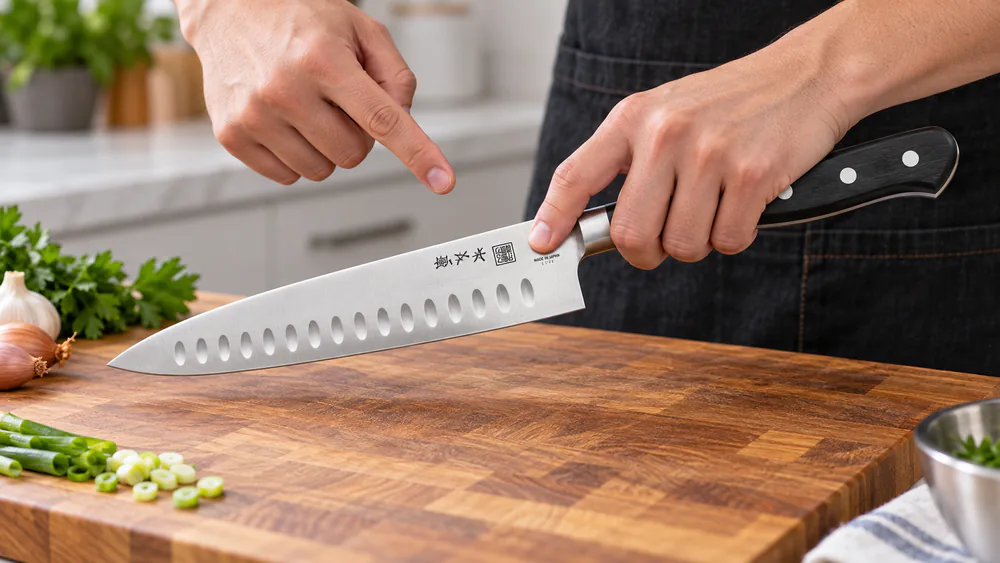
A pinch grip shows how a MAC handle really fits your hand.
Caring for Your MAC Chef Knife
A MAC rewards routine care, and the routine is short. These blades are thin and hard, so most problems come from moisture and impact rather than from wear.
Most of the care advice below is the same advice a professional kitchen gives to any thin Japanese-made blade. It costs a minute at the end of each session, and it keeps the knife looking and cutting the way it did on day one. Skipping it is the most common reason a good MAC ends up spotted, dull or chipped.
Cleaning, drying and storage
Wash the knife by hand with a soft sponge, warm water and a neutral detergent. Rinse it and dry it right away with a soft cloth. Keep it out of the dishwasher and away from abrasive scrubbers, because both damage the finish and the edge.
Drying is the habit that matters most. Small rust spots can appear after washing without a thorough dry, and wiping the blade down after each use keeps discoloration under control. If spots do appear, cleaning them off and drying the knife after use brings it back to a practical state.
For storage, a wooden block or a magnetic strip both work well, as long as the knife goes in dry. Avoid a loose drawer, where the edge can knock against other tools. Take care when you hang it too, because a fall onto tile can chip the heel corner.
If a drawer is the only option, use an edge guard or a knife sheath so the blade does not rattle. Never let a wet knife sit in a sink full of other dishes, because that is how both rust spots and chipped edges happen.
Warning. Keep a MAC off bones, frozen food, shellfish shells, hard squash, hard cheese, nut shells and chocolate blocks. Cutting these voids warranty coverage and can chip the thin edge.
Honing, sharpening and protecting the edge
Light, regular honing keeps the edge working between sharpenings. A strop or a suitable honing tool preserves a useful edge, and the steel on these knives takes a fresh edge readily. Keep any ceramic sharpener clean, because a clogged one loses its effectiveness.
A good rhythm for a home cook is a few light passes on a strop or honing tool whenever the knife starts to feel less keen, and a proper sharpening only when honing no longer brings it back. Frequent light touch-ups remove less steel than occasional heavy sharpening, and on a thin blade that adds up over the years.
For a full sharpening, MAC supports Rollsharp as a home-maintenance option, and it also offers factory sharpening and small-chip repairs. Factory service preserves the original warranty, which matters if you want to keep that coverage intact. Edge life varies with the steel and how you use the knife, so we do not promise a fixed interval.
When you sharpen at home, follow the existing bevel on the knife rather than forcing a new angle. Published bevel figures differ between sources, and the safest approach is to match what the factory put there.
If you are not confident with a stone, factory sharpening is a sound option. It takes the guesswork out, it preserves the warranty, and it can repair a small chip in the edge. For most home cooks, an occasional factory visit and regular honing in between is a realistic plan.
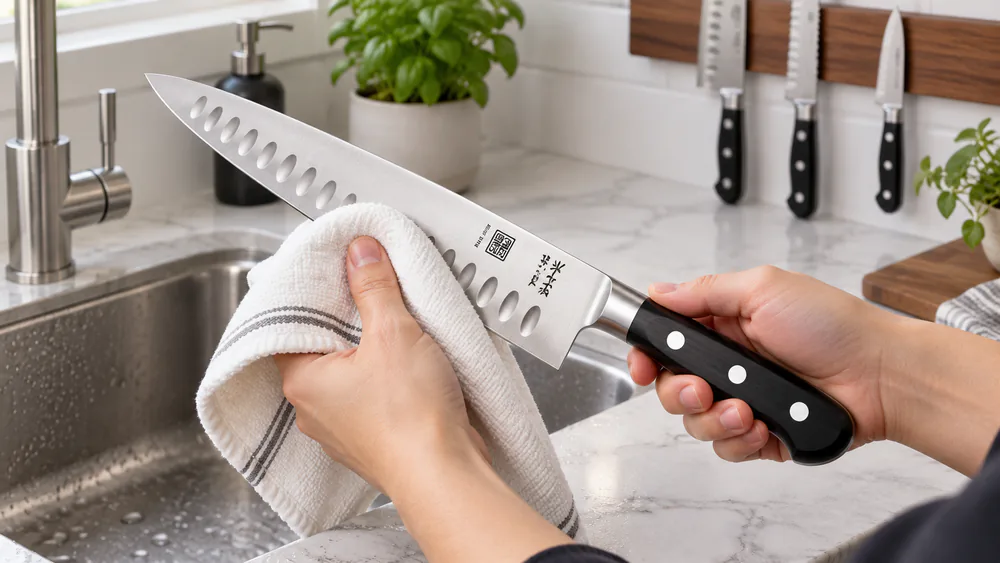
Dry the blade right after washing and store it on a strip or in a block.
Frequently Asked Questions
Does a MAC warranty cover a knife I received as a gift or bought secondhand?
Not reliably. The 25-year US limited warranty is for the original purchaser, it is not transferable, and it requires a new knife from an authorized seller. If you are buying a MAC as a gift, buy it new from an authorized seller and keep the receipt with the knife.
Should I use Rollsharp or send the knife to the factory?
Rollsharp is MAC's supported home-maintenance option, so it suits routine touch-ups. Factory sharpening is the better call when the edge has a small chip or when you want the original warranty kept intact, and it also handles small-chip repairs.
Are MAC chef knives made in Japan?
Yes. The knives in this guide are Japanese-made, with Pakkawood handles on the Chef and Professional models.
How does the SA-80 handle compare with the older UK-80?
The SA-80 has a larger handle than the Original UK-80, and its handle is raised for knuckle clearance, so it suits cooks who found the older knife's grip small.
Final Verdict: Which MAC Chef Knife Fits Your Kitchen?
If you only ever own one MAC, make it the MTH-80, and make your second knife something sturdier. A broader, thicker blade for dense produce is the natural partner, because it covers the heavy work the thin MAC is not built for.