As an Amazon Associate we earn from qualifying purchases. We may earn a commission from links on this page, at no extra cost to you. Learn more.
A chef knife does the same few jobs all day: rocking through herbs, slicing onions thin, dicing carrots, and trimming meat. Every Shun series does those jobs well, so the real question is which handle, steel, and finish fits your hand and your habits. After comparing handle, steel, finish, and care across the lineup, we recommend the Shun Classic 8-Inch Chef's Knife for most home cooks. The Sora is our budget-minded alternative, and the Premier suits anyone who wants a rounder grip.
Shun is a Japanese brand, and if you are still deciding between Western and Japanese blades, our Japanese knife reviews are a good place to widen the search. Below we explain how we judged each knife, compare the five principal picks side by side, and then cover sizing, steel, handle fit, and care.
How We Tested These Shun Chef Knives
This is how we score a chef knife. A fresh edge is easy to love, so we care more about how a knife behaves across a full session of prep: how the blade tracks through an onion, how the handle feels once your grip has settled in, and how much attention the finish demands during cleanup. No manufacturer has any say in our rankings.
We look at edge behavior on the cuts a home cook repeats most: rocking through herbs, slicing tomatoes thin, and making horizontal onion cuts. We assess how the handle fits either hand and how much care the finish and handle material need during washing. Shun tells you to hand wash and dry every knife, so we treat that as the baseline for all five.
Our judgments on edge and feel rest on each series' documented geometry and construction and on how its blade and handle behave in everyday prep. We do not claim a matched end-of-period edge comparison across the knives, because workloads and maintenance differ from kitchen to kitchen.
We score four things: how the edge cuts, how the handle feels in hand, how much care the knife asks for, and how well the shape matches a specific kind of cook. We do not publish a sharpening interval, because board, food, technique, and the starting edge all change the answer.
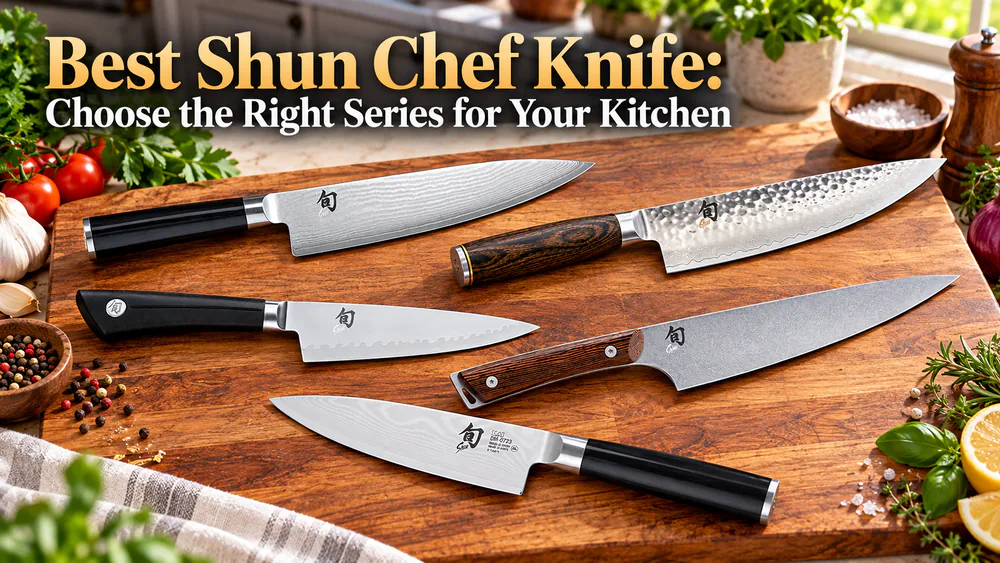
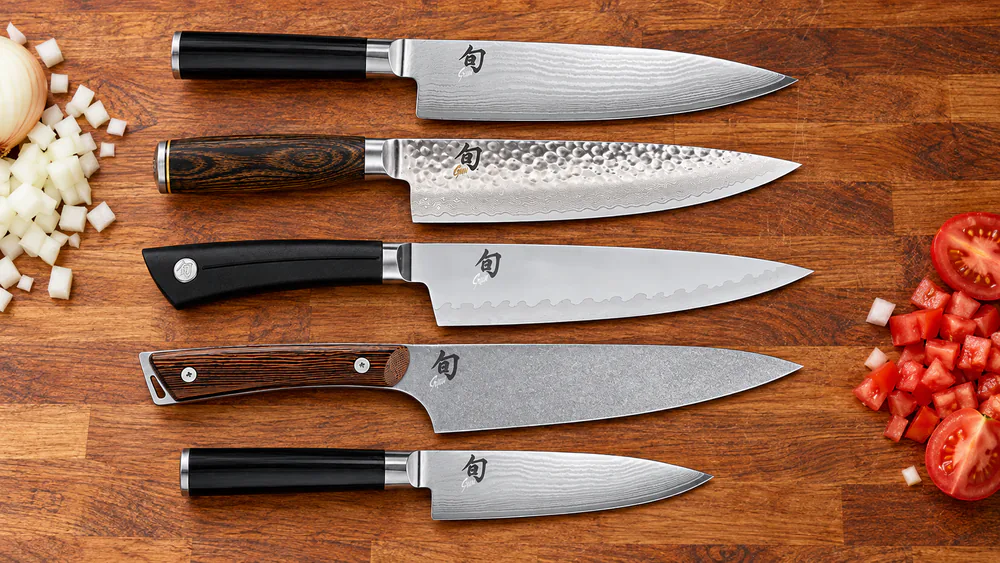
The five principal Shun picks, set out before a prep session.
Note. Every pick here has a 16-degree edge on each side. That matters when you sharpen, because a generic fixed-angle sharpener is not automatically compatible with these knives.
Best Shun Chef Knives at a Glance
The five principal picks share the same edge angle, so the differences come down to steel, handle, finish, and weight. The table below lays those out using the manufacturer specifications, with a plain-language note on who each knife suits.
Product
Blade length and profile
Steel
Handle
Finish
Weight
Care
Best for
Shun Classic 8-Inch
8-inch; curved chef
VG-MAX core
D-shaped ebony Pakkawood
Damascus
6.7 oz
Hand wash, dry promptly, protect the edge
General prep and rocking cuts
Shun Premier 8-Inch
8-inch; curved chef
VG-MAX core
Contoured walnut-color Pakkawood
Hammered tsuchime plus Damascus
7.4 oz
Same, plus clean the textured face
A rounded grip and decorative finish
Shun Sora 8-Inch
8-inch; gentler gyuto curve
VG10 edge, 420J upper
Textured PP/TPE polymer
Smooth upper with composite join
6.5 oz
Hand wash despite the polymer handle
A lower-cost entry and a practical grip
Shun Kanso 8-Inch
8-inch; chef/gyuto
AUS10A solid steel
Contoured tagayasan wood; exposed tang
Rustic fine-grained
6.3 oz
Hand wash, dry the natural wood carefully
A simple look and a pinch grip
Shun Classic 6-Inch
6-inch; compact chef
VG-MAX core
D-shaped ebony Pakkawood
Damascus
4.7 oz
Hand wash, dry promptly, protect the edge
Small boards and compact prep
Our ranking order reflects how broadly each knife suits cooks, not a measured score. The Classic comes first because it fits the widest range of hands and tasks. The Classic 6-Inch comes last because it is a specialist size, not because it cuts worse.
If you only read one row of the table, read the handle row. Blade geometry across the 8-inch picks is close enough that most cooks will notice the grip long before they notice any difference in how the steel cuts. The weight row is the second most useful, because a half-ounce gap sounds trivial on paper and feels larger by the end of a long dicing session.
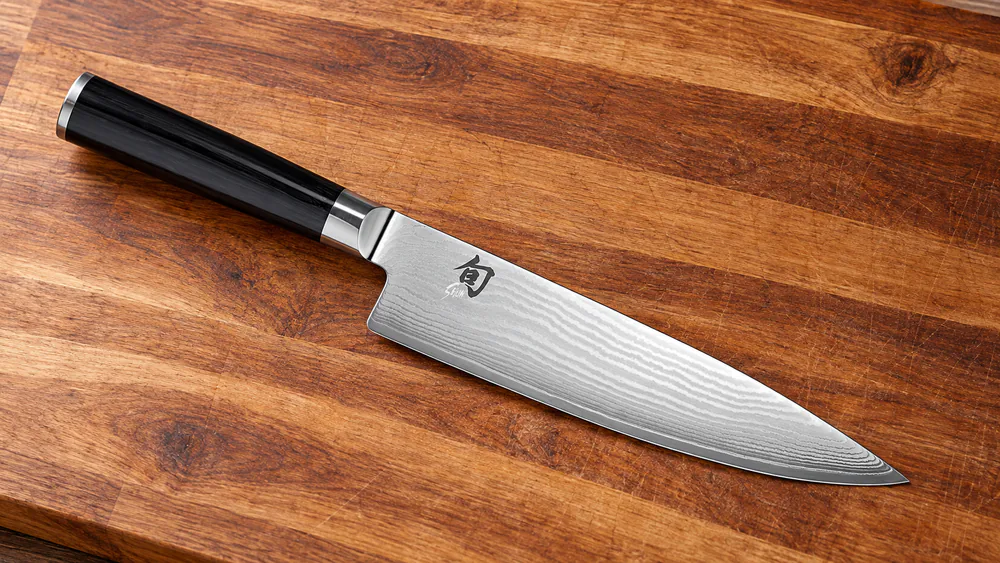
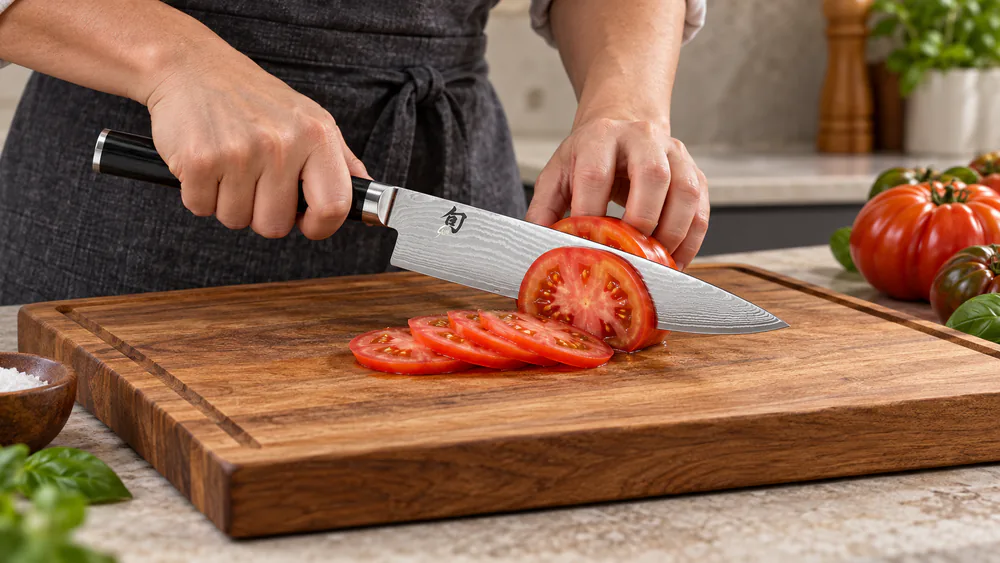
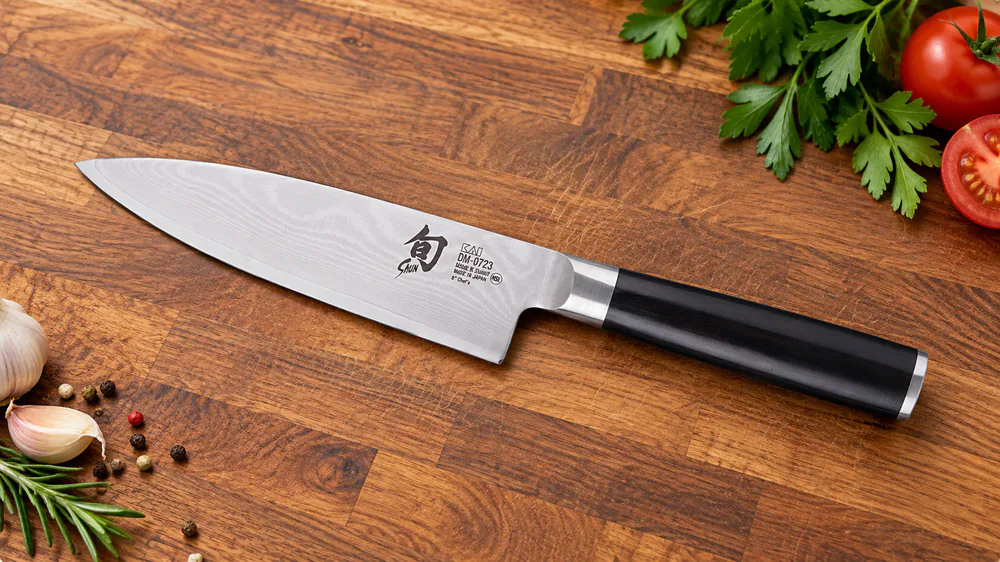
The Classic is the Shun we would hand to most people. The curved belly makes rocking through herbs feel familiar if you learned on a Western chef knife. The light blade reduces the effort of repeated prep while retaining some weight in the hand. Tomatoes and onions parted cleanly, and that is where the fine edge earns its keep.
Pros
Curved belly feels familiar for rocking cuts through herbs
Light blade reduces fatigue during repeated prep
VG-MAX core with a 16-degree edge on each side
Cuts tomatoes and onions cleanly
Cons
The D-shaped handle can feel large in smaller palms
Fine edge needs more care around hard ingredients than a heavier German-style knife
Handle shape can feel different in a left hand than in a right
Thin tomato slices are where the Classic's fine edge shows.
Who the Classic suits
The Classic suits cooks who work with a rocking motion and want a blade that stays out of the way. At 6.7 oz by the manufacturer's specification, it is light enough that a long session of dicing does not tire the wrist. The blade is 8 inches long, and the dimensions come to 1.9 inches high by 13.4 inches long by 0.8 inches wide, which fits a standard home board without trouble.
The steel is a VG-MAX core wrapped in 68 layers of stainless Damascus cladding, or 69 layers if you count the core. Those are the same construction counted two ways, not two different builds. The handle is D-shaped ebony Pakkawood with a full composite tang.
Advantages and trade-offs
The trade-off is the handle, covered in the Cons above. The asymmetric D-shape favors the right hand more than the left. Official pages describe it as comfortable for either hand, but comfort depends on your grip, so hold one before you commit if you can.
The other trade-off is the edge itself. The first keenness of a Shun fades gradually with daily use, though useful cutting sharpness remains after the freshest edge is gone. Plan to hone lightly and to sharpen at the correct angle when honing stops restoring performance.
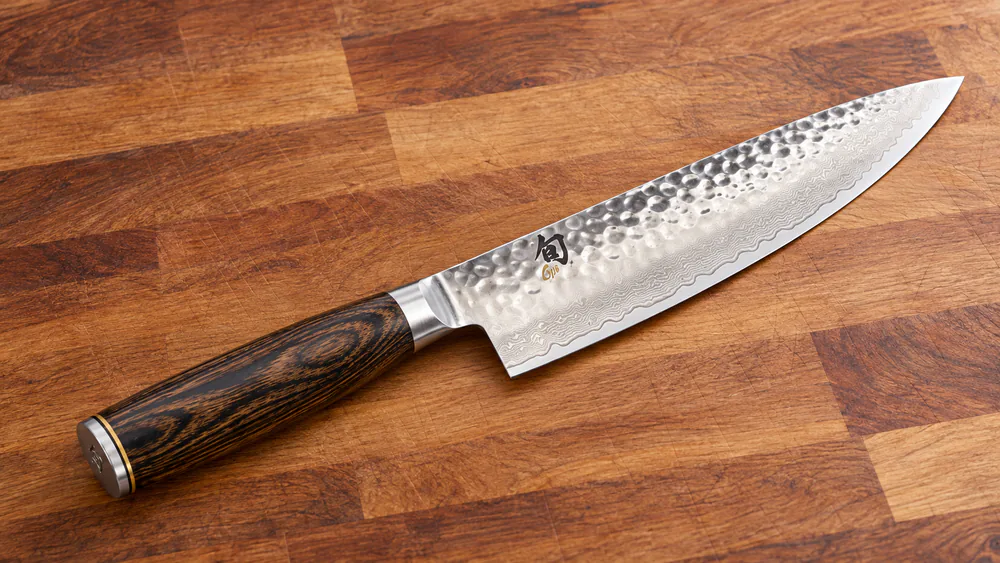
The Premier is the Classic's blade geometry in a more comfortable package. The thin blade moved through horizontal onion cuts with little drag, and thin tomato slices came easily. The rounded handle felt more neutral between the hands than the Classic's asymmetric D-shape, and it stayed comfortable even for a cook used to heavier German knives.
Pros
Rounded handle feels more neutral in either hand
Thin blade glides through horizontal onion cuts
VG-MAX core, 16-degree edge on each side
Hammered tsuchime upper adds a distinct look
Cons
Handle and blade collect food residue during busy prep
Hammered texture needs attention when washing
Heaviest of the five at 7.4 oz
When the Premier is worth considering
Consider the Premier when handle comfort is your top concern, or when you are left-handed and the Classic's D-shape felt awkward. The contoured walnut-color Pakkawood has no pronounced right-hand bias. The manufacturer lists the weight at 7.4 oz, and the dimensions are 1.9 inches high by 13.6 inches long by 0.8 inches wide.
It also has a hammered tsuchime finish above a Damascus lower blade, with the same VG-MAX core and 68 layers of cladding, 69 including the core. The finish is documented and decorative. Whether it helps food release is a separate question, and we address it below.
Advantages and trade-offs
The hammered face is attractive, but it asks for attention. During busy prep the handle and blade collect residue, so expect to wipe the knife as you work. Washing needs a little extra care so nothing stays in the dimples.
Food release is the claim to treat carefully. The hammered finish can reduce sticking, but sticky ingredients can still cling, so do not buy the Premier expecting a blade that never needs wiping. Buy it for the grip and the look, and treat any release benefit as a bonus that depends on the ingredient and the cut.
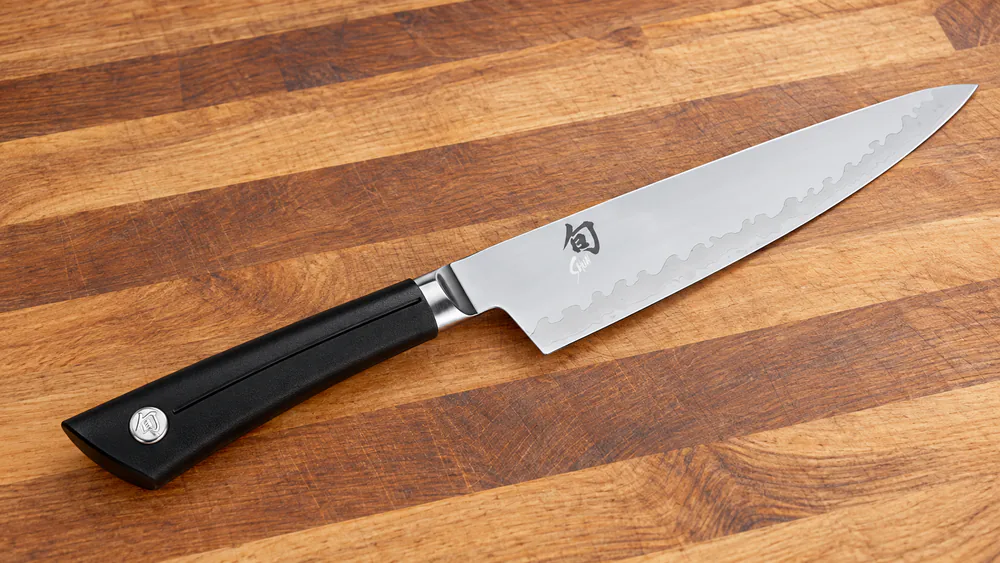
Where the Premier adds decoration, the Sora strips it back: it is the least expensive of the five and still feels like a real Shun. It was nimble during vegetable prep, and the textured polymer grip stayed secure with damp hands and wiped clean easily. The handle does feel plainer and less substantial than the wood-handled lines, and it can feel slightly hollow next to the Classic, though it stays secure in use.
Pros
Textured polymer grip stays secure with damp hands
Easy-to-clean handle surface
Nimble through vegetable prep
VG10 edge in san mai construction, 16-degree edge
Cons
Handle feels plainer and less substantial than wood
Grip can feel slightly hollow compared with the Classic
Gentler belly rocks less than a Western profile
Who the Sora suits
The Sora suits cooks who want Shun's edge without paying for decorative extras. It weighs 6.5 oz, and the dimensions are 1.8 inches high by 14.0 inches long by 0.8 inches wide. The cutting edge is VG10 in san mai construction, joined to a 420J stainless upper, and the tang reaches the handle medallion.
The blade has a gentler belly than a Western chef knife. That is the middle ground between a German-style rocker and a flatter Japanese push-cutter. If you mostly slice and dice vegetables and rarely rock through a mountain of herbs, that shape suits you.
Advantages and trade-offs
The polymer handle is the point. It tolerates wet hands and cleans without fuss, which makes it a sensible choice for a busy kitchen. The polymer is not a reason to skip hand washing, though. The Sora still needs the same care as every other Shun: no dishwasher, no soaking, and dry it right away.
The trade-off is feel. If you value the warmth and weight of a wood handle, the Sora will seem plain. For a first Shun or a gift where price matters, we think that is a trade worth making.
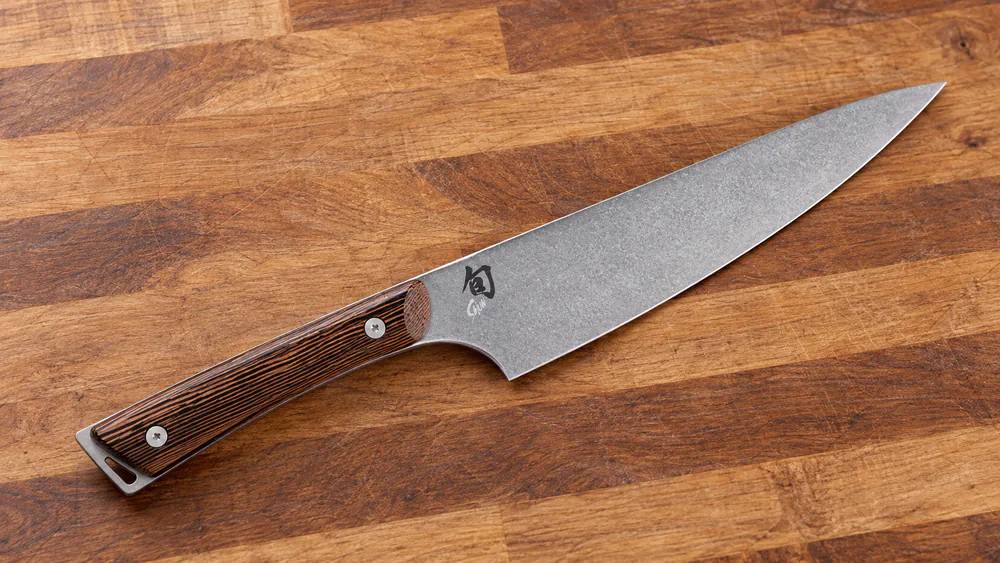
The wood-handled Kanso is the lightest of the 8-inch picks at 6.3 oz, yet it felt solid and balanced in normal prep. With no prominent bolster, a pinch grip was easy to adopt. The rustic surface made everyday wear less visually obvious than on a polished blade. The exposed tang can feel proud of the wooden scales and press into the hand during a firm grip, so test your grip before choosing it.
Pros
No prominent bolster, so a pinch grip comes naturally
Light and balanced in normal prep
Rustic finish hides everyday wear better than polish
AUS10A solid stainless steel with a 16-degree edge
Cons
Exposed tang can press into the hand in a firm grip
Finish conceals scratches but does not resist them
Natural wood handle needs careful drying
Who the Kanso suits
The Kanso suits cooks who prefer a simple, honest-looking knife and use a pinch grip. The steel is AUS10A solid stainless, so there is no layered cladding, and the handle is contoured tagayasan (wenge) wood with an exposed full tang. The dimensions are 1.9 inches high by 13.6 inches long by 0.9 inches wide.
That makes it a mid-priced pick with a different personality from the Classic. It has fewer decorative touches and a more workmanlike feel.
Advantages and trade-offs
The finish is the part to be realistic about. The rustic, fine-grained surface conceals cosmetic wear, but concealing scratches is not the same as resisting them, and you should not expect the blade to stay pristine. Natural wood also asks for more careful drying than polymer. Treat it as a user-friendly knife with an honest, aging look.
After four 8-inch knives, the 6-inch Classic is the odd one out by design: it keeps the same VG-MAX core and 16-degree edge as its bigger sibling in a compact, 4.7 oz body. It was easier to guide through small vegetable trimming and fine chopping. Large ingredients took more repositioning or extra strokes, which is the price of a shorter blade.
Pros
Easy to steer through small trimming and fine chopping
Very light at 4.7 oz
Same VG-MAX core and 16-degree edge as the 8-inch Classic
Suits small boards and compact prep areas
Cons
Large ingredients need repositioning or extra strokes
Less rocking travel than an 8-inch blade
Same D-shaped handle that can feel large in small palms
When a shorter chef knife makes sense
A 6-inch blade makes sense when your board is small, your hands are small, or you do mostly detail work such as trimming, mincing, and slicing small produce. The dimensions are 1.6 inches high by 11.00 inches long by 0.7 inches wide. The blade is 6-inch, and the weight is 4.7 oz.
It is also a good second knife. Many cooks keep an 8-inch for the heavy lifting and a 6-inch for quick jobs.
Advantages and trade-offs
The compact blade makes control easier but limits throughput. Cutting a large squash or a whole cabbage takes more strokes, and you will reposition the food more often. That is a reasonable cost if you value agility, and a poor one if you prep for a crowd.
How to Choose the Right Shun Chef Knife
Choosing a Shun comes down to five questions: which series, what length, which handle, what steel and finish, and how much care you will give it. The sections below take them in that order.
Classic vs Premier vs Sora vs Kanso
The Classic and Premier share the same VG-MAX core, the same 16-degree edge, and the same curved profile. The real difference is the handle and the finish. The Classic has an asymmetric D-shaped ebony Pakkawood handle and a smooth Damascus face. The Premier has a rounded, walnut-color handle and a hammered tsuchime upper. If a rounded grip appeals to you, the Premier is the better fit, and if you want the lighter knife at 6.7 oz, the Classic is.
The Sora is the sweet spot for value, with a VG10 edge, a polymer handle, and a gentler belly. The Kanso takes a different route, using AUS10A solid steel and a plain wood handle with an exposed tang. If you are unsure, start with the Classic and move to the Premier only if the handle bothers you.
Choosing a 6-, 8-, or 10-inch blade
For most home cooks, 8 inches is the right length. It gives you rocking travel, enough blade to cut large vegetables, and a size that fits ordinary boards. Think about the board you own before the knife you want. An 8-inch chef knife needs a board at least a hand longer than the blade to feel comfortable, and a cramped counter is a better reason to choose the 6-inch than any spec sheet. Weight tracks length too: the 6-inch Classic is 4.7 oz, while the 8-inch picks sit between 6.3 oz and 7.4 oz. The 6-inch bridges the gap for people who find 8 inches unwieldy, and it works well as a companion knife.
We did not test a 10-inch model, and we do not recommend one unless you regularly cut very large items and have the board space. Longer blades need more room and more control, and a bigger knife is not automatically a better one.
Handle shape, grip comfort, and left-handed use
Handle choice is the most personal part of the decision. Two knives with nearly identical blades can feel like different tools in the hand. A handle that is slightly too big makes you grip harder, and a tight grip is what tires the hand. A handle that is slightly too small makes you choke up on the blade. Neither is a flaw in the knife, only a mismatch with the cook. The Classic's D-shape can feel large in smaller palms and different between hands. The Premier's rounded grip is more neutral. The Sora's textured polymer is secure when wet. The Kanso has a contoured wood handle and no bolster, which makes a pinch grip easy, though the exposed tang can press into the hand.
Left-handed comfort depends on hand shape and grip, so we do not claim any Shun is universally left-friendly. The Premier's rounded handle is the most neutral of the five, and the Dual Core kiritsuke's octagonal handle sits securely in a left hand. If you are left-handed, handle a knife before you buy it.
Steel, blade finish, and maintenance needs
The five picks use three steel recipes. VG-MAX sits in the core of the Classic, Premier, and 6-inch Classic. The Sora uses VG10 at the edge with a 420J stainless upper. The Kanso uses AUS10A throughout. We do not publish a hardness comparison, because the sources overlap and the manufacturer does not confirm model-specific numbers.
Finish matters for care more than for cutting. Do not choose a finish because you expect it to change how food behaves on the blade. The hammered tsuchime finish on the Premier is documented and attractive, and the Premier section covers what it does and does not do for food release. The Damascus pattern on the Classic is cosmetic in the same way: it tells you about the cladding, not about extra cutting performance. A polished Damascus face is easy to wipe. A hammered face needs attention in the dimples. A rustic finish hides wear but not scratches. Stainless steel resists rust but is not rust-proof, so dry every knife after washing.
A Shun's finish and handle decide how it feels on day one; your drying habit decides how it looks on day one hundred.
Shiranami and Dual Core: when to consider premium alternatives
If you want to spend more, two premium lines are worth a look. The Shiranami 8-inch chef's knife uses 71 alternating layers of VG10 and VG2 that extend to the edge, has a Prussian blue jute micarta handle, and weighs 8.0 oz. Its forward-tilting bolster encourages a controlled pinch grip, and the micarta felt grippier than smooth Pakkawood when damp.
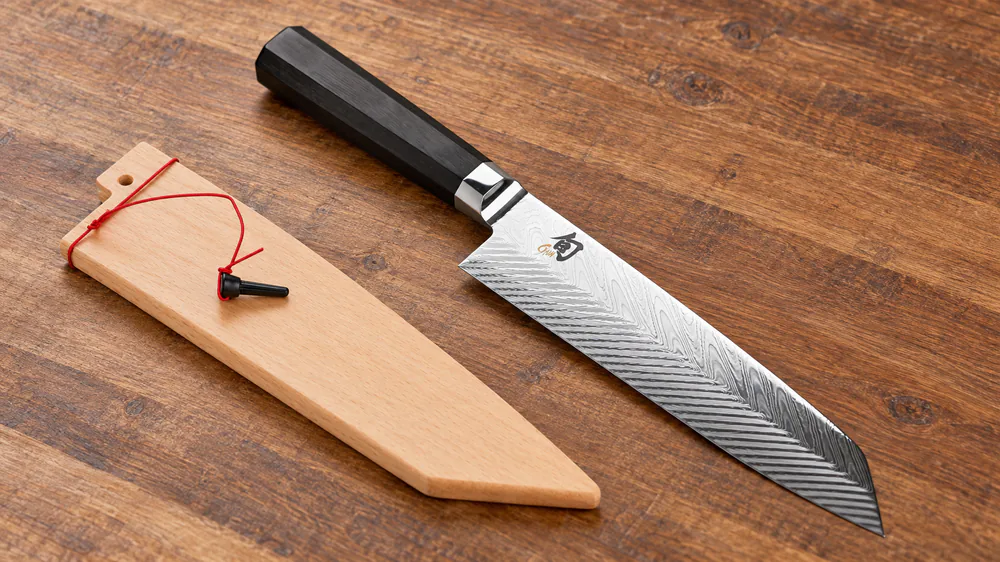
The Dual Core 8-inch kiritsuke also uses 71 alternating layers of VG10 and VG2 that reach the edge, with a 16-degree double bevel on each side. Its straighter edge suits push cuts and slicing, and it is a different shape from the curved Dual Core chef knife. It felt light and agile when moving between dicing and slicing, and it cleaned easily after ordinary prep. The octagonal ebony Pakkawood handle sat securely in a left hand, while the supplied wooden saya felt bulky for transport.
The kiritsuke can take a useful fresh edge on a stone, but sharpening it can feel laborious. It is the splurge pick here, and a shape to consider only if you like a flatter profile. For a standard rocking cook, the Classic still wins.
The Dual Core kiritsuke and its included saya.
Tip. Shun also makes the Narukami, with a Blue II carbon-steel core under stainless cladding. Immediate cleaning and drying are essential, and a dark patina is expected. It is a knife for people who want that care routine, not a general recommendation.
There is also a Western Cook's profile with a 22-degree edge on each side for harder produce. It is distinct from the standard Classic chef knife, so do not assume the two sharpen the same way.
Caring for Your Shun Chef Knife
Shun knives keep a fine edge and ask for habits in return. Most chipped edges and dull blades come from a short list of mistakes, all of them avoidable.
Cutting boards, technique, and chipping prevention
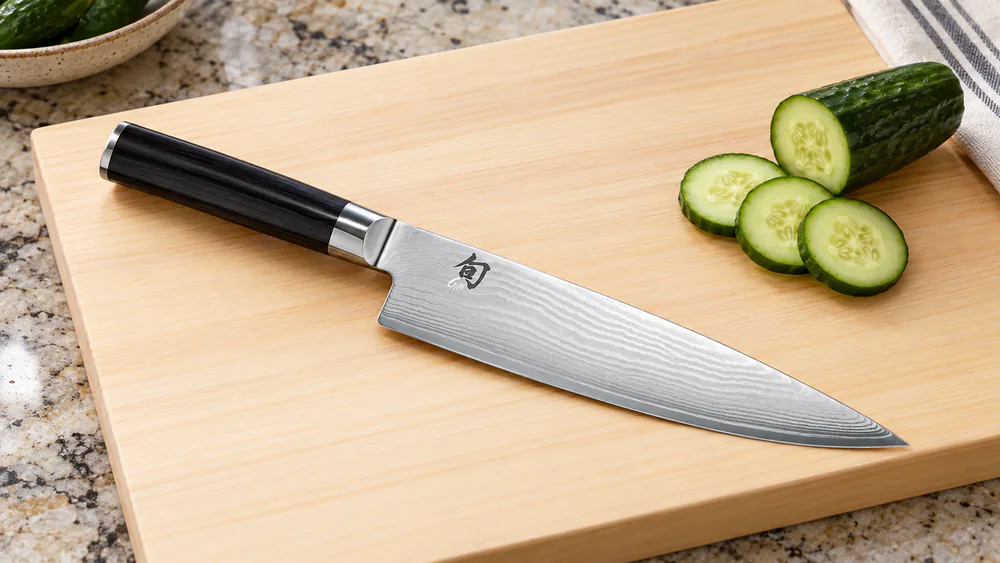
Choose a medium-soft wood board, such as hinoki. Avoid glass, stone, ceramic, and other hard surfaces, which can chip or dull a fine edge. Use smooth forward or backward slicing, and do not twist a stuck blade. These chef knives are not for bone, frozen food, or fruit pits.
A fine, hard edge is stronger at cutting and weaker at taking abuse. The fix is cheap. Keep a proper wood board on the counter, cut through food instead of prying it, and reach for a cleaver or an old knife when you meet bone or frozen food. If a blade catches mid-cut, back it out along the line of the edge rather than levering it sideways. Most chips begin with a twist, not with the cutting itself.
Medium-soft wood is the kind of board that protects a fine edge.
Cleaning, storage, honing, and sharpening
Hand wash with mild soap and dry immediately. No dishwasher, no soaking, no abrasive scrubbers. Store the knife in a block, a sheath, a drawer insert, or a suitable magnetic holder, and avoid loose drawer storage that lets blades knock together.
Honing and sharpening are different jobs. Light-pressure honing realigns the edge. Sharpening removes steel, so use a whetstone or a professional service when honing stops restoring cutting performance. Keep the 16-degree angle per side on the five principal picks.
A good rhythm is a few light passes on a honing rod when the knife starts to feel less crisp, then a proper sharpening only when honing no longer brings the bite back. If you would rather not learn a whetstone, Shun's mail-in sharpening service is an option for qualifying purchases from authorized dealers. You pay shipping and processing, you complete the request form before sending the knife, and you should allow for transit and processing time rather than count on a fixed return date.
If you want a machine option, see professional knife sharpeners for care adjacency, but check the angle first, because a generic fixed-angle sharpener is not automatically compatible.
Warning. Do not put a Shun in the dishwasher. The heat, detergent, and tumbling can damage the edge and the handle, and the warranty excludes improper maintenance.
Which Shun Chef Knife Should You Choose?
Pick the Classic 8-Inch if you want the best all-purpose Shun. It is light, keen, and familiar to anyone who has rocked a Western chef knife. Pick the Premier if the Classic's handle feels large or awkward in your hand. Pick the Sora if you want Shun's edge in a lower-cost body with a grippy handle. Pick the Kanso if you prefer a simple, rustic wood handle and a pinch grip. Pick the 6-inch Classic if your board or your hands are small.
Whichever you choose, treat it like the fine tool it is: hand wash it, dry it, store it with the edge protected, and hone it lightly. The knife that fits your hand and your habits will outcut a fancier one that does not.
Shun Chef Knife FAQs
When should you consider Wusthof instead?
Consider Wusthof if you want a heavier, German-style knife that tolerates hard ingredients and rough use more readily. A Shun is lighter and has a finer edge, so it rewards careful technique. Handle one of each if you can, because weight and balance are a matter of preference.
Is a Shun chef knife worth the price?
For most cooks who value a light blade and a fine edge, yes. The Sora is the cheapest pick here, the Classic and Kanso sit in the middle, and the Premier costs more still. The Dual Core kiritsuke is the splurge. Spend more only if the handle or shape solves a problem you actually have.
Should you choose a chef's knife, santoku, or kiritsuke?
Choose a curved chef's knife if you rock the blade, a santoku if you prefer push cutting on a smaller board, and a kiritsuke if you like a straighter edge for push cuts and slicing boneless protein and fine vegetables. A curved profile offers more rocking travel.
What does Shun's warranty cover?
Shun offers a limited lifetime manufacturing-defect warranty for the original owner. It is nontransferable, it excludes normal wear, rust, misuse, and improper maintenance, and you need to buy from an authorized dealer. Minor chips may be repaired, but large chips and handle repairs are excluded. Direct-site purchases have a 30-day return window.