As an Amazon Associate we earn from qualifying purchases. We may earn a commission from links on this page, at no extra cost to you. Learn more.
A diamond sharpening stone is a steel plate coated with diamond particles that grind a dull edge back to a clean apex. It stays flat, cuts fast, and needs no soaking. The main tradeoff is between grit and size: a coarse face repairs damage quickly, a fine face finishes the edge, and a longer plate makes every stroke easier on a chef's knife. After working through six plates, our top pick is the SHARPAL 162N, an 8 x 3 inch double-sided plate that handles most kitchens.
We judged each plate the way a working kitchen would: how quickly it fixes a chipped or neglected edge, how steady it sits on the bench, and how easily it cleans up afterward. If you want to see how plates fit alongside other tools, our knife sharpener reviews cover pull-throughs, electric units, and guided systems too.
Quick Comparison: Diamond Sharpening Stones at a Glance
The table below lines up the six plates on the details that decide a purchase. Grit numbers are printed by each maker and are not interchangeable across brands, so read the micron or mesh figures where we list them.
Product
Use case
Grit designation
Usable dimensions
Format and surface
Base and accessories
Principal limitation
SHARPAL 162N
Broad all-in-one kitchen setup
325 / 1200
8 x 3 inches
Double-sided, continuous
Case that doubles as a base, angle reference
Wide jump from coarse to fine
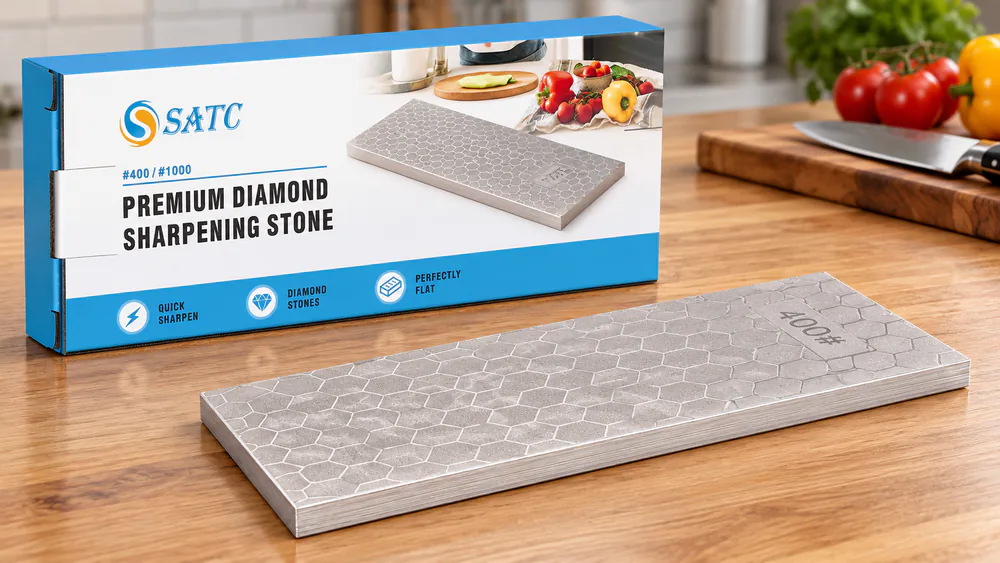
S SATC 400/1000
Budget entry to diamond sharpening
400/1000
Nominal 8-inch plate, width unconfirmed
Double-sided, clearance channels
Package-dependent supports, holder unconfirmed
Fine-face scratch consistency, dimensions unclear
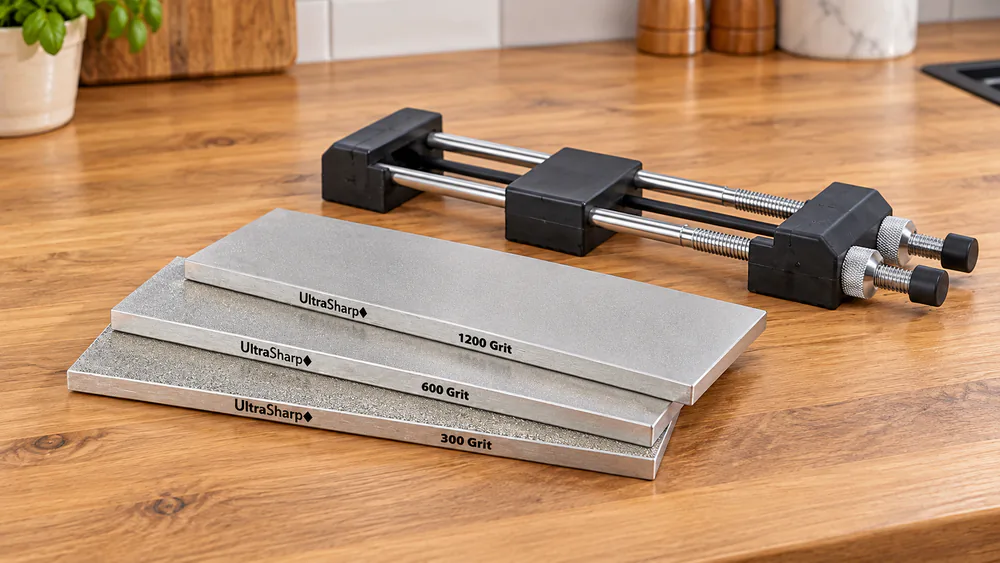
Ultra Sharp 8 x 3 Three-Stone Set
Full repair-to-finish progression
300/600/1200
8 x 3 inches per stone
Three single-sided continuous plates
Adjustable stone holder
Storage space and carrying weight
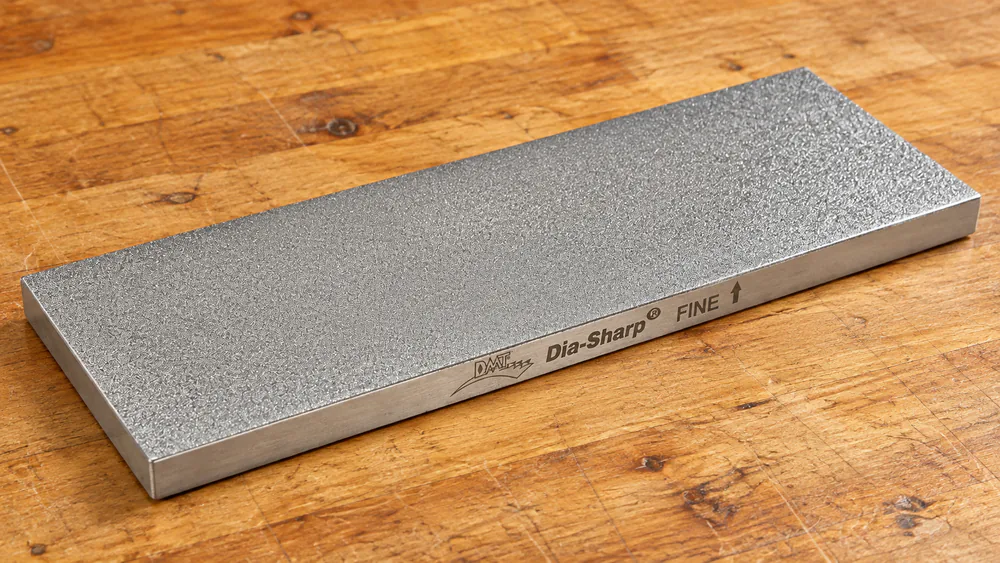
DMT D8F Dia-Sharp Fine
Routine maintenance
Fine, 600 mesh / 25 micron
8 x 3 inches
Single-sided, continuous
4 rubber feet
Only one grit
Atoma Medium #400
Coarse work and lapping water stones
Medium Rough #400
Commonly 210 x 75 mm, linked unit unconfirmed
Single-sided, clustered diamonds
Complete plate, no holder verified
Coarse scratch pattern, needs a finer step
SHARPAL 156N
Smaller knives and compact storage
325 / 1200
6 x 2.5 inches
Double-sided, continuous
Case that doubles as a base, angle reference
Short stroke for long knives
How We Tested These Diamond Sharpening Stones
We judge a diamond plate on four things: how fast it cuts, how steady it stays under the knife, how much work cleanup takes, and where its limits show. Cutting speed tells us whether a plate can repair a neglected edge or only maintain a good one. Stability tells us whether the angle survives a full stroke. Cleanup and care tell us what the plate asks of you after the knife is back in the block.
Our ratings are editorial scores out of five. They weigh cutting performance and feel, stability and setup, how complete the plate is for a home cook, and how serious its limitations are. A marketplace star rating never feeds our scores.
We also held every plate to the same fairness rule. Printed grit numbers do not match across brands, so we compared the micron or mesh figures the makers publish and never treated a 1200 from one brand as the same as a 1200 from another. Where a maker's published dimensions or accessories disagree with each other, we say so rather than guess.
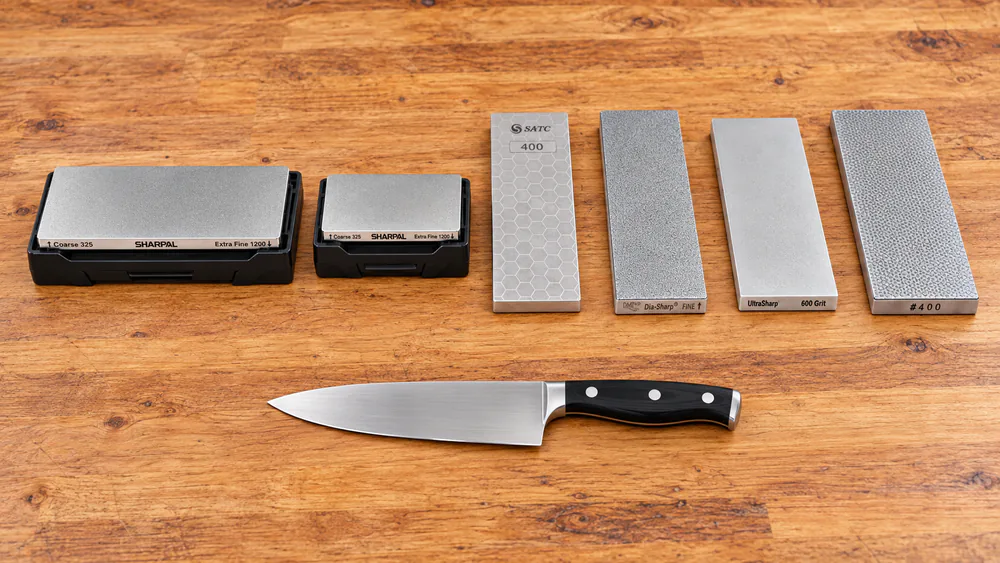
The six plates before testing, laid out on our sharpening bench.
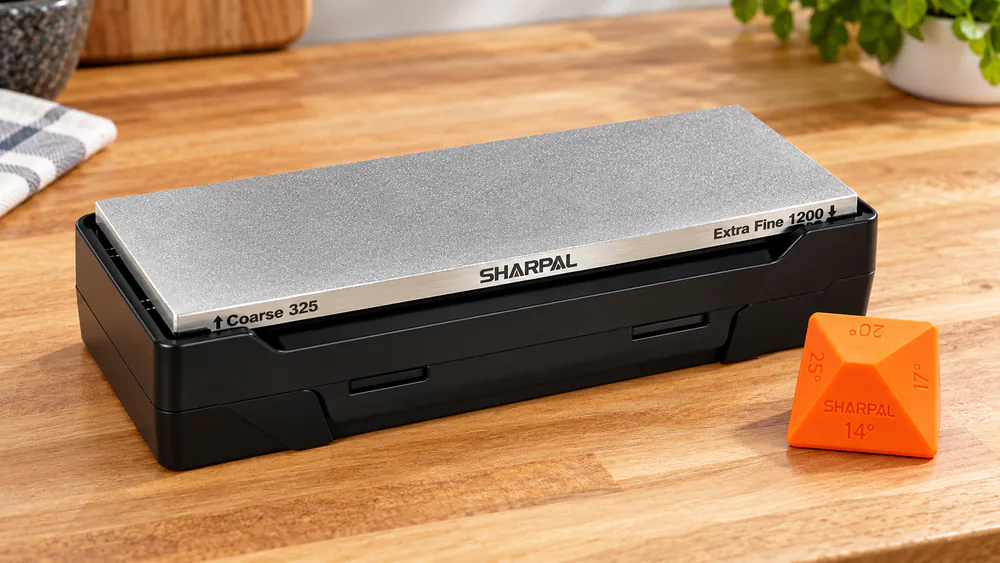
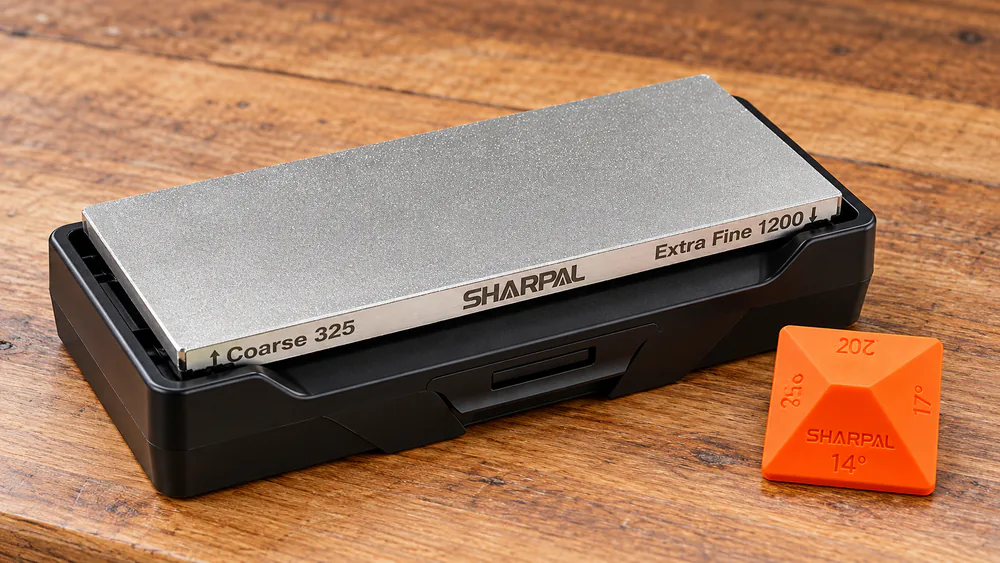
The SHARPAL 162N is the plate we would hand to most home cooks. The 8 x 3 inch working surface gives a chef's knife plenty of room, the 325 coarse face removes damaged-edge material quickly, and the 1200 face leaves a clean edge. The case works as a base, though it is functional rather than luxurious.
Pros
Roomy 8 x 3 inch surface suits full chef's knife strokes
Coarse face removes damaged-edge material quickly
Case doubles as a non-slip base, with a 14, 17, 20 and 25 degree angle reference
3-year warranty, with a 1-year extension when you register
Cons
Wide jump from the 325 face to the 1200 face with no middle step
Case stability needs checking on your work surface
Metal debris can take brushing to clear
Who This Double-Sided Stone Suits
This is the plate for a cook who owns a handful of knives and wants one stone to keep them all working. The two faces cover the two jobs that matter most: bringing back an edge that has been neglected, then refining it into something you can slice a tomato with.
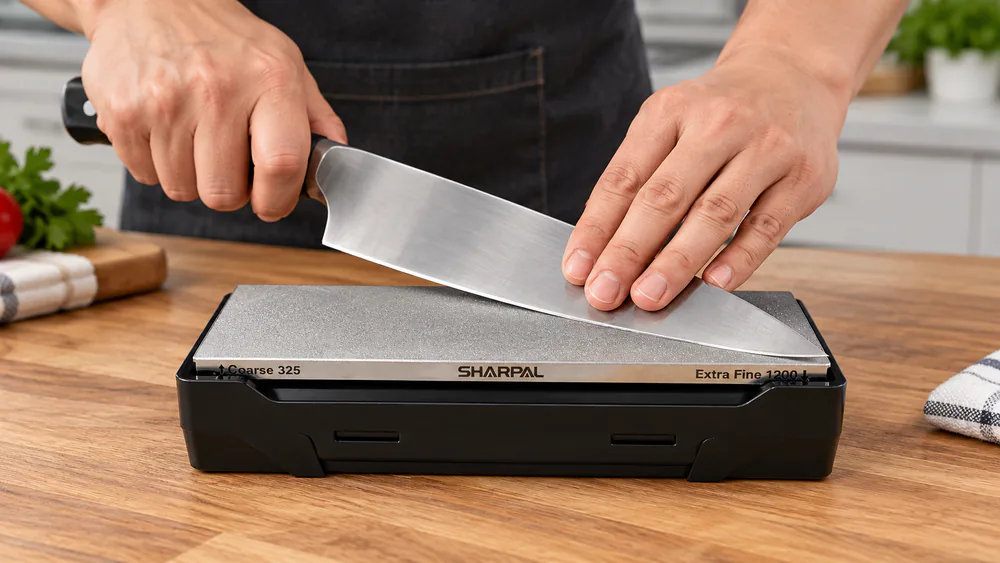
The coarse face is fast, and a damaged edge gives up material quickly. Because diamond is so hard, the plate gives less soft, slurry-like feedback than a water stone, so you feel the knife through the steel rather than through a muddy surface. When we laid a blade against the angle reference, it showed us where to begin. Stopping to reposition it over and over broke the sharpening rhythm, so the sensible move is to use it once to find the angle and then rely on muscle memory.
Care and Inspection
The published flatness tolerance is +/-0.002 inch. Dry sharpening needs no lubricant, and the maker allows optional water or oil as long as you clean and dry the plate promptly. Remove the swarf before you put it away. Dark patches are usually residue, so clean the surface before judging whether the abrasive is worn.
Keep your stroke controlled. Letting a blade run over the far corner can scratch the side of the knife. Inspect a new plate before using a valuable knife: a raised plating spot on the coarse side can damage the edge, and spotting it early can save the bevel.
If you buy direct from SHARPAL, there is a 30-day return window from delivery, with the plate unused or like-new and all accessories included. Other sellers set their own terms.
The coarse face on a chef's knife, with the case acting as the base.
Where the SHARPAL asks for a mid-priced commitment, the S SATC 400/1000 is the budget plate that makes diamond sharpening easy to try. The steel support feels rigid under the knife, and early loose grit settles with use.
Pros
Budget tier, the cheapest plate in this group
400 coarse and 1000 fine faces on one plate
Rigid steel support with clearance channels for debris
Needs no oil or water for sharpening
Cons
Raised coarse particles can show up on the fine face
Exact usable width and accessory package are unclear
Finish looks marked after use and needs cleaning
Who This Budget Plate Suits
This plate suits a cook who has never used diamond and does not want to commit to a larger purchase. It gives you two faces, a coarse 400 for repair and a fine 1000 for refinement, at a price that makes it the cheapest pick here. It suits straight-edged knives and tools, so a standard chef's knife or paring knife is a good match.
Working an Edge on the SATC
The sequence that worked best for us was simple. We cut the bevel on the coarse side, lightened our pressure on the fine side to remove the burr, and finished with a few passes on a strop. That produced a useful working edge we were happy to cook with. Treat the first few sessions as a break-in and use light pressure while the loose grit settles.
The fine face can carry raised coarse particles you will feel during a stroke, so run a fingertip lightly alongside the surface before you commit a good knife to it. The clearance channels give debris somewhere to go, and the trade is a slightly less continuous feel than a solid face.
Reading the Fine Print
The published dimensions mix inch and millimeter figures that do not agree, so we cannot promise an exact working width. All we can say is that it is a nominal 8-inch plate. Accessory packages vary too: check the exact package before assuming an elevated holder or an angle guide is included. The pale finish shows sharpening marks quickly, which is cosmetic, and a wipe after each session keeps it tidy.
The Ultra Sharp set asks the most of your bench: it is the heaviest, bulkiest pick here, and it is cumbersome to carry between workspaces. In return, the three separate plates in 300/600/1200 make the progression straightforward, and the broad faces give comfortable sharpening room.
Pros
Three single-sided plates: 300 coarse, 600 medium, 1200 extra fine
Each stone has an 8 x 3 inch working area
Holder accepts stones 6-9 inches long
Middle grit bridges repair and refinement
Cons
Full set is cumbersome to carry between workspaces
Occupies the most storage space and weight of any pick
Coating patches can detach during conditioning on some plates
Who Benefits from Separate Grits
Separate plates make sense if you sharpen often, own a mix of knives, or like to control each stage of the edge. The middle 600 plate is the real advantage, because it softens the leap from repair to finish that the two-sided plates leave open. The holder keeps the stones planted, which frees both hands for the knife.
For routine maintenance, the coarse plate sees little use compared with the finer plates, so the 300 may sit in the box for months while you touch up on the 600 and 1200.
Weight, Lubricant, and Break-In
Each stone weighs 2.2 pounds, and the packed set weighs 8.5 pounds, so this is a bench set rather than a grab-and-go kit. Adequate lubricant helps the abrasive keep cutting. The maker specifies water, glass cleaner, or Krud Kutter, and you should clean and dry each plate after use.
The fine plate initially feels rougher and then smooths out, and some surface discoloration can remain after sharpening. That is normal and does not hurt the cut. Patches of diamond coating that detach during conditioning are a different thing, so inspect the plates when they arrive. The direct seller offers a no-questions-asked lifetime satisfaction guarantee, a good safety net but not a prediction of how long the abrasive will last.
The three-plate progression and adjustable holder, laid out before use.
After a three-plate set, the DMT D8F is refreshingly simple: a single fine plate, and the one we would pick for upkeep. It is a Fine Dia-Sharp at 600 mesh / 25 micron, and it suits regular edge maintenance.
Pros
Continuous monocrystalline diamond surface, made in the USA
8 x 3 inch working face with 0.38 inch thick plate
4 non-skid rubber feet included
Sharpen dry or with water, no oil needed
Cons
Single grit, so it is not a complete progression
Not suited to repairing a badly damaged edge
Other grits are separate purchases
Choosing the Right Dia-Sharp Grit
The D8F is the Fine model. DMT sells Coarse at 325 mesh / 45 micron, Extra Fine at 1200 mesh / 9 micron, and Extra Extra Fine at 8000 mesh / 3 micron, but those are separate products and none are included here. Do not assume another grit's performance carries over to the D8F.
If you keep your knives sharp with frequent touch-ups, the fine plate is enough, and the rubber feet keep it where you set it. If your knives are chipped or very dull, you will need a coarser plate first.
Inspection, Warranty, and Flattening
Treat a new plate with a little suspicion. Inspect any uneven or marred abrasive surface instead of assuming every raised spot will wear down harmlessly. If something looks wrong out of the box, get the plate replaced. DMT covers defects in materials or workmanship regardless of age, while normal wear, industrial use, misuse, and neglect are excluded.
Flatten water stones with a dedicated Dia-Flat instead of this plate, because wear from lapping with an ordinary sharpening plate is not covered.
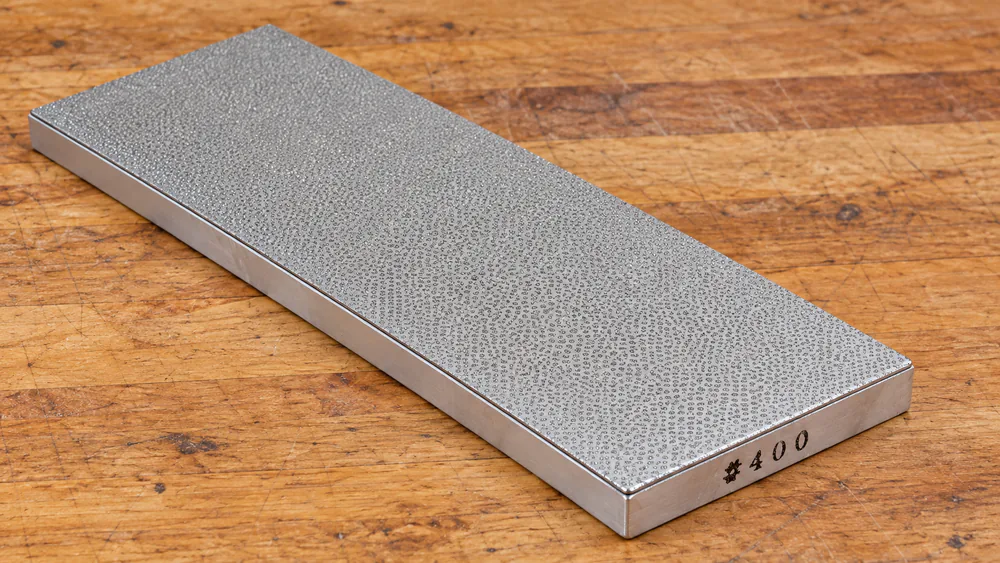
Where the DMT is built for upkeep, the Atoma Medium #400 is a coarse, fast plate and the odd one out in this group. Its clustered diamond pattern sheds swarf readily with a rinse, and it can sharpen blades as well as flatten water stones. It is a specialist, so we rate it for cooks who already have finer stones.
Pros
Clustered diamond pattern sheds swarf readily when rinsed
Replaceable abrasive sheet on an aluminum support
Can sharpen blades and flatten water stones
Premium build for coarse work
Cons
Dotted surface feels less smooth than a continuous face
Fine-edge work can retain a textured scratch pattern
Linked unit's exact dimensions are unconfirmed
Flattening a Dished Stone
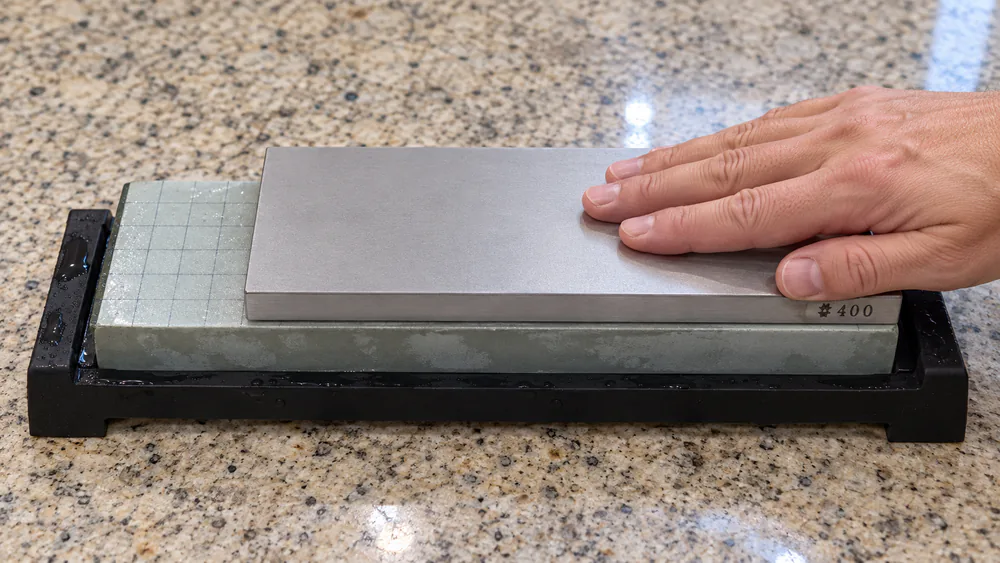
Choose the Atoma if you already sharpen on water stones. It is the plate you reach for when a stone has dished: wet the surface, keep the pressure light, and work it across the stone until the dish is gone. It also cuts a neglected edge fast. If it will be your only plate, you will want a finer step afterward, because the dotted surface feels less smooth for edge finishing than a continuous face and fine-edge work can leave a textured scratch pattern.
Check It Before You Trust It
Fast cutting does not guarantee flawless flatness. A straightedge can reveal an imperfect plate, so check it before you use the plate to flatten an expensive stone. Buy the complete plate, not a replacement sheet, because the abrasive sheet and support are separate components.
Atoma plates are commonly specified as 210 x 75 mm, but the product copy for the linked unit gives different figures, so confirm the size you receive. We could not verify a warranty or a return period, so check the seller's terms.
The Atoma at work flattening a dished water stone.
After the specialist Atoma, the SHARPAL 156N is a friendlier all-rounder: the 162N shrunk down to 6 x 2.5 inches. The case is practical as both storage and a base, and the guide is useful for building angle memory. The short face limits long strokes, which is why it ranks last for chef's knives.
Pros
Compact 6 x 2.5 inch plate with a case that doubles as the base
Same 325 / 1200 faces as the larger SHARPAL
Dry sharpening avoids the water mess of a soaking-stone setup
3-year warranty, with a 1-year extension when you register
Cons
Short face limits a long sharpening stroke
Two faces with no middle step
Case mounting fit can feel tight
Who Benefits from a Smaller Stone
Pick the 156N if drawer space is tight or you mostly sharpen paring knives, utility knives, and small blades. It uses the same 325 coarse and 1200 extra fine faces as the 162N, with diamond sizes of 45 micron and 12 micron, and the 6 x 2.5 inch surface is enough for short edges.
The case holds the stone securely without rattling, and its angle guide is handy for building angle memory. Dry sharpening also keeps the bench clean compared with a soaking-stone setup.
Main Benefits and Tradeoffs
On a long chef's knife you will sharpen in sections, and that slows you down. The external case mounting fit can feel tight, so go gently when you seat the plate. The two-face progression lacks a middle step, though the supplied faces can work as a standalone pair. A middle-grit plate would make the transition more comfortable.
The same care rules apply as on the larger model. Use light pressure, let the initial roughness settle during break-in, and clean off dark patches before judging wear. The coarse face can flatten a stone occasionally, but the maker discourages frequent lapping because this is a knife sharpener. The 3-year warranty carries over from the larger plate.
If you sharpen long knives, spend a little more on the 162N. SHARPAL also lists a 168H, which has an 8 x 3 inch plate with 325/1000 grits and an angle guide but no storage case. It is not the 162N, and we did not test it as a separate pick.
How to Choose a Diamond Sharpening Stone
Choosing well comes down to what your knives need today and how much room you have. Think about the task first, then the size, then the extras.
Match the Grit to Repair, Routine Sharpening, or Finishing
Use a coarse abrasive for a neglected or damaged edge. A knife that is only a little dull may need nothing more than a fine plate. Extra fine stages refine the finish, but they do not replace correct angle control.
That is why the SHARPAL pair works well for most people, while the D8F suits cooks who maintain their knives regularly. If your knives are in rough shape, a coarse face earns its place on day one.
Compare Grit Ratings and Micron Sizes Carefully
Note. Do not equate brands by the printed grit alone. SHARPAL's 1200 uses a 12 micron diamond, while DMT's 1200 uses 9 micron. Compare the micron or mesh figures the maker publishes, and never treat two brands' numbers as matching.
A printed grit is a label, not a measurement you can carry across brands. The Atoma #400 has no authoritative micron figure we can quote, so we do not compare it with any other brand's number.
Choose a Surface Size and Stable Base for Kitchen Knives
A chef's knife is long, so the longer the plate, the fewer sections you need. An 8 x 3 inch surface lets a full blade pass in a few strokes. A 6 x 2.5 inch plate works for short blades but slows down long ones.
Stability matters as much as size. A plate that slides under pressure ruins your angle. Look for rubber feet, a non-slip case, or a holder, and test it on your own counter.
A diamond plate cuts fast, but an unstable plate and a wandering angle undo that speed on the first stroke.
Compare Continuous and Interrupted Diamond Surfaces
Continuous surfaces offer uninterrupted contact, which is why the SHARPAL, Ultra Sharp, and DMT plates feel smooth under the blade. Interrupted surfaces, like the S SATC channels or the Atoma dots, collect metal fines in their recesses. Both pattern and grit change how a plate feels, so choose by the feel you prefer.
Understand Diamond Crystal Type and Bonding Method
These two terms describe different things. Monocrystalline describes the diamond crystal, and electroplated describes how it is attached to the steel. A plate can be both, and most in this group are. The Atoma differs in using a replaceable abrasive sheet on an aluminum support.
Decide Between a Double-Sided Stone and Separate Plates
A double-sided plate gives you two grits in one footprint and costs less than buying two plates. Separate plates give you finer control, a middle step, and a holder, but they cost more and take up more room.
For most home cooks, one double-sided 8 x 3 plate is the practical choice. If you sharpen weekly and enjoy the process, the three-stone set repays the extra space. If you only want upkeep, a single fine plate does the job.
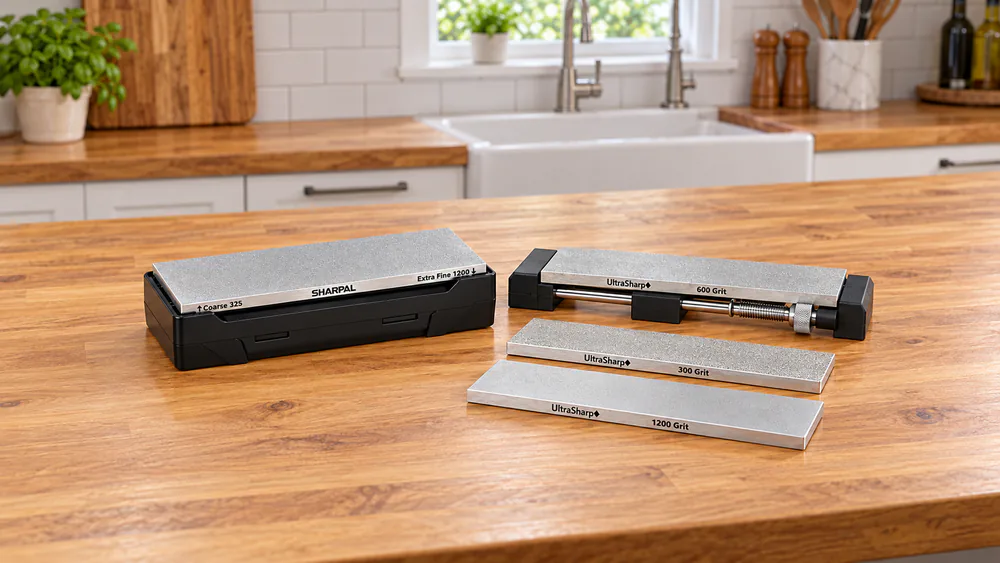
One double-sided plate versus a three-plate progression.
Diamond Stones vs Water Stones for Kitchen Knives
Diamond plates and water stones both sharpen kitchen knives well. They differ in how they feel, how they wear, and how much care they ask of you.
Cutting Speed, Feedback, and Maintenance
Diamond cuts quickly and stays flat, so it needs no soaking and no regular flattening. Dry sharpening avoids the water mess a soaking stone brings. The tradeoff is feedback. A hard diamond plate gives less soft, slurry-like feel than a water stone, so beginners may find it harder to read.
A water stone wears into a dish and must be flattened, which is a job a coarse diamond plate does well. That is why many cooks own both.
Edge Finish and When to Add a Finishing Stone
A fine plate with careful deburring gives a strong working edge for a kitchen knife, and whether you also want a polished finish depends on the edge you want. If you want a polished, push-cutting finish, add a finishing stone. It is an option, not a requirement for a sharp knife.
How to Use a Diamond Stone on a Kitchen Knife
The method is the same on every plate here. Hold a steady angle, keep the pressure light, and let the diamond do the cutting.
Set the Angle and Use Light Pressure
Match the existing bevel. A marker on the bevel shows where the abrasive makes contact, so you can see if your angle is right. An angle guide helps you find a starting position, but it does not clamp the knife through the stroke. Make light strokes across the surface and let the plate cut.
Heavy pressure does not speed things up. It wears the plate and risks a poor edge.
Refine the Edge and Remove the Burr
Work the coarse face until a burr forms along the whole edge. Then move to the finer face or plate and use lighter strokes until the burr is gone. Progress to a finer abrasive when the edge needs more refinement. A few strokes on a strop clean up what remains.
Tip. Color the bevel with a marker before the first stroke. After a pass or two, the marks that disappear show you where the plate is touching, and you can adjust your angle on the spot.
Cleaning, Break-In, and Storage
Diamond plates are low-maintenance, but a few habits keep them cutting.
Follow the Maker's Lubrication and Cleaning Instructions
Dry sharpening is the safe default for the SHARPAL, S SATC, and DMT plates. SHARPAL allows optional water or oil with prompt cleaning and complete drying. DMT allows water but needs no oil. Ultra Sharp specifies water, glass cleaner, or Krud Kutter. The Atoma wants water. Whatever you use, rinse, dry, and remove swarf before storing.
Recognize Break-In, Clogging, and Wear
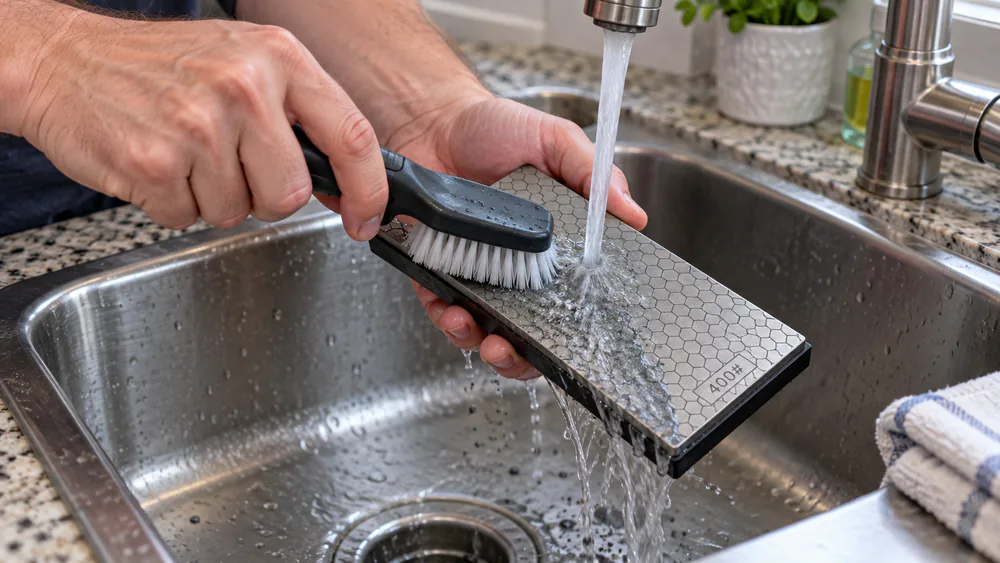
New plates feel rough at first. That roughness settles with use. Do not confuse it with coating loss, which looks like bare patches. Swarf can make a good surface stop cutting, so clean it before deciding it has worn out. Store plates dry, and keep abrasive faces apart so they do not scratch each other.
Clearing swarf with a brush and rinse before drying and storing.
Frequently Asked Questions
Can you sharpen hard Japanese knives on diamond stones?
Yes. Diamond is harder than any steel, so it cuts hard Japanese blades without trouble. Use light pressure, match the existing bevel, and finish on a fine plate. A finishing stone is optional if you want a polished edge.
Do diamond sharpening stones need flattening?
Not in the way water stones do. A diamond plate is made flat and stays flat, though a plate can remain flat while its abrasive wears. Do not lap one plate against another, since DMT does not cover lapping wear.
Can a diamond plate flatten a water stone?
Yes, and a coarse plate does it well. The Atoma is made for this job, and the SHARPAL coarse face can do it occasionally. DMT recommends a dedicated Dia-Flat for regular lapping.
How long does a diamond sharpening stone last?
It depends on how often you sharpen, how hard you press, and how well you clean it. A plate can stay flat while the abrasive wears. A warranty covers defects, not wear, so do not read it as a lifespan.
Final Verdict: Which Diamond Stone Should You Choose?
For a kitchen with a few knives, the SHARPAL 162N is the plate to buy. Choose the S SATC if budget matters most, and the Ultra Sharp set if you want a full progression and have the space. Pick the DMT D8F for upkeep, the Atoma if you flatten water stones, and the SHARPAL 156N for small blades and tight drawers.