As an Amazon Associate we earn from qualifying purchases. We may earn a commission from links on this page, at no extra cost to you. Learn more.
A honing rod is the tool that keeps a sharp kitchen knife cutting well between full sharpenings. A few light passes before you start prepping can bring back clean tomato slices and smooth onion cuts, and it takes less than a minute.
The trouble is choosing one. Rods come in steel, ceramic, and diamond, with working lengths from nine to twelve inches. Handle designs range from basic plastic grips to versions with guards and angle guides. Retailers also use the names honing rod, honing steel, and sharpening steel almost interchangeably, which makes the shelf more confusing than it needs to be.
We compared six rods on handling, guard, length and edge recovery, and this guide ranks them by who each one suits. If you also want to see what a full edge reset looks like, our knife sharpener reviews cover that side of maintenance.
Best Honing Rods at a Glance
Our picks are editorial fits, not a single universal ranking. A rod that suits a long chef's knife may be a poor match for a short paring knife, so read the buyer fit column first. Working length here means the exposed honing surface, not the handle-inclusive length.
Product
Buyer fit
Material and surface
Working length
What sets it apart
Made In Honing Steel
Overall, mixed edge angles
Tungsten steel, dual textures
11.625 inches
Dual angle guides and balance
Winco K-12S
Budget, long blades
Round stainless steel
12-inch
Long working surface for low cost
Wusthof 9-Inch Honing Steel
Everyday steel maintenance
Grooved magnetic steel
9-inch
Controlled texture, compact storage
Messermeister CR-12F
Long ceramic touch-ups
Fine ceramic, 1200-grit
12-inch
Grip and generous working room
Work Sharp Ceramic Honing Rod
Beginners with compatible angles
Fine ceramic
9-inch
Rubber tip and fixed 20-degree guides
Wusthof Wide Fine Diamond
Deliberate abrasive touch-ups
Diamond-coated wide steel
Nominal 10 inches, measured 10.25
Broad abrasive contact
How We Tested These Honing Rods
We rate each rod on the criteria a home cook feels first: how the grip and guard sit in the hand, whether the tip holds steady, and whether the length gives a full-size chef's knife room to move. Then we assess how well the rod restores everyday cutting performance by checking for clean tomato slices and snag-free paper cuts.
Each score also reflects the known limits of the rod's material and how easy the rod is to clean.
We did not rank by grit numbers alone. Grit labels use different standards across steel, ceramic, and diamond, so a bigger number does not tell you which rod is more aggressive.
Note. None of the prices in this roundup are listed on purpose. We place each pick in a tier (budget, mid-priced, premium) so the guide stays accurate when store pricing changes.
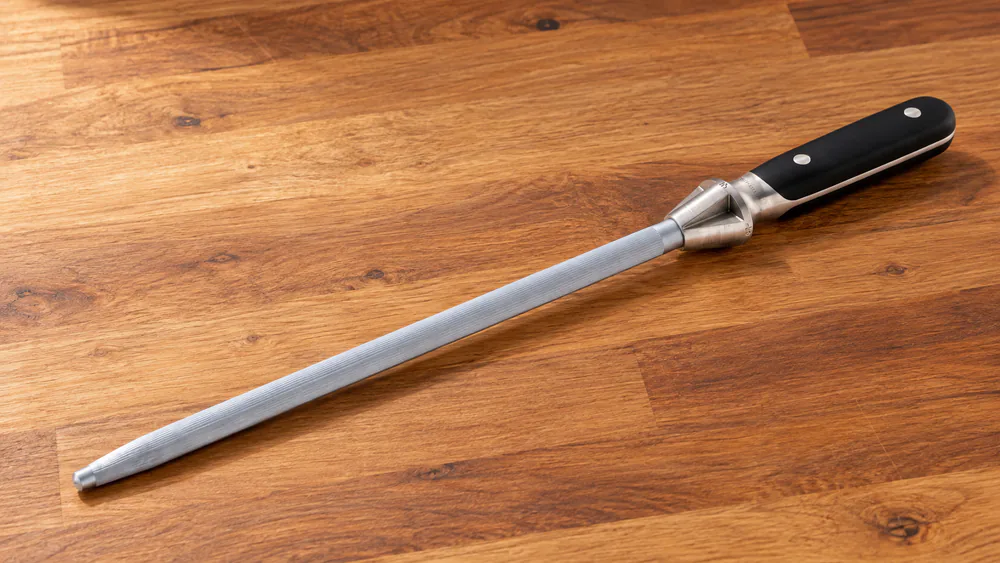
The Made In rod felt heavy when we first picked it up, but the balance and the comfortable handle kept it easy to manage. It restores clean tomato slicing, and the guides take the guesswork out of holding a steady angle on both thin and sturdy blades.
Pros
11.625-inch working rod suits long blades
Tungsten steel with dual surface textures
15-degree and 20-degree guides plus an integrated guard
Balanced, comfortable handle
Cons
Feels heavy at first
The shaft can loosen in drawer storage and need tightening
Our one handling note is that the shaft can loosen during drawer storage, so check that it is tight before you hone. Wash it by hand and wipe it down with a damp towel now and then.
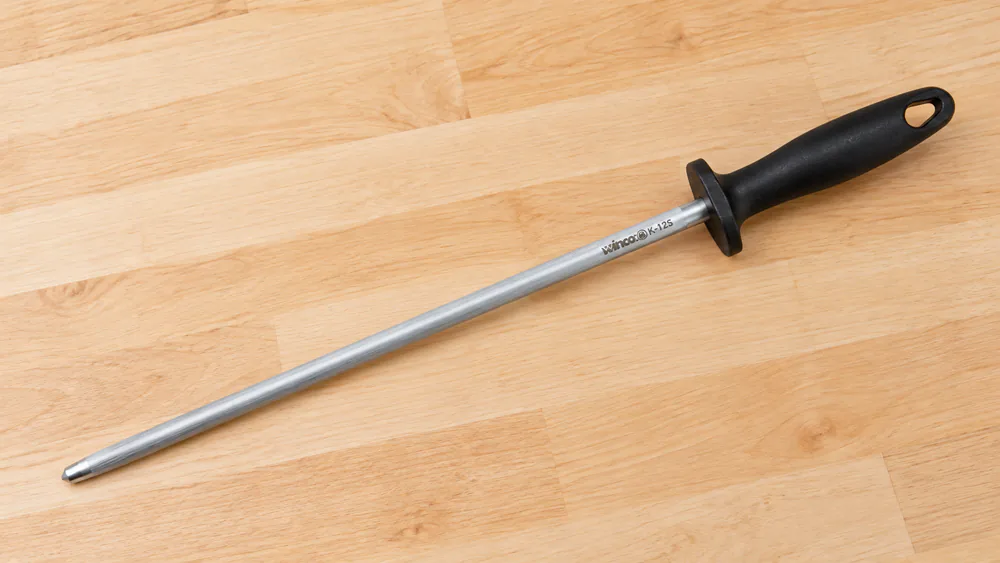
Where the Made In guides your angle, the Winco is plain, and it feels that way in the hand. Even so, it can restore clean paper cutting and thin tomato slices, which is exactly the job a budget rod should do. It suits big chef's knives, and the protective finger guard and molded plastic handle cover the safety basics.
Pros
Budget tier with a long 12-inch working surface
Finger guard and hanging hole
Restores clean paper cutting and thin tomato slices
Cons
Basic feel and balance
Edge recovery can trail better steel rods
No angle guide
The tradeoffs show up in feel and recovery. It feels less balanced when you hold it anywhere other than the intended grip, and its edge recovery can lag behind the better-performing steel rods. There is no angle guide, so you set the angle yourself. At 17.5 inches overall, it also needs real drawer or hook space.
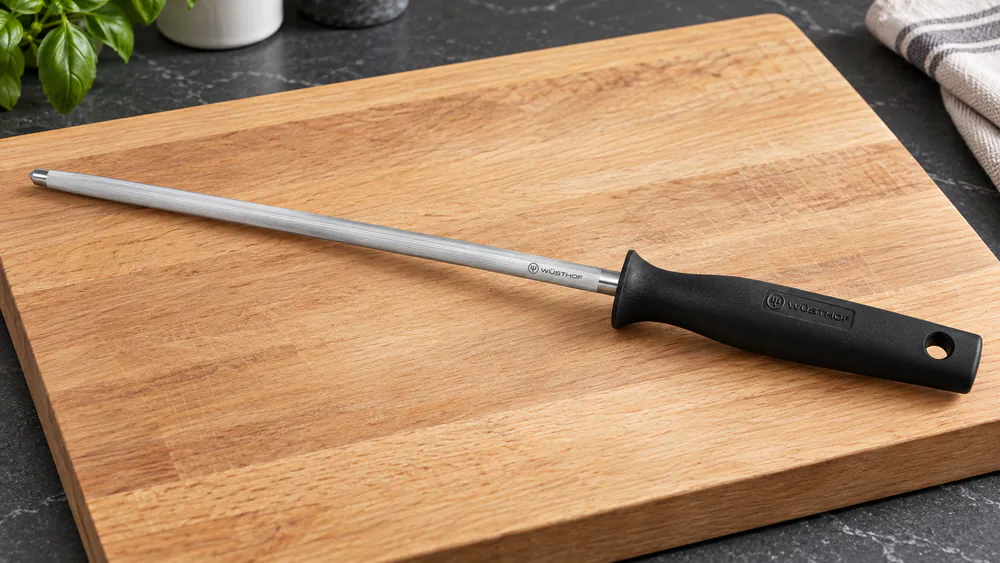
Stepping down in length, the Wusthof steel is the rod we would hand to a cook who wants a straightforward everyday tool. The fine ridges give enough friction to guide a controlled stroke without making the rod cumbersome, and the flared handle supports a comfortable grip while keeping your hand back from the working surface. The grooved magnetic steel also catches loose metal particles, and you clean it with a damp cloth.
Pros
Controlled fine-ridge texture
Flared handle with a protective bolster
Compact enough to store easily
Cons
Limited runway for long blades
Grooves reward a light touch
Basic-feeling handle
It is a shorter rod, so it stores easily, though long blades leave less room for an unhurried stroke. The grooves can feel aggressive against the edge, so a light touch matters, and the textured handle feels basic even while the rod does its job well. We are not making a hardness or country-of-origin claim for this model because published specifications conflict.
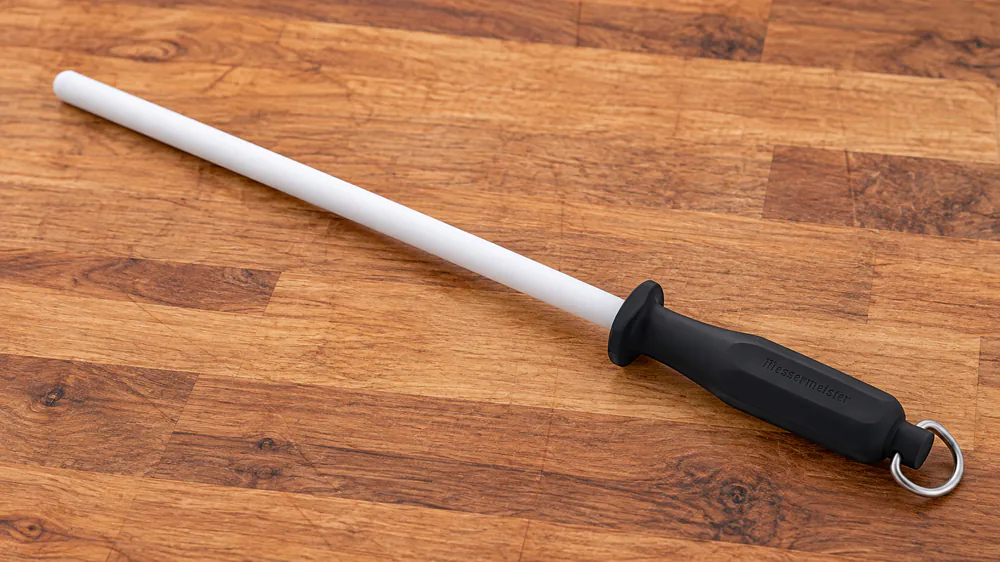
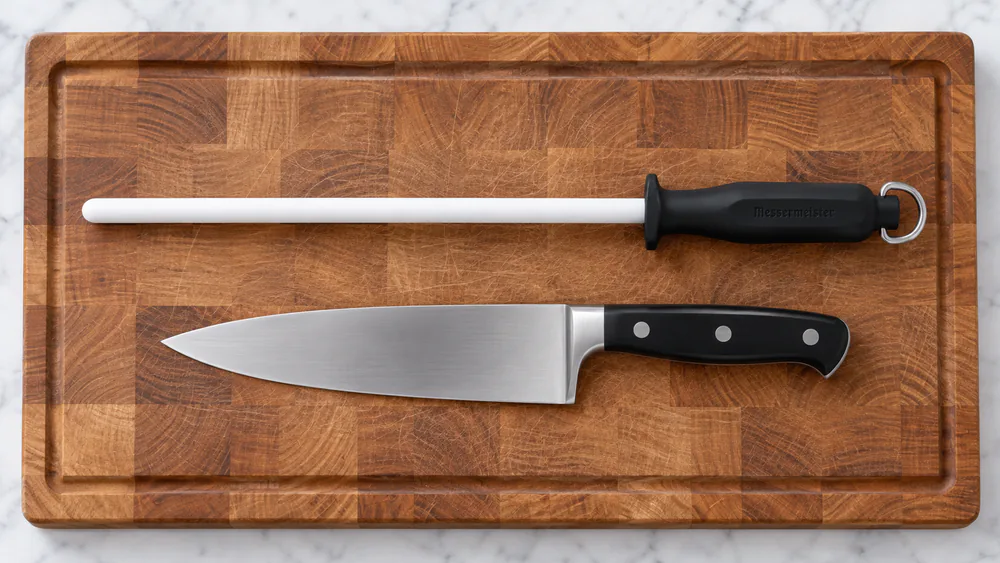
Switching to ceramic, the Messermeister gives long blades room for smooth passes and also works comfortably with shorter knives. The ceramic texture and the grippy handle make the stroke easier to control, and it needs no water or oil.
Pros
1200-grit ceramic with a 12-inch working rod
Grippy soft-touch handle
Smooth passes on long and short knives
Cons
May need more passes than steel
Can break on impact
Metal deposits take extra cleaning
Ceramic has real downsides. It may need more passes than an efficient steel rod to recover a comparable edge, and it is not drop-proof, so protect it from impacts. Metal deposits on white ceramic can also take more effort than a quick wipe. Hand wash it with soap and water, and a melamine sponge can lift stubborn deposits.
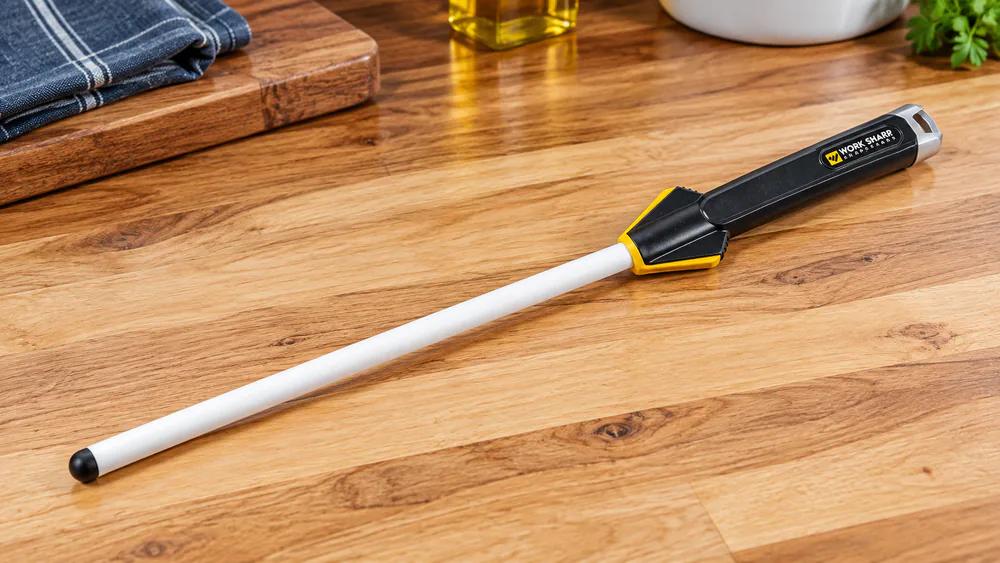
The Work Sharp is the most limited of the ceramics, because its fixed guides only suit a knife near 20 degrees per side. Within that limit it makes angle control easy for a first-time user. The 20-degree guides simplify setting the starting angle, while the rubber tip steadies the upright rod and protects the counter from scratches. The grip stays comfortable through repeated touch-ups. The 9-inch ceramic surface is backed by a 3-year warranty.
Pros
Fixed 20-degree guides simplify the angle
Rubber tip steadies the rod
Comfortable grip, 3-year warranty
Cons
Guides may not match your knife's angle
Results on stainless blades can be modest
Ceramic can break on impact
Fixed guides concentrate guided use on the same areas of the rod, so using the rest of the surface takes freehand control. Comfortable handling also does not guarantee strong edge recovery on every knife, and results on stainless blades can be modest. The ceramic grit is approximately 1200-grit equivalent.
6
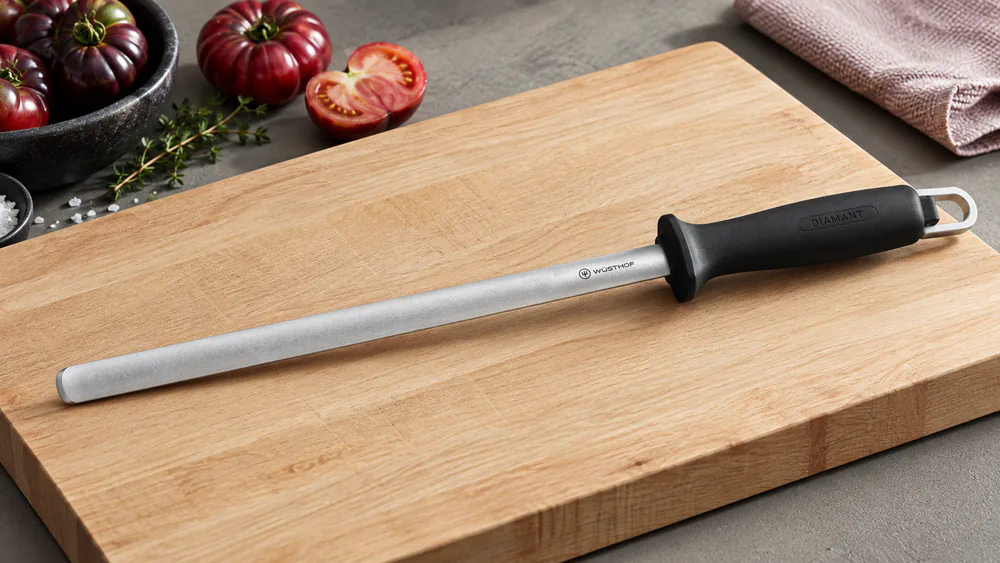
Wusthof 10-Inch Wide Fine Diamond Sharpening Steel
The Wusthof diamond cannot do the daily job the other five do, because it removes metal rather than just maintaining an edge. It has a comfortable grip and a broad surface with a fine-sandpaper feel, and the wide design feels sturdy with useful reach. It can restore clean paper cutting and thin tomato slices without tearing the skin.
Pros
Broad diamond surface for deliberate touch-ups
Sturdy, comfortable handle
Fine 240 grit (European standard)
Cons
Removes metal, so not a daily rod
Coating wears with use
Premium tier
The surface is rated 240 grit under the European standard, described as fine, and it removes metal. Wusthof itself recommends a separate honing steel for daily or weekly maintenance. The diamond coating wears with use, so wipe it gently with a damp cloth and towel-dry it right away. The name says 10-inch, but the measured working length is about 10.25 inches. It sits in the premium tier.
How to Choose a Honing Rod for Your Knives
Start with what the knife is made of and what its maker says, then think about length, grip, and how much surface texture you want. Buyers often give the material too much attention and the handling too little.
Honing Rod, Honing Steel, Sharpening Steel: Are They the Same Tool?
Mostly, yes, at the retail level. The three names overlap, so choose by the actual surface material and intended job, not by the label. A "sharpening steel" with a diamond coating, like the Wusthof above, is an abrasive tool, while a smooth or fine-ridged steel is a maintenance tool.
Honing vs. Sharpening: What Does Your Knife Need?
Honing is edge maintenance between full sharpenings. Even smooth steel can remove microscopic amounts of metal, so we avoid saying a rod only realigns the edge, but the practical difference is real. If a few passes bring back clean slicing, you needed honing. If the edge stays blunt or has chips, it needs sharpening or repair, and more forceful honing will not fix it.
Tip. After a few strokes, test the edge on a tomato or a sheet of paper. If cutting has not improved, stop honing and sharpen on stones or a sharpener instead.
Steel vs. Ceramic vs. Diamond Rods
Steel is mechanically durable and forgiving. Ceramic allows fine touch-ups but can break on impact, and metal deposits show up on its pale surface. Diamond abrades and eventually wears, which makes it a deliberate occasional tool. Surface finish and pressure matter as much as the material name.
Match the Rod to Your Knife's Steel and Manufacturer Guidance
Neither carbon steel nor Japanese origin alone tells you whether a rod is safe. Some makers permit gentle honing of suitable knives, while other Japanese knife suppliers explicitly tell customers not to use rods and prescribe waterstones. Follow the care guidance for your particular knife, and when in doubt, skip the rod.
Warning. Check your knife maker's care page before honing a Japanese or carbon-steel blade. Model-specific rules vary, and a rod that suits a Western chef's knife may not suit a hard, thin Japanese edge.
Rod Length, Handle Comfort, and Hand Guards
Extra working length gives you room to complete a controlled stroke, which is why the 12-inch Winco and Messermeister suit long chef's knives. Shorter rods like the 9-inch Wusthof steel and Work Sharp store more easily but ask for more technique with long blades. Choose a handle that is comfortable to hold and a guard that keeps your fingers back from the working surface.
Grit, Surface Finish, and Value
Compare surface finish and function before grit numbers, since steel, ceramic, and diamond grit labels do not use one standard. For value, a basic steel rod handles routine maintenance well, and the budget Winco proves you do not need to spend much for a long working surface.
A rod that feels comfortable and safe in your hand will get used. One that does not will stay in the drawer.
How to Use a Honing Rod
Use a plain, steady routine, and be gentle. The rod is a maintenance tool, not a grinder.
Set the Angle and Use Light, Controlled Strokes
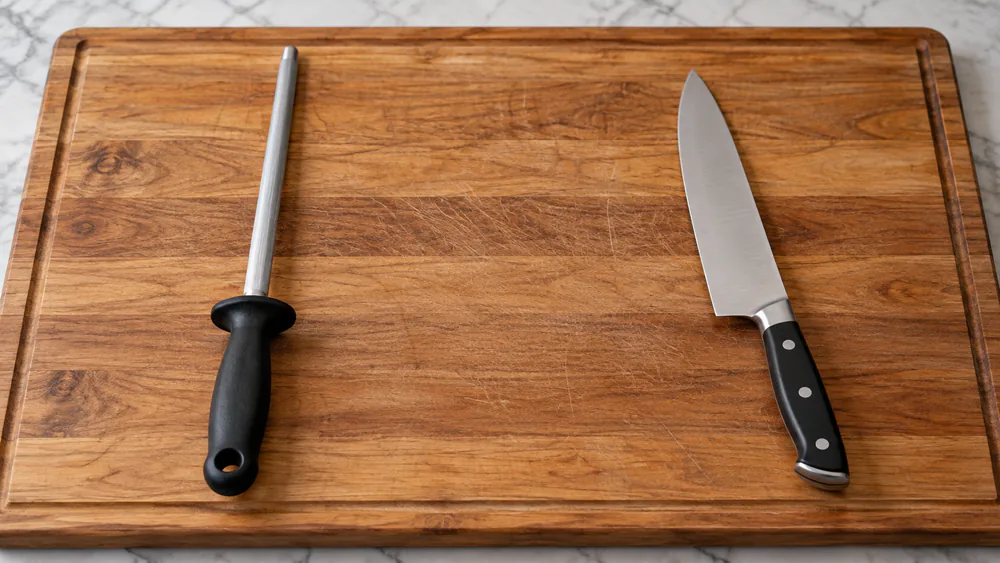
Plant the tip of the rod on a stable surface, such as a folded towel on the counter, so it cannot slip. Match your knife's existing edge angle and draw the knife from heel to tip with light, controlled strokes. Keep your fingers behind the guard the whole time.
Prepare a stable work area and identify the rod’s guard before honing.
Check the Edge and Know When to Stop
A few passes per side is usually enough. Then check whether the knife cuts better. If it does not, the edge needs sharpening, not harder honing.
Cleaning and Storing Your Honing Rod
Cleaning Steel, Ceramic, and Diamond Surfaces
Wipe grooved steel with a damp cloth. Wash ceramic with soap and water and use a melamine sponge for stubborn deposits. Wipe diamond gently with a damp cloth and dry it immediately. Clean off deposits before judging whether a rod has lost its cutting action.
Storage, Damage Checks, and Replacement
Protect ceramic from impacts, check every rod for damage, and make sure the handle is attached securely. We do not promise a fixed replacement interval, because wear depends on how often you use the rod and how hard you press.
Frequently Asked Questions
How often should you hone a kitchen knife?
Hone when cutting performance tells you to. Knife steel, cutting surface, and workload all change how often a touch-up helps, and your knife's care guidance matters too, so a fixed calendar does not fit every kitchen.
How do you clean metal deposits off a honing rod?
Wipe grooved steel with a damp cloth, and wash ceramic with soap and water. A melamine sponge lifts stubborn deposits from white ceramic, and diamond only needs a gentle wipe and an immediate dry.
Can you use a honing rod on serrated knives?
Not with ordinary heel-to-tip passes. Serrations need specialist guidance or service, not routine passes across their teeth.
Can a honing rod replace a knife sharpener?
No. A rod maintains an edge that is still fairly sharp, while a sharpener or stones remove metal to create a new one.
Does a brand-new knife need honing?
Usually not at first. Hone once you notice slicing getting less clean, and check your knife's care guidance before you start.
Final Verdict: Which Honing Rod Should You Buy?
Buy the Made In Honing Steel if you want one rod for most kitchens, and the Winco if you want a long rod without spending much. Choose the Messermeister or Work Sharp if you prefer ceramic, and keep the Wusthof diamond for deliberate abrasive touch-ups only.
If you mostly cook with short paring knives, skip the 12-inch rods and the Wusthof diamond, since their length and abrasiveness are wasted on small blades.