As an Amazon Associate we earn from qualifying purchases. We may earn a commission from links on this page, at no extra cost to you. Learn more.
Every knife here went into a month of real prep rotation, and we checked the edge after each session, not at the end of the run. The work was ordinary: bags of onions, whole chickens broken down to parts, ripe tomatoes, sourdough loaves and a lot of apples. Nothing was scored in a lab; the ranking came down to which knives we kept reaching for.
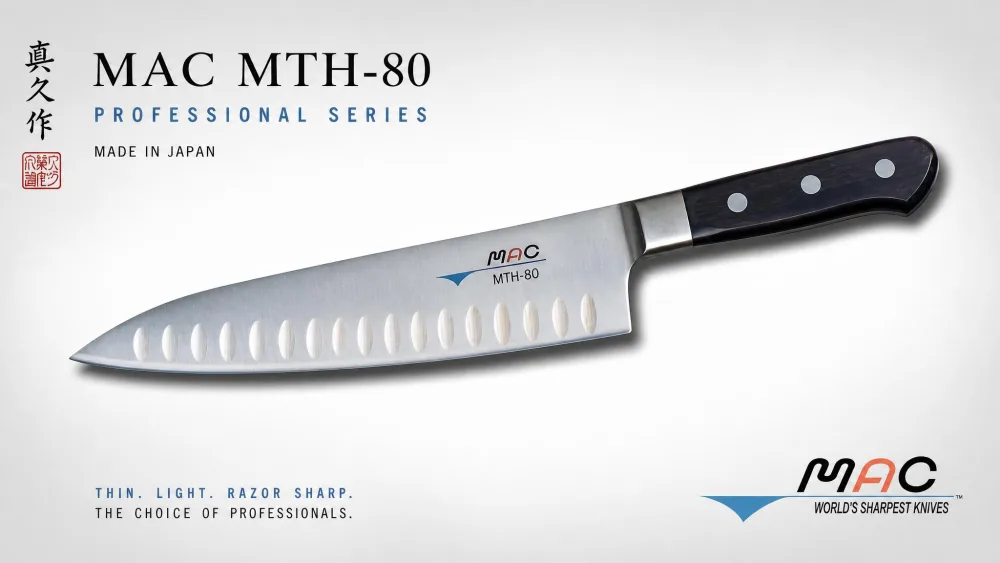
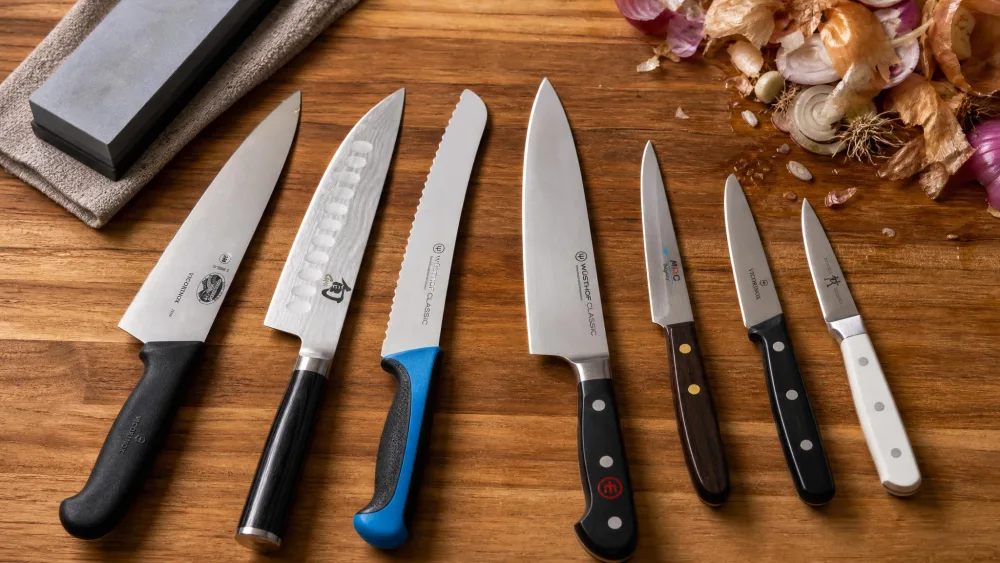
The MAC MTH-80 is our top pick, and it won on precision and weight. At 6.8 ounces with a 2.5 mm spine it falls through an onion instead of splitting it, and stays comfortable through an afternoon of prep. If that is more than you want to spend, the Victorinox Fibrox Pro does most of the same work for well under a third of the money. Below that sit a santoku, a bread knife, a paring knife and a full block set.
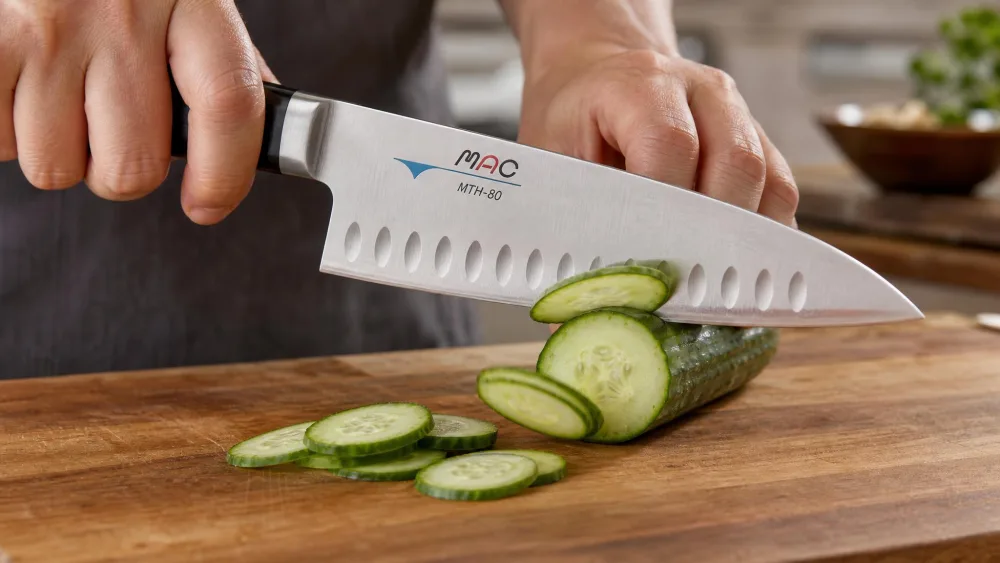
Halfway through a tray of cucumbers we noticed we had stopped flicking slices off the blade. The dimpled hollow edge keeps wet potato and cucumber rounds from clinging to the steel, and they drop onto the board as fast as you can cut them. The thin blade gives precise control, though cooks with big hands notice the handle runs short in the first session. This is the knife we reached for more than any other, and the one we would buy again.
An 8-inch blade (200mm) with a 15 degree edge per side
Sub-zero tempered molybdenum vanadium alloy, made in Japan
Backed by a 25-year warranty
Specifications
Blade length
8 inches (200mm)
Weight
6.8 ounces
Hardness
61 HRC
Spine thickness
2.5 mm at the heel
Handle
Triple-riveted Pakkawood
Why it wins
The spine measures 2.5 mm at the heel, thin for a Western-style knife, and that is what lets it fall through an onion instead of splitting it. At 6.8 ounces it will not wear out your forearm.
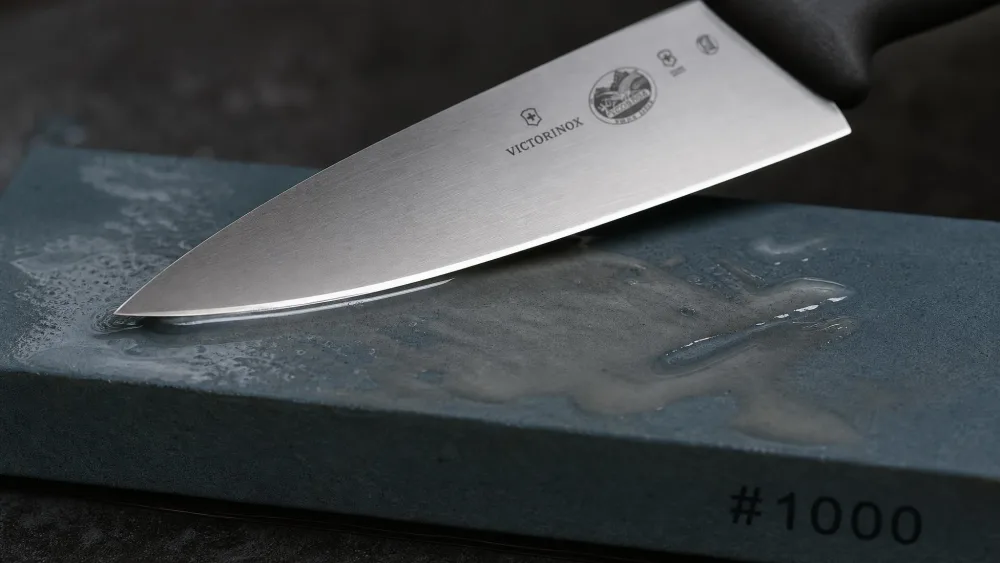
The alloy is hardened to 61 HRC, steel that stays sharp for months between full sharpenings, and it comes back on a #1000 stone in minutes. One thing to check on day one: the occasional MAC arrives dull.
Pros and cons
Pros
Held its edge through a month of daily prep with almost no measurable dulling
The dimpled edge keeps wet slices off the steel
Light and precise, at 6.8 ounces
Cons
The handle runs short for large hands
The thin spine is wrong for squash or bone
Drop it on tile and the heel corner can chip
Some arrive dull out of the box
Who it's for
Buy the MAC if you prep most nights and keep it off bone and off the floor.
The dimples are why cucumber rounds drop off the blade instead of riding along it.
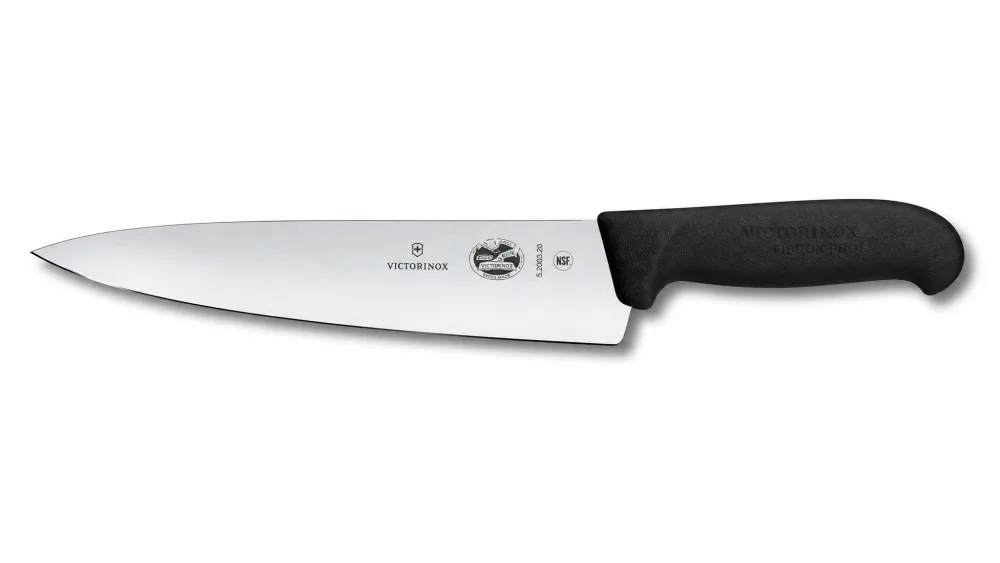
Best value chef's knife: Victorinox Fibrox Pro 8-inch
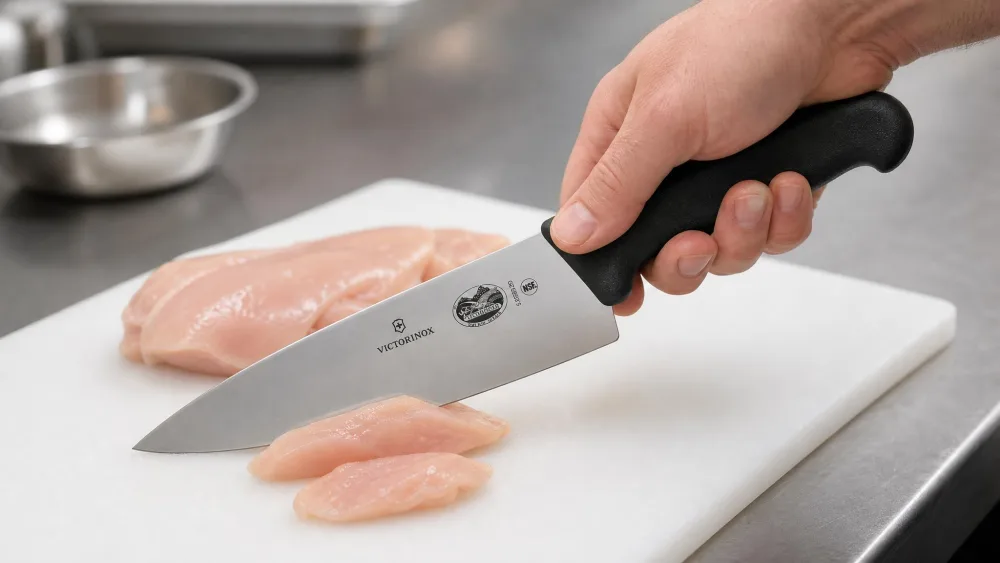
The textured handle keeps its grip through greasy chicken breakdown, which is exactly where slick riveted handles get scary. Its light weight means noticeably less hand fatigue across a long prep session, and none of the blisters that come from gripping a dull knife hard. The handle feels cheap for the first few days, then the impression fades once you have used it for real work.
A 7.9-inch stamped blade with a laser-tested edge
Non-slip TPE handle that holds grip when wet
A lifetime warranty against defects
Specifications
Blade length
7.9 inches
Weight
About 5.7 ounces
Hardness
About 56 HRC
Construction
Stamped, no bolster
Handle
Textured TPE
Why it wins
Where the MAC asks about $155 and a careful hand, the Victorinox asks neither, and nothing else at this price cuts this well. The blade is stamped rather than forged, with no bolster, which is exactly why it costs and weighs what it does.
Weight varies between production runs and handle colors, so treat it as a touch under six ounces. The steel runs about 56 HRC, and hardness on softer stainless measures differently depending on where you test it. Softer steel dulls sooner, but it takes a new edge in seconds.
Pros and cons
Pros
Cuts far above its price, usually under $50
Textured handle stays secure through greasy work
Carries a lifetime warranty
Cons
The handle looks and feels cheap at first
Softer steel needs honing more often
No bolster, so there is less of a finger stop
Not a knife to buy for its looks
Who it's for
Our go-to for a first serious knife, or for a cook who would rather spend the difference on a good board and a stone.
The textured handle is why this knife stays safe through greasy work.
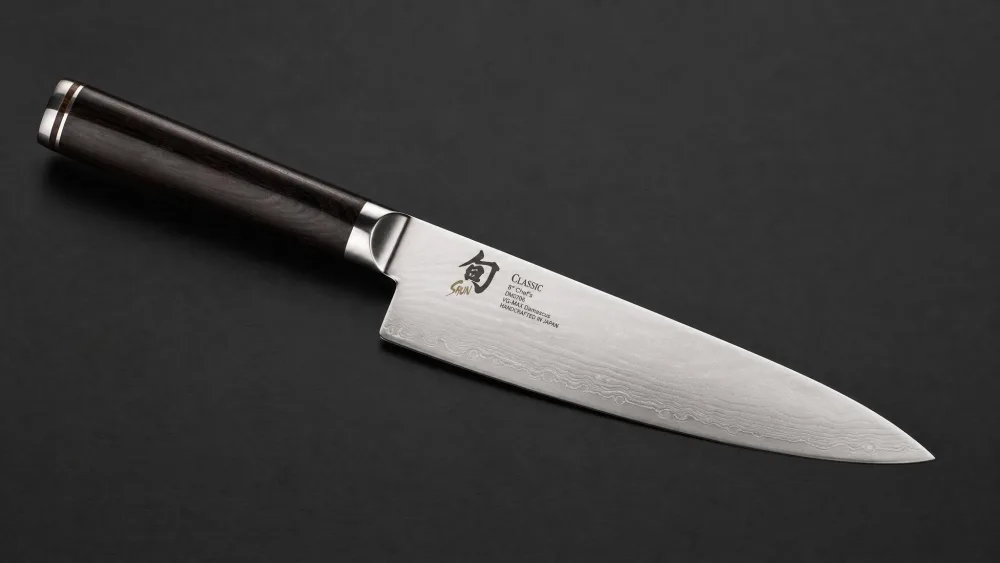
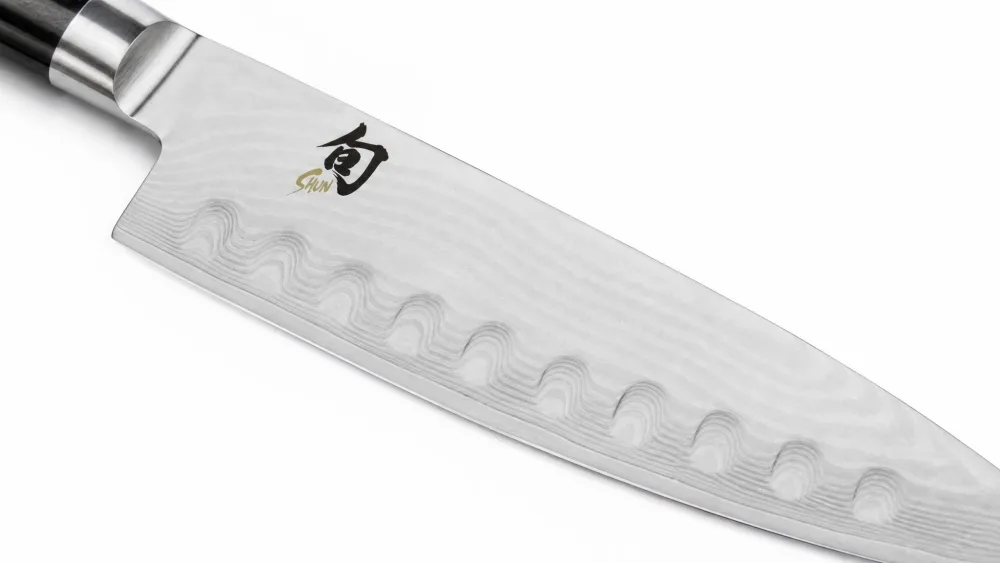
Best Japanese chef's knife: Shun Classic 8-inch
Somewhere in the heavy end of the rotation, the Shun picked up a small chip. That is this knife in one detail: ground thinner and harder than anything else here, it buys the finest slices and the longest edge life, and charges you a blade that will not forgive a bone.
The Shun needs honing far less often than a German blade, going weeks of daily prep between touch-ups. Its D-shaped Pakkawood handle keeps grip when wet or greasy, works for left and right hands, and the knife is light enough that an average-sized hand does not tire out. The thin hard blade did pick up that small chip during heavy work, so this is the wrong knife for bones, frozen food or a careless hand.
A VG-MAX core wrapped in 68 layers of Damascus cladding
D-shaped Pakkawood handle that suits either hand
Free lifetime sharpening from the maker
Specifications
Blade length
8 inches
Weight
About 7.9 ounces
Hardness
60 to 61 HRC
Spine thickness
2.4 mm at the heel
Edge angle
16 degrees per side
Why it wins
The Shun takes the MAC's Japanese geometry further, and edge retention is the whole argument. At 60 to 61 HRC, the steel in Shun's Classic line holds an edge for months, and the spine measures 2.4 mm at the heel, thinner than any German blade here.
The published edge angle is 16 degrees per side, though the factory grind runs finer on some knives, so your edge can be thinner than the spec sheet says. The wa-style handle sits in your palm differently from a Western handle, so it is worth understanding first. Leave a Shun wet and it will spot.
Pros and cons
Pros
Goes weeks of daily prep between honings
68 cladding layers over a hard VG-MAX core
Free lifetime sharpening from the maker
Cons
The thin hard blade chips under heavy work
Spots if left wet, so hand wash and dry only
The cladding is cosmetic, and garlic still sticks
The tip bends if you pry with it
Who it's for
Buy the Shun if you enjoy knife work, prep vegetables and fish, and will keep it out of the sink pile.
The cladding looks striking, but the core steel does the work.
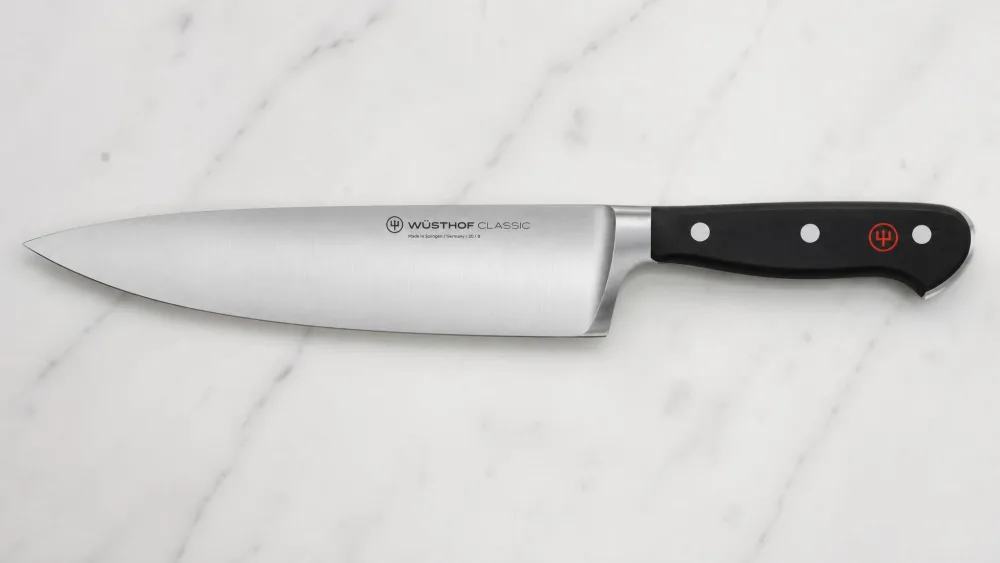
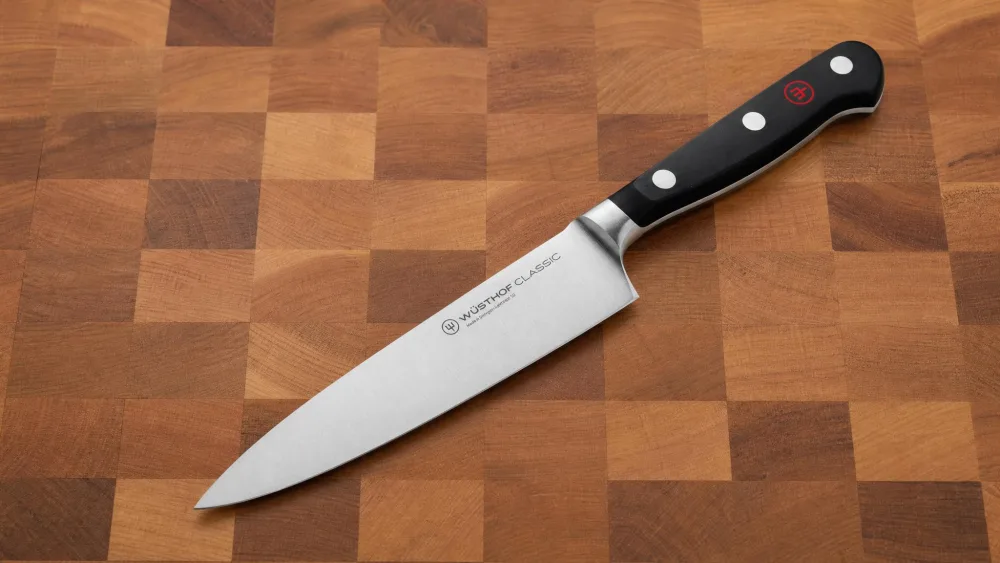
Best German chef's knife: Wusthof Classic 8-inch
Pick this one up straight after the Shun and the difference registers before you cut anything. The full bolster fills the web of your hand, the heel carries real mass, and the knife wants to be pushed through food rather than drawn across it.
This knife sliced tomato skin as cleanly at the end of the month as it did on the first day, after breaking down whole chickens, working through tough squash and getting through bags of onions. The polymer handle stays secure with wet hands during chicken work, which is where a slick handle turns dangerous. The weight is the polarizing part, since the full bolster and heavy heel feel reassuring to most hands but tiring for cooks with smaller ones.
X50CrMoV15 stainless, forged in Solingen
A 14 degree edge per side, full bolster and finger guard
A 4.5-inch handle on an 8-inch blade
Specifications
Blade length
8 inches
Weight
8.5 ounces
Hardness
58 HRC
Edge angle
14 degrees per side
Handle
Synthetic POM
Why it wins
Where the Shun is thin and hard, the Wusthof is thick and forgiving, and heft is the point. The published weight is 8.5 ounces, and weighed figures land about half an ounce higher, so call it eight and a half to nine ounces. Tempered to 58 HRC, the steel is softer than the Japanese knives here. It dulls sooner, and it also lets you drive through a chicken joint, then come back on a steel in a few passes.
The X50CrMoV15 recipe leans on molybdenum for corrosion resistance, which is why the blade shrugs off acidic prep.
Pros and cons
Pros
Cut tomato skin as cleanly at the end of the rotation as at the start
Full bolster and finger guard make heavy work secure
Forged full tang construction that will outlast you
Cons
At 8.5 ounces it tires smaller hands
The full bolster complicates sharpening the heel
Dulls sooner than a 61 HRC Japanese blade
The dishwasher will pit and dull it
Who it's for
For cooks who buy whole chickens and want a blade that forgives a heavy hand.
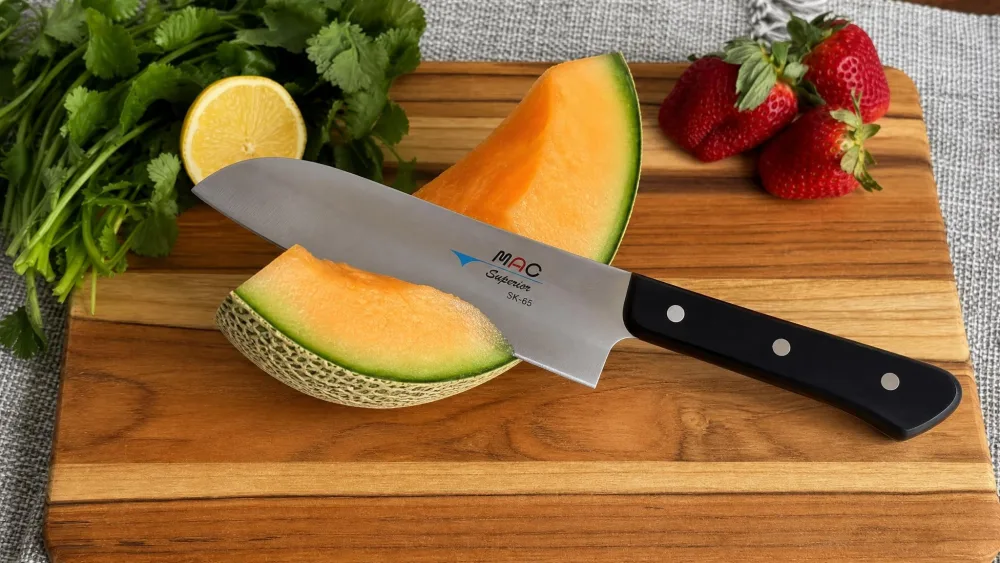
The narrow 2 mm blade glides through melon rind and the hard fat cap on a brisket, where a thicker blade wedges and forces the halves apart. This is also the knife most likely to still be in rotation in fifteen years, and ours has been: one has lived in a working kitchen far longer than this comparison ran, on roughly one sharpening a year. It needs drying right after washing, and while it takes less babying than a traditional carbon Japanese knife, it is not a leave-it-in-the-sink blade.
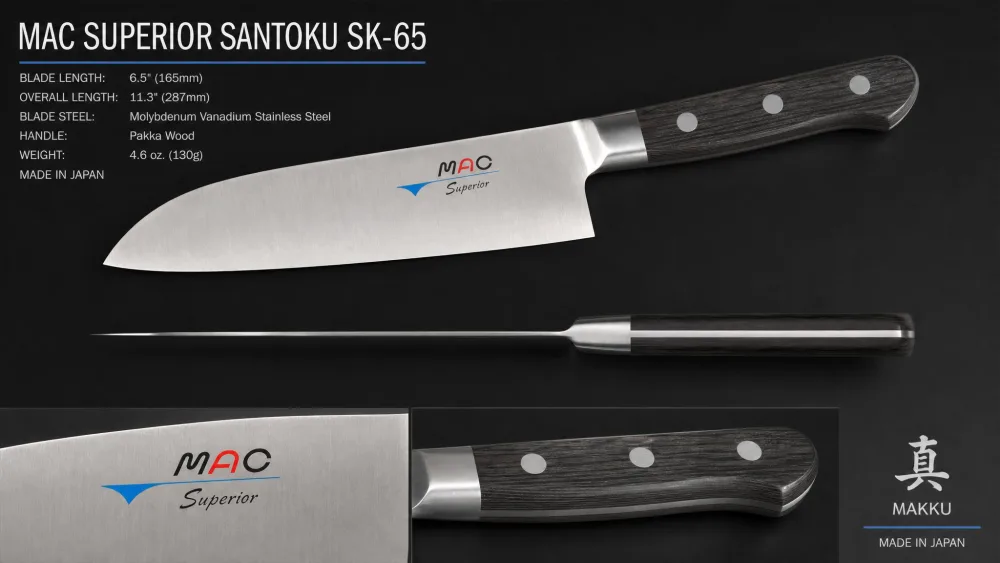
A 6.5-inch santoku blade with a 2mm spine
Pakkawood handle with stainless rivets
Made in Japan, with a 25-year warranty
Specifications
Blade length
6.5 inches
Weight
5.4 ounces
Hardness
61 HRC
Blade thickness
2 mm
Care
Hand wash only
Why it wins
After four full-size chef's knives, this is the one that disappears in the hand. At 5.4 ounces it is the lightest knife here, and the 6.5-inch blade is easier to control on a small board than a full chef's knife.
The steel is the same 61 HRC alloy as our top pick, and the flat profile suits the push cut most people use on vegetables.
Pros and cons
Pros
A 2 mm blade that will not wedge in dense produce
Lightest knife here at 5.4 ounces
61 HRC steel holds an edge for a year of home use
Backed by a 25-year warranty
Cons
Hand wash and dry only, with no soaking
The flat profile does not rock chop
Too short for a large roast or a big cabbage
Around $80 is real money for a second knife
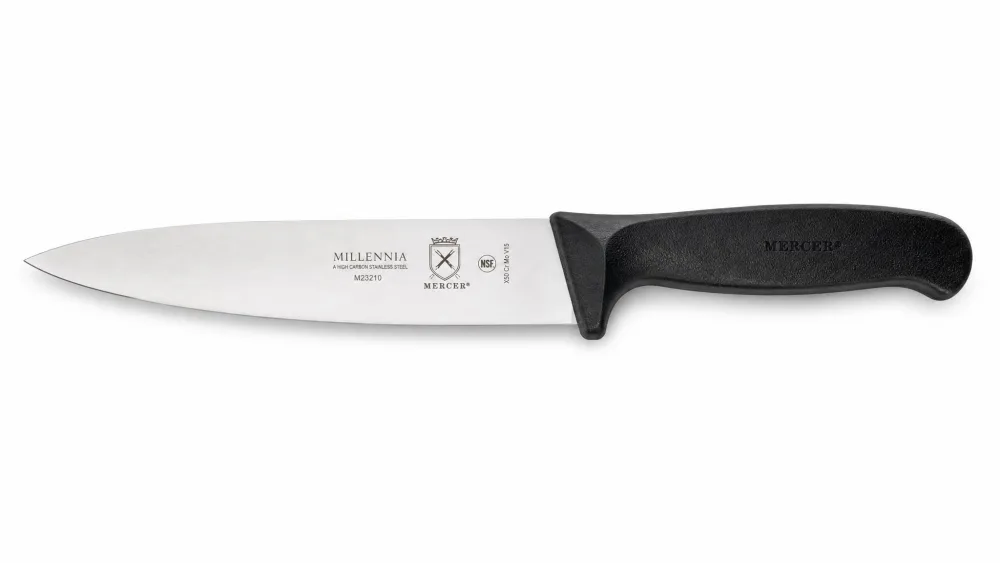
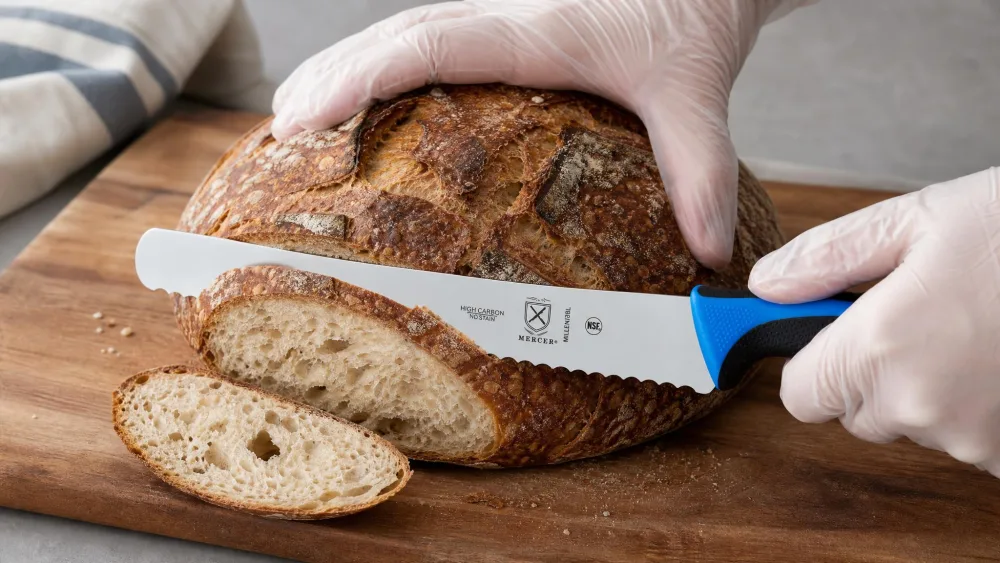
Best bread knife: Mercer Culinary Millennia M23210
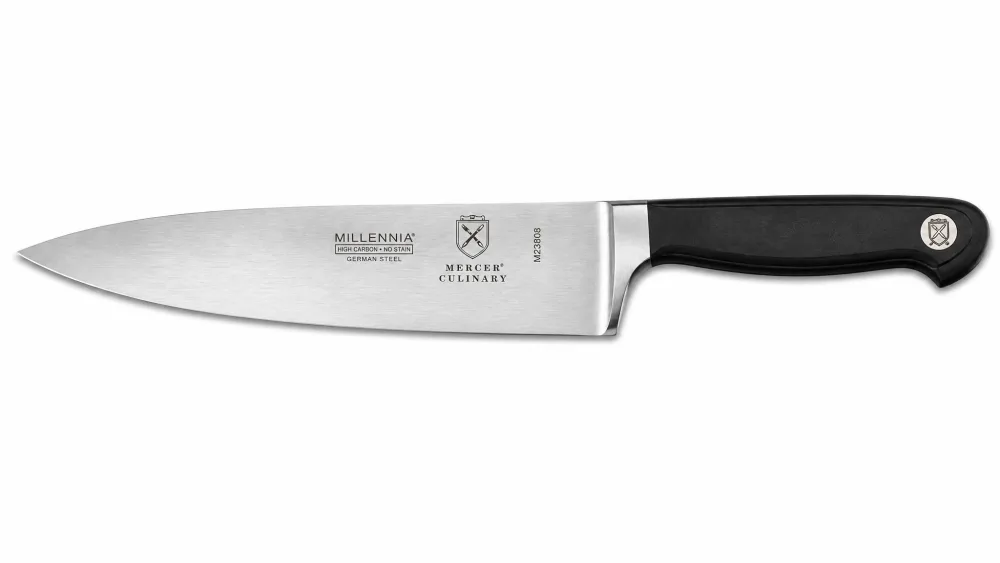
This knife crosses thick artisan sourdough crust without crushing the loaf or covering the counter in crumbs, which is the whole job. It outperforms bread knives costing several times as much, though the handle feels plain rather than premium.
A 10-inch wavy edge that crosses a boule in one stroke
Textured handle with non-slip finger points
Also handles angel food cake, meatloaf and citrus
Specifications
Blade length
10 inches
Steel
One-piece high-carbon Japanese steel
Edge
Wide wavy serrations
Construction
Full tang
Care
Hand wash recommended
Why it wins
None of the four chef's knives above will cut a crusty loaf cleanly, and here length does the work. A 10-inch blade lets you draw once instead of sawing, and sawing is what tears crumb and showers your counter.
The wide serrations bite crust on the first pass rather than skating across it. Serrated edges cannot be honed at home, so this is a knife you replace rather than maintain.
Pros and cons
Pros
Crosses a full sourdough boule in one stroke
Cuts crust without crushing or tearing the crumb
Costs a fraction of premium bread knives
Handles cake, meatloaf and citrus just as well
Cons
The handle feels plain next to a forged knife
Serrations cannot be honed at home
At 10 inches it needs real drawer or block space
Hand wash recommended
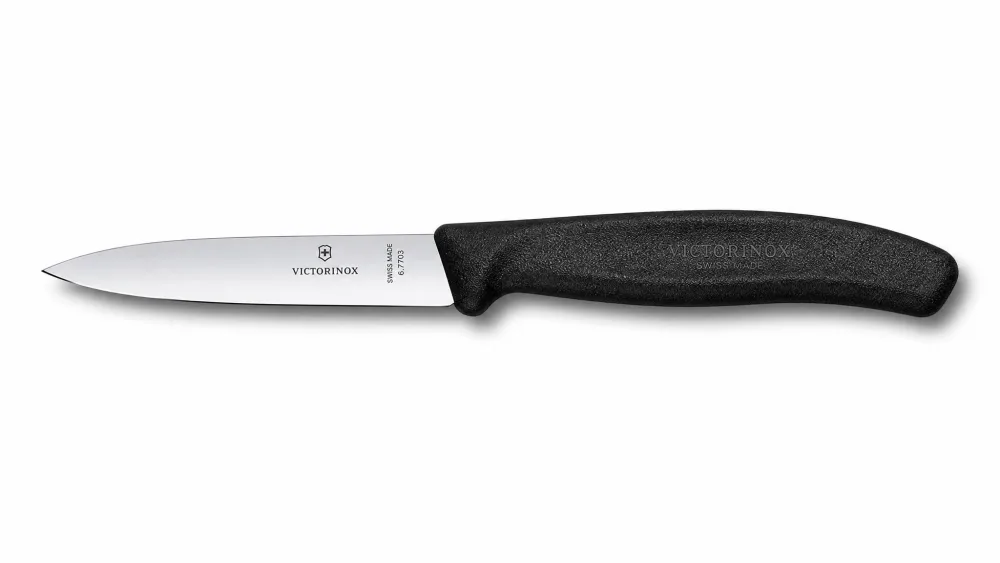
Best paring knife: Victorinox Swiss Classic 3.25-inch
Every knife above costs at least twice as much, and several twenty times as much. This is the one that kept stealing their work. Apples, peppers, the eye out of a potato: those in-hand jobs add up to more of an evening than most cooks realize, and an eight-dollar blade does them best.
This little knife ends up doing most in-hand jobs, from apples to peppers to small vegetables, to the point that it displaces far more expensive knives. It takes a sharpening well, holds its edge with occasional honing, and does not discolor after dishwasher cycles. Paring knives are small enough that they get thrown out with food scraps, so buying two is sensible.
A 3.25-inch straight edge with a spear point
Textured non-slip handle that holds grip when wet
Dishwasher safe and NSF approved
Specifications
Blade length
3.25 inches
Edge
Straight, spear point
Handle
Textured non-slip
Care
Dishwasher safe
Best for
Coring, seeding, peeling
Why it wins
A paring knife lives in your hand, not on a board, and 3.25 inches lets you core an apple without the tip poking out the far side. The handle grips when wet, which is the whole safety story on a knife you point toward your own thumb.
Pros and cons
Pros
Does most of the small daily jobs in a kitchen
Grips reliably with wet hands
Takes a sharpening easily and holds it
Cheap enough to own two
Cons
Too short for anything on a board
No published weight or hardness figures
Small enough to get thrown out with scraps
The plastic handle will never look premium
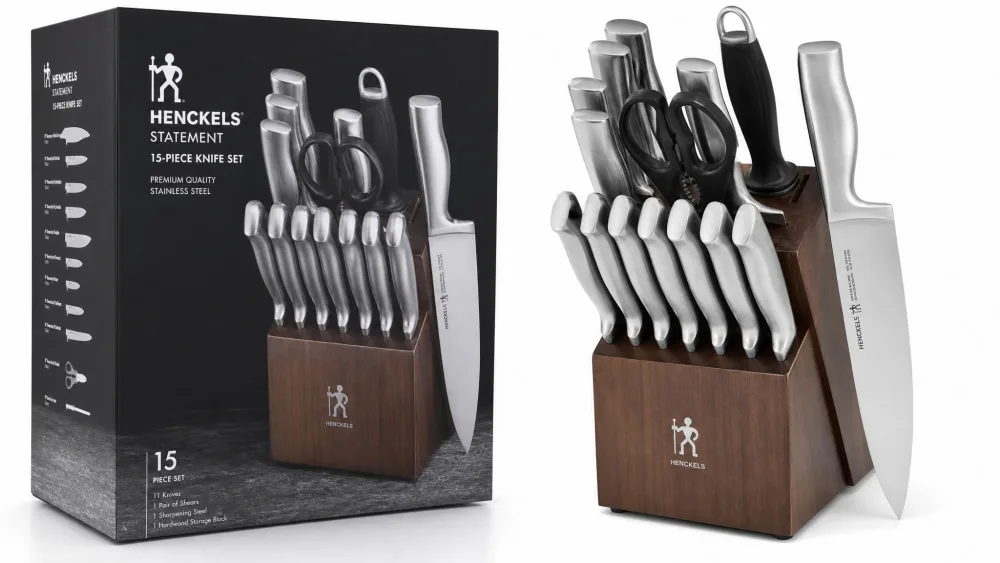
Best knife set for a full kitchen: Henckels Statement 15-piece
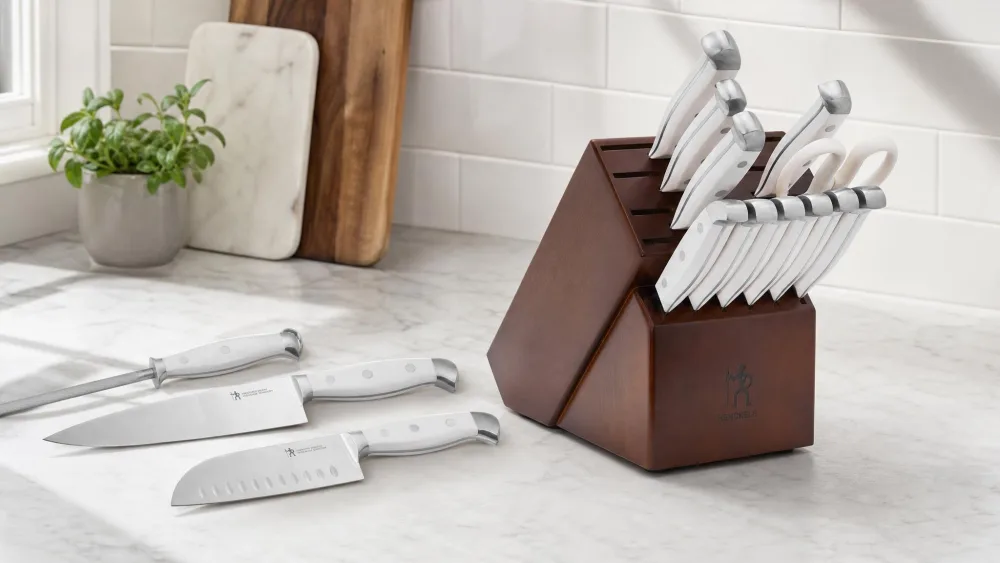
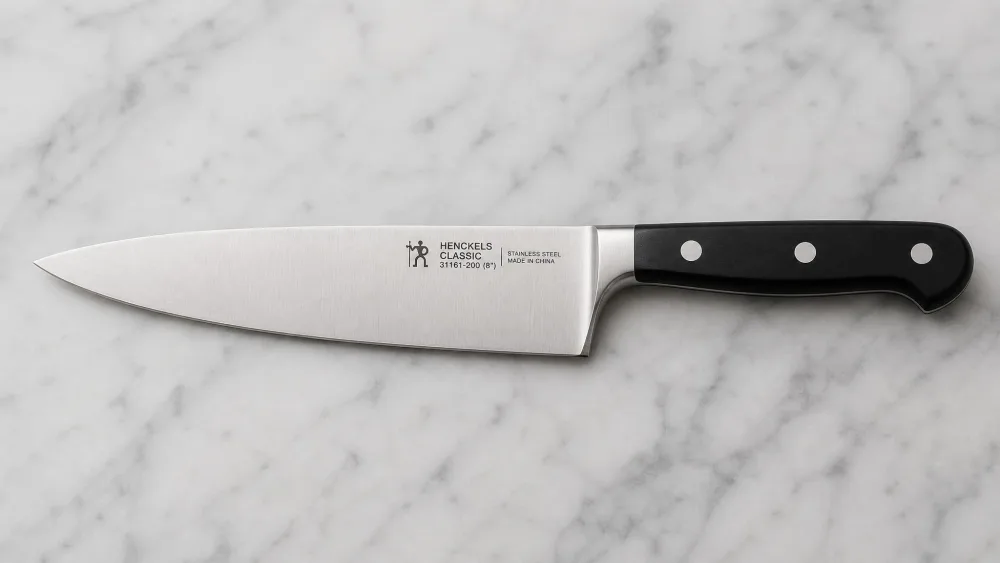
The blades in this set are noticeably thin, which keeps them nimble but means they are not the ones you reach for on heavy work. They were still sharp after nearly a year of use when kept up with the included honing steel, though the softer German steel will spot with rust if the knives are left wet. A few passes on the steel and they behave again.
15 pieces, including block, shears and honing steel
Single-piece precision-stamped blades
Lightweight, dishwasher safe and rust resistant
Specifications
Pieces
15
Construction
Precision stamped
Steel
German stainless
Chef's knife
8 inches
Santoku
7-inch hollow edge
Why it wins
Every pick above is a single knife you choose deliberately. This is fifteen decisions made at once, and if you are furnishing a kitchen from nothing that is worth something: the block and shears alone would cost most of the difference bought separately.
Be honest with yourself first, though. Buying a big block set means paying for knives that rarely leave the block, and plenty of cooks conclude afterwards that two or three good knives would have been the better spend.
Pros and cons
Pros
Covers every knife job in one purchase, block included
Comes with a honing steel, which most sets skip
Lightweight and easy to handle for new cooks
Softer steel is easy to bring back on a steel
Cons
Thin stamped blades are wrong for heavy work
Six steak knives pad the piece count
No published steel grade or hardness
Will spot with rust if left wet
How we tested and compared these knives
Each knife went into a month of real prep in rotation, and we checked the edge after every session rather than at the end. That cadence is the point, because a knife that feels razor-sharp out of the box can be dragging on tomato skin by week two. We judged three things: how the edge holds after a week of prep, how the handle wears in hour three, and how easily the steel comes back on a stone.
Sessions were kept deliberately long, since a knife that feels well-balanced for ten minutes can raise a hot spot by the end of an afternoon. We cut the same foods with every knife rather than assigning each blade its speciality, which is how we learned the MAC's thinner spine makes it a worse choice than a German knife for splitting a squash.
Edge checks happened after every session, not at the end of the month.
What to look for when buying a kitchen knife
Price is only part of it. Chef's knives differ in steel, length, handle shape and weight, and each changes how the blade feels in your hand.
Blade steel and edge retention
Steel hardness is measured on the Rockwell hardness scale, written as HRC, and it predicts how a knife behaves. Most Japanese kitchen knives land between 60 and 62 HRC, which is why they hold an edge so long. German knives generally sit at 56 to 58 HRC, softer steel that dulls sooner but sharpens back easily, and French knives lower still, around 54 to 56 HRC.
Note. Kitchen stainless owes its rust resistance to molybdenum, the alloying element that also lets the steel take a harder temper without turning brittle. That is why you see "MoV" in so many blade steel names.
Blade length and profile
An 8-inch chef's knife is the right first buy for most home cooks: long enough to halve a cabbage, short enough to control on a small board.
Go to 10 inches only if you cook for a crowd, and drop to 6 or 7 inches if your board or your hands are small. Profile matters as much: a curved blade rocks through herbs, a flatter one suits a push cut.
Weight, balance and handle comfort
Heft is personal. The Wusthof feels secure to most hands and tiring to smaller ones, while the lighter Victorinox feels nimble to some and insubstantial to others.
Balance should sit near where your index finger meets the blade, so judge a knife in a pinch grip. Texture beats beauty: the knives that stayed comfortable through greasy chicken work all had textured or wood handles.
Forged versus stamped construction
Forged blades are hammered from a single billet, which means more weight, a bolster and a higher price. Stamped blades are cut from sheet steel, which makes them lighter and cheaper. Our best value pick and our bread knife are both stamped, and both cut beautifully, so construction matters less than steel quality and edge geometry.
Full tang and build quality
A full tang runs the length of the handle, which adds balance and keeps the blade from working loose. Look at where blade meets handle: gaps there trap water and food, and that is where a cheap knife starts to fail.
Price versus longevity
A $150 knife that lasts twenty years costs less per year than three $40 knives you keep replacing, though a well-kept Victorinox will also last twenty years. Care is the real cost driver: the dishwasher, the sink pile and a glass board end a good knife faster than any amount of chopping.
Tip. Hone before or after each session, not once a month. Ten seconds on a steel keeps a working edge true, and a proper sharpening on a stone is then only a two or three time a year job.
Japanese versus German knives: which one suits you
Blade angle, hardness and how they cut
Japanese blades are ground thinner and harder. The Shun's spine is 2.4 mm at the heel, and its steel runs 60 to 61 HRC against the Wusthof's 58 HRC.
That translates directly into feel. The Japanese knife falls through a tomato, the German knife pushes through it, and both get dinner done. A hard Japanese blade sharpens back easily but chips if it is not looked after, and that is the bargain you accept at 60 HRC and above. Edge angles follow the same logic: 14 degrees per side on the Wusthof, 15 on the MAC, 16 as published on the Shun.
Handle shape and balance
Western handles sit in the palm with a bolster as a finger stop, and carry more weight toward the heel. Japanese wa-style and D-shaped handles are lighter and further forward, putting the balance point closer to the blade. Neither is better, so hold both if you can: handle shape is the one thing you cannot learn from a spec sheet.
Which one to buy first
Buy German first if you cook meat, break down poultry, and want one knife that tolerates everything. Buy Japanese first if you prep a lot of vegetables and enjoy maintaining an edge. If you can only own one, the MAC splits the difference: Japanese steel and geometry with a Western handle.
Which knives you actually need (and which you can skip)
Three knives cover almost everything: a chef's knife, a serrated bread knife, and a paring knife.
The chef's knife handles most board work, the bread knife exists because no straight blade cuts crusty bread cleanly, and the paring knife takes over everything you do in your hand. A santoku is the sensible fourth if you prep a lot of vegetables.
What you can skip is easier to list than to accept: the cleaver you will use twice a year, the tomato knife, and most of the steak knives that pad out block sets. The real difference a sharp knife makes day to day is fatigue, because prep stops feeling like a chore when you are not forcing the blade through.
Other knives worth a look
9
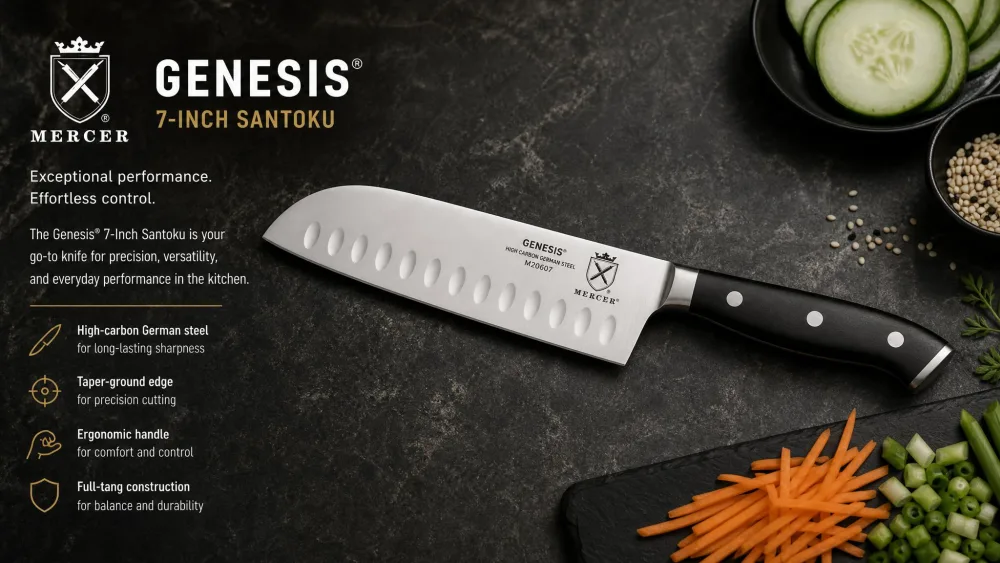
Mercer Culinary Genesis 7-inch santoku
4.5
A precision-forged German steel santoku with a taper-ground edge and a grippy handle, at a fraction of the Mac's price.
Some knives came out of rotation early, for reasons that cluster into three patterns.
The first is the decorative Damascus-clad blade. Cladding layers look striking, but they are mostly cosmetic, and finely chopped garlic still sticks to the flats. The second is the padded block set, where a piece count inflated with six steak knives means paying for drawer filler around two or three knives you will use. The third is the thin-bladed budget set, whose stamped blades flex on anything heavy and become the wrong tool the moment you meet a squash.
We also set aside anything with a slick, polished handle, because grip failure during greasy work is the one flaw that is genuinely dangerous rather than annoying.
How to keep your knives sharp
Honing versus sharpening
Honing and sharpening are different jobs. A honing steel straightens a rolled edge, removes almost no metal, and takes ten seconds.
Sharpening removes metal to create a new edge, and that happens on a stone. A #1000 grit stone is the standard workhorse, with #4000 to #8000 stones used to refine the edge. A good medium-grit water stone runs roughly $25 to $60, though pricing varies by brand and size. Specialist suppliers of Japanese whetstones are the easiest place to see the grit progression laid out.
Washing, drying and storage
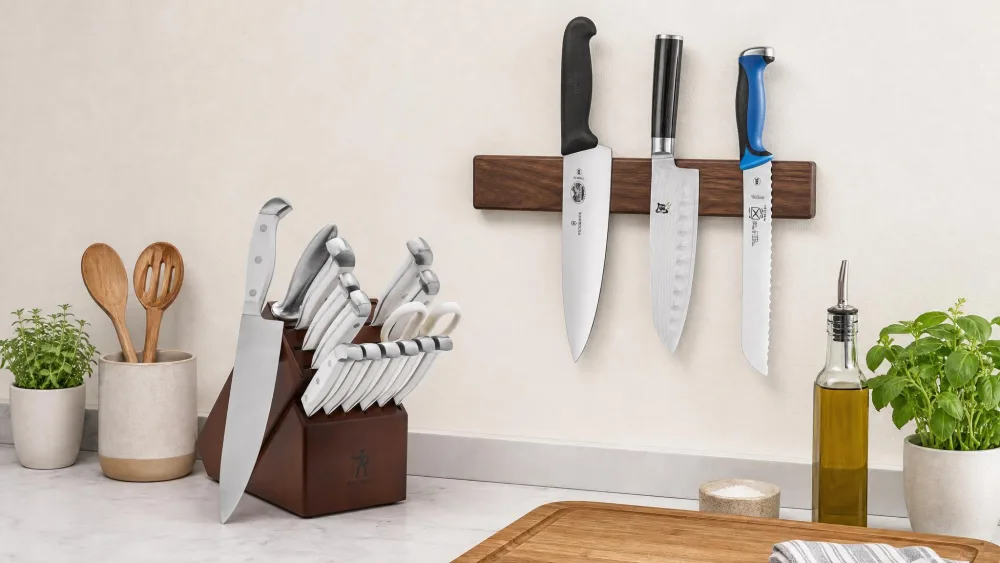
Hand wash, then dry immediately. That habit does more for a knife's life than anything else you can do. Storage is the other half: a block, a magnetic strip or in-drawer guards all beat loose knives rattling in a drawer, which chips edges and cuts fingers.
Warning. Never leave a good knife soaking in the sink or run it through the dishwasher. Detergent and heat pit the steel, the edge bangs against other items, and reaching blindly into cloudy water is how people get cut.
Why trust Mr. Kitchen Adviser
Every knife here went through a month of real prep in our rotation with edge checks after each session, and we keep using them long after an article publishes. We also say plainly when a knife is not worth it: the Henckels set is here because it kits out a kitchen in one purchase, not because most cooks need fifteen pieces.
Specification numbers come from maker and specialist retailer spec sheets, and where published and measured figures disagree we give the range rather than a false precision.
Storage is the cheapest edge protection there is.
Frequently asked questions
My new knife arrived dull. Is that a defect?
Usually not. The occasional knife leaves the factory without its final pass, and the MAC is the pick where we saw it. Give it five minutes on a #1000 stone before you return it: a blade that takes a good edge quickly was never faulty, just unfinished. If it will not take an edge at all, that is a warranty case.
How do I avoid buying a counterfeit knife?
Counterfeits cluster around the brands worth faking, and Mac is one. Buy from the maker's own store or a seller named on its authorized list, then check the knife on arrival for a crooked or shallow-etched logo, a handle scale that does not sit flush with the tang, and packaging with no model number.
Can a serrated bread knife be sharpened, or do I replace it?
You cannot hone serrations at home, and a pull-through sharpener will wreck them. The real options are a tapered ceramic rod worked into each scallop, or a professional service. On a bread knife under twenty dollars, replacement is the honest answer: the service costs more than the knife.
What cutting board should I use if I care about the edge?
End-grain wood is best, because the fibers part around the blade instead of grinding against it. Edge-grain wood and soft polyethylene are fine and cheaper. What to avoid matters more: glass, granite, ceramic and tile dull a good knife within a few uses.
Does a lifetime warranty cover it if I chip the blade?
Almost never. These warranties cover defects in material and workmanship: a loose handle, a cracked tang, a blade ground wrong. A chip is damage in use, and so is a bent tip from prying. Worth knowing before you buy a hard 60 HRC blade, because the thing most likely to go wrong is excluded.
My knife already went through the dishwasher. Can I save it?
Often, yes. Dry it now and look at the blade in good light. Light rust spotting comes off with a nylon pad and bar cleaner, and a dulled edge comes back on a stone. What you cannot undo is pitting. One cycle is rarely fatal; a year of them does the damage.