As an Amazon Associate we earn from qualifying purchases. We may earn a commission from links on this page, at no extra cost to you. Learn more.
Is the Toyama Gyuto 210 the last workhorse chef knife you will ever need to buy? That is the question we set out to answer after running this Sanjo-forged blade through weeks of everyday prep in our test kitchen. Our verdict comes from real board time, not spec sheets: we cut with the 210mm daily, checked the edge after each session, and watched the details that show up only in hour three, how the handle feels and where the balance sits when your grip tires. The short version: a serious cutter with a couple of honest quirks.
Toyama Gyuto 210 at a Glance
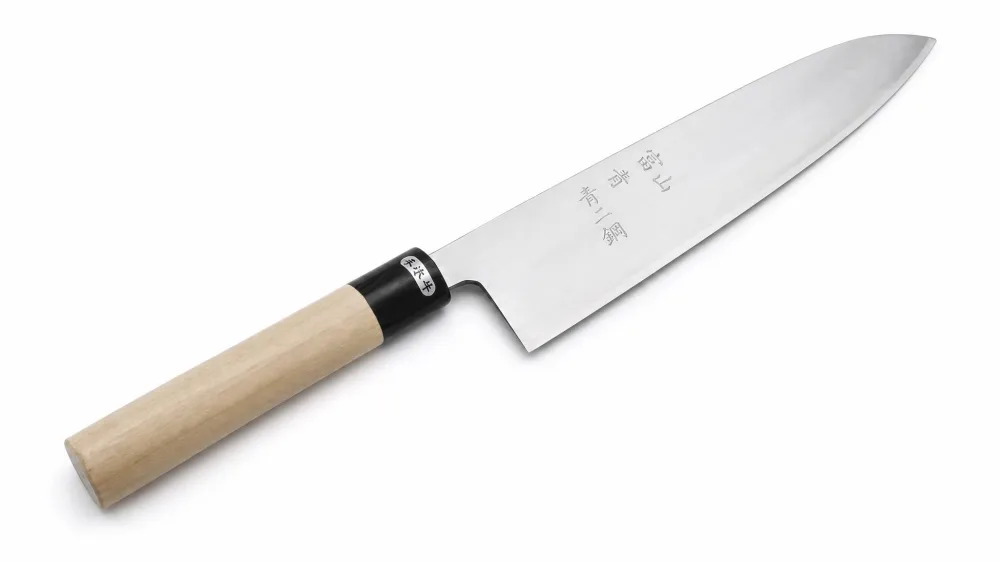
The Toyama 210mm gyuto is a hand-forged Japanese knife with a Blue #2 carbon core and stainless cladding. At a nominal 210 mm, a heel near 50 mm, and a weight of 174 g, it lands in classic workhorse territory: substantial enough to power through dense produce, short enough to stay nimble on a home board.
Toyama 210mm gyuto key specs
Steel core
Aogami #2 (Blue #2) carbon
Cladding
stainless (kasumi); kurouchi option
Blade length
210 mm nominal
Height at heel
50 mm
Weight
174 g
Hardness
62-64 HRC (varies a little by finish line)
Handle
D-shaped ho magnolia, buffalo horn ferrule
Price band
roughly $320 to $774 by line and stockist
Who Makes the Toyama Gyuto: Shuji Toyama and Sanjo Heritage
Every Toyama gyuto comes from one pair of hands. Shuji Toyama, born in 1939 and working in Sanjo, Niigata, makes each knife alone, from forging the blade to fitting the handle, with no apprentices and no production line. That explains both the waiting lists and the working-knife aesthetic. The premium expression of his work is the Toyama Noborikoi line, carried exclusively by Japanese Natural Stones. If Watanabe sounds familiar, that is no accident: Shinichi Watanabe is Toyama's student, now an independent Sanjo blacksmith who shares the same technique.
Construction and Steel: Blue #2 Core, Stainless Clad
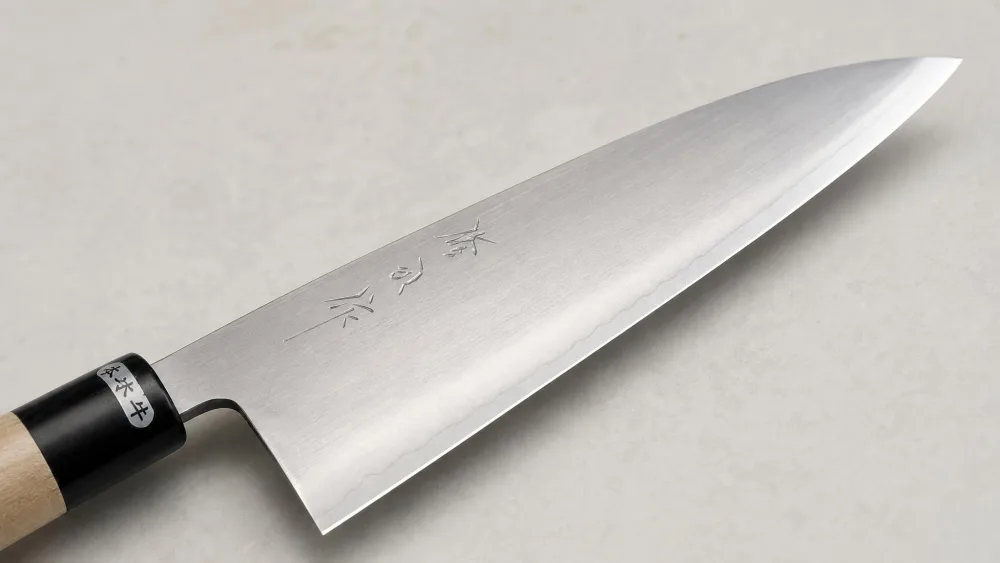
At the heart of the blade sits a Hitachi Aogami #2 core, better known as Blue #2, a carbon steel prized for taking a keen edge and holding it. Hardness figures land around 62-64 HRC, though the exact number varies a little by source and finish line, so we treat that as a band. The core is wrapped in stainless cladding with a kasumi finish, the practical genius of the design. Only the thin exposed edge is reactive carbon; the rest resists rust like any stainless knife. In our kitchen this kept the maintenance load low, and the kasumi finish blends well with future stone work.
Blade Geometry and Grind
The grind is where this knife earns its reputation. It is a convex, kindly asymmetric profile with a slight right-biased bevel, ground thin behind the edge and tapered toward the tip. In use, that means an aggressive cutter that drives through product rather than wedging in it. We felt it most on carrots and winter squash, where thinner knives stall.
The convex grind is thin behind the edge but beefy up top.
One caveat for left-handed cooks: the bevel is asymmetric and right-biased. A lefty can accept that edge or have it adjusted, but a full left-handed grind is not standard.
Handle and Balance
The stock handle is a D-shaped ho (magnolia) wood with a buffalo horn ferrule; the Noborikoi line upgrades to ebony. It is comfortable but plain, and the fit and finish are a touch crude relative to the asking price. That is normal for Toyama's working-knife aesthetic, and after a few sessions we stopped noticing.
Balance is worth flagging. The blade is clearly forward-balanced, the point about 30 mm ahead of the heel, and the lightweight ho handle and thicker tip make it feel blade-heavy, which some cooks find borderline for a 210 mm. If you like a knife that falls into the cut, you will love it; if you prefer a neutral pivot at the pinch grip, it takes an hour or two to adjust.
Performance on the Board
This is a cutter first. Out of the box the edge was among the sharpest we have handled at this length, and the thin-behind-the-edge geometry meant almost no wedging on dense product.
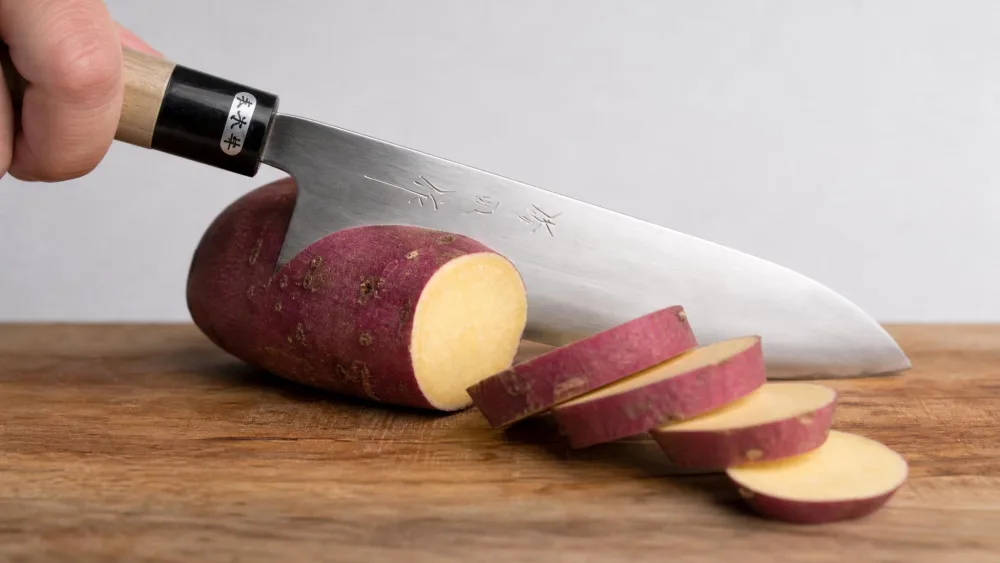
Dense root vegetables are where the convex grind shines.
Edge Retention and Sharpening
Blue #2 holds a working edge well. In our rotation the Aogami #2 edge held for roughly four to six weeks between full sharpening sessions, and took a fresh edge easily on whetstones. We ran a 1000-grit stone for thinning, a 6000-grit to restore the edge, and a strop to keep the bite crisp between sessions. Owners who push Toyamas hard in professional settings report occasional chipping, but we saw none of that in home prep.
Food Release and Cutting Feel
Food release is very good, a direct benefit of the convex grind. Sticky ingredients that normally cling to a flat blade, potatoes especially, fell away cleanly for us. The one limit is the tip: the profile is slightly santoku-ish, so fine tip work is not its strength, making this a bulk-prep workhorse rather than a precision petty.
210mm vs 240mm: Is the Shorter Length Right for You
The 210 mm is the nimble member of the family. Step up to the 240 mm and the blade runs 242 to 244 mm with a 53 to 54.7 mm heel and 215 to 222 g of mass, versus the 210 mm at 174 g and a 50 mm heel. That is a real jump in heft, and the forward balance amplifies it. For most home kitchens the 210 mm is the right call: same convex grind, easier to control. The 240 mm rewards a big board and long prep. If you break down cases of produce daily, size up; otherwise the 210 mm is the sweet spot.
Tip. If you are torn between lengths, pick the size that matches your board, not your ambition. A 240 mm crowds a small board and tempts you to choke up.
How It Compares to Other 210 Workhorses
Cross-shoppers usually weigh the Toyama against three knives. The Watanabe Pro 210 shares the Blue #2 core and Sanjo lineage, runs a 214 mm edge at 178 g with a 51 mm heel and a true 50:50 double bevel, and delivers outstanding food release at roughly 63 HRC. The Mazaki 210 is typically a White #2 blade tapering to a laser-ish tip around 217 mm; its out-of-box edge is superb, but food release on the migaki finish is only average. The Tojiro DP is the value benchmark: a VG-10 stainless blade at 60 HRC, a 210 mm edge, a 1.9 mm spine, and an 11-12 degree per side edge, around $139 and razor-sharp out of the box, though the softer steel scratches more easily. America's Test Kitchen's gyuto testing offers category context across price points.
Product
Steel core
HRC
Length
Weight
Price band
Toyama 210mm
Aogami #2
62-64
210 mm
174 g
$320-$774
Watanabe Pro 210mm
Aogami #2
~63
214 mm
178 g
~$875
Mazaki 210mm
White #2
62-65
~217 mm
157-206 g
$246-$392
Tojiro DP 210mm
VG-10
60
210 mm
light
~$139
Honest Limitations and Who Should Skip It
No knife is for everyone, and the Toyama is honest about its trade-offs. The forward balance, plain handle, and reactive carbon edge are all real, and they matter more to some cooks than others.
Pros
Superb out-of-box sharpness and thin-behind-the-edge geometry
Excellent food release on sticky and starchy ingredients
Blue #2 core takes a fresh edge easily and holds it for weeks
Stainless cladding keeps rust worry to the exposed edge only
Cons
Clearly blade-heavy balance that some find borderline at 210 mm
Fit and finish and the stock handle are plain for the price
Santoku-ish tip limits fine, detailed tip work
Frequently sold out and priced well above mass-market gyutos
Carbon-Steel Maintenance Routine
The care routine is simple but non-negotiable. Hand wash the blade, dry it immediately, and oil it before long storage. A natural patina forms on the exposed edge, which is normal and even protective. The stainless cladding does most of the anti-rust work, so you are only babysitting the carbon edge.
Warning. Never leave this blade wet in a sink or run it through a dishwasher. The exposed Blue #2 edge will spot or rust, and heat and detergent can damage the wa-handle.
Where to Buy and What It Costs
Pricing has no single number. Depending on line, finish, length, and stockist, a Toyama runs from roughly $320 to over $770, with the standard Aogami #2 210 mm near $630 at Zahocho and the Noborikoi line higher. Stock sells out frequently, so availability often decides the purchase more than price. The Noborikoi line is exclusive to Japanese Natural Stones; Zahocho in Tokyo and Knifewear also carry his work.
This is the knife we kept reaching for once we stopped fighting its forward balance. The convex grind drives through dense produce, the out-of-box edge was among the sharpest we have tested at this length, and the Blue #2 steel took a fresh edge easily after weeks of prep. It is razor-sharp and capable, honest about being a plain-finished working tool rather than a showpiece.
Blue #2 carbon core with rust-resistant stainless cladding
Convex grind that drives through dense produce
Holds a working edge four to six weeks in home use
Sharpens easily on 1000 and 6000-grit whetstones
Specifications
Steel core
Aogami #2 (Blue #2)
Blade length
210 mm
Height at heel
50 mm
Weight
174 g
Handle
D-shaped ho magnolia, buffalo horn ferrule
Final Verdict
The Toyama Gyuto 210 earns its reputation. It is a beefy, thin-behind-the-edge carbon workhorse that cuts above its price and asks only that you keep up with simple carbon care and accept a plainly finished, blade-heavy tool. It is not for someone who wants a neutral balance or delicate tip work. For a home cook who wants one serious knife for years of daily prep, it is very much worth it.
Key takeaway. Our rating: 4.6 out of 5. A superb-cutting Blue #2 workhorse held back only by a plain finish and a forward balance you either love or learn to live with.
Frequently Asked Questions
How often does the Toyama Blue #2 gyuto need sharpening?
In our home rotation the Aogami #2 edge held a working sharpness for about four to six weeks between full sharpening sessions. A quick strop between sessions keeps the bite crisp.
Will the carbon steel rust easily?
Only the exposed edge is reactive carbon; the stainless cladding resists rust. Hand wash, dry immediately, and oil for long storage, and you will see a light protective patina rather than active rust.
Who makes the Toyama gyuto, and how is it related to Watanabe?
Shuji Toyama forges every knife alone in Sanjo, Niigata. Shinichi Watanabe is his former student and now an independent Sanjo blacksmith, which is why the two are so often cross-shopped.
Is 210mm too small for a primary chef knife?
For most home kitchens, no. The 210 mm keeps the same convex grind as the 240 mm in a nimbler package. Only cooks breaking down large volumes daily tend to need the heavier 240 mm.
Can I use it on a glass cutting board?
No. A glass or stone board will chip and dull the hard Blue #2 edge quickly. Use an end-grain or soft edge-grain wooden board.