As an Amazon Associate we earn from qualifying purchases. We may earn a commission from links on this page, at no extra cost to you. Learn more.
Is your favorite chef's knife crushing tomatoes instead of slicing them? A dull edge is the most common reason a good knife stops feeling good, and a whetstone is the most reliable way to bring it back.
A whetstone is a block of abrasive that you rub the blade across to grind a fresh edge. The choice between stones comes down to grit, how the stone is prepared, and how much patience you bring. The stone matters less than the habit, but the right stone makes the habit far easier to keep.
We judged all six stones on how they cut, how they feel under the blade, and how much upkeep they ask for.
Below you will find six picks, from an everyday medium stone to a diamond plate and a finishing stone. If you want more options beyond stones, our knife sharpener reviews cover pull-through and electric models too.
Best Whetstones at a Glance
The table below puts all six stones side by side so you can compare grit, stone type, preparation, and accessories at once, with the full reasoning in the reviews that follow.
Product
Best for
Grit(s)
Type
Preparation
Usable size
Included accessories
Shapton Kuromaku 1000
Overall routine sharpening
1000
Synthetic water stone
Splash-and-go; first-use soak of 5-6 minutes
8.3 x 2.8 inches
Case that works as a holder
Sharp Pebble Premium 1000/6000
Beginners wanting a guide
1000/6000
Synthetic water stone
Soak 10-15 minutes
Check the supplied stone
Bamboo base, angle guide, instructions
King KW-65 1000/6000
Budget combination stone
1000/6000
Synthetic water stone
Soak; follow face-specific instructions
About 185 x 63 mm (varies by offer)
Plastic base
Intelitopia Complete Knife Sharpening Stone Set
Complete starter kit
400/1000 and 3000/8000
Aluminum oxide water stones
Soak; follow the supplied instructions
Varies by setup
Stand, holders, guide, strop, flattening tools
DMT DuoSharp Plus 8-inch
Diamond sharpening
325/600 mesh
Monocrystalline diamond plate
Dry or with water
8 x 2-5/8 inches
Adjustable base
Shapton Kuromaku 5000
Finishing after a medium stone
5000
Synthetic water stone
Splash-and-go; follow first-use guidance
8.3 x 2.8 inches
Case that works as a holder
How We Tested These Whetstones
We judge stones the way a working kitchen does. Out-of-box sharpness matters less than how a stone cuts, how it feels under the blade, and how much upkeep it asks for once the novelty wears off. The simplest edge check is to cut a sheet of paper and a tomato and see whether the edge bites cleanly.
For every stone we score five things. First, how quickly it forms a burr, the thin curl of displaced metal that tells you the edge has been ground all the way to the tip. Second, how the surface feels, since a stone that gives you no feedback makes angle control harder. Third, how much prep it needs before and during a session. Fourth, how flat it stays as it wears. Fifth, whether the included accessories actually help a beginner or just fill the box.
A simple edge check: slice a sheet of paper and a tomato after sharpening.
Note. A price is not a ranking factor here. We placed each pick in a budget, mid-priced, or premium tier and let the sharpening results decide the order.
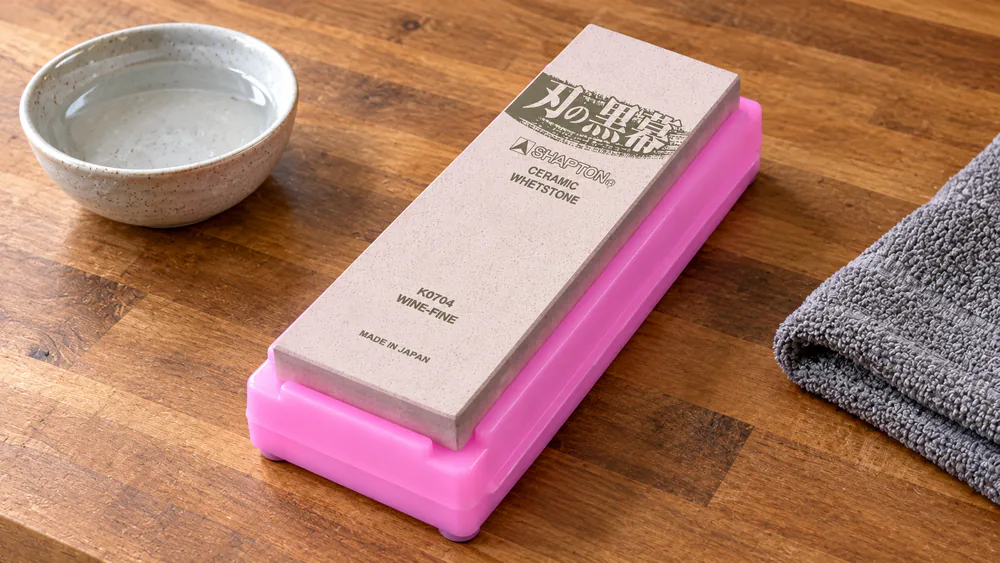
The Shapton Kuromaku 1000 is the stone we would hand to most home cooks. It cuts efficiently without a long soaking wait, so a quick touch-up fits into the time it takes to heat a pan. The surface is dense and firm, it resists dishing, and it sheds very little abrasive, which keeps the work area tidy.
Pros
Cuts efficiently with only a splash of water after the first use
Dense, firm surface resists dishing
Case doubles as a holder
Standalone medium stone that does the heavy lifting of edge formation
Cons
No finishing face and no angle guide
Scratch pattern feels coarse for the printed grit
Instructions in the box are Japanese only
Shapton recommends a first-use presoak of 5-6 minutes, and after that the stone needs only water on the surface. A stone that is ready in seconds gets used, and a stone that needs a bowl and a timer tends to sit on the shelf.
The scratch pattern feels relatively coarse for a 1000 label. That is a plus for fast edge formation on a dull chef's knife, though it leaves a toothy edge that suits tomatoes, onions, and meat more than a polished slicing line. Paired with the 5000 stone, the progression restored clean paper cutting, but freehand angle control still takes practice.
The plastic case works as a working base, and it benefits from a towel or nonslip mat underneath when the counter gets wet. The stone measures 8.3 x 2.8 inches, long enough for a full-size chef's knife to sweep through one stroke.
2. Best Whetstone for Beginners: Sharp Pebble Premium 1000/6000
Where the Shapton asks for no soak, the Sharp Pebble trades speed for support. It is the stone we would point a first-time sharpener toward. The 1000 side forms the edge and the 6000 side refines it, and the bamboo base and angle guide remove two of the biggest beginner headaches. It worked best on medium-size Western knives, where the guide sits comfortably against the spine.
Pros
Two grits cover sharpening and finishing in one block
Bamboo base holds the stone steady
Angle guide, instructions, and an ebook support new sharpeners
Direct-store purchases come with a 30-day refund offer
Cons
Needs frequent rewetting during a session
Short surface interrupts a sweeping stroke with a full-size chef's knife
Guide has some play and is less convenient on oversized blades
You soak this stone for 10-15 minutes before sharpening, and then you keep the surface wet as you work. It needed rewetting more often than the Shapton, and the short surface interrupted a long sweeping stroke with a full-size chef's knife. Sharpening in sections is slower but works.
The guide helps, though it does not remove the need to hold the blade consistently. It has some play, so steady pressure against it still matters. With that in mind, the stone restored a useful kitchen edge. A very dull vegetable knife recovered, but extensive restoration took sustained work rather than a few effortless passes.
Published dimensions differ between the bare stone and the complete setup, so check the stone that arrives before planning storage. Treat the 6000 side as a polish, not a substitute for the 1000 stage.
The King KW-65 cannot be left alone: its soft abrasive wears quickly, so it needs regular flattening, and the instructions can leave a beginner wanting clearer technique guidance. Accept those trade-offs and this classic budget combination stone still produces useful sharpness with practice, and it is the cheapest route to a real two-stage progression.
Pros
Combination 1000/6000 stone at the lowest cost of the group
Can maintain sharp kitchen edges with practice
Plastic base included
Cons
Soft abrasive needs flattening as it wears
Fine face can be damaged by excessive soaking
No angle guide or cloth should be assumed with this offer
Preparation is where this stone catches people out. The coarse face needs hydration, but prolonged soaking can damage the fine face, so follow the face-specific instructions that come with the stone rather than a universal timer. Keep soaking conservative and wet the fine face only as needed.
Dimensions vary across offers. The manufacturer specifies about 185 x 63 x 25 mm, so confirm the stone you receive before you plan a holder or storage spot. This is the KW-65 alone, not the separately sold starter set with its guide and cloth.
The King rewards the cook who is willing to learn. Expect to flatten it more often than the Shapton, and expect a learning curve in the first few sessions. A budget stone is a good place to make your first mistakes.
4. Best Whetstone Kit: Intelitopia Complete Knife Sharpening Stone Set
Where the King gives you two faces, the Intelitopia set gives you two dual-sided stones covering 400, 1000, 3000, and 8000 grit, plus a bamboo stand, silicone holders, an angle guide, a leather strop, and flattening and dressing accessories. The bamboo-and-silicone setup is stable, and the stones hold water well, which means fewer interruptions to replenish the slurry. It produced an edge that sliced a tomato thinly and cut fine carrot pieces.
Pros
Broad grit progression from coarse repair to fine finishing
Stable bamboo-and-silicone setup
Holds water well during a session
Includes strop and flattening accessories
Cons
More pieces to set up, clean, and store
Short stones make it easy to concentrate work on the middle of the blade
Instructions do not fully teach sharpening technique
The catch with this kit is the stone length. The short stones make it easy to spend all your time on the middle of the blade, so the heel and tip need extra attention. Work the ends deliberately and check them with a paper cut.
The supplied guidance is basic. It will get you started, but a beginner will still want a technique video or two. The stones are soaking water stones, and we could not confirm a manufacturer soak time, so keep the working face wet while you sharpen and follow what the box says.
This is the pick for the cook who wants to buy once and has room for the extras. If you already own a medium stone, you will use less of the kit.
5. Best Diamond Sharpening Stone: DMT DuoSharp Plus 8-inch
The DMT DuoSharp Plus is not a true whetstone, and that is the point: it solves the problems that frustrate people with water stones, with no soaking and no dishing. It removes metal rapidly with little mess, and it does not develop the soft hollows of a water stone. The coarse face repaired a chipped edge after some angle-control practice, and the base clips hold the plate firmly.
Pros
Removes metal quickly and stays flat
Use dry or with water, with no soaking
Adjustable base grips the plate firmly
Fine face is useful for touch-ups when stropping no longer restores the edge
Cons
Needs a gentle touch and a break-in before fine blade work
Poor technique can leave scratches
Not a substitute for a polishing water stone
The coarse face is 325 mesh and the fine face is 600 mesh. Those numbers are not interchangeable with water stone grit labels, so do not assume the fine face equals a 1000 or 3000 stone. The plate measures 8 x 2-5/8 inches, and the interrupted surface collects swarf while the continuous zone handles pointed tools.
Use light pressure. The first sessions cut aggressively and can leave scratches if you press hard. After a short break-in the plate is gentler, and the fine face is handy for quick touch-ups between full sessions.
DMT permits ceramic blades on its diamond surfaces but warns that ceramic accelerates wear, and it recommends its Hardcoat surface for that use. The warranty covers defects in materials or workmanship regardless of age, but not normal wear or misuse.
6. Best Finishing Whetstone: Shapton Kuromaku 5000
The Shapton Kuromaku 5000 is the one stone here most cooks can skip at first: it is a second-stage stone, not a starter purchase. It adds a bright bevel finish after a medium stone has formed the edge, but it gives little tactile information about where the edge sits, and it feels comparatively dead under the knife. If you are new to sharpening, buy a medium stone first and add this later.
Pros
Bright polish on the bevel
Splash-and-go use with no long soak
Same 8.3 x 2.8 inch size and case as the 1000 stone
Cons
Low feedback makes angle control harder
An additional stage, not a replacement for a medium stone
Polished results still depend on forming a burr first
The 5000 shines when it follows the 1000. A polished result still depends on establishing a burr first, because the finishing stone refines the bevel and does not reshape a dull one. Shapton advises routine splash-and-go use, with no prolonged immersion and no detergents, then a rinse and an air dry before storage.
For general kitchen prep, a medium stone leaves an edge that cuts food well, and finer polishing is optional. The 5000 suits slicing knives and for cooks who enjoy the finish, but it is the pick most people can skip at first.
How to Choose the Right Whetstone
The right whetstone depends on what you already own, how dull your knives are, and how much time you want to spend. Start with the medium stone, since that is where most of the work happens.
Grit Levels and Sharpening Progression
Grit is the coarseness of the abrasive. Lower numbers cut metal quickly, and higher numbers refine the edge. Coarse abrasion repairs a damaged edge, medium abrasion establishes a useful cutting edge, and fine abrasion refines the bevel you already have.
For kitchen knives, a 1000 stone is the workhorse. A medium stone can leave a toothy edge that is suitable for general prep, and finer polishing is optional rather than a prerequisite for cutting food. A finishing stone is an extra stage, so it never replaces the medium stage.
Treat grit numbers as a rough guide. Different makers use different scales, and diamond plates use mesh sizes that do not map neatly to water stone grit. The Shapton 1000 feels coarser than its label, while the DMT fine face is its own thing.
In practice, a three-step ladder is more than most kitchens need. One medium stone gets you a working edge, a second finer stone adds polish, and a coarse stone is only for chips or very dull blades. If a knife has a visible chip, start coarser, such as the DMT coarse face or the 400 side of the Intelitopia set, and move up from there. If the knife is merely tired, the medium stone alone is usually enough.
Water Stones, Oil Stones, and Diamond Plates
Water stones, oil stones, and diamond plates all sharpen by abrasion. Each needs its own lubricant and preparation, so follow the rule for the exact abrasive rather than one rule for every stone.
Water stones, including every synthetic stone in this roundup except the DMT, cut quickly and give the finest edges, but they wear and need flattening. Oil stones are slower and harder-wearing. Diamond plates stay flat and cut fast, but the feel is different and technique needs a lighter hand.
Soaking vs. Splash-and-Go Stones
Some stones need a soak of 10-15 minutes, such as the Sharp Pebble. Others, like the Shapton Kuromaku, need only a splash of water after a short first-use soak. The convenience difference is real: a stone that is ready in seconds is easier to use often.
Be careful, though. Prolonged soaking can damage some fine faces, as with the King KW-65. Follow the manufacturer's instructions for the exact stone, and do not carry a rule over from one stone to another. If you sharpen on a busy weeknight, the stone with the shortest setup is the one you will actually reach for, and that habit matters more than a few extra minutes of polish.
Stone Size, Stability, and Knife Compatibility
Measure your longest knife before you buy. A long chef's knife is easiest to sweep on a stone that is at least as long as its cutting edge, while smaller stones are fine for paring knives and utility blades. Longer stones let you sweep a full chef's knife in one stroke. Short stones, like those in many kits, force you to work in sections and make it easy to neglect the heel and tip. A stone that slides around on the counter is a safety problem, so look for a base, holder, or nonslip mat.
Flat stones are meant for accessible bevels. Do not grind the scalloped side of a serrated blade flat; use a tool made to fit the serrations. Shapton excludes ceramic blades, while DMT permits them on diamond surfaces with extra wear.
Single Stones vs. Combination Stones and Kits
A combination stone puts sharpening and finishing in one block, which is economical and compact. Kits add supports and maintenance tools. Separate stones let you replace each stage independently as it wears.
Our rule of thumb is simple. If you are new, a combination stone or a kit with a guide keeps you from buying several things at once. If you already sharpen, a quality medium stone and later a finishing stone give you more control over each stage.
Tip. Buy a medium stone first and learn to raise a burr on it. A finishing stone only adds value once that skill is solid.
How to Use a Whetstone
Technique matters more than the brand. The steps below apply to most water stones; always check the instructions for your exact stone.
Prepare the Stone and Secure Your Setup
Prepare the stone as the maker specifies, whether that is a soak or a splash. Set the stone on a damp towel or nonslip mat so it cannot slide, and keep a small bowl of water nearby. Keep the working face wet so it builds a thin slurry that helps cutting.
Sharpen, Form a Burr, and Refine the Edge
Hold the knife at a consistent, shallow angle and push the edge across the stone with light, even pressure. Work one side until you feel a burr along the opposite edge. A burr is displaced metal at the edge, and it tells you the stone has reached the apex.
Many beginners lift the spine as they push, which rounds the edge and wastes the work. Keep your wrist and elbow quiet and let the shoulder move the blade. Count your strokes on each side so the two bevels stay even.
Then flip the knife and repeat. Reduce pressure for deburring, and finish with a few light alternating passes. If you move to a finer stone, rinse the blade and your hands between grits so coarse particles do not scratch the finer finish.
Freehand angle control takes practice, and a guide helps but does not do the thinking for you.
Whetstone Care and Maintenance
A good stone lasts for years if you look after it. Most of the care comes down to cleaning, drying, flattening, and storing it correctly. Skipping these steps is the most common reason a good stone starts to feel bad, and a few minutes after each session keeps it cutting evenly.
Cleaning and Drying
Clean the stone with a brush or sponge and water, and avoid detergents on stones like the Shapton. Let it air dry away from heat and direct sun. For a diamond plate, rinse away residue and dry it before storage.
Flattening and Storage
Water stones wear into a dish, and a dished stone makes it hard to hold an angle. Flatten with a suitable lapping plate when the surface dips. Do not use ordinary DuoSharp models for lapping other stones. Remove any transport foam before you store a used stone, and keep it somewhere dry.
Frequently Asked Questions
Is a whetstone the same as a sharpening stone?
In everyday use, yes. People say whetstone, sharpening stone, and waterstone interchangeably. Strictly, a whetstone is any stone used to hone an edge, while water stones, oil stones, and diamond plates are different types that need different preparation.
How do you know when a whetstone needs flattening?
Lay a straightedge across the face or watch the knife as you work. If light shows under the ruler, or you struggle to hold a steady angle because the stone has worn into a dish, it is time to flatten it with a lapping plate.
Can a diamond plate be used to flatten water stones?
Only a plate made for lapping. DMT says ordinary DuoSharp models should not be used to flatten other stones, so buy a dedicated lapping plate instead.
How often should you sharpen kitchen knives?
Sharpen when cutting performance declines. The right interval depends on the steel, how much you cook, and how sharp you want the knife to be.
How do you sharpen a knife that has a serrated section on a flat stone?
Leave the scalloped side alone and sharpen only the flat-ground side lightly, then use a tool made to fit the serrations for the rest.
Final Verdict: Which Whetstone Should You Choose?
Here is how we would split the field by use case. Choose the King KW-65 if cost is the only concern and you are happy to flatten the stone. Choose the Intelitopia set if you want a full progression and the extras in one box. Choose the DMT if you hate soaking and dishing. Leave the Shapton 5000 for later, once you can raise a burr reliably.
If you buy one thing, buy a medium stone and spend ten minutes a week with it. Your knives will cut better, and you will stop dreading the dull ones.