As an Amazon Associate we earn from qualifying purchases. We may earn a commission from links on this page, at no extra cost to you. Learn more.
A knife that cannot hold an edge through a week of prep is not a coworker, it is a hazard. Dull steel makes every slice harder and every slip more likely, and the fix is a sharpener that brings a professional edge back. So we put the leading professional sharpeners to work in our kitchen and checked how repeatably each brought an edge back, how it held after a week of cutting, and how easily the steel took a fresh edge on the next run. Guided systems, electric three-stagers, whetstones, and rolling sharpeners all earned bench time, and the eight picks below survived a month of prep in rotation, from the two-thousand-dollar Wicked Edge down to the twelve-dollar Work Sharp Pivot.
The Best Professional Knife Sharpeners at a Glance
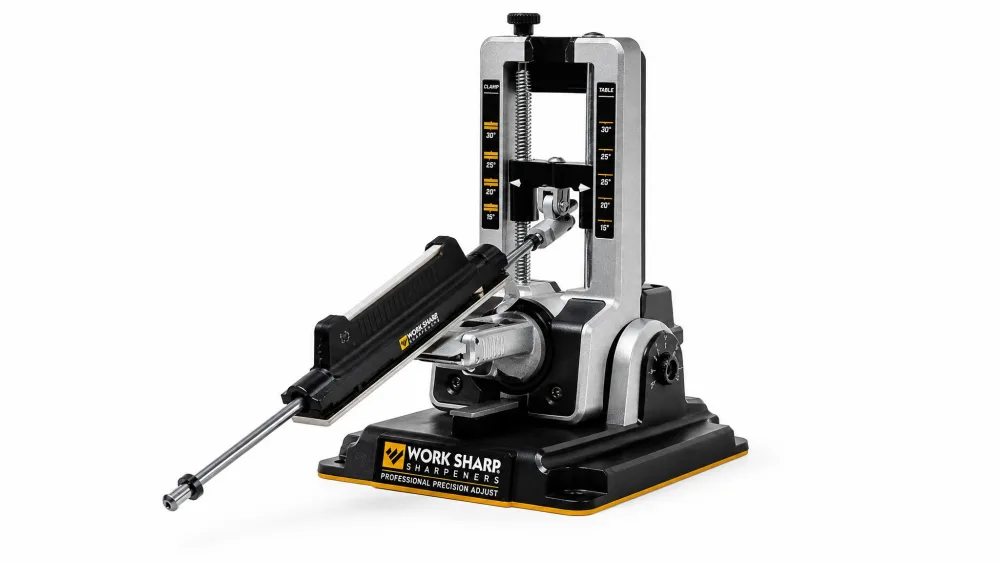
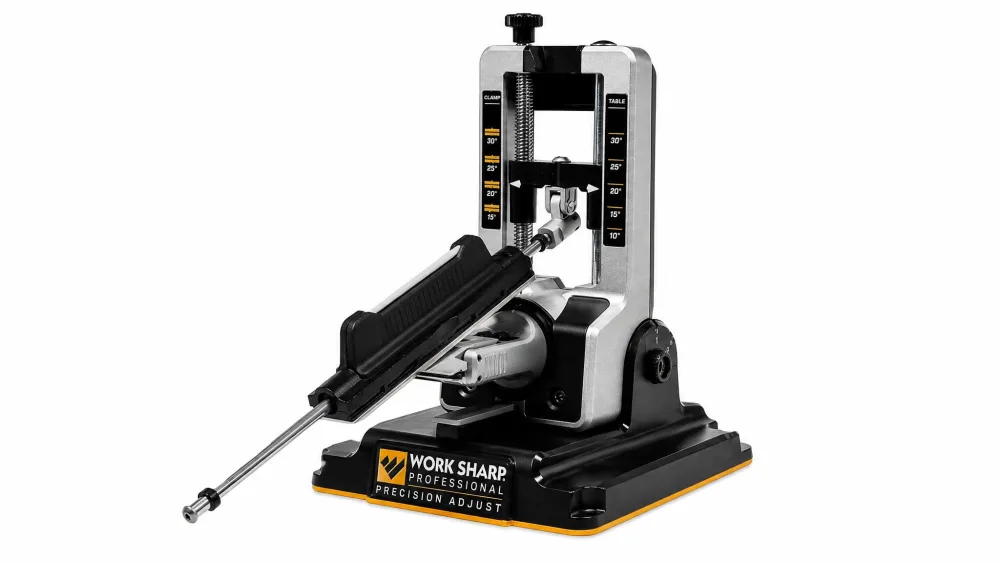
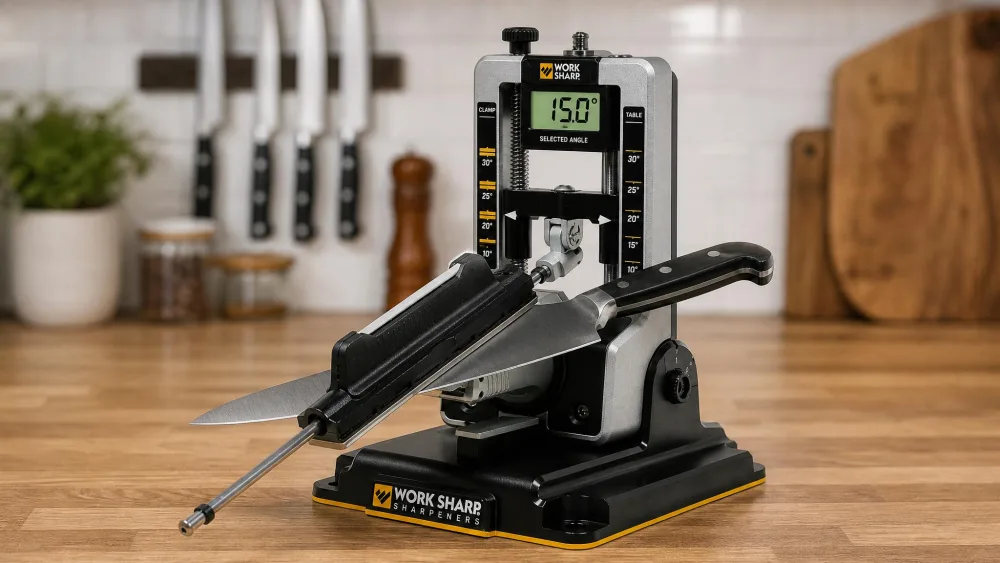
We came back to the Work Sharp Professional Precision Adjust more than any other sharpener in the test, because the digital angle finder makes every stroke match the last. A dull, nicked edge came back razor sharp in a single sitting, not over a weekend, and the seven-abrasive progression from 220-grit diamond through fine ceramic to the leather strop covered everything from reprofiling to a final polish. The metal V-block clamp holds a thin, distal-tapering blade with a little wiggle at the tip, so you stay conscious of pressure, but the rubber jaw pads protect the finish and the clamp stabilizer is the part you want for longer knives.
Pros
Digital angle indicator sets the edge to within 0.25 degree, repeatable pass after pass
Seven abrasives from 220-grit diamond through fine ceramic and a leather strop
Metal frame, V-block clamp, and benchtop base feel like a permanent tool
Ceramic rod for serrated blades and magnetic plate changes that take seconds
Cons
Real learning curve; read the manual and watch a video before the first session
Thin blades wiggle at the tip in the V-block if you lean on it
Price is a real investment for a home kitchen
At about 7.5 pounds with the metal frame, base, and V-block clamp in place, the unit reads as a permanent benchtop tool rather than a kitchen gadget. The magnetic plate changes are quick, and the base tilts back so you can flip a long kitchen knife without unclamping, which keeps the angle consistent heel to tip. The 15 to 30 degree range covers every kitchen blade we own, and the learning curve is real, so watch a video and practice on a cheap knife before your first session. Form then remove a burr at every grit, because skipping burr removal folds the edge over fast. It lists around $299.95, but the street price usually lands closer to $250, so expect a roughly $50 spread depending on the retailer and the week. For a working kitchen that wants repeatable, razor-sharp edges, we would reach for the Work Sharp Professional Precision Adjust ahead of any other system we tested. Check the current price on Amazon before you commit.
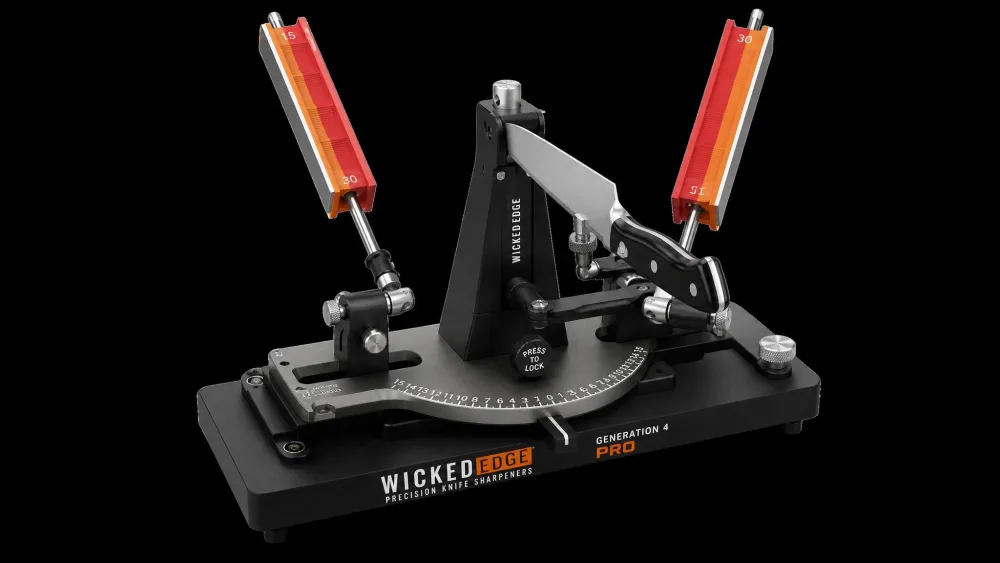
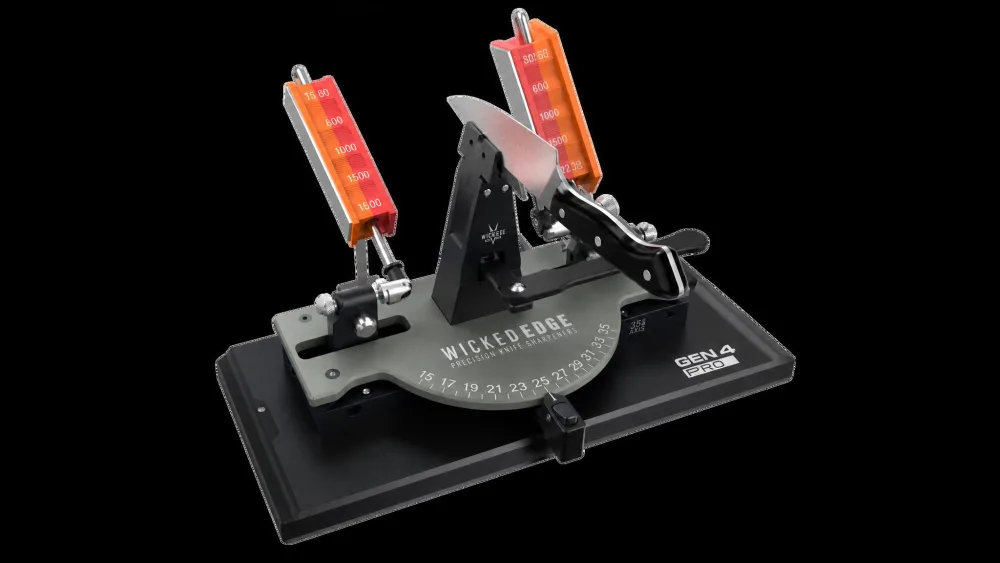
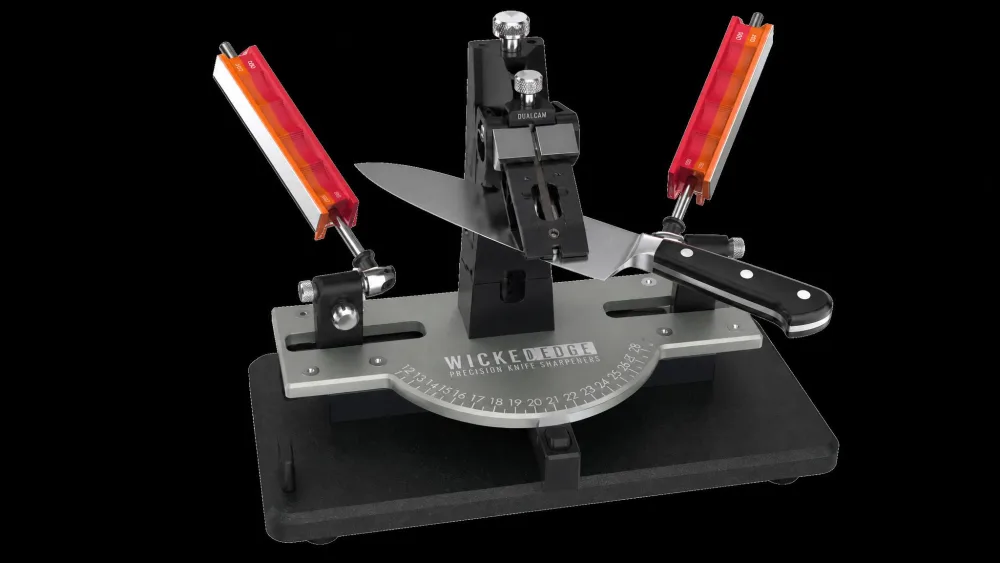
If the Precision Adjust serves a working kitchen, the Gen 4 Pro is the guided system for the collector who wants the most precise edge money can buy. The DualCam vise is the easiest, most robust clamp of any guided system we have used, and the heavy base anchors firmly without bolting to a bench. The included practice knife is a real help for first-timers, who spent time learning the down-and-forward stroke on it before risking their good knives; once it clicks, the system is extremely fast and accurate.
Pros
DualCam vise clamps both sides for symmetrical bevels, no tools needed
Angle increments down to 0.05 degree with the Micro-Adjust towers
Handles blades up to 15 inches long; heavy base needs no bench bolting
Limited Lifetime Warranty and 60-day returns on a US-made tool
Cons
Base configuration runs $1,099 and a loaded setup climbs past $1,599
Slow when you need to regrind very hard steels
Stock jaws top out at 3/16-inch blades; long blades are awkward to reposition
The main angle adjustment moves in 0.50-degree increments, and the optional Micro-Adjust towers tighten that to 0.05 degree, with a blade capacity up to 15 inches long and 3/16 inch thick. Long blades are awkward to reposition, and the stock jaws top out at 3/16 inch, so thick tools and meaty khukuri blades are off the table. It is slow when you need to regrind super-hard steels, and build quality is strong overall, though we did see the occasional loose joint on a guide rod in our testing. The base configuration runs $1,099, and a loaded setup with Micro-Adjusts and the storage shelf climbs to $1,599 and beyond, which makes it a professional's and collector's tool rather than a kitchen counter buy. The 60-day returns and the Limited Lifetime Warranty soften the sting. If precision at this level is the goal, the Wicked Edge Gen 4 Pro is where enthusiasts end up. You can compare configurations and prices on Amazon before you commit.
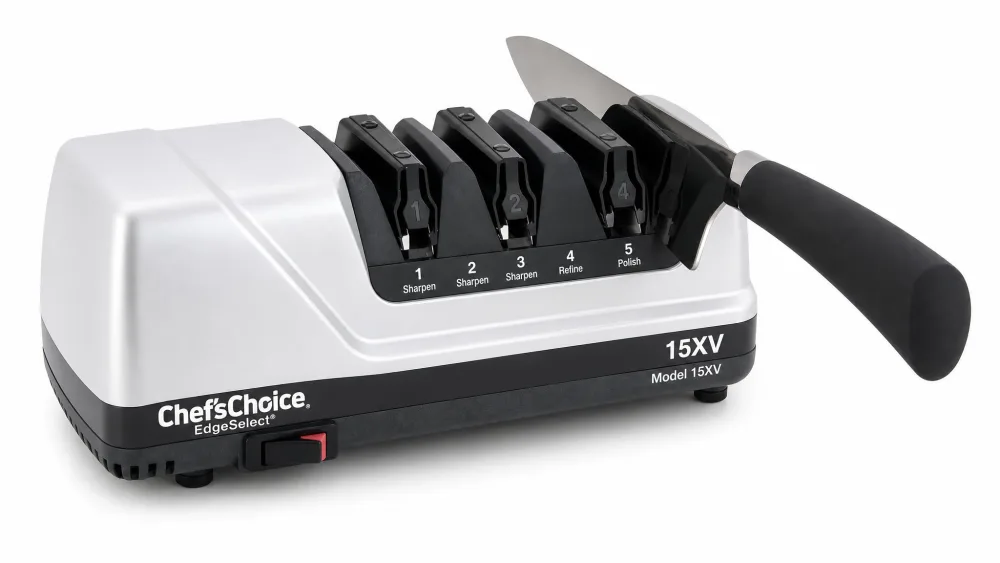
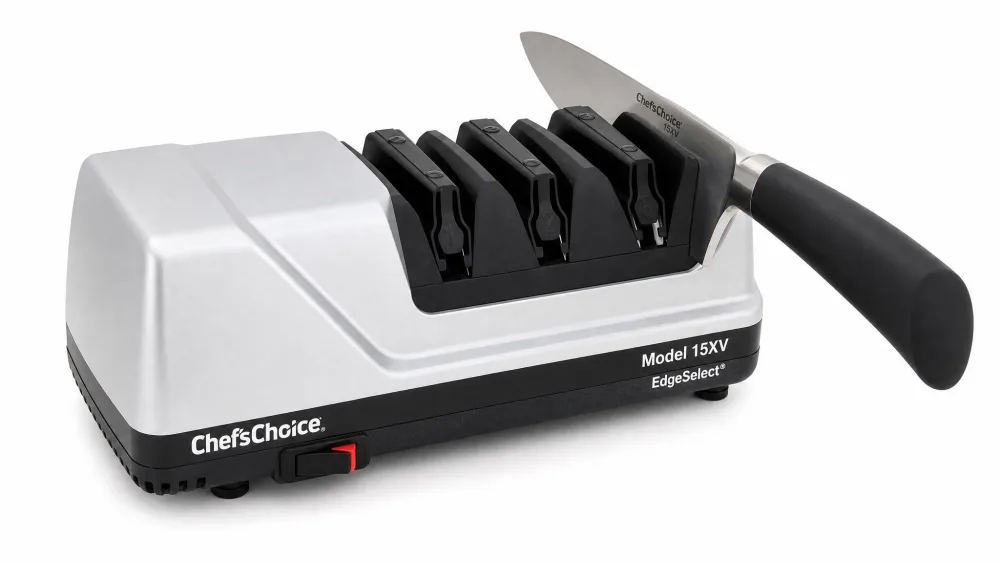
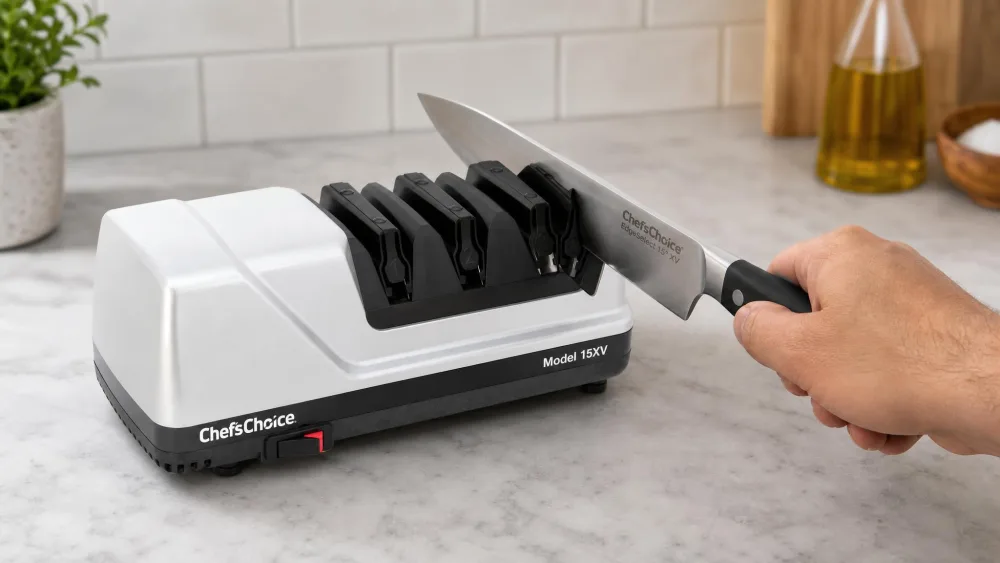
If the Wicked Edge is the enthusiast's obsession, the Chef'sChoice is the professional's shortcut. Once the initial 15-degree edge is set, most of our sessions were just the final stropping stage, and a full knife took seconds rather than minutes. The spring-loaded guides make it nearly foolproof for a first-timer, and the third stage polishes serrated bread knives without rounding off the teeth, which most electric sharpeners cannot do.
Pros
Three stages take a dull knife to a razor edge in about a minute the first time
Touch-ups take about ten seconds on the stropping stage
Third stage polishes serrated bread knives without rounding the teeth
Spring-loaded guides make it nearly foolproof for a first-timer
Cons
Lean on it or skip the guide slots and it can chew a blade fast
Diamond wheels wear with heavy use and cannot be replaced
Fixed 15 degrees only; pocket and outdoor knives will be thinned past what they want
The 15-degree Trizor XV edge comes from three stages: a coarse diamond grind, a fine diamond hone, and a stropping polish, all on 100-percent diamond abrasives. A first-time sharpening takes about a minute and a touch-up about ten seconds, and the machine converts a 20-degree factory edge to 15 degrees. The trade-off is control: lean on it or ignore the guide slots and it can chew up a blade fast, so the manual matters more than it looks. The diamond wheels are the first thing to watch on long-term durability, because the discs cannot be replaced and the machine has a finite lifespan. The street price sits around $124 to $170 depending on finish and week. Cooks who want razor sharp with no skill and no time will get the most from the Chef'sChoice 15XV EdgeSelect. Check the price on Amazon to see today's finish options.
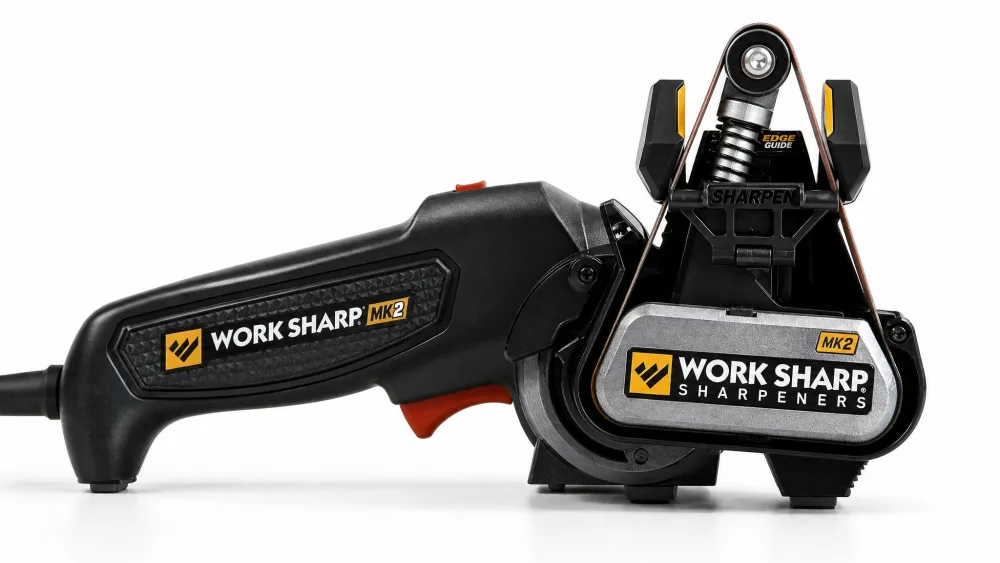
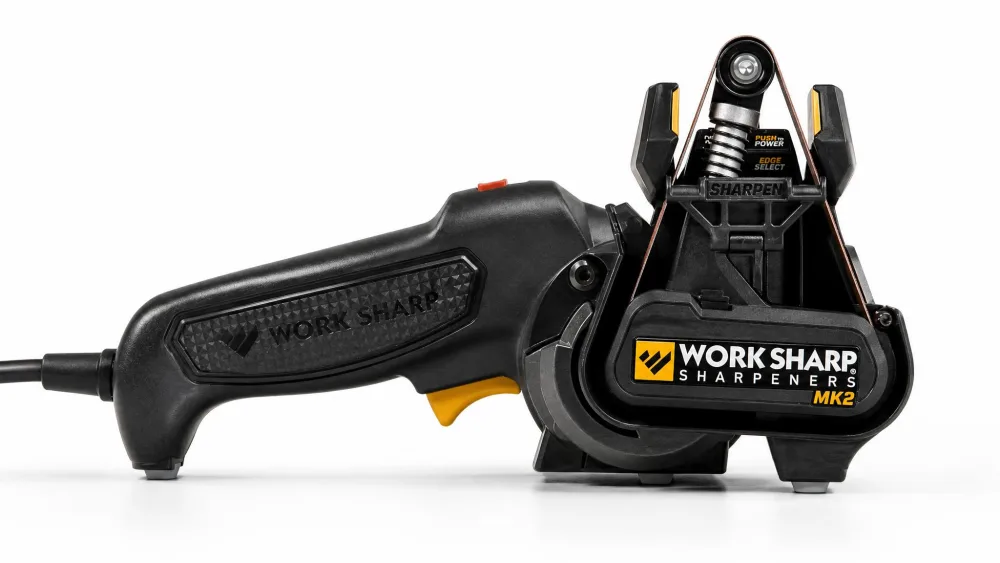
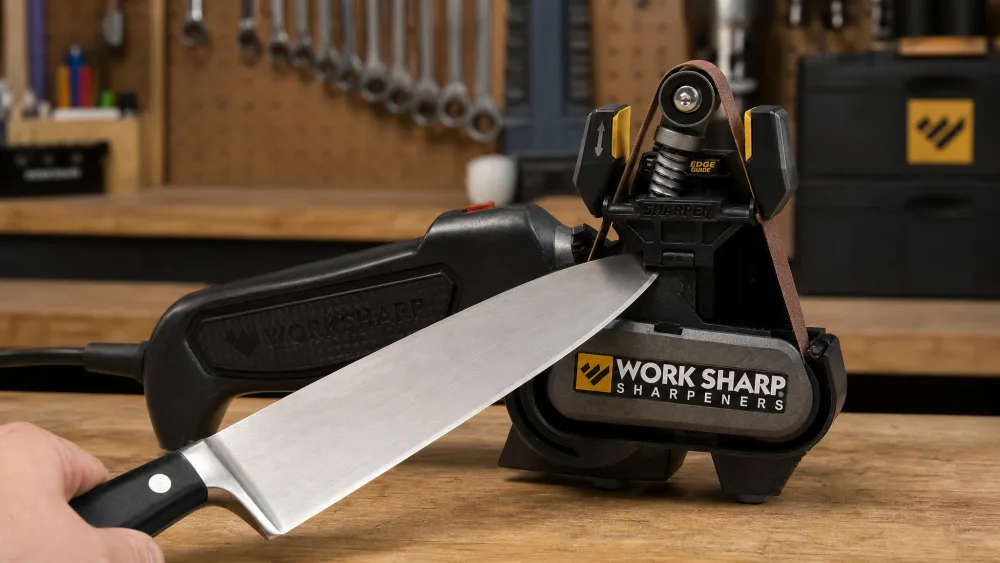
Where the Chef'sChoice removes the skill, the MK2 removes the limitation of what you can sharpen. It took about ten minutes to feel confident running chef's knives, pocket knives, scissors, and even lawn mower blades over the flexible belts, and the two-speed motor with low-tension belts limits heat damage if you let the tool do the work. The edge guide supports the blade all the way to the tip, which is the detail that keeps a long chef's knife stable.
Pros
Flexible belts conform to curved, serrated, and tool edges
Two-speed motor with low-tension belts that limit heat damage
Handles kitchen knives, pocket knives, scissors, axes, and mower blades
Edge guide supports the blade all the way to the tip
Cons
Included belts are a starter pack; budget for spares and a strop
Coarse-to-fine belt jump is steep for a true mirror finish
Over-aggressive for fine kitchen knives if you rush the pass
The box includes one each of P80, P220, and 6000-grit belts, and the 20- and 25-degree angle guides handle the two most common kitchen edges. Those included belts are effectively a starter pack, so budget for a spare belt pack and a leather strop alongside, because belt life shortens on hard steels, sometimes to a few sessions per belt. The coarse-to-fine jump is steep, so plan on a strop for a mirror finish. It is over-aggressive for fine kitchen knives if you rush the pass, which makes it more of a workshop tool for people who also sharpen tools, axes, and mower blades. The list price is $109.95, and the street price usually lands around $89.95, with a 3-year warranty on the Oregon-designed build. At around $90, the Work Sharp MK2 is the value call for anyone who sharpens more than kitchen knives. Check the current price of the Work Sharp MK2 on Amazon.
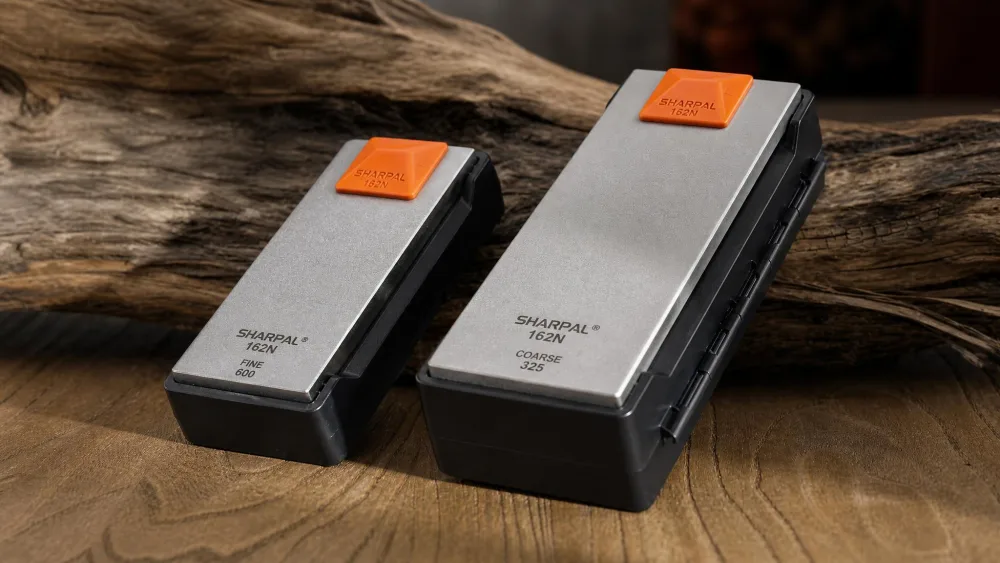
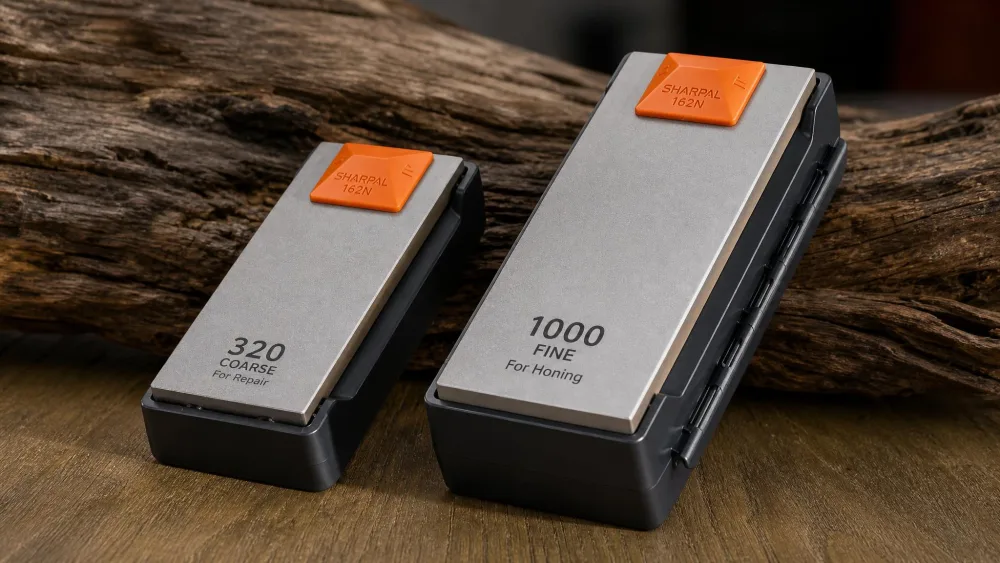
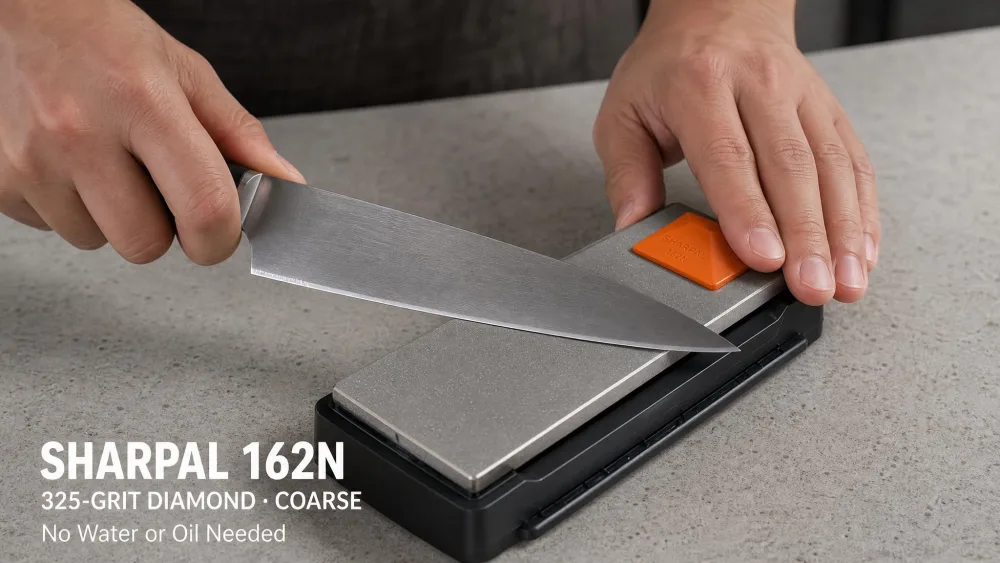
Where the MK2 is the powered route for the whole workshop, the Sharpal 162N is the manual route for the cook who wants the skill itself. If you are willing to learn freehand sharpening, it rewards the effort with a flat, dry-cutting diamond surface that stays true. It cuts dry with no mess and no soaking, and the diamond plate stays flat instead of dishing out into a bowl shape the way oil and water stones do. The integrated angle guide with 14, 17, 20, and 25 degrees helps, but holding the blade flat and at the right angle still takes practice, so this is slower and steeper to learn than an electric or guided system.
Pros
Cuts dry with no oil, no water, and no soaking
Diamond surface stays flat instead of dishing out over time
Integrated angle guide with 14, 17, 20, and 25 degrees
3-year warranty from a US-based company
Cons
Freehand skill matters; steeper learning curve than guided or electric
The 325-to-1200 grit jump is big; an intermediate stone or strop helps
Storage case top is not a sturdy sharpening base; use a dedicated holder
The dual-grit surface pairs a coarse 325-grit side for edge setting with an extra-fine 1200-grit side for honing, on an 8 x 3 inch monocrystalline diamond plate bonded to a stainless steel base. We found the 325-to-1200 jump big enough that an intermediate stone or a strop helped us finish the edge. During one edge-setting session on a dull chef's knife, the 1200-grit side loaded up with grey metal dust and the blade started to glide instead of cut; a couple of wipes with a damp cloth brought the bite back, so we now clean it between passes. The storage-case lid slid under pressure when we tried to sharpen on it, so we set the stone on a dedicated holder instead. Use it dry, no oil or water, and the street price runs about $63 to $70 with a 3-year warranty. If you want to learn the skill, this is the stone we would learn on. See today's price for the Sharpal 162N on Amazon.
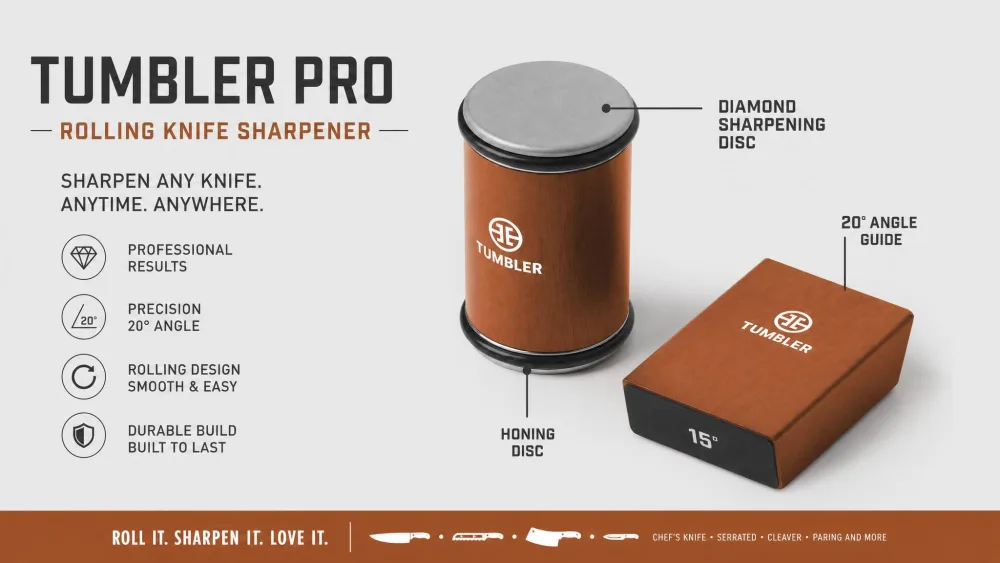
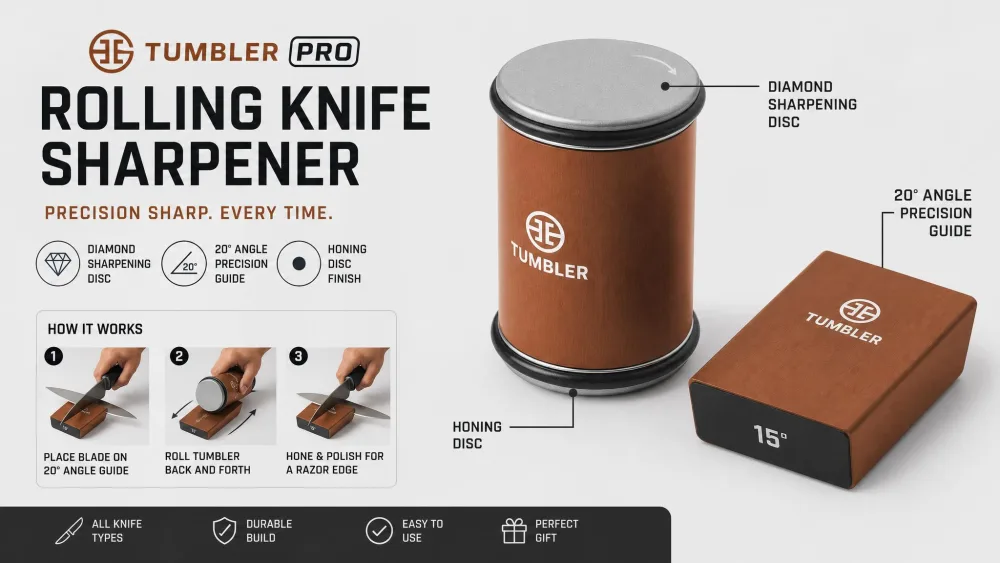
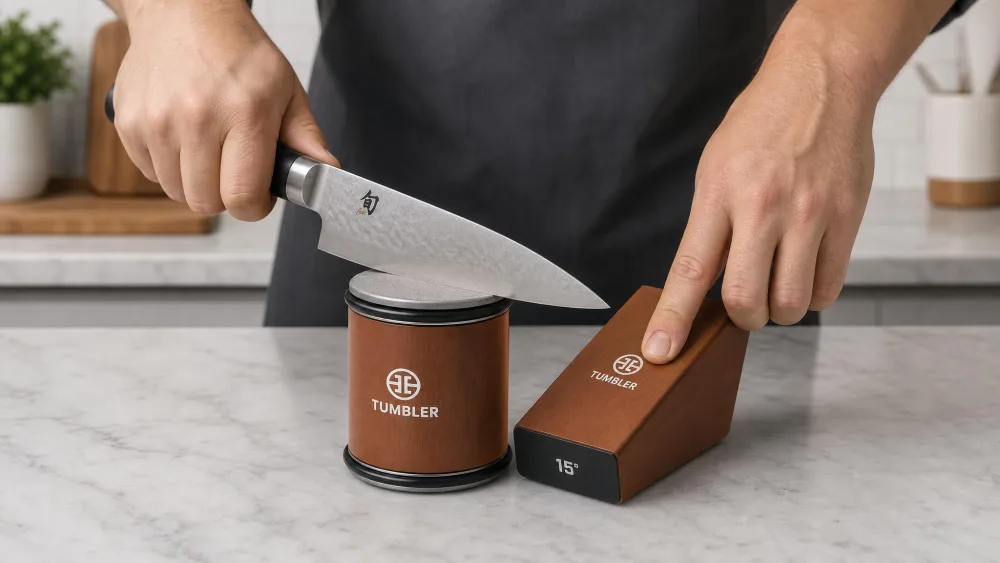
Where the Sharpal asks you to learn freehand angles, the Tumbler Pro hands the angle to a magnetic block and asks only that you keep the blade flat and roll. The magnetic holder keeps the blade in place and the rolling motion stays smooth even with almost no practice, so a first-time user gets a consistent edge without special skill. It is brilliant on larger kitchen knives, and the magnetic angle block holds the knife at 15 or 20 degrees while the premium 4-layer diamond disc and the EdgeBoost ceramic honing disc cover restoration and refinement.
Pros
Magnetic holder keeps the angle steady and smooth for first-timers
Brilliant on large chef's knives and fillet blades
Removable discs open the door to whetstone grits later
No water, oil, or electricity
Cons
Too tall for steak, paring, and small utility blades
Reviving a truly dull edge takes about six minutes per side
Disc is not replaceable on the standard setup, so inspect it regularly
But it is really a big-blade maintenance tool. It is too tall to reach steak-knife, filet, and paring blades, because the blade has to be taller and longer than the alignment block. Reviving a genuinely dull blade takes patience, around six minutes per side, and near-constant rolling for at least ten minutes caused real hand and shoulder fatigue in our testing. It maintains high-end Japanese and high-carbon steels beautifully, but it will not fix chipped or badly damaged edges and it does not handle serrations. Long-term disc life is the open question: Tumbler says the wheel should not need replacing under proper use, but the disc is not replaceable on the standard setup, so a worn disc would end the set's useful life, and we would inspect it regularly. At around $159, it is a maintenance and refinement tool, not a rehab system. The Tumbler Pro is at its best on large chef's and fillet blades, which is exactly where it earns the counter space. Check the current price of the Tumbler Pro on Amazon.
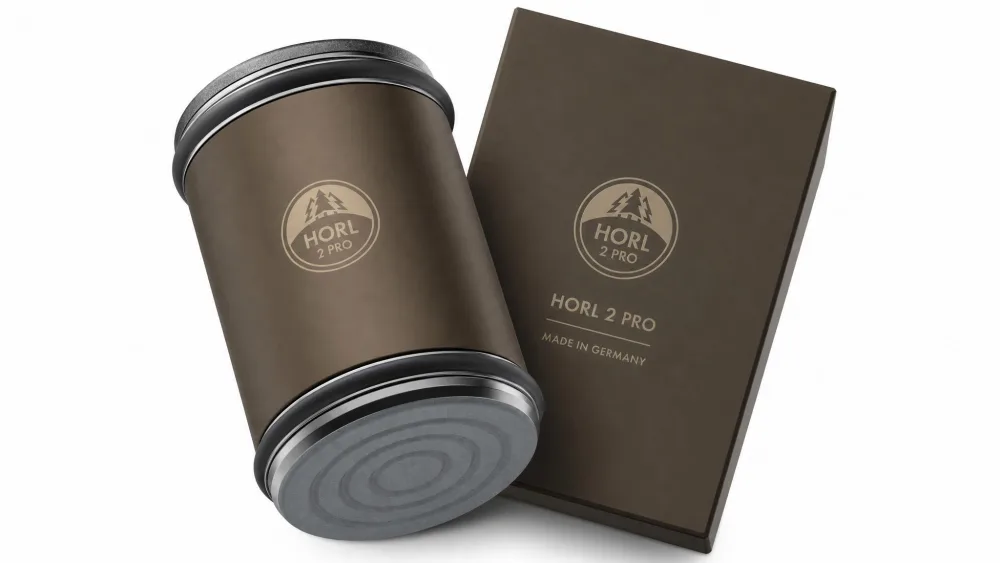
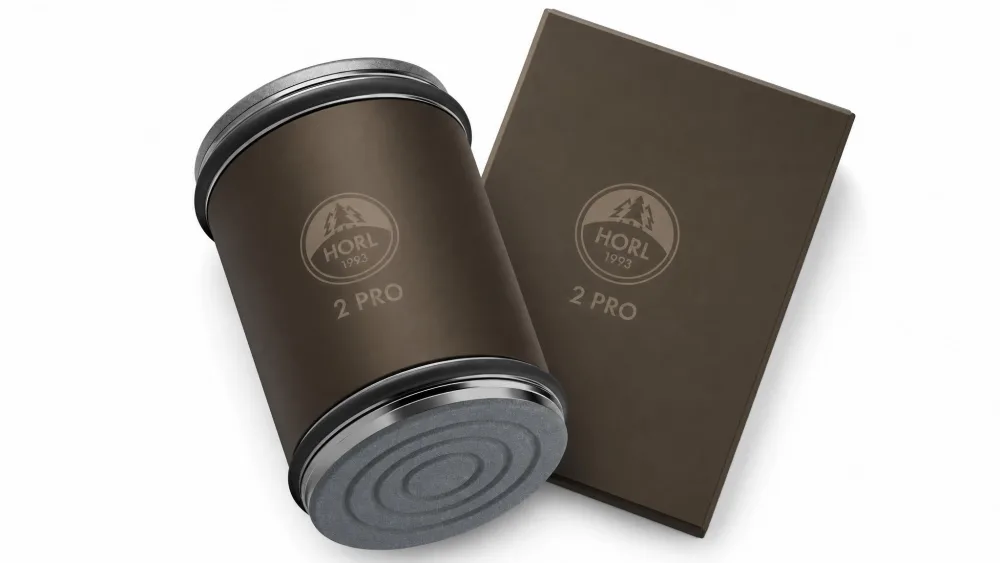
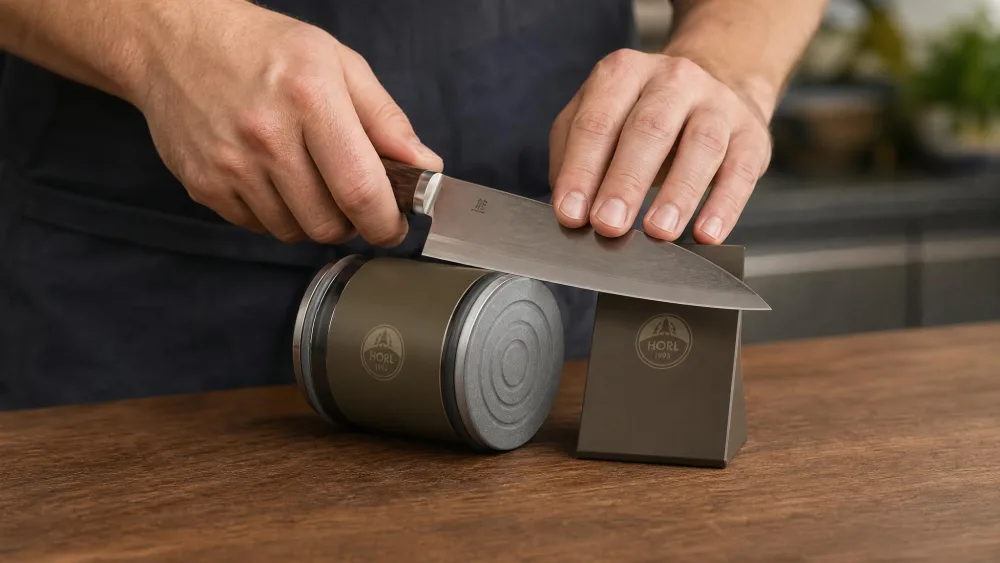
If the Tumbler is the gentle introduction to rolling sharpeners, the HORL 2 Pro is the escalation: the 1:3 planetary gear spins the disc three times for every full roll, so a single pass sharpens about three times faster than a simple rolling sharpener. The two-part design, a magnetic angle block plus the roller, is the simplest guided setup we have used, and the silicone-padded magnet holds the blade firmly without scratching it. It runs much quieter than a motorized belt sharpener and holds an angle more easily than a Lansky or freehand whetstone.
Pros
The 1:3 planetary gear sharpens about three times faster per roll
Two-part design is the simplest guided setup we have used
Silicone-padded magnet holds blades firmly without scratches
Quiet, compact, and made in Germany
Cons
Premium price, and the #3000/#6000 discs and strop cost extra
Tall-belly blades like Chinese cleavers are too tall to sharpen
Gear reduction adds rolling resistance, so it takes more effort
The 20-degree grinding angle suits robust kitchen work, and the 15-degree extra-fine angle covers sushi, sashimi, Damascus, and hard high-carbon steels. The stock diamond grinding disc and grooved ceramic honing disc handle most maintenance, but to go beyond them to true razor sharpness you buy the #3000/#6000 corundum whetstone discs and leather strop separately, which is where the premium price really adds up. The trade-offs are real: the gear reduction adds rolling resistance, so it takes more effort to roll than a simple rolling sharpener, and any blade with a really tall belly, like a Chinese cleaver, is too tall to sharpen, so those stay on a whetstone. Made in Germany, with a compact aluminum and stainless build in dark bronze, it lands around $349 on the US street. A busy kitchen that sharpens many knives will get the most from the HORL 2 Pro, where the faster per-roll speed pays for the extra effort. You can check the current price of the HORL 2 Pro on Amazon.
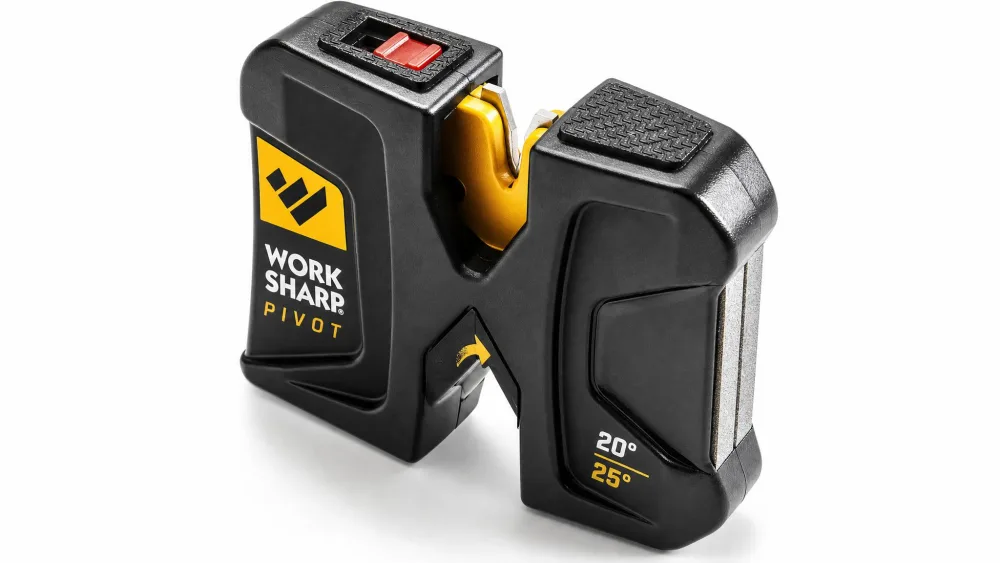
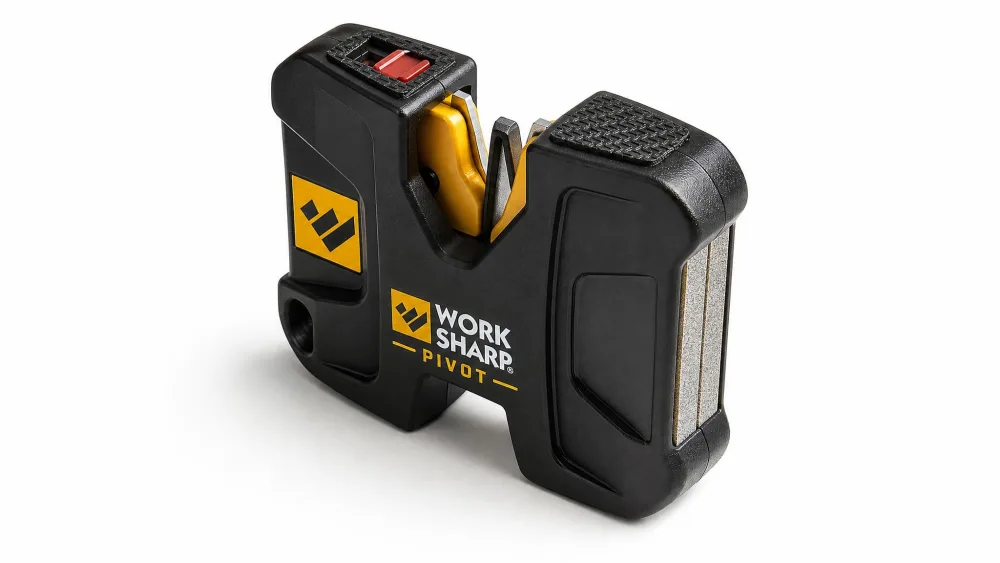
Where the HORL earns a permanent spot on the counter, the Work Sharp Pivot is the sharpener we carry, not the one we install on a bench. It is not fancy and it will not produce a mirror edge, but when a knife is dull it makes it sharp fast. The key is to not press down on the blade; just let the knife's own weight set the pressure as you pull it across the rods, and it restores a dull field knife quickly. At about 35 grams with a lanyard hole, it disappears into a pack or pocket, which is the whole point for emergency sharpening.
Pros
Turns a dull blade sharp in seconds with almost no technique
Weighs about 35 grams and disappears into a pocket or pack
Spring-loaded carbide rods follow the blade on the pull-through
Handles kitchen, pocket, outdoor, and even axes and hatchets
Cons
Fixed 25 degrees only, and it will not produce a mirror edge
Carbide stage cuts fast, so let the knife's weight do the work
Not for precision work on fine kitchen knives
The two-stage design pairs a carbide V-groove for basic grinding with a ceramic V-groove for fine grinding, both fixed at 25 degrees, with spring-loaded carbide rods that follow the blade on the pull-through. The non-slip rubber body fits a hand easily, and it handles kitchen, pocket, outdoor, survival, and bushcraft knives, plus axes and hatchets. It is a quick-fix tool, not a precision system, so we would not trust it to reprofile a fine Japanese chef's knife. Street price runs about $10 to $13 depending on retailer. We carry the Work Sharp Pivot for exactly this kind of emergency edge. Check the current price of the Work Sharp Pivot on Amazon.
Professional Knife Sharpener Comparison Chart
Here is how all eight picks line up on the specs that matter most. Prices are street estimates as of August 2026 and vary by finish, configuration, and week.
Product
Best For
Sharpening method/Type
Abrasives (and grit)
Angle range
Stages
Warranty
Price
Work Sharp Professional Precision Adjust
Best Overall
Guided (jig and clamp)
220-800 diamond, ceramic, strop (7)
15-30 deg
7
3-year
~$250
Wicked Edge Generation 4 Pro
Best Guided System
Guided (DualCam vise and rods)
100/200, 400/600, 800/1000 diamond (6)
12-33 deg per side
Multi-grit
Limited Lifetime
$1,099-$1,599
Chef'sChoice 15XV EdgeSelect
Best Electric
Electric 3-stage
100-percent diamond, 3 stages
15 deg (converts 20)
3
3-year
~$125-$170
Work Sharp MK2
Best Budget
Belt-driven electric
Flexible belts P80/P220/6000
20/25 deg guides
2-speed
3-year
~$90
Sharpal 162N Dual-Grit Whetstone
Best Manual
Manual diamond whetstone
325/1200 diamond (2 grits)
Freehand, 14-25 deg guide
2
3-year
~$63-$70
Tumbler Pro Rolling
Best Rolling
Manual rolling (magnetic angle block)
4-layer diamond + EdgeBoost ceramic
15/20 deg
2
Not stated
~$159
HORL 2 Pro
Best for High-Volume Kitchens
Rolling (planetary gear)
Diamond + ceramic discs
15/20 deg
2
Not stated
~$349
Work Sharp Pivot
Best Compact/Pocket
Pull-through V (carbide + ceramic)
Carbide + fine ceramic
25 deg fixed
2
Not stated
~$10-$13
How We Tested Professional Knife Sharpeners
We put the leading professional sharpeners to work in our kitchen, running each system through a month of real prep in rotation with an edge check after every session. We started every blade at the same place, dull enough that it would not push-cut a ripe tomato without squashing it, and we scored how each system brought the edge back, how long that edge held through a week of cutting, how easily the steel took a fresh edge on the next run, and how the sharpener itself wore under repeated use.
Our Testing Process
Every knife followed the same arc: we worked it hard until it would not slice cleanly, then sharpened it on each system following the manufacturer's instructions, then used it for a week of real prep. We checked the edge after every session, noted how long each sharpening took, and watched for the details that show up only in real use: clamp slippage, blade wiggle at the tip, belt wear, stone loading, and how easy cleanup was. To see how far the commercial end goes, watch how the Tormek water-cooled system runs before you shop. Spec numbers like angle range and grit came from the manufacturers, but the judgment on each pick came from the edge it left behind and how long that edge lasted.
Checking edge retention after a week of prep.
Tip. Mark your edge with a permanent marker before the first pass. The ink shows exactly where the abrasive is contacting the bevel, so you can match your existing angle instead of guessing.
What Makes a Sharpener "Professional"
A sharpener earns the word professional when it does three things: holds a chosen angle repeatably, uses abrasives that match hard modern steels, and stands up to daily use. Angle control is the biggest divider. A guided system like the Work Sharp Precision Adjust locks the blade in a clamp and moves the stone at a fixed angle, so every stroke removes steel at the same rate, while a freehand whetstone leans on the skill of the hand holding it. Abrasives matter almost as much. Diamond cuts fast on the high-hardness steels that hold a working edge, which is why every electric pick here uses it, and the Rockwell hardness scale is the measure that tells you whether your steel is soft enough for a ceramic rod or hard enough to need diamond. In a licensed commercial kitchen, knife maintenance is a food-safety matter, and the FDA Food Code is the framework a professional operation follows. The eight picks below all clear that bar in different ways, from the twelve-dollar pocket sharpener to the two-thousand-dollar guided system.
Our Testers
The same hands ran every sharpener in this roundup, so the results stay comparable across all eight picks. We judged edges the way a working kitchen does, where out-of-box sharpness matters less than how an edge holds after a week of prep and how easily the steel takes a fresh edge. We watched for the failures that only show up over time, like a clamp that slips, a belt that sheds, or a stone that loads up with metal dust, and we scored each system against that standard.
How to Choose the Best Professional Knife Sharpener
A professional knife sharpener is not a single tool; it is a category with a few very different approaches, and the right one depends on the knives you own, the time you have, and how sharp is sharp enough for you. We weighed all of them against a month of real prep, and this is the framework we used.
Sharpening Methods: Electric, Guided, and Manual
The market splits into three main approaches, with rolling sharpeners as a recent fourth. Guided systems clamp the blade and move an abrasive along a fixed angle, which removes the guesswork; the Work Sharp Guided Field Sharpener is a compact take on the idea, and the Tormek T-8 is the water-cooled bench machine you will find in restaurant supply houses. Electric sharpeners push the blade through motorized abrasive wheels and are the fastest, most foolproof option on the counter. Whetstones are the traditional choice, a flat stone you work by hand, and they reward skill with the finest edge. Rolling sharpeners sit on the counter and roll the blade across an abrasive disc, a design easiest on large blades. Each has a place, and the eight picks above cover all four. For a deep dive on the differences, our best electric knife sharpeners guide covers the powered side of the category.
Angle Control and Adjustment
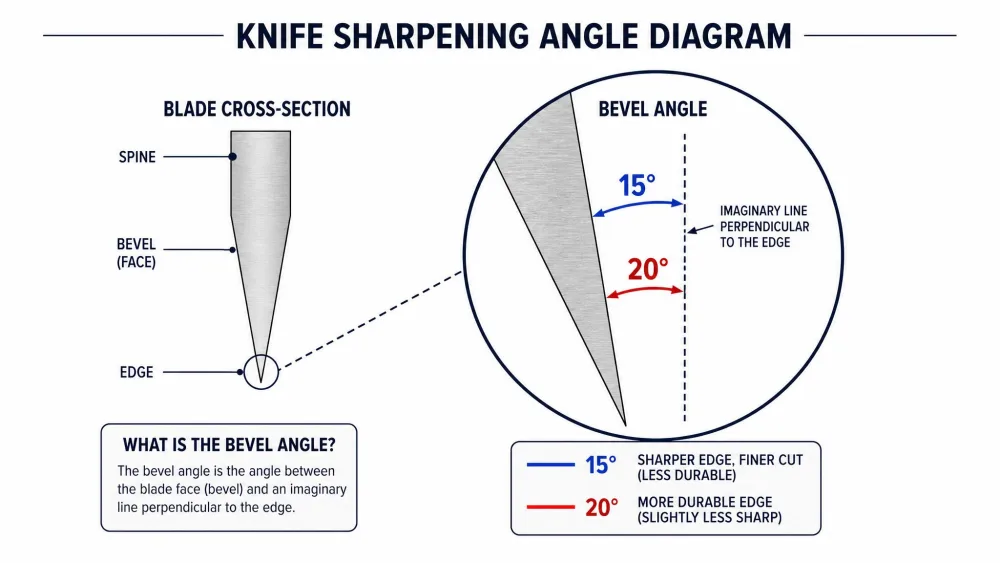
Beyond the mechanism, the angle is the single biggest variable in how a knife feels. Most Western kitchen knives leave the factory around 20 degrees per side, while Japanese knives run closer to 15. Sharpeners either lock you into one angle, like the Chef'sChoice 15XV's fixed 15-degree edge, or let you choose, like the 15 to 30 degree range on the Work Sharp Precision Adjust and the 12 to 33 degrees per side on the Wicked Edge Gen 4 Pro. A guided system is the surest way to hold a chosen angle pass after pass, which is why they dominate our top picks. The science behind why the angle matters lives in the knife-sharpening angle discussion, and our best knife sharpening angle guide walks through matching it to your blades.
Matching the sharpening angle to your blade type.
Abrasive Material and Grit Stages
The angle sets the shape of the edge; the abrasive does the cutting. Diamond is the fastest cutter and the best choice for hard modern steels, which is why every electric pick here, from the Chef'sChoice 15XV on up, uses it. Ceramic is finer and works well as a finishing or honing stage that refines the edge without removing much steel. Whetstone, typically aluminum oxide or a synthetic water stone, offers the most control but cuts slower and demands technique. Grit numbers matter as much as the material: lower numbers cut faster and remove more steel, higher numbers refine the edge, and a strop or fine ceramic stage is what turns a sharp edge into a razor-sharp one.
Note. Match the grit to the dullness: a coarse stone around 200 to 400 grit reshapes a damaged or nicked edge first, a mid grit around 600 to 800 refines it, and a fine stage of 1000 or higher finishes the job. Between real sharpenings, a honing steel keeps the edge alive, but it is not a sharpener: it realigns the edge and takes thirty seconds, yet it removes no steel, so a genuinely dull blade still needs the coarse stage to come back.
Blade Types and Versatility
The last question is what you actually sharpen, because not every sharpener handles every blade. Serrated knives need a dedicated slot or a tapered ceramic rod, which the Chef'sChoice 15XV, the Work Sharp Precision Adjust, and the Work Sharp MK2 all provide in different ways. Very thick blades and cleavers need a clamp that opens wide enough, which is where the Wicked Edge Gen 4 Pro and the Work Sharp MK2 shine and the Sharpal 162N stone struggles. Small paring and pocket knives can be too small for the rolling sharpeners' magnets. Think about the blades you actually own before you pick a system.
Budget and Value
Finally, price tiers map cleanly onto the categories. Professional sharpeners range from about ten dollars to well past two thousand, and the price tracks precision and scope more than raw sharpness. Under fifty dollars, the Work Sharp Pivot restores a dull blade in seconds. The fifty-to-a-hundred-and-fifty band is where most cooks should look: the Sharpal 162N, the Work Sharp MK2, and the Chef'sChoice 15XV all live there, and any of them will keep a kitchen razor sharp. Above that, the Work Sharp Precision Adjust and the HORL 2 Pro add precision and speed, and the Wicked Edge Gen 4 Pro is a precision instrument for enthusiasts whose price reflects the 0.05-degree adjustments rather than a sharper edge.
Warning. High-speed electric sharpeners can overheat thin blades and ruin a heat treat. Use light pressure and short passes, and let the motor do the work rather than forcing the steel through the guides.
The best sharpener is the one you will actually sit down with every few weeks, because a sharp edge is a safety feature in a working kitchen.
Frequently Asked Questions
Is an electric or manual professional knife sharpener better?
It depends on what you want from the tool. Electric sharpeners like the Chef'sChoice 15XV are faster and nearly foolproof, which makes them the right choice for a busy kitchen or for cooks who just want the edge back before dinner. Manual systems, whether guided, whetstone, or rolling, give you more control over angle and pressure, which is gentler on the blade over years of use. Choose electric for speed and simplicity, manual for control and craftsmanship.
What angle should professional kitchen knives be sharpened at?
Match the edge to how you cut, and know the tradeoff. A 15-degree bevel slices a tomato or raw meat with noticeably less resistance than a 20-degree one, which is why the Chef'sChoice 15XV sets kitchen blades at 15; the catch is that a thinner, lower-angle edge rolls sooner on bones and hard chopping. That tradeoff is why we would not run a pocket or outdoor knife through that machine: a fixed 15-degree conversion thins those blades past what a working edge wants. Most Western kitchen knives sit around 20 degrees per side and Japanese knives closer to 15, and an adjustable guided system lets you dial in the spot that matches your knives.
Can a professional knife sharpener handle serrated knives?
Many can, but you need the right feature. The Chef'sChoice 15XV has a dedicated third stage that polishes serrated edges without rounding the teeth, the Work Sharp Precision Adjust includes a ceramic rod for serrations, and the MK2's flexible belts conform to scalloped edges. Run serrated blades gently, matching the curve of each scallop, and they will keep working for years.
How often should professional knives be sharpened?
With regular honing on a steel every few uses, most home cooks need a real sharpening every one to three months. A busy professional kitchen may sharpen weekly. The reliable signal is the tomato test: if a knife will not slice a ripe tomato cleanly, it is time to sharpen.
What grit should I use for a very dull or damaged knife?
Start coarse and let the stone do the reshaping, then finish fine. The Sharpal 162N covers both ends with a 325-grit coarse side for edge setting and a 1200-grit fine side for honing. The part most buying guides skip is cleaning: when the fine side starts to feel slick and the blade glides instead of cutting, grey metal swarf has loaded the surface, and a few wipes with a damp cloth bring the bite right back. Keep it clean between passes and the edge finishes without tiny imperfections.
What do professional chefs use to sharpen their knives?
It depends on the kitchen and the skill of the cook. Traditional chefs, especially Japanese-trained ones, favor whetstones for the control and the edge quality. Butchers and line cooks who sharpen throughout a shift often use a honing steel for maintenance and a belt or guided system for the real sharpening. The picks above span all of that, from the whetstone's finesse to the electric's speed.
The Bottom Line
Put the testing and the buying guidance together, and the choice narrows to how you cook and what you own. Our top pick, the Work Sharp Precision Adjust, earns the Best Overall slot, but the rest of the list is where most shoppers should look first. If you want electric speed and zero learning curve, the Chef'sChoice 15XV is the fastest route to a razor edge we tested. If you sharpen everything in the house, from chef's knives to lawn mower blades, the Work Sharp MK2 does the whole job for under a hundred dollars. And if you are just learning what a real edge feels like, the Sharpal 162N shows you the manual method for about sixty-five dollars, which is the best money we know to spend on the skill.
The one thing we would tell a friend is to buy for the knives you own, not the ones you admire. A sharpener is a tool you will use every few weeks for years, so choose the system you will actually sit down with, and keep a honing steel nearby for the weeks in between. A razor-sharp edge is not a luxury in a working kitchen; it is the difference between effortless prep and a knife that fights you.