As an Amazon Associate we earn from qualifying purchases. We may earn a commission from links on this page, at no extra cost to you. Learn more.
Work Sharp sells two very different kinds of sharpener under one name, and choosing between them matters more than choosing between models. One family is a clamped, hand-guided system where you control every stroke. The other is a powered belt or disc machine that removes steel quickly and rewards a light touch.
We sharpen on stones for a living, so we judge every sharpener by the edge it produces: how the knife cuts on a board, how cleanly it slices paper, and how readily it regains a fine apex. This guide sorts our Work Sharp picks by the kind of cook who should buy each one.
How We Tested These Work Sharp Sharpeners
We worked through each sharpener the way a home cook would use it. We set up the guide, clamped or held a kitchen knife, and ran the full abrasive progression from coarse to fine. Then we checked the edge by feel and on paper, and cleaned up afterward.
Three questions drove every verdict. How much control does the system give you over the edge angle? How easily can a beginner repeat the result? And what does the machine do to a knife when you make a mistake?
The answers shaped our editorial ratings. Those ratings are our own judgment of how well each model fits the cook it targets, weighing ease of setup, edge control, flexibility, and the main limitation. They are not marketplace scores.
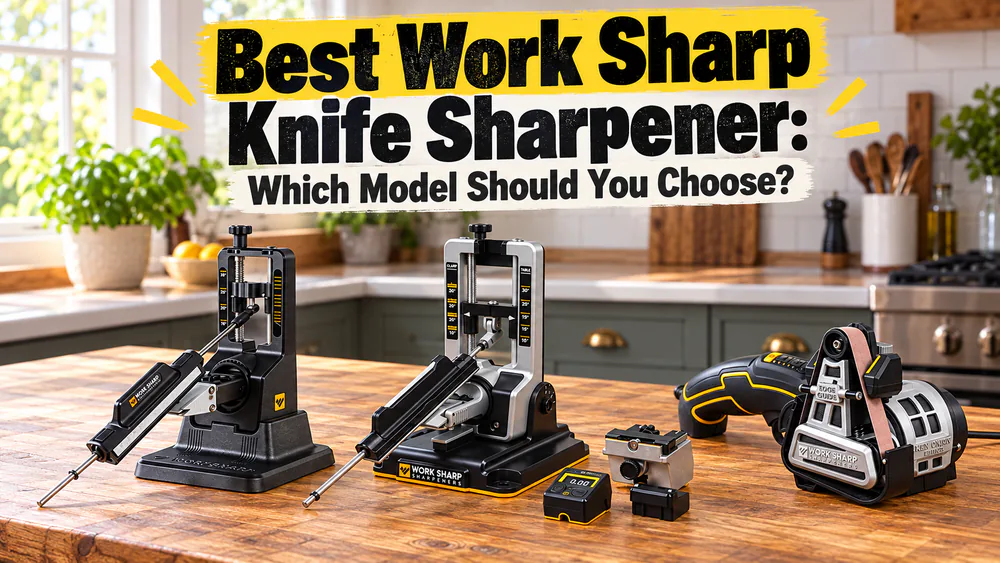
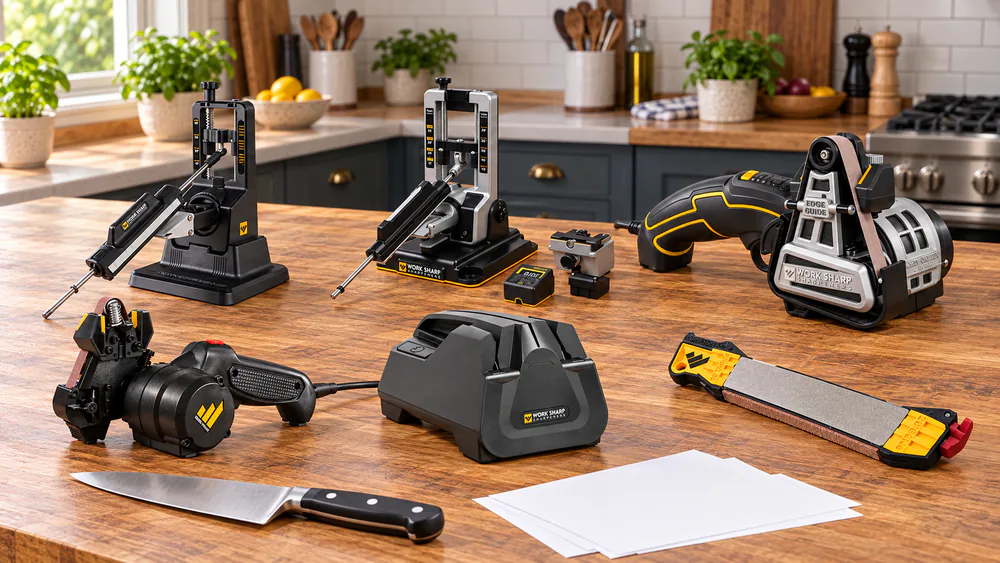
The families we compared, from handheld to powered.
Work Sharp Knife Sharpeners at a Glance
If you want one line, here it is. Buy the Precision Adjust if you want control and patience, the Ken Onion Mk.2 if you want speed with adjustable angles, and the Kitchen Electric if you want the simplest possible routine for ordinary kitchen knives.
The table below lines up the six main models we reviewed. Each Elite or Professional upgrade is explained inside its family section.
Product
Method
Angle and blade fit
Abrasives
Intended user
Main limitation
Precision Adjust
Manual clamped guided rod
15-30 degrees; blade must clear the clamp
320 and 600 grit diamond plus fine ceramic
Patient beginner wanting angle control
Setup time, lighter chassis, narrow grip
Professional Precision Adjust
Manual clamped guided rod
15-30 degrees in the main clamp; small-knife table for narrow blades
220, 320, 400, 600 and 800 grit diamond, ceramic, leather strop, serration rod
Frequent sharpener wanting stability
Bench space and blade-fit checks
Ken Onion Mk.2
Powered flexible belt
15-30 degrees in the guided cassette
P120, X65, X22, X4 and 6000 belts
Cook balancing speed with adjustable angles
Tip control and belt technique
Knife & Tool Sharpener Mk.2
Powered flexible belt
20 or 25 degrees, fixed choices
P80, P220 and 6000 belts
Household knives plus workshop tools
Limited angles, dust, fast metal removal
Kitchen Electric (CPE2)
Powered discs plus manual ceramic hone
Fixed 20 degrees; common kitchen blades
P120 ceramic discs and a fine ceramic wheel
Cook who wants simple maintenance
Changes acute bevels; limited finish control
Guided Field Sharpener
Handheld diamond, ceramic and strop
20-degree sharpening and 25-degree honing guides
Coarse and fine diamond, ceramic, leather
Portable touch-ups and small blades
Short abrasive surfaces
Every model here carries the maker's 3-year warranty.
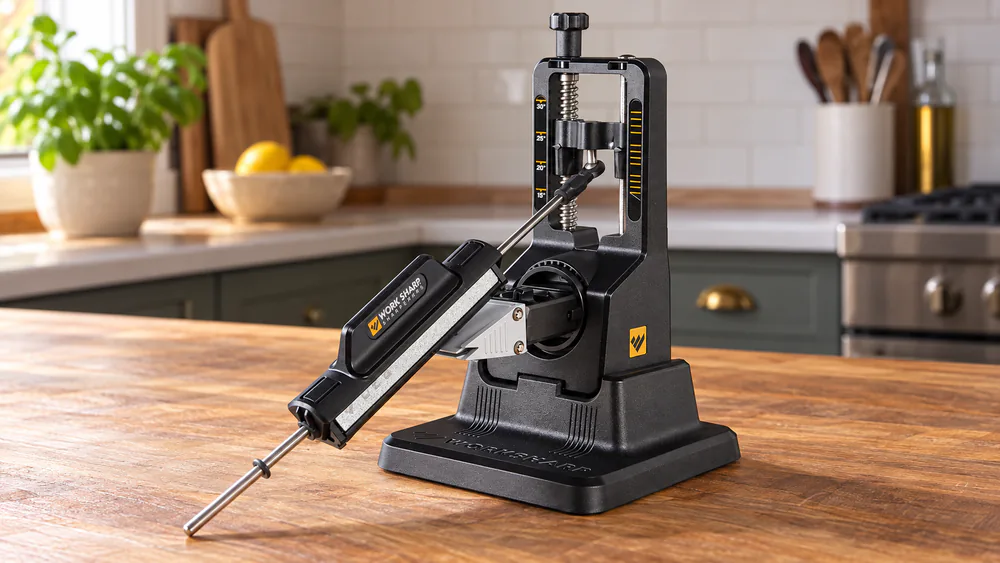
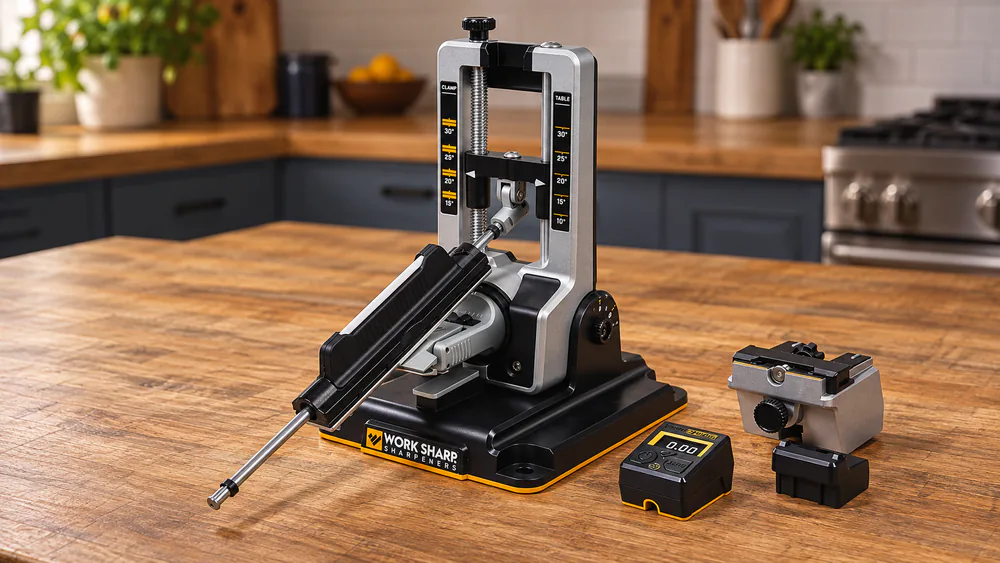
The Precision Adjust is the sharpener we would hand to a careful beginner. The guided rod holds the angle for you, and the ceramic finishing surface produced a keen, usable edge without any extra polishing accessories. For routine maintenance, the fine diamond and ceramic often do the whole job before a blade gets badly dull.
Pros
Repeatable angle control suited to a beginner
Fine finishing stage gives a clean working edge
Dry abrasives mean no cleanup mess
Cons
Clamping and angle setup add friction compared with grabbing a familiar bench stone
Establishing a new edge with the supplied coarse plate is slower than routine finishing
The narrow pinch grip can tire the hand on a long session
Who It Suits and Where It Falls Short
This is the model for someone who sharpens a few times a year and wants the same result each time. The limitation is time. The first time we flipped the clamped blade to work the other side, it took more deliberate pressure than we expected, so we slowed down and kept our fingers well clear of the edge. After a few flips the motion became routine.
Is the Precision Adjust Elite Upgrade Worth It?
The Elite keeps the same platform and angle range, with 1-degree increments from 15 to 30 degrees. It adds rotating abrasive handles, a diamond progression, fine ceramic, a leather strop, a serration rod, a carry case, and a storage rack.
Rotating between grits and flipping the clamped blade keeps the finishing sequence convenient. Light pressure and long strokes gave us cleaner results, and pushing hard into the leather can cut the strop. Fine diamond, ceramic, and stropping restored clean tomato-skin slicing on a thin double-bevel kitchen knife.
Check the kit contents before you buy to be sure you are getting the full Elite system. If you own bread knives or want a polished edge, the Elite earns its cost. If you only keep plain chef's knives sharp, the standard model is enough.
The clamp and rod hold the angle while you do the work.
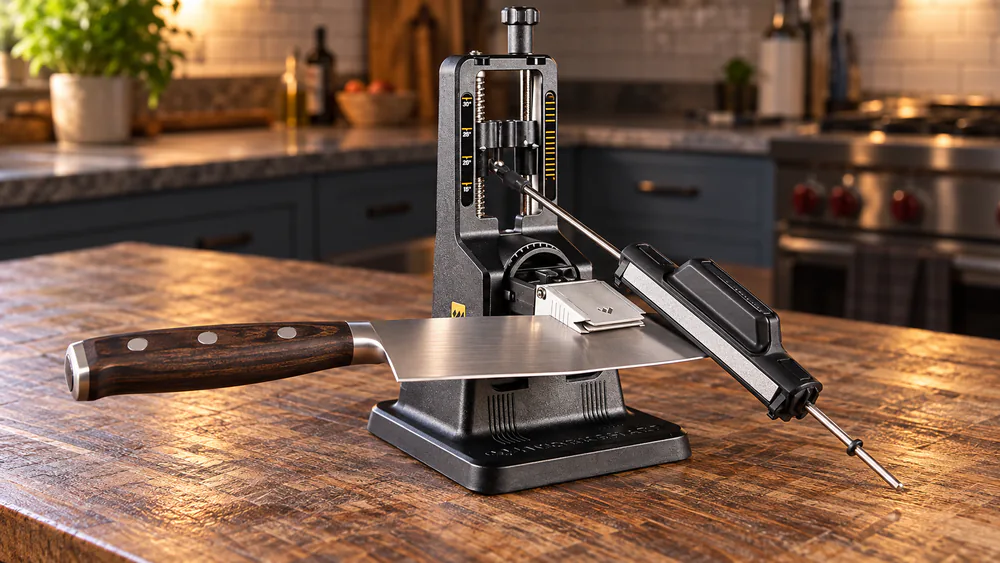
The Professional is the Precision Adjust with the wobble removed. Its abrasives measure 1 x 6 inches. With a long chef's knife in the clamp, the heavy frame stayed put on the bench and the clamp support gave us confidence. We could still feel a little play in the arm and clamp. The solid base and rotating clamp kept the edge work controlled, and the magnetic abrasive changes were quick.
Pros
Weighted metal chassis stays put on the bench
Quick magnetic abrasive changes
Dry abrasives avoid the cleanup of wet stones
Cons
Takes more bench space than the standard model
Check that your blade clears the clamp before you buy
The shipping box is an awkward long-term storage solution
What You Gain over the Precision Adjust
Stability, a digital angle indicator, a clamp stabilizer, and a small-knife table. Those matter most if you sharpen a lot or handle long, heavy blades. The narrow ceramic rod also makes serration work accessible.
The small-knife table deserves a caution. Do not buy this system expecting a 10-degree edge, and remember that blade height and fixture setup affect clearance.
When the Professional Elite Kit Makes Sense
The Professional Elite adds 1200, 2000, and 3000 grit resin-bonded diamond plates and a rugged carrying case, for a complete kit of 10 abrasives. It is the most complete manual system in this group.
The magnetic small-knife table makes short blades easier to position than the main clamp. Fine progression and stropping can produce a highly polished edge, and the travel stops keep strokes controlled. The review above covers the standard Professional; add the Elite plates later if you want the finer finish.
Work Sharp Ken Onion Edition Knife & Tool Sharpener Mk.2
3
Work Sharp Ken Onion Edition Knife & Tool Sharpener Mk.2
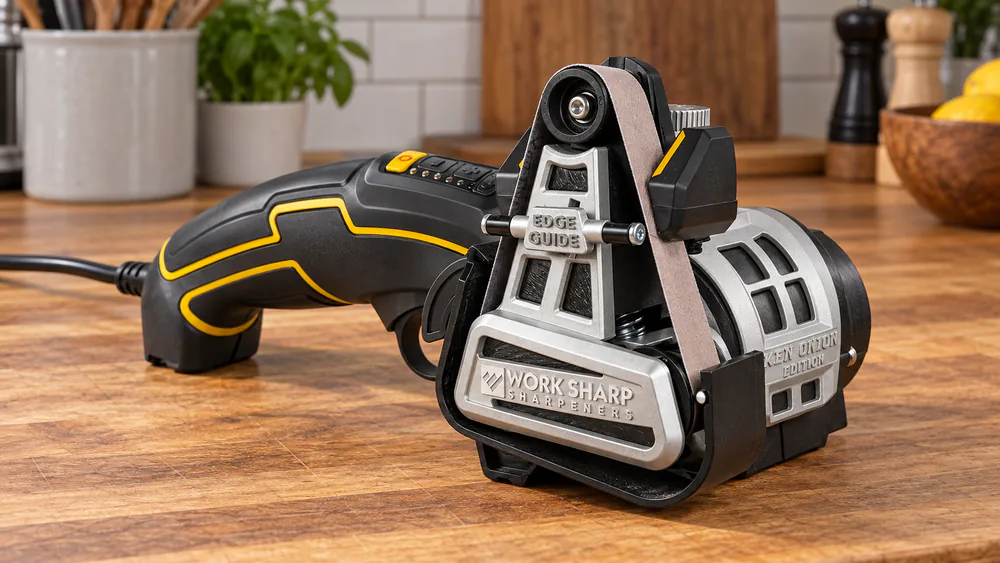
Where the Professional is slow and steady, the Ken Onion Mk.2 is quick. It uses 3/4 x 12 inch belts and gives you the speed of a belt machine and the angle choice of a guided system. The guided cassette adjusts from 15-30 degrees per side. The heads swap easily at the motor connection, making it practical to switch between guided sharpening and grinding. When we let the motor run with the tip unsupported, the belt started to round it, which is the lesson this machine teaches fast. It rewards a cook who will learn belt pressure and tip control, and punishes one who will not.
Pros
Seven speeds and a wide angle range
Fast at reprofiling dull knives
Heads swap easily between guided sharpening and grinding
Cons
Needs practice to control belt pressure and the tip
Noise and dust make a workbench more comfortable than a kitchen counter
The open grinder head does not constrain the blade, so it takes practice
Speed, Control, and the Learning Curve
Speed is the draw. The 7 speed settings let you slow down for fine work and speed up for coarse removal. Low speed and light pressure help you control how much steel you take, but they do not make a mistake impossible.
The learning curve is real. Practice on a spare knife first, and stop the motor while the tip is still supported so the belt cannot round it.
Standard Kit or Elite Kit?
The standard kit is the right choice for kitchen use. The Ken Onion Edition Elite Mk.2 adds a Blade Grinding Attachment that adjusts from 10-35 degrees and uses 1 x 18 inch belts, along with tool-free head changes and larger belts. Grinding-head adjustments are easier to dial in, and the build feels sturdier than the earlier attachment.
The grinder gives room for tip repair and big reshaping jobs, but it does not constrain the blade like the guided cassette, so it needs practice. Most kitchen cooks will never need it.
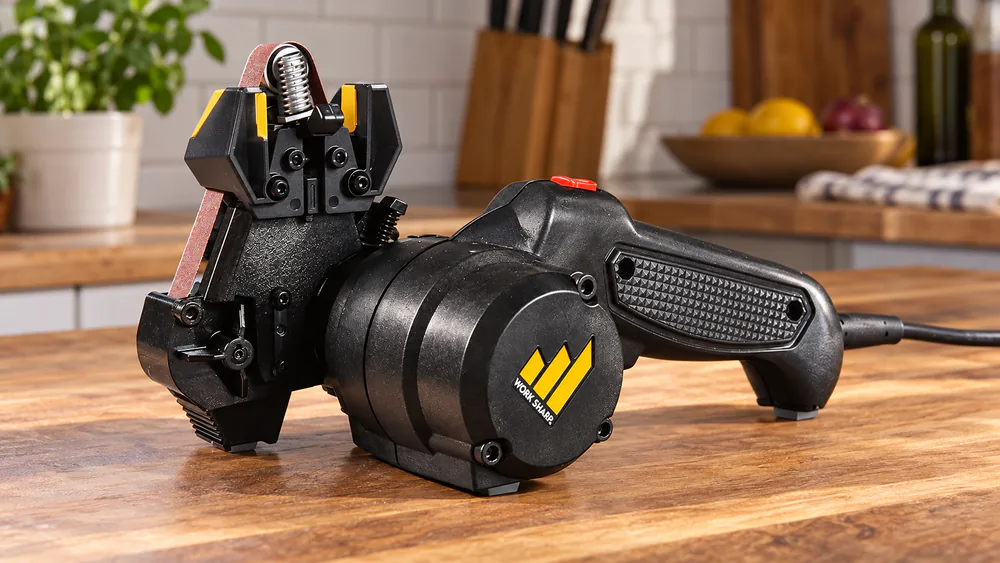
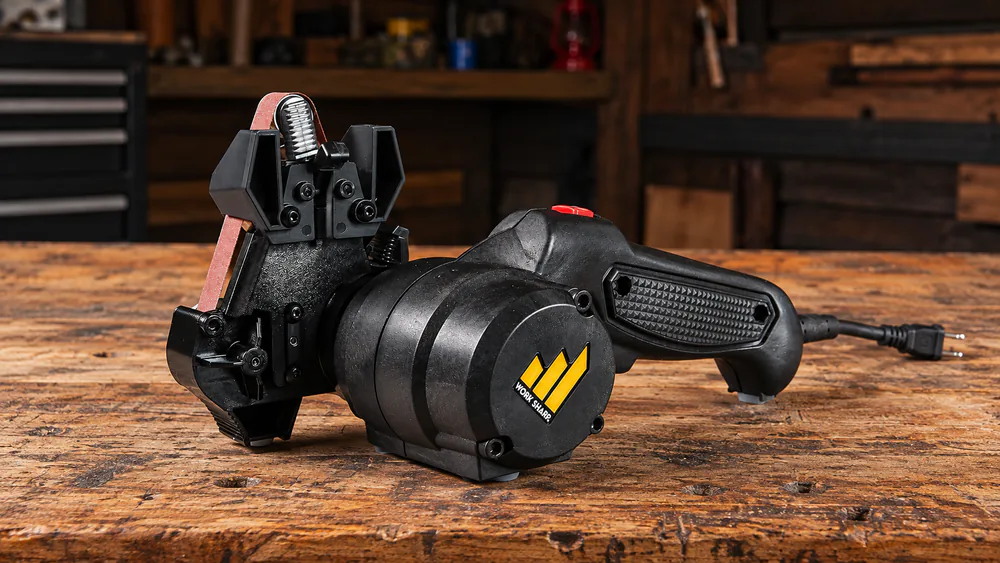
Speed is the risk with the standard Mk.2, and also its strength. Material disappears quickly enough that extra passes changed the blade before we noticed the mistake. Unlike the Ken Onion, it offers only fixed angles. Belts were easy to install, and the closer front guide improved access near the heel.
Pros
Quick results and easy belt changes
Sharpens tools and scissors as well as knives
Closer front guide helps near the heel
Cons
Only two fixed angles
Dust and noise suit a workbench better than a kitchen counter
A large jump between the medium belt and the fine polishing belt
Who Should Choose the Standard Mk.2?
Choose it if the sharpener will earn its keep on shears, lawn tools, and the household knives together. When we drew a tip off a moving belt it rounded, so stop the motor while the tip remains supported.
The included progression leaves a big jump between medium sharpening and fine polishing. Extra intermediate belts can fill that gap if you care about finish. Match replacement belts to the standard Mk.2 model, since its belts are not the same size as the Ken Onion belts.
What You Give Up Compared with the Ken Onion Mk.2
You give up angle choice and speed range. The Ken Onion offers adjustable angles and 7 speeds, while this model has two angles and 2 speeds. You also give up the wider belt and the optional grinder, which belong to the Ken Onion line.
For a cook who owns mostly Western kitchen knives, the fixed 20-degree guide is a fine match. For anyone with thinner or more acute edges, the Ken Onion is the safer choice.
The Mk.2 belt and guide, shown with the machine switched off.
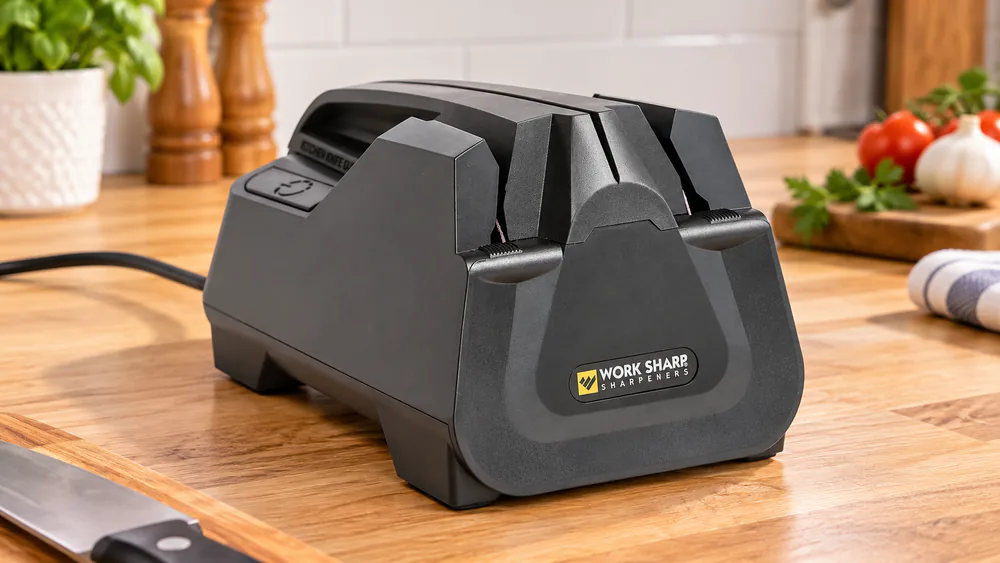
The Kitchen Electric, model CPE2, gives up finish quality for simplicity, and it is the least demanding sharpener here. Automatic stopping reduces the need to count passes, and the compact body is easy to store. When we tested the edge on paper, it cut curls but still tore slightly, so think of it as a practical working edge rather than a consistently pristine finish.
Pros
Easy routine with an automatic stop
Compact and simple to store
Removable shell makes dust cleanup easy
Cons
Fixed guides can change an acute factory bevel
Thick blades fit less comfortably than slim kitchen blades
Limited control over the final finish
Fit for Everyday Kitchen Knives
For slim chef's knives and paring knives, this is a sensible tool. The ceramic honing wheel noticeably smooths the edge, and skipping it leaves a poorer cutting result, so always finish on the wheel.
Angle and Blade Compatibility to Check
The guides are fixed at 20 degrees, and fixed guides cannot preserve a more acute factory bevel without changing its geometry. A blade with a different existing bevel may need repeated cycles before the abrasive reaches its edge.
Thick blades fit less comfortably because of the light body and tight guides. For serrated knives, use the ceramic honing wheel and follow the serration procedure instead of grinding both sides as a plain edge.
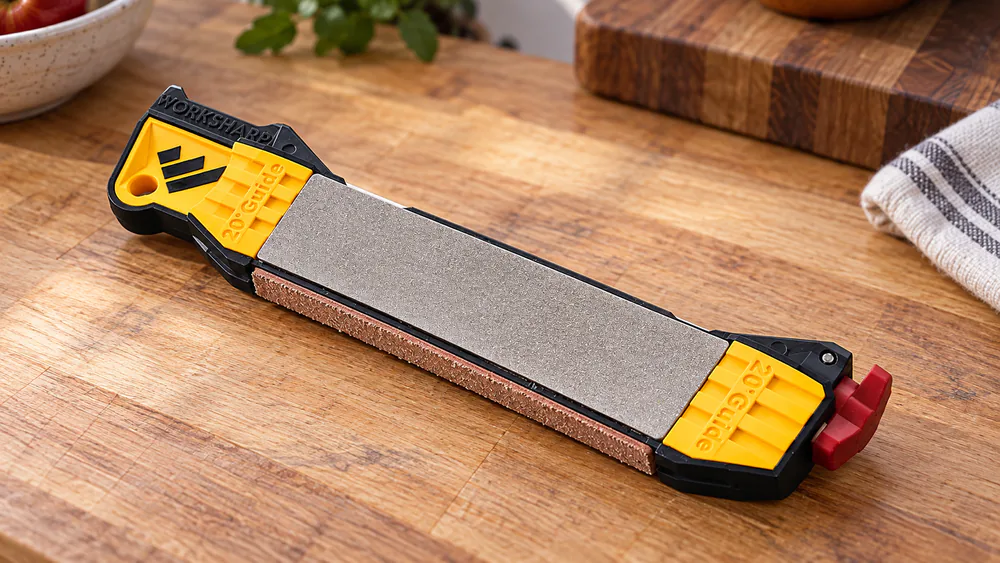
Smaller and simpler than every other pick, the Guided Field Sharpener is a handheld all-in-one that weighs 4.6 ounces. Rubberized ends steady it on a table, and the thumb grip helps control handheld strokes. It is not a kitchen centerpiece, but it is a handy second sharpener for small knives.
Pros
Small and light
Touch-ups need no assembled sharpening station
Rubberized ends steady it on a table
Cons
Short abrasive surfaces
Fixed guide references suit smaller blades best
Less comfortable on a full-length chef's knife
Portable Touch-Ups and Occasional Sharpening
All-in-one construction makes touch-ups convenient without assembling a sharpening station. Small and medium pocket blades can be refreshed without the setup of a full bench system. The coarse diamond plate does the heavy work, and the fine plate and ceramic bring the edge back.
When a Benchtop Sharpener Is More Practical
A full-size chef's knife is awkward on short abrasive surfaces. For an eight-inch knife, step up to the Precision Adjust or the Kitchen Electric.
How to Choose a Work Sharp Sharpener for Your Knives
Start with the knives, not the sharpener. Their steel, thickness, and edge angle decide which of these models suits you.
Guided Manual Systems vs. Powered Belts
A guided manual system, such as the Precision Adjust, is slower but forgiving. You move the abrasive across a fixed angle, and the metal comes off gradually. A powered belt removes steel quickly, which is the benefit when you reshape a knife and the hazard when you slip.
On the other hand, a powered system is much faster once you get the hang of it. If you maintain a block of knives every few months, the speed adds up. If you sharpen one or two knives a year, the manual route is calmer and cheaper in the long run.
Chef's Knives, Small Blades, and Long or Flexible Knives
Chef's knives are the easy case for almost every model here. Small blades work well on the small-knife table of the Professional or on the Guided Field Sharpener. Long or flexible blades are harder. Check that the blade clears the clamp on the manual systems, and take extra care with thin, flexible blades on belts.
Edge Angles, Serrations, and Specialty Blades
Knife edge angles normally describe each side of a double-bevel edge, so preserve the geometry the knife came with. Many Western kitchen knives sit near 20 degrees, and many Japanese knives are more acute. The adjustable systems, which span 15-30 degrees, cover far more knives than the fixed 20-degree models.
Serrations depend on the accessory fitted. The standard Precision Adjust kit does not include the serration rod, so do not count on it for bread knives. The Elite and Professional kits include a serration rod; the Kitchen Electric uses its ceramic wheel with a dedicated procedure. Single-bevel knives need different treatment of the flat back, and equal passes through both sides can add an unwanted bevel.
Warning. Check your particular blade geometry and the maker's manual before sharpening a single-bevel, ceramic, or very acute knife. Blanket approval does not exist for these.
Setup Time, Storage, and Replacement Abrasives
The manual systems take minutes to set up but run clean because the abrasives are used dry. Powered units are ready quickly but throw dust and noise. Standard Mk.2 belts are not the same size as the Ken Onion belts.
Which Work Sharp Upgrades Are Worth Paying For?
Tip. Buy the base model first if you are unsure. Every system here can grow, and you will know more about what you actually miss after a few sessions.
Included Abrasives and Accessories vs. Buying Them Later
Upgrade kits mostly add finer grits, a strop, a serration rod, and a case. If you already know you need serration work or a polished edge, buying the Elite or Professional version at the start saves you a second purchase. If you do not, buy the base model and add pieces later.
More grits help you polish, not sharpen. For ordinary kitchen maintenance, the extra stages are a nice finish, not a necessity.
Frequently Asked Questions
Which Work Sharp sharpener is easiest for beginners?
The Precision Adjust. The guided rod and clamp hold the angle for you, so results are repeatable, and the dry abrasives make cleanup simple. The Kitchen Electric is the easiest powered option for slim kitchen knives.
Can you use a Work Sharp sharpener on Japanese kitchen knives?
Often yes, with the right model. The adjustable 15-30 degree systems, the Precision Adjust and the Ken Onion, can match more acute edges than the fixed 20-degree models. Single-bevel knives such as yanagiba and deba need different handling of the flat back, and ceramic or very acute blades need a manual check first.
What if my bread knife is serrated and I own the standard kit?
Move to a kit that includes the serration rod, or use the Kitchen Electric's ceramic wheel. Sharpen only the beveled side of each scallop, never the flat face.
How often should you sharpen rather than hone?
Hone often to refresh the edge, using the fine finishing surface. Sharpen with a coarser abrasive when honing no longer restores cutting or when damage needs removing.
Final Verdict: Where to Spend and What to Skip
If your household only sharpens kitchen knives, skip the standard Knife & Tool Sharpener Mk.2 and its fixed angles. And whichever model you pick, add a leather strop early: a few light passes keep the edge keen between full sharpenings.